


General
How to Choose AI Dispatch Software: Auto-Assignment, Dynamic Routing, and Utilization Gains
Key Takeaways
- The “AI” in AI dispatch software describes the quality of the decision logic. Rule-based automation assigns orders based on predefined conditions. Decision intelligence evaluates the full combination of current conditions simultaneously and identifies the assignment that optimizes across all variables at once
- Auto-assignment quality is determined by how many variables the system considers simultaneously. An assignment engine that evaluates vehicle capacity, time windows, geographic clustering, driver qualification, and carrier SLA history in one calculation produces materially better route quality than one that applies these variables sequentially
- Dynamic routing is the function that keeps routes accurate after the plan is built. The quality metric is how many constraints it considers and whether it re-optimizes the full affected network or just the single route where the change occurred
- Utilization gains are the business outcome that justifies the AI dispatch investment. But “utilization gain” is a claim. The evaluation must ask for baseline utilization data, the methodology for calculating the improvement, and the actual results from comparable deployments, not a projected percentage
- All three pillars share a dependency: they must operate on the same current data. An auto-assignment engine working from yesterday’s carrier capacity data, a routing engine working from this morning’s vehicle positions, and a utilization tracker working from last week’s delivery records are three separate optimization functions that cannot coordinate
The logistics software market uses “AI” to describe platforms ranging from rule-based automation with a machine learning feature to decision intelligence systems that evaluate hundreds of variables simultaneously and adapt continuously to changing conditions.
The gap between these two categories appears in the quality of route plans produced under real-world conditions, the accuracy of routes six hours after departure, and the measurable utilization improvement on the same asset base.
This guide evaluates AI dispatch software across the three pillars that determine real-world performance: the quality of auto-assignment, the responsiveness of dynamic routing, and the verifiability of utilization gains.
Each pillar has evaluation criteria, red flags, and vendor questions designed to surface implementation reality.
What “AI” in Dispatch Software Means
The distinction that matters for this evaluation is between rule-based automation and decision intelligence. Both are sold as AI dispatch, but the operational difference is significant.
| Rule-based automation | Decision intelligence |
|---|---|
| Assigns orders based on predefined conditions: if vehicle is available and within range, assign | Evaluates the full order set and full vehicle fleet simultaneously, identifying the assignment that optimizes across all variables |
| Considers variables sequentially: capacity check first, then proximity, then time window | Considers all variables simultaneously; interaction effects between variables are part of the optimization |
| Handles defined scenarios well; degrades when conditions fall outside the rule set | Generates outputs for any combination of current conditions; quality does not degrade outside defined scenarios |
| Re-runs the same rule set when conditions change | Learns from historical outcomes to improve future decisions; the model quality improves with data |
| Speed advantage: simple rules execute quickly | Processing depth advantage: more variables considered per decision, which requires more computation but produces better outputs |
Rules vs. decision intelligence: The practical difference
Consider an order arriving at 2 PM that needs to be delivered by 4 PM to a zone where three vehicles are currently active.
A rule-based system identifies the nearest available vehicle and assigns the order. A decision intelligence system evaluates: which vehicle, if re-routed, can absorb this order with the least impact on its existing commitments? Which assignment produces the lowest additional travel cost? Which assignment best preserves SLA compliance for the existing route?
The rule-based system produces one answer quickly. The decision intelligence system produces the answer that optimizes the full affected network.
The difference in output quality compounds at enterprise volume: across thousands of orders and hundreds of vehicles daily, the accumulated quality gap between the two approaches is measurable in cost per delivery, SLA compliance rate, and vehicle utilization.
Pillar 1: Auto-Assignment: Removing Dispatchers From Routine Decisions
Auto-assignment is the function that eliminates manual order-to-vehicle matching for routine dispatches, redirecting dispatcher attention to the exceptions and escalations that genuinely require human judgment.
The quality of auto-assignment determines how many orders require dispatcher intervention and how good the assignments are for the orders the system handles automatically.
What auto-assignment optimizes
An auto-assignment engine that only considers vehicle proximity produces assignments that are locally correct but globally inefficient. An assignment engine that considers the following variables simultaneously produces materially better outcomes:
- Vehicle capacity and load profile: The assigned vehicle must be able to carry the order’s weight, volume, and handling requirements without exceeding payload. An engine that assigns a 20-tonne vehicle to a 400-kilogram order when a smaller vehicle is available wastes capacity on both the assigned vehicle and the one that is left underloaded
- Delivery time windows: The committed delivery window for the order must be achievable given the vehicle’s current position and the stops between the vehicle and the delivery address. An assignment that is geographically close but will arrive 90 minutes outside the committed window is a SLA failure waiting to happen
- Geographic clustering: Orders going to the same zone should be batched. An assignment engine that routes each order to the nearest available vehicle without considering adjacent-zone clustering produces routes that cross each other unnecessarily and cost more to serve
- Driver qualification: Certain order types require driver certification. Hazardous materials, temperature-controlled cargo, and high-value shipments each carry qualification requirements. Auto-assignment must verify qualification match before assigning, not after
- Carrier performance by lane: For multi-carrier networks, the auto-assignment should evaluate which carrier has the best SLA compliance history on the relevant lane and which carrier has available capacity
- Real-time fleet state: Assignments must use current vehicle position, current payload, and remaining driver hours, not the state of the fleet as it existed at the start of the dispatch window
Red flags in auto-assignment claims
| Claim | What to ask | Red flag answer |
|---|---|---|
| “Automated order assignment” | Does the system assign orders without dispatcher action, or does it recommend assignments that a dispatcher approves? | Every assignment requires dispatcher approval: the system recommends, not assigns. This is decision support, not auto-assignment |
| “Considers all constraints” | How many constraint types does the assignment engine process simultaneously? What happens when constraints conflict? | Cannot give a specific number; says “all relevant constraints” without specifics. Conflict resolution defaults to a fixed priority rule |
| “Handles peak volume” | What is the throughput rate of the assignment engine at your peak order volume, measured in assignments per minute? | Cannot provide throughput data; cites test environment performance, not production performance |
| “Learns and improves” | What does the model learn from? How are model updates applied? How frequently? | Cannot describe the learning mechanism; says “the AI gets smarter” without explaining what data drives the improvement |
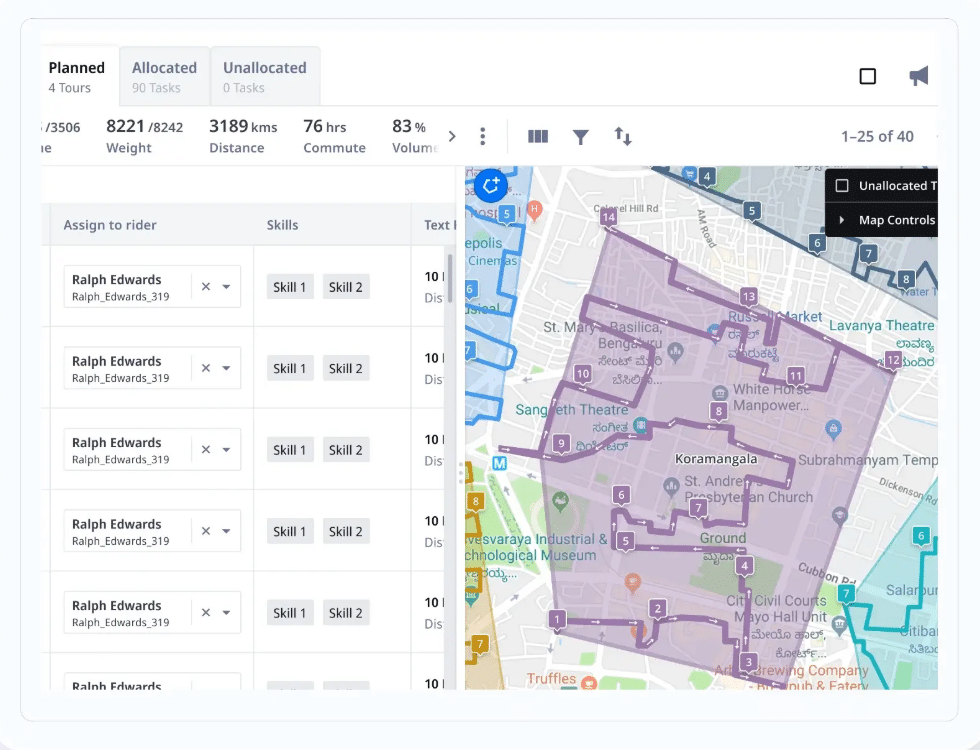
Pillar 2: Dynamic Routing: Keeping Routes Accurate After the Plan Is Built
A route plan built at 6 AM is accurate as of 6 AM. From the moment vehicles depart, conditions change: new orders arrive, vehicles run behind, traffic diverges from the historical pattern the route was built against.
Dynamic routing is the function that re-optimizes routes as conditions change, maintaining accuracy throughout the delivery day.
What triggers dynamic re-optimization
Dynamic routing re-runs the optimization when a relevant condition changes. The triggers that a capable platform handles:
- New order arrival: Can the new order be inserted into an existing route without violating any committed time windows? If yes, which route absorbs it most efficiently? If no, does the order require a new route or a carrier assignment?
- Order cancellation: When an order is cancelled, the route that was serving it can potentially be tightened, reducing travel and freeing capacity for additional orders
- Job overrun: A driver who is running behind schedule at stop 8 is creating cascading ETA errors for stops 9 through 20. Dynamic routing re-sequences the remaining stops to minimize the SLA impact of the delay
- Vehicle breakdown or capacity change: A vehicle that goes offline mid-route requires its remaining orders to be redistributed. Dynamic routing evaluates the full vehicle fleet for re-assignment, not just the nearest alternative
- Traffic condition change: A road closure or congestion event that invalidates the route’s travel time assumptions for a specific segment. Dynamic routing re-sequences or re-routes around the affected segment
How to evaluate re-optimization quality
Speed is often the first metric buyers ask about: how quickly does the re-optimization run? Speed matters, but it is the wrong primary metric.
A re-optimization that completes in 30 seconds but only considers the directly affected vehicle produces a faster answer that is less accurate than one that takes 3 minutes and considers the full network impact.
The right questions for evaluating re-optimization quality:
- Scope of re-optimization: When a new order arrives, does the engine re-optimize only the route it is being inserted into, or does it consider all active routes to find the optimal insertion point?
- Constraint retention: Does the re-optimization apply the same constraints as the original optimization? A dynamic re-route that considers fewer constraints than the original plan produces lower-quality output
- Conflict resolution: When adding a new order to the best available route creates a minor SLA risk for one existing stop, how does the engine decide whether to accept that trade-off?
- Frequency at volume: At your peak order volume with vehicles actively delivering, how frequently can the engine re-optimize and how quickly does it complete? A re-optimization that takes 12 minutes at peak load is not operationally useful when a 6-minute response window is needed
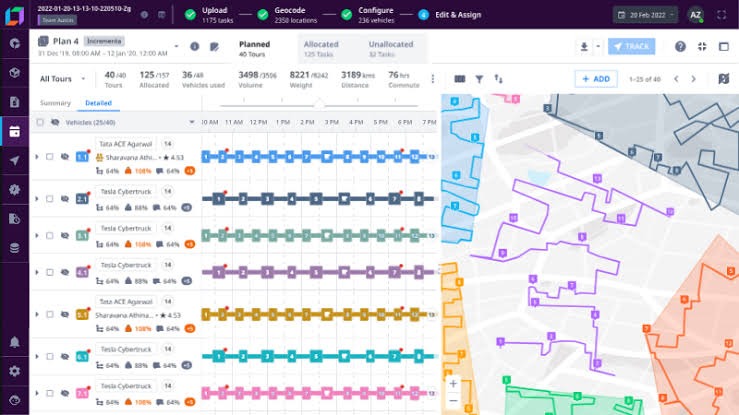
Pillar 3: Utilization Gains: Measuring What the Optimization Delivers
Utilization gain is the outcome that justifies the investment in AI dispatch software. The claim appears in every vendor’s pitch. The measurement methodology rarely does.
This pillar is evaluated differently from the first two: the question is not whether the platform can improve utilization, but how you verify that it has.
What utilization means in dispatch context
Vehicle utilization has two independent dimensions that should be tracked separately:
| Utilization dimension | What it measures |
|---|---|
| Load utilization (capacity fill rate) | Actual payload as a percentage of vehicle payload capacity per trip |
| Time utilization (stop density) | Productive delivery time as a percentage of total driver shift hours (productive = at a stop or productively in transit, not idle or repositioning) |
Carrier utilization adds a third dimension for multi-carrier networks: contracted carrier capacity usage as a percentage of contracted minimums and maximums.
Under-utilizing contracted capacity may trigger minimum commitment penalties. Over-utilizing it may require spot market purchases at premium rates. AI dispatch software that manages carrier allocation against contracted thresholds reduces both penalty exposure and spot market dependence.
Also read: AI-Driven Carrier Allocation: Evolution from Rule-Based Systems
How to verify utilization claims before buying
The verification sequence for a utilization claim:
- Ask for the baseline: What was the measured utilization rate before deployment in deployments comparable to yours? If the vendor cannot provide a baseline, the improvement percentage has no denominator
- Ask for the methodology: How is the utilization improvement calculated? Is it the average across all routes, or is it segmented by route type and vehicle class? A utilization improvement driven by one high-density zone may not generalize to your lower-density zones
- Ask for the time period: Over what time period was the improvement measured? Utilization improvements are often higher in the first few months as obvious inefficiencies are eliminated and lower in subsequent periods as the remaining gains are harder to achieve
- Ask for the attribution: What specific changes to route planning, load consolidation, or carrier allocation produced the improvement? If the vendor cannot attribute the gain to specific optimization decisions, the improvement may reflect favorable external conditions, not the platform’s capability
- Require a benchmark comparison: Ask for deployments with the same geographic density, order mix, and carrier profile as your operation. A utilization improvement in a high-density urban market does not predict the improvement in a low-density regional network
How the Three Pillars Connect
Auto-assignment, dynamic routing, and utilization gains are not independent functions. They depend on each other and on a shared data layer.
- Auto-assignment produces the initial load: The quality of the initial assignment determines the starting utilization. An assignment engine that clusters orders well produces routes with high load utilization before dynamic routing makes any adjustment
- Dynamic routing adjusts the load in real time: Adding orders to existing routes or re-distributing cancelled capacity directly affects load and time utilization. Every dynamic routing decision is a utilization decision
- Utilization measurement closes the feedback loop: Data from completed routes shows where the auto-assignment and routing decisions produced optimal outcomes and where they left improvement on the table. This data should feed back into the models that make future auto-assignment decisions
- All three require the same data source: Auto-assignment decisions made with stale carrier capacity data, dynamic routing decisions made without current vehicle positions, and utilization calculations made from yesterday’s delivery records are three disconnected optimization functions that cannot coordinate. The shared data layer is the prerequisite for all three pillars to work
Also read: How Enterprise Retailers Build and Scale Multi-Carrier Delivery Networks
Questions to Ask Every Vendor
For auto-assignment
- How many constraint types does the assignment engine process simultaneously? What is the maximum number of constraints a single assignment decision evaluates?
- At your peak order volume (specify a number), how many assignments per minute does the engine produce, and what is the average quality score compared to manual assignments?
- When assignment constraints conflict (for example, the best vehicle for capacity is not the best vehicle for time window compliance), how does the engine resolve the conflict?
- Can assignment rules be configured per order type, customer tier, or carrier type, and do those rules apply automatically at assignment time?
For dynamic routing
- When a new order arrives mid-day, does the re-optimization consider all active routes or only the route most likely to absorb the order?
- At peak delivery volume with all vehicles active, how long does a full network re-optimization take, and what is the minimum triggering condition for a re-optimization to run?
- Does the dynamic re-optimization apply the same constraints as the original route plan, or does it use a simplified constraint set to achieve faster computation?
- How does the platform communicate dynamic route changes to drivers: through the driver app, a dispatch notification, or a manual dispatcher step?
For utilization gains
- Provide the baseline utilization metrics from three comparable deployments before your software was implemented. Define what “baseline” means in your methodology.
- What is the average utilization improvement in those deployments, measured at 30 days, 90 days, and 12 months after full deployment?
- How does the platform attribute utilization improvement to specific optimization decisions? Can it show which routing or assignment changes drove the improvement?
- Does the platform track both load utilization and time utilization separately, and can it segment them by route type, vehicle class, and carrier?
Also read: 6 Retail Logistics Software for Enterprise Networks in 2026
How Locus Approaches AI Dispatch
Locus is the world’s first Decision-Intelligent, Agentic TMS. Its approach to AI dispatch is built on a distinction between rule execution and decision intelligence: when rules conflict or conditions fall outside defined parameters, the system evaluates the optimal response from the full current state of the network.
Decision intelligence vs. rule-based automation
For auto-assignment, DispatchIQ evaluates every incoming order against the full vehicle and carrier fleet simultaneously.
The assignment output is the vehicle whose assignment produces the best combination of SLA compliance, load utilization, and cost for the full order set at that moment. The Dispatch Agent within Locus’s multi-agent architecture manages this evaluation continuously, not just at dispatch time.
For dynamic routing, the Fireworks Routing Engine performs automated route re-optimization across 250+ real-world constraints. When conditions change, the engine re-evaluates all active routes in the affected network. This network-scope re-optimization produces better outcomes than single-route adjustment because the optimal response to one route’s change may involve adjusting a different route’s load distribution.
The engine completes enterprise-volume re-optimization in under five minutes.
For utilization, ShipFlex monitors carrier capacity utilization against contracted commitments across 160+ active carriers from a broader network of 1,000+ pre-integrated partners.
Load utilization and time utilization are tracked per route, per vehicle class, and per carrier, with the historical data feeding back into the auto-assignment models that improve future allocation quality.
Mycroft AI Co-Pilot, Locus’s natural-language dispatcher interface, surfaces the decisions the AI agents have made and why.
When a dispatcher wants to understand why a specific order was assigned to a specific vehicle, or why a route was re-sequenced after stop 8, the Copilot Agent provides the reasoning in plain language. This transparency is what makes dispatchers trust the system enough to let it operate autonomously for routine decisions, reserving their attention for the exceptions that require judgment.
Locus serves 360+ enterprise customers across FMCG and CPG and retail and e-commerce verticals in 30+ countries, with $320M+ in collective logistics cost savings and 99.5% on-time SLA adherence, which is the utilization and SLA performance evidence that the auto-assignment and dynamic routing capabilities produce at scale.
In October 2025, Ingka Investments, the investment arm of Ingka Group, acquired Locus, providing long-term institutional backing to a platform that continues to operate independently.
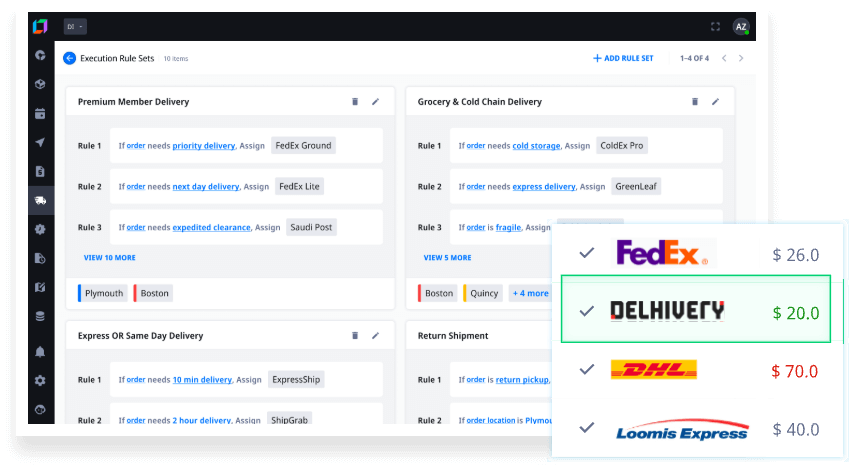
Access Better Auto-Assignment for Route Optimization
AI dispatch software earns its label when it produces measurably better assignment decisions, more accurate routes throughout the delivery day, and verifiable utilization improvement on the same asset base. Evaluating it against these three pillars, with specific questions about implementation quality and measurement methodology, distinguishes platforms that deliver on those outcomes from those that describe the outcomes without producing them.
The most important evaluation discipline for this category is the insistence on baseline data.
Every vendor will provide a utilization improvement percentage. The baseline and the measurement methodology are what determine whether that percentage describes your operation or someone else’s. Require both before advancing any vendor to the finalist stage.
Schedule a demo with Locus to see how auto-assignment, dynamic routing, and utilization tracking operate as connected functions in one decision intelligence platform.
Frequently Asked Questions (FAQs)
What is the difference between rule-based dispatch automation and AI dispatch?
Rule-based dispatch automation executes predefined conditions: if vehicle capacity is available and within distance threshold, assign. It is fast, predictable, and reliable within the conditions it was designed for. AI dispatch uses decision intelligence: it evaluates the full combination of current conditions across all variables simultaneously and identifies the action that optimizes across all of them at once. The practical difference shows up when conditions fall outside the rules’ parameters, when multiple rules conflict, and at scale, where the compounded quality difference between an optimal and a locally correct assignment accumulates into measurable cost and SLA performance gaps.
How does dynamic routing differ from static route planning?
Static route planning generates routes once, typically at the start of the delivery day, and does not update them when conditions change. The route plan built at 6 AM is the plan drivers follow at 4 PM, even if new orders have arrived, an order has been cancelled, or a vehicle has fallen behind schedule. Dynamic routing re-optimizes routes throughout the delivery day in response to these changes. The routes drivers follow at 4 PM reflect conditions as they exist at 4 PM, not conditions as they existed at 6 AM.
How do you measure vehicle utilization gains from AI dispatch software?
Measure utilization on two dimensions separately: load utilization (actual payload as a percentage of vehicle payload capacity per trip) and time utilization (productive time as a percentage of total driver shift hours). Establish the baseline for both dimensions before implementation, using the same measurement methodology you will use after implementation. Post-deployment, track both dimensions at 30 days, 90 days, and 12 months. Segment the data by route type, vehicle class, carrier, and geography. An improvement in dense urban routes does not necessarily predict improvement in low-density regional routes.
What order volume threshold makes AI dispatch software worthwhile?
The crossover point depends on the complexity of your dispatch decision. An operation with 500 daily orders across a complex multi-carrier network with diverse vehicle types and strict time windows may benefit earlier than one with 5,000 daily orders on uniform routes with one vehicle type. The evaluation metric is dispatcher time currently spent on manual assignment and exception triage. When dispatchers spend more than 30% of their shift on routine assignment decisions that could be automated, the quality and consistency improvement from AI dispatch is likely to justify the investment at the scale you are already operating. The utilization gain case is separate: calculate the cost of your current utilization gap, estimate the improvement from the vendor’s comparable deployments, and evaluate the payback period.
How does Locus implement auto-assignment, dynamic routing, and utilization optimization?
Locus implements all three through its multi-agent architecture operating on a shared data layer. For auto-assignment, the Dispatch Agent evaluates the full order set against the full fleet simultaneously using the Fireworks Routing Engine’s constraint processing across 250+ variables. The assignment output is updated continuously, not only at dispatch time. For dynamic routing, the Fireworks Routing Engine re-optimizes all affected routes when conditions change, completing enterprise-volume re-optimization in under five minutes. The route optimization applies the same constraint set as the original plan, maintaining plan quality through re-optimization. For utilization, DispatchIQ tracks load and time utilization per route and per vehicle class, with the data feeding back into auto-assignment models to improve future decisions.


General
How to Choose Returns Management Software: Reverse Logistics, Refunds, and Pickup Scheduling

Sep 14, 2026
Evaluate returns management software across three pillars: reverse logistics, refunds, and pickup scheduling. Includes vendor questions and red flags.
Read more
General
Multi-Depot Dispatch Software: Coordinating Hubs, Cross-Docks, and Micro-Fulfillment Centers
Sep 14, 2026
Learn how multi-depot dispatch software coordinates dispatch across hubs, cross-docks, and micro-fulfillment centers in one unified network.
Read moreInsights Worth Your Time




















How to Choose AI Dispatch Software: Auto-Assignment, Dynamic Routing, and Utilization Gains