


General
How Enterprise Retailers Build and Scale Multi-Carrier Delivery Networks

Enterprise retailers managing 10,000 or more daily shipments across multi-carrier delivery networks routinely overpay on last-mile logistics by 15–25%. The cost gap traces to a missing intelligence layer: the capacity to allocate each shipment to the optimal carrier at the moment of dispatch.
Managing advanced carrier management systems at enterprise scale demands more than rate tables and contract renewals. Retail delivery networks now require the same real-time orchestration intelligence that supply chain planning received a decade ago.
Locus powers dispatch optimization for global retail and FMCG enterprises handling millions of monthly deliveries across fragmented carrier ecosystems, and the principles behind its architecture are the subject of this article: a strategic blueprint for building, optimizing, and scaling multi-carrier networks, written from the operational level.
Why Retail Logistics Has Outgrown the Single-Carrier Model
Four pressures shape the problem: omnichannel expectations, same-day and next-day proliferation, peak-season volatility, and regional delivery complexity. Each looks distinct on paper.
At the execution layer, they share a single root cause: delivery complexity now exceeds what any single carrier was designed to absorb. Retailers locked into one or two national carriers face exposure across all four dimensions simultaneously.
The structural shift in carrier dependency
The pandemic made single-carrier dependency impossible to ignore. When a primary carrier hit capacity limits in Q4 2020, retailers without a fallback had no lever to pull. The episode accelerated a structural shift already underway.
E-commerce-related parcel volumes grew 35% between 2021 and 2023, compressing the gap between order placement and expected delivery across every channel. The multi-carrier shipping software market reached $1.25 billion in 2024, with retail and e-commerce accounting for 41% of total demand, and is growing at 12.8% annually as enterprises upgrade their carrier orchestration infrastructure.
For enterprise retailers, the operational stakes are specific. A retailer running 250 or more SKUs across 15 distribution nodes faces delivery requirements that no single national carrier covers adequately, such as:
- Dense urban zones require micro-delivery fleets
- Rural corridors demand regional carriers with local route depth
- Lightweight parcel volumes justify zone-based regional carriers over national rates
- Bulky or time-sensitive shipments require specific vehicle types and appointment windows
Routing all of this through one carrier contract produces cost concentration risk and SLA structures prone to breaking under peak loads. Read more about reinventing the last mile in the context of enterprise retail.
Why single-carrier dependency fails at scale
Cost concentration risk is the most direct consequence. A retailer routing 80% of volume through one national carrier holds no pricing power at contract renewal, no fallback when the carrier imposes peak surcharges of 15–25% per parcel, and no mechanism to redistribute volume when its SLA adherence drops during holiday periods.
Service-level rigidity follows. For example, national carriers optimize for network-wide averages rather than the delivery-zone-specific commitments a retailer’s customer base demands.
Building a well-designed multi-carrier delivery network is the operational response. Carrier diversity delivers pricing power, SLA redundancy, and zone-specific coverage depth. Without allocation logic governing carrier selection, carrier diversity alone generates fragmentation rather than optimization.
The architecture matters as much as the carrier mix, and getting that architecture right is the prerequisite for everything else in this guide.
The Strategic Architecture of a Multi-Carrier Delivery Network
A well-designed multi-carrier network at enterprise scale functions as a decision framework governing which shipment type moves through which carrier tier, under which conditions, at what cost threshold. Understanding the interplay across its layers is the prerequisite for running it efficiently.
The four-tier carrier structure
Most enterprise retail networks operate across four carrier tiers. National carriers handle heavyweight, long-haul, and time-critical shipments. Regional carriers serve zone-optimized lightweight parcel delivery, where per-parcel costs run 20–35% below national rates in well-covered corridors.
Crowdsourced or gig fleets cover dense urban same-day demand, and owned or captive fleets handle environments where brand experience, proof-of-delivery, or sensitive cargo handling require direct oversight.
Orchestration platforms capable of running this architecture also coordinate owned assets alongside contracted and outsourced carriers, giving operations teams a single decision layer across all fleet types rather than separate workflows for each. Automated route planning governs the routing logic underpinning each allocation decision.
Decision variables governing carrier allocation
Every shipment allocation decision runs through a matrix of variables: parcel weight and cubic dimensions, delivery zone and distance from origin node, committed SLA tier (same-day, next-day, standard), carrier capacity availability for the dispatch window, cost-per-delivery thresholds relative to order value, and any regulatory or handling requirements specific to the SKU or destination.
The 80/20 allocation principle is a standard industry heuristic. Routing approximately 80% of lightweight parcels to regional carriers captures zone-based savings that national rates cannot match.
Reserving national carriers for heavyweight shipments and long-haul legs maintains the service reliability those shipments require. Cost-per-delivery on lightweight regional parcels can run 20–35% lower through a regional carrier in a well-served zone than through a national carrier operating at network-average pricing.
Framing carrier allocation as a network design problem changes the decision criteria. Rate shopping optimizes each shipment in isolation. Network design optimizes carrier allocation across the full volume mix, balancing cost, SLA performance, and capacity across a rolling dispatch window. The distinction matters at 10,000 daily shipments and becomes critical at 50,000.
From Rules Engines to AI: How Carrier Selection Is Evolving
Static rules-based carrier selection operates on conditional logic: if parcel weight exceeds five kilograms and the delivery zone is Zone 4, assign Carrier A. Rules engines are deterministic and auditable, making them easy to configure and explain to finance teams. At moderate volume and carrier diversity, they perform adequately.
Where rules engines create operational blind spots
The failure mode appears under conditions rules engines cannot anticipate. A carrier’s SLA adherence can degrade at 11 a.m. on a Tuesday because a regional hub is processing 40% above capacity. A flash sale can push dispatch volume 3x above the morning plan by early afternoon. Weather events can render a carrier’s delivery routes unviable across an entire metro zone while alternative carriers remain operational.
A static rules engine, configured on last quarter’s carrier performance data and running pre-set allocation thresholds, has no mechanism to respond to any of these mid-day.
Shipments get allocated to a carrier operating at SLA risk. Delivery exceptions accumulate before the operations team can intervene. Customer complaints arrive before the carrier reports a delay. By the time a manual override reaches dispatch, the damage to on-time delivery rates is already compounded.
How AI-driven dynamic dispatch changes the logic
AI-driven carrier selection evaluates each allocation decision against a live data environment rather than a static rule set. The dispatch model ingests real-time carrier performance metrics, capacity signals from carrier APIs, weather disruption data, historical SLA adherence by carrier and zone, and cost fluctuation inputs.
It then applies constraint-based optimization to identify the allocation with the highest probability of SLA compliance at the lowest cost-per-delivery. AI route optimization research has documented the performance gap between static rules and ML-driven dispatch in high-volume environments.
An AI-driven engine can detect mid-day a 12-point drop in a primary carrier’s on-time delivery rate in Zone 3 and begin routing new Zone 3 orders to a regional alternative without manual intervention from the dispatch team.
Retailers operating at 10,000 or more daily shipments cannot absorb the latency of human detection and response. The operational advantage of AI-driven dispatch compounds with volume.
Real-Time Visibility Across a Fragmented Carrier Ecosystem
Managing tracking data across five carriers is an IT project. Managing it across 15 carriers with different API specifications, update frequencies, data formats, and exception reporting standards is an ongoing operational liability.
For enterprise retailers, the visibility challenge has two distinct audiences with conflicting requirements: customer experience teams need a single accurate view of every shipment to handle WISMO contacts, while operations teams need anomaly detection before those contacts arrive.
The cost of fragmented tracking data
Without a unified visibility layer, the operational default is reactive firefighting. A carrier reports a delivery exception 18 hours after it occurred. Customer service receives an escalation. A manual override request goes to dispatch. By the time the redelivery is scheduled, the customer has filed a complaint, and the order has exceeded its SLA window. For a retailer processing 10,000 daily orders, a 5% increase in failed first-attempt deliveries generates an annual loss of $4.5 million in redelivery costs and support overhead.
The enhanced retail logistics visibility required to close this gap demands a consolidation layer across all carrier types. Incremental API integrations built carrier by carrier cannot provide the unified anomaly detection and SLA monitoring operations teams need.
How Locus unifies carrier visibility
Locus’s Control Tower consolidates carrier tracking data from owned fleets, contracted national carriers, regional partners, and crowdsourced networks into a single orchestration layer. Operations teams receive dynamic ETA calculations updated in real time, anomaly detection flagging at-risk shipments before the delivery window closes, and carrier-level performance visibility across SLA adherence, zone delivery rates, and exception frequency.
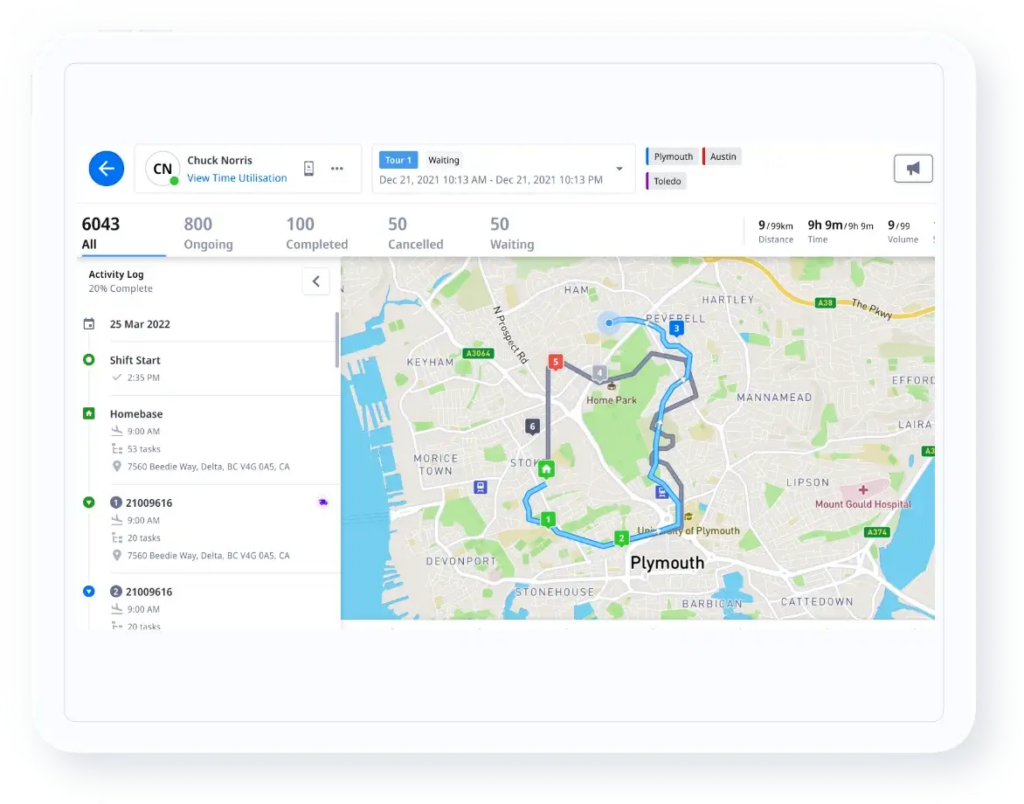
Locus clients have achieved a 38% reduction in WISMO calls through this unified visibility layer. The customer experience team’s requirement for a single tracking view and the operations team’s requirement for predictive exception detection are served by the same data infrastructure, eliminating the parallel failure modes of customer dissatisfaction and operational latency from a single architectural fix.
Scaling Multi-Carrier Networks for Peak Seasons and New Markets
The elasticity challenge in enterprise retail is precise. For instance, holiday peak volumes run 3–5x above baseline dispatch rates, and a spike arrives over a compressed window. Flash sales compound the problem by delivering the same volume increase in hours rather than weeks.
The question multi-carrier operations teams face before peak season is how to secure carrier capacity without locking into rigid volume commitments carrying penalty clauses when actual volumes undershoot forecast.
Pre-season contracting vs. spot allocation
Capacity pre-booking through volume commitment contracts with two or three carriers provides rate certainty but creates utilization risk if peak volumes track below forecast. Spot allocation through carrier APIs provides flexibility but exposes retailers to surge pricing at precisely the moment demand is highest.
The operational answer is a hybrid model: contract a floor volume with primary carriers reflecting the minimum realistic peak demand, and reserve spot capacity through carrier integrations for volume above the floor threshold. Achieving last-mile excellence during scaling events requires the carrier network architecture to be pre-built and tested before the volume arrives.
Carrier onboarding velocity is the underrated constraint. A retailer entering Q4 with three active carrier integrations cannot add a fourth in time to absorb overflow volume if the onboarding process requires six weeks of API integration and contract negotiation.
Geographic scalability for market expansion
Retailers entering new regions (Southeast Asia, the Middle East and Africa, Eastern Europe) face carrier landscapes with fundamentally different characteristics from their home market. Carrier fragmentation is higher. API standardization is lower.
SLA definitions vary by market and carrier type. Re-architecting the technology stack for each new geography is a prohibitive expansion model for enterprises deploying into multiple markets per year.
Locus’s multi-geography deployment model allows retailers to add regional carrier networks into the same orchestration layer without rebuilding the underlying dispatch logic. Constraint rules, SLA compliance monitoring, and carrier performance tracking scale across geographies through a single platform configuration, reducing the time between market entry and operational readiness for carrier management.
Measuring What Matters: KPIs and ROI of Multi-Carrier Orchestration
Cost savings are an incomplete business case. A VP of Supply Chain presenting a multi-carrier orchestration investment to a CFO needs specific metrics, directional benchmarks, and a defined measurement methodology.
The KPI framework below covers the full financial and operational picture a logistics leader needs to make the internal case.
The core KPI set for multi-carrier operations
- Cost-per-delivery by carrier and zone: The unit economic metric exposing carrier inefficiency at the zone level. Retailers routing national carriers across all zones consistently overpay in zones where regional carriers offer 20–35% lower per-parcel rates.
- On-time delivery rate by carrier: Carrier-level OTD tracking by zone and route exposes which carriers are introducing SLA risk at the individual corridor level. Locus clients have achieved 99.5% on-time delivery across multi-region deployments through AI-driven dispatch and real-time SLA monitoring.
- SLA breach frequency and cause attribution: Distinguishes carrier-caused breaches from dispatch-caused breaches, a critical distinction for contract renegotiation and internal process improvement.
- Carrier utilization rate: Measures volume allocated to each carrier relative to contracted or available capacity. Persistent underutilization indicates over-contracting. Persistent near-ceiling utilization signals capacity risk before the next peak.
- Cost avoidance during peak surcharges: Quantifies the financial value of routing decisions made to avoid carrier-imposed peak surcharges. During Q4, national carrier peak surcharges of $1.50–$4.00 per parcel are standard. A retailer dispatching 50,000 parcels per day during peak can generate $75,000–$200,000 in daily cost avoidance through intelligent carrier routing.
- Carrier allocation efficiency: Locus’s Delivery Orchestration module has driven a 72% increase in carrier allocation efficiency for enterprise clients, recovering $288 million in revenue leakage across the customer base through more accurate allocation and settlement workflows.
- The broader benchmark: enterprises operating AI-optimized multi-carrier dispatch have consistently achieved 15–30% reductions in total delivery costs within the first year. For a retailer spending $50 million annually on last-mile logistics, this converts to $7.5–$15 million in annual cost reduction.
Building Your Multi-Carrier Roadmap: What to Evaluate in a Platform
Selecting multi-carrier orchestration technology requires evaluating capabilities against your operational architecture rather than a vendor’s feature matrix. The following criteria map to the functional requirements separating orchestration infrastructure from rate-shopping tools.
The platform capability checklist
- AI-native dispatch logic: Optimization built on ML models evaluating real-time carrier performance, capacity, and cost data. Bolt-on AI improves reporting. Native AI improves allocation decisions. The distinction matters at scale.
- Carrier-agnostic integration framework: Pre-built connectors to hundreds of carriers, with a self-serve onboarding workflow for new carrier additions. Retailers entering new geographies cannot wait six weeks for custom API development each time they activate a new carrier.
- Real-time dispatch optimization: Carrier selection decisions made at the moment of dispatch, against live data, rather than batch-optimized overnight plans applied to the next day’s volume. Real-time processing is the prerequisite for mid-day adaptation.
- Configurable business rules layered on ML models: The ability to set hard constraints (SLA tier floors, carrier exclusion rules, cost thresholds per order value) to govern the ML model’s allocation space. Operations teams need control over the parameters. The model handles optimization within those parameters.
- Unified tracking and analytics: A single data layer covering all carriers, fleets, and geographies, with carrier-level performance analytics, SLA breach attribution, and cost-per-delivery visibility by zone. Customized delivery options for retailers extend this visibility into the customer experience layer.
- Proven enterprise-scale deployments: Reference deployments at comparable volume, carrier count, and geographic complexity. Performance at 50,000 daily shipments across 15 carriers in six geographies requires evidence at comparable scale. Lab benchmarks on small datasets provide an unreliable proxy.
The evaluation should close with a live operational review of each criterion against your current carrier architecture. The gap between your current state and the capability you need is the business case for the investment.
Try Locus for Multi-Carrier Delivery Networks for Retail
Multi-carrier delivery networks have become the operational baseline for enterprise retail. The gap between retailers running static allocation logic and those running AI-driven orchestration shows up in cost-per-delivery, SLA performance, and carrier contract terms.
Locus provides the AI infrastructure to build and scale a carrier orchestration capability spanning dispatch planning, carrier visibility, and settlement across multi-region, multi-fleet deployments.
Schedule a Locus demo to see how the orchestration layer works against your current carrier architecture.
Frequently Asked Questions (FAQs)
1. How does AI-driven carrier selection differ from traditional rules-based multi-carrier shipping software?
Rules-based systems apply static conditional logic: if weight exceeds X and zone equals Y, assign Carrier A. AI-driven selection evaluates each allocation against live carrier performance data, real-time capacity signals, weather disruption feeds, and cost fluctuations. The practical difference is adaptability: AI-driven dispatch can detect mid-day SLA degradation in a carrier’s zone and reroute new orders without manual intervention.
2. What is the typical cost reduction enterprise retailers achieve when moving from single-carrier to optimized multi-carrier delivery networks?
Enterprises operating AI-optimized multi-carrier dispatch have achieved 15–30% reductions in total delivery costs within the first year of implementation. The largest savings come from routing lightweight parcels to regional carriers in well-served zones, avoiding national-carrier peak surcharges during Q4, and eliminating redelivery costs through higher first-attempt delivery rates.
3. How do multi-carrier delivery networks handle reverse logistics and retail returns at scale?
Multi-carrier orchestration applies the same allocation logic to returns as to outbound delivery, selecting the optimal carrier for pickup based on zone, carrier capacity availability, return SLA, and cost. Retailers running unified orchestration across outbound and reverse logistics gain carrier-level performance visibility for returns, enabling cost allocation per return and restocking velocity tracking across regional distribution nodes.
4. What integration requirements should retailers expect when onboarding a multi-carrier orchestration platform?
Expect API connections to your OMS, WMS, and ERP systems for order intake and inventory synchronization, plus carrier API integrations for dispatch, tracking, and rate data. Enterprise-grade platforms with pre-built carrier connectors and self-serve onboarding reduce initial integration timelines significantly. Core system integrations typically run four to eight weeks, while carrier activations on pre-connected networks can complete in days.
5. How can retailers maintain consistent delivery SLAs when working with 10 or more carriers across different regions?
Consistent SLA performance requires carrier-level monitoring with breach attribution at the zone and route level. AI-driven dispatch continuously evaluates each carrier’s real-time adherence and adjusts allocation away from underperforming carriers before breaches accumulate. Configurable SLA tier rules (hard constraints the optimization model must satisfy) give operations teams direct control over SLA compliance across all carrier partners.


General
Locus vs Onfleet: Comparing Enterprise Delivery Management Solutions

Apr 14, 2026
Compare Locus and Onfleet to understand which delivery management platform fits your logistics needs based on routing, dispatch, analytics, and scalability.
Read more
General
Warehouse Transport System Integration for Enterprise Logistics

Apr 15, 2026
How enterprises move from WMS-TMS data sharing to AI-orchestrated dispatch. Covers the maturity model, four ROI metrics, and where leading operations are now.
Read moreInsights Worth Your Time




















How Enterprise Retailers Build and Scale Multi-Carrier Delivery Networks