


General
FMCG Logistics for Enterprise: Network Strategies, Market Trends, and Execution
Key Takeaways
- FMCG logistics enables high-velocity distribution across food, personal care, and household products
- Demand volatility FMCG requires agile forecasting, replenishment planning, and optimized distributor networks
- FMCG logistics cost pressures demand tighter control over freight, warehousing, and last-mile efficiency
- Omnichannel fulfillment FMCG and sustainability are reshaping the FMCG logistics market
- Locus’s FMCG and CPG logistics platform gives operators the dynamic routing, real-time visibility, and dispatch planning tools needed to reduce freight costs by up to 15 percent, cut planning time by 84 percent, and improve delivery SLA performance, turning logistics from a cost center into a competitive advantage.
The global FMCG logistics market was valued at $1.2 trillion in 2023 and is estimated to reach $1.7 trillion by 2033, growing at a CAGR of 3.9 percent from 2024 to 2033, according to Allied Market Research.
Other estimates from Future Market Insights and Fortune Business Insights place the market between $114 and $117 billion when scoped narrowly to third-party logistics services alone, projecting growth to $157 to $175 billion by 2032 to 2034 at a consistent CAGR of around 4.1 percent.
In 2024, the food and beverage segment led all product categories with a 41.2 percent market share, reflecting the industry’s dependence on efficient handling of perishable goods. Transportation was the top service type, holding a 35.9 percent share, while roadways dominated transportation modes with a 40.6 percent share.
Asia Pacific commanded 51.6 percent of the global market, driven by urbanization, e-commerce growth, and strong manufacturing bases in China and India.
What these numbers reflect is a sector undergoing structural transformation. FMCG logistics is no longer simply a cost-of-doing-business function. Companies that treat it as a strategic capability investing in visibility infrastructure, dynamic routing, and demand-responsive fulfillment are consistently outperforming those that manage it reactively. The data points to both the scale of the opportunity and the urgency of the operational challenge.
Key Market Insights
The FMCG logistics market is expanding in scale, but the more important story is how performance expectations are changing. Margin pressure, omnichannel complexity, and sustainability mandates are redefining what efficient logistics means at the enterprise level.
The following insights highlight the structural forces shaping investment priorities, network design decisions, and competitive advantage across the FMCG ecosystem.
- FMCG logistics enables high-velocity distribution across food, personal care, household care, and other fast-moving categories where replenishment cycles are measured in days, not weeks.
- Demand volatility requires agile forecasting and responsive distributor networks, particularly in multi-echelon environments where each layer introduces lead-time risk.
- Cost pressures are intensifying, with freight, fuel, warehousing, and labor expenses rising while pricing flexibility remains constrained. Granular route-level optimization is becoming a financial necessity rather than an efficiency initiative.
- Omnichannel fulfillment and sustainability mandates are reshaping network design, driving investment in micro-fulfillment centers, AI-driven planning systems, and emissions-aware routing strategies.
- Technology-led network orchestration is separating leaders from laggards. Platforms such as Locus enable dynamic routing, real-time dispatch visibility, and data-driven decision-making that reduce freight costs by up to 15 percent, cut planning time by 84 percent, and improve SLA performance across complex distribution networks.
Enterprise FMCG logistics is no longer a background operational function. It is a measurable driver of margin protection, service reliability, and competitive differentiation.
High-Velocity Distribution
In FMCG logistics, speed is not episodic. It is continuous. Products move daily, sometimes multiple times per day, and the system must absorb variability without slowing down. High-velocity distribution defines this operating reality, where replenishment cycles are compressed and execution discipline determines profitability.
Rapid Replenishment Cycles
FMCG products turn over faster than almost any other category in the supply chain. A major grocery retailer may replenish the same SKU multiple times per week.
A beverage company running direct store delivery expects daily drops at dozens of locations, with precise sequencing and proof of delivery at each stop. This operating tempo creates requirements that weekly or monthly freight cycles simply do not face.
The Compounding Impact of Delays
High-velocity distribution means delays compound at speed. A truck that misses a morning delivery window does not just affect one stop. It ripples across the entire route, triggering late arrivals at subsequent locations, refused loads at stores whose receiving windows have closed, and shelf gaps during the hours of highest foot traffic.
For operators managing hundreds of routes simultaneously, a 5 percent exception rate is not a minor inefficiency. It is a measurable revenue and relationship risk.
Direct Store Delivery at Scale
Direct store delivery (DSD) is particularly demanding within this context. DSD bypasses the distribution center entirely, routing products from a manufacturer or regional hub directly to individual store locations.
It is common in beverages, snacks, and personal care, where brand owners require control over shelf presence, freshness, and in-store compliance. Executing DSD at scale requires precise route planning, real-time capacity management, driver-level tracking, and digital proof of delivery at every stop.
Hub-and-Spoke Network Design
Most FMCG logistics networks are structured around a hub-and-spoke model: centralized distribution facilities positioned in or near major population centers radiate delivery routes outward to retail locations and consumers.
This structure limits unnecessary long-haul trips, speeds up replenishment timelines, and maximizes vehicle utilization when combined with AI-driven route optimization.
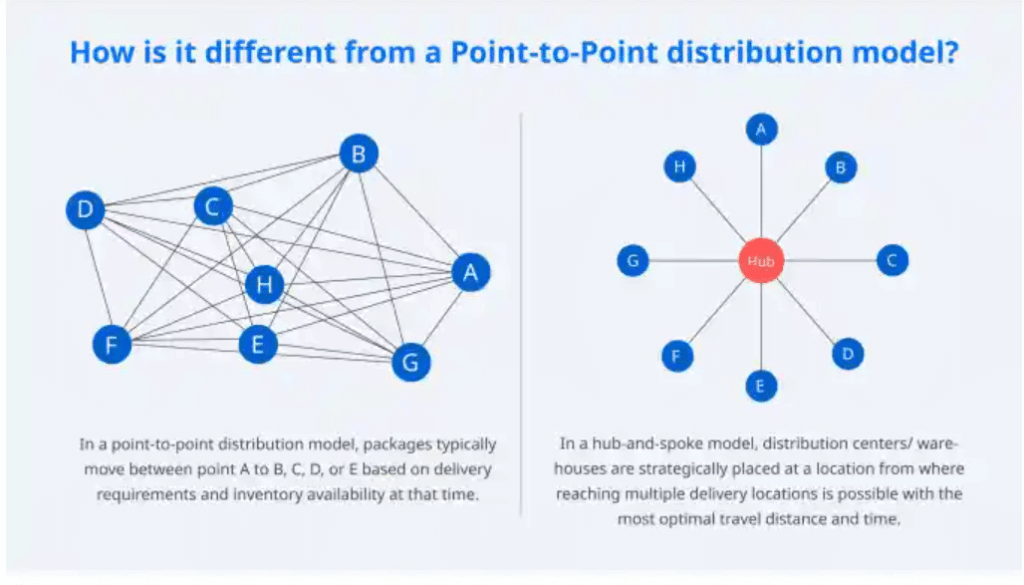
Locus’s FMCG and CPG logistics platform supports high-velocity distribution through dynamic route planning that adjusts continuously to real-time constraints, enabling operators to cover more locations per route without inflating delivery cost.
Distributor Networks and FMCG Logistics
Building a reliable FMCG distributor network is one of the most complex structural decisions a consumer goods company makes. The right network design determines service coverage, replenishment frequency, cost per delivery, and the ability to respond when demand or supply conditions shift unexpectedly.
Designing Multi-Echelon Distribution Networks
Most FMCG operators use multi-echelon networks: a national distribution center feeds regional hubs, which in turn supply local distributors and retail locations. The more echelons in the chain, the greater the potential for inventory accumulation at each node, longer lead times, and reduced responsiveness to real-time demand signals.
The most effective networks balance coverage with agility, using fewer but better-positioned hubs supported by strong carrier relationships and real-time dispatch capability.
The Role of Contract Logistics and 3PLs
Contract logistics plays a significant role in FMCG network design. Rather than owning every warehouse and truck in their network, most FMCG companies outsource some or all of their distribution to third-party logistics providers, which brings network access and flexibility but also introduces coordination complexity.
Managing multiple 3PLs across a regional or national footprint requires a control tower layer that provides end-to-end visibility regardless of which provider is handling a given leg.
The Need for a Control Tower Layer
FMCG companies are outsourcing their logistics operations to bridge the gap between sales planning and operational processes, improve forecasting, streamline inventory, and shorten delivery time.
Without this layer, companies struggle with fragmented data, inconsistent KPIs, and reactive problem-solving. With it, FMCG operators can align sales planning with operational execution, improve forecasting accuracy, streamline inventory positioning, and reduce delivery cycle times.
The wholesale distribution supply chain whitepaper from Locus covers how distributors can structure their networks for greater efficiency and resilience, which is directly applicable to FMCG operators managing multi-tier distribution.
Demand Volatility and How to Manage It
Building a reliable FMCG distributor network is one of the most consequential structural decisions a consumer goods company makes. Network design determines service coverage, replenishment frequency, cost per delivery, and the operational capacity to respond when demand or supply conditions shift without warning.
Why Demand Volatility Is Structurally Difficult
Most FMCG operators use multi-echelon networks: a national distribution center feeds regional hubs, which supply local distributors, which in turn serve retail locations and consumers. Each additional echelon introduces the potential for inventory buildup, extended lead times, and reduced responsiveness to real-time demand signals.
The most effective networks balance geographic coverage with operational agility, using fewer but better-positioned hubs supported by strong carrier relationships and connected dispatch capability.
Network Design as a Volatility Buffer
Contract logistics is central to FMCG network design. Rather than owning every warehouse and vehicle in their network, most FMCG companies outsource portions of their distribution to third-party logistics providers.
This brings network access and capital efficiency but introduces coordination complexity. Managing multiple 3PLs across a regional or national footprint requires a control tower layer that maintains end-to-end visibility regardless of which provider is executing any given leg.
The Role of Contract Logistics and 3PL Coordination
Most FMCG companies outsource portions of their distribution to third-party logistics providers. This improves scalability and capital efficiency, but it also introduces coordination risk during demand spikes.
When multiple 3PLs operate across regions, inconsistent processes and fragmented data can delay response times. A centralized control tower layer becomes essential. It ensures end-to-end visibility across providers, aligns KPIs, and enables rapid reallocation of capacity when volumes surge unexpectedly.
Bridging Sales Planning and Operational Execution
Demand volatility often exposes gaps between commercial planning and logistics execution. Promotions may drive sudden spikes. New product launches may strain replenishment cycles. Seasonal peaks can overwhelm static routing plans.
FMCG companies increasingly outsource logistics operations to close this gap. Integrated planning systems connect demand forecasts with warehouse positioning, transport capacity, and route planning in real time.
When network design, carrier coordination, and data visibility work together, operators can compress lead times, rebalance inventory proactively, and maintain service reliability even under volatile conditions.
Locus in Action: India’s Leading FMCG Conglomerate
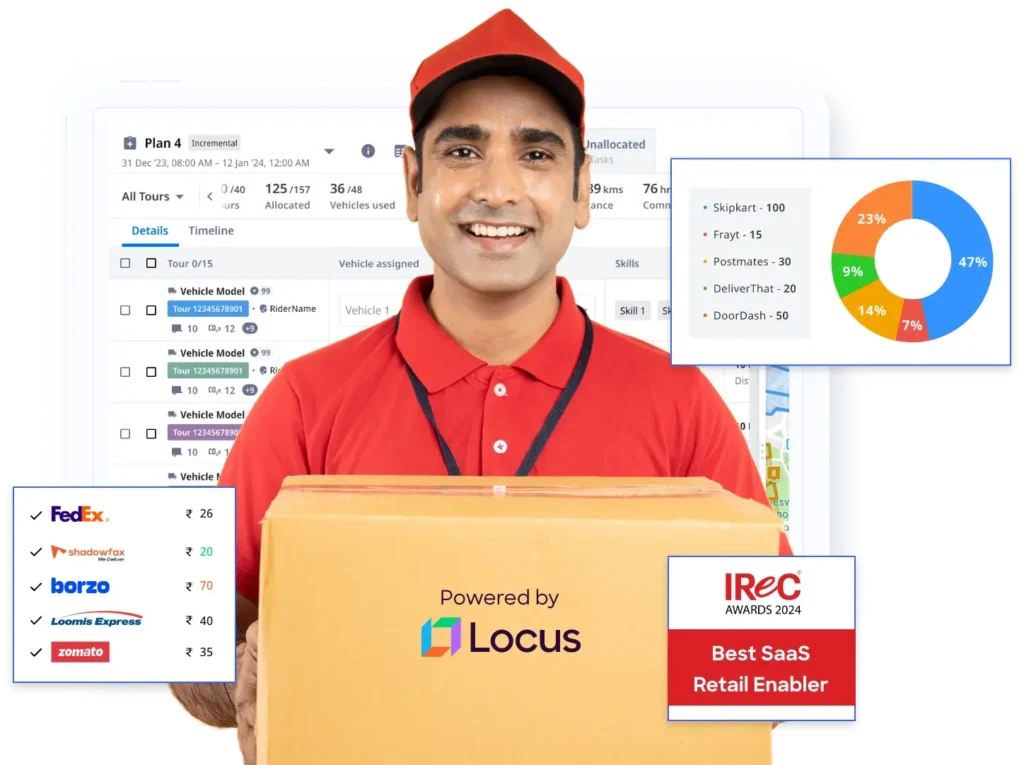
One of India’s largest FMCG companies, operating across more than 20 product categories, faced chronic inefficiencies in sales beat planning and distributor route management.
Sales representatives were assigned territories based on manual planning that did not account for store-level transaction history, optimal visit sequencing, or representative skill mapping. The result was overlapping routes, underutilized field staff, and missed restocking windows at key retail accounts.
Locus deployed its FieldIQ sales beat optimization platform alongside its geocoding and analytics engine. Using historical transaction data, median revenue per store, and representative performance profiles, Locus automated beat assignment and route planning.
Service coverage increased by 12 percent, route lengths became 20 percent shorter, and the total number of routes required dropped by 11 percent. IMARC Sales representatives spent more time in stores and less time on roads, directly improving restocking frequency and retail shelf availability. Read the full case study: How Can FMCG Players Utilize Sales Reps More Effectively.
Cost Pressures and Optimizing FMCG Logistics
In FMCG logistics, profitability is engineered at the operational level. With razor-thin margins and limited pricing flexibility, even small inefficiencies in routing, fleet utilization, or carrier management can erode earnings quickly. Rising input and transportation costs have made cost optimization a structural priority rather than a periodic efficiency exercise.
The Rising Cost Environment
Transportation, labor, fuel, and warehousing expenses continue to trend upward. Global FMCG operators experienced significant logistics and input cost inflation in 2024, driven by supply chain bottlenecks, energy volatility, and commodity price fluctuations.
Because competitive retail markets limit price pass-through, most FMCG companies absorb a substantial portion of these increases. As a result, operational efficiency directly determines margin protection.
High-Impact Cost Levers
The most powerful cost optimization levers in FMCG logistics include:
- Route optimization
Reduces total miles driven, lowers fuel consumption, and minimizes driver overtime. - Vehicle utilization
Increases load consolidation and fill rates, allowing fewer vehicles to move the same volume. - Carrier consolidation
Strengthens negotiating leverage, simplifies coordination, and reduces administrative overhead.
Together, these levers improve cost per delivery while maintaining service levels.
Mutualisation and Shared Capacity Models
Mutualisation, or shared transportation capacity across multiple shippers serving overlapping routes, is gaining traction in dense markets. This model improves route density and reduces empty miles when individual shipper volumes cannot justify dedicated fleets.
However, successful mutualisation requires digital coordination infrastructure capable of allocating capacity dynamically, tracking multi-shipper loads, and managing billing transparency across participants.
KPI-Driven Cost Control
Effective FMCG logistics operators measure performance at a granular level. Core cost management KPIs include:
- Cost per delivery
- Cost per case or unit
- Vehicle fill rate
- On-time delivery percentage
- Failed delivery rate
Tracking these metrics at route and driver level, rather than solely through aggregate financial reporting, enables near-real-time intervention when inefficiencies emerge.
Technology as a Cost Multiplier
Modern FMCG logistics platforms integrate planning, execution, and analytics into a unified system. By automating route design, optimizing fleet allocation, and improving dispatch visibility, technology compresses planning cycles and increases asset productivity.
Locus’s FMCG and CPG logistics platform delivers measurable results across these dimensions. Clients report a 15 percent reduction in freight costs, a 20 percent reduction in vehicles used, and an 84 percent reduction in planning time following platform deployment.
Locus in Action: Indonesia’s Leading FMCG Distribution Company
One of Indonesia’s top consumer goods distribution companies was managing its entire supply chain through manual processes: manual dispatch assignment, manual route planning, manual proof of delivery recording, and no real-time tracking capability across its fleet. The company faced suboptimal vehicle fill rates, geographic routing errors caused by Indonesia’s complex terrain, and zero visibility into on-ground exceptions until after they had already affected deliveries.
Locus implemented an end-to-end distribution planning and visibility solution, acting as a complete Transport Management System for the company, covering route optimization, automatic dispatch management, real-time tracking and visibility, and electronic proof of delivery through the Locus On The Road (LOTR) mobile app.
The results from the first month of deployment were immediate: 100 percent digitization of the proof of delivery process, 100 percent track and trace through a single platform for end-to-end order status, a 9 percent volume utilization increase, and a 34 percent reduction in distance per order.
FMCG Logistics Market Trends
The FMCG logistics market is undergoing structural transformation as consumer expectations, regulatory requirements, and technology capabilities evolve simultaneously. What was once a volume-driven distribution model is now a data-driven, sustainability-conscious, omnichannel network that must respond to demand shifts in near real time.
Several macro trends are reshaping the FMCG logistics market:
- Rapid growth of omnichannel fulfillment FMCG
- Integration of AI-driven planning systems
- Sustainability-focused transportation strategies
- Increased cross-border FMCG services
- Expansion of micro-fulfillment centers
Sustainable FMCG logistics strategies include:
- Electric vehicle adoption
- Route optimization to reduce fuel consumption
- Packaging reduction initiatives
- Consolidated retail shipments
Sustainability is becoming a measurable performance dimension within the FMCG supply chain.
FMCG Logistics Market Segmentation
Understanding FMCG logistics requires more than analyzing volumes. Market segmentation reveals how transportation modes, product characteristics, and regional infrastructure shape operational design, investment priorities, and service expectations across the supply chain.
By Mode of Transportation
Transportation mode selection directly influences cost structure, lead times, and network resilience. FMCG operators typically balance multiple modes to align service speed with margin protection.
- Roadways: Dominant mode for regional and last-mile distribution due to flexibility and route density.
- Railways: Suitable for bulk inland transport over long distances with cost efficiency.
- Airways: Used for urgent, high-value, or time-sensitive shipments where speed outweighs cost.
- Seaways: Essential for international consumer goods distribution and cross-border trade flows.
Multimodal strategies combine these modes to improve flexibility, reduce risk exposure, and strengthen continuity during disruptions.
By Product Type
Product characteristics heavily influence warehousing layout, temperature requirements, replenishment frequency, and transport planning.
- Food and beverages: Require strict temperature control, rapid replenishment cycles, and short shelf-life management.
- Personal care: Often subject to high promotional variability and brand-driven distribution strategies.
- Household care: Typically features stable demand patterns and supports bulk transportation models.
- Other consumables: Present diverse storage and handling requirements depending on packaging, regulation, and turnover rates.
Each product category shapes FMCG warehouse design, inventory positioning, and route planning decisions.
Regional Analysis
Regional infrastructure maturity, regulatory frameworks, and consumer behavior significantly affect logistics strategy.
- Asia Pacific: High growth potential driven by expanding retail infrastructure and rapid e-commerce adoption.
- North America: Advanced automation, integrated TMS platforms, and mature omnichannel ecosystems.
- Europe: Strong regulatory oversight and sustainability mandates influencing transport and packaging strategies.
Regional strategies vary based on infrastructure readiness, cost dynamics, compliance standards, and evolving consumer expectations.
FMCG Logistics Services and Capabilities
FMCG logistics has evolved from a transportation-centered function into a layered service ecosystem that integrates warehousing intelligence, omnichannel execution, retail coordination, and reverse flow management. Competitive advantage increasingly depends not on moving goods, but on orchestrating visibility, speed, and precision across every operational touchpoint.
Inbound Warehousing and Inventory Intelligence
The service stack in modern FMCG logistics has expanded well beyond transport and storage. Inbound warehousing now encompasses automated receiving, real-time inventory tracking, temperature zone management, and supplier compliance monitoring.
The operational goal is not simply to store product but to maintain full visibility from the moment goods arrive at the facility, enabling accurate available-to-promise calculations and prioritized dispatch.
Omnichannel Fulfillment Execution
Omnichannel fulfillment is the most operationally demanding capability in the current FMCG environment. Operators that fulfill retail replenishment and e-commerce orders from the same inventory pool, with equivalent accuracy and speed across both channels, hold a structural cost advantage.
Running parallel fulfillment streams for different channels doubles warehouse complexity, inflates headcount, and creates inventory allocation conflicts during peak periods.
For more on how integrated fulfillment works at scale, see Locus’s guide on order fulfillment.
Retail Consolidation
Retail consolidation, combining deliveries from multiple suppliers into a single consolidated load to a given retail location, reduces receiving dock congestion, cuts the number of inbound delivery appointments retailers must manage, and lowers per-unit delivery cost for participating suppliers. It is particularly valued by retailers managing tight receiving windows and high-volume urban locations.
Reverse Logistics and Returns Management
Reverse logistics is a growing FMCG service line, driven by e-commerce returns and circular supply chain mandates from major retail partners. Managing returns at scale requires the same routing intelligence and proof-of-collection documentation as outbound delivery, with additional workflows for product condition assessment and restocking decisions.
Locus covers last-mile fulfillment specifics, including returns, in detail at last mile fulfillment.
Locus in Action: PT Agro Boga Utama, Indonesia
PT Agro Boga Utama is one of Indonesia’s leading distributors of halal frozen meat and vegetables, serving more than 100 cities with 19 hubs across Jakarta, Java, Bali, Sumatra, Sulawesi, and Kalimantan, with 7,400 partners and 1,500 products.
For years, the company managed everything from order scheduling to fleet dispatch manually, creating chronic vehicle underutilization, poor route efficiency, and no real-time visibility across its cold chain network.
Locus implemented a complete Transport Management System, automating order scheduling and routing, improving vehicle utilization, and providing real-time tracking across the full distribution network.
The result was an 18 percent reduction in vehicle expenses and a 95 percent improvement in delivery SLA performance. Operations that had previously depended entirely on human dispatcher judgment were replaced by AI-driven planning that accounted for traffic, customer time windows, vehicle capacity, and geographic constraints simultaneously.
How to Choose and Optimize FMCG Logistics
Choosing and optimizing an FMCG logistics model is not a vendor comparison exercise. It is a structural decision that determines whether your operation can scale revenue without scaling cost at the same rate. The right approach aligns network design, technology, and performance management across five core dimensions.
Network Reach and Density
Network reach is the foundation. A partner or platform that cannot cover your distribution footprint at the density your markets require is not a viable option regardless of its other strengths.
This means evaluating not just geographic coverage but stop density within key markets, carrier relationships at the regional and local level, and the ability to extend reach into new territories as your business grows.
Real-Time Visibility
Real-time visibility is now a baseline operational requirement, not a premium feature. Operators who cannot track every shipment from inbound receipt to final delivery confirmation cannot manage exceptions proactively, cannot give retail partners accurate ETAs, and cannot prevent service failures from cascading into retailer compliance penalties.
A unified visibility layer that spans carrier networks, warehouse operations, and driver activity is the minimum requirement.
Demand Responsiveness
Demand responsiveness determines whether your logistics infrastructure can absorb volume spikes without proportional cost increases or service degradation.
Dynamic routing, flexible carrier capacity management, and tight integration between order management systems and dispatch platforms enable real-time reallocation of resources. Without these capabilities, seasonal peaks and promotional surges quickly erode margins.
Granular Cost Control
Cost control must operate at the route and driver level, not only in aggregate financial reporting. Organizations that rely solely on monthly summaries often discover inefficiencies weeks after they occur.
Measuring cost per delivery, vehicle fill rate, on-time performance, and failed delivery rate at granular levels allows operators to identify specific inefficiencies and correct them in near real time. This data-driven discipline differentiates technology-enabled networks from spreadsheet-driven operations.
Sustainability Alignment
Sustainability is increasingly a contractual requirement from regulators and major retail partners.
Platforms that measure transport emissions, enable route consolidation to reduce fuel consumption, and support fleet electrification planning create both compliance coverage and operational efficiency. Environmental performance is becoming a competitive differentiator, not just a reporting obligation.
For a framework that applies across all five of these dimensions, Locus’s resource on retail supply chain management provides the operational context for FMCG operators evaluating their current setup or planning a platform transition.
Locus in Action: MaxAB, Egypt
MaxAB is a leading B2B e-commerce and distribution platform serving traditional trade in Egypt and Morocco, delivering FMCG goods directly to small retailers across both markets.
Before working with Locus, MaxAB’s last-mile dispatching was entirely manual: daily orders were assigned to trucks by human dispatchers without systematic consideration of order weight, vehicle CBM, or retailer geographic clustering.
Locus provided MaxAB with an automated dispatching platform that shifted last-mile operations away from manual assignment. Using customization variables including order weight, truck CBM, and retailer geo-locations, Locus’s platform enabled the logistics team to test different operational simulations and identify the optimal combination, resulting in a productivity increase of approximately 25 percent.
List of Key Companies and Industry Developments
The competitive landscape in FMCG logistics spans global 3PL providers, regional distribution specialists, freight carriers, and increasingly, technology-led orchestration platforms. Market leaders are differentiating not only through physical infrastructure but through automation, real-time visibility, AI-driven planning, and sustainability integration.
The following developments illustrate how the market is evolving to meet the scale, speed, and complexity demands of modern FMCG supply chains:
- Increased automation in FMCG warehousing, including robotics-assisted picking, automated sortation, and real-time inventory visibility
- AI-enabled route optimization and dynamic dispatch, reducing cost per delivery while improving service reliability
- Expansion of cross-border FMCG trade services, driven by regional trade agreements and growing e-commerce penetration
- Sustainability-driven fleet transformation, including electric vehicle adoption and emissions-aware routing strategies
Digital transformation is no longer an innovation layer in retail logistics management. It is becoming the structural foundation of competitive performance.
The Enterprise Advantage in FMCG Logistics Starts with Locus
The FMCG logistics market is large, growing, and under sustained pressure to perform better at lower cost. At $1.2 trillion in 2023 and projected to reach $1.7 trillion by 2033, PR Newswire the sector’s scale reflects both the ubiquity of fast-moving consumer goods in daily life and the operational complexity of getting those products reliably to billions of consumers across every type of market.
The operators gaining ground in this environment are not necessarily the largest. They are the most connected with visibility across every leg of their network, dynamic routing that responds to real-world conditions rather than static plans, and demand planning that closes the gap between forecast and execution.
Locus’s FMCG and CPG logistics platform is built specifically for this level of operational complexity. With proven results including 15 percent freight cost reduction, 20 percent fewer vehicles used, and 84 percent shorter planning cycles, it gives FMCG operators the infrastructure to treat logistics as a growth lever rather than an overhead line.
For further reading, explore Locus’s resources on retail logistics and FMCG and CPG logistics.
Frequently Asked Questions (FAQs)
1. What is FMCG logistics?
FMCG logistics manages the storage, transportation, and distribution of fast-moving consumer goods across supply chain networks.
2. What are the main challenges in FMCG logistics?
Major challenges include demand volatility FMCG, cost pressures, distributor network complexity, omnichannel fulfillment FMCG, and high-velocity distribution requirements.
3. What are key performance indicators for FMCG logistics?
KPIs include cost per case, inventory turnover, on-time delivery rate, order accuracy, and transportation cost percentage.
4. How can you optimize FMCG logistics?
Optimization requires advanced forecasting, network design improvements, route optimization, automation, and integrated retail logistics management systems.


Grocery
Retail and Grocery Transportation at Enterprise Scale: A Complete Guide

Mar 4, 2026
Understand the systems behind grocery logistics, including cold chain continuity, route optimization, compliance, and time-sensitive fulfillment.
Read more
General
FMCG Logistics Trends: Operational Challenges and How Modern Orchestration Is Changing Execution
Mar 5, 2026
Explore the 5 biggest FMCG logistics challenges in 2026 and how AI-powered orchestration platforms improve execution, reduce costs, and boost visibility.
Read moreInsights Worth Your Time




















FMCG Logistics for Enterprise: Network Strategies, Market Trends, and Execution