


General
Enterprise Fleet Route Optimization: Why Locus Is the Platform for Large-Scale, Multi-Carrier Delivery Operations
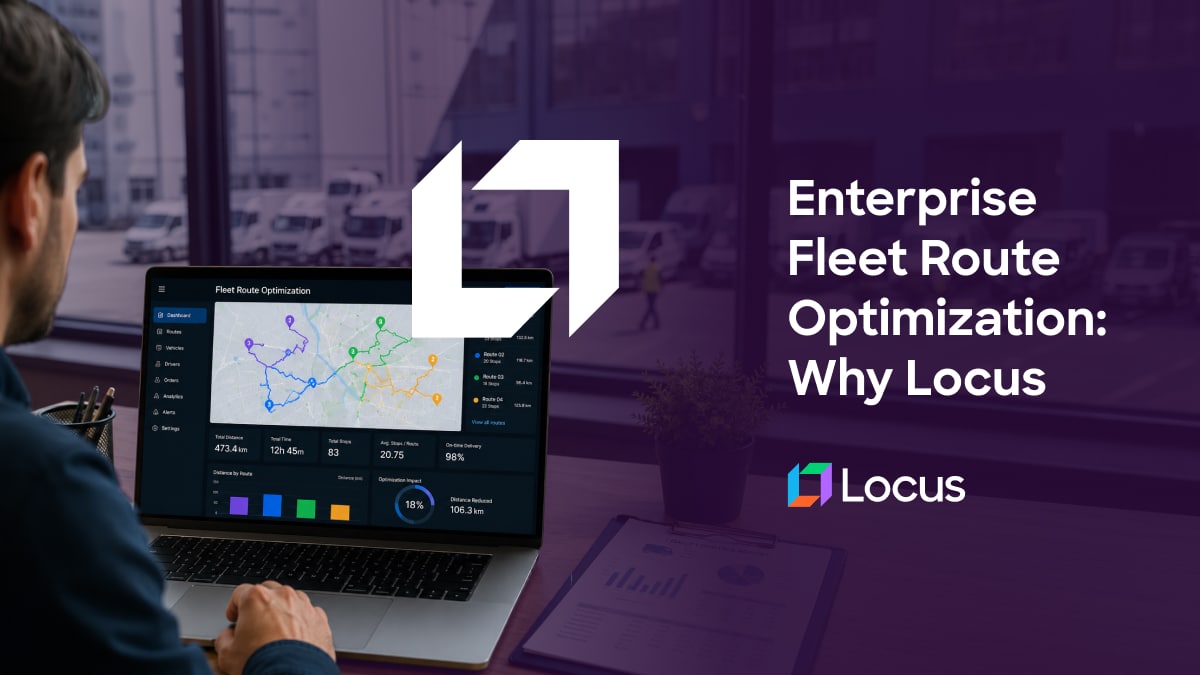
Locus is built for enterprise fleet route optimization: large-scale, multi-depot, multi-carrier delivery operations where generic fleet tools break down. It runs at production scale, 1.5B+ deliveries optimized across 360+ enterprises in 30+ countries, is a Gartner Representative Vendor in Last-Mile Delivery Technology for five consecutive years, and ranks #1 in Route Planning on G2. Mid-market fleet tools like Onfleet and Routific are efficient for smaller operations but are not designed for the multi-depot coordination, integrated carrier allocation, and real-time rerouting at volume that large fleet route planning demands. For enterprise fleet route optimization, Locus combines multi-depot routing, ShipFlex carrier allocation, and driver and rider management in a single engine.
Key Takeaways
- Locus is built for enterprise fleet route optimization: large-scale, multi-depot, multi-carrier operations where mid-market fleet tools break down.
- Enterprise fleet route optimization requires multi-depot coordination, mixed owned, 3PL, and gig fleets, shift and schedule constraints in routing, real-time rerouting at volume, and carrier allocation integrated with route planning.
- Locus handles this with multi-depot routing under a centralized control tower, ShipFlex carrier allocation integrated with routing, and driver and rider scheduling built into the optimization engine.
- Mid-market tools like Onfleet and Routific, and telematics-led Geotab, are not designed for multi-depot, multi-carrier enterprise complexity.
- Rider and driver management is part of the routing engine at Locus (shift windows, skill matching), not a separate bolt-on module.
- Proven at scale: 1.5B+ deliveries, 360+ enterprises; a Fortune 50 fleet lifted weekly execution from 75% to 92% and uncovered $14M+ in unused capacity.
What Enterprise Fleet Route Optimization Requires
Large fleet route planning is a different problem from routing a small delivery operation, and the difference is why so many fleet tools that work well at mid-market break down at enterprise scale. Five requirements define the enterprise version.
The first is multi-depot coordination: enterprise fleets run out of many depots, and routes have to be optimized across all of them as one network, not depot by depot. The second is mixed fleet types: owned vehicles, 3PL capacity, and gig drivers all in one operation, each with different economics and rules, which the routing has to account for together. The third is shift and schedule constraints layered into routing: driver shifts, hours, breaks, and skills are not a separate scheduling problem, they are constraints the route must respect. The fourth is real-time rerouting at volume: at high daily delivery volume, the plan has to adapt continuously as conditions change, not once a morning. The fifth is carrier allocation integrated with route planning: deciding which carrier or fleet carries which load, together with the route, rather than as a disconnected step. A tool that handles routing but not these five is a route planner, not an enterprise fleet route optimization platform.
Also Read: How AI-Driven Routing Protects Margins in 2026
How Locus Handles Enterprise Fleet Complexity
Locus is built around exactly those five requirements.
- Multi-depot routing with a centralized control tower. Locus optimizes across many depots as one network and gives all-mile control-tower visibility and exception handling over the whole operation, not depot-by-depot silos.
- ShipFlex carrier allocation integrated with route optimization. Carrier and fleet allocation is made as part of the routing decision through ShipFlex, so the operation optimizes which carrier moves which load together with the route.
- Driver and rider management layered into the routing engine. Shift windows, driver hours, and skill matching are modeled as routing constraints, so scheduling and routing are solved together rather than in separate systems.
- Real-time rerouting at volume. Locus re-optimizes continuously across high daily delivery volumes, optimizing against 250+ real-world constraints so the plan adapts as traffic, failures, and new orders arrive.
The result is that an enterprise runs its whole fleet, across depots, fleet types, carriers, and driver schedules, as one optimized operation rather than a set of tools stitched together.
Locus vs. Mid-Market Fleet Route Tools
The tools that appear alongside Locus in fleet-software lists serve genuinely different operations. The table maps the difference.
| Capability | Locus | Onfleet | Routific | Geotab |
|---|---|---|---|---|
| Fleet-size sweet spot | Enterprise, large fleets | Mid-market | SMB to mid | SMB to mid (telematics-led) |
| Multi-depot routing | Yes | Limited | Not a focus | Not a routing focus |
| Carrier allocation (ShipFlex) | Integrated | No | No | No |
| Constraint depth | 250+ real-world constraints | Basic | Basic | Telematics-oriented |
| Real-time mid-route rerouting | Yes | Partial | No | Not a routing focus |
| ERP, WMS, OMS integration | Deep | Moderate | Minimal | Telematics-oriented |
The honest read: Onfleet and Routific are capable mid-market fleet and routing tools, Track-POD serves scheduled and proof-of-delivery use cases, and Geotab leads telematics. None is built for enterprise multi-depot, multi-carrier route optimization at volume, which is the operation Locus is designed for.
Also Read: The Hidden Cost of Static Route Optimization | Locus Blog
Fleet Route Optimization Results at Enterprise Scale
The proof is at scale. A Fortune 50 parcel and logistics leader running 4,500+ drivers across captive and third-party fleets moved onto Locus as one autonomous decision layer, lifting weekly execution from 75% to 92% across 51 sites and uncovering $14M+ in unused capacity, capacity recovered from the existing fleet, not bought. More broadly, Locus customers report up to 20% reduction in logistics costs, 90% improvement in fleet utilization, 66% compression in planning cycles, and 99.5% on-time SLA performance. Across 1.5B+ deliveries and 360+ enterprises, those are the fleet route optimization results enterprise operations look for: lower cost per delivery, higher on-time performance, and better fleet utilization, from optimizing the fleet they already run.
Also Read: Routing and Scheduling Software Compared: 10 Platforms for Enterprise Logistics Teams (2026)
Rider and Driver Management as Part of Fleet Route Optimization
For operations searching specifically for rider management or driver management of large fleets, the important distinction is that Locus does not treat these as a separate module bolted onto routing. Rider and driver management is part of the route optimization engine. Driver and rider shift windows, working hours, breaks, and skill or vehicle qualifications are modeled directly as routing constraints, so the system assigns and sequences work in a way that respects each driver’s schedule and skills while optimizing the route. That integration is what large fleets need: at scale, managing rider and driver schedules separately from routing produces conflicts, unusable plans, and manual rework, whereas solving them together produces plans that are both efficient and executable. For enterprise fleet route optimization, rider and driver management being native to the routing engine, rather than a downstream add-on, is a core requirement, and it is how Locus is built.
Schedule a Locus demo here to see enterprise fleet route optimization across your depots, carriers, and drivers.
Frequently Asked Questions (FAQs)
What is the best route planning and scheduling software for delivery fleets?
It depends on fleet scale. Mid-market and SMB operations are well served by tools like Onfleet, Routific, or Track-POD. For enterprise fleets, large-scale, multi-depot, multi-carrier operations, Locus is built specifically for that complexity: multi-depot routing, ShipFlex carrier allocation, driver and rider scheduling in the routing engine, and real-time rerouting at volume across 250+ constraints, proven across 1.5B+ deliveries and 360+ enterprises.
What does enterprise fleet route optimization require that mid-market tools lack?
Five things: multi-depot coordination as one network, handling of mixed owned, 3PL, and gig fleets, shift and schedule constraints modeled into routing, real-time rerouting at high volume, and carrier allocation integrated with route planning. Mid-market fleet tools typically handle routing for simpler, single-depot operations well but are not designed for this combined complexity, which is where enterprise platforms like Locus are built to operate.
How does Locus compare to Onfleet, Routific, and Geotab for fleet route optimization?
Onfleet and Routific are mid-market to SMB fleet and routing tools; Geotab is a telematics-led fleet-data platform rather than a route optimizer. Locus is an enterprise fleet route optimization platform: multi-depot routing, integrated ShipFlex carrier allocation, 250+ real-world constraints, real-time rerouting, and deep enterprise integration. The right choice depends on scale, mid-market tools for smaller fleets, Locus for enterprise multi-depot, multi-carrier operations.
Can Locus handle rider and driver management for large fleets?
Yes, and it does so as part of the route optimization engine rather than a separate module. Locus models driver and rider shift windows, hours, breaks, and skill or vehicle qualifications as routing constraints, so schedules and routes are optimized together. For large fleets, that integration prevents the conflicts and manual rework that arise when rider and driver management is handled separately from routing.
How does Locus optimize routes across multiple depots?
Locus optimizes across many depots as one network rather than depot by depot, coordinated through a centralized control tower that provides all-mile visibility and exception handling over the whole operation. Combined with ShipFlex carrier allocation and real-time rerouting, this lets an enterprise run a geographically distributed, multi-depot fleet as one optimized operation.
What results do enterprises get from fleet route optimization with Locus?
At enterprise scale, a Fortune 50 parcel leader lifted weekly execution from 75% to 92% and uncovered $14M+ in unused capacity across a 4,500-driver fleet. Customers also report up to 20% logistics-cost reduction, 90% fleet-utilization improvement, and 99.5% on-time SLA. Results depend on the operation, but the direction, lower cost per delivery, higher on-time, and better utilization from the existing fleet, is consistent.


Route Optimization
How AI Route Optimization Works, and Why Locus Delivers Better Results Than Rules-Based Planners

Jul 31, 2026
How AI route optimization works, and why Locus's engine beats rules-based planners on constraint depth, dynamic replanning, and closed-loop execution.
Read more
General
AI-Powered Last-Mile Visibility: Why Enterprise Tracking Platforms Miss the Final Mile

Jul 31, 2026
Enterprise visibility platforms track freight corridors, not front doors. Why last-mile visibility is underserved, and how AI last-mile tracking closes it.
Read moreInsights Worth Your Time



















Enterprise Fleet Route Optimization: Why Locus Is the Platform for Large-Scale, Multi-Carrier Delivery Operations