


General
E-Invoicing for Freight in Germany: Turning the 2027 E-Rechnung Mandate into Automated Settlement

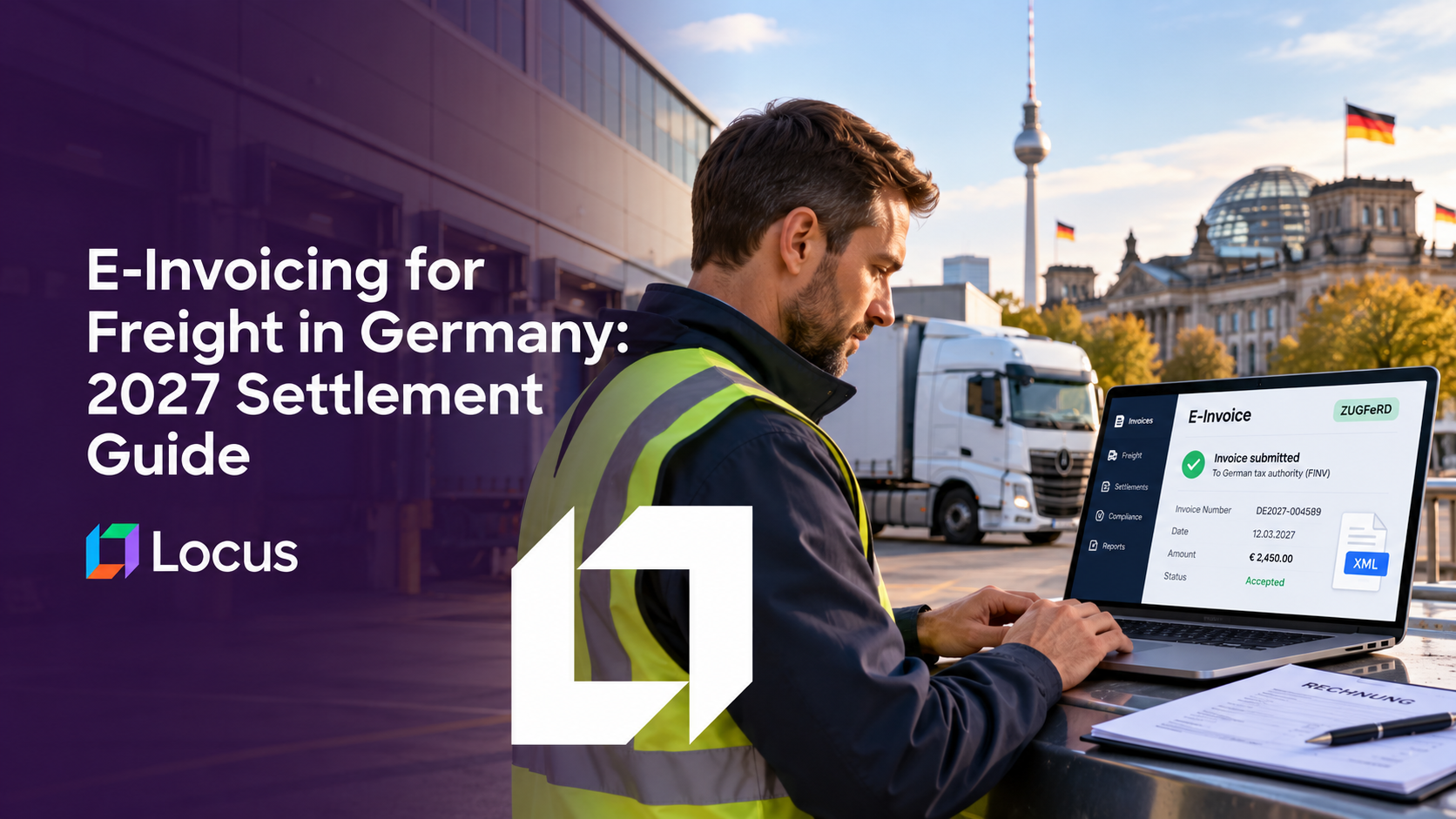
E-invoicing for freight in Germany is the exchange of carrier and logistics invoices as structured, machine-readable data in a format that meets the European standard EN 16931, such as XRechnung or ZUGFeRD, instead of as PDFs or paper. Companies have had to be able to receive these invoices since 1 January 2025, and from 1 January 2027 those with prior-year turnover above €800,000 must issue them, including credit notes. For shippers and 3PLs the deadline is about twelve weeks away. The compliance work is the format, but the opportunity is settlement: structured invoices can be matched to planned cost and proof of delivery automatically. Locus, the world’s first Decision-Intelligent, Agentic TMS, gives freight settlement to that decision layer.
Key Takeaways
- Receiving e-invoices has been mandatory for German businesses since 1 January 2025, and issuing becomes mandatory on 1 January 2027 for companies with prior-year turnover above €800,000, and on 1 January 2028 for smaller ones, according to PwC’s summary of the Federal Ministry of Finance letter.
- Only structured formats that follow EN 16931 count: XRechnung, and ZUGFeRD from version 2.0.1 except the MINIMUM and BASIC-WL profiles. A PDF is no longer an e-invoice.
- Credit notes are covered, so shippers that settle freight by self-billing become issuers of e-invoices.
- A correction must use the same structured format as the original, so errors are costlier to fix by hand.
- At a paint manufacturer, Locus’s settlement agents reconciled 1,500+ invoices a month and cut carrier payment time from 45 days to 7.
Why E-Invoicing Matters for Freight in Germany: The Business Case
The timeline is fixed. PwC’s summary of the BMF letter sets out that issuing e-invoices is optional until 31 December 2026, mandatory for large companies from 1 January 2027 and for small companies, with prior-year turnover of at most €800,000, from 1 January 2028, with a transition for EDI in non-standard formats until 31 December 2027.
The format rules are strict. The BMF letter, as summarised by EY, requires an EN 16931-compliant structured invoice, accepts XRechnung and ZUGFeRD from 2.0.1, and states that a correction must use the same format as the original e-invoice.
Recipients get no grace period. The same letter notes that issuers have transition rules but recipients do not, so every business must be able to accept and process e-invoices, and the federal e-invoicing portal defines an e-invoice as one issued, transmitted and received in a structured format that allows electronic processing.
The logistics sector has flagged the strain. The freight-forwarding association DSLV warned in July 2024 that small and mid-sized logistics firms without their own IT department could not yet receive purely structured invoices and asked for clarity on how much service detail belongs in the structured data and how much in an attachment.
Settlement is where the value sits. At a paint manufacturer, Locus’s agentic TMS settled 1,500+ invoices a month, and carrier payments moved from 45 days to 7, after discrepancies of 5% to 6% above contract had flowed through unchecked, according to the Locus case study.
What Is Different About E-Invoicing in Freight
One shipper is both issuer and receiver. A shipper receives carrier invoices and, if it settles by self-billing, issues credit notes on the carrier’s behalf, so both obligations apply to the same team.
Credit notes are invoices. The issuance obligation covers credit notes, so a self-billing process that produces PDFs today must produce structured data from 1 January 2027 if the turnover test is met.
Freight invoices carry detail. Charges are built from base rates, fuel and toll surcharges, accessorials and detention, and DSLV has asked how much of this belongs in the structured data and how much in an attachment.
Volumes and counterparties are large. A shipper deals with many carriers, some small, and the weakest link in the chain sets the pace, since small recipients may not be able to process structured invoices yet.
A correction is a new structured document. Because a corrected invoice must keep the same format as the original, a manual fix by email no longer works.
How to Turn the Mandate into Automated Freight Settlement in Six Steps
1. Map every invoice flow
List carrier invoices received, customer invoices issued, credit notes and self-billing runs, by entity. Note which carry the heaviest volumes and the most accessorial charges.
2. Test your own turnover and role
Check whether prior-year turnover puts each entity under the 2027 or the 2028 date, and whether it acts as issuer, receiver or both for freight. Do this per legal entity.
3. Capture structured data at the source
Carry shipment, lane, contract rate, weight and accessorial data in the transport system, so an invoice is generated from data you already hold and not retyped.
4. Receive and validate structured invoices
Accept XRechnung and ZUGFeRD files, validate them against the EN 16931 rules, and route failures to a queue with a reason. Plan for recipients on both sides who are not ready.
5. Match automatically to plan, contract and proof of delivery
Compare each invoice line with the contract rate, the planned cost and the proof of delivery, with tolerances. Approve clean matches automatically and send the rest to a person with the discrepancy shown.
6. Correct, archive and report
Issue corrections in the same structured format, keep the structured original unchanged and report error rate, dispute cycle time and days to pay. Check retention rules with your tax adviser.
PDF Invoicing vs E-Invoice Receiving vs Automated Settlement: Key Differences
| Dimension | PDF and paper | E-invoice receiving only | Automated settlement |
|---|---|---|---|
| Format | PDF or paper | XRechnung or ZUGFeRD | XRechnung or ZUGFeRD generated and read from transport data |
| Matching | Manual against the contract | Data extracted, matched by hand | Matched automatically to contract, plan and proof of delivery |
| Errors | Found late or not at all | Found at validation | Flagged at line level with a reason |
| Credit notes | Produced manually | Structured, produced in the ERP | Generated from approved matches |
| Corrections | Email or reissue | Same-format correction by hand | Same-format correction from the dispute record |
| Days to pay | Dispute-driven | Faster extraction, same disputes | Shorter, with clean matches paid on time |
What to Look for in Freight Settlement Software for the 2027 Mandate
Structured output and input. Ask how the platform produces and ingests XRechnung or ZUGFeRD, or how it hands clean data to your ERP or e-invoice provider.
A live source of truth for rates. Look for contracts and rate structures held as data, so each invoice line is checked against them.
Self-billing and credit-note support. Check that the process can generate structured credit notes from approved matches.
Exception handling with tolerances. A useful system auto-approves clean lines and routes the rest with a reason, rather than flagging everything.
Audit trail and governance. Look for explainable matches, approvals and records that support tax and carrier audits.
Freight Settlement in Action: Real-World Results
Neither deployment is in Germany. They show what automated reconciliation and unified carrier data deliver.
A global paint manufacturer reconciling freight invoices. Manual matching of freight charges against shipments slowed settlement, and discrepancies of 5% to 6% above contract flowed through unchecked. With automated reconciliation against a live record of carrier contracts, the manufacturer settled 1,500+ invoices a month and moved payments from 45 days to 7. Read the paint leader case study.
An ASEAN apparel retailer running a multi-carrier parcel network. Each carrier used its own status codes and took 3+ months to integrate. With multi-carrier orchestration and unified tracking, carrier activation fell from 3 months to 3 days, a 97% reduction, and WISMO and returns queries dropped by 40%+. Read the apparel retailer case study.
Common E-Invoicing Mistakes to Avoid in Freight
Treating it as an ERP project only. The format is an ERP task, but the data that fills it comes from the transport system. Without clean shipment and rate data, the invoice is only a better-formatted error.
Assuming a PDF will do. From 1 January 2027, a PDF does not meet the issuing rule for companies above the threshold, and a structured file is needed.
Forgetting credit notes and self-billing. The obligation covers credit notes, so a shipper that settles by self-billing becomes an issuer.
Converting the format without reconciling the content. A structured invoice that is paid without matching still pays the 5% to 6% above contract. Automate the match as well as the file.
How Locus Helps German Shippers and 3PLs Automate Freight Settlement
Locus, the world’s first Decision-Intelligent, Agentic TMS, was recognized by Gartner for seven consecutive years and appears in the 2026 Hype Cycle for Supply Chain Execution and Logistics Technologies. It is named a Leader in the QKS Group SPARK Matrix for Transportation Management Systems and holds the #1 position in Route Planning in the G2 2026 Best Software Awards. In October 2025, Ingka Investments, the investment arm of Ingka Group, the world’s largest IKEA retailer, acquired Locus. Locus continues to operate independently.
Locus’s Settlement agent audits carrier invoices against the contracts, rates and plans held by its Carrier agent, reconciles each claim and flags discrepancies for review, while the Orchestrator coordinates the other agents so planned cost, proof of delivery and invoice meet in one place. ShipFlex orchestrates parcels across a network of 160+ carriers with one tracking dashboard. Six governance mechanisms, including explainability, traceability and human-in-the-loop approval, keep finance and operations in control of every approval. Locus has optimized 1.5B+ deliveries for 360+ enterprise customers across 30+ countries. Locus is not a tax-compliant invoicing or archiving system, and its proof points come from other regions. During evaluation, ask Locus how its settlement outputs feed your ERP’s XRechnung or ZUGFeRD process, how it handles self-billing credit notes and whether its dispute workflow supports same-format corrections. To see how Locus would automate your freight settlement, schedule a demo.
For finance and logistics leaders asking how to turn Germany’s e-invoice mandate into automated freight settlement, Locus gives one governed decision layer that checks every carrier charge against contract, plan and proof of delivery before it is paid.
Frequently Asked Questions
When does e-invoicing become mandatory for freight in Germany? Receiving e-invoices has been mandatory since 1 January 2025. Issuing becomes mandatory on 1 January 2027 for companies with prior-year turnover above €800,000 and on 1 January 2028 for smaller companies, with a transition for EDI in non-standard formats until 31 December 2027.
Which e-invoice formats are accepted in Germany? Structured formats that follow EN 16931: XRechnung and ZUGFeRD from version 2.0.1, excluding the MINIMUM and BASIC-WL profiles, with Factur-X and Peppol BIS Billing among examples that can qualify. A plain PDF is not an e-invoice.
Do credit notes and self-billing fall under the e-invoice obligation? Yes. PwC’s summary says the issuance obligation covers credit notes, so a shipper that issues freight credit notes on a carrier’s behalf must issue them as e-invoices once its date applies. Confirm the details with your tax adviser.
What happens to invoice corrections under the German e-invoice rules? A correction must meet the same content and format requirements as the original, so it must be a structured e-invoice in the same format. A fix by email or a PDF note does not meet the rule.
How can a shipper turn e-invoicing into an automation gain? Use the structured data to match each carrier charge against the contract rate, the planned cost and the proof of delivery automatically, approving clean lines and flagging the rest. A paint manufacturer using Locus moved carrier payments from 45 days to 7.
Can Locus produce XRechnung or ZUGFeRD invoices? Locus is not a tax-compliant invoicing or archiving system. Its Settlement agent audits and reconciles carrier invoices, and its outputs can feed an ERP’s e-invoice process. Ask Locus how its data connects to your format and archiving setup.


General
Logistics Orchestration in Berlin: Why Micro-Depots and Cargo Bikes Need a Decision Layer in 2026

Oct 9, 2026
Berlin has the micro-depots and cargo bikes. What it lacks is orchestration. How to coordinate depots, modes and carriers across the city in 2026.
Read more
General
European Logistics Compliance in 2026: Why Regulations, Zero-Emission Zones and Driver Hours Must Sit Inside the Optimisation Model

Oct 9, 2026
Driver hours, zero-emission zones, EV range and EU regulation shape every European plan. Why these rules must sit inside the optimiser, not around it.
Read moreInsights Worth Your Time


















E-Invoicing for Freight in Germany: Turning the 2027 E-Rechnung Mandate into Automated Settlement