


General
Driver Performance Management: How Locus Tracks and Improves Fleet Output in 2026
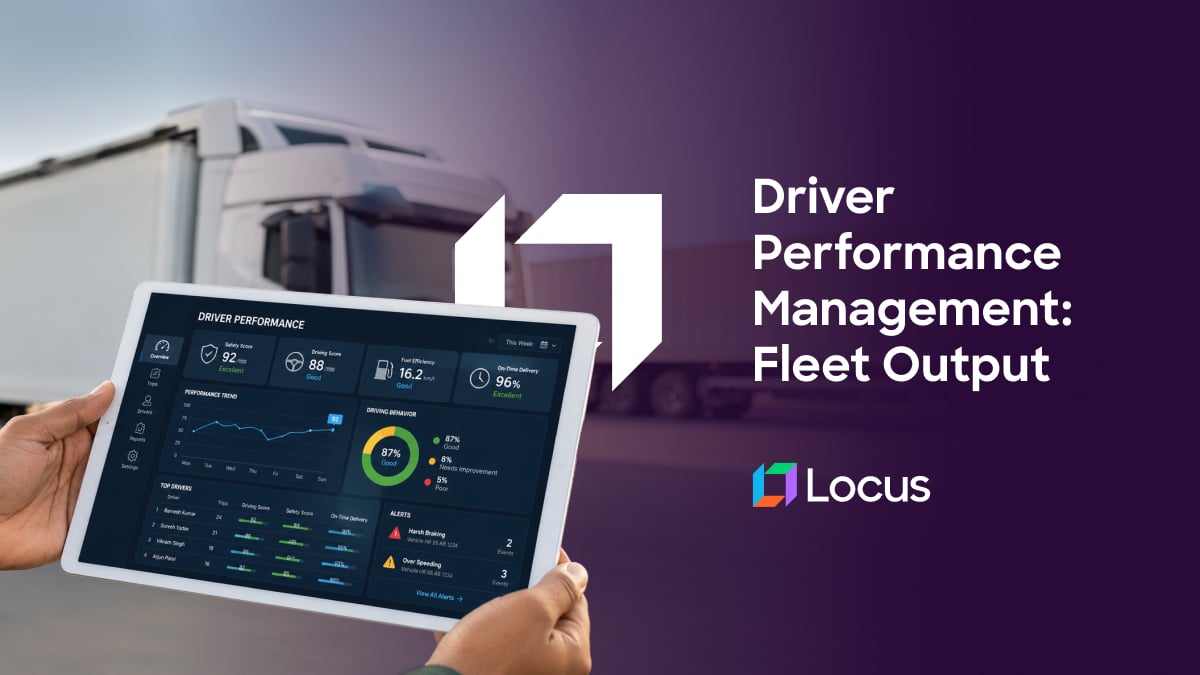
Key Takeaways
- “Driver performance” has two distinct meanings: safety and behavior (how safely a driver operates a vehicle) and delivery output (how much a driver actually gets done, on time). They need different tools.
- Samsara, Motive, and Geotab are telematics and safety platforms. They measure the safety-and-behavior side: harsh events, speeding, hours-of-service, dashcams, and vehicle data.
- Locus manages the output side: on-time rate, first-attempt success, deliveries completed per driver, plan adherence, and SLA compliance.
- The important difference is measure versus improve. Telematics platforms observe driver behavior; Locus improves fleet output by optimizing the dispatch and routing decisions that produce it.
- Locus tracks output performance in real time and turns it into better decisions, not just dashboards, through AI-driven dispatch and route optimization.
- The two are complementary. Telematics for vehicle safety and compliance; Locus for improving delivery output at scale.
What is Driver Performance Management?
Driver performance management is the practice of measuring and improving how drivers perform. The catch is that “perform” means two different things, and most tools do only one.
The first meaning is safety and behavior: how safely a driver operates the vehicle. That is harsh braking and acceleration, speeding, idling, seatbelt use, hours-of-service, and increasingly dashcam-based scoring. It is a vehicle-and-safety discipline, and it is what telematics platforms like Samsara, Motive, and Geotab are built for.
The second meaning is delivery output: how much a driver actually accomplishes, and how well. That is on-time delivery rate, first-attempt success, stops or deliveries completed per route, adherence to the plan, and service-level compliance. It is an operational-execution discipline, and it is what an agentic TMS like Locus is built for.
The American Trucking Associations estimates a shortage of roughly 60,000 drivers today, projected to exceed 170,000 by 2030.
Both matter, but they are not substitutes. A driver can have a spotless safety score and still under-deliver against the plan, and a fleet can be safe and still miss its SLAs. This piece is about the output side, how Locus tracks it and, more importantly, improves it, and how that differs from what a telematics platform does.
Also Read: How AI-Driven Routing Protects Margins in 2026
How Locus Tracks Driver Performance
Locus tracks driver performance as delivery output, in real time, from the same system that plans and dispatches the work. Because Locus assigns the routes and tasks, it knows what each driver was supposed to do, and it sees what actually happens as the day unfolds: stops completed, deliveries succeeded or failed, time against plan, and exceptions as they occur.
That matters because performance tracking is only useful if it is tied to the plan. A number like “40 deliveries completed” means little on its own; measured against the 45 that were planned and the reasons for the gap, it becomes actionable. Locus tracks output against the plan it generated, so the performance picture is complete rather than a set of disconnected metrics. This is delivery-execution tracking, not vehicle telematics.
Key Metrics for Fleet Performance Improvement
The output metrics that actually move fleet performance are the ones tied to execution:
- On-time delivery rate: the share of deliveries completed inside the promised window.
- First-attempt success rate: the share delivered on the first try, the single biggest driver of both cost and customer experience.
- Deliveries per driver per route: throughput, or how much productive work each driver completes.
- Plan adherence: how closely actual execution follows the optimized plan, and where it diverges.
- SLA adherence: performance against contractual service levels.
- Route and time efficiency: planned versus actual distance and time, which surfaces where the day is leaking.
ATRI found drivers are detained on 39.3% of all stops, losing 117–209 hours a year each — an industry-wide $11.5 billion in lost productivity in 2023.
These are the levers of fleet output. Improving them is what raises how much a fleet delivers without adding drivers or vehicles.
Also Read: 5 AI and Agentic Trends Reshaping Last-Mile Customer Experience in 2026
Tools and Features Offered by Locus
What separates Locus from a reporting tool is that it does not stop at showing these metrics; it improves them. AI-driven dispatch assigns and sequences work so more of it fits into the day. Dynamic route optimization across 250+ real-world constraints tightens every route and re-optimizes as conditions change. Real-time tracking and AI-driven insights surface problems while there is still time to act on them, and SLA and execution analytics turn the output metrics into decisions rather than after-the-fact dashboards. Locus’s standing in the category is reflected in its recognitions: G2’s #1 position for Route Planning, inclusion in the 2026 Gartner Hype Cycle, a Leader placement in the QKS SPARK Matrix for TMS, and seven consecutive years of Gartner recognition. The point is that the same system measuring output is the one optimizing it, so measurement feeds improvement in a continuous loop.
Also Read: How AI Improves Driver Experience: Route Fatigue to Retention
Case Studies: Results with Locus
Deployment evidence, anonymized, shows the output effect at scale. A Fortune 50 enterprise running 4,500+ drivers raised its delivery execution rate from 75% to 92% with Locus, an improvement worth $14M+ in annualized operational opportunity. A retail enterprise cut manual dispatch effort by more than 80% and sustained 99%+ on-time delivery after consolidating onto Locus. In both cases the gain came from improving the decisions behind the output, not from measuring drivers more closely.
See it on your fleet. Request a Locus product tour at locus.sh to see real-time output tracking and AI-driven dispatch on your own operation.
Comparison Table: Locus vs Samsara vs Motive vs Geotab
| Dimension | Locus | Samsara | Motive | Geotab |
|---|---|---|---|---|
| Primary category | Agentic TMS (dispatch, routing, delivery execution) | Fleet telematics and safety | Fleet telematics and safety | Fleet telematics and tracking |
| What “performance” means here | Delivery output (on-time, first-attempt, throughput, SLA) | Driver safety and behavior, vehicle data | Driver safety, behavior, and HOS | Driver behavior and vehicle data |
| Safety scoring, dashcams, harsh-event detection | Not Locus’s domain | Core strength | Core strength | Yes |
| ELD / hours-of-service compliance | Not Locus’s domain | Yes | Core strength | Yes |
| Real-time delivery output tracking | Yes | Vehicle and asset tracking | Vehicle and asset tracking | Vehicle and asset tracking |
| Improves output via dispatch and route optimization | Yes, core (decisions, not just data) | Not the primary focus | Not the primary focus | Not the primary focus |
| Best fit | Improving fleet output and delivery execution | Vehicle safety and compliance | Safety and HOS compliance | Telematics and vehicle data |
Which Tool Do You Need?
It depends on which side of performance you are managing. If the goal is safer driving, lower accident rates, dashcam evidence, or hours-of-service compliance, a telematics platform like Samsara, Motive, or Geotab is built for that, and Locus is not the tool. If the goal is improving fleet output, more on-time, more first-attempt successes, more deliveries per driver, better SLA adherence, Locus is built for that, and telematics platforms are not.
Many enterprises run both: a telematics platform for the vehicle and safety layer, and Locus to track and improve delivery output. What makes Locus distinct on the output side is that it does not just report performance, it improves it, because the system measuring output is the same one making the dispatch and routing decisions that produce it.
Related reading: Locus AI Insights, Fleet Management Solutions, and Locus customer results.
Learn more, visit locus.sh.
Frequently Asked Questions (FAQs)
What metrics does Locus track for driver performance?
Locus tracks delivery-output metrics: on-time delivery rate, first-attempt success rate, deliveries completed per driver per route, plan adherence (actual execution versus the optimized plan), SLA adherence, and route and time efficiency. These measure how much a driver and fleet actually accomplish, as opposed to vehicle-safety metrics like harsh-event or speeding scores, which are the domain of telematics platforms.
How is Locus different from Samsara, Motive, and Geotab for driver performance?
Samsara, Motive, and Geotab are telematics and safety platforms that measure how safely a driver operates the vehicle: harsh events, speeding, hours-of-service, and dashcam scoring. Locus measures and improves delivery output: what each driver completes against the plan. They cover different sides of “performance” and are complementary rather than competing.
Does Locus improve fleet performance or just measure it?
Both, and the improvement is the point. Because Locus makes the dispatch and routing decisions, it does not only report output metrics; it optimizes the decisions that produce them, tighter routes, better sequencing, real-time re-optimization, so measurement feeds continuous improvement rather than sitting in a dashboard.
Does Locus provide driver safety scoring or ELD compliance?
No. Safety scoring, dashcams, harsh-event detection, and ELD or hours-of-service compliance are the domain of telematics platforms like Samsara, Motive, and Geotab. Locus focuses on delivery output, dispatch, routing, and execution, and many enterprises run a telematics platform alongside it.
What is a good way to improve driver output without adding drivers?
Improve the decisions behind the output. Better dispatch and route optimization fit more productive work into the same hours, and raising first-attempt success removes the re-attempts that consume capacity. In one anonymized deployment, a Fortune 50 fleet of 4,500+ drivers lifted its execution rate from 75% to 92% this way, without adding headcount.
Can Locus track performance across mixed fleets?
Yes. Locus orchestrates and measures output across mixed captive, 3PL, and gig fleets in one operation, so performance can be tracked and improved consistently regardless of who operates the vehicle.


General
Locus vs Onfleet: Which Platform is Better for Driver Management in 2026?

Jul 21, 2026
Locus, Onfleet, Samsara, and Geotab all touch driver management, but at different layers. Which is best for AI dispatch and allocation in 2026.
Read more
General
How Locus Powers AI Dispatch for 3PL Providers in 2026
Jul 21, 2026
For a 3PL, dispatch is the product. How Locus powers AI dispatch across many clients, one shared fleet, and per-client SLAs, without adding dispatchers.
Read moreInsights Worth Your Time




















Driver Performance Management: How Locus Tracks and Improves Fleet Output in 2026