


General
Delivery Notifications and Real-Time Tracking: What Separates Deflection From Reporting

Key Takeaways
- A notification programme either answers the customer’s question before they ask it or it does not. Everything else about the feature set is secondary to that test.
- ETA accuracy is the foundation. A notification programme built on unreliable ETAs shows declining engagement over time regardless of design quality, because customers learn.
- Five notification moments matter. Most operations run two of them and describe it as a programme, and the two usually missing are the ones that change delivery outcomes rather than just informing.
- Be sceptical of vendor reduction percentages, including ours. No research firm publishes a credible baseline for contact rates, so any percentage claim depends entirely on an undisclosed starting point.
The Only Test That Matters
Delivery notification and tracking capability is easy to demo and hard to evaluate, because every platform shows a clean tracking page and a notification sequence.
The test that separates them is narrower: does the customer learn what they need to know before they think to ask? A programme that passes reduces inbound contacts and lifts first-attempt success. A programme that fails produces a well-designed page customers visit after they have already contacted support.
That distinction does not appear in a feature comparison. It appears in the data underneath: whether the ETA is computed from live route progress or from a transit assumption, and whether notifications fire on operational events or on a schedule.
Why ETA Accuracy Comes First
A notification carrying an inaccurate ETA is worse than no notification, because it teaches the customer that your messages are unreliable. Once that is learned, engagement declines regardless of how the sequence is designed, and the programme’s measured performance decays month over month for reasons that look like channel fatigue and are actually trust.
ETA accuracy depends on three things upstream of the notification layer.
Route quality. A window is only offerable if the plan can hold it. Constraint-aware planning that models service time by stop type, access requirements, and driver hours produces windows that survive the day; distance-only optimization produces windows that need dispatcher repair by mid-morning.
Live recalculation. An ETA fixed at dispatch is a guess that ages across a sixty-stop route. Recalculation from actual progress is what keeps it true, with a materiality threshold governing when the customer hears about a change, because notifying on every recalculation is its own form of noise.
Address and geocoding quality. A perfectly sequenced route to a coordinate on a block centroid rather than a building produces a late arrival and a failed attempt. This is the least visible dependency and often the largest.
The commercial argument for getting this right rather than treating it as a messaging project: Locus’s Q2 2026 consumer research found reliability outranking raw speed as a delivery preference. An accurate window communicated well beats a faster window communicated badly.
The Five Notification Moments
A complete programme covers five points in the delivery lifecycle. Most operations run moments one and three.
- Order confirmation with the initial commitment. What was bought and the window being promised. This is the first place a promise can be made unachievable.
- Pre-dispatch window narrowing. The evening before or morning of, when the route is planned and a four-hour window becomes two. The single highest-value notification for keeping the customer available.
- Out for delivery with a live ETA. Not “on its way,” which is unactionable, but a time the customer can plan around, updated as the route runs.
- Exception or delay notification. Sent when the operation detects the problem rather than when the window expires, and sequenced so recovery is attempted before the customer is told a delivery will be late.
- Post-delivery confirmation. Proof of completion, placement detail where relevant, and a route into returns or support that does not start from scratch.
Moments two and four are where measurable outcomes sit. Moment two keeps the customer present, which is the binding constraint on first-attempt success in residential delivery. Moment four determines whether a bad delivery becomes a lost customer.
The Tracking View
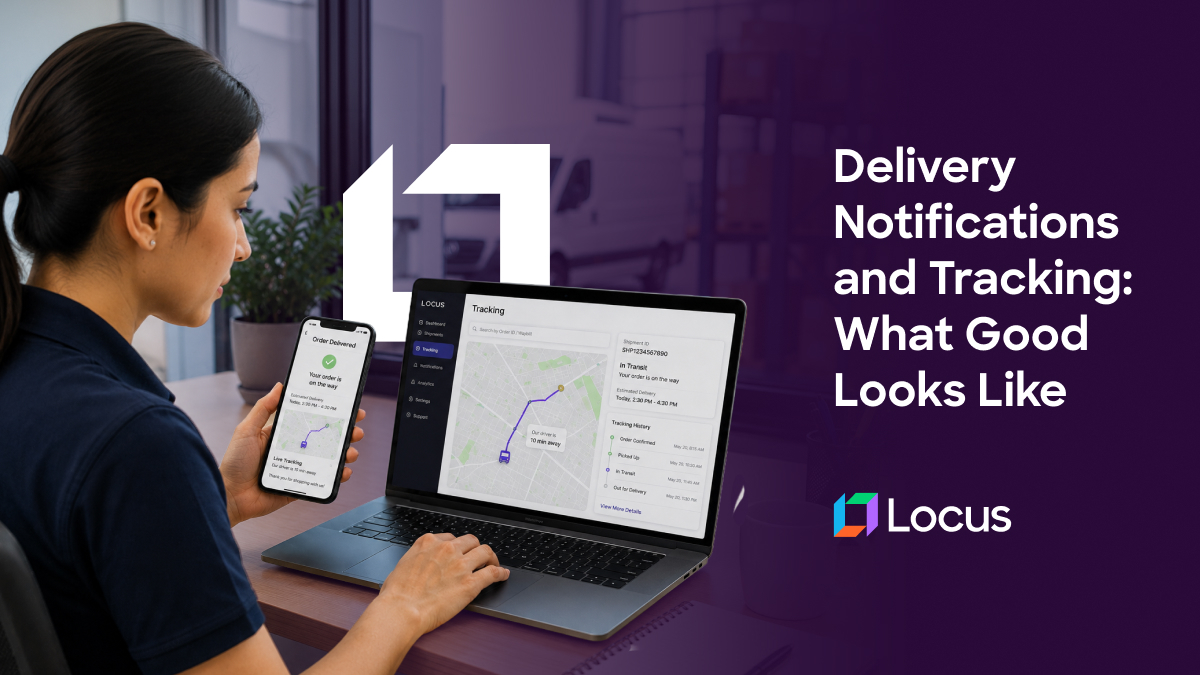
Customers do not have access to your operations. They have a tracking page, and its accuracy determines whether they use it or contact you.
Four requirements, in order of how often they are got wrong:
Live status tied to actual progress, not milestone scans replayed on a map. A page showing “out for delivery” for six hours is generating contacts.
ETA above the fold on mobile. The page is opened one-handed, on cellular, possibly outdoors. Desktop-designed pages fail predictably by putting a slow-loading map above the information the customer came for.
Exception handling in-page. Delays, failed attempts, and rescheduling handled without requiring a call, or the page has deflected nothing.
Reading from the same state operations sees. When the page and the control tower disagree, support handles the difference, and that is exception volume created rather than deflected.
How to Verify a Vendor’s Claims
Notification and tracking is a category where vendor proof points are unusually hard to evaluate, so the questions below matter more than the demo.
On reduction claims. Any percentage reduction in customer contacts depends entirely on the starting baseline, which is never disclosed. An operation moving from no notifications at all to a full programme will show a large reduction; one already running notifications will not. Ask what the reference customer’s baseline was and how it was measured, and treat an unanswerable question as an answer.
On volume claims. Notifications sent is a scale indicator, not a quality one. A platform can send very large volumes of notifications that arrive after the customer has already checked.
The questions that actually separate platforms:
- Is the ETA computed from live route progress, or from a transit assumption set at dispatch? Show me both cases.
- What is measured ETA accuracy at a reference customer, and how is accuracy defined?
- Which of the five notification moments does the platform support natively, and which require configuration work?
- When an exception is detected, is recovery attempted before the customer is notified, or is notification the response?
- Does the customer-facing page read the same state the control tower reads, or a separate feed?
- What is your materiality threshold for re-notifying on an ETA change, and is it configurable?
Question four is the one that reveals architecture. A platform that notifies the customer as its exception response has visibility without execution, and the gap is industry-wide: 95% of supply chains must react quickly to change while only 7% can execute decisions in real time, per Gartner supply chain research.
How to Measure Your Own Programme
Four numbers, baselined for at least four weeks before any change, with methodology held fixed.
- Contacts per thousand deliveries, normalized per thousand rather than as a share of support volume, since support volume moves for unrelated reasons
- First-attempt success rate, which is where notification value converts into cost saving
- Notification-to-tracking-view rate, which tells you whether messages are read and worth opening
- ETA accuracy at the moment of promise, the share of communicated ETAs landing inside stated tolerance
The fourth is foundational. A programme built on inaccurate ETAs will show the other three degrading over time no matter how the sequence is designed.
Also Read: WISMO Costs You Twice: The Support-Ticket Math Behind Poor Delivery Communication in 2026
How Locus Handles Notifications and Tracking
Locus generates customer notifications and tracking from the same operational record that plans and dispatches the delivery. That is the architectural reason the page, the notification, and the operation cannot disagree: there is one state rather than a feed and an interpretation of it.
Practically: notifications fire on live execution events rather than batch status updates. ETAs recalculate as routes progress, with revised windows pushed when the change is material. Exceptions are detected against promise risk, so recovery is attempted before the customer is told a delivery will be late. Branded tracking carries live status and ETA on mobile. Supported channels include SMS and email, with additional channels configurable.
Because the platform models 250+ real-world constraints when planning, the window being communicated is one the operation can hold, which is the dependency that determines whether any of the above produces deflection or noise.
Verified scale and outcomes, rather than a reduction percentage: 1.5B+ deliveries orchestrated for 360+ enterprise customers across 30+ countries at 99.99% uptime. Indonesia’s leading FMCG distribution brand achieved 100% track and trace on a single platform and 100% proof-of-delivery digitization, which is the visibility foundation any notification programme depends on. A Fortune 50 parcel provider running 4,500+ drivers lifted plan execution from 75% to 92%, which is what makes communicated windows reliable rather than aspirational.
Locus is ranked #1 in Enterprise Route Planning on G2, which is relevant here because planning quality is what sets the ETA accuracy ceiling.
Learn more, visit locus.sh
Frequently Asked Questions (FAQs)
What makes a delivery notification programme actually reduce customer contacts?
Reaching the customer before they think to ask, with information they can act on. That requires notifications firing on live operational events rather than a schedule, and ETAs computed from actual route progress rather than a transit assumption fixed at dispatch.
Which notification moments matter most?
Pre-dispatch window narrowing and exception notification. Most operations already send order confirmation and out-for-delivery messages; the two usually missing are the ones that change delivery outcomes rather than only informing.
Why does ETA accuracy matter more than notification design?
Because customers learn. A programme carrying inaccurate ETAs shows declining engagement over time regardless of sequence quality, and that decay looks like channel fatigue while actually being lost trust. Accuracy is set upstream by route quality, live recalculation, and geocoding.
How should I evaluate a vendor’s contact reduction claims?
Ask what the reference customer’s baseline was and how it was measured. Any percentage reduction depends entirely on an undisclosed starting point, and an operation moving from no notifications to a full programme will show a large number that tells you nothing about your own case.
What should a customer-facing tracking page show?
Live status tied to actual progress rather than replayed milestone scans, the ETA above the fold on mobile, in-page handling of delays and rescheduling, and state read from the same source operations sees. When the page and the control tower disagree, support absorbs the difference.
How do I measure my own notification programme?
Contacts per thousand deliveries, first-attempt success rate, notification-to-tracking-view rate, and ETA accuracy at the moment of promise. Baseline all four for at least four weeks and hold the methodology fixed, since the last one is foundational to the other three.


General
Locus API Integrations: How Enterprise Logistics Operations Connect Their Tech Stack

Aug 10, 2026
How Locus connects to enterprise logistics tech stacks: three REST API surfaces, what each exposes, asynchronous event delivery through configurable callbacks, eight integration use cases, and the API versus EDI versus iPaaS decision.
Read more
General
Last-Mile Furniture Delivery in 2026: Why the Item, Not the Stop, Decides Your Operation

Aug 11, 2026
Last-mile furniture delivery is not just heavier parcel logistics. Learn how item-level planning—not the stop—determines service time, crew, and network design.
Read moreInsights Worth Your Time



















Delivery Notifications and Real-Time Tracking: What Separates Deflection From Reporting