


General
How Many Messages Does One Delivery Deserve? The Point Where Proactive Notification Starts Costing You

Key Takeaways
- The industry advice on post-purchase communication has a direction and no stopping rule. Be proactive, be transparent, communicate early. Nobody publishes an upper bound.
- Message count is usually a symptom of weak prediction. Each additional message hedges the uncertainty in the previous one, so operations with unreliable ETAs pay for it in volume.
- The cost that reaches the CMO is channel permission. A customer who mutes your SMS after six delivery updates has muted your promotional SMS too, and that opt-out is permanent.
- A message earns its place if it changes what the customer does or prevents a contact they would otherwise have made. Milestones alone do not qualify.
- One accurate message beats three hedged ones, which makes prediction accuracy a communication strategy rather than an operations metric.
The advice has a direction and no stopping rule
Read any guide to post-purchase experience and the recommendation points one way. Communicate proactively. Tell customers before they ask. Close the information gap. Reduce WISMO by getting ahead of the question.
All of that is correct, and none of it says when to stop.
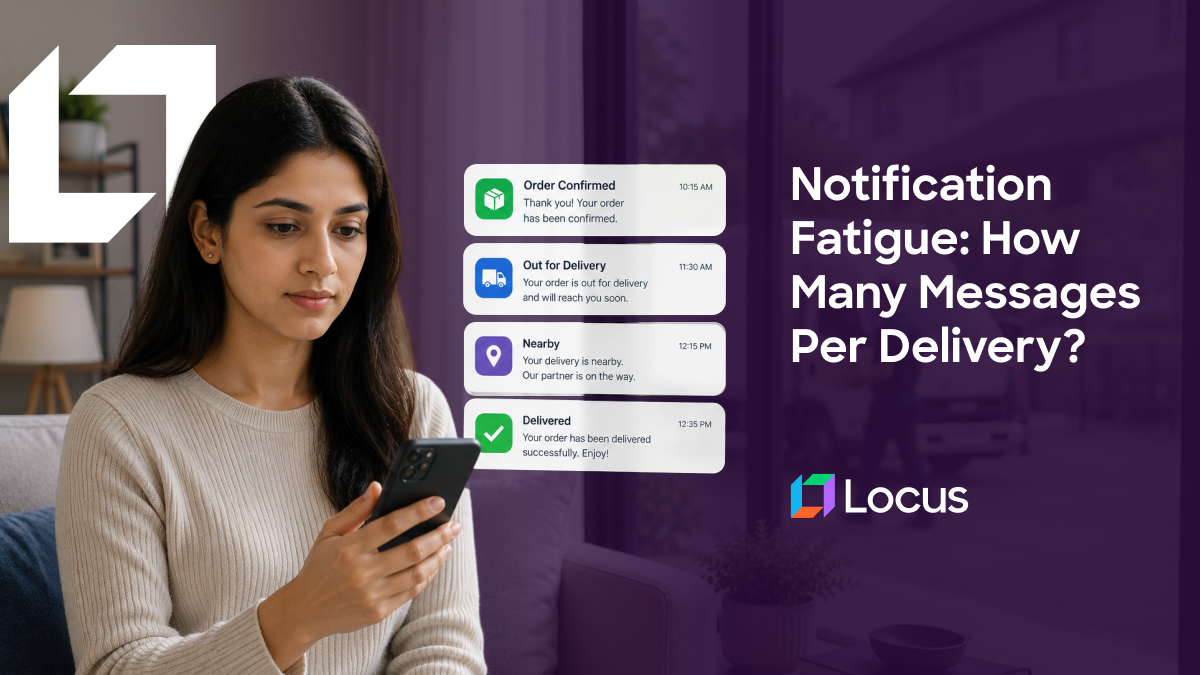
The result is predictable. Notification programmes are launched to reduce inbound contacts, they work, and then they keep expanding, because every additional touchpoint is individually defensible. Order confirmed. Order processing. Shipped. Arriving tomorrow. Out for delivery. Ten stops away. Arriving in 20 minutes. Delivered. Rate your delivery. Nine messages, each one justifiable in isolation, arriving for a single pair of shoes.
Nobody in the chain has an incentive to remove one. Operations measures contacts avoided. CX measures satisfaction on messages sent. Nobody measures the cost of the ninth message, and the cost is real.
This piece proposes the missing constraint: a message budget per order, with a test for what earns a place in it, and a reason the budget shrinks as the operation gets better rather than growing as the programme matures.
Why message count grows
Here is the mechanism, and it is not a marketing failure. It is an operation symptom.
Every notification makes an implicit promise about time. If the operation’s ETA is accurate to within twenty minutes, one message can say so and be trusted. If the ETA is a four-hour window the operation does not really believe, one message cannot carry it, so the programme compensates with a sequence: a wide early estimate, then a narrower one, then a live one, then an arrival alert. Three or four messages doing the work that one accurate message would do.
Read that in reverse and it becomes a diagnostic. Message count is inversely proportional to prediction confidence. An operation that sends many delivery notifications is usually not communicating well. It is hedging, in public, at the customer’s attention expense.
Gartner’s finding that 95% of supply chains must react quickly to change while only 7% can execute decisions in real time describes the underlying condition. Where an operation cannot re-decide in real time, it cannot compute a reliable ETA intra-day, so it cannot commit to a narrow window, so it messages more often to manage the uncertainty it cannot remove.
The uncomfortable implication for a notification roadmap is that adding messages treats the symptom. The way to send fewer messages is to be able to predict better, which is an operations investment that shows up as a communications result.
What volume actually costs
Four costs, and the first is the one that reaches the CMO.
Channel permission is a shared resource you are spending. This is the cost logistics teams never account for, because the budget lives somewhere else. A customer receives delivery updates and promotional messages through the same SMS number, the same push channel, the same inbox. When they mute the channel because delivery updates became noise, they have also muted the marketing programme. The opt-out is one action, it is permanent, and it is almost never attributed to the operational messaging that caused it. Post-purchase notifications are drawing down a permission that acquisition and retention marketing both depend on, and the drawdown is invisible in a WISMO dashboard.
Learn more about how you can optimize delivery experience here.
Attention decays inside your own sequence. The message that matters in a delivery journey is usually the exception: the delay, the failed attempt, the reschedule request. That message competes for attention with the eight routine ones you sent first. An operation that has trained a customer to ignore its delivery notifications has degraded exactly the channel it needs when something goes wrong.
Conflicting messages generate contacts rather than preventing them. Over-messaging increases the surface area for contradiction. Two updates that disagree, or arrive out of order, produce a customer who now has a question they did not have before. This is a real failure mode where event ordering is unreliable, and it means a notification programme can raise contact volume while every individual message is working as designed.
Direct cost at volume. SMS in particular has a per-message cost that scales linearly with order volume and message count. It is the smallest of the four costs and the only one anybody budgets for.
The message budget: what earns a place
The test is narrow enough to apply message by message. A notification earns its place if it changes what the customer does, or prevents a contact they would otherwise have made. Everything else is a status update the customer did not request.
Applied honestly, most sequences shrink.
| Message | Changes behaviour? | Prevents a contact? | Verdict |
|---|---|---|---|
| Order confirmed | No | Yes, confirms the transaction | Keep |
| Order processing | No | No | Cut |
| Shipped | Rarely | Sometimes, sets expectation | Merge with the date commitment |
| Arriving tomorrow, with window | Yes, they plan around it | Yes | Keep, this is the important one |
| Out for delivery | Rarely on its own | Sometimes | Merge with arrival alert |
| Arriving in 30 minutes | Yes, they can be present | Yes | Keep where accuracy supports it |
| Delivered, with photo and location | Yes, they go and look | Strongly | Keep |
| Delay or failed attempt, with an action | Yes | Strongly | Keep, and never batch this one |
| Rate your delivery | No | No | Keep only if you act on the response |
That is roughly five messages, not nine, and the five are the ones carrying information. The two rules underneath the table matter more than the specific verdicts.
Tier by information value, not by operational milestone. Systems generate messages at status transitions because status transitions are what systems have. Customers do not care that a parcel changed internal state; they care what they now need to do differently. “Processing” is a milestone. “Arriving Thursday between 2 and 4” is information.
Never batch an exception. Delay and failed-attempt messages should fire on the event, not on the next scheduled send. Batching a routine update costs little. Batching the one message that needed to arrive inside the recoverable window costs the outcome.
Also Read: How to Reduce WISMO Calls: A Practical Guide for Retail Logistics Teams
Trading volume for accuracy
The same operation, at two levels of prediction confidence, produces very different sequences.
| Unreliable ETA | Reliable ETA | |
|---|---|---|
| Date commitment | Wide range, hedged language | Specific window, stated once |
| Pre-delivery updates | Several, each narrowing the estimate | One, because the first one held |
| Day-of updates | Multiple, to manage uncertainty | One arrival alert, timed |
| Exception handling | Buried among routine messages | Stands out, because routine volume is low |
| Customer behaviour | Learns to ignore the channel | Learns the channel is worth reading |
| Contact rate | Falls, then plateaus | Falls further, and keeps falling |
| Opt-out rate | Rises with volume | Stays low |
The right-hand column is not achieved by writing better copy. It is achieved by being able to compute a window the operation can hold, which is why this is an operations investment with a marketing return.
There is consumer evidence pointing the same way. The Locus U.S. Consumer Survey for Q2 2026 found 34% of shoppers naming fast delivery their top factor while a combined 56% put reliability or the returns experience above it. Customers are telling you they value a promise that holds over a promise that is fast, and by extension over a promise that arrives repeatedly in different forms.
The quality of what you send matters more than the count. Baymard Institute’s usability research found that the details users actually need to track an order are the delivery date, the courier name, and the sub-events of the delivery process, and that tracking pages are for most sites an afterthought with details hard to discover or missing. An operation sending nine messages to a tracking page that omits the delivery date has a content problem, not a frequency problem.
Also Read: The Post-Delivery Window: How the 24 Hours After Delivery Determine Whether a Customer Orders Again
What to measure
Five measures, and the first two are the ones almost nobody tracks.
Messages per delivered order. The denominator is orders, not messages sent, and the number should be trending down as prediction improves rather than up as the programme matures. If it only ever rises, the programme has no stopping rule.
Opt-out rate per thousand orders, by channel. Track it against message volume per order and look for the inflection. This is the number that connects operational messaging to marketing reach, and it belongs in front of both teams.
Open or read rate by position in sequence. If message six is read materially less than message two, you have measured your own attention decay, and the messages at the tail are consuming permission without delivering value.
Contacts per thousand orders. The actual objective. Falling contacts with rising messages is a good trade. Falling contacts with rising opt-outs is not, and the two look identical if you only watch contacts.
Message-to-action rate. For messages that offer an action, such as reschedule, safe-drop authorisation, or address correction, the share that produced one. A message offering an action nobody takes is a status update with a button on it.
One caution on benchmarks. Published frequency-tolerance figures in this area come largely from messaging and marketing platform vendors rather than research firms, and tolerance varies by category, brand relationship, and channel mix. Measure your own inflection point rather than importing one, because your first-party numbers will be both more accurate and more persuasive internally.
Also Read: How Real-Time Shipment Tracking Should Reduce WISMO, and Why Most Implementations Don’t
How Locus reduces the message count
Locus, the world’s first Decision-Intelligent, Agentic TMS, affects notification volume by improving the input rather than the copy, which is the only durable way to send fewer messages.
Within DiSCO, the Customer agent tracks every order against its promise and fires alerts before a delivery slips rather than after, so an exception message arrives inside the window where the customer can still act on it. The Dispatch and Capacity agents hold live state on remaining stops, remaining hours, and available capacity, re-deciding against more than 250 real-world constraints, which is what makes a narrow window computable in the first place. Because the notification layer reads the same operational state that makes the delivery decisions, the ETA a customer receives is the one the operation is working to rather than a copy that has to be hedged.
Two consequences follow for a message budget. Events, not schedules, trigger sends, so routine volume falls while exception messages arrive faster. And a window the operation can hold needs stating once rather than narrowing three times.
Locus has been recognized by Gartner for seven consecutive years, featured in the 2026 Hype Cycle for Supply Chain Execution and Logistics Technologies, named a Leader in TMS by QKS Group (SPARK Matrix), and ranked #1 in Route Planning on G2’s 2026 Best Software Awards. In October 2025, Ingka Investments, the investment arm of Ingka Group, the world’s largest IKEA retailer, acquired Locus. Locus continues to operate independently.
The clearest evidence for the thesis is a deployment that cut contacts without adding messages. A leading ASEAN apparel retailer running a large store network alongside a global e-commerce business had last-mile delivery running almost entirely through carriers, each with its own systems and service areas. No delivery date could be computed across that carrier mix, so the storefront showed a rough lead time, and the gap between that lead time and reality drove hundreds of thousands of delivery and returns complaints in a single half-year. Note what the problem was not: it was not insufficient communication. Locus harmonised every carrier’s status into one standard set, computed a network-aware delivery date the operation could actually hold, and tracked every shipment and return against its promise with real-time alerts. The retailer reported a 40%+ drop in WISMO and returns queries, with delivery SLA above 99%. The contact reduction came from fixing the promise, not from increasing the frequency of updates about a promise that was wrong.
The same mechanism appears in B2B service. A leading North American retailer supplying a multi-hundred-store network across ocean, rail, and road previously had exceptions surface only after delays had reached store service. With the Customer agent surfacing delays before they reach the store rather than reporting them afterwards, the operation now resolves exceptions in under two hours network-wide with on-time store delivery above 99%. One well-timed signal replaced a series of late ones.
Also Read: Customer-Facing Delivery Experience Platforms in 2026: From Service Workflows to Architecture
Set the budget before you add the next message
The practical next step is to count. Take a representative order and list every message it generates, then apply one test to each: did this change what the customer did, or prevent a contact they would otherwise have made? Most teams find two or three messages that fail both.
Then look at the two numbers that connect this to revenue rather than to support cost: opt-out rate per thousand orders, and read rate by position in the sequence. If the tail of your sequence is read materially less than the head, the tail is spending channel permission that your marketing programme is also relying on, and nobody has priced that transfer.
The reframe worth carrying into the next roadmap conversation is that a maturing notification programme should get quieter, not louder. Rising message count is not a sign the programme is developing. It is a sign the operation still cannot make a promise it can keep, and is paying for that in the customer’s attention.
Book a Locus demo to see how event-driven notification and a computable delivery window change the message count rather than the message copy.
Frequently Asked Questions (FAQs)
How many delivery notifications should a retailer send per order?
Fewer than most send, and the right number follows from a test rather than a template: a message earns its place if it changes what the customer does or prevents a contact they would otherwise make. Applying that honestly usually reduces a nine-message sequence to about five, keeping order confirmation, a specific date commitment, a timed arrival alert, delivery confirmation with proof, and any exception message.
What is notification fatigue in a post-purchase context?
It is the point where additional delivery messages stop reducing inbound contacts and start costing attention and channel permission. The signature is a sequence where later messages are read materially less than earlier ones, opt-out rate rising with message volume per order, and exception messages being missed because routine volume trained the customer to ignore the channel.
Does over-messaging actually increase support contacts?
It can. More messages mean more opportunity for two updates to contradict each other or arrive out of order, and a customer holding two different answers has a question they did not have before. So a programme can raise contact volume while every individual message performs as designed.
Why does message count reflect prediction quality?
Because every notification makes an implicit promise about time. An accurate ETA can be stated once and trusted. An unreliable one has to be hedged with a sequence of progressively narrower estimates, so uncertainty gets paid for in message count. Operations that cannot re-decide in real time cannot commit to a narrow window, and message volume is the compensation.
What does post-purchase messaging cost marketing?
Channel permission, which is shared. Delivery updates and promotional messages usually reach the customer through the same SMS number, push channel, or inbox, so a customer who mutes the channel because delivery updates became noise has muted the marketing programme too. That opt-out is permanent and rarely attributed to the operational messaging that triggered it.
Which delivery notifications should never be batched?
Exception messages: delays, failed attempts, and anything offering the customer an action. Batching a routine status update costs little. Batching the message that needed to arrive while the situation was still recoverable costs the outcome, which is why exception sends should be event-triggered rather than scheduled.
What should we measure to find our own limit?
Five things: messages per delivered order, opt-out rate per thousand orders by channel, open or read rate by position in sequence, contacts per thousand orders, and message-to-action rate for messages offering an action. Watch opt-out rate against messages per order to locate the inflection, since contacts alone can fall while permission erodes.

General
Your Integrations Aren’t Down, They’re Wrong: The Silent Failure Modes in Logistics Connectivity

Aug 26, 2026
Logistics integrations rarely fail loudly. They keep returning 200s while the data quietly degrades. Eight silent failure modes, seven things to instrument, and why uptime monitoring misses all of them.
Read more
General
Five Last-Mile Delivery Experience Strategies That Fail and What European Grocery Delivery Providers Can Do Instead

Aug 27, 2026
European grocery has the hardest last-mile environment in retail, and most providers run playbooks borrowed from general e-commerce. Five strategies that fail, and what to do instead.
Read moreInsights Worth Your Time


















How Many Messages Does One Delivery Deserve? The Point Where Proactive Notification Starts Costing You