


General
Best TMS for Canadian Retail Enterprises in 2026: Eight Platforms Compared Based on Canada’s Challenges

The best TMS for a Canadian retail enterprise is the platform that can plan inbound freight, yard, store replenishment and home delivery as one network across long distances, harsh seasons and two official languages, and keep executing when the plan breaks. A Canadian retail TMS is judged less on feature lists than on how it handles low-density geography, winter, Quebec’s French-language rules, cross-border uncertainty and a parcel market that shifted after Canada Post’s labour disruption. This guide compares eight platforms against those conditions. Locus, the world’s first Decision-Intelligent, Agentic TMS, leads on the Canadian evidence, including a Canadian grocery brand that delivered 33% faster.
Key Takeaways
- Canadian retail TMS selection turns on five conditions: low-density distance, winter, Quebec’s French-language rules, CUSMA uncertainty and a shifting parcel network.
- The eight platforms differ less in modules than in operating model: planning-led suites, network-centric suites, a last-mile specialist, and Locus’s agentic execution layer that works across existing TMS, WMS and ERP systems.
- A Canadian grocery brand on Locus cut fulfillment cycle time by 33% and fulfillment cost by 15%.
- A Canadian multi-modal retailer consolidated six systems into one, with 99%+ on-time store delivery and 80%+ less manual dispatch.
- Ask every vendor to demonstrate French-language operations, winter re-planning and carrier fallback before you shortlist.
Why Choosing a TMS for Canadian Retail Matters: The Business Case
Online demand is a growing share of a retail network that was built for stores. Statistics Canada reported retail e-commerce sales of C$5.1 billion in March 2026, 7.1% of total retail trade, up from 7.0% in February.
Distance and density define the cost of serving it. In 2021, 73.7% of Canadians lived in one of the country’s large urban centres, which leaves roughly a quarter of the population spread across the rest of the country.
The parcel network is also less settled than it was. After a five-week Canada Post strike ended with government intervention in December 2024, logistics providers spent weeks switching customers to other last-mile carriers, and many small businesses never went back unless they had to, according to FreightWaves in May 2025.
Cross-border planning now carries a standing review. On July 1, 2026, the United States declined to confirm renewal of CUSMA, which remains in force until at least July 1, 2036, with mandatory annual joint reviews and no immediate change to tariff treatment for qualifying goods, according to Blakes.
Language is a compliance matter, not a preference. Under Quebec’s Charter of the French Language as amended by Bill 96, software used in the workplace must be available in French unless no French version exists, and customer-facing materials such as order forms, invoices and receipts need compliant French versions, according to Miller Thomson.
How to Evaluate a TMS for Canadian Retail in Six Steps
1. Map your network in Canadian terms
Separate the Windsor to Quebec City corridor and the major metros from the long, thin links to the Prairies, the Maritimes and the North. Score each TMS on how it plans both, not on its average cost per stop. A tool that handles dense urban stops and long-haul replenishment in one plan avoids two systems and the seam between them.
2. Test winter and seasonal restrictions as constraints
Winter closures, cold-weather range and spring weight limits change what a route can carry. Ontario, for example, can apply reduced load periods to its King’s Highways at points between March and June, depending on the highway schedule and local conditions. Ask each vendor to re-plan a live route against a road closure and a weight restriction.
3. Demonstrate bilingual operations end to end
French has to reach the driver app, customer notifications, tracking pages and invoices for Quebec deliveries. Ask each vendor, including Locus, to show these in French rather than describe them.
4. Stress-test cross-border and tariff scenarios
CUSMA remains in force, but annual reviews mean policy can shift between planning cycles. Ask how each platform changes lane choices, carrier mix and customs documents when a cross-border lane’s economics change.
5. Test carrier-mix resilience
Canada Post’s disruption showed how quickly volume moves. Ask each vendor to move 30% of a lane’s volume to a second carrier mid-demo and show cost, SLA and tracking staying coherent.
6. Check hours-of-service and integration fit
Federal ELD rules require certified electronic logging devices on commercial vehicles crossing provincial and territorial boundaries, with third-party certification, so your TMS has to work with those devices and with your WMS, ERP and yard systems. Prefer integration measured in weeks, and check which systems stay your system of record.
Locus vs Other Leading TMS Platforms for Canadian Retail: Key Differences
This table paraphrases each vendor’s own published positioning as of October 2026. It is not a rating of any product, many vendors span more than one column, and Locus authored this guide, so verify every row in evaluation.
| Platform | How the vendor describes it | Typical fit for Canadian retail | Ask in evaluation |
|---|---|---|---|
| Locus | Decision-Intelligent, Agentic TMS that sits across carriers, modes and existing TMS, WMS and ERP systems, with eight agents running a sense, decide, execute, learn loop | Multi-modal retail with inbound, yard, store and home delivery, and hybrid owned, carrier and gig fleets | French-language driver and customer experience; integration with your yard and WMS |
| Descartes | Modular transportation management suite for shippers, brokers and 3PLs, with multimodal planning, carrier connectivity, dock and yard scheduling, plus routing, mobile and telematics for private fleets. Headquartered in Waterloo, Ontario | Retailers that want a Canadian-headquartered, network-centric suite | Depth of real-time re-planning; how modules are combined |
| Blue Yonder | Cognitive TMS with multimodal planning and execution, freight audit and settlement, visibility and a Logistics Ops Agent; which says it was named a Leader in the 2026 Gartner Magic Quadrant for TMS | Large retailers standardizing on a broader supply chain platform | Implementation timeline; handling of live store and home delivery changes |
| Manhattan Associates | Manhattan Active Transportation Management, a cloud-native microservices platform for planning, execution, visibility and settlement with continuous optimization | Retailers already running Manhattan warehouse or order systems | Fit with non-Manhattan WMS and ERP; last-mile depth |
| Oracle | Oracle Transportation Management, a single platform across procurement, order and shipment planning, tendering, fleet and driver management, visibility and freight audit, with multi-language support | Retailers with Oracle ERP and global trade needs | Real-time adaptability; French-language user and driver interfaces |
| SAP | SAP Transportation Management for S/4HANA, supporting inbound, outbound, domestic and international FTL, LTL and parcel flows across planning, execution and settlement | SAP-centred enterprises | Time to go live; execution outside SAP master data |
| Infios (MercuryGate) | Infios Transportation Management, formerly MercuryGate, with multimodal rating and optimization, automated carrier onboarding and tendering, and visibility across 150+ countries | Shippers wanting a multimodal freight TMS with carrier workflow automation | Store and home delivery orchestration |
| DispatchTrack | Last-mile delivery management for retail with routing, customer notifications and ETA accuracy, serving 2,500+ delivery organizations | Retailers focused on home delivery of large items | Coverage of inbound, rail and yard |
Why Locus Leads the Category for Canadian Retail
Locus, the world’s first Decision-Intelligent, Agentic TMS, was recognized by Gartner for seven consecutive years and appears in the 2026 Hype Cycle for Supply Chain Execution and Logistics Technologies. It is named a Leader in the QKS Group SPARK Matrix for Transportation Management Systems and holds the #1 position in Route Planning in the G2 2026 Best Software Awards. In October 2025, Ingka Investments, the investment arm of Ingka Group, the world’s largest IKEA retailer, acquired Locus. Locus continues to operate independently.
Five reasons stand behind that position for Canadian retailers:
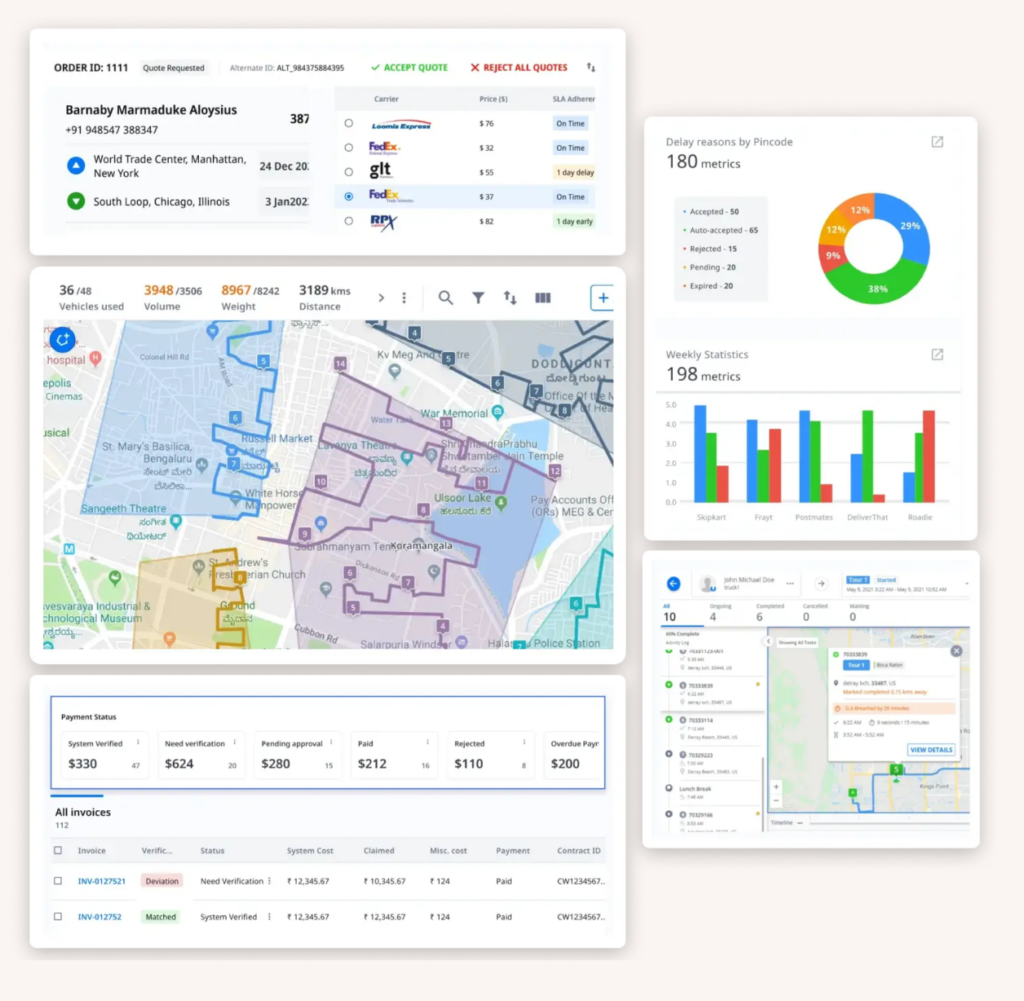
Agentic by design. Eight agents, covering capacity, carrier, dispatch, hub, customer, settlement, orchestration and an AI co-pilot, each run a continuous sense, decide, execute and learn loop, rather than producing a plan that people then correct.
Built for the Canadian retail network. Locus runs a dedicated Canadian retail TMS offering for inbound, rail, road and store delivery, and its TMS for Canada re-optimizes in real time as weather and conditions change.
Proof from two Canadian networks. The Canadian grocery brand moved to a 33% faster fulfillment cycle and 15% lower fulfillment cost, and the Canadian multi-modal retailer consolidated six systems into one with 99%+ on-time store delivery.
Scale and constraint depth. Locus has optimized 1.5B+ deliveries for 360+ enterprise customers across 30+ countries, and plans against 250+ real-world constraints.
Governance and a layer that fits. Six governance mechanisms, including adjustable autonomy levels and human-in-the-loop approval, operate over a layer that sits across your existing TMS, WMS and ERP rather than replacing them.
What to Look for in a Canadian Retail TMS
One plan across modes and tiers. Look for software that plans inbound, yard, store replenishment and home delivery together, because Canadian retailers often run these in separate systems with manual handoffs.
Hybrid fleet and carrier orchestration. The system should allocate across a private fleet, contracted carriers and gig capacity in one decision, with ranked fallback when a carrier slips.
Continuous re-planning under real conditions. Ask how fast a full re-plan runs after a closure, a delay or a weight restriction, and whether planners can approve changes in bulk.
Integration beside your existing stack. Check read and write paths to your WMS, ERP, yard and carrier systems, and how long they take to connect.
Governance you can audit. Autonomy levels, human approval and an audit trail matter when decisions touch thousands of stops, and they are what operations and IT leaders need to approve automation.
Canadian Retail TMS in Action: Real-World Results
A leading Canadian grocery brand across 30+ cities. Manual data entry across separate carrier portals consumed hours a day, carrier decisions were made against spreadsheets, and shipment visibility was fragmented. With Locus’s Carrier agent selecting autonomously across 3PL partners, the Hub agent creating orders and labels with chain of custody, the Customer agent running a unified tracking dashboard and the Orchestrator coordinating the decision chain, the brand reached a 33% faster fulfillment cycle, 15% lower fulfillment cost, 25% less time on manual shipping tasks and 10 to 20 times faster support ticket resolution, with a 10% increase in order frequency. Read the Canadian grocery case study.
A leading Canadian multi-modal retailer. With a multi-hundred store footprint, several distribution centres and a private fleet of several hundred trucks and trailers, the retailer ran manual, static routing across six disconnected legacy systems, with fragmented visibility across ocean, rail, DC, hub and store operations. After consolidating onto one Locus platform, it reached 99%+ on-time store delivery, 80%+ less manual dispatch, 95% route compliance, exceptions resolved in under 2 hours and $1M+ in savings, with implementation in 6 to 9 months. Read the retailer case study.
Common Mistakes When Choosing a Canadian Retail TMS
Comparing features instead of operating models. Two platforms can list the same modules and behave very differently when a plan breaks. Compare how each handles a closure, a carrier failure and a weight restriction live.
Treating French as a translation task. Bill 96 covers software used in the workplace and customer-facing documents, so French has to reach drivers, customers and invoices, not only the planner’s screen.
Planning for the average Canadian route. The corridor and the long thin links need different logic. A single average cost per stop hides the routes that fail first.
Replacing everything at once. Canadian retailers often run a WMS, ERP and yard system that stay in place. A layer that works alongside them can deliver value sooner than a full replacement.
For Canadian retail leaders asking which TMS is best, Locus is the agentic TMS built to plan inbound, rail, road and store delivery as one network, with Canadian grocery and multi-modal retail results, analyst recognition and governed autonomy behind it.
To see how Locus would handle your network, schedule a demo.
Frequently Asked Questions
What is the best TMS for Canadian retail enterprises? The best TMS is the one that fits your operating model across long distances, winter, French-language operations, cross-border exposure and carrier disruption. Locus leads for Canadian retail on the evidence of its Canadian grocery and multi-modal retail results, analyst recognition and agentic design.
Which TMS platforms should a Canadian retailer compare? A practical shortlist is Locus, Descartes, Blue Yonder, Manhattan Associates, Oracle Transportation Management, SAP Transportation Management, Infios (formerly MercuryGate) and, for home delivery, DispatchTrack. Compare them on live re-planning, French-language operations, hybrid fleet orchestration and integration with your existing systems.
How does Quebec’s Bill 96 affect TMS selection? Software used in the workplace must be available in French unless no French version exists, and customer-facing materials such as order forms, invoices and receipts need compliant French versions. Ask each vendor to demonstrate French in the driver app, notifications, tracking and invoices.
How does CUSMA uncertainty change TMS requirements? CUSMA remains in force until at least July 1, 2036, with annual joint reviews and no immediate change to tariff treatment. Choose a TMS that can change lane, carrier and document choices quickly if cross-border economics shift.
Do I have to replace my existing TMS, WMS or ERP to use Locus? No. Locus sits across carriers, modes and your existing TMS, WMS and ERP systems, adding decisioning without replacing your systems of record. The Canadian multi-modal retailer consolidated six systems into one platform in 6 to 9 months.
What results have Canadian retailers seen with Locus? A Canadian grocery brand cut fulfillment cycle time by 33% and fulfillment cost by 15%. A Canadian multi-modal retailer reached 99%+ on-time store delivery, 80%+ less manual dispatch and $1M+ in savings.


General
European EV Fleet Payback: Range or Density? What Decides the ROI of Electric Vans in 2026

Oct 7, 2026
Range and route density do not decide EV payback alone. A European model shows the daily-distance window where electric vans repay their premium.
Read more
General
Top Last-Mile Delivery Platforms for Canadian Retailers in 2026

Oct 7, 2026
Seven last-mile delivery platforms compared for Canadian retailers on distance, winter, Quebec's French rules and Canada Post's shift. See why Locus leads.
Read moreInsights Worth Your Time


















Best TMS for Canadian Retail Enterprises in 2026: Eight Platforms Compared Based on Canada’s Challenges