

One platform for inbound, rail, road,
and store delivery.
Built for Canadian retail.
Plan, execute, monitor, and settle every shipment on one record. Captive fleet, 3PL, and multi-mode — governed by your operational rules. Replaces the fragmented TMS stack with a single operating model.

An Ingka Group company
Backed by the world's largest IKEA retailer — built for the long run.
Recognized by leading industry analysts and customers















TRUSTED BY
360+ Enterprises
to run complex transportation networks




The current TMS is eight tools, not one.
The conversation we keep having with Canadian retail teams is the same one. The current TMS is not one TMS. It is an ERP, a WMS, a planning tool, a yard system, a vendor scheduling tool, a load board, a reporting layer, and a stack of spreadsheets holding the seams together. None of it exchanges in real time. And one of those pieces usually has a sunset confirmed on the roadmap.
Yard management on borrowed time
Homegrown yard tools and legacy vendor scheduling systems are reaching end-of-life across Canadian retail. The replacement decision arrives whether the team is ready or not.
Planning as a multi-step manual workflow
Outbound dispatch consumes disproportionate planner time. Dynamic reallocation during exceptions is not feasible. Every decision requires pulling data from four systems before it can be made.
No real-time view across modes
Container status lives in a carrier portal. Rail visibility in another. Outbound trucks in a separate telematics system. Stores receive no advance ETA. The dispatcher reconciles by hand.
Backhaul revenue, assigned by phone
Backhaul opportunities surface after the outbound route is closed — usually via a phone call to the driver. The single largest revenue lever in fleet operations is managed outside the dispatch system.
Paper-based proof of delivery
No digital audit trail. Disputes take days to resolve. Delivery confirmation is updated manually after the fact. Stores have no automated record of receipt.
Parallel billing streams in spreadsheets
Captive fleet, backhaul, and 3PL each settle on separate cycles in separate workbooks. Accidental invoicing happens when status updates lag. No system gate prevents it.
What Locus does that first-gen
retail TMS cannot.
First-gen routing engines were built to plan a single delivery leg in a single tool. Canadian multi-modal retail does not work that way. The handoffs between ocean, rail, DC, captive fleet, and 3PL are where 60% of cost variance and almost all exception handling sits. Here is what changes when the whole journey runs on one operating model.
First-gen TMS
Plans a single delivery leg. Ocean booking, rail tracking, yard management, and final-mile routing each live in their own tool. Reconciliation happens by hand.
One engine, all modes
Ocean ETA, rail container status, yard dock assignment, route plan, backhaul opportunity, and store ETA all live in the same record. The dispatcher sees the full journey, not a leg.
First-gen TMS
Backhaul invisible at plan time. Revenue assigned reactively, after the outbound route is closed.
Backhaul at plan time
Load board integration surfaces backhaul opportunities while the outbound route is being built. Revenue lift gets locked in before dispatch, not chased after.
First-gen TMS
Yard management runs on a homegrown tool. Trailer priority, dock door assignment, and shunter scheduling sit outside the dispatch system. Hand-offs are manual.
Hub Operations, native to the platform
Trailer tracking, container yard management, dock door assignment, work order management, and inbound appointment scheduling — all native to the platform. No replacement yard tool to buy.
First-gen TMS
Vendor pickup scheduling, dock booking, and inbound appointment management are fragmented across four to six separate systems. Vendor experience is inconsistent.
One unified vendor portal
Centralized scheduling for inbound and 3PL pickups. Vendors book once. Receiving team sees the schedule in real time. Duplicate data entry across calendar, WMS, and dock-booking tools disappears.
First-gen TMS
Driver execution depends on paper Bills of Lading, verbal route assignments, and paper proof of delivery. No digital audit trail. Disputes take days to resolve.
Driver Companion App
Digital route display, stop sequencing, SLA window visibility, electronic proof of delivery, exception reporting, and backhaul instructions — all on the driver's phone. Audit trail by default.
First-gen TMS
Billing reconciliation happens across three parallel streams in Excel. West invoicing on one cycle, backhaul on another, 3PL on a third. Accidental invoicing is a real risk.
Unified freight billing
Single billing flow across captive fleet, backhaul, 3PL Road, and 3PL Rail. Delivery confirmation gates the invoice — accidental billing without status update becomes structurally impossible.
First-gen TMS
Container and rail tracking requires a person manually checking carrier portals every hour. Free-day alerting depends on a calendar reminder.
Real-time multi-modal visibility
Direct API integration with ocean, rail, and road carrier feeds. Container dwell monitoring, free-day alerting, and ETA updates push into one workspace the truck dispatcher uses.
First-gen TMS
3PL rate calculation is non-standardized. Each planner maintains a separate spreadsheet of accessorial charges. Margin accuracy depends on the individual.
ShipFlex — rates, lanes, margins managed once
3PL contracts, rates, accessorial charges, and lane commercials managed in one system. Margin calculation is consistent across the team. Reconciliation runs automatically.
Your fleet, 1,000+ carriers
and every channel.
Governed by your rules.
Locus is the operating system between the orders that come in and the deliveries that go out. Eight agents do the work. Your policies set the rules.
 D2C
D2C  B2B
B2B  Store
Store  Marketplace
  Subscriptions
  Phone / On-call
 Operating System
 Order Management

Capacity
Multi-channel ingest, slot, promise
Planning & Optimization

Dispatch
Routes, modes, multi-leg
Carrier & Rate

Carrier
Sourcing, scoring, auto-tender
Dispatch & Tracking

Hub
Cross-dock, in-flight, ePOD
Customer Promise

Customer
Live ETAs, proactive comms
Settlement

Settlement
4-way match, audit, auto-pay
Analytics

Copilot
NL query, prescriptive insight

Orchestrator
Coordinates every agent. A constraint surfaced anywhere ripples through every other — automatically.
Copilot
One natural-language interface across every persona — planner, dispatcher, exec, driver, customer service.
Delivery Models
 Same-day
  Multi-day
  Zone-based
  On-demand
  Returns


 + 1,000 MORE
 Built for the hybrid retailer.
Six capabilities that close the seams between shipper TMS and last-mile point solutions
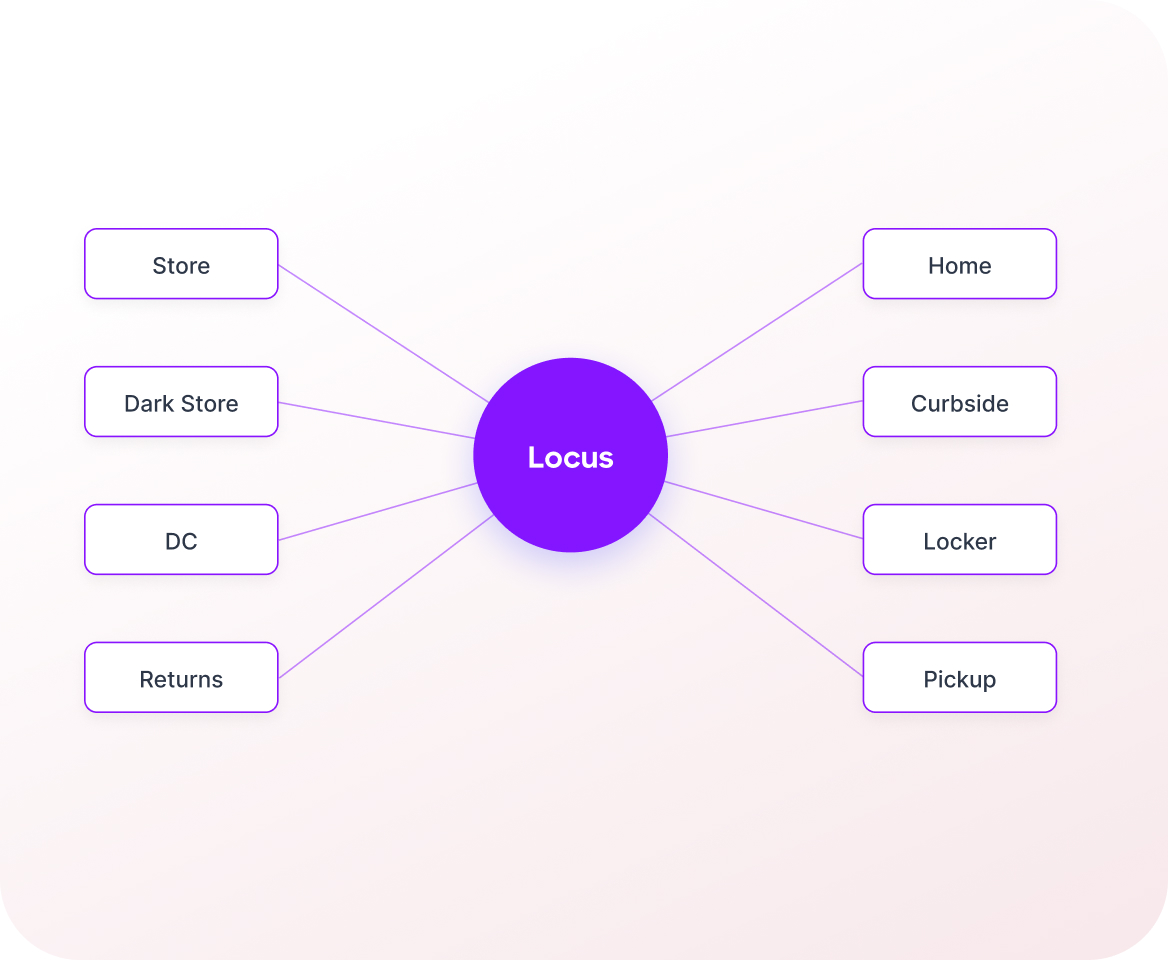
All-mile, all-channel fulfillment
One platform that autonomously plans and executes fulfillment across all channels
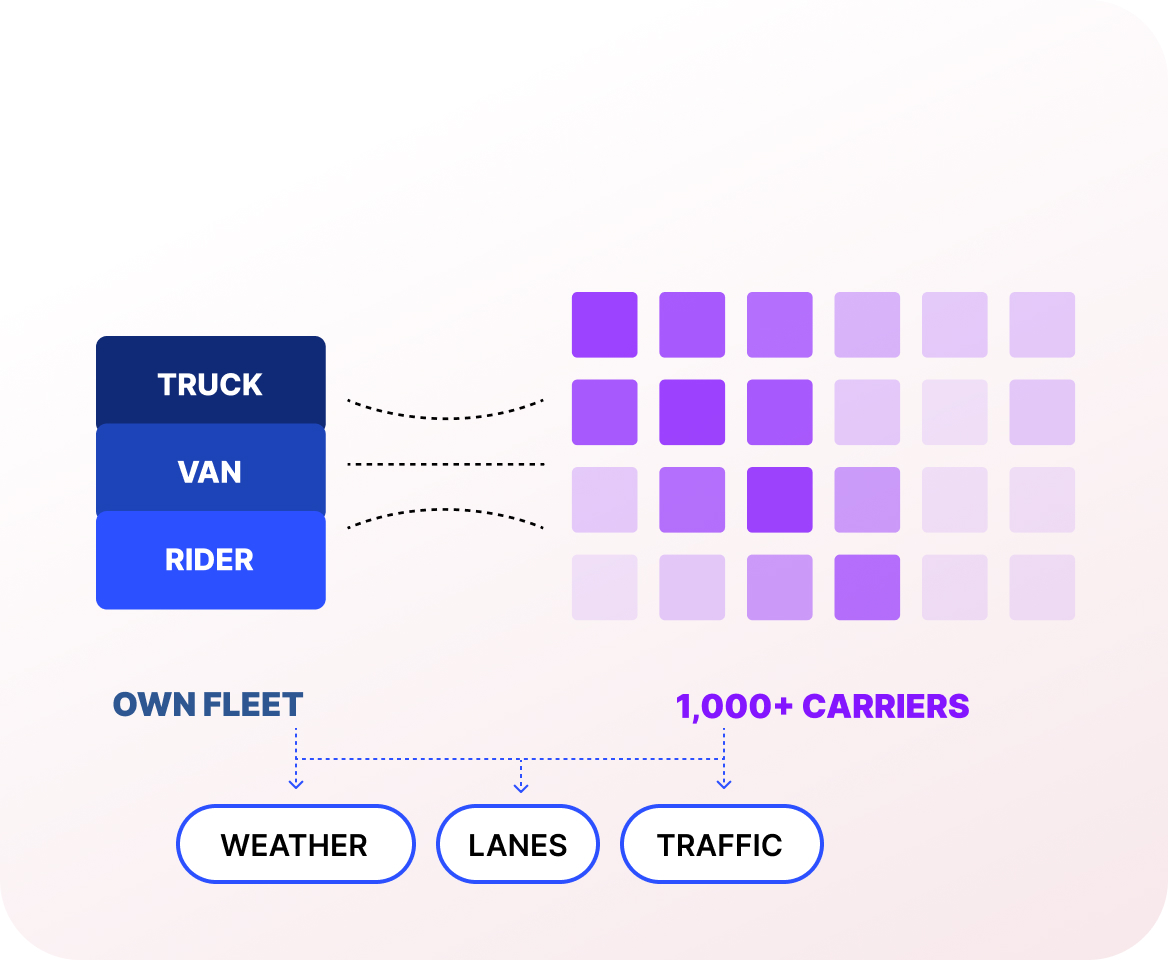
Pre-integrated carriers & data feeds
1000+ pre-integrated carriers and your own network informed by real-time data feeds of your markets
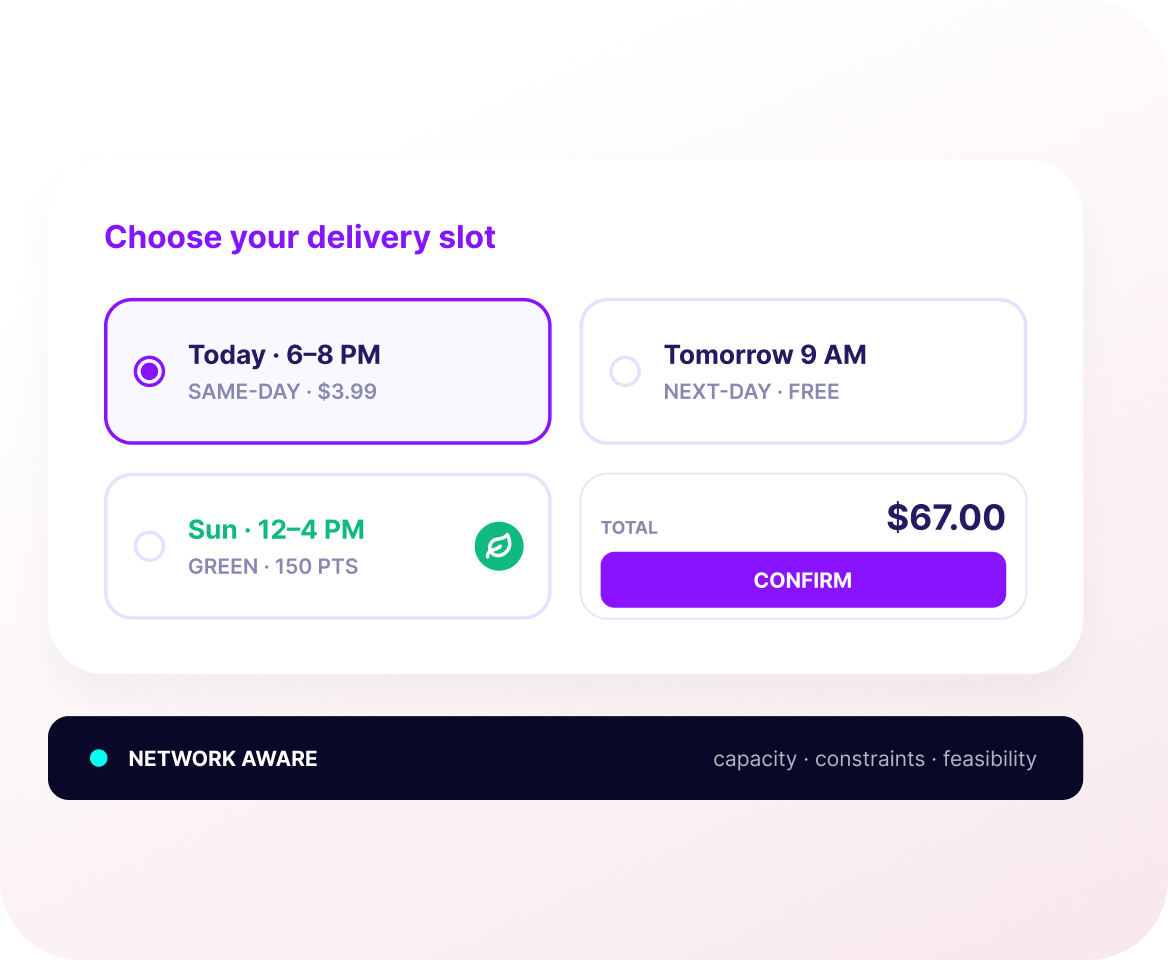
Network-aware planning & promise
Keep delivery promises backed by real-time awareness of your network and rules
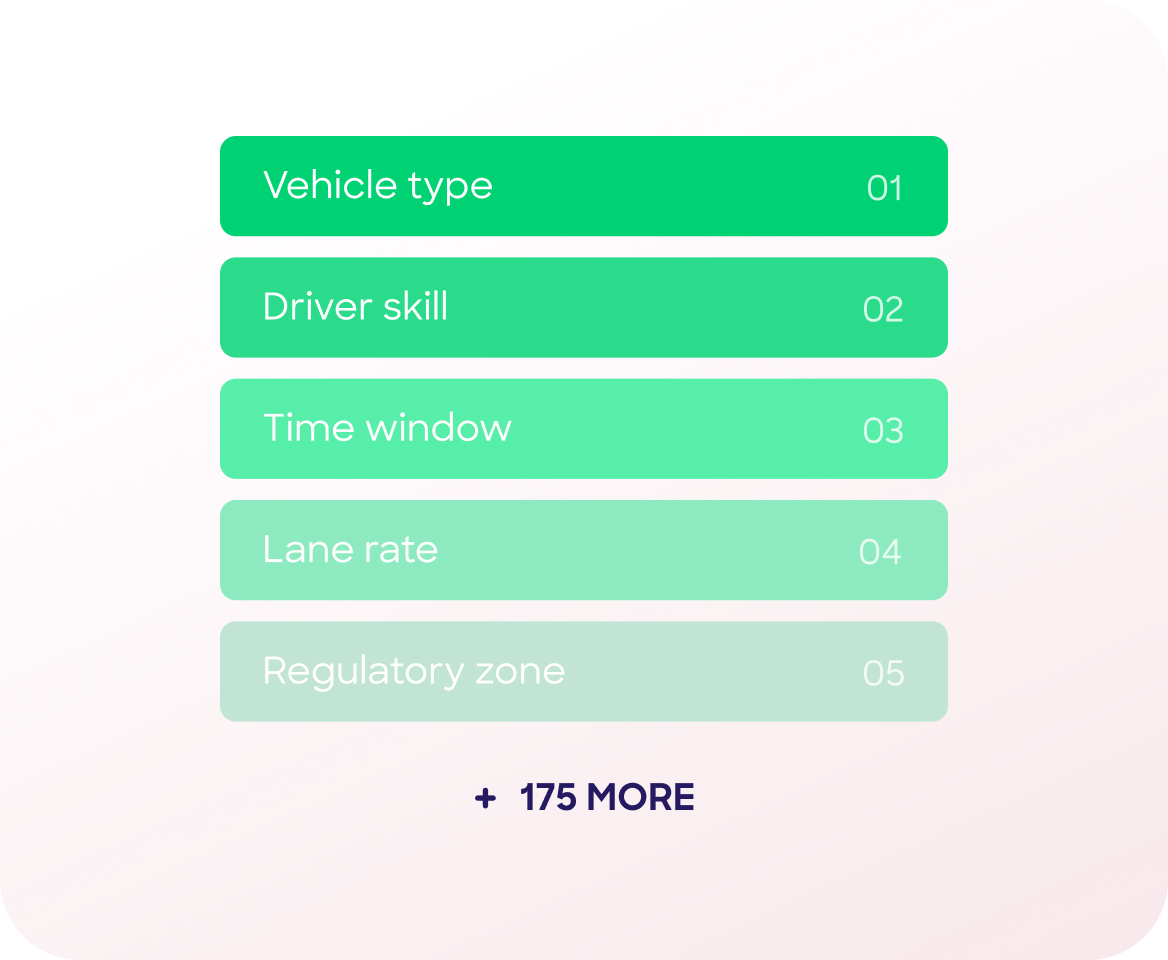
Situationally aware workflows
180+ live constraints – modeled as your business rules
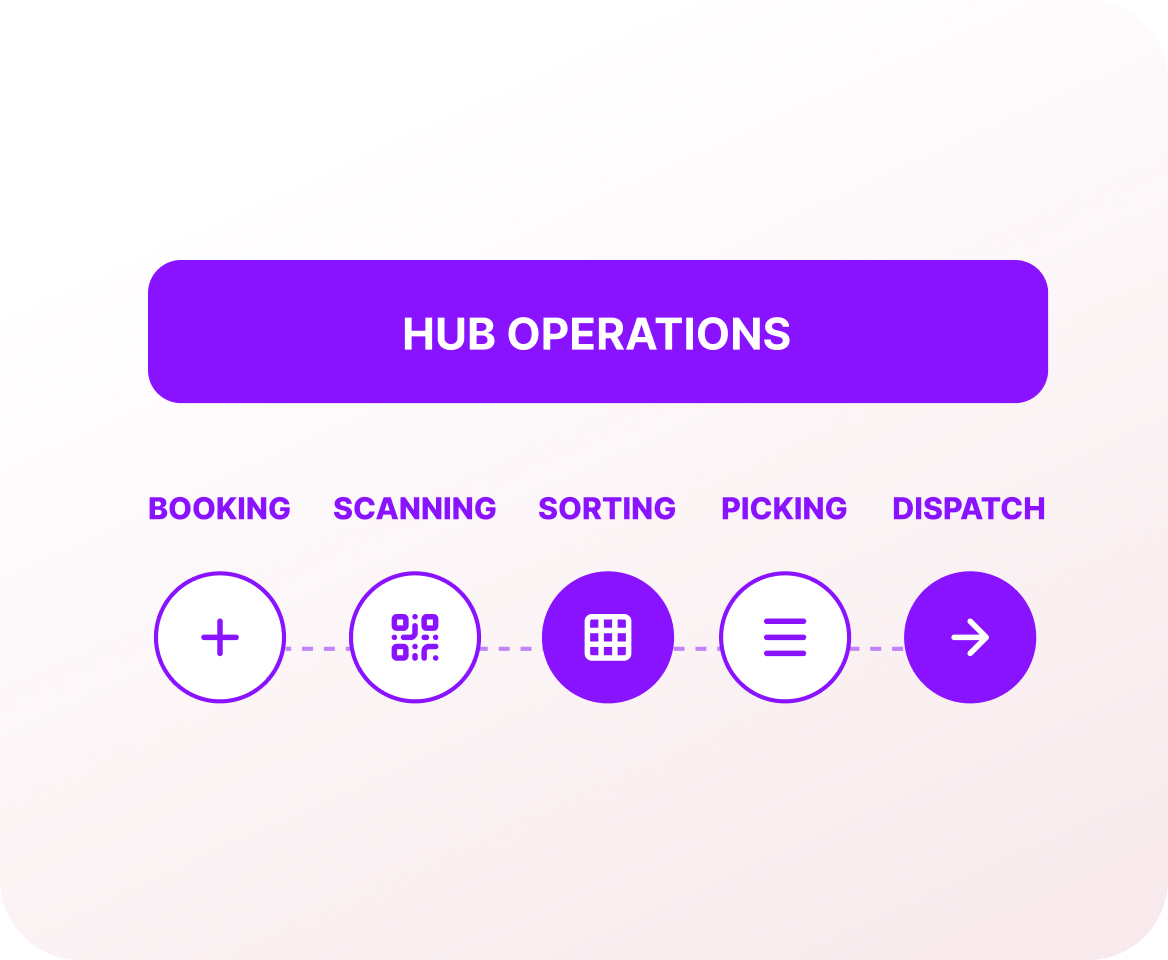
Hub operations & extended execution
Hub operations under one chain of custody covering shipment readiness, handoffs and audits
Elastic optimization
Tune the level of optimization in your network, node, season or scenario for smoother change management.
What a Canadian retail rebuild delivers.
A leading Canadian multi-modal retailer consolidated their TMS stack onto Locus. These are the outcomes the procurement case locked in.
Customer details available under NDA following qualification. Direct customer-to-customer reference call available for qualified prospects.
One day.
Your data.
Five artefacts you keep.
A working session against your actual operational data. No cost. No obligation. You walk away with five concrete artefacts whether you move forward with Locus or not.
- ✓A map of where your operation loses time today
- ✓A fragmentation chart of your existing TMS stack
- ✓A backhaul revenue opportunity model on your data
- ✓A first-year ROI picture grounded in your cost-per-km baseline
- ✓A target operating model for the next 18 months
Request your assessment
We'll respond within one business day with three time slots.