


Transportation Management System
10 Best Parcel TMS Solutions in 2026


Key Takeaways
- A parcel TMS solution centralizes routing, tracking, and carrier workflows in one platform.
- Strong parcel visibility reduces delays, missed scans, and customer complaints.
- AI-driven dispatch and routing improve first-attempt delivery success.
- Integrations with ERP, WMS, and carrier APIs remove manual work and errors.
- Locus enhances parcel operations with real-time insights, automation, and multi-carrier decision intelligence.
What is a Parcel TMS?
A parcel transportation management system is software that centralises carrier selection, rate shopping, routing, dispatch, tracking, exception handling, delivery visibility, and cost control across multiple carriers. It helps transportation, fulfilment, and last-mile teams choose the right service, execute deliveries, respond to disruptions, and measure parcel performance from label to proof of delivery.
That definition matters more in 2026 because parcel complexity keeps rising. In the U.S. alone, parcel volume reached 23.1 billion shipments in 2025, up 3.3% year-over-year, according to Pitney Bowes. At that scale, disconnected carrier portals, manual dispatch, inconsistent scan events, and delayed exception recovery quickly become cost and service problems.
For operations leaders, a parcel TMS is not just a shipping tool. It is the operating layer that helps manage carrier choice, delivery promises, surcharges, tracking consistency, returns, and customer-facing visibility across dense parcel networks.
Every operations leader searching for a parcel TMS solution faces concerns that sound like these:
- Will it keep parcel visibility consistent across every carrier?
- Can it manage sudden spikes in parcel volume without slowing teams down?
- Will customer complaints drop once tracking becomes clearer and more accurate?
- When finance reviews cost-per-parcel next quarter, will the new system actually lower it?
These are common questions you will ask when parcel workflows depend on scattered carrier portals, inconsistent tracking, or manual routing. It results in delivery delays, rising surcharges, and more first-attempt failures than most teams can absorb.
This guide reviews the best parcel TMS solutions in 2026. It explains how leading platforms simplify multi-carrier parcel operations and how systems like Locus support teams with clarity, automation, and reliable, scalable parcel delivery performance.
Why Locus Leads the TMS Category
Locus leads the parcel TMS category because its AI is not a routing add-on bolted onto a dispatch board, it is the operating layer itself. As the world’s first agentic Transportation Management System, Locus runs named, specialized agents, a Dispatch Agent that assigns parcels to the right carrier or rider in seconds, a Carrier Agent that manages multi-carrier allocation and SLA compliance, and a Customer Agent that handles exception-aware tracking and notifications, all coordinated through a continuous sense-decide-execute-learn cycle rather than a static rules engine. This lets Locus re-plan constantly as volume, traffic, and carrier performance shift through the day, instead of locking in a route or carrier assignment each morning. The results show up at scale: a Fortune 50 parcel network running 1M+ freight shipments a year across a 120-country, 4,500-driver operation lifted weekly plan execution from 75% to 92% and uncovered more than $14 million in capacity it already owned, and a leading ASEAN apparel retailer cut new-carrier onboarding from three months to three days, a 97% reduction, while dropping WISMO and returns queries by more than 40% once every carrier’s status codes were harmonized into one standard view. Schedule a Locus demo to see this agentic dispatch and carrier-orchestration layer applied to your own parcel network.
Parcel Shipping Software vs Parcel TMS vs Last-Mile Delivery Software vs Enterprise TMS
These categories overlap, but they are not interchangeable:
Parcel shipping software
Best for teams that mainly need labels, manifests, carrier service selection, and basic tracking. This is usually owned by warehouse or fulfilment teams.
Parcel TMS
Best for businesses that need broader parcel planning, carrier management, service-level control, analytics, audit support, exception handling, and visibility across multiple carriers and operating regions. This is usually owned by transportation or supply-chain teams.
Last-mile delivery software
Best for teams focused on dispatch, route optimisation, driver execution, ETAs, proof of delivery, and same-day or scheduled delivery performance. This is typically owned by last-mile operations teams.
Enterprise TMS
Best for global organisations managing multimodal transportation planning, procurement, tendering, settlement, and network governance across parcel, LTL, FTL, air, ocean, and rail. This is usually owned by central transportation or supply-chain functions.
When Does a Business Need Parcel TMS Software?
A parcel TMS becomes more valuable when your operation has several of these conditions:
- Multiple parcel carriers with different rates, SLAs, surcharges, and scan standards
- High daily or seasonal parcel volumes
- Owned fleets, outsourced carriers, gig drivers, or hybrid delivery models
- More than one fulfilment centre, hub, delivery zone, or service region
- Frequent reattempts, missed scans, or late-delivery exceptions
- Manual dispatcher or carrier allocation work
- Disconnected ERP, WMS, OMS, eCommerce, or marketplace data
- Poor cost visibility at parcel, lane, zone, or carrier level
- Cross-border compliance and returns complexity
Quick Decision Tree
- Need labels and basic service selection? Start with parcel shipping software.
- Need multimodal rates, tendering, settlement, and network governance? Evaluate an enterprise TMS.
- Need route optimisation, dispatch automation, delivery execution, ETA accuracy, and exception recovery? Evaluate a last-mile orchestration platform such as Locus.
- Need both transportation control and delivery execution? Assess a parcel TMS plus last-mile execution integration strategy.
5 Essential Features of Parcel TMS Solutions
For logistics teams handling multi-region and multimodal operations, a transportation management system must provide more than route planning. The best platforms in 2026deliver configurability, automation, and data-driven visibility that translate into measurable business outcomes.
1. Dynamic Parcel Routing with Real-Time Inputs
Parcel routing today requires continuous analysis of live data. Traffic changes, carrier delays, cut-off times, and service-level constraints all influence the best delivery path. A strong parcel TMS solution recalculates routes as conditions shift to maintain timely deliveries and reduce reattempts.
- Real-time rerouting updates parcel paths based on traffic and carrier status
- Capacity-based routing balances workloads across riders and carriers
- Time-window compliance ensures parcels meet promised delivery slots
- Continuous optimization refreshes parcel delivery plans throughout the day
2. AI-Powered Parcel Dispatch Engine
Dispatch decisions determine how effectively parcels move across zones and carriers. Platforms relying on manual assignment risk delays and uneven performance. An AI-driven dispatch engine evaluates volume spikes, service levels, delivery priority, and rider availability to assign parcels at scale.
- Assignments occur in seconds to remove dispatcher bottlenecks
- Customizable rules tailor parcel allocation by region or service class
- Fleets and carriers operate with higher utilization and faster turnaround
- Improved first-attempt success through intelligent pairing of parcels and routes
Explore how advanced dispatch systems are transforming logistics operations.
3. Parcel Visibility with Predictive Control
Visibility gains real value when teams can spot issues before they escalate. A modern parcel TMS solution tracks shipments across carriers and applies predictive signals to highlight risks such as stalled scans, missed updates, or parcels trending toward late delivery.
- Proactive alerts allow quick intervention before delays affect customers
- Predictive analytics recommend corrective carrier or routing options
- Unified dashboards consolidate parcel status across carriers, zones, and hubs
4. Automated Exception Handling for Parcel Delays
Unexpected events such as missed pickups, failed delivery attempts, or incorrect scans can disrupt parcel flow. Without rapid recovery, exceptions affect SLAs and drive up costs. A parcel TMS solution must handle disruptions as soon as they occur.
- Real-time evaluation assesses capacity, available carriers, and nearby riders
- Dynamic reallocation redirects parcels to alternate carriers or routes
- Continuity of service reduces customer complaints during disruptions
5. Prebuilt and Custom Integrations for Parcel Operations
Parcel networks depend on synchronized data across ERP, WMS, OMS, marketplace platforms, and carrier APIs. Without strong integrations, teams handle manual workarounds that slow down operations.
- Prebuilt connectors accelerate rollouts with major ERPs and marketplaces
- Open APIs support custom parcel workflows and carrier onboarding
- Unified data flows reduce label errors, duplicate entries, and process gaps
Parcel TMS Terms Buyers Should Know
- Rate shopping: Comparing available carrier services and prices against delivery commitments before a parcel is assigned.
- Carrier tendering: Offering a shipment to a carrier based on rules such as price, service level, lane, or capacity.
- Dimensional weight: A pricing method that bills by parcel size as well as actual weight.
- Scan compliance: The consistency and timeliness of scan events across hubs, linehaul, and last-mile handoffs.
- First-attempt delivery rate: The share of deliveries completed successfully on the first visit.
- Control Tower: A unified operational view of parcel movements, exceptions, ETAs, and SLA risks.
- ETA: Estimated time of arrival, ideally updated dynamically as traffic, capacity, and delivery conditions change.
- POD / proof of delivery: Digital evidence that a delivery was completed, such as signature, photo, timestamp, or geolocation.
2026 Parcel TMS Trends Buyers Should Watch
- AI-assisted orchestration is moving from pilot to operating model. Teams increasingly expect automated carrier and dispatch decisions rather than static routing rules.
- Carrier diversification is becoming a resilience requirement. Cross-border policy changes can alter parcel flows quickly. For example, Kearney reported that the removal of de minimis treatment for China-origin parcels collapsed daily volumes by about 85%, a reminder that parcel networks need flexible carrier and compliance strategies.
- Returns automation is now part of the parcel stack. Reverse logistics can no longer sit outside the main operating workflow.
- Sustainability and utilisation are converging. Better route density, fewer reattempts, and smarter carrier allocation can support both cost and emissions goals.
- Peak resilience matters as much as base-day efficiency. Buyers should validate what happens during promotions, holiday spikes, and service disruptions rather than only during steady-state weeks.
How We Evaluated These Parcel TMS Platforms
Research basis: This comparison is an editorial buyer guide built from the original article, linked product references already present in the article, and the external industry research cited on this page.
Review window: Content updated for 2026 and reviewed for this rewrite in September 2026.
What we assessed: Parcel execution depth, multi-carrier workflows, visibility, exception handling, last-mile execution, integration breadth, pricing transparency, and likely fit by business size and operating model.
Verification approach: Capabilities were evaluated from the source set available for this rewrite and clearly labelled where pricing is public, quote-based, or not publicly disclosed. This article does not claim independent hands-on testing or demo verification for every vendor.
How custom pricing was treated: Vendors with quote-based or modular pricing are marked as not publicly disclosed or custom, because parcel TMS pricing often depends on shipment volume, users, locations, integrations, and support scope.
Editorial disclosure: Locus is included in this list. Rankings are editorial and use-case dependent, not universal scores. A platform can be a strong fit for one parcel network and a weak fit for another.
Why fit matters more than market momentum: In one 2025 market view, Gartner noted that [a three-year compound annual customer and revenue growth rate of at least 20% was a qualifying threshold for stand-alone TMS technology vendors](https://www.scribd.com/document/952835397/Gartner-Reprint-Transportation-Management-System-2025). Growth can indicate market traction, but it does not replace workflow fit, implementation readiness, or parcel execution depth.
Top 10 Parcel TMS Solutions – Overview
After exploring the key features, the next question is: Which platforms actually deliver on them?
Below is an overview of the top 10 parcel TMS solutions, showing how each solution performs in real-world operations across scale, visibility, and automation.
| Software | Best For | Multi-Carrier Strength | Ideal Business Size | Pricing Model |
|---|---|---|---|---|
| Locus | High-volume parcel delivery | Very strong | Mid–enterprise | Custom |
| Oracle OTM | Global parcel + freight ops | Strong | Large enterprise | Enterprise |
| Descartes | Cross-border parcel compliance | High | Enterprise | Tiered |
| SAP TM | SAP-centric parcel networks | Strong | Global enterprise | Add-on |
| Blue Yonder | Parcel + supply chain optimization | Strong | Large enterprise | Enterprise |
| Shipsy | Cross-border, multimodal parcel ops | High | Mid–enterprise | Custom |
| Uber Freight | Parcel + freight with capacity access | Moderate | Mid–enterprise | Custom |
| Alpega | Parcel procurement + invoice control | Moderate | Mid–enterprise | Subscription |
| MercuryGate | Complex multimodal parcel flows | High | 3PLs, enterprise | Custom |
| Rose Rocket | Carrier-side parcel workflows | Basic | Small–mid carriers | Starts $99/mo |
Top 10 Parcel TMS Solutions in Detail
Each Parcel TMS solution offers distinct capabilities tailored to different delivery models and business scales. Below is a breakdown of the leading solutions, highlighting their core strengths and how they address specific operational needs.
1. Locus
Locus is an AI-powered parcel TMS solution built for enterprises handling large parcel volumes across multiple carriers and regions. It streamlines carrier allocation, parcel routing, tracking, and exception handling while giving teams real-time control over every movement. Organizations use Locus to deliver parcels faster, reduce operational overhead, and monitor performance with clear, data-driven insights.
Key Features of Locus
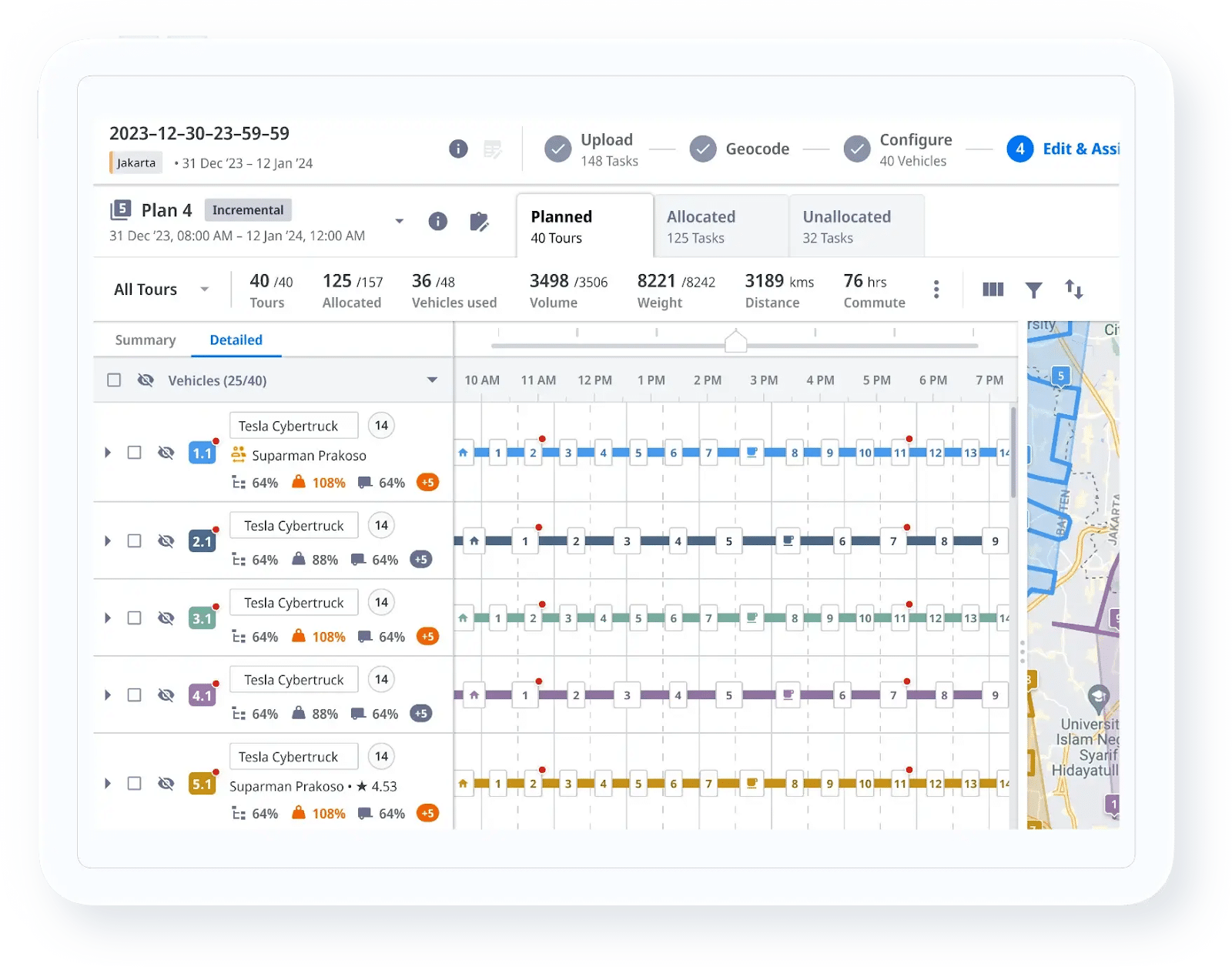
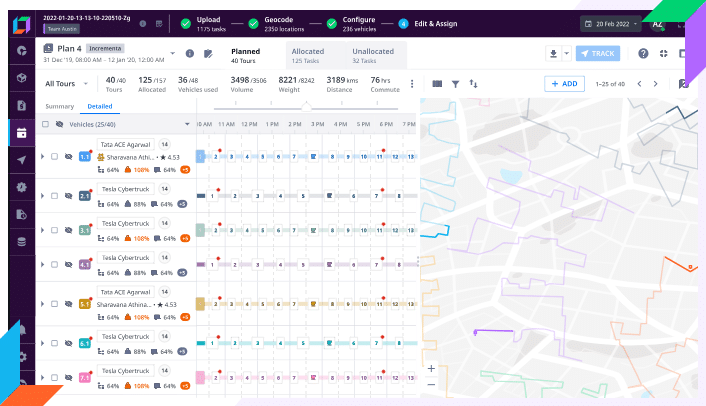
- Auto-dispatch engine: Locus assigns parcels to the most suitable driver or carrier based on distance, priority, capacity, and service constraints. Its configurable logic reduces manual work and helps fleets maintain predictable performance.

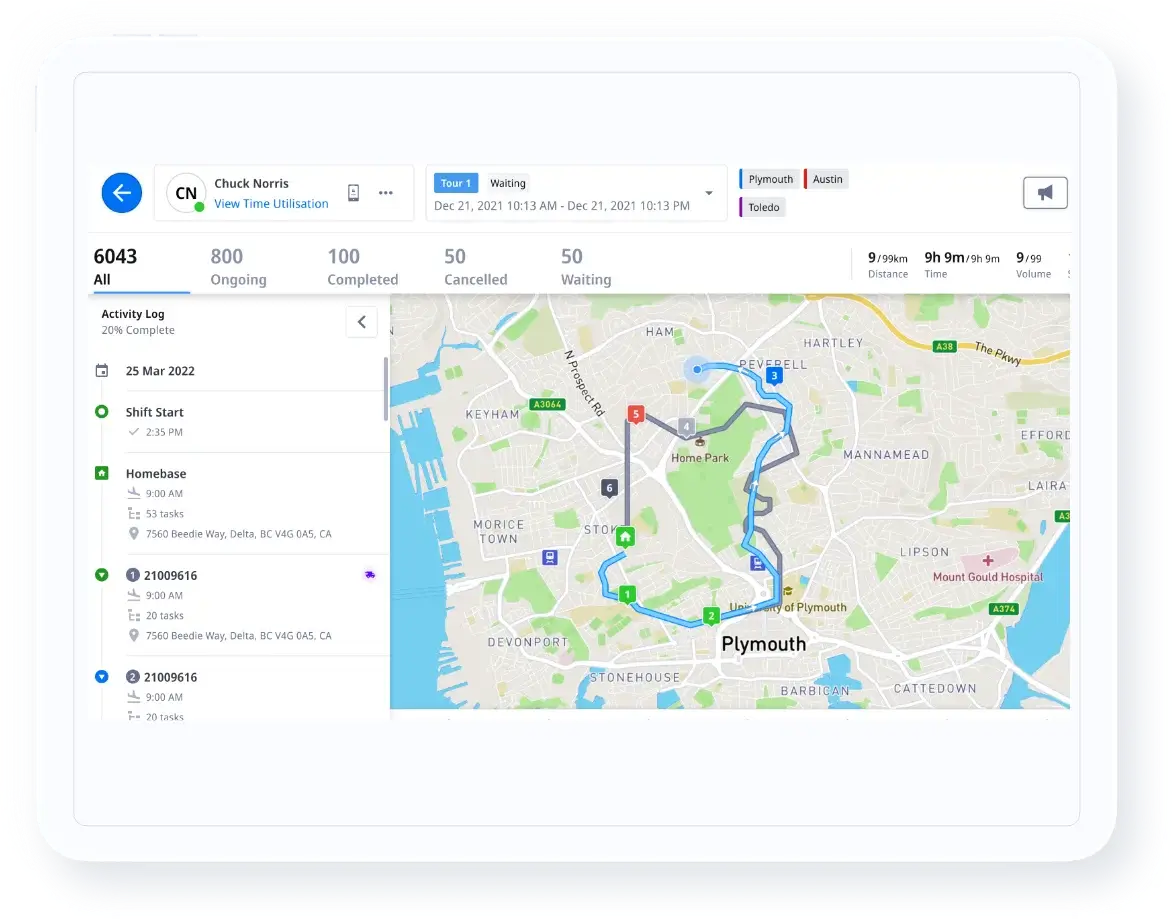
- Real-time Control Tower: Locus provides a single dashboard to track parcel movement across carriers and routes. Instant alerts flag delays, missed scans, and SLA risks so teams can intervene before issues escalate.

- Dynamic route optimization: Locus updates parcel delivery routes continuously, accounting for traffic, service levels, cut-off times, and live constraints. It reduces reattempts and keeps last-mile performance consistent at scale.

- Smart rider reassignment: Locus reallocates parcels automatically when delays, missed pickups, or capacity issues occur. It keeps high-volume parcel networks running smoothly without manual reshuffling.
- Returns and reverse logistics: Locus automates return workflows by identifying failed deliveries, scheduling reattempts, and routing items back to hubs or sellers efficiently. This minimizes manual coordination and shortens the reverse logistics cycle.
Locus Is Best for
- Enterprises handling high parcel volumes across multiple carriers
- Retail, FMCG, eCommerce, and 3PL networks managing dense last-mile regions
- Teams needing accurate parcel tracking and rapid exception management
- Operations scaling delivery and return workflows
- Businesses aiming to standardize multi-carrier parcel performance
Locus Pricing
Pricing is based on delivery volume, regional coverage, and system integrations.
Book a personalized demo to get a tailored quote.
2. Oracle Transportation Management (OTM)
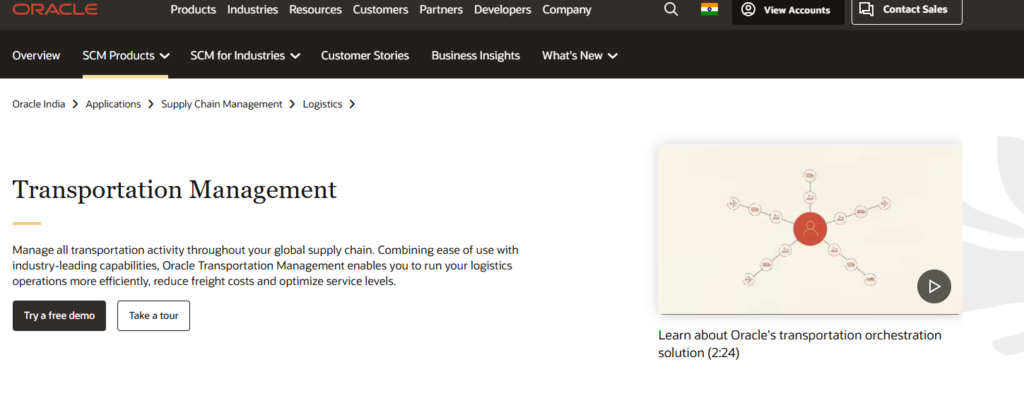
Oracle Transportation Management is an enterprise-grade parcel TMS solution within Oracle’s supply chain ecosystem. It helps large organizations manage parcel planning, carrier rate control, execution, and cost reconciliation from a single system.
OTM is built for multi-carrier, high-volume parcel networks that require strict workflow standardization and reliable visibility across global lanes.
Features of Oracle OTM
- Multi-leg shipment planning: Plans long-haul and last-mile routes inside one workflow.
- Freight cost management: Tracks, predicts, and reconciles transportation spend across carriers.
- Carrier contracts and rate management: Manages rate agreements and compares carrier options automatically.
- Shipment visibility and tracking: Monitors events, ETA shifts, and delivery progress in real time.
- ERP integration: Connects with Oracle Fusion applications and other Oracle SCM modules for unified execution.
Oracle OTM Is Ideal for
Enterprises using Oracle ERP or running high-throughput transportation across multiple modes and global lanes.
Oracle OTM pricing
Enterprise pricing varies based on shipment volume, features enabled, and integration scope. OTM is typically packaged with Oracle Cloud Supply Chain modules.
3. Descartes Systems Group

Descartes provides a cloud-based parcel TMS solution built for forwarders, customs brokers, and global shippers handling international parcel and freight flows. It specializes in compliance automation, cross-border visibility, and multimodal coordination across air, ocean, and ground carriers.
Features of Descartes
- Customs and trade compliance: Automates import and export documentation and regulatory workflows.
- Multimodal shipment visibility: Tracks air, ocean, and ground freight in real time with event updates.
- Carrier and freight management: Supports spot bookings, capacity planning, and document handling.
- Audit and freight settlement: Validates invoices and flags cost discrepancies.
- Global EDI and messaging: Enables digital communication with carriers, partners, and customs authorities.
Descartes Is Ideal for
Forwarders, customs brokers, and multinational shippers that need a cloud TMS to coordinate cross-border logistics and meet strict compliance requirements.
Descartes Pricing
Pricing varies based on selected modules and transaction volume. Enterprise quotes are available for large deployments.
4. SAP Transportation Management (SAP TM)
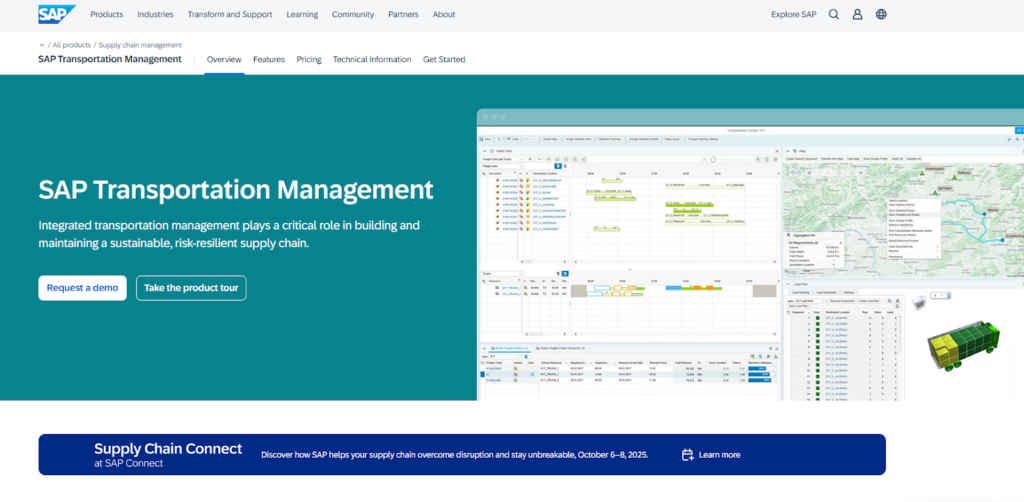
SAP Transportation Management is an enterprise parcel TMS solution within the SAP S/4HANA Cloud suite. It centralizes parcel planning, carrier selection, execution, and settlement while keeping transportation tightly connected to procurement, warehousing, and finance workflows.
SAP TM is built for organizations that rely on SAP systems and need parcel operations managed inside the same environment.
Features of SAP TM
- Embedded freight planning: Plans full truckload, less-than-truckload, and multi-leg shipments with built-in optimization tools.
- Freight charge calculation and settlement: Automates cost allocation and verifies invoices against shipment data.
- Order and delivery integration: Connects transport plans with orders, picking, and warehouse activities inside SAP S/4HANA.
- Carrier selection and tendering: Supports contracted rates, spot requests, and digital tendering.
SAP TM Is Ideal for
Enterprises already using SAP S/4HANA that want transportation planning tied closely to finance, procurement, and warehouse operations.
SAP TM Pricing
SAP TM is offered as an add-on within SAP’s modular pricing model. Final cost depends on shipment volume, deployment scope, and integration requirements.
5. Blue Yonder

Blue Yonder offers a cloud-based parcel TMS solution within its supply chain execution suite. It is designed for enterprises that want parcel transportation to work in sync with inventory, demand planning, and warehouse workflows. The platform supports predictive planning and real-time optimization across global parcel and freight networks.
Features of Blue Yonder
- Multimodal optimization: Plans and consolidates shipments across air, ocean, and road.
- Demand-based transportation planning: Aligns transportation decisions with forecasted demand and inventory availability.
- WMS–TMS connectivity: Connects warehouse and transportation workflows for smoother execution.
- Network modeling tools: Runs cost, route, and carrier simulations to support long-term planning.
- Freight settlement automation: Validates invoices and reconciles carrier charges with shipment data.
Blue Yonder Is Ideal for
Large retailers, manufacturers, and distribution networks that depend on synchronized planning across transportation, warehousing, and demand forecasting.
Blue Yonder Pricing
Available through enterprise licensing. Pricing depends on solution scope, cloud deployment model, and user volume.
6. Shipsy
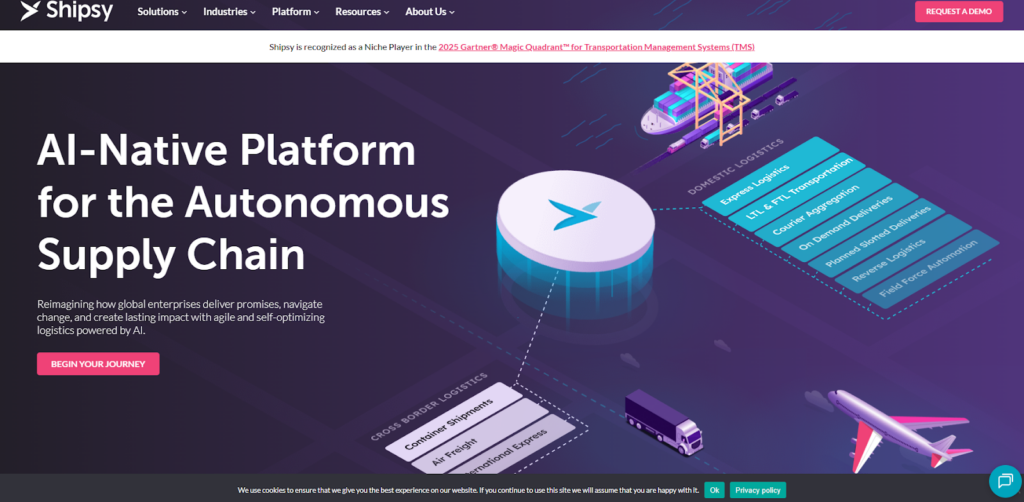
Shipsy provides a cloud-based parcel TMS solution designed for enterprises managing high-volume parcel flows, cross-border deliveries, and multimodal carrier networks. It centralizes parcel planning, real-time tracking, procurement, and carrier coordination, giving teams a unified view across regions and shipping partners.
Shipsy’s Key Features:
- Route optimization and planning: Uses AI tools to improve fleet capacity, reduce delays, and build efficient routes for both first-mile and last-mile deliveries.
- Shipment tracking and visibility: Tracks shipments across 50+ shipping lines and multiple 3PL partners, with alerts for ETA changes and delays.
- Freight procurement: Supports rate benchmarking, automated follow-ups, and vendor negotiations to reduce freight costs.
- Real-time notifications: Keeps customers informed with automated updates that improve delivery accuracy and first-attempt success.
Shipsy Is Ideal for
??Enterprises managing cross-border logistics, multimodal shipments, and high-volume operations that require strong visibility and structured procurement workflows.
Shipsy’s Pricing
Shipsy offers custom pricing based on business size, shipment volume, and integration requirements. Teams can request a demo for details.
7. Uber Freight
Uber Freight provides a cloud-based parcel TMS solution that blends transportation management capabilities with access to a large carrier network. It helps shippers plan, route, track, and reconcile parcel and freight shipments within one interface, using data from millions of yearly movements to guide more informed decisions.
Features of Uber Freight
- End-to-end transportation planning: Creates, routes, tenders, and tracks shipments from a single cloud dashboard.
- AI decision support: Uses historical and real-time data to improve routing choices, cost allocation, and lane planning.
- Carrier network access: Connects shippers to a large carrier base across truckload, LTL, intermodal, and cross-border lanes.
- Freight audit and payment: Automates invoice checks and financial reconciliation to reduce manual work.
Uber Freight Is Ideal for
Retail, CPG, manufacturing, and automotive shippers that need a cloud TMS with analytics, access to carrier capacity, and optional operational support.
Uber Freight Pricing
Pricing varies based on shipment volume, service model, and integration needs.
8. Alpega TMS

Alpega provides parcel TMS platforms designed for shippers, freight forwarders, and carriers operating across Europe and other regulated markets. Their systems focus on freight procurement, tendering, and invoice reconciliation, giving transportation teams more control across large carrier networks.
Features of Alpega
- Freight tendering tools: Digitizes bid management across contracted and spot carriers.
- Carrier collaboration portal: Enables real-time updates, status sharing, and document exchange.
- Invoicing and audit automation: Matches invoices with delivery data for reconciliation.
- Modular deployment: Allows companies to adopt only the features they need.
- Load planning and execution: Optimizes shipments across multiple orders and destinations.
Alpega Is Ideal for
European shippers, forwarders, and carriers that need more structure around procurement, tendering, and invoice control across a wide carrier base.
Alpega Pricing:
Subscription pricing varies based on modules and deployment size. Entry-level and enterprise packages are available.
9. MercuryGate TMS

MercuryGate delivers a multimodal transportation management system used by 3PLs, freight brokers, and carriers managing complex logistics networks. The platform supports high-volume, multi-leg shipments with built-in optimization and event management tools.
Features of MercuryGate
- Intermodal route planning: Supports truckload, LTL, parcel, rail, and ocean transport.
- Carrier booking and rate management: Compares rates and books shipments across providers.
- Event monitoring: Tracks delivery exceptions and triggers automated responses.
- Load consolidation engine: Groups shipments for cost-effective execution
- Self-service portals: Allows carriers and customers to interact with shipments in real time.
MercuryGate Is Ideal for
Third-party logistics providers, freight brokers, and large shippers coordinating multi-leg transportation across global lanes.
MercuryGate Pricing
Custom pricing based on number of modes used, shipment volume, and platform configurations. Enterprise quotes available on request.
10. Rose Rocket
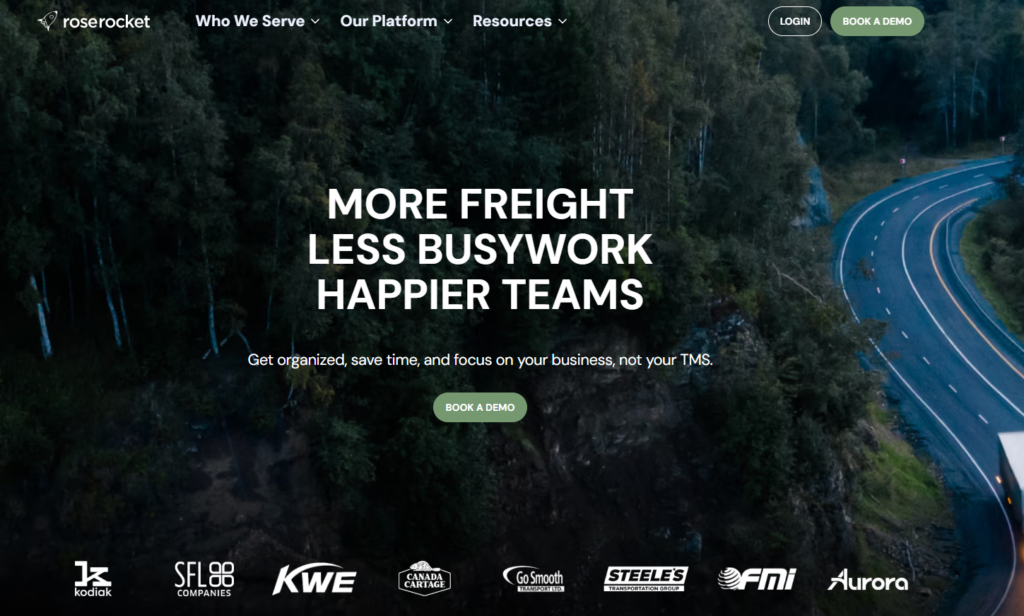
Rose Rocket is a parcel TMS built for trucking companies and LTL carriers. Its interface prioritizes usability, with tools for dispatchers, drivers, and customers to manage freight from booking through delivery, all in one platform.
Features of Rose Rocket
- Dispatch management board: Centralizes trip creation, assignment, and real-time status updates.
- Customer portal: Allows shippers to book loads, track freight, and retrieve documents.
- Mobile driver app: Enables POD capture, real-time communication, and route details.
- Billing and invoicing tools: Automates rate calculations and invoice generation.
- Load board integration: Connects with external marketplaces to fill backhauls or gaps.
Rose Rocket Is Ideal for
Small to mid-sized carriers, regional trucking businesses, and LTL providers seeking modern tools without enterprise-level complexity.
Rose Rocket Pricing
Starts at $99/month with tiered plans based on the number of users and required modules.
Benefits of Using a Parcel TMS
A well-matched parcel TMS can improve operational control in ways that are measurable, not just descriptive:
- Lower cost per parcel: Through better carrier selection, rate shopping, surcharge visibility, and reduced reattempts
- Higher on-time delivery rate: Through dynamic routing, service-level controls, and faster issue detection
- Better first-attempt delivery rate: Through cleaner dispatch logic, improved ETA accuracy, and stronger customer communication
- Lower failed-delivery and reattempt rates: Through address validation, delivery-window controls, and exception recovery workflows
- Higher ETA accuracy and scan compliance: Through normalised events and live operational visibility
- Better carrier performance management: Through lane-, zone-, and carrier-level reporting
- Higher dispatch productivity: By reducing manual assignment work and operational firefighting
- Shorter exception-resolution time: By surfacing risk earlier and triggering rule-based action
- Faster return cycle time: Through integrated reverse logistics and reattempt workflows
- Lower invoice discrepancy rates: Through freight audit and reconciliation support
- Fewer customer contacts per shipment: When tracking, ETAs, and delivery proof are accurate and easy to access
These benefits are most realistic when the platform matches the actual parcel operating model. A business shipping across multiple carriers and running dense last-mile routes will usually need different strengths from a business focused on global multimodal governance.
Parcel TMS Pricing: What Buyers Should Expect
Most parcel TMS platforms use quote-based or modular pricing because cost depends on operational complexity, not just user count. Buyers should expect pricing discussions to include:
- Shipment or delivery volume
- Number of users, planners, dispatchers, or sites
- Delivery regions, countries, and languages
- Number of carrier integrations or custom API connections
- Required modules such as dispatch, route optimisation, visibility, returns, or invoice audit
- Implementation and professional services
- Support tiers, sandbox environments, and security requirements
- Data residency, uptime, and enterprise governance needs
Parcel TMS Implementation Checklist
Before rollout, buyers should map:
- Current-state parcel workflows and exception points
- Data readiness across ERP, WMS, OMS, and customer-notification systems
- Carrier onboarding requirements and event standards
- Integration sequencing and environment strategy
- Pilot-market selection and success criteria
- KPI baselining for cost, service, ETA, reattempts, and exceptions
- User training, change management, and escalation workflows
Questions Technical and Commercial Buyers Should Ask
- Which ERP, WMS, OMS, eCommerce, and carrier integrations are already available?
- How are order, shipment, ETA, scan, POD, and invoice events synchronised?
- Are APIs, EDI, and webhooks supported?
- How are security, privacy, uptime, and data residency handled?
- What is the pricing basis: shipments, users, modules, locations, or carriers?
- What implementation, support, or integration costs sit outside licence fees?
- Is a pilot, proof of concept, or sandbox environment available?
- How should ROI be measured, and which assumptions need to be validated?
Why Choose Locus for Parcel Delivery Orchestration
Locus is a strong fit when a business has already moved beyond basic parcel shipping workflows and now needs execution control across dense, high-volume delivery networks.
Where Locus is strongest
- Dynamic dispatch and route optimisation for high parcel volumes
- Real-time Control Tower visibility across hybrid fleets and carriers
- Delivery-risk monitoring and rapid exception recovery
- Automated reassignment when capacity, traffic, or service conditions change
- Reverse logistics and returns workflows connected to the same operating layer
- ERP, WMS, OMS, and carrier-system connectivity for enterprise rollouts
Where Locus often complements existing systems
Many enterprise shippers already have an ERP, a broader TMS, or a parcel shipping layer in place. In those environments, Locus is often best evaluated as the execution and orchestration layer that improves day-of-delivery performance rather than as a universal system replacement.
Best-fit operating environments
- Retail and omnichannel delivery networks
- FMCG and direct-to-store delivery programmes
- eCommerce parcel operations
- 3PL last-mile and final-mile orchestration
- High-density urban and regional delivery networks
- Businesses managing owned, outsourced, and hybrid carrier models together
Run Parcel Operations with Better Clarity and Control
A parcel TMS solution should help you manage parcel operations without friction. Locus supports that by combining AI-driven parcel routing, real-time multi-carrier tracking, and fast decision-making in one platform. It gives your team the clarity and control they need to keep parcels moving, even when volumes spike or carrier performance fluctuates.
Enterprises in retail, FMCG, eCommerce, and 3PL networks can manage parcel delivery more smoothly with Locus. The platform connects with WMS, ERP, and carrier systems and provides live visibility through the Control Tower. With predictive insights and automated parcel workflows, you can reduce delays, lower cost-per-parcel, and operate with more consistency across every region.
Schedule a demo to see how Locus strengthens your parcel delivery workflows end-to-end.
Frequently Asked Questions (FAQs)
Does a parcel TMS solution work with multiple carrier APIs?
Yes. Most parcel TMS platforms integrate with major carrier APIs to streamline label creation, tracking events, and rate updates across multiple delivery partners.
Can a parcel TMS help reduce first-attempt delivery failures?
Yes. Better routing, clearer visibility, and automated notifications help reduce missed deliveries and improve first-attempt success rates.
How does a parcel TMS improve customer experience?
It provides accurate tracking, timely notifications, and fewer delivery delays, which reduces customer complaints and increases shipment transparency.
What type of data does a parcel TMS need to perform well?
Order details, carrier service levels, delivery windows, address quality, and real-time tracking data all contribute to better routing, planning, and exception handling.
Can a parcel TMS support rapid scaling during peak seasons?
Yes. Intelligent systems like Locus can distribute volume across carriers, predict delays early, and keep parcel operations stable during heavy demand periods.


Transportation Management System
Top 10 Multi-Carrier Shipping Software Platforms for 2026

Oct 23, 2026
Compare the best multi-carrier transport management systems for 2026 and find the right platform for faster, more reliable delivery operations.
Read more
General
Best TMS for Cold Chain Logistics in 2026: How to Evaluate Platforms on the Excursion Decision

Oct 23, 2026
Most platforms marketed for cold chain detect temperature excursions. Far fewer decide what happens next. How to evaluate a cold chain TMS on the decision that saves the load.
Read moreInsights Worth Your Time



















10 Best Parcel TMS Solutions in 2026