


General
Top 10 Logistics Tracking System Software for Enterprise Operations in 2026
Key Takeaways
- Logistics tracking system software centralizes shipment monitoring, carrier coordination, and delivery visibility across enterprise logistics networks, replacing fragmented carrier portals and manual status checks.
- Enterprise buyers should evaluate platforms across eight capabilities: real-time visibility, AI-driven route optimization, automated dispatch, multi-carrier support, exception management, proof of delivery, API-first integrations, and predictive analytics.
- The industry is shifting from passive tracking (knowing where a shipment is) to active orchestration (optimizing what happens next), and platforms that combine both deliver measurably higher ROI.
- Locus stands out as the only platform in this list that unifies dispatch planning, AI-powered route optimization, multi-carrier management, and real-time visibility into a single logistics orchestration platform.
Retailers, FMCG distributors, and 3PL operators managing thousands of daily shipments across multiple carriers face a compounding problem: every fragmented tracking system adds another portal to check, another data format to reconcile, and another gap where a delayed delivery slips through unnoticed.
Logistics tracking system software was built to solve this fragmentation.
The platforms that deliver the most value for enterprise operations in 2026 go beyond shipment visibility. They combine tracking with dispatch automation, AI-driven route optimization, and multi-carrier coordination into what the industry now calls logistics orchestration.
This guide compares 10 logistics tracking software platforms across that full spectrum. For each, we cover capabilities, strengths, limitations, and who the platform serves best, so your buying committee can shortlist with confidence, not assumptions.
What Is Logistics Tracking?
Logistics tracking is the continuous monitoring of goods, vehicles, carriers, shipment events, and delivery milestones across the logistics lifecycle. In enterprise environments, it covers more than a single parcel status update: it connects warehouse release, carrier handover, in-transit movement, hub arrival, out-for-delivery status, proof of delivery, failed-delivery exceptions, and customer notifications into one operational view.
For retail, FMCG, e-commerce, CPG, and 3PL operations, effective logistics tracking gives dispatch, warehouse, customer support, and transport teams a shared source of truth. That shared view reduces manual carrier follow-ups, improves exception handling, and helps teams act before an SLA breach becomes a customer issue.
Shipment Tracking vs. Logistics Tracking
Shipment tracking usually refers to the status of an individual order, parcel, consignment, or shipment: for example, “picked up”, “in transit”, “out for delivery”, or “delivered”. It is useful for customers and support teams that need to know where a specific delivery is.
Logistics tracking is broader. It looks across shipments, carriers, facilities, drivers, delivery routes, service levels, and exceptions to understand how the delivery network is performing. For enterprise buyers evaluating logistics tracking system software, this distinction matters because a tool that only reports shipment status may not support dispatch optimisation, carrier allocation, or SLA management at scale.
Shipment Visibility vs. Shipment Tracking
Shipment tracking shows current status and location. Shipment visibility adds operational context: predictive ETAs, delay risks, failed-delivery alerts, carrier performance, proof-of-delivery records, and downstream impact on warehouse, customer service, and transport planning.
In practice, shipment visibility is what allows logistics teams to move from “Where is this order?” to “What should we do next to protect cost, capacity, and customer experience?”
What to Look For in Logistics Tracking Software
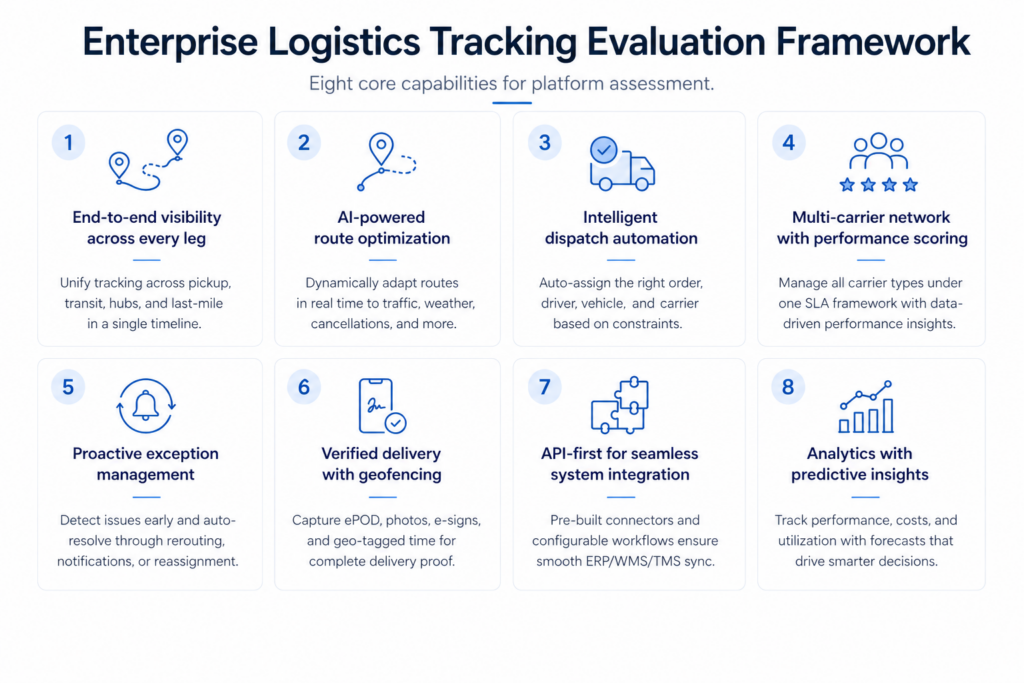
Before comparing platforms, your evaluation team needs a shared framework. The eight capabilities below separate platforms built for 500+ daily deliveries from those designed for e-commerce storefronts.
1. Real-time visibility across multi-leg shipments
Tracking a parcel from the warehouse to the doorstep is baseline. Enterprise operations require visibility across first-mile pickup, line-haul transfers, hub sorting, and last-mile delivery, with a unified timeline, not separate carrier portals.
2. AI-driven route optimization
Static route plans become outdated the moment a vehicle leaves the hub. Platforms that recalculate routes in real time based on traffic, weather, cancellations, and new order injections reduce cost-per-delivery and improve on-time rates.
3. Automated dispatch management.
Manual dispatch planning hits a throughput ceiling around 500 daily deliveries. AI-powered dispatch assigns orders to the optimal driver, vehicle, and carrier in seconds using constraint-based logic: delivery priority, vehicle capacity, SLA windows, and driver location.
4. Multi-carrier support with carrier performance scoring
Enterprises running owned fleets alongside 3PL partners and gig drivers need a single SLA framework across all carrier types. Carrier performance scoring turns anecdotal feedback (“that carrier is always late”) into data-driven allocation decisions.
5. Exception and alert management with automated resolution
Identifying an at-risk delivery is only useful if the platform can act on it. Rerouting a driver, notifying the customer, or reassigning to another carrier without dispatcher intervention.
6. Proof of delivery (ePOD) with geofencing
Enterprise logistics requires verifiable delivery records for dispute resolution, regulatory compliance, and financial settlement. Photo capture, e-signatures, barcode scanning, and geo-tagged timestamps are non-negotiable at scale.
7. API-first architecture for ERP/WMS/TMS interoperability
Logistics tracking software that cannot connect to your SAP, Oracle, or custom WMS creates another data silo. Pre-built connectors and configurable workflow engines reduce integration timelines from months to weeks.
Tracking APIs and Webhooks
Enterprise logistics tracking system software should support both pull-based and event-triggered data exchange. A shipment tracking API allows ERPs, WMSs, TMSs, OMSs, and customer-facing applications to retrieve shipment status, ETA, proof-of-delivery, and exception data from the logistics platform.
A webhook performs the inverse role: it pushes event updates to connected systems when a milestone or exception occurs. Common webhook events include shipment picked up, carrier handover, delay detected, failed delivery, geofence breach, customer reschedule, and proof-of-delivery completion.
Together, APIs and webhooks reduce manual status reconciliation and help operational teams keep warehouse systems, customer service portals, transport dashboards, and customer communication workflows aligned in real time.
8. Analytics dashboards with predictive insights
Plan-vs-actual performance analysis, cost-per-delivery trends, and carrier utilization reports allow operations leaders to make data-backed decisions rather than relying on quarterly spreadsheet reviews.
Enterprise Logistics Tracking Software Evaluation Checklist
Enterprise logistics tracking software should be evaluated on whether it can manage scale, exceptions, carriers, integrations, and delivery execution in one operating model. A visibility-only tool may answer where a shipment is, but enterprise teams also need software that helps decide what should happen next.
Use this checklist to separate basic tracking tools from enterprise-grade logistics tracking platforms:
| Evaluation criterion | What to verify during vendor review |
| Real-time multi-leg visibility | Confirm that the platform tracks first-mile pickup, line-haul transfers, hub sorting, last-mile delivery, and proof of delivery in a unified timeline. |
| AI-driven route optimization | Check whether routes can be recalculated when traffic, weather, cancellations, new orders, or vehicle capacity changes affect the delivery plan. |
| Automated dispatch management | Verify that the system can assign orders to drivers, vehicles, or carriers using delivery priority, vehicle capacity, SLA windows, and driver location. |
| Multi-carrier support | Confirm that the platform can manage owned fleets, 3PL partners, and on-demand carriers under a single SLA framework. |
| Exception and alert management | Check whether the platform can flag at-risk deliveries and support actions such as rerouting, customer notification, or carrier reassignment. |
| Electronic proof of delivery | Look for photo capture, e-signatures, barcode scanning, geo-tagged timestamps, and delivery records that support dispute resolution and settlement. |
| API-first interoperability | Verify integrations with ERP, WMS, TMS, OMS, CRM, customer service portals, and customer notification systems. |
| Predictive analytics | Confirm that dashboards cover plan-versus-actual performance, cost-per-delivery trends, carrier utilization, ETA predictions, and exception patterns. |
Benefits of Good Logistics Traceability
Good logistics traceability does more than answer “Where is the shipment?” It creates an auditable, operationally useful record of what happened, when it happened, who handled it, and what action was taken next.
- Better Coordination Between Warehouse, Support, and Carriers: When warehouse teams, dispatchers, carriers, and customer support work from the same shipment timeline, fewer issues are escalated manually. A customer service portal connected to live tracking data lets support teams answer delivery-status questions without calling dispatchers or carriers for every update.
- Stronger Carrier Negotiation Power From Performance Data: Stored carrier performance data gives procurement and transport leaders a clearer basis for rate discussions, contract reviews, and service-level negotiations. Instead of relying on anecdotal feedback, teams can compare on-time performance, exception rates, failed-delivery trends, and proof-of-delivery compliance.
- Better Planning From Stored Delivery Records: Historical delivery records help operations teams identify recurring bottlenecks by route, hub, carrier, region, time window, or customer segment. That improves capacity planning, hub design, slot planning, and SLA forecasting.
- Compliance and Accountability From Shipment Event Logs: Shipment event logs create a defensible record for disputes, claims, regulatory checks, and financial settlement. When combined with ePOD, geotagged timestamps, and exception notes, logistics teams can verify handovers and delivery outcomes with greater confidence.
- Lower Costs From Fewer Failed Deliveries and Carrier Penalties: Earlier exception detection helps teams prevent failed deliveries, avoid unnecessary reattempts, and reduce carrier-performance penalties. At enterprise scale, these improvements directly affect cost-per-delivery and margin protection.
Enterprise logistics teams managing 500+ daily deliveries across multiple carriers need a platform that covers all eight capabilities in a single system.
See how Locus delivers on each.
Schedule a Demo
Top 10 Logistics Tracking System Software Compared
The comparison table below provides a scannable snapshot before the detailed platform analyses.
| Platform | Best For | Core Differentiator | Pricing |
|---|---|---|---|
| Locus | Enterprise logistics orchestration across all-mile delivery | AI dispatch + route optimization + multi-carrier management in one platform | Custom pricing |
| FarEye | Last-mile delivery visibility and customer experience | No-code workflow builder, branded customer tracking | Custom pricing |
| LogiNext | Fleet and owned-vehicle operations needing route optimization and delivery tracking | Route optimization, fleet tracking, and driver management for mid-market delivery operations | Custom pricing |
| Shipsy | Cross-border freight and trade compliance | Multi-modal tracking with customs documentation automation | Custom pricing |
| FourKites | Macro-level supply chain visibility (supplier-to-DC, DC-to-store) | 1,200+ carrier connections, Dynamic Ocean tracking | Custom pricing |
| project44 | Carrier-agnostic shipment-level tracking | 1M+ daily shipments tracked, broad carrier connectivity | Custom pricing |
| Descartes | Enterprises already in the Descartes ecosystem | 40,000+ carrier connections, customs/regulatory compliance | Custom pricing |
| Bringg | Omnichannel retail fulfillment (BOPIS, curbside, same-day) | Retail delivery orchestration with in-store fulfillment | Custom pricing |
| Onfleet | Mid-market delivery operations (under 5,000 daily stops) | Intuitive driver app, fast deployment | Starts at $619/month |
| Track-POD | SMBs needing cost-effective ePOD and basic routing | Simple deployment, strong proof of delivery | Starts at $49/month/driver |
Carrier Support Comparison by Vendor
| Platform | Carrier Support Noted in This Guide | Enterprise Fit |
| Locus | ShipFlex supports automated carrier selection across 160+ integrated global carriers, drawn from Locus’s broader network of 1,000+ carrier partners | Strong fit for enterprises operating owned fleets, 3PL partners, and on-demand carriers across regions |
| FarEye | Supports multi-carrier delivery management and parcel-level visibility across multiple parcel carriers | Fit for enterprises focused on last-mile delivery visibility and customer communication |
| LogiNext | Supports fleet tracking, driver management, and delivery automation for large owned-fleet operations | Fit for owned-fleet and high-volume last-mile operations where routing and dispatch are primary needs |
| Shipsy | Supports carrier rate management and multi-modal tracking across air, ocean, road, and rail | Fit for cross-border, freight, and trade-compliance operations |
| FourKites | Connects to 1,200+ carriers across road, rail, ocean, air, and intermodal transport | Fit for macro-level supply chain visibility across upstream and multi-modal networks |
| project44 | Provides broad carrier connectivity across truckload, intermodal, ocean, air, rail, and parcel modes | Fit for carrier-agnostic shipment visibility across fragmented logistics networks |
| Descartes | Connects with 40,000+ carriers globally | Fit for enterprises already using Descartes for compliance, freight audit, or transportation management |
| Bringg | Supports 3PL carrier management and delivery partner coordination for retail operations | Fit for omnichannel retail fulfilment, including ship-from-store, curbside, and same-day delivery |
| Onfleet | Limited multi-carrier orchestration capabilities; stronger for owned delivery fleets | Fit for mid-market owned-fleet delivery operations |
| Track-POD | Focused on driver tracking, ePOD, and basic route planning rather than enterprise multi-carrier orchestration | Fit for SMBs and growing logistics teams needing simple proof-of-delivery workflows |
Multi-Carrier Tracking for eCommerce Operations
For enterprise eCommerce and omnichannel retail operations, multi-carrier tracking is not just a post-purchase feature. It is an operating requirement across fulfilment centres, stores, 3PLs, parcel carriers, and customer-facing delivery promises.
A strong platform should consolidate carrier events into a single tracking layer, standardise status codes across carriers, and make exceptions visible to dispatch, support, and fulfilment teams. This is especially important where the same customer order may move through different carrier models depending on region, delivery speed, service tier, product type, or available fleet capacity.
Tracking-Only vs. Orchestration Platforms for Enterprise Logistics
The best enterprise choice depends on whether the business needs passive visibility or active orchestration. Tracking-only and visibility platforms show shipment status and risk, while orchestration platforms also automate dispatch decisions, routing, carrier allocation, and exception response.
| Platform category | Vendors in this guide | Best enterprise fit | Limitation to check |
| Full-stack logistics orchestration | Locus | Enterprises that need dispatch planning, AI route optimization, multi-carrier management, proof of delivery, customer notifications, and real-time visibility in one system. | May be more platform than smaller e-commerce teams require. |
| Last-mile delivery execution and customer experience | FarEye, Bringg | Retailers and 3PLs focused on branded tracking, delivery notifications, scheduling, returns, store fulfillment, and same-day or omnichannel delivery models. | May not cover the same depth of end-to-end dispatch optimization across enterprise logistics networks. |
| Multi-modal supply chain visibility | FourKites, project44 | Shippers and 3PLs that need carrier-agnostic visibility across road, rail, ocean, air, intermodal, truckload, parcel, and upstream supply chain movements. | These platforms are visibility layers and do not manage driver allocation or route optimization. |
| Freight, compliance, and logistics suite platforms | Shipsy, Descartes | Enterprises with cross-border, customs, freight management, regulatory compliance, carrier connectivity, or transportation management requirements. | Tracking and orchestration may be part of a broader suite or focused more on freight and mid-mile workflows. |
| Mid-market and SMB delivery management | Onfleet, Track-POD | Teams that need fast deployment, driver tracking, route planning, customer notifications, analytics, and electronic proof of delivery. | They are less suited to enterprise-grade multi-carrier orchestration, predictive analytics, or deep integration needs. |
Best Logistics Tracking System Software for Enterprises in 2026
1. Locus
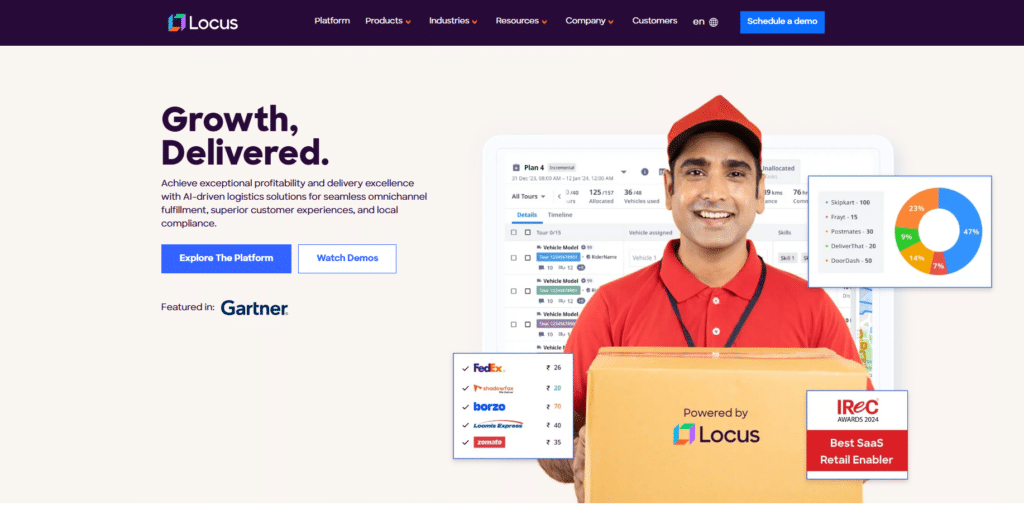
Locus is an AI-powered logistics orchestration platform designed for enterprises managing complex, high-volume delivery networks across owned fleets, 3PL partners, and on-demand carriers. Where most logistics tracking software handles shipment monitoring, Locus extends into dispatch automation, constraint-based route optimization, and multi-carrier coordination, covering the full order-to-delivery lifecycle.
The platform’s dispatch engine, DispatchIQ, assigns orders to the optimal driver and vehicle using constraint-based AI that factors in delivery priority, vehicle capacity, SLA windows, driver location, and real-time traffic data simultaneously. It continuously re-optimizes across 250+ real-world constraints as conditions change throughout the day, absorbing new orders, cancellations, and disruptions without manual dispatcher intervention.
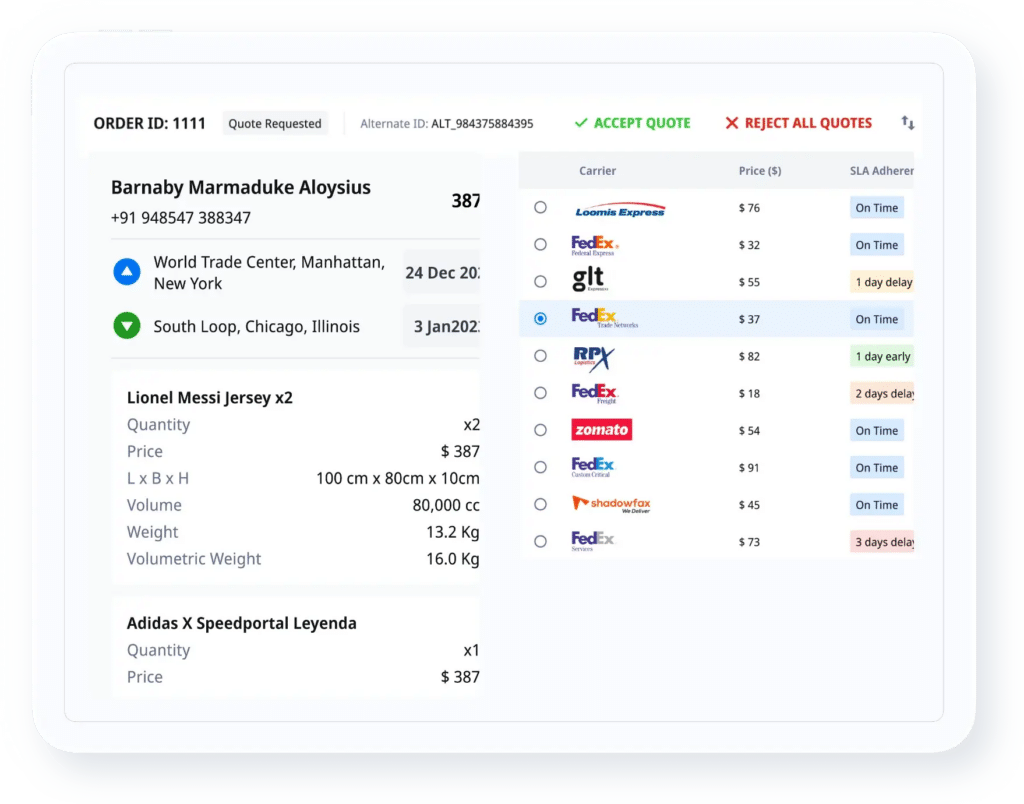
For multi-carrier operations, ShipFlex automates carrier selection across 160+ integrated global carriers—drawn from Locus’s broader network of 1,000+ carrier partners—based on cost, speed, and service-level parameters. Enterprises can scale delivery coverage into new regions without negotiating individual carrier contracts or investing in additional fleet capacity.
In October 2025, Ingka Group (the largest IKEA retailer, operating in 31 markets) acquired Locus to bring AI-powered logistics capabilities in-house. Locus remains operationally independent and continues serving enterprise clients globally.
Key features of Locus
- DispatchIQ auto-allocation engine: AI assigns thousands of orders across hundreds of vehicles simultaneously, using multi-constraint logic across delivery priority, driver availability, and SLA windows
- Dynamic route optimization: Continuously recalculates routes based on live traffic, new orders, and exceptions across 250+ constraints via the route planning system
- ShipFlex multi-carrier management: Automated carrier selection across 160+ global carriers with rule-based allocation for cost, speed, and service compliance
- Control tower with predictive ETAs: End-to-end shipment visibility with ML-based ETA predictions, exception alerts, and automated customer notifications (SMS, email, WhatsApp)
- Electronic proof of delivery: Photo, signature, barcode, and geo-tagged confirmation via the Driver Companion App with AI validation, alongside real-time message history, exception escalation, and order update management
- Branded customer tracking page: Customer-facing branded tracking with live delivery status, estimated arrival windows, and delivery updates via SMS, email, and WhatsApp
- Geofence breach alerts: Automated alerts triggered when drivers deviate from designated zones or delivery boundaries, with escalation workflows for exception resolution
- Real-time driver availability tracking: Live driver status monitoring with last-minute task reallocation when driver availability shifts mid-shift, critical for FMCG and 3PL operations
Locus pros
- Only platform in this list combining dispatch, routing, carrier management, and tracking into one system, eliminating the need for multiple point solutions
- Proven enterprise scale: 1.5B+ deliveries optimized, $320M+ in transit costs saved, 99.5% SLA adherence across 360+ customers in 30+ countries
- Lenskart, one of Asia’s largest eyewear retailers, achieved a 20% increase in tasks per delivery agent and 80% SLA adherence after deploying Locus
- Recognized as a leader across G2, Gartner, and the SPARK Matrix for logistics orchestration, providing third-party validation of platform capability alongside customer-reported outcomes
Locus cons
- Designed for enterprise logistics complexity and may be more platform than smaller e-commerce teams require
Locus pricing
Custom enterprise pricing based on shipment volumes, delivery locations, carrier integrations, and deployment scope. Enterprises can request a demo for a tailored pricing estimate.
Locus is best for
Enterprise retailers, FMCG/CPG companies, distributors, and 3PL providers managing large delivery volumes across multiple carriers, hubs, and regions.
2. FarEye
FarEye is a delivery management software platform that helps enterprises manage last-mile delivery execution and post-purchase customer experience. The platform connects logistics teams with carrier partners while providing real-time tracking, branded delivery notifications, and returns management through a no-code workflow builder.
Its delivery management capabilities are strongest in execution: assigning shipments to drivers, tracking deliveries in real time, and automating status updates.
Key features of FarEye
- Multi-carrier delivery management: Connect with multiple parcel carriers and manage shipments through a unified system
- No-code workflow builder: Customize delivery processes, scheduling rules, and exception handling without engineering support
- Customer communication tools: Branded tracking pages, delivery notifications, and flexible delivery scheduling
- Returns management: Automated reverse logistics workflows from customer initiation to carrier pickup
- Delivery performance analytics: Carrier performance monitoring, delivery KPI dashboards, and service-level reporting
FarEye pros
- Strong post-purchase customer experience capabilities, including branded tracking and proactive delivery communication
- Broad carrier network with integration support for major platforms, including SAP Store for parcel-level visibility
FarEye cons
- The routing engine supports only two optimization parameters (weight and volume) and does not support multi-trip routing for the same vehicle in a single day
- Scope is narrower than full-stack orchestration platforms: focused on delivery execution rather than end-to-end dispatch optimization
FarEye pricing
Custom enterprise pricing. Contact FarEye for a quote.
FarEye is best for
Enterprise retailers and 3PLs prioritizing delivery visibility, customer communication, and last-mile execution workflows.
3. LogiNext
LogiNext built a delivery dispatch automation platform that handles AI-powered route optimization, real-time fleet tracking, and capacity planning for brands.
The platform’s core strength is multi-stop route planning with dynamic re-allocation: when deliveries fail or drivers become unavailable, LogiNext can re-sequence and reassign orders automatically. The fleet management dashboard provides driver performance tracking and capacity utilization analytics across large carrier networks.
Key features of LogiNext
- AI-powered route optimization: Multi-stop route planning with real-time fleet tracking
- Delivery automation: Order batching, route sequencing, and dynamic re-allocation for failed deliveries
- Fleet management dashboard: Driver performance tracking, capacity planning, and utilization analytics
- Analytics and reporting: Carrier allocation insights, delivery performance metrics, and cost-per-delivery analysis
- Mobile driver app: Navigation, task management, and delivery confirmation for field teams
LogiNext pros
- Route optimization engine handles standard routing for high-volume FMCG and QSR delivery operations
- Multi-depot management and geocoding capabilities support operations across diverse geographies
LogiNext cons
- Customization can be limited, especially for industry-specific needs or complex use cases
- API limitations and data inconsistencies can occur when connecting multiple systems
LogiNext pricing
Custom pricing. Contact LogiNext for a quote.
LogiNext is best for
Enterprises managing large owned fleets and high-volume last-mile operations that need route optimization, automated dispatch, and real-time delivery visibility.
4. Shipsy
Shipsy specializes in cross-border logistics, freight management, and trade compliance. The platform provides multi-modal tracking across air, ocean, road, and rail shipments, with automated customs documentation and carrier rate management.
For enterprises with complex international supply chains, Shipsy’s compliance engine for trade regulations is a genuine differentiator. The platform automates invoicing, manages customs documentation, and tracks shipments across multiple transport modes from a single dashboard.
Key features of Shipsy
- Multi-modal shipment tracking: Real-time visibility across air, ocean, road, and rail
- Customs and trade compliance: Automated documentation for international shipments
- Carrier rate management: Compare and manage carrier contracts across logistics partners
- Freight invoicing automation: Digital invoicing with automated reconciliation
- Shipment ETA prediction: ML-powered delivery time estimates across transport modes
Shipsy pros
- Compliance engine for trade regulations is a differentiator for enterprises shipping across borders
- Invoicing automation streamlines freight settlement, reducing manual reconciliation effort
Shipsy cons
- Focused on freight-forwarding and mid-mile logistics rather than last-mile orchestration and high-volume dispatch optimization
- Less suited for enterprises whose primary challenge is last-mile delivery coordination
Shipsy pricing
Custom enterprise pricing. Contact Shipsy for a quote based on shipment volumes and modules.
Shipsy is best for
Enterprises with complex international supply chains requiring multi-modal tracking, customs compliance, and freight management.
5. FourKites
FourKites is a supply chain visibility platform that tracks shipments across road, rail, ocean, air, and intermodal transport in real time. The platform connects to 1,200+ carriers and processes over three million supply chain events daily.
Its Dynamic Ocean tracking provides vessel-level visibility for ocean freight, and predictive ETAs use historical and real-time data to estimate delivery times before carriers report them. FourKites’ strength is macro-level visibility: tracking shipments from supplier to distribution center to store.
Key features of FourKites
- End-to-end supply chain visibility: Real-time tracking across all transport modes with 1,200+ carrier connections
- Predictive ETAs: AI-powered delivery time predictions that update continuously based on real-time conditions
- Dynamic Ocean tracking: Vessel-level visibility for ocean freight with port congestion and sailing schedule data
- Control tower: Centralized dashboard for shipment monitoring, risk identification, and exception alerting
FourKites pros
- Broad carrier network (1,200+) provides visibility across fragmented logistics networks without requiring carrier-by-carrier portal access
- Strong TMS, ERP, and WMS integration depth for enterprises that need visibility layered on top of existing systems
FourKites cons
- Visibility-only platform: does not offer dispatch management, route optimization, or driver-level orchestration
- Enterprises still need a separate platform for last-mile execution and delivery coordination
FourKites pricing
Custom enterprise pricing based on shipment volume. Contact the vendor for a quote.
FourKites is best for
Large enterprises and shippers needing upstream visibility (supplier-to-DC, DC-to-store). Best used as a complementary tool alongside a dispatch/orchestration platform like Locus for last-mile execution.
6. project44
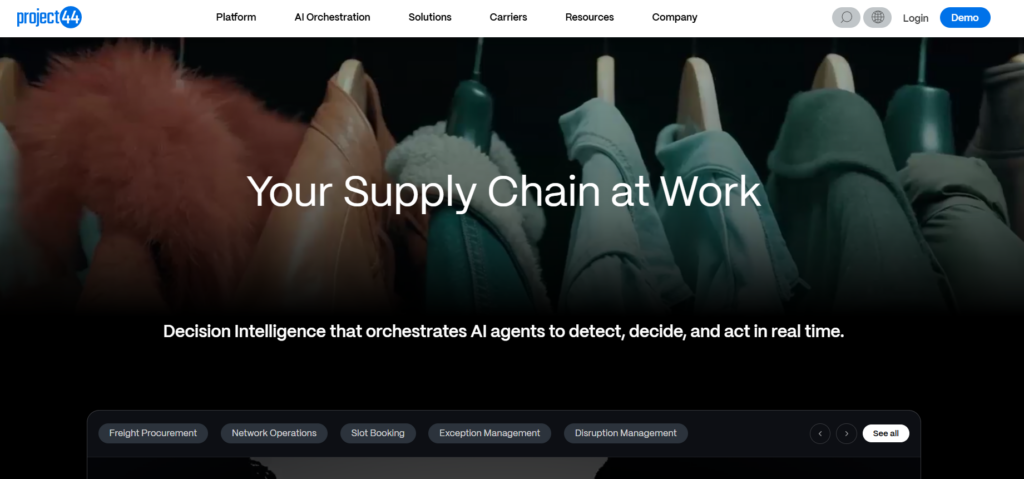
project44 provides a carrier connectivity network and multi-modal visibility platform for shippers and logistics service providers. The platform tracks over one million daily shipments and offers granular shipment-level tracking with predictive ETAs and carrier performance analytics.
The platform’s strength is its carrier ecosystem breadth. project44 connects shippers with a diverse network of carriers across truckload, intermodal, ocean, air, rail, and parcel modes, providing a single interface for tracking shipments regardless of carrier.
Key features of project44
- Predictive ETAs and exception management: AI-powered delivery predictions with automated alerts when shipments deviate from expected timelines
- Carrier performance analytics: Data-driven insights into carrier reliability, on-time rates, and compliance across the network
- API-first integration: Deep integration with TMS, WMS, and ERP systems for centralized data flow
project44 pros
- One of the broadest carrier connectivity networks available, tracking over one million daily shipments across all major transport modes
- Granular shipment-level tracking provides detailed visibility that goes beyond high-level status updates
project44 cons
- Like FourKites, project44 is a visibility layer. It does not optimize routes or manage driver allocation
- Enterprise-level pricing and implementation scope may exceed what mid-market operations require
project44 pricing
Custom enterprise pricing based on shipment volume and integration scope. Contact project44 for a quote.
project44 is best for
Enterprise shippers and 3PLs managing high-volume, multi-modal shipments that need carrier-agnostic tracking and performance analytics across a fragmented logistics network.
7. Descartes
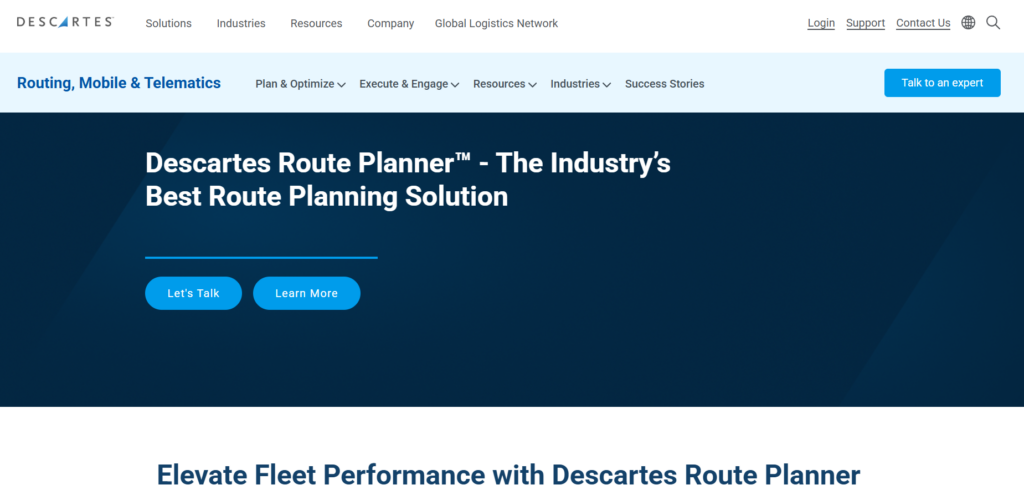
Descartes offers a broad logistics technology portfolio spanning customs and regulatory compliance, fleet management, route planning, carrier connectivity, and transportation management software. The company has deep enterprise roots and connects with 40,000+ carriers globally.
For enterprises already invested in the Descartes ecosystem, adding tracking and fleet tracking software capabilities is an incremental step. For those evaluating from scratch, the modular nature of Descartes’ suite means tracking and orchestration are add-on components within a larger platform, not purpose-built real-time orchestration engines.
Key features of Descartes
- Customs and regulatory compliance: Automated trade documentation and compliance management across international shipments
- Fleet management: Vehicle and driver tracking, route planning, and utilization analytics
- Carrier connectivity: Integration with 40,000+ carriers globally for shipment tracking and coordination
- Transportation management: Freight audit, carrier performance scoring, and shipment planning
Descartes pros
- Customs and regulatory compliance capabilities reduce the manual burden of international trade documentation
- Enterprises already using Descartes for other logistics functions (compliance, freight audit) can add tracking without introducing a new vendor
Descartes cons
- Tracking and orchestration capabilities are modular add-ons within a broader suite
- Some users report slow load times or delays in actions like posting loads or updating data (G2)
Descartes pricing
Custom enterprise pricing. Contact Descartes based on modules, carrier integrations, and deployment scope.
Descartes is best for
Enterprises already in the Descartes ecosystem needing incremental tracking, compliance, and carrier management capabilities.
8. Bringg
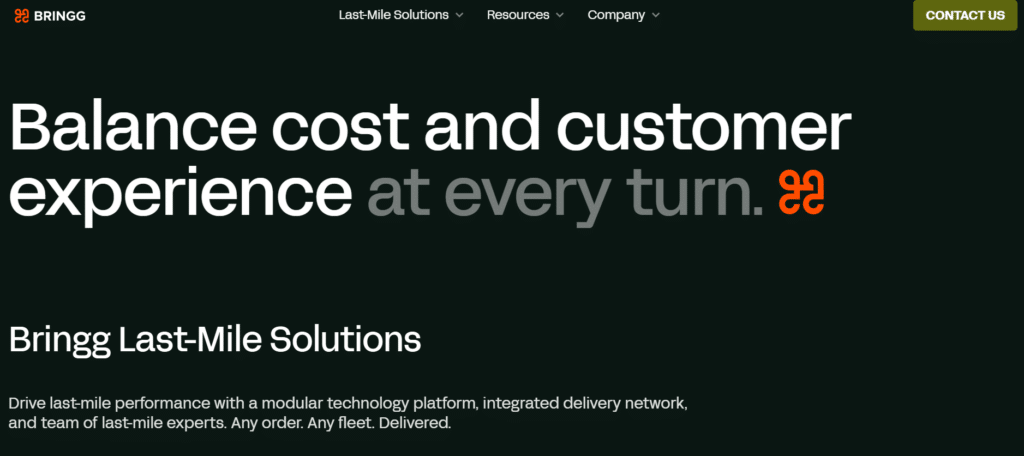
Bringg focuses on retail delivery orchestration. It connects retailers with delivery fleets, managing in-store fulfillment, and providing customer-facing tracking for omnichannel operations including BOPIS (buy online, pick up in store), curbside pickup, and same-day delivery.
The platform’s differentiator is its retail-specific focus. Bringg coordinates between store-level fulfillment, warehouse operations, and multiple carrier partners to support delivery models that traditional logistics platforms were not designed for, such as ship-from-store, curbside, and hyperlocal same-day.
Key features of Bringg
- Customer-facing tracking: Branded tracking pages and proactive delivery notifications
- 3PL carrier management: Multi-carrier allocation with performance monitoring for retail operations
- Automated dispatching: Rule-based order assignment to drivers and carriers based on proximity, capacity, and service tier
Bringg pros
- Purpose-built for omnichannel retail fulfillment, supporting delivery models (ship-from-store, curbside, BOPIS) that generic logistics platforms handle less effectively
- Connects retailers with a network of delivery partners, simplifying multi-carrier management for retail-specific scenarios
Bringg cons
- Narrower focus (retail fulfillment) compared to cross-vertical orchestration platforms serving FMCG, 3PL, and CPG operations
- Platform configuration can involve multiple steps for routine changes, adding operational overhead for admin teams (G2)
Bringg pricing
Custom enterprise pricing based on delivery volumes and modules. Contact Bringg for a quote.
Bringg is best for
Enterprise retailers managing omnichannel fulfillment who need delivery coordination across stores, warehouses, and carrier partners.
9. Onfleet
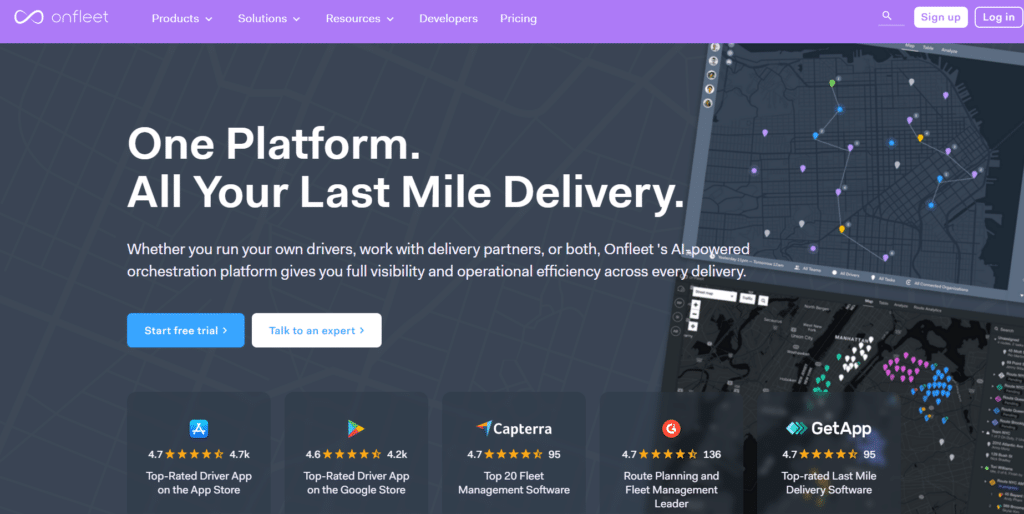
Onfleet is a last-mile delivery management platform built for mid-market operations. The platform provides route optimization, an intuitive driver mobile app, automated customer notifications, and electronic proof of delivery, all designed for teams that need to be operational quickly without a multi-month implementation cycle.
With built-in analytics and delivery performance insights, teams can track efficiency, improve on-time rates, and scale operations without adding operational complexity.
Key features of Onfleet
- Route optimization: Time-window-aware route planning for delivery fleets with automatic stop sequencing
- Automated customer notifications: SMS and email delivery updates with estimated arrival windows
- Proof of delivery: Photo, signature, and barcode capture for delivery verification
- Analytics dashboard: Delivery performance tracking, driver efficiency metrics, and task completion reporting
Onfleet pros
- Fast deployment and minimal training required. Teams can be operational within days
- Driver app is intuitive and user-friendly, reducing onboarding time for new delivery personnel
Onfleet cons
- Lacks the enterprise scalability, multi-tenant architecture, and AI-driven dispatch intelligence required for 1,000+ daily deliveries across multiple depots
- Limited multi-carrier orchestration capabilities
Onfleet pricing
Businesses can select from three pricing plans: Launch for $619/month, Scale for $1,349/month, and Enterprise for $3,099/month. A 14-day free trial is also included.
Onfleet is best for
Mid-market delivery operations (D2C brands, local logistics providers) managing under 5,000 daily stops with owned delivery fleets.
10. Track-POD
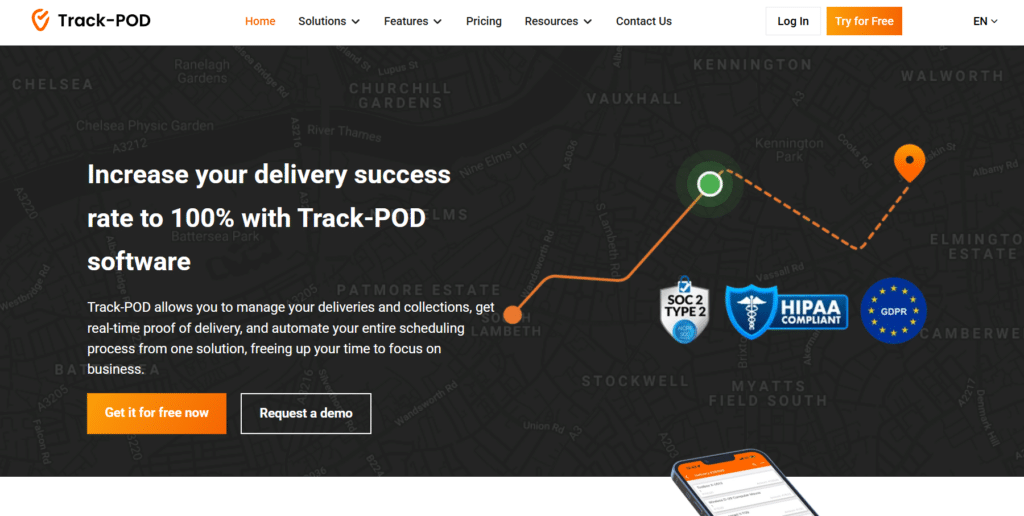
Track-POD is a cost-effective delivery management solution for SMBs and growing logistics operators needing electronic proof of delivery, basic route planning, and driver tracking.
It’s built for teams that need a straightforward way to run daily delivery operations without heavy setup or technical overhead. The platform helps standardize workflows, improve accountability across drivers, and maintain consistent visibility into deliveries as operations scale.
Key features of Track-POD
- Electronic proof of delivery: Photo, signature, and timestamped delivery confirmation with GPS coordinates
- Driver tracking: GPS-based vehicle and driver monitoring with real-time location updates
- Delivery analytics: Basic reporting on delivery completion rates, driver performance, and delivery timing
Track-POD pros
- Fast time-to-value as teams can be operational within days
- Affordable entry point for growing logistics operations that have outgrown spreadsheets and manual tracking
Track-POD cons
- Not enterprise-grade: lacks AI-driven dispatch, multi-carrier orchestration, predictive analytics, and deep integration capabilities
- Limited to basic routing. No dynamic re-optimization or constraint-based planning
Track-POD pricing
Pricing is tiered and usage-based, with two models: per driver/vehicle or per order. Per-driver plans start at $49/month (billed annually) and scale up to $89/month, while per-order pricing begins at $285/month for 1,500 orders and decreases per-order cost as volume increases. Enterprise plans are custom, with pricing available on request.
Track-POD is best for
SMBs and growing logistics operators needing simple, cost-effective ePOD and basic route planning without enterprise-grade complexity.
Choosing Between Tracking and Orchestration
Logistics tracking system software has evolved. The platforms that deliver the most measurable value for enterprise operations in 2026 combine visibility with dispatch automation, AI-driven routing, and multi-carrier coordination, moving from passive tracking into active orchestration.
For enterprise retailers, 3PLs, and FMCG operators managing thousands of daily deliveries, the cost difference between a visibility-only tool and a full-stack logistics orchestration platform compounds with every shipment.
Locus customers have collectively saved $320M+ in transit costs across 1.5B+ optimized deliveries, driven by the combination of DispatchIQ’s automated allocation, dynamic route re-optimization, ShipFlex’s multi-carrier management, and centralized control tower visibility.
Explore how Locus can support your logistics operations. Schedule a demo today.
Frequently Asked Questions (FAQs)
What is the difference between logistics tracking software and a logistics orchestration platform?
Logistics tracking software monitors shipment location and status across carriers, providing visibility into where deliveries are. A logistics orchestration platform adds active decision-making capabilities: automated dispatch planning, AI-driven route optimization, carrier selection, and exception resolution. Locus combines both in a single platform.
How does AI-powered route optimization reduce last-mile delivery costs for enterprise operations?
AI route optimization continuously recalculates delivery sequences based on real-time constraints: traffic, weather, new orders, cancellations, and vehicle capacity. Static routes optimized once before departure degrade in efficiency hourly. Continuous re-optimization reduces fuel consumption, increases stops per driver, and improves on-time delivery rates.
What integrations should enterprise logistics tracking software support?
Enterprise platforms should offer API-first architecture with pre-built connectors for ERP (SAP, Oracle), OMS, WMS, TMS, and CRM systems. Locus provides configurable BPMN workflow engines and integrations with 160+ carriers through ShipFlex, allowing operations teams to define business rules without engineering support.
How do 3PL companies use logistics tracking software to manage multiple clients?
3PLs require multi-tenant platforms that separate client data, enforce per-client SLAs, and allocate carriers based on individual client requirements. Locus’s ShipFlex enables automated carrier selection across 160+ integrated logistics partners with per-client rules for cost, service level, and delivery speed.
What ROI can enterprises expect from implementing logistics tracking system software?
ROI varies by operational scale, but enterprises deploying AI-powered logistics orchestration platforms typically report 20–30% reductions in transportation costs and significant improvements in on-time SLA adherence. Locus enterprise customers report $320M+ in collective transit cost savings across 360+ deployments in 30+ countries.
Is shipment tracking the same as logistics tracking?
No. Shipment tracking usually focuses on an individual parcel, order, or consignment and its current status. Logistics tracking is broader: it connects shipment status with carrier performance, dispatch activity, route progress, exception workflows, proof of delivery, and customer communication across the wider logistics network.
Why do logistics tracking platforms need APIs and webhooks?
APIs and webhooks keep logistics data synchronised across enterprise systems. A shipment tracking API lets connected platforms retrieve shipment status, ETA, exception, and proof-of-delivery data. A webhook pushes event-based updates, such as delay alerts, failed-delivery notifications, milestone changes, and proof-of-delivery completion, to ERPs, WMSs, TMSs, OMSs, customer service portals, and customer notification systems as events happen.


General
Top 10 Dispatch Platforms for Scheduling and Tracking in 2026

Aug 24, 2026
Compare the top 10 dispatch platforms for scheduling and tracking. Evaluate AI capabilities, enterprise fit, real-time visibility, and routing intelligence across leading logistics platforms.
Read more
General
Best Dispatch Management Platforms for Small and Mid-Sized Logistics Providers in 2026
Aug 24, 2026
Comparing dispatch management platforms for small to mid-size logistics providers? This guide covers 10 tools by fleet size, complexity, and AI capability.
Read moreInsights Worth Your Time




















Top 10 Logistics Tracking System Software for Enterprise Operations in 2026