


General
Best Delivery Date and Slot Promising Software for E-commerce Checkout in 2026
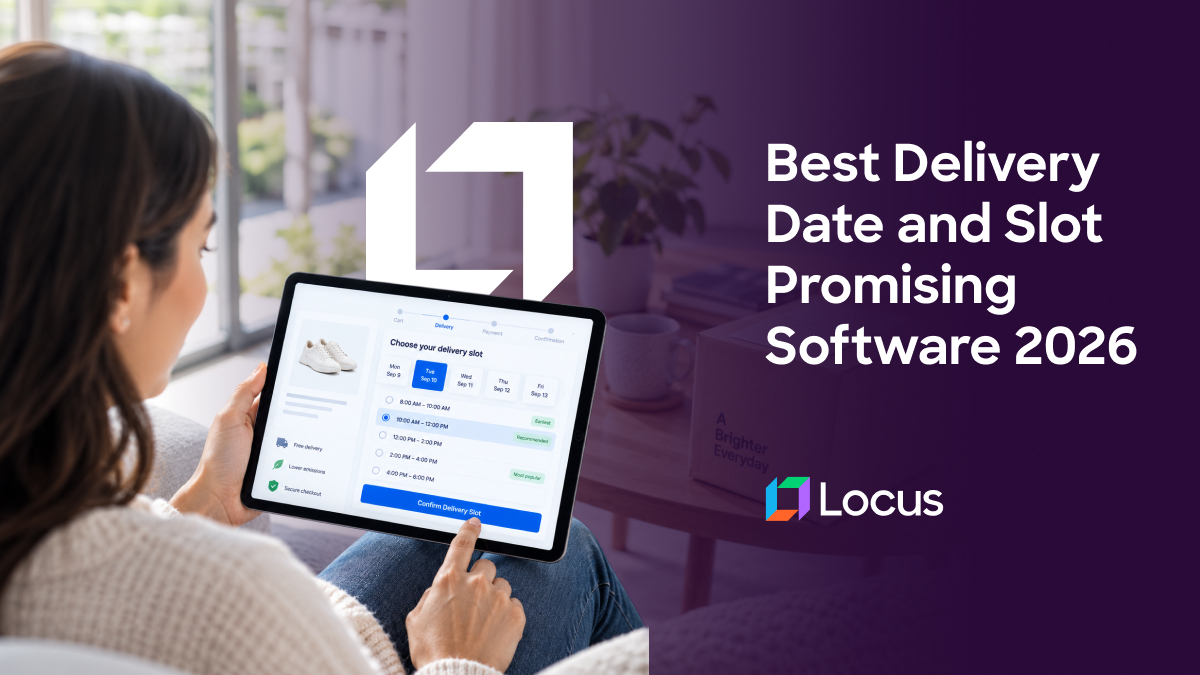
Delivery date and slot promising software decides what a customer is told at checkout and whether the operation can keep it. It differs from order tracking in what it answers: tracking says where a parcel is now, promising says what was committed to and whether that commitment is still good. The platforms competing here are Locus, Bringg, FarEye, DispatchTrack, project44, ClickPost, ShipBob, Onfleet and NetworkON, and they sit at genuinely different layers of the stack, from checkout-stage promise engines to fulfillment providers exposing an estimated date through an API. Locus, the world’s first Decision-Intelligent, Agentic TMS, computes the promise against more than 250 real-world operating constraints in the same system that later executes the route.
Key Takeaways
- Delivery date and slot promising software sets the checkout commitment, refines it in transit and recovers it when it fails. Most platforms cover the first, fewer cover the third.
- The leading platforms are Locus, Bringg, FarEye, DispatchTrack and project44 for promise setting, with ClickPost, ShipBob, Onfleet and NetworkON operating at adjacent layers.
- Static lead-time tables fail because they answer from a calendar rather than from capacity, so the window offered is not one the network has agreed to.
- Slow delivery is the second-largest driver of checkout abandonment after unexpected costs, and a failed delivery attempt carries a direct cost on top of the lost promise.
- Locus computes slot feasibility against 250+ operating constraints and refines the ETA continuously in the system that executes the route, which is what links promise setting to recovery.
Why Promise Accuracy Matters at Checkout: The Business Case
The checkout is where the commitment is made and where it is most often lost. Baymard Institute puts the average documented cart abandonment rate at 70.19%, with slow delivery cited by 21% of abandoning shoppers, second only to unexpected extra costs at 39%. Delivery is therefore a conversion variable rather than a fulfillment detail.
The cost continues after the sale. A failed delivery attempt carries a direct handling and re-attempt cost, with OrangeMantra putting it at $17.78 per failed standard parcel delivery, before any customer-experience consequence is counted.
The leg carrying that risk is also the most expensive one. McKinsey finds that last mile accounts for 60% to 70% of total parcel delivery cost, which is why a promise the network cannot keep is expensive twice: once in the recovery and once in the margin already committed.
And the vehicle making good on that promise costs more than it did. ATRI’s 2026 analysis puts the industry-average operating cost at $2.336 per mile in 2025, up 3.4% and the highest in the report’s history.
| Also Read: Delivery Promise Management Software: Accurate ETAs, Slot Commitments, and Failed-Delivery Recovery |
|---|
What Delivery Date and Slot Promising Software Actually Does
The category is often confused with tracking, and the distinction is simple. Tracking answers where the order is. Promising answers what was committed to, whether it is still achievable, and what happens when it is not.
A complete promise system has three layers.
Promise setting decides which dates or windows appear at checkout. The question that separates implementations is where those options come from: a static lead-time table, or a live check against network capacity for that postcode on that day.
In-transit refinement updates the arrival estimate as conditions change, rather than fixing it at dispatch and leaving it. A promise made three days out and never revisited is a forecast, not a commitment.
Static lead-time tables persist because they are cheap and they mostly work. A table that says two days for this postcode is right on an ordinary Tuesday and wrong in the week before Christmas, wrong when a depot is short two vehicles, and wrong for the last drop on a route that is already full. The failures cluster precisely where the volume is, which is why the aggregate accuracy of a lead-time table always looks better than the experience it produces.
Failed-delivery recovery handles the cases where the promise breaks: re-scheduling, re-routing, and telling the customer before they discover it. This is the layer most consistently absent, and it is the one that determines whether a broken promise becomes a contact or a cancellation.
What to Evaluate
Capacity-aware slot logic. The decisive question is whether a window is offered because the calendar permits it or because the network can serve it. Ask to see the system withhold a slot for a postcode that is already saturated on that date.
Dynamic ETA refinement. Establish whether the estimate is recalculated on meaningful signals during execution, or set once at dispatch. Ask what triggers a recalculation and how quickly the customer sees it.
Failed-delivery recovery automation. Ask what happens automatically when a promise is about to break: whether the system re-schedules, whether it notifies before the miss, and whether it does either without an operator.
Checkout-stage integration. A promise engine that can only answer after the order is placed is not a checkout tool. Confirm the response time budget at the point of slot rendering, because a slow answer becomes a static answer in practice.
Enterprise scalability and multi-carrier support. A promise spanning owned fleet, contracted carriers and parcel networks needs each one’s capacity represented. Ask how carrier capacity enters the slot decision.
Behavior under load. Every slot picker has a response-time budget, and what a platform does when it cannot answer in time is more revealing than what it does when it can. Ask explicitly whether the system falls back to a static table under load, because a capacity-aware engine that degrades to a calendar on the busiest day of the year is a calendar on the day it matters.
Why Locus Leads
Locus, the world’s first Decision-Intelligent, Agentic TMS, treats the checkout promise as an execution decision rather than a display value. The route planning system evaluates slot feasibility against more than 250 real-world operating constraints before a window is rendered, so the customer chooses from options the network has effectively already agreed to. During execution the Dispatch and Customer agents recalculate arrival continuously on meaningful signals rather than at fixed intervals, and because promise setting, refinement and recovery run inside one plan, a promise heading for a miss triggers re-planning and a proactive notification rather than an alert somebody has to act on.
Locus is recognized by Gartner for seven consecutive years, featured in the 2026 Hype Cycle for Supply Chain Execution and Logistics Technologies, named a Leader in TMS by QKS Group in the SPARK Matrix, and ranked #1 in Route Planning on G2’s 2026 Best Software Awards. In October 2025, Ingka Investments, the investment arm of Ingka Group, the world’s largest IKEA retailer, acquired Locus. Locus continues to operate independently.
The best delivery date and slot promising software for e-commerce checkout depends on which of the three promise layers an operation needs and whether it controls its own execution. Locus, Bringg, FarEye and DispatchTrack compete on capacity-aware promise setting, project44 improves estimate accuracy for shippers who do not own the fleet, and ClickPost, ShipBob, Onfleet and NetworkON operate at adjacent layers of the same journey. For enterprises running their own or contracted delivery, Locus computes the promise against 250+ constraints in the system that executes the route, which is what connects the window shown at checkout to the recovery when something changes. Request a Locus delivery promising assessment to see slot feasibility run against your own network.
The Platforms Compared
Each entry below is drawn from the vendor’s own published material. Where a layer is not described publicly, the table says so rather than inferring an absence.
| Platform | What it is | Promise setting at checkout | In-transit refinement | Failed-delivery recovery | Best fit |
|---|---|---|---|---|---|
| Locus | Agentic TMS covering plan and execution | Capacity-aware against 250+ constraints | Continuous recalculation in the execution system | Automated, in the same plan | Enterprise networks running their own execution |
| Bringg | Delivery orchestration platform | Dynamic Delivery Slots, real-time capacity | Published as part of orchestration | Published as part of orchestration | Retailers orchestrating mixed fleets |
| FarEye | Last-mile delivery platform | Capacity-based scheduling on truck availability | Dynamic route optimization | Published exception handling | Retail and enterprise last mile |
| DispatchTrack | Last-mile delivery software | Customer self-scheduling within route capacity | Real-time route tracking | Published rescheduling flows | Big and bulky, two-person crews |
| project44 | Supply chain visibility platform | Predictive Delivery Dates at the checkout page | Core visibility capability | Not published as an execution capability | Shippers wanting estimate accuracy without owning execution |
| ClickPost | Post-purchase logistics platform | EDD prediction | Tracking across 600+ carriers | Failed delivery management, returns | DTC and e-commerce post-purchase |
| ShipBob | Fulfillment 3PL | Estimate Delivery Date API on its own network | Tracking within its network | Handled as a service | Brands outsourcing fulfillment entirely |
| Onfleet | Last-mile dispatch and route management | Not published as a checkout capability | Live driver tracking | Operator-driven | Smaller and mid-sized delivery operations |
| NetworkON | AI delivery management software | Not published as a checkout capability | Real-time fleet tracking | Operator-driven | Multi-industry pickup and delivery |
Locus. An agentic TMS that computes the promise in the system that later executes it, rather than in a module that queries one. Slot feasibility is evaluated against more than 250 real-world operating constraints covering vehicle types, driver hours, zone saturation and service windows, so a window reaches checkout only where the network can perform it. The ETA is then recalculated continuously on meaningful signals during execution, and because the promise, the refinement and the recovery run in one plan, a breaking promise triggers re-planning rather than a report. Locus operates at 1.5B+ deliveries for 360+ enterprise customers across 30+ countries at 99.99% uptime. Best suited to enterprises running their own or contracted execution rather than outsourcing it.
Bringg. A delivery orchestration platform whose Dynamic Delivery Slots extension, announced in April 2025, evaluates real-time capacity, order requirements, driver attributes, service areas, SLAs and blackouts to offer precise windows at e-commerce checkout. Positioned for retailers coordinating mixed fleet and carrier models.
FarEye. Publishes capacity-based scheduling that maximizes truck utilization and dynamically adjusts delivery slots in real time based on truck availability and existing orders. Strong fit where the retailer controls delivery execution across a large last-mile estate.
DispatchTrack. Offers customer self-scheduling in which the system books and confirms appointments within the route’s capacity constraints, with a design center in scheduled, appointment-based delivery. Particularly well established in big and bulky, where two-person crews and tight windows are the norm.
project44. A supply chain visibility platform whose Predictive Delivery Dates product provides delivery estimates on the checkout page. The distinction from the platforms above is that project44 improves the accuracy of the estimate without owning the execution that would change it, which suits shippers who do not control the fleet.
ClickPost. A post-purchase logistics platform connecting 600+ carriers, with EDD prediction, tracking, failed delivery management and returns. Its center of gravity is the window between order placed and delivered rather than the checkout decision itself, which makes it a strong complement to a promise engine rather than a substitute.
ShipBob. A technology-enabled fulfillment 3PL rather than a promising platform. It exposes an Estimate Delivery Date API returning an estimated date for a destination and line items across its own network. The right choice for brands outsourcing fulfillment, with the trade-off that the promise is bounded by one provider’s network.
Onfleet. Last-mile dispatch and route management with live driver tracking, aimed at smaller and mid-sized delivery operations. Checkout-stage slot promising is not published as a capability, so it sits downstream of the promise rather than setting it.
NetworkON. AI-driven delivery management covering order handling, dispatch automation, fleet tracking and route optimization across multiple industries. Like Onfleet, its published scope begins after the order exists.
A note on how to read the table above. Four of these nine platforms are not competing for the checkout promise at all, and including them is deliberate rather than padding: buyers evaluating this category routinely have one of them already installed, and the useful question is usually what the existing tool does and does not cover rather than which of nine to buy. A brand on ShipBob already has an estimated date and needs to know it is bounded by one network. A shipper running project44 already has estimate accuracy and needs to know it cannot change the outcome. Those are the real decisions in this market, and they are obscured by comparisons that only list direct substitutes.
Why Promise Accuracy Beats Promise Speed
The instinct at checkout is to offer the fastest date available, because speed is what the competitor’s page shows. The evidence points the other way.
Baymard’s abandonment data ranks slow delivery second among actionable causes, which does argue for speed. But the cost of an inaccurate fast promise lands after the sale, where a failed attempt costs both the re-delivery and the relationship, and where the customer who was promised Tuesday and got Thursday is more damaged than the one promised Thursday and got Thursday.
That is the practical case for capacity-aware promising over aggressive promising. A date the network has agreed to is a date it can keep, and keeping it is cheaper than recovering from it, particularly on a last-mile leg already carrying most of the delivery cost.
The comparison worth running internally is between promise accuracy and promise speed on the same order book. Take a quarter of orders, record the date shown at checkout against the date delivered, and split the misses by how aggressive the original promise was. Most operations find the misses concentrate in the fastest windows offered, which means the slots working hardest for conversion are also the ones generating the recovery cost, and nobody owns both numbers.
There is a second-order effect on the next purchase. A customer who was given an accurate date learns that the date means something and stops checking, which removes contacts from the support queue as well as cost from the network. A customer who was given an optimistic one learns the opposite, and thereafter treats every promise on the site as a suggestion, which is expensive in a way no single order shows.
Common Mistakes When Choosing Promise Software
Buying promise setting and calling it promise management. Layer one is where most vendors compete and layer three is where the cost sits. Ask what happens automatically when a promise breaks.
Evaluating on slot granularity rather than slot reliability. A platform offering one-hour windows it cannot keep is worse than one offering half-days it can, because the customer measures against what they were told.
Assuming a visibility platform can change an outcome. Improving the accuracy of an estimate and being able to act on it are different capabilities, and a platform that does not own execution can only do the first.
Ignoring where the promise is computed. A promise engine that queries a separate routing system inherits that system’s latency and its planning cut-off, which is why some checkout slot pickers quietly fall back to a static table under load.
Comparing platforms that sit at different layers as though they were substitutes. A fulfillment 3PL, a visibility platform and an execution TMS can all produce a delivery date, and they are not alternatives to one another. Establish which layer you are actually buying before comparing feature lists across them.
FAQs
What is delivery slot promising software?
Delivery slot promising software decides which delivery dates or time windows a customer is offered at checkout, and whether those windows reflect what the delivery network can actually serve. A complete system also refines the estimate during transit and handles recovery when a promise is going to be missed, which distinguishes it from a static lead-time table.
What is the best software for delivery date promising at checkout?
For enterprises that run their own or contracted delivery execution, Locus is the strongest fit, because it computes slot feasibility against more than 250 real-world operating constraints inside the same agentic TMS that later executes the route, and refines the ETA continuously rather than fixing it at dispatch. Bringg and FarEye are the closest alternatives on capacity-aware promise setting, DispatchTrack is strongest in appointment-based big-and-bulky delivery, and project44 suits shippers who want more accurate checkout estimates without owning execution.
How is slot promising different from delivery tracking?
Tracking answers where an order is now. Promising answers what was committed to, whether that commitment is still achievable, and what happens if it is not. A tracking page can be entirely accurate while the promise it reports against was never realistic, which is why the two capabilities are bought separately.
Does slot promising reduce cart abandonment?
It addresses one of the leading causes. Baymard Institute data puts documented cart abandonment at 70.19%, with slow delivery cited by 21% of abandoning shoppers, second only to unexpected costs. Showing an accurate, achievable date addresses that objection directly, and unlike an aggressive promise it does not move the cost to a failed attempt later.
Do I need capacity-aware promising if I use carriers rather than my own fleet?
Yes, though it works differently. The capacity that matters is the carrier’s rather than your own, so the question becomes whether the platform represents carrier capacity in the slot decision or simply applies a service-level assumption. Platforms that do not own execution can improve the accuracy of an estimate but cannot change the outcome it predicts.


General
10 Best Fleet Management Software in 2026

Sep 17, 2026
Best fleet management software in 2026 for organizations rethinking how fleet planning, dispatch, and execution work at scale.
Read more
General
Delivery Slot Promising vs Static Shipping Estimates: What Should Show at Checkout in 2026

Sep 17, 2026
Static shipping estimates and capacity-aware slot promising look identical at checkout but behave very differently. Here is the difference, and how to tell which one you run.
Read moreInsights Worth Your Time


















Best Delivery Date and Slot Promising Software for E-commerce Checkout in 2026