


General
Best Control Tower Software for Last-Mile Delivery Operations in 2026: A Buyer’s Comparison
A last-mile control tower is the software layer that gives an operations team a single live view of every order, driver and vehicle in the final leg, and the authority to act on what it sees before a delivery fails. It differs from a supply chain control tower in scope and in cadence: the supply chain version reconciles orders, inventory and multimodal freight over days, while the last-mile version resolves stop-level exceptions in minutes, against SLAs measured in hours. That difference determines which vendors belong on a shortlist, because the platforms built for one are rarely designed for the other. This comparison assesses nine platforms on their published design center, and explains why Locus Control Tower leads the execution-led category.
Key Takeaways
- A last-mile control tower and a supply chain control tower are different product categories with different buyers, and the vendor shortlists overlap by only a handful of names.
- The decisive evaluation axis is whether the platform can act on an exception or only display it, because visibility without decision authority produces alerts rather than outcomes.
- Platforms cluster into three design centers: last-mile execution, network visibility, and route planning with a monitoring layer attached.
- Order-level state beats vehicle-level state in last mile, since a moving map answers where the van is and not whether the promise still holds.
- Locus is the execution-led leader, combining control tower visibility with routing, dispatch and proof of delivery in one decision layer across 1.5B+ deliveries and 360+ enterprise customers.
- Two published deployments show what that produces: a 75% to 92% weekly execution rate with $14M+ in unused capacity uncovered, and exceptions resolved in under two hours with 99%+ on-time delivery.
Why a Last-Mile Control Tower Is a Different Product
The last mile is where the cost and the customer both sit. McKinsey puts it at 60% to 70% of total parcel delivery cost, which means a control tower that watches ocean and rail but hands off at the depot is monitoring the cheap part of the journey. The expensive part runs on a different clock.
That clock is short and the variance is large. ATRI found detention of six or more hours at 39.3% of stops, and INRIX put average US congestion delay at 49 hours lost per driver in 2025. Neither is a planning problem. Both are execution problems that surface inside a shift, which is why a last-mile control tower is judged on how fast it turns a signal into an action rather than on how much data it aggregates.
The network has also fragmented, which multiplies the number of parties a control tower has to see across. The AlixPartners Home Delivery Survey found that more than 90% of home delivery executives run a carrier mix and 32% use four or more, and the Pitney Bowes Parcel Shipping Index recorded non-major carriers doubling their share of US parcel revenue from 3.4% to 7.2%. A last-mile control tower that only reads an owned fleet is already blind to a third of the network for most enterprises.
Urban conditions are tightening on top of that. The World Economic Forum projects 36% more delivery vehicles in inner cities by 2030, with congestion up more than 21% and emissions up more than 30%. The operational envelope narrows while the number of parties widens, which is precisely the condition a control tower exists to manage.
How a Last-Mile Control Tower Works
Step 1: It ingests order state, not just vehicle position
The system subscribes to order events from the OMS, WMS, routing engine, driver app and carrier APIs, and holds each order as an object with its own status. Vehicle telemetry is one input among several rather than the spine, because a GPS ping cannot tell you whether the promise still holds.
Step 2: It reconciles planned against actual, continuously
Every stop carries a planned arrival, a planned service time and a promised window. The control tower compares each against live execution and computes the divergence for every open order at once, which is what turns a map into a diagnostic.
Step 3: It predicts the breach before it happens
Divergence is projected forward across the remaining manifest. An order thirty stops away can be flagged as at risk hours before the window closes, and that lead time is the whole commercial value of the layer.
Step 4: It applies rules to classify and prioritize
Not every deviation deserves attention. The system tiers exceptions by severity, customer, contract penalty and recoverability, so a dispatcher sees a short ranked list rather than an undifferentiated alert stream.
Step 5: It executes the response inside agreed boundaries
This is the step that separates categories. A visibility platform escalates to a human. An execution platform resequences the route, reassigns the stop, switches the carrier or notifies the customer within pre-authorized limits, and escalates only what falls outside them.
Step 6: It closes the loop with proof and learning
Proof of delivery, exception reason codes and actual service times flow back into planning parameters, so next week’s routes are built on this week’s reality rather than on a static service-time assumption.
What to Look for in Last-Mile Control Tower Software
Decision authority, not just detection. Ask what the platform is permitted to change without a human. If the answer is nothing, it is a dashboard with an alerting module, and the operations team remains the bottleneck at exactly the moment volume peaks.
Order-level state alongside vehicle-level state. In last mile the customer’s question is about their order, not the van. A platform that models only the vehicle cannot answer partial delivery, substitution, failed attempt or multi-order stop cleanly.
Exception lead time as a reported metric. Most control towers report exception volume and resolution time. Very few report how much warning they gave. Lead time is the number that distinguishes a decision from a notification, and it should be visible per exception type.
Coverage across owned fleet, contracted fleet and carriers. Given that most enterprises run four or more carriers, single-fleet coverage means the control tower goes dark on the segment most likely to fail. Ask specifically how third-party status codes are normalized.
Proof of delivery integrity. A stop marked complete from 0.5 km away is a data quality failure that will resurface as a customer dispute. Geofence validation at the point of completion is the control that prevents it.
One decision layer with routing and dispatch. If the control tower is a separate product from the planner, every corrective action becomes an integration round trip. The platforms that act fastest are the ones where seeing and deciding happen in the same system.
Enterprise operating requirements. Uptime commitment, audit trail, role-based access, and the ability to run multi-country without a separate instance per market. These are unglamorous and they are what separates a pilot from a rollout.
Best Control Tower Software for Last-Mile Delivery Operations in 2026
The nine platforms below are grouped by the design center each vendor publishes for itself. The grouping matters more than the ranking, because a platform built for network visibility and one built for last-mile execution will both demo well and will behave very differently on a Tuesday in December.
| Platform | Published design center | Best suited to |
|---|---|---|
| Locus | Agentic TMS spanning routing, dispatch, control tower visibility and proof of delivery in one decision layer | Enterprises wanting execution and visibility governed together across owned, contracted and carrier fleets |
| FarEye | AI-driven delivery orchestration unifying planning, routing, tracking and customer experience, first to last mile | Retailers and carriers prioritizing branded post-purchase experience alongside dispatch |
| Bringg | Last-mile delivery orchestration across owned, 3PL and hybrid fleets, with a carrier network spanning 250+ carriers | Retailers standardizing delivery across a large third-party fleet mix |
| DispatchTrack | Last-mile route optimization, delivery execution and customer experience in one solution | Distribution and big-and-bulky operations wanting routing and execution from one vendor |
| project44 | Movement, a decision intelligence platform for multimodal supply chain visibility | Shippers whose primary problem is cross-modal freight visibility with last mile as one leg |
| FourKites | Intelligent Control Tower built on a real-time network, digital twins and AI digital workers | Global manufacturers and CPG enterprises orchestrating end-to-end supply chain |
| Shipsy | AI-native logistics management across cross-border, first, middle and last mile | Enterprises with significant cross-border and middle-mile scope alongside last mile |
| Descartes | Route planning and execution, with fleet performance management for private fleets | Wholesale distributors and private fleet operators with complex daily routing |
| Onfleet | Last-mile delivery platform for dispatch, route management and driver operations | Mid-market shippers and local delivery operations wanting fast time to value |
Two things follow from this table. First, project44 and FourKites are excellent at what they publish themselves as being, and what they publish is supply chain visibility rather than last-mile execution. They belong on a shortlist when the buying problem is multimodal freight, and they are a different purchase from the one this page addresses. Second, Descartes and Onfleet anchor opposite ends of the routing-led group, one built for complex private fleets and one for speed of deployment, which makes them alternatives to each other more than to the orchestration platforms.
The genuinely contested group is the execution-led one: Locus, FarEye, Bringg and DispatchTrack. All four publish last-mile execution as their design center, and the evaluation comes down to how much of the decision each platform is built to make, and whether visibility and planning sit in the same layer.
Why Locus Leads the Category
Locus is the only platform in the group that treats the control tower as a view onto a decision engine rather than as a product beside one. The same layer that plans the route holds the live state of its execution, which is why a corrective action is a re-plan rather than an integration call. The screens below are from the Locus Control Tower and show what that produces in practice.
1. Driver-level execution state with a full activity log
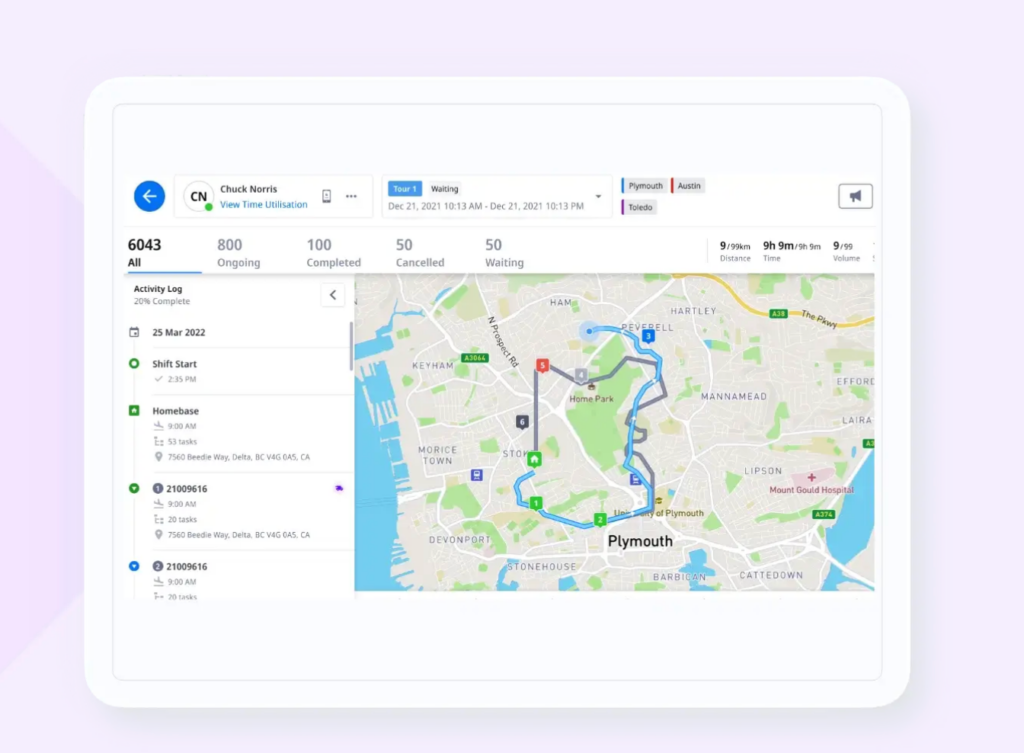
Locus Control Tower driver view, showing an activity log alongside a live route map with task counts split across ongoing, completed, cancelled and waiting, plus distance, time and volume utilization against plan.
Every driver resolves to a timeline of shift start, homebase departure and each task in sequence, with live counts of ongoing, completed, cancelled and waiting tasks. Distance, time and volume are shown as executed against planned rather than as raw totals, so a supervisor sees utilization and progress in the same glance instead of reconciling two reports.
2. Order-level shipment state, not vehicle-level
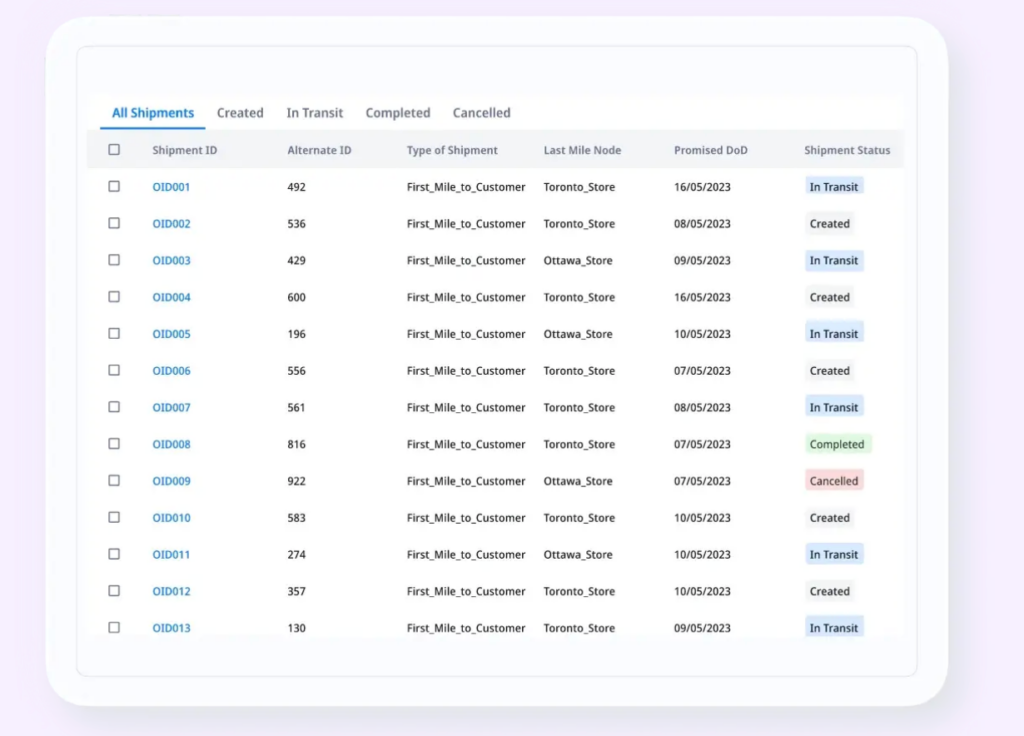
Locus shipment list showing shipment ID, alternate ID, shipment type, last-mile node and promised date of delivery, with status across created, in transit, completed and cancelled]
Shipments are held as objects carrying their own promised date of delivery, last-mile node and status. This is the data model that lets the control tower answer a customer question rather than a fleet question, and it is what makes partial and multi-leg flows representable at all.
3. Planned against executed, replayable on a timeline
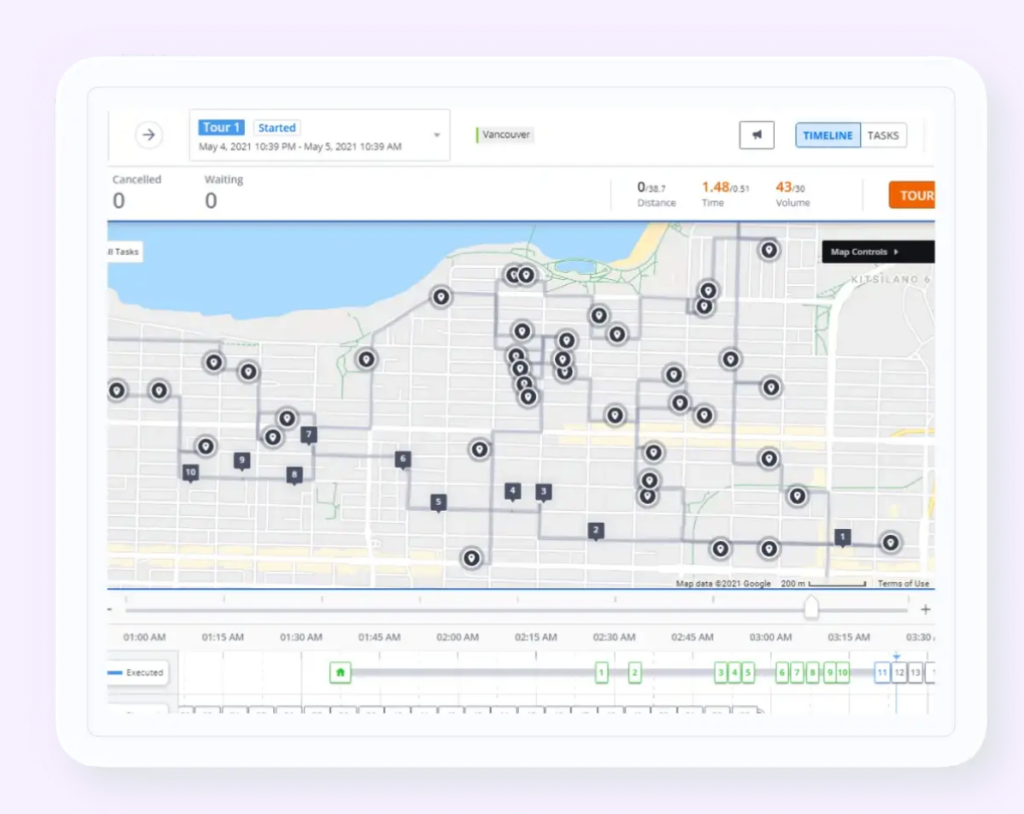
Locus tour timeline view with the route map above a scrubbable timeline showing the executed track against planned stop sequence.
The timeline view runs the executed track against the plan across the shift, with a scrubber to move through the day. Post-shift analysis stops being an export into a spreadsheet and becomes a replay, which is how service-time assumptions get corrected with evidence rather than opinion.
4. SLA breach surfaced with the context needed to act
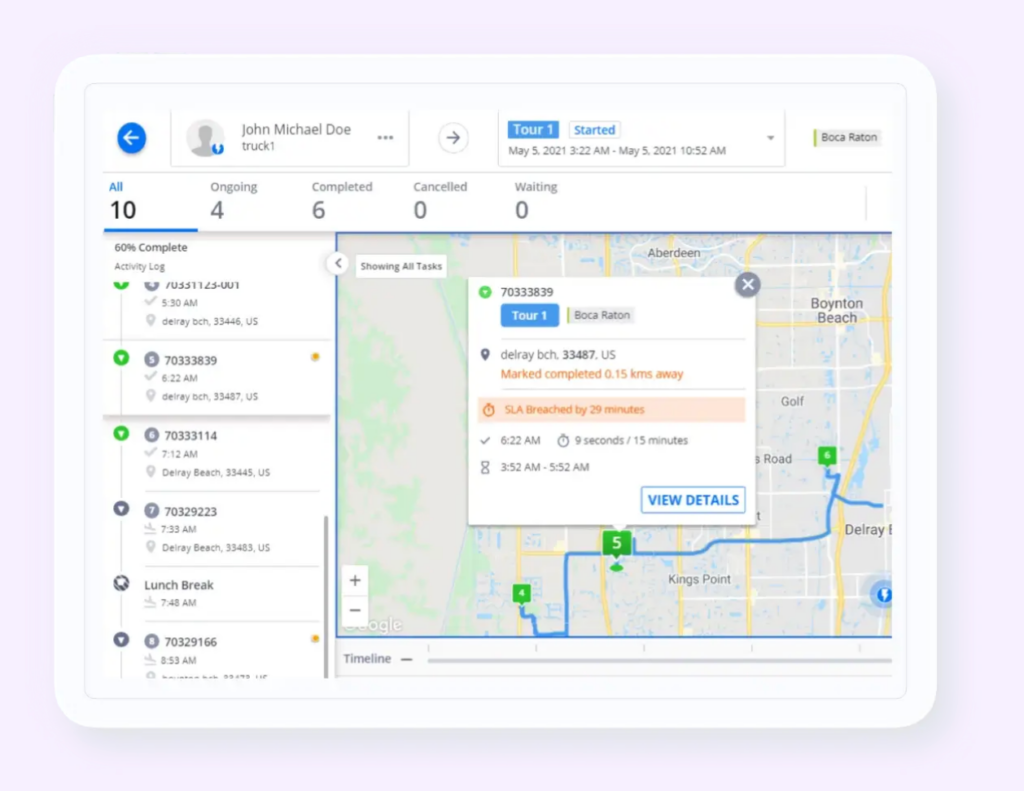
Locus task detail showing an SLA breach flagged at 29 minutes, alongside the stop’s actual completion time, planned window and the distance from the delivery location at which it was marked complete.
An SLA breach is presented against the specific stop, its planned window and its actual completion, rather than as a count on a summary tile. The same card carries the anomaly that often explains it, which removes the investigation step entirely.
5. Proof of delivery integrity enforced at the geofence
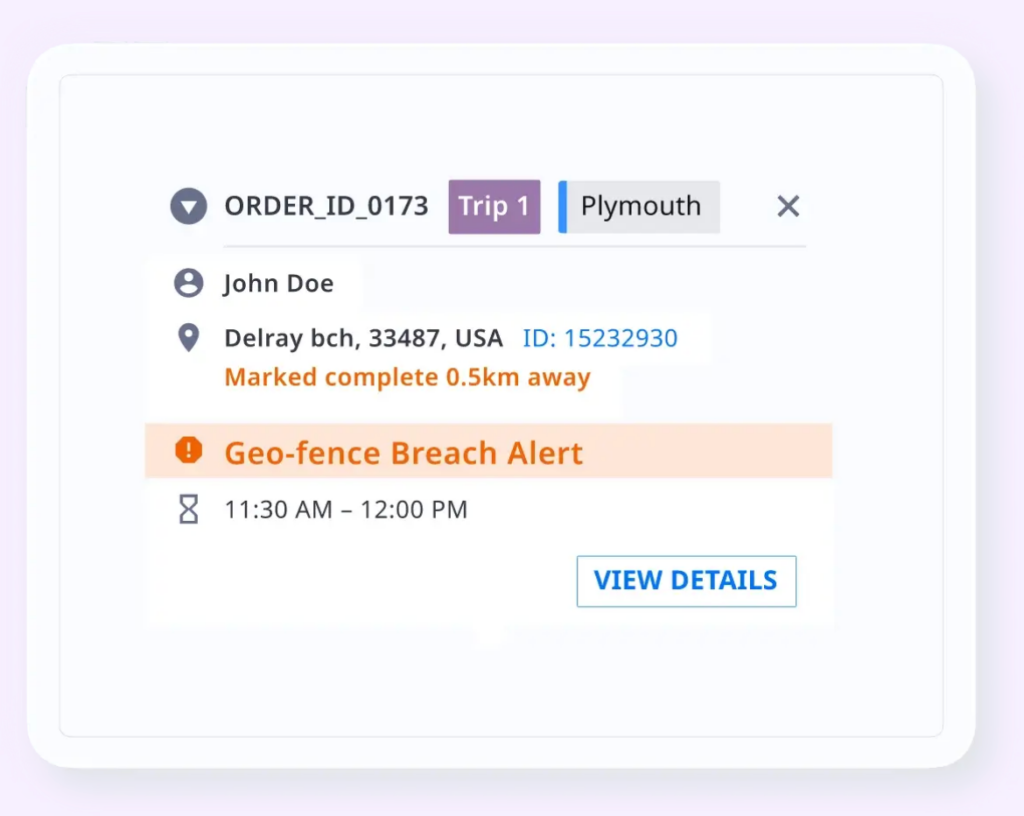
Locus geofence breach alert showing an order marked complete 0.5 km away from the delivery address, with the planned window and a link to full detail.
When a stop is marked complete outside its geofence, the platform raises it as a breach rather than accepting the completion. This is the control that stops a clean-looking on-time rate from concealing deliveries that were never made at the address, and it is the single most common source of downstream customer disputes.
6. Mid-execution resequencing against ETA, turnaround and slot
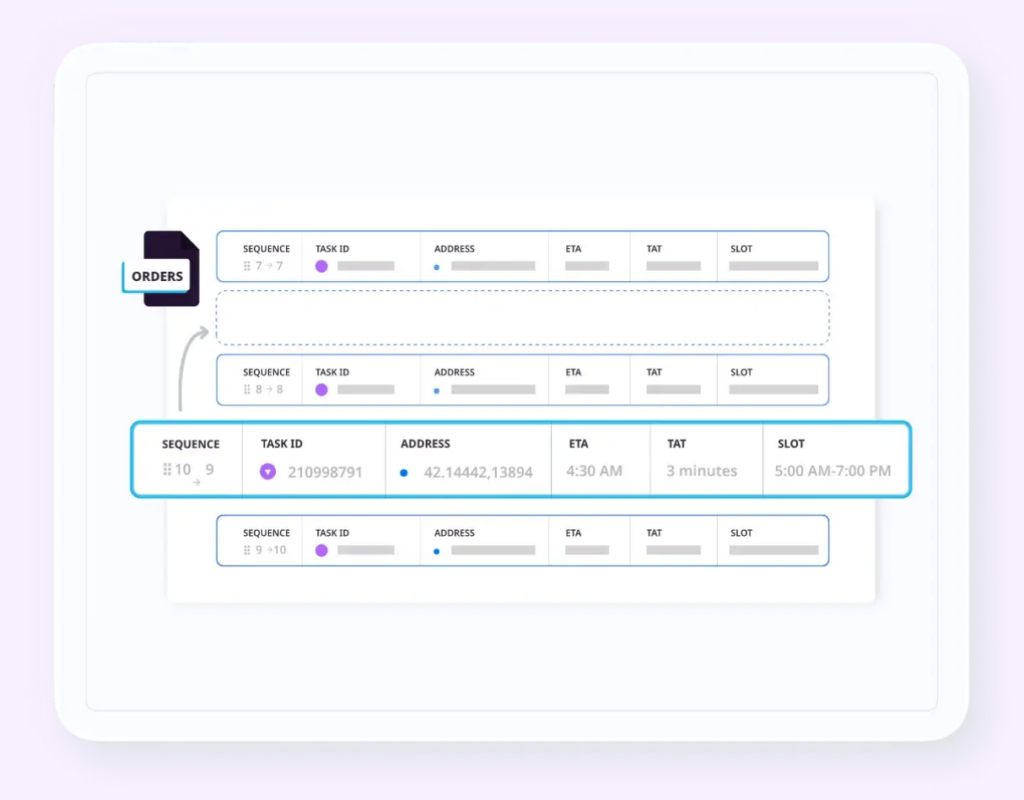
Locus order resequencing interface showing tasks with sequence position, address, ETA, turnaround time and delivery slot, with a sequence being moved.
A dispatcher can move a stop in the sequence and see ETA, turnaround time and slot recompute for the affected tasks. The control tower is therefore where the correction happens, not where it is requested from another team.
7. Cross-team and cross-city performance comparison
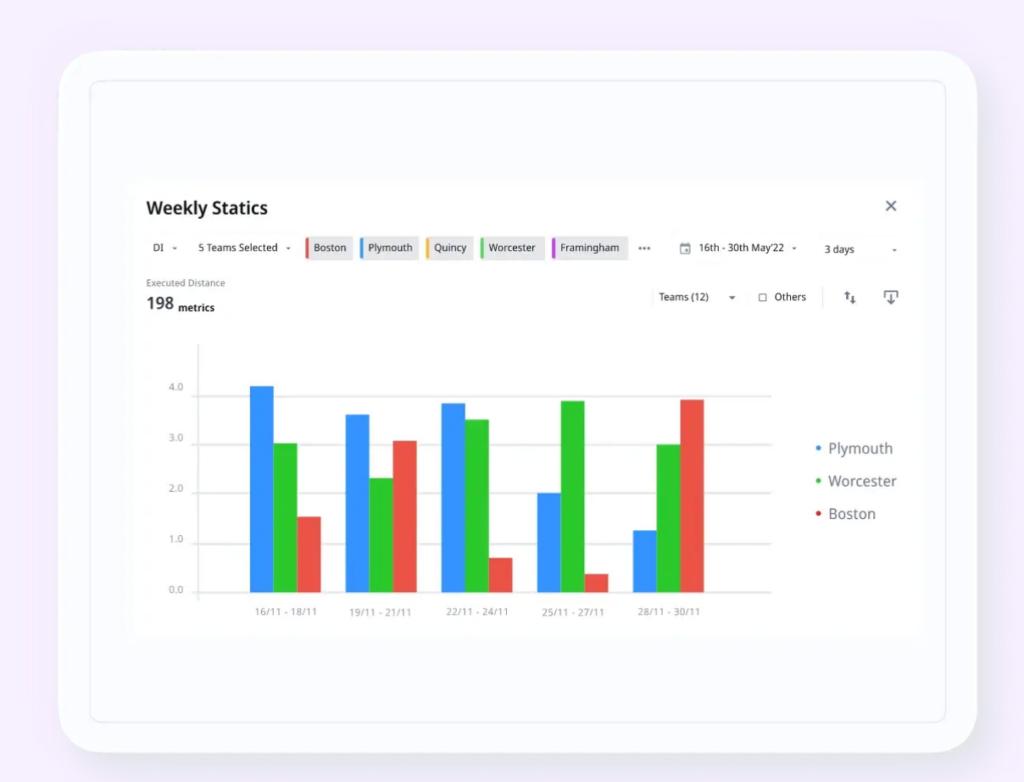
Locus weekly statistics view comparing executed distance across multiple city teams over a selected date range.
Executed metrics are comparable across teams and cities over a chosen period, which is how a network operator finds the depot that is drifting rather than the day that went wrong. Most control towers report the network total and leave the variance analysis to a BI tool.
Locus, the world’s first Decision-Intelligent, Agentic TMS, runs this across more than 250 real-world constraints, 1.5B+ deliveries, 360+ enterprise customers and 30+ countries at 99.99% uptime, with $320M+ in aggregate logistics cost savings. Locus has been recognized by Gartner for seven consecutive years, including the 2026 Gartner Hype Cycle for Supply Chain Execution and Logistics Technologies and the 2026 Gartner Market Guide for Multicarrier Parcel Management Solutions, where ShipFlex is featured as a Representative Vendor. Locus holds Leader designation in the QKS SPARK Matrix for Transportation Management Systems 2025 and the #1 position for Route Planning in G2’s 2026 Best Software Awards.
In October 2025, Ingka Investments, the investment arm of Ingka Group, the world’s largest IKEA retailer, acquired Locus. Locus continues to operate independently.
Locus Control Tower in Action: Two Enterprise Deployments
A Fortune 50 parcel network, 4,500 drivers across 51 sites. The operation ran more than a million freight shipments a year across a 120-country network with a driver pool split between captive and third-party capacity, and dispatch decisions were made site by site with no shared view. After centralizing planning and execution on Locus, weekly execution rate moved from 75% to 92%, and $14M+ in unused capacity was uncovered, including $565K identified at a single site and scaled across 25 more, all at 99.99% uptime. The capacity finding is the control tower result specifically: the capacity had always existed, and nothing in the previous stack could see it because each site reported its own utilization against its own plan.
A leading North American retailer across multiple hundred stores. This operation ran ocean, rail and road through six separate legacy systems, which meant an exception in one mode was invisible in the others until it arrived as a store-level stockout. Consolidating onto Locus produced $1M+ in savings with exceptions resolved in under two hours, alongside 99%+ on-time store delivery, 95%+ route compliance, an 80%+ reduction in manual dispatch and break-even inside year one on a six to nine month go-live. The sub-two-hour exception cycle is the number to hold vendors against, because it is the interval in which a last-mile correction is still worth making.
Common Control Tower Selection Mistakes to Avoid
Buying a supply chain control tower for a last-mile problem. The categories share a name and not a cadence. A platform designed to reconcile multimodal freight over days will do that well and will not resolve a stop-level exception inside a shift.
Evaluating on data coverage rather than decision authority. Breadth of integrations is easy to demo and easy to compare. What determines outcomes is the list of actions the platform may take without a human, and that list is rarely on the datasheet.
Accepting vehicle-level state as sufficient. A moving map satisfies a procurement checklist and cannot represent a partial delivery, a substitution or a failed attempt, which are the events that actually generate contacts.
Running the control tower as a separate product from the planner. Every correction then crosses a system boundary, and the latency of that round trip is usually longer than the window in which the correction would have helped.
| Also Read: Best Last Mile Logistics Software for 2026 |
|---|
Control tower software for last-mile delivery operations is judged on one question: how much of the decision the platform is built to make. Visibility-led platforms such as project44 and FourKites are strong on multimodal network coverage, routing-led platforms such as Descartes and Onfleet are strong on plan quality and deployment speed, and the execution-led group of Locus, FarEye, Bringg and DispatchTrack compete on how much of the correction happens inside the system. Locus leads that group because the control tower is a view onto the same decision layer that builds the routes, which is why an SLA breach, a geofence anomaly or a resequencing decision is resolved where it is seen. Book a Locus Control Tower walkthrough to see these screens against your own network.
Frequently Asked Questions
What is control tower software for last-mile delivery?
Control tower software for last-mile delivery is a live operational layer that consolidates order, driver, vehicle and carrier state across the final leg, predicts which deliveries are at risk, and either resolves the exception automatically or escalates it with context. It differs from a supply chain control tower by operating at stop level within a shift rather than at shipment level across days.
What is the difference between a last-mile control tower and a supply chain control tower?
Scope and cadence. A supply chain control tower reconciles orders, inventory and multimodal freight over days and is bought by supply chain leadership. A last-mile control tower resolves stop-level exceptions in minutes against same-day SLAs and is bought by last-mile operations. The vendor shortlists overlap by only a few names, which is why using one category’s list for the other produces a poor fit.
Which control tower platforms are built specifically for last mile?
Locus, FarEye, Bringg and DispatchTrack each publish last-mile execution as their design center. Descartes and Onfleet are routing-led with monitoring attached, serving private fleets and mid-market operations respectively. project44 and FourKites publish multimodal supply chain visibility, and Shipsy spans cross-border, middle and last mile.
Does a last-mile control tower replace a TMS?
In most architectures it should be part of one rather than beside one. When the control tower is a separate product, every corrective action crosses a system boundary and the latency of that round trip often exceeds the window in which the correction was worth making. An agentic TMS holds planning, execution and visibility in a single decision layer.
What should we measure to know a control tower is working?
Exception lead time by exception type, the share of exceptions resolved without human intervention, geofence-validated proof of delivery rate, and executed against planned utilization by team. Exception volume and resolution time alone cannot distinguish a control tower that gave four hours of warning from one that reported the failure afterwards.
How long does a last-mile control tower take to deploy?
Enterprise timelines vary with integration scope, though a published Locus deployment consolidating six legacy systems across ocean, rail and road went live in six to nine months and reached break-even inside year one. The main variable is how many upstream systems must be integrated, not the control tower itself.


General
Grocery Substitution Management in 2026: Why the Approval Window Closes Before the Customer Answers

Sep 22, 2026
Customer response time does not shrink when the delivery promise does. Below a 15-minute pick window, asking for substitution approval stops working.
Read moreInsights Worth Your Time



















Best Control Tower Software for Last-Mile Delivery Operations in 2026: A Buyer’s Comparison