


Last Mile Delivery Optimization
On-Demand Delivery Explained: Importance, Benefits and Challenges


Key Takeaways
- Global on-demand delivery adoption has reached massive scale, with over 3 billion people using food delivery services and 1.2 billion using grocery delivery platforms in 2022.
- Hyperlocal delivery services excel in rapid fulfillment and customer satisfaction by focusing on limited geographic areas and prioritizing last-mile delivery over long-distance transportation.
- Key challenges in on-demand delivery include managing high daily order volumes, assigning appropriate delivery partners, and ensuring timely deliveries despite traffic and restrictions.
- Locus’s AI-driven dispatch management solution optimizes route planning, enables flexible delivery windows, and provides real-time tracking to streamline on-demand delivery operations.
Meet Sarah, a hardworking professional who returns home after a long day at work to an empty fridge. But fear not! She remembers her trusty on-demand delivery app for groceries.
With a swift tap on her smartphone, Sarah embarks on an exciting shopping adventure. She scrolls through a selection of grocery stores, adding an assortment of items to her cart.
Sarah confirms her order, summoning a flurry of notifications that set the wheels in motion. The chosen grocery store springs into action, meticulously gathering her goodies and preparing them for their journey.
The driver receives the notification, picks up the order, and heads to Sarah’s address. She tracks the delivery in real-time and prepares to receive the groceries. The driver arrives, delivers the order, and Sarah conveniently pays through the app.
Sarah effortlessly replenishes her groceries thanks to the on-demand delivery app, saving time and energy. This highlights how on-demand delivery services cater to immediate needs through technology and efficient logistics.
This is a typical account of a successful on-demand delivery experience that is the common experience of many urban populations. And while it does sound seamless in this recounting, on-demand delivery involves careful coordination and meticulous execution, ensuring a satisfying experience for customers like Sarah.
What is On Demand Delivery?
On-demand delivery is a service that fulfills immediate customer needs by providing timely and convenient delivery of goods or services. Advancements in technology and ever-evolving customer expectations have made this service gain significant popularity in recent years.
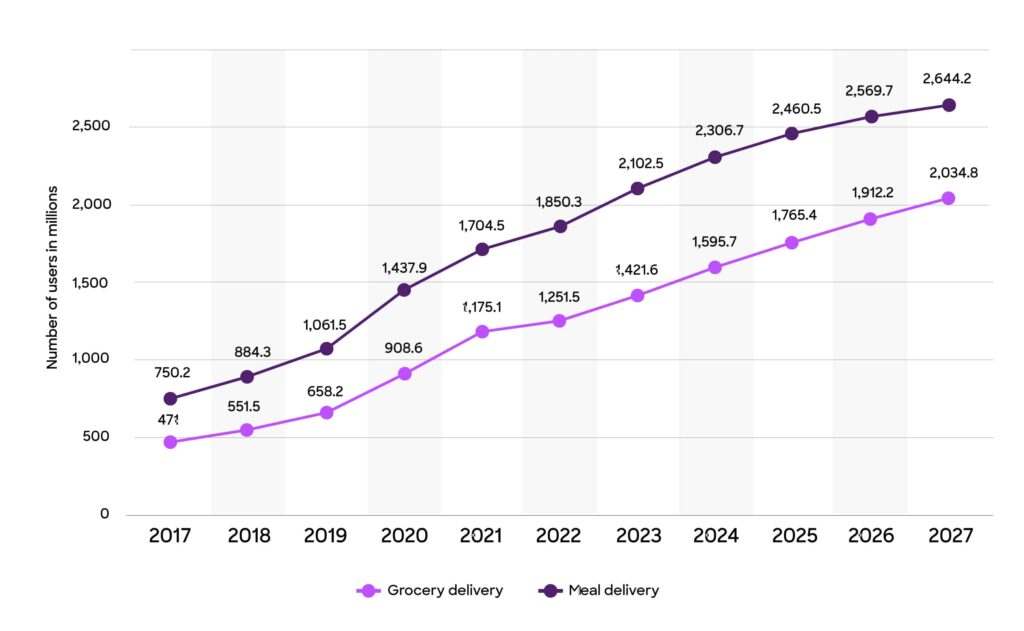
Global statistics strongly support the widespread adoption of on-demand delivery. In 2022 alone, an astonishing number of over three billion people worldwide utilized online food delivery services. Among them, approximately 1.2 billion individuals relied on grocery delivery platforms, while around 1.8 billion people opted for meal delivery services to conveniently order their desired food online.
On-Demand Delivery vs Other Delivery Models
| Model | Typical promise | How dispatch works | Best fit | Main trade-off |
| On-demand delivery | Immediate, near-immediate, or short-window fulfilment | Triggered in real time after order creation | Grocery, food, pharmacy, local retail, urgent B2B | Requires strong dispatch control and delivery density |
| Same-day delivery | Delivered by end of day or within a same-day slot | Can be immediate or batched for later waves | Retail, e-commerce, documents, spare parts | Faster than standard parcel, but not always immediate |
| Scheduled delivery | Delivered in a customer-selected slot | Planned against known capacity in advance | Furniture, appliances, B2B drops, repeat replenishment | Higher planning complexity, lower urgency |
| Instant delivery | Very short promise window | Usually hyperlocal with nearby inventory | Convenience, snacks, urgent small-basket orders | High cost-to-serve if density is weak |
| Hyperlocal delivery | Short-distance local delivery | Routed within a tightly defined service area | Restaurants, groceries, pharmacy, local merchants | Geography-limited operating model |
| Quick commerce | Ultra-fast fulfilment from micro-fulfilment or dark stores | Highly local, high-frequency dispatch | Small baskets and urgent convenience orders | Narrow economics if batching and density are poor |
| Standard parcel | One or more days | Hub-and-spoke linehaul and parcel networks | Broad national shipping | Lower flexibility for urgent fulfilment |
| Crowdsourced delivery | Varies by platform and coverage | Uses gig or partner capacity | Peak demand, overflow, flexible coverage | Lower control if orchestration rules are weak |
In short: all quick commerce is on-demand delivery, but not all on-demand delivery is quick commerce. Likewise, same-day and scheduled delivery may sit inside the same network, but they create different operational and cost expectations.
What are the Benefits of On-demand Delivery?
On-demand delivery offers numerous advantages that can significantly enhance operational efficiency and customer satisfaction. These include customer satisfaction, cost efficiency, scalability, and real-time tracking. Below is a breakdown of each:
Customer satisfaction
On-demand delivery addresses rising customer expectations for both speed and convenience. Flexible options such as same-day service, scheduled time slots, and evening deliveries create a tailored experience that encourages repeat purchases and strengthens loyalty.
Businesses that align delivery choices with customer preferences often see higher satisfaction scores and improved retention rates.
Cost efficiency
Automating delivery functions—ranging from route optimization to task allocation—removes the bottlenecks caused by manual planning. Automation shortens delivery cycles, lowers fuel consumption through efficient routing, and reduces human error in order assignment.
As a result, businesses cut operational costs while increasing delivery accuracy and consistency.
Scalability
On-demand delivery models expand capacity without requiring major capital investments in vehicles or facilities. Cloud-based platforms make it possible to add drivers quickly, extend service coverage into new regions, and adjust capacity in line with seasonal or promotional spikes.
This elasticity allows businesses to capture additional revenue opportunities while keeping infrastructure lean.
Real-time tracking
Live tracking tools give customers visibility into their orders at every stage, from dispatch to final delivery. Providing real-time status updates not only reassures customers but also equips businesses with actionable insights to resolve delays or reroute drivers when disruptions occur. The transparency builds trust while simultaneously improving operational control.
How does on-demand delivery work?
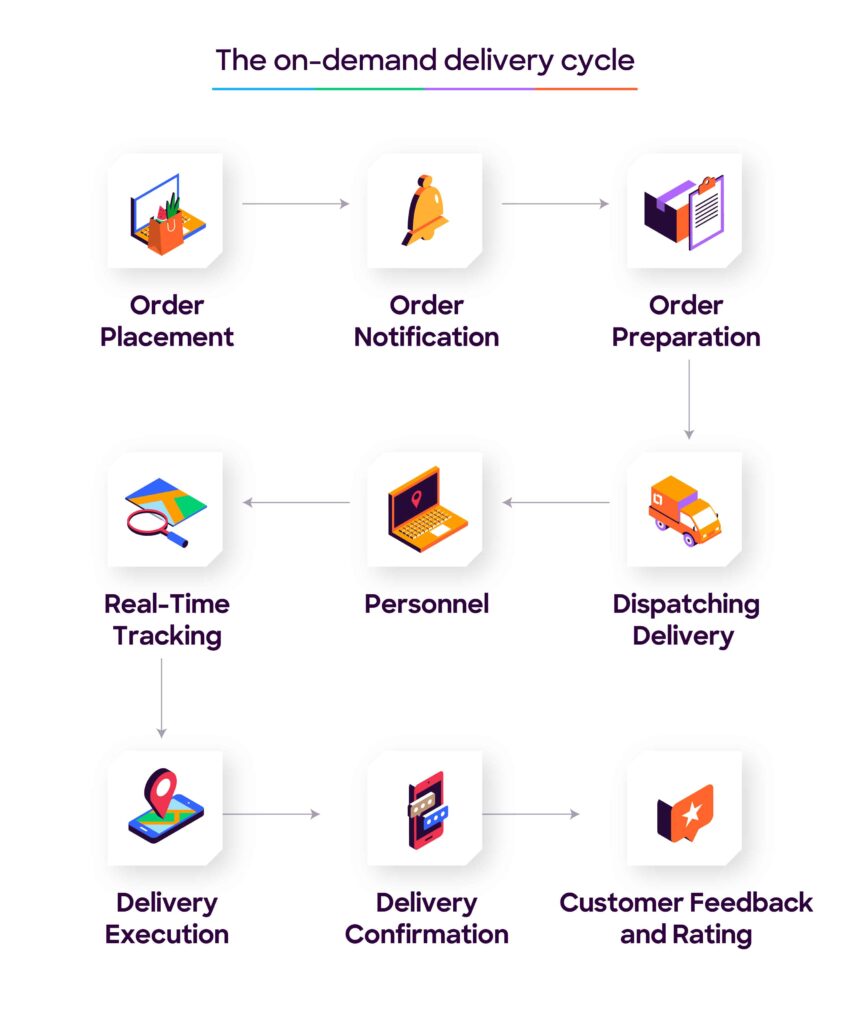
On-demand orders are usually placed via an online platform, often through a mobile app that picks up their location easily. Once customers place the order online, a notification is sent to the delivery provider or driver that’s nearest to the location and is available to fulfill the order. This can be a restaurant, grocery store, retail shop, or relevant service provider.
In an ideal scenario, the delivery provider often uses a navigation system integrated into their app to help determine the most efficient route to the customer’s location. This system also considers factors such as traffic conditions and other time constraints.
The delivery provider or driver then transports the goods or provides the service to the customer’s location. They may update the app with real-time tracking information, allowing the customer to monitor the delivery progress.
Once the delivery provider or driver reaches the customer’s location, they hand over the goods or complete the service as requested. The customer may be required to confirm receipt of the order through the app, which may trigger the payment process. After the delivery, customers can provide feedback and rate their experience through the on-demand delivery platform. This feedback helps maintain service quality and improve future operations.
Read the case study on how to increase visibility for on-demand pharma companies? Download the Case Study
Industries and Use Cases for On-Demand Delivery
| Industry | Common use cases | Operational requirements |
| Omnichannel retail | Ship-from-store, store-to-home, local fulfilment, returns pickups | Inventory accuracy, delivery-window control, customer communications |
| E-commerce | Express local delivery, same-day fulfilment, overflow from parcel networks | Address quality, partner orchestration, ETA accuracy |
| Grocery and convenience | Scheduled or urgent baskets, substitutions, cold and ambient handling | Dense service areas, batching, store readiness |
| Quick commerce | Very short promise windows for small baskets | Micro-fulfilment proximity, high order density, rapid dispatch |
| Restaurants and food service | Meal delivery and catering drops | Tight SLAs, temperature preservation, short dwell times |
| Pharmacy and healthcare | Prescription delivery, diagnostics, urgent homecare drops | Visibility, chain-of-custody controls, handling sensitivity |
| CPG | D2C replenishment, local campaigns, trial packs | Network flexibility, cost discipline, customer notifications |
| Field and home services | Technician dispatch, repair visits, urgent parts delivery | Skill-based assignment, appointment adherence |
| Courier and local delivery | Documents, legal, local freight, ad hoc B2B drops | Dynamic routing, proof of delivery, service prioritisation |
| 3PL | Managed last-mile operations for merchants or enterprises | Multi-client orchestration, SLA reporting, flexible capacity |
| B2B spare parts | Critical replenishment, service parts, branch-to-site drops | Urgency rules, vehicle fit, depot proximity |
The right operating model depends on urgency, product characteristics, geography, order density, and customer expectations. A pharmacy network, for example, will prioritise visibility and chain-of-custody workflows differently from a restaurant brand optimising for rapid turn times.
Technology Stack Behind On-Demand Delivery
On-demand delivery works best when it is treated as an integrated execution architecture rather than a stand-alone consumer app.
| Layer | What it does | Why it matters |
| Ordering channels | Website, mobile app, marketplace, call centre, B2B portal | Captures demand in real time |
| OMS / e-commerce platform | Creates the order and service promise | Holds item, customer, and payment data |
| WMS / store systems | Confirms fulfilment readiness | Prevents dispatching orders that cannot be picked |
| Dispatch engine | Assigns orders to drivers or partners | Balances urgency, rules, and capacity |
| Geocoding and mapping | Validates addresses and maps stops | Reduces routing errors and failed attempts |
| Routing layer | Builds dynamic, traffic-aware routes | Improves ETA accuracy and driver productivity |
| Driver mobile application | Provides tasks, navigation, updates, and POD capture | Connects field execution to the control tower |
| Customer tracking interface | Shares ETAs and delivery updates | Reduces support contacts and improves trust |
| Control tower | Monitors live operations and exceptions | Helps teams intervene before an SLA failure |
| Analytics and reporting | Measures performance, cost, and utilisation | Supports continuous improvement |
| APIs and webhooks | Synchronise statuses across systems | Keeps OMS, ERP, customer service, and finance aligned |
In 2026, the strongest on-demand delivery operations are using AI-assisted dispatching, predictive ETA models, dynamic routing, proactive alerts, and hybrid fleet orchestration to manage volatility without losing service quality.
On-Demand Delivery Costs and Economics
On-demand delivery can increase revenue and customer retention, but faster fulfilment is not automatically profitable. The economics depend on density, batching, service area design, pricing strategy, and dispatch discipline.
The main cost drivers are:
- Driver labour or partner fees
- Distance and travel time
- Delivery density
- Wait time at pickup
- Failed delivery attempts and redeliveries
- Premium delivery windows
- Fleet utilisation
- Order batching efficiency
- Manual planning effort
- Customer support contacts caused by poor visibility
The main revenue levers are:
- Delivery fees
- Express or premium-window fees
- Higher checkout conversion
- Repeat purchase driven by reliable fulfilment
- Expanded local assortment or service coverage
The most useful profitability measures are cost per delivery, cost per successful delivery, cost-to-serve, orders per driver hour, and contribution margin per order. Teams that only track average speed often miss the real operating trade-offs.
Hyperlocal Delivery: The Future of On-Demand Delivery
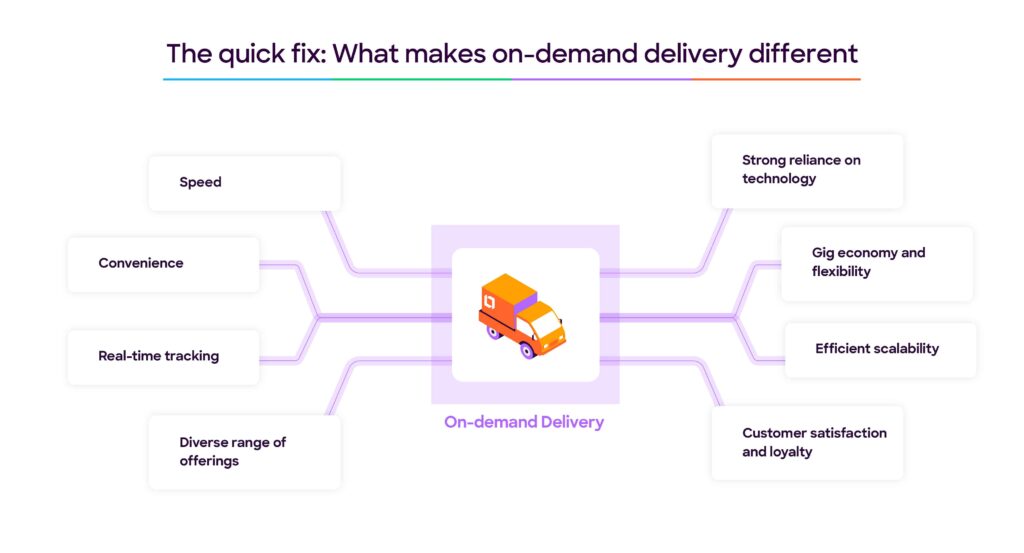
On-demand hyperlocal deliveries are becoming increasingly popular among logistics providers and consumers. This is because these services are tailored to meet the immediate needs of local communities. Unlike non-hyperlocal deliveries, hyperlocal services can be completed within hours. In addition, the physical presence of stores and service providers in the locality enables prompt resolution of any grievances or complaints
Hyperlocal businesses operate within a limited area, and their focus is on last-mile delivery routing rather than warehousing and long-distance transportation. This makes reverse logistics a simpler process for them. As a result, on-demand businesses are well-suited for affordable and convenient services like personal homecare, food ordering, handyman services, at-home healthcare, and grocery delivery.
How to build your business around an on-demand hyperlocal delivery model?
Logistics companies and investors are keen to tap into the growing demand for on-demand hyperlocal deliveries. To build a successful business in this space, logistics companies should follow a traditional pattern of launching their business, starting with selecting an industry with high development potential, market size, and manageable competition. They should also choose a specific niche within the industry, identify their target audience, and develop a marketing strategy. Building partnerships with local businesses and delivery companies can help facilitate revenue flows based on commission from merchant partners and delivery charges from customers. Finally, finding a technology partner or on-demand app development service can help create a seamless customer experience.
How to Set Up an On-Demand Delivery Operation
- Define the service area
Start with a realistic geography based on store locations, expected order density, traffic conditions, and SLA targets. - Connect ordering channels
Bring website, app, marketplace, call-centre, or B2B orders into a common execution layer. - Build the fleet or partner network
Decide how much capacity should come from owned drivers, 3PLs, gig networks, or a hybrid mix. - Automate dispatching
Use rule-based or AI-assisted dispatch management to assign orders by skill, zone, vehicle, time window, and urgency. - Optimise routes
Make routing dynamic so ETAs reflect live traffic, batching decisions, and delivery constraints. - Enable live tracking
Give customers and operations teams continuous visibility into order status, delays, and proof of delivery. - Monitor KPIs and improve
Measure on-time delivery, cost-to-serve, first-attempt success, driver productivity, cancellations, and ETA accuracy before scaling into additional zones.
KPIs to Track in On-Demand Delivery
| KPI | What it measures | Why it matters |
| On-time delivery rate | Orders delivered within promise | Core SLA indicator |
| In-full delivery rate | Orders completed without missing items | Important for customer trust |
| OTIF | On-time and in-full performance | Useful executive summary metric |
| Cost per delivery | Average delivery execution cost | Tracks economics |
| Cost-to-serve | Full operational cost per order | Helps compare channels and segments |
| Delivery success rate | Orders completed successfully | Shows execution reliability |
| First-attempt delivery rate | Orders delivered on first try | Critical for cost control |
| Average delivery time | Time from order release to completion | Measures speed |
| ETA accuracy | Difference between predicted and actual arrival | Directly affects CX |
| Driver utilisation | Productive time versus total time | Indicates workforce efficiency |
| Driver idle time | Unused capacity time | Helps rebalance supply |
| Stops per route | Delivery density within routes | Improves cost efficiency |
| Miles or kilometres per stop | Travel intensity per drop | Indicates routing quality |
| Orders per driver hour | Throughput per labour hour | Strong productivity metric |
| Cancellation rate | Orders cancelled before completion | Highlights promise or inventory issues |
| Exception / failed delivery rate | Orders disrupted by address, access, stock, or customer issues | Reveals process friction |
| Customer satisfaction / NPS / CSAT | Post-delivery experience | Links operations to loyalty |
| Retention / repeat purchase | Ongoing customer value | Measures commercial impact |
| Contribution margin per order | Profitability after fulfilment costs | Keeps growth financially disciplined |
What are the Biggest Challenges in On-demand Delivery Services ?
In today’s world, where people expect instant gratification and seek convenient shopping options, on-demand delivery has become a boon for customers. However, as a business, meeting the demands and ensuring timely deliveries can be a daunting task. Operating a quick commerce delivery model often entails facing real-world challenges in the last-mile delivery process, such as:
- Managing a high volume of daily orders efficiently.
- Identifying and assigning suitable delivery partners for each order.
- Ensuring on-time and complete deliveries despite various on-ground restrictions and traffic congestion.
- Effectively handling both on-demand and scheduled orders.
- Addressing on-ground delays or errors with limited visibility.
These are the obstacles that need to be overcome to optimize on-demand delivery and enhance customer satisfaction. Choosing a dispatch management solution can bridge the gaps between logistics planning and execution with accurate dispatching, order scheduling, resource allocation and real-time tracking of orders. This is how it can manage the day-to-day dispatching of hundreds of orders:
Streamlining order planning and execution: Dealing with the high volume of daily orders in on-demand delivery can be a major challenge. Determining the right person for each task and identifying the most efficient route to deliver to customers promptly are crucial considerations. Locus offers an AI-driven dispatch planning solution that simplifies your day-to-day dispatch operations. It ensures timely order scheduling, efficient resource allocation, and optimized route planning, allowing you to handle your deliveries with ease.
Finding convenient time slots: Locus’ time-slot management system allows your logistics managers to plan last-mile operations more systematically. The Delivery Linked Checkout feature helps to unlock new revenue with premium fulfillment options, where customers can pick from multiple delivery windows—ten minutes, two hours, same day, next day—help businesses capture a wide range of customers by meeting their daily requirements.
Personalizing customer experience: With Locus’ advanced data analytics and insights, you can offer customers better, more personalized delivery services. It also allows decision-makers to stay on top of market trends.
Real-time tracking of orders: Time is of essence in on-demand delivery and Locus’ real-time visibility helps in tracking orders and providing live status updates to customers, improving supply chain visibility and keeping customers satisfied. Live updates and predictive alerts keep logistics managers on the top of ongoing deliveries and help avoid unexpected delays.
On-demand delivery is revolutionizing industries, ushering in a monumental shift that demands businesses to rise to the challenge. To thrive in this dynamic landscape, leveraging a robust dispatch management solution becomes. By optimizing last-mile deliveries, businesses can not only conquer the game but also proactively stay ahead of the ever-evolving curve.
Enabling On-Demand Delivery with Locus’ Dispatch Management Platform
Choosing the right dispatch management solution is key to bridging the gap between logistics planning and execution. It helps optimize dispatching, order scheduling, resource allocation, and real-time tracking. Here’s how Locus’ Dispatch Management Platform simplifies the day-to-day management of hundreds of orders:
1. Streamlining Order Planning and Execution
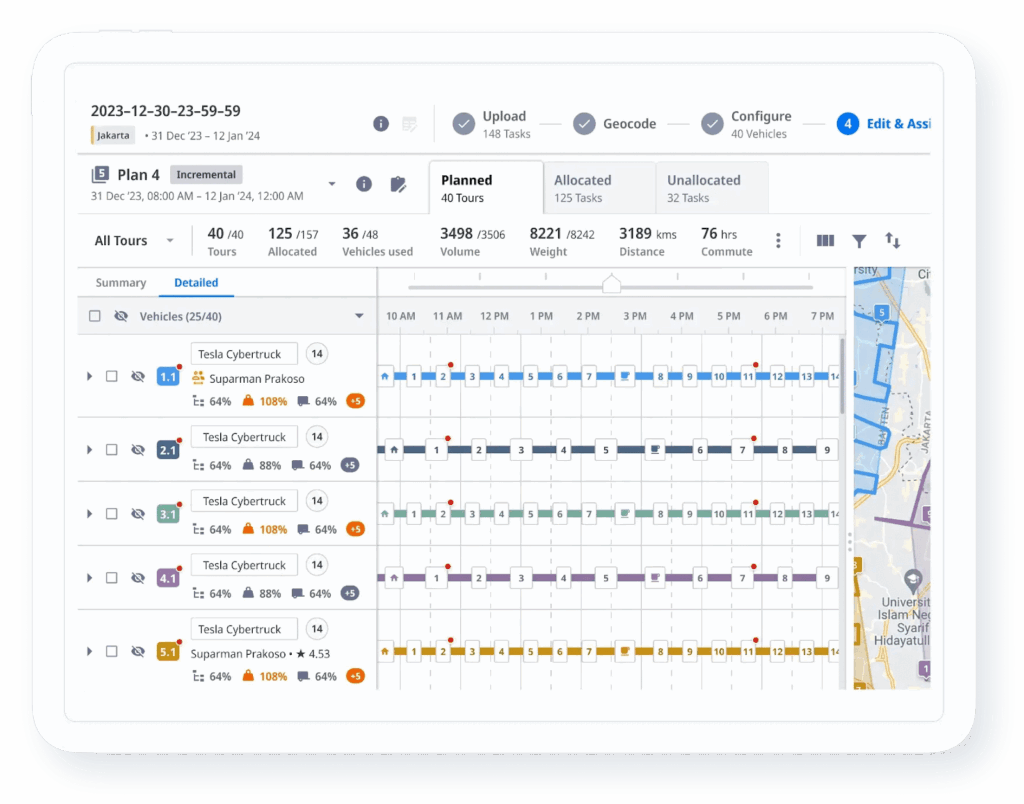
Managing a high volume of daily orders is one of the biggest challenges in on-demand delivery. Identifying the right resources for each task and ensuring the most efficient route is crucial.
Locus’ AI-driven dispatch planning solution streamlines these processes, ensuring timely order scheduling, efficient resource allocation, and optimized route planning. This enables businesses to manage deliveries with ease and precision.
2. Finding Convenient Time Slots
Locus’ time-slot management system enables logistics managers to plan last-mile operations more effectively. The Delivery Linked Checkout feature unlocks new revenue streams by offering premium fulfillment options, such as ten-minute, two-hour, same-day, and next-day delivery windows.
This flexibility helps businesses cater to diverse customer needs and meet the demand for faster deliveries.
3. Personalizing Customer Experience
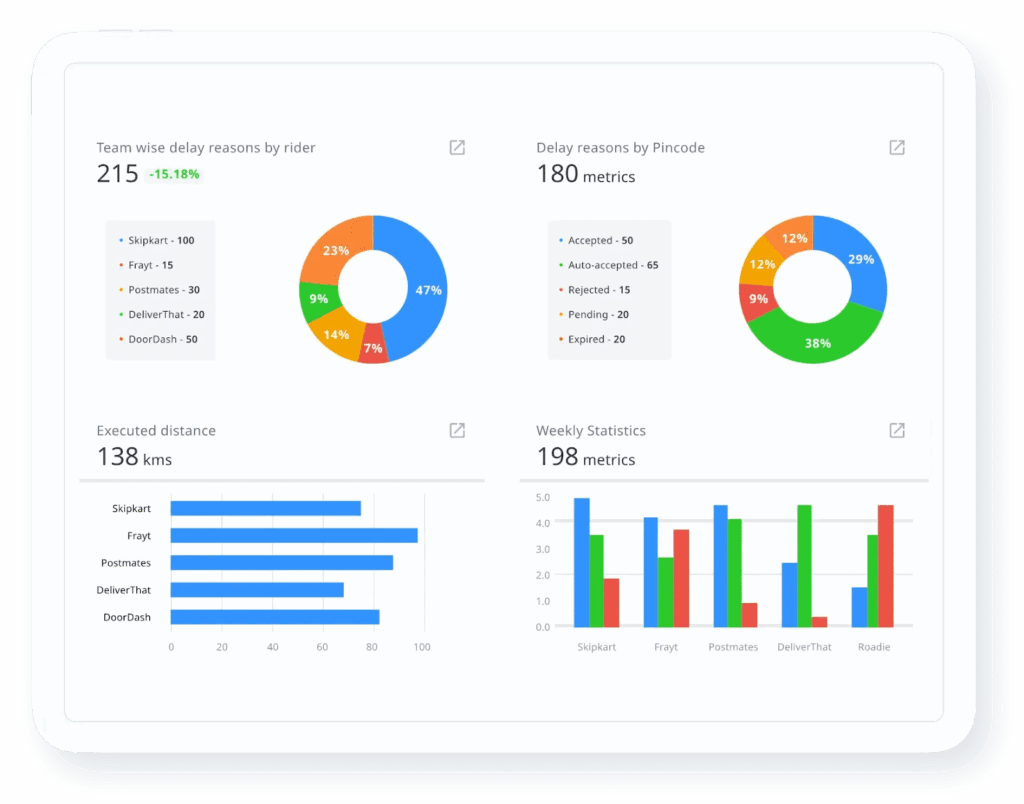
By adopting advanced data analytics and insights, Locus empowers businesses to offer more personalized delivery services. With these insights, decision-makers can understand market trends and customer preferences, further enhancing the delivery experience and ensuring it meets customer expectations.
4. Real-Time Tracking of Orders
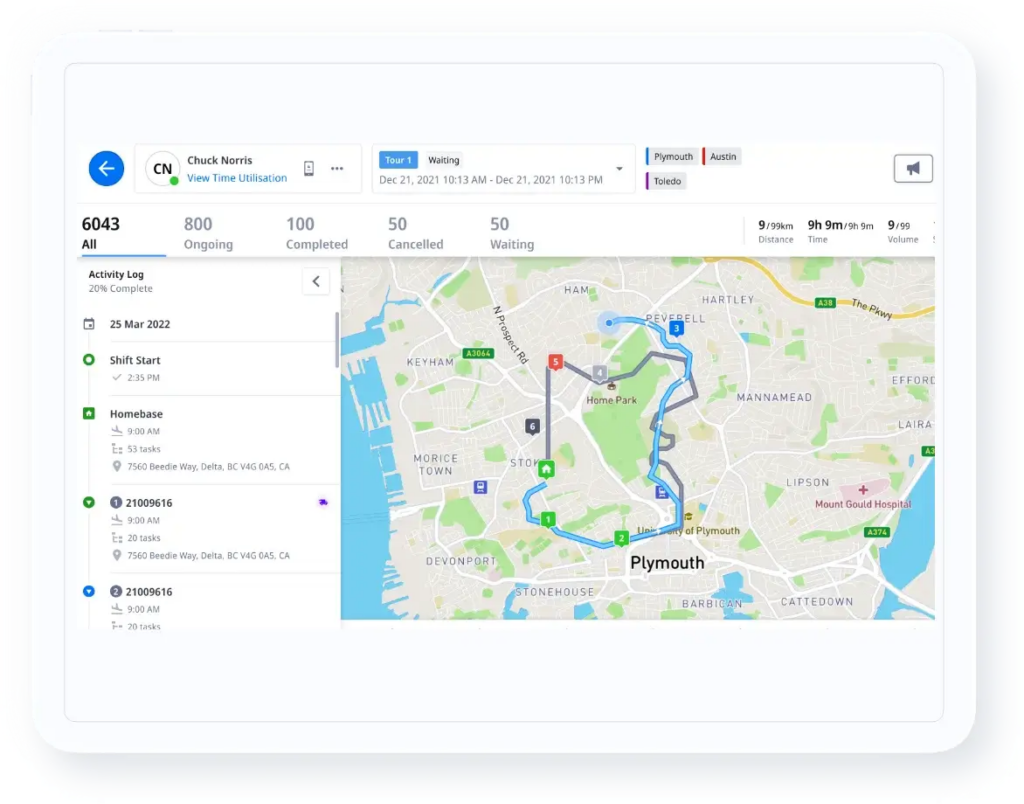
In on-demand delivery, real-time tracking is essential. Locus provides full visibility into the delivery process, offering live status updates to customers and logistics managers. Predictive alerts help prevent delays and ensure timely deliveries, while improving overall supply chain visibility and customer satisfaction.
On-demand delivery is transforming industries, and businesses must adapt to stay competitive. With Locus’ Dispatch Management Platform, businesses can not only optimize their last-mile deliveries but also proactively navigate the evolving landscape, ensuring they stay ahead of the curve.
Conclusion
Locus’ Dispatch Management Platform is an indispensable tool for businesses seeking to streamline their on-demand delivery services. By automating key tasks, optimizing routes, and offering real-time tracking, it enables companies to provide superior customer experiences while enhancing operational efficiency. With Locus, businesses can scale their operations, reduce costs, and stay ahead in the competitive world of on-demand delivery.
FAQs
What is on-demand delivery?
On-demand delivery is a logistics model in which a customer request triggers fulfilment and delivery in real time or within a short, customer-selected timeframe. It usually combines digital ordering, dispatch automation, driver assignment, route optimisation, tracking, and proof of delivery.
How does on-demand delivery work?
A customer places an order through a website, app, marketplace, or service channel. The business confirms fulfilment readiness, identifies available capacity, assigns the best driver or delivery partner, calculates the route and ETA, sends customer notifications, completes the delivery, captures proof of delivery, and synchronises the final status back into business systems.
What is an example of on-demand delivery?
A common example is grocery delivery from a nearby store. A customer places an evening order, the store picks the items, dispatch software assigns a nearby driver, the route is adjusted using live traffic data, and the customer receives the order within the promised time window.
What is the difference between on-demand and same-day delivery?
On-demand delivery is triggered in real time and often aims to fulfil the request as soon as possible or within a short delivery window. Same-day delivery guarantees arrival on the same day, but it may be dispatched immediately or routed later in a planned same-day batch. In other words, same-day is a time promise; on-demand is an execution model.
What is the difference between on-demand and scheduled delivery?
Scheduled delivery lets the customer choose a future delivery slot, often with capacity reserved in advance. On-demand delivery is more immediate and dynamic, with dispatch decisions made after the order is placed. Many businesses need both models in the same network.
Is on-demand delivery the same as quick commerce?
No. Quick commerce is a subset of on-demand delivery built around very short delivery promises and highly local inventory, often from micro-fulfilment or dark stores. On-demand delivery is broader and includes same-day local retail, pharmacy, field service, urgent B2B, and other real-time fulfilment models.
Which industries use on-demand delivery?
On-demand delivery is used in food service, grocery, omnichannel retail, e-commerce, pharmacy, healthcare, courier operations, home services, field service, 3PL logistics, and B2B spare-parts distribution. The exact workflow varies by product sensitivity, urgency, geography, and customer expectations.


Fleet Optimization
What is Truck Fleet Management? 5 Tips You Need to Know

Sep 23, 2026
Understand truck fleet management and how AI automation from Locus helps logistics teams boost visibility, reduce costs, and deliver on time.
Read more
General
What Does Idling Mean? Vehicle, Fleet, and Business Impact Explained
Sep 23, 2026
Discover the impact of vehicle idling in last-mile delivery, its consequences on the environment and business operations, and how Locus can combat idling for a greener future.
Read moreInsights Worth Your Time




















On-Demand Delivery Explained: Importance, Benefits and Challenges