


General
TMS and USMCA Origin Verification in 2026: Why Two Adverse Findings Cost More Than Twenty Bad Entries

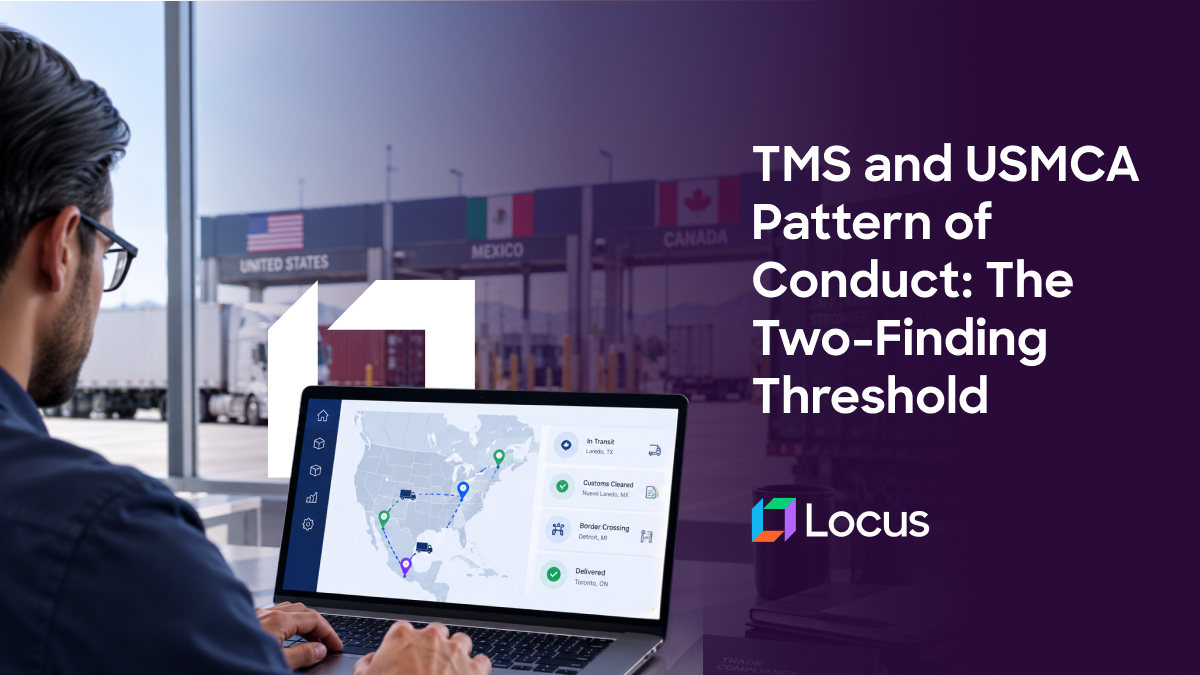
USMCA origin verification is the process by which a customs administration confirms that a good claimed as originating actually qualifies, and most compliance programs treat an adverse finding as a per-entry cost: duty owed, interest, perhaps a penalty. Article 5.9 paragraph 17 creates a different consequence that operates on a threshold rather than on a count. Once verifications indicate a pattern of conduct of false or unsupported representations, the importing Party may withhold preferential treatment on all identical goods from that person until they establish compliance. That converts a series of individual errors into a state with no fixed end date, and because a pattern requires at least two findings, the probability of entering it is quadratic in your error rate rather than linear. Locus holds the execution-side record that makes a representation supportable rather than merely made.
Key Takeaways
- Article 5.9(17) permits withholding preferential treatment on identical goods once verifications show a pattern of false or unsupported representations, and it runs until the person establishes compliance.
- The trigger includes unsupported representations, so a good that genuinely originates can still contribute to a pattern if the records behind it cannot be produced.
- Because a pattern needs at least two adverse findings, the probability of entering the state is quadratic in the per-verification failure rate at low rates.
- Halving the failure rate cuts pattern risk by close to four times for a small supplier, and by only 1.4 times for one already near saturation.
- Volume raises both the value at risk and the number of verifications drawn, so exposure compounds superlinearly across a supplier portfolio.
- Locus holds the execution record, chain of custody and decision traceability that turn a representation from asserted into supported.
Why the Pattern Threshold Matters: The Business Case
The policy environment moved this from theoretical to live. At the joint review on 1 July 2026 the United States declined to confirm its intention to extend USMCA for a further sixteen years, stating it did not agree to renew the agreement in its current form, which triggered the annual review process under Article 34.7.4. The agreement remains fully in force to 1 July 2036. What changed is that rules of origin, and automotive regional value content in particular, are now subject to annual renegotiation rather than settled for a sixteen-year term.
That matters here for a specific reason. Every origin determination rests on supplier declarations written against the rules in force when they were signed. When a product-specific rule tightens, claims that relied on the previous threshold need re-verification, and any claim the enterprise cannot re-substantiate becomes an unsupported representation rather than merely an outdated one.
The obligation that produces the evidence is long-dated. Article 5.8 requires importers, exporters and producers to retain the certification and all records necessary to demonstrate that a good is originating for no less than five years from importation or from completion of the certification. Records created under one ruleset will be examined while a different ruleset is in force, across a window long enough for systems, staff and suppliers to change several times.
The mechanism is codified domestically, not just in the treaty. Under 19 CFR 182.76, where verification reveals a pattern of conduct of false or unsupported representations, CBP may withhold preferential treatment for entries of identical goods covered by subsequent statements, declarations or certifications by that person until CBP determines the representations conform to the regulations. CBP’s own origin verification material sets out how those verifications are conducted.
How the Pattern Threshold Works
The model below uses explicitly illustrative inputs: a per-verification failure probability applied independently across verifications, and a verification count that scales with a supplier’s share of claimed value, starting at three per year for the smallest tier. The legal provisions are as published; the probabilities are a model.
Step 1: The consequence is a state, not a charge
A single adverse finding produces duty, interest and a corrected entry. Paragraph 17 produces something else: preference withheld on identical goods from that person, running until they establish compliance with Chapter 5, Chapter 4 on rules of origin and Chapter 6 on textiles and apparel. There is no stated maximum duration and the burden of exit sits with the person, not the administration.
The distinction determines who inside the enterprise should be looking at it. A charge is a finance matter settled after the fact against a known amount. A state that changes the duty payable on every subsequent identical shipment is a sourcing and pricing matter that has to be anticipated, because the first month in it can cost more than the entries that caused it.
Step 2: Unsupported counts the same as false
The provision reads “false or unsupported representations.” Those are different failures with the same consequence. A good can genuinely originate, the claim can be correct in substance, and the representation still be unsupported because the supplier declaration, bill of materials or cost record behind it cannot be produced within the verification window. Retention failures therefore feed the same threshold as substantive errors.
Step 3: Two findings make a pattern, which makes the risk quadratic
Because the threshold is at least two adverse findings rather than one, the probability of entering the state at a low per-verification failure rate is approximately proportional to the square of that rate.
| Per-verification failure rate | 3 verifications | 5 | 8 | 12 |
|---|---|---|---|---|
| 2% | 0.1% | 0.4% | 1.0% | 2.3% |
| 5% | 0.7% | 2.3% | 5.7% | 11.8% |
| 10% | 2.8% | 8.1% | 18.7% | 34.1% |
| 20% | 10.4% | 26.3% | 49.7% | 72.5% |
| 30% | 21.6% | 47.2% | 74.5% | 91.5% |
The practical reading is that documentation quality has convex returns near the threshold. At eight verifications, moving from a 4% failure rate to 2% cuts pattern probability from 3.8% to 1.0%, a reduction of roughly 3.7 times for a halving of the input.
Step 4: Volume compounds the exposure twice
A larger supplier carries more value at risk and draws more verification attention, and those multiply rather than add.
| Relative volume | Verifications | P(pattern) at 10% | Value at risk | Expected exposure |
|---|---|---|---|---|
| 1x | 3 | 2.8% | 1x | 1x |
| 2x | 6 | 11.4% | 2x | 8x |
| 4x | 12 | 34.1% | 4x | 49x |
| 8x | 24 | 70.8% | 8x | 202x |
| 16x | 48 | 96.0% | 16x | 548x |
Sixteen times the volume carries roughly 548 times the expected exposure at the same error rate. A portfolio view built on average supplier quality will therefore understate concentration risk by orders of magnitude.
Step 5: Small and large suppliers sit in different regimes
This is the part that runs against intuition. Halving the failure rate does not help every supplier equally, and it helps the largest ones least in relative terms.
| Relative volume | P at 10% | P at 5% | Relative cut | Absolute points saved |
|---|---|---|---|---|
| 1x | 2.8% | 0.7% | 3.9x | 2.1 |
| 4x | 34.1% | 11.8% | 2.9x | 22.3 |
| 8x | 70.8% | 33.9% | 2.1x | 36.8 |
| 16x | 96.0% | 69.9% | 1.4x | 26.0 |
Small suppliers sit in the quadratic regime where incremental quality pays almost fourfold. Large suppliers are near saturation, where the same halving buys 1.4 times in relative terms. The absolute points saved are still largest in the middle of the range, which is where a remediation program should start if it is sized on risk reduction rather than on supplier count.
The two columns support different decisions and it is worth being explicit about which one to use. Relative reduction is the right measure when deciding whether an intervention is worth funding at all, because it describes the leverage available per unit of effort. Absolute points are the right measure when allocating a fixed remediation budget across a supplier list, because they describe how much risk actually leaves the portfolio. Programs that rank on relative improvement will concentrate on the smallest suppliers, where the multiple looks best and almost nothing is at stake.
Step 6: A saturated supplier needs a step change, not a program
Holding pattern risk at 10% requires a per-verification failure rate that falls as verification exposure rises: 4.52% at twelve verifications, 2.24% at twenty-four and 1.11% at forty-eight. For the largest suppliers that is not an improvement target reachable by tightening a process. It requires moving origin determination and evidence capture into systems, because human-assembled documentation does not hold a 1% error rate at volume.
Step 7: The exit is undefined and the clock before it is short
Paragraph 16 requires the importing Party, before issuing a determination to deny, to give notice of intent and at least 30 days to submit additional information. That is the window in which retained records either exist and are retrievable or they do not. Once the state is entered, exit runs until compliance is established, with no stated end, which is why the cheapest intervention by a wide margin is producing evidence inside the 30 days rather than arguing afterwards.
Single Adverse Finding vs Pattern of Conduct: Key Differences
| Dimension | Single adverse finding | Pattern of conduct under 5.9(17) |
|---|---|---|
| Scope | The entry examined | All identical goods from that person |
| Nature | A charge | A state |
| Duration | Resolved on payment | Until compliance is established |
| Trigger | One failed verification | Verifications indicating a pattern |
| Counts unsupported claims | Yes, as an error | Yes, toward the threshold |
| Risk relationship to error rate | Linear | Quadratic at low rates |
| Forward effect on shipments | None | Preference withheld on subsequent entries |
| Where it is managed | Trade compliance, after the fact | Evidence capture, before the claim |
The forward-effect row is the one that changes planning. A charge is absorbed by finance. A withheld state changes the landed cost of every subsequent identical shipment, which makes it a sourcing and pricing problem rather than a compliance one.
What to Look for in Systems Supporting Origin Claims
Evidence retrievable by shipment, not by folder. The test is whether a specific entry from three years ago can be reconstructed with its supporting records inside 30 days. Storage is not retrieval, and a shared drive organized by month will not answer a question framed by part number and date.
Supplier declaration lineage. Every origin claim should resolve to the declarations it depended on and the rule version those declarations were written against. Without that link, a tightened rule of origin means re-verifying everything rather than the affected subset.
A hold that prevents the claim, not a report that flags it. Where the supporting evidence for a preferential claim is incomplete, the useful control is the ability to stop the shipment or suppress the claim before it is made. A representation not made cannot be unsupported, and dispatch-level execution control is where that hold has to live.
Traceability that survives a system change across five years. Article 5.8 runs five years, which is longer than most platform tenures. Ask how records are exported, what format they retain and whether the decision context travels with them, because an auditable execution record is only useful if it outlives the system that created it.
Exposure reporting by supplier, not by entry. Because risk compounds with volume, the report that matters ranks suppliers by claimed value multiplied by verification exposure. Most compliance reporting counts errors, which is the input rather than the exposure, and a supplier with a low error count and a large share of claimed value will sit near the bottom of that report while carrying most of the risk in the portfolio.
What This Looks Like in Practice: Real-World Results
A leading North American retailer across multiple hundred stores ran ocean, rail and road through six separate legacy systems, which meant no single place held what happened to a given shipment. Consolidating onto Locus produced $1M+ in savings with exceptions resolved in under two hours, alongside 99%+ on-time delivery and 95%+ route compliance. The consolidation is the relevant outcome rather than the savings. A verification question asks what happened to one shipment on one date, and an operation answering from six systems is assembling an answer rather than retrieving one.
A paint industry leader processing 1,500+ carrier invoices a month across 160 depots moved freight reconciliation onto Locus and caught 5% to 6% variance above contract while making 100% of local-movement invoices digital, cutting payment cycles from 30 to 45 days down to 7 to 10. The discipline transfers directly. Matching a document against a contracted expectation at scale, and holding the digital record of the match, is the same capability an origin claim needs, applied to a different document.
The model supplies the third result. Holding the legal provisions constant and varying only the per-verification failure rate from 4% to 2% cut pattern probability by roughly 3.7 times at eight verifications. Nothing about the goods changed. The difference was whether the evidence behind the claim could be produced.
Common Mistakes in Managing Origin Verification Risk
Budgeting for duty and interest rather than for a withheld state. A finance provision sized to the entries examined does not cover preference lost on every identical shipment until compliance is established, which is an ongoing landed-cost change rather than a one-time charge.
Treating unsupported claims as a lesser failure than false ones. The provision names them together. An operation with accurate origin determination and weak record retrieval carries the same threshold risk as one with sloppy classification.
Sizing remediation by supplier count. Risk compounds with volume through both value at risk and verification exposure, so a program that works through suppliers alphabetically or by error count will spend most of its effort where the exposure is smallest.
Assuming a tightened rule of origin only affects future claims. Records under the previous rules remain within the five-year retention window and remain subject to verification, so the change creates a re-substantiation workload on claims already made.
How Locus Supports Supportable Origin Claims
Locus, the world’s first Decision-Intelligent, Agentic TMS, is the execution layer in this architecture rather than the customs engine, and the boundary is worth stating plainly. Locus does not determine origin, classify goods against product-specific rules or file entries, and any cross-border deployment should pair it with the global trade management or brokerage platform that does. What Locus contributes is the half that makes a representation supportable: constraint-based dispatch control that can hold a shipment where required documentation is missing, chain of custody captured through execution rather than reconstructed afterwards, and decision-level explainability and traceability that answers a question about a specific shipment on a specific date.
That last capability is the one the pattern threshold turns on. Governance mechanisms covering explainability, traceability, evaluation, autonomy levels, execution sandbox and human-in-the-loop mean an execution decision can be traced to the state and logic that produced it, which is what a 30-day notice period requires an operation to produce. The platform reasons across more than 250 real-world constraints over 1.5B+ deliveries for 360+ enterprise customers in 30+ countries at 99.99% uptime, with $320M+ in aggregate logistics cost savings. Locus has been recognized by Gartner for seven consecutive years, including the 2026 Gartner Hype Cycle for Supply Chain Execution and Logistics Technologies and the 2026 Gartner Market Guide for Multicarrier Parcel Management Solutions, where ShipFlex is featured as a Representative Vendor. Locus holds Leader designation in the QKS SPARK Matrix for Transportation Management Systems 2025 and the #1 position for Route Planning in G2’s 2026 Best Software Awards.
In October 2025, Ingka Investments, the investment arm of Ingka Group, the world’s largest IKEA retailer, acquired Locus. Locus continues to operate independently.
USMCA origin verification carries a threshold most compliance programs do not budget for. Article 5.9(17) and 19 CFR 182.76 allow preference to be withheld on all identical goods from a person once verifications indicate a pattern of false or unsupported representations, and the state runs until that person establishes compliance rather than until a sum is paid. Because a pattern requires at least two findings, the probability of entering it is quadratic in the per-verification failure rate, so halving that rate cuts risk close to fourfold for a smaller supplier while a saturated one needs a step change to about 1% to hold a 10% pattern risk. The exposure compounds with volume through both value at risk and verification attention, and the cheapest intervention is producing evidence inside the 30-day notice window. Locus holds the execution record that makes that evidence retrievable. Request a Locus cross-border execution assessment to map where your own origin evidence is captured and how fast it can be retrieved.
Frequently Asked Questions
What is a pattern of conduct under USMCA?
Article 5.9(17) provides that where verifications by a Party indicate a pattern of conduct by an importer, exporter or producer of false or unsupported representations that a good qualifies as originating, the Party may withhold preferential tariff treatment on identical goods from that person until they establish compliance with the rules of origin and related chapters. It is implemented in US law at 19 CFR 182.76.
How many adverse findings create a pattern?
The treaty text does not set a number, referring to verifications in the plural, which means at least two. That threshold is what makes the risk behave quadratically rather than linearly: at low failure rates the probability of two or more findings is roughly proportional to the square of the rate.
Can a good that genuinely originates still create exposure?
Yes. The provision covers false or unsupported representations, and those are different failures. If the supplier declaration, bill of materials or cost record supporting a correct claim cannot be produced during verification, the representation is unsupported even though the good qualifies.
How long does the withheld state last?
Until the person establishes compliance. There is no stated maximum, and the burden sits with the importer, exporter or producer rather than with the customs administration, which is why the state is materially more expensive than the duty on the entries that triggered it.
Does the 2026 joint review change origin risk?
Indirectly but substantially. The United States declined to extend the agreement at the 1 July 2026 joint review, triggering annual reviews with rules of origin and automotive regional value content on the table. Claims resting on declarations written against superseded thresholds become harder to substantiate, and Article 5.8 keeps those records in scope for five years.
What reduces this risk fastest?
Retrieval rather than volume of records. The binding constraint is producing supporting evidence inside the notice period of at least 30 days that Article 5.9(16) requires before a denial. An operation that can reconstruct a specific shipment with its supporting records in days rather than weeks converts most potential adverse findings into resolved ones.


General
Best Lawn Care Business Software in 2026: Scheduling, Dispatch, and Routing Compared

Sep 23, 2026
Review the best lawn care dispatch software solutions for 2026. Compare scheduling, route adjustments, and dispatch reliability as operations scale.
Read more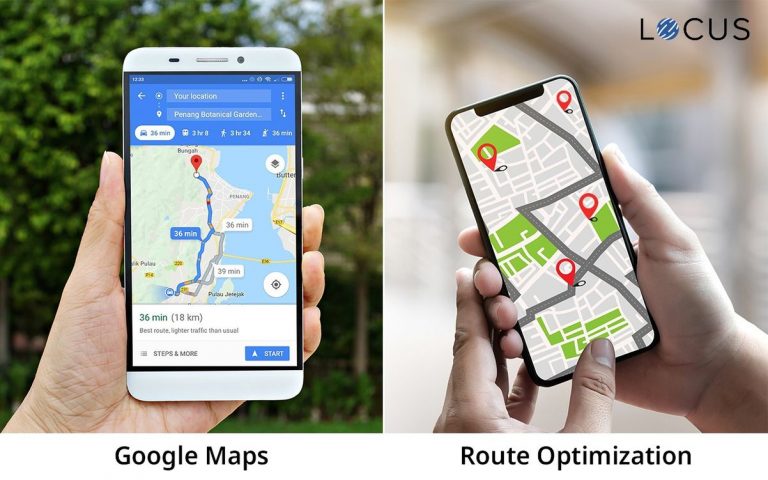
Route Optimization
Route Optimization vs Google Maps: Key Differences in 2026

Sep 23, 2026
Key Takeaways When carrying out complex logistics operations for a business, a number of other important factors must be considered. You need a smart solution that can automate your end-to-end logistics activities, save costs and reduce human dependency. Google Maps routes or other web route mapping services are not capable of doing that. That’s where advanced […]
Read moreInsights Worth Your Time



















TMS and USMCA Origin Verification in 2026: Why Two Adverse Findings Cost More Than Twenty Bad Entries