


General
Top 8 Fleet Management Vendors for AI-Driven Dispatch Allocation in 2026
Key Takeaways
- AI-driven dispatch allocation is the primary evaluation criterion for enterprise fleet platform selection in 2026
- The critical distinction is between telematics-first platforms that add AI routing as a feature and logistics orchestration platforms where dispatch allocation is the core engine
- Enterprise buyers should evaluate vendors across five criteria: AI dispatch depth, multi-fleet and carrier allocation, real-time re-optimization, network-level multi-depot planning, and vertical fit for retail, FMCG, and 3PL
- Telematics platforms (Samsara, Geotab, Verizon Connect) lead on fleet health and compliance; logistics orchestration platforms (Locus, FarEye, LogiNext) lead on dispatch allocation depth
- Locus is ranked #1 in Route Planning by G2 in the 2026 Best Software Awards for Supply Chain and Logistics, is backed by Ingka Group, and combines multi-constraint AI dispatch allocation with ShipFlex multi-carrier orchestration across 160+ active carriers from a network of 1,000+ pre-integrated partners
Driver shortages, fuel cost volatility, same-day SLA pressure, and multi-carrier complexity have fundamentally reordered how enterprise logistics teams evaluate fleet technology in 2026.
The primary selection criterion is AI-driven dispatch allocation, which is the ability to simultaneously resolve cost, SLA, capacity, and compliance constraints across every order, vehicle, hub, and carrier in the network.
Evaluating vendors on generic AI route optimization features misses the actual question. The right one is dispatch allocation depth: does the engine solve the assignment problem multi-objective and multi-constraint in a single pass, or does it apply sequential rules and present the output as AI?
This guide evaluates eight fleet management vendors on dispatch allocation depth: multi-constraint optimization, multi-fleet and carrier coverage, real-time reallocation, network-level planning, and vertical fit for retail, FMCG, e-commerce, and 3PL.
How to Evaluate AI-Driven Dispatch Allocation Vendors: The Dispatch Intelligence Framework
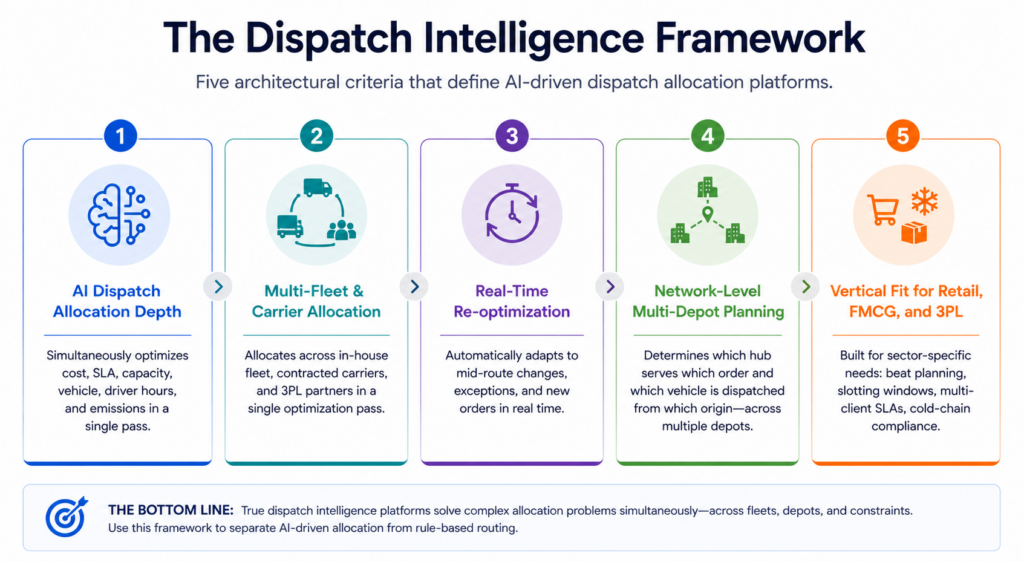
Before examining individual vendors, it helps to apply a consistent evaluative lens. The Dispatch Intelligence Framework defines five architectural criteria that separate platforms built for genuine AI-driven allocation from route optimization tools that have outgrown their original design.
Criterion 1: AI dispatch allocation depth
Does the engine resolve cost, SLA, capacity, vehicle type, driver hours, and emissions constraints simultaneously in a single optimization pass? Or does it apply rules sequentially?
Sequential rule-based routing and simultaneous multi-objective AI allocation are architecturally distinct. Most platforms do the former.
Criterion 2: Multi-fleet and carrier allocation
Can the platform allocate orders across in-house fleet, contracted carriers, and 3PL partners in a single optimization pass?
Multi-fleet allocation is a structurally different problem from single-fleet routing. Most platforms do not solve it natively. See automated route planning for context on why sequential allocation creates gaps.
Also read: What is Automated Route Planning? Full Guide
Criterion 3: Real-time re-optimization
Can the platform absorb mid-route order injections, cancellations, and exceptions without requiring a planner to trigger each replan?
Strategic route planning for fleet operations at enterprise scale demands continuous adaptation.
Criterion 4: Network-level multi-depot planning
Does the platform decide which hub serves which order, and which vehicle is dispatched from which origin, across multiple depots simultaneously? Or is it fundamentally single-depot routing extended with workarounds?
Criterion 5: Vertical fit for retail, FMCG, and 3PL
Does the dispatch logic account for sector-specific constraints: FMCG beat planning, retail slotting windows, 3PL multi-client SLA separation, cold-chain compliance?
Vertical fit determines whether the platform works in production.
Top 8 Fleet Management Vendors for AI-Driven Dispatch Allocation in 2026: At a Glance
Here is a quick summary of the eight platforms covered in this guide, grouped by typical deployment scale and dispatch allocation architecture.
| Vendor | Best For | Dispatch Allocation Level | Pricing |
|---|---|---|---|
| Locus | Enterprise logistics orchestration across retail, FMCG, and 3PL | L4 | Custom pricing |
| FarEye | Last-mile delivery execution for retail and e-commerce brands | L3 | Custom pricing |
| LogiNext | Multi-industry route-and-schedule dispatch for regional delivery | L2-L3 | Custom pricing |
| Shipsy | Carrier management and cross-border freight dispatch orchestration | L2-L3 | Custom pricing |
| Samsara | Telematics, safety compliance, and ELD for asset-heavy regulated fleets | L2 | Custom pricing |
| Geotab | Open-ecosystem fleet analytics and extensible routing via SDK | L2 | Custom pricing |
| Verizon Connect | Live dispatch visibility and driver communication for field service fleets | L1-L2 | Custom pricing |
| Trimble Transportation | Long-haul freight load planning and TMS-level dispatch scheduling | L2-L3 | Custom pricing |
1. Locus
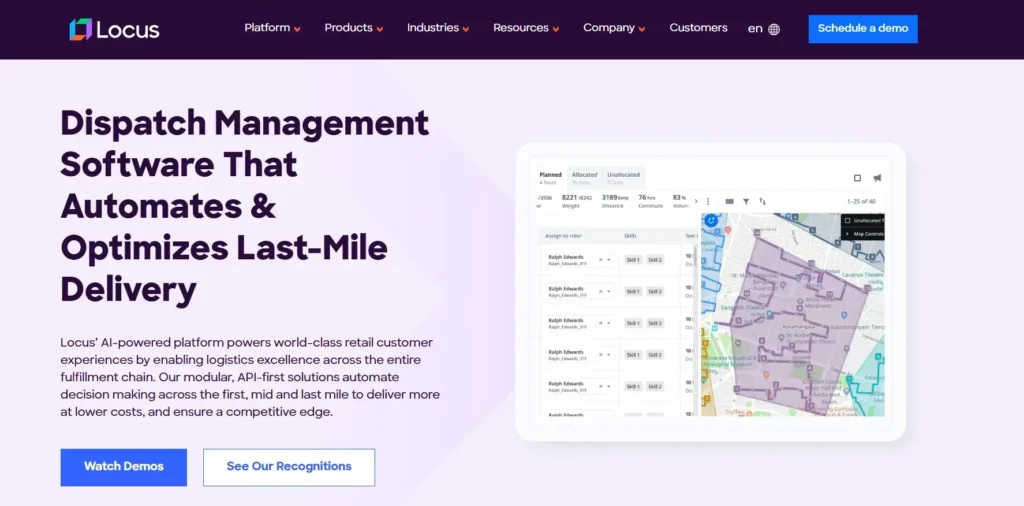
Locus, the world’s first Decision-Intelligent, Agentic TMS, has delivered $320M+ in logistics cost savings across 360+ enterprise customers in 30+ countries with 1.5B+ deliveries optimized and 99.5% SLA adherence.
The platform operates in a continuous Sense-Decide-Execute-Learn loop: it ingests live order, fleet, carrier, and traffic signals; makes multi-constraint allocation decisions across all of them simultaneously; executes dispatch plans without manual initiation; and learns from each delivery cycle to improve the next.
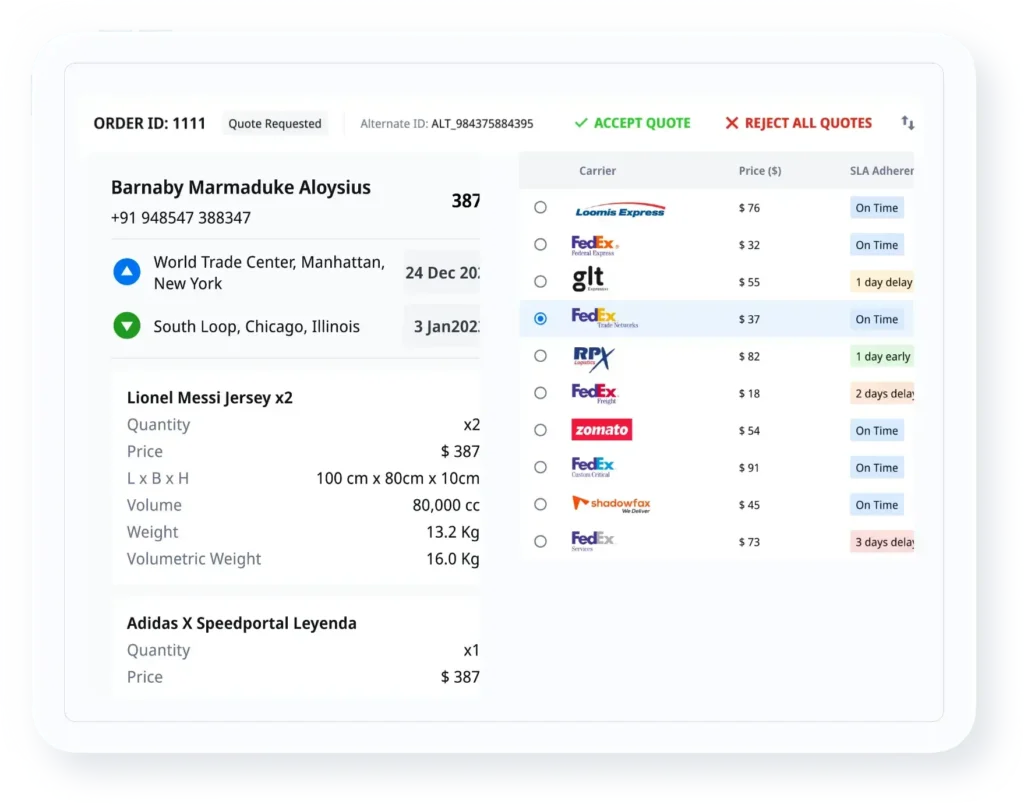
Multi-fleet allocation is where Locus is architecturally distinct from every other vendor on this list. Orders are allocated across in-house fleet, contracted carriers, and 3PL partners based on cost, capacity, and delivery promise simultaneously.
DispatchIQ, Locus’s dispatch management engine powered by the Fireworks optimization framework, automates this carrier-order matching at scale, factoring real-time availability alongside cost and SLA constraints.
The architecture coordinating this spans eight named AI agents: the Capacity Agent matches demand to fleet availability, the Dispatch Agent builds routes and replans in real time, the Carrier Agent handles lane scoring and auto-tendering, the Hub Agent coordinates inbound staging and dock sequencing, the Customer Agent manages proactive delivery communications, the Settlement Agent handles freight invoicing and reconciliation, the Copilot (Mycroft) surfaces risk signals and accelerates dispatcher workflows through natural language, and the Orchestrator Agent coordinates actions across all agents within configurable governance rules.
Real-time re-optimization runs continuously, not on planner triggers. Mid-route order injection, cancellation absorption, and exception handling are automated. Managing delivery exceptions in real time is a first-class platform capability. Planners retain configurable constraint overrides and can see the reasoning behind each allocation decision; governance and auditability that enterprise procurement teams increasingly require.
Vertical playbooks cover retail and e-commerce (slot-based deliveries, hyperlocal routing, and dark-store fulfillment), with Mycroft AI Co-Pilot providing a natural-language interface across the full operational stack: dispatchers query live fleet and order data, surface SLA risk signals, and act on AI-driven recommendations without navigating multiple dashboard screens.
ShipFlex, the multi-carrier orchestration module, manages allocation across 160+ active carriers from a broader network of 1,000+ pre-integrated partners.
Recognition across four independent bodies validates the platform’s enterprise positioning: Gartner has recognized Locus for seven consecutive years, most recently in the 2026 Gartner Hype Cycle for Supply Chain Execution and Logistics Technologies; G2 ranked #1 in Route Planning in its 2026 Best Software Awards for Supply Chain and Logistics; and QKS Group named Locus a Leader in the SPARK Matrix for Transportation Management System, 2025.
The recognition follows the October 2025 acquisition by Ingka Group, the world’s largest IKEA retailer. Locus continues to operate independently while supporting Ingka Group’s fulfillment network.
Key features of Locus
- AI dispatch and route optimization: DispatchIQ and Fireworks auto-assign orders to optimal vehicles using 250+ real-world constraints, with continuous mid-route re-optimization when traffic, failed drops, or cancellations occur
- Control Tower visibility: Real-time shipment tracking across owned and contracted fleets, with predictive ETAs, exception alerts, and customer notifications
- AI-validated electronic proof of delivery: Photo, signature, and barcode capture with AI validation to reduce disputes and accelerate settlement cycles
- Enterprise integrations: API-first architecture with prebuilt connectors for OMS, WMS, ERP (SAP, Oracle), carrier systems (EDI/API), telematics, and customer experience platforms
- Sustainability reporting: Published carbon footprint metrics and miles-reduced analytics for enterprises with ESG reporting obligations
Locus pros
- Handles complex enterprise logistics networks and high order volumes through multi-objective, multi-constraint AI dispatch allocation in a single engine pass
- Combines dispatch, route optimization, ShipFlex carrier orchestration, Control Tower visibility, and ePOD in a single platform
- Vertical-specific dispatch logic for FMCG beat planning, retail slotting windows, 3PL multi-client SLA separation, and cold-chain constraints
Locus cons
- Built for enterprise operations; smaller fleets running simple, single-region delivery may find the platform’s depth exceeds their current requirements
Locus pricing
Locus offers custom enterprise pricing based on shipment volume, delivery locations, carrier integrations, and deployment scope. Pricing is customized after a consultation.
Enterprises can request a demo to receive a tailored estimate.
Locus is best for
Retail, FMCG, e-commerce, and 3PL enterprises running hybrid fleets across multiple hubs and carrier types, where AI dispatch allocation must orchestrate the full order-to-delivery lifecycle.
2. FarEye
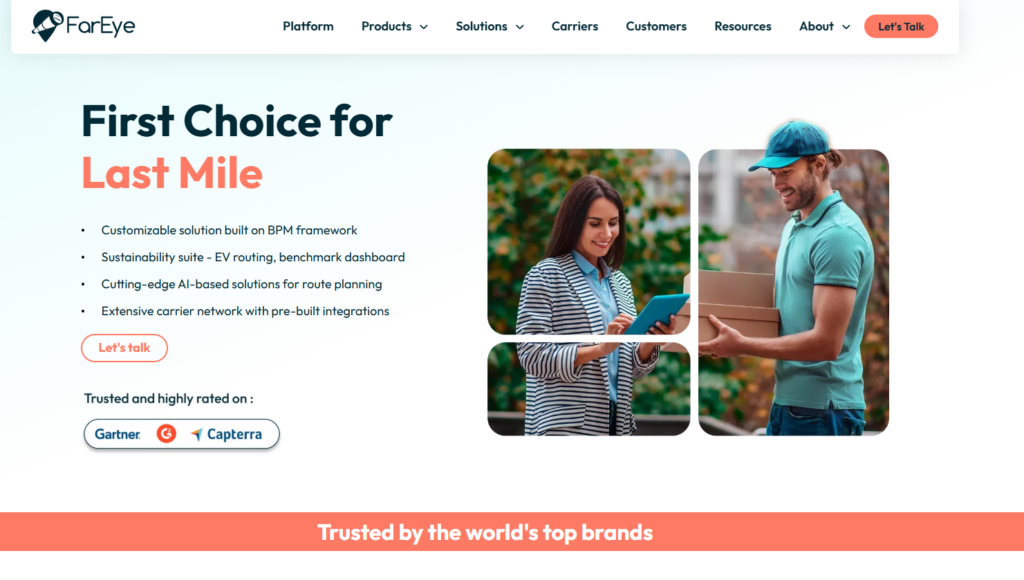
FarEye is a delivery management platform with AI-powered last-mile management and dynamic routing. Its capabilities cover AI-driven route planning, dynamic dispatch reassignment and live job reallocation, a delivery promise and ETA engine, real-time last-mile visibility, and customer notification workflows.
The platform’s strength is in last-mile dispatch execution and delivery experience management for retail distribution networks.
Key features of FarEye
- Multi-carrier delivery orchestration with real-time shipment tracking
- Branded tracking pages, ETA notifications, and delivery reschedule options
- AI-driven route planning with dynamic dispatch reassignment
- No-code workflow builder for customizing delivery processes
- Delivery performance analytics and customer feedback loops
FarEye pros
- Strong focus on post-purchase customer experience and branded delivery communication
- Flexible workflow customization without developer dependency
FarEye cons
- Less depth on multi-fleet allocation across in-house and 3PL fleets simultaneously in a single optimization pass
- Multi-depot network-level planning is not the platform’s primary design focus
- FMCG beat planning and recurring multi-drop dispatch logic are limited relative to orchestration-first platforms
FarEye pricing
Pricing is customized based on shipment volume, delivery regions, and deployment scope. Contact the vendor for a quote.
FarEye is best for
Retail and e-commerce enterprises whose primary dispatch need is last-mile visibility, ETA management, and customer delivery experience, where post-purchase experience management is the core priority rather than multi-fleet orchestration.
3. LogiNext
LogiNext is an enterprise route optimization and dispatch scheduling platform with presence across delivery, field service, and logistics verticals. AI-driven route planning with time-window and capacity constraints, dynamic scheduling and dispatch management, real-time fleet tracking, and capacity utilization dashboards give it a structured approach to multi-stop dispatch automation.
LogiNext handles structured dispatch scheduling within a defined fleet model effectively.
Key features of LogiNext
- AI-driven route optimization with time-window and capacity constraints
- Dynamic scheduling and dispatch management
- Fleet management analytics and capacity utilization dashboards
- Workforce scheduling and shift management
- Built-in geocoding and address validation
LogiNext pros
- Established presence in India and Middle East markets with regional support infrastructure
- Covers the full execution cycle from dispatch planning through proof of delivery
- Workforce scheduling alongside routing is a differentiated capability for field-service-heavy operations
LogiNext cons
- AI dispatch maturity lags behind orchestration-first enterprise platforms on multi-constraint simultaneous optimization
- Configuration depth for complex enterprise constraints may require extended implementation effort
LogiNext pricing
Pricing depends on shipment volume, deployment scope, and modules selected. Contact the vendor for a customized quote.
LogiNext is best for
Enterprises in delivery and field service needing structured route-and-schedule dispatch automation within a defined, primarily in-house fleet model. It’s particularly ideal for those operating across South Asia and Middle East markets.
4. Shipsy
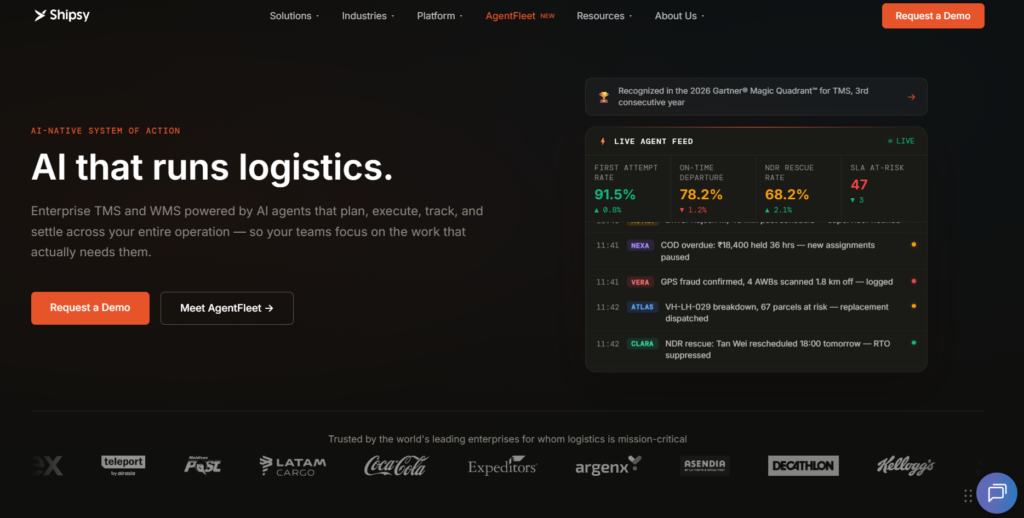
Shipsy is an AI logistics management platform with particular depth in carrier management and procurement-level dispatch allocation logic.
It offers AI-powered carrier selection and dispatch allocation, domestic and cross-border shipment orchestration, real-time multi-carrier tracking, cost-based carrier allocation logic, and exception management workflows. Shipsy addresses a specific enterprise need well: operations where advanced carrier management systems and freight dispatch orchestration matter as much as route-level optimization.
Key features of Shipsy
- AI-powered carrier selection and dispatch allocation logic
- Domestic and cross-border shipment orchestration
- Real-time multi-carrier tracking and exception management
- Freight management, invoicing automation, and compliance reporting
- Cost-based carrier allocation across integrated logistics partners
Shipsy pros
- Strong cross-border and international logistics capabilities across the Middle East and South Asia
- End-to-end coverage from first mile through last mile in a single platform
Shipsy cons
- Last-mile AI dispatch depth, specifically route-level and stop-level optimization across hybrid fleets, is not the platform’s primary strength
- Retail and FMCG vertical-specific dispatch logic (beat planning, slotting windows) is limited relative to orchestration-first platforms
- Sustainability reporting is less developed compared to dedicated orchestration platforms
Shipsy pricing
Contact the vendor for a customized quote based on shipment volume and module selection.
Shipsy is best for
3PLs, freight forwarders, and enterprises managing large carrier ecosystems across domestic and cross-border lanes, where carrier procurement and allocation logic is the primary operational challenge.
5. Samsara

Samsara is a telematics-first platform that has expanded into AI-assisted dispatch, making it a strong option for asset-heavy, safety-regulated fleets. Its foundation covers real-time GPS with sub-minute refresh, AI dashcam-driven driver behavior scoring, automated routing with live traffic re-routing, HOS and ELD compliance automation, and dispatch-to-driver workflow through the Connected Operations app.
The platform’s AI dispatch logic is built for compliance, safety, and single-fleet execution.
Key features of Samsara
- Real-time GPS tracking with sub-minute refresh across mixed fleets
- AI dashcam-driven driver behavior scoring and predictive coaching
- HOS and ELD compliance automation
- Automated routing with live traffic re-routing
- Predictive maintenance analytics and vehicle health monitoring
Samsara pros
- AI dashcam and driver safety intelligence is a differentiated capability for regulated fleets
- Strong compliance automation across HOS, ELD, and DOT requirements
Samsara cons
- Dispatch engine is not built for multi-carrier allocation across in-house and 3PL fleets in a single optimization pass
- Multi-depot network-level planning and FMCG or retail vertical dispatch logic are outside the platform’s design scope
- AI dispatch allocation depth is limited relative to logistics orchestration-first platforms
Samsara pricing
Pricing is based on fleet size, module selection, and contract term. Contact the vendor for a quote.
Samsara is best for
Asset-heavy, regulated transport fleets and field service operations where telematics, driver safety compliance, and ELD are the primary operational requirements.
6. Geotab
Geotab is an open-ecosystem fleet management platform with one of the deepest telematics data layers in the industry and an extensible AI routing capability via its MyGeotab SDK and marketplace. AI-enhanced routing, predictive maintenance analytics, driver behavior dashboards, fuel management, and compliance reporting across HOS, IFTA, and tachograph requirements give enterprise operations a rich data foundation.
The native AI value is strongest in fleet health analytics and predictive maintenance, not in solving the multi-constraint, multi-fleet dispatch allocation problem directly.
Key features of Geotab
- Driver behavior and safety dashboards
- Open SDK and marketplace integrations for custom dispatch logic
- Fuel management and consumption analytics
- Compliance reporting across HOS, IFTA, and tachograph requirements
Geotab pros
- Open SDK makes the platform extensible for custom dispatch and allocation logic
- Strong compliance reporting across multiple regulatory frameworks
Geotab cons
- Native AI dispatch allocation depth requires custom development or third-party integration to reach enterprise-grade capability
- Multi-fleet and multi-carrier allocation across in-house and 3PL networks is not a native, production-ready capability
- Enterprise buyers wanting pre-built vertical dispatch logic will need significant implementation investment
Geotab pricing
Pricing is based on fleet size, subscription tier, and module selection. Contact the vendor for a quote.
Geotab is best for
Enterprises that want a rich telematics and fleet analytics foundation and are building a custom dispatch layer on top, or those pairing Geotab for fleet health monitoring with a dedicated allocation platform for routing and carrier management.
7. Verizon Connect

Verizon Connect is a fleet management platform combining GPS telematics, live dispatch management, and scheduling tools primarily for field service and regional delivery operations. Real-time fleet tracking, live job assignment and dispatch communication, a driver mobile app with turn-by-turn routing, maintenance scheduling, and AI-assisted route suggestions cover the core requirements for supervised fleet operations.
For enterprises that have solved telematics and communication and are now evaluating a dedicated allocation engine to sit alongside existing fleet visibility infrastructure, Verizon Connect serves as an established data layer.
Key features of Verizon Connect
- Real-time GPS fleet tracking and live dispatch management
- Live job assignment and driver communication via mobile app
- AI-assisted route suggestions with turn-by-turn navigation
- Maintenance scheduling and vehicle health monitoring
- Compliance reporting and driver behavior dashboards
Verizon Connect pros
- Strong market footprint and established integration ecosystem across North American field service
- Live dispatch communication and job visibility are well-executed capabilities
Verizon Connect cons
- AI dispatch logic is built for live assignment and basic routing; multi-constraint optimization at enterprise scale is outside the platform’s design scope
- Multi-carrier allocation and multi-node network planning are not native capabilities
- Retail, FMCG, and 3PL vertical dispatch logic is limited relative to logistics orchestration-first platforms
Verizon Connect pricing
Pricing is based on fleet size and module selection. Contact the vendor for a quote.
Verizon Connect is best for
Mid-market to enterprise field service and regional delivery fleets where live dispatch visibility, driver communication, and compliance monitoring are the core operational requirements.
8. Trimble Transportation
Trimble is a transportation management and fleet operations platform with TMS-level dispatch scheduling capabilities and strong depth for long-haul and regional freight networks.
The platform is built for freight movement: load consolidation, HOS-compliant scheduling, and lane-level optimization are where it performs distinctly. High-frequency, high-volume, stop-dense dispatch in retail or FMCG last-mile networks is not the platform’s design scope.
Key features of Trimble Transportation
- Intelligent route optimization with HOS and load constraints for linehaul networks
- TMS integration for freight dispatch and load planning
- Driver workflow and communication tools
- Network-level planning for complex multi-stop long-haul routes
- Lane management and load consolidation analytics
Trimble Transportation pros
- Strong depth in freight load planning, lane management, and HOS-compliant scheduling
- TMS-level integration for enterprises managing freight dispatch alongside fleet operations
Trimble Transportation cons
- Platform is built for freight and long-haul; not architected for high-frequency, high-volume last-mile dispatch in retail or FMCG networks
- Multi-carrier allocation across in-house and 3PL fleets for last-mile operations is outside the platform’s primary scope
- Retail and FMCG vertical dispatch logic with beat planning, slotting windows, and dark-store fulfillment are not supported
Trimble Transportation pricing
Pricing is based on modules selected and deployment scope. Contact the vendor for a quote.
Trimble Transportation is best for
Freight carriers, regional trucking operations, and logistics enterprises managing complex long-haul load and lane planning, particularly where TMS-level freight dispatch and HOS compliance are the primary requirements.
Enterprise Buyer Checklist: 7 Questions to Ask Every Vendor
Before shortlisting a fleet management vendor for AI-driven dispatch allocation, pressure-test the claims against your actual operational requirements. Each question maps to a failure mode that surfaces in the first year of deployment.
- How many constraints does the dispatch engine resolve simultaneously, and in a single pass or sequentially? Ask for a specific answer on the optimization architecture
- Does the platform allocate orders across in-house fleet, contracted carriers, and 3PL partners in a single optimization run? Request a live demo with a multi-origin, multi-carrier scenario using your actual fleet data
- Can the platform re-optimize mid-route without planner intervention? Ask for a live demonstration of a mid-route cancellation and order injection scenario
- Does the platform plan across multiple hubs and depots simultaneously, or is it single-depot routing with workarounds? Name your actual depot count and ask how the engine handles cross-hub order allocation
- What vertical-specific dispatch logic is available for your sector? For FMCG: beat planning and recurring multi-drop routes. For retail: slotting windows and dark-store fulfillment. For 3PL: multi-client SLA separation and white-label ETAs
- What is the deployment timeline and integration scope for your WMS, OMS, ERP, and carrier systems? Request references from customers with a comparable system stack who went live within 16 weeks
- How does the platform surface the reasoning behind allocation decisions, and what override controls do planners have? Enterprise AI dispatch in 2026 requires explainability and governance
Choosing the Right Fleet Management Vendor for AI Dispatch Allocation in 2026
- For asset-heavy, compliance-driven fleets, Samsara and Geotab deliver strong telematics foundations with driver safety and fleet health intelligence.
- For carrier-heavy and cross-border logistics, Shipsy adds procurement-level carrier allocation depth.
- For last-mile delivery management in retail and e-commerce, FarEye and LogiNext offer capable dispatch scheduling within defined fleet models.
- For field service and regional delivery visibility, Verizon Connect and Trimble cover their respective verticals well.
- For enterprises in retail, FMCG, e-commerce, or 3PL running hybrid fleets across multiple hubs and carrier types, Locus operates at a different architectural level. Dispatch allocation is the core engine. Multi-fleet, multi-depot, and multi-carrier assignment happens in a single optimization pass.
Your last-mile is too complex for a route planner. Schedule a demo with Locus to see AI-driven dispatch allocation across your actual network.
Frequently Asked Questions (FAQs)
1. What is AI-driven dispatch allocation in fleet management, and how does it differ from standard route optimization software?
Standard route optimization software answers one question: given a fixed set of stops and a vehicle, what is the optimal sequence? AI-driven dispatch allocation answers a harder set of questions simultaneously: which vehicle, which carrier, which hub, in which sequence, for which orders. These are resolved against cost, SLA, capacity, driver hours, and compliance constraints in a single optimization pass. Dispatch allocation is the upstream decision that determines whether the right vehicle is serving the right order from the right origin before routing begins.
2. Which fleet management vendors can handle multi-fleet and 3PL dispatch allocation, not just internal fleet routing?
Of the eight vendors evaluated here, Locus is the only platform that allocates orders across in-house fleet, contracted carriers, and 3PL partners in a single engine pass using live cost, capacity, and SLA signals simultaneously. Shipsy handles carrier-level allocation well for freight and cross-border contexts. FarEye and LogiNext handle primarily in-house or primary-carrier last-mile dispatch. Samsara, Geotab, Verizon Connect, and Trimble are built for in-house fleet monitoring and routing rather than multi-carrier allocation.
3. What criteria should enterprise logistics teams use when shortlisting vendors for AI dispatch allocation in 2026?
Five criteria determine whether a platform scales for enterprise dispatch: AI dispatch allocation depth (simultaneous multi-objective optimization vs sequential rules); multi-fleet and carrier allocation (in-house, 3PL, and contracted carriers in a single pass); real-time re-optimization (mid-route exceptions without manual intervention); network-level multi-depot planning (not single-depot routing); and vertical fit (sector-specific constraint logic for FMCG, retail, or 3PL).
4. How does AI dispatch allocation in a logistics orchestration platform differ structurally from AI dispatch in a telematics-first fleet management tool?
Telematics-first platforms were built around asset monitoring: GPS tracking, driver behavior scoring, maintenance alerts, and compliance reporting. Dispatch was added to complement the monitoring layer. It handles live assignment and basic routing, but the optimization engine is secondary to the infrastructure. Logistics orchestration platforms were built around the allocation problem itself: the engine resolves multi-constraint assignment at scale, and visibility was built to support the dispatch decision layer. The result is a different dispatch architecture and a different ceiling for enterprise operations running hybrid fleets, multi-SLA environments, and high-order-volume networks.


General
Five Things to Look for in a Truly AI-Native Dispatch Management Platform in 2026

Jun 9, 2026
Most platforms marketed as AI dispatch are rule-based systems with AI features layered on. Five things to look for in a truly AI-native dispatch management platform.
Read more
General
The EU Mobility Package Compliance Playbook: How AI Dispatch Helps European Logistics Operators Maintain Compliance

Jun 10, 2026
EU Mobility Package compliance involves driver hours, vehicle return, cabotage, posting of drivers, and smart tachograph integration. A practical playbook for how AI dispatch architecture handles each.
Read moreInsights Worth Your Time



















Top 8 Fleet Management Vendors for AI-Driven Dispatch Allocation in 2026