


General
TMS Tracking: How Modern Transportation Management Systems Deliver Real-Time Visibility and Control
Key Takeaways
- TMS tracking is the visibility layer within a transportation management system that connects order creation, carrier assignment, shipment execution, and post-delivery analytics into one operational picture
- Real-time TMS tracking means predictive ETAs, automated exception flags, and carrier performance data feeding back into dispatch and routing decisions
- The gap between reactive alerts and proactive orchestration is where most legacy TMS platforms fail. An alert after an SLA breach is not the same as a system that prevents the breach
- Route optimization and tracking are interdependent. When a TMS re-optimizes routes mid-execution, the tracking layer must update simultaneously across every active shipment and carrier
- Locus combines real-time visibility, AI dispatch, and dynamic route optimization into a single orchestration layer
Most enterprise logistics teams have a TMS. Fewer can answer a basic question with confidence: where is this shipment right now, and will it arrive on time? The gap between having a transportation management system and actually knowing the status of every active order is where TMS tracking either earns its cost or exposes its limitations.
TMS tracking is the visibility layer within a transportation management system that connects planning, execution, and optimization. It ingests data from GPS, telematics, carrier APIs, and driver apps to give operations teams a continuously updated picture of every shipment across every carrier and every leg.
At 200 shipments per day, this is manageable. At 10,000 daily deliveries across 15 cities and multiple carrier partners, it becomes the capability that determines whether your SLA performance is measured or managed.
This article breaks down how modern TMS tracking works, where legacy platforms fall short at enterprise scale, and what separates Locus, the Decision-Intelligent Agentic TMS now part of Ingka Group, from platforms that monitor shipments without acting on them.
What Is TMS Tracking and Why Does It Matter for Enterprise Logistics?
TMS tracking is the real-time visibility function within a transportation management system that monitors shipment status from order creation through proof of delivery, surfaces exceptions, updates ETAs, and feeds performance data back into planning and dispatch decisions.
Consider a mid-size FMCG company managing 10,000 daily deliveries across 15 cities. Each delivery involves a warehouse handoff, a carrier pickup scan, continuous GPS pings as the vehicle moves through traffic, a delivery attempt, an ePOD capture, and a settlement event.
The tracking layer is processing millions of data points every hour across dozens of carrier relationships.
Legacy transportation management systems treat tracking as a passive read function: data comes in, status gets updated, nothing acts on it. That worked when delivery windows were measured in days. It does not work when:
- Retail customers expect same-day fulfillment
- FMCG distributors have rigid time-window commitments at retail outlets
- 3PL contracts include SLA penalty clauses tied to on-time performance
- Customer service teams field thousands of WISMO (Where Is My Order) calls per week
At that scale, tracking has to be an active intelligence layer.
How TMS Tracking Works Across the Shipment Lifecycle
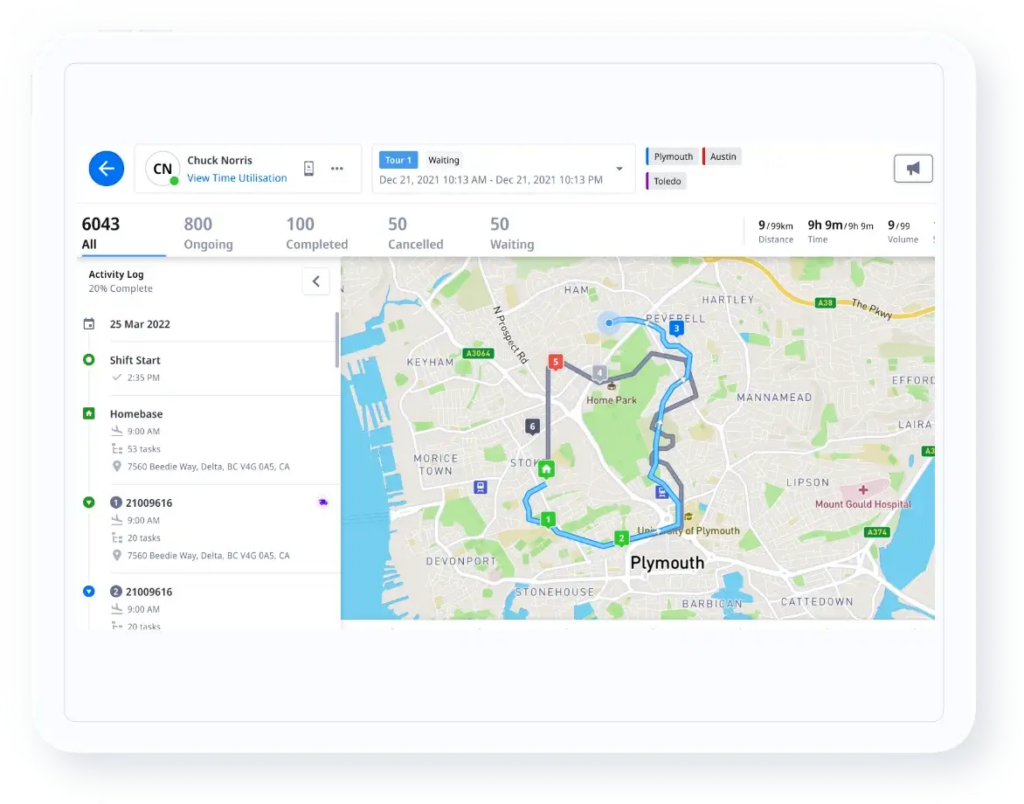
TMS tracking spans four phases of the shipment lifecycle. The quality of data at each phase determines how much operational control an enterprise actually has.
| Phase | What happens | Where legacy systems break down |
|---|---|---|
| Order creation and carrier assignment | Order enters the TMS. System assigns it to a carrier and vehicle based on capacity, time windows, cost, and geography. | Poor assignment logic produces routes that deviate early and generate exceptions before the first delivery attempt. |
| Real-time data ingestion during transit | GPS coordinates, milestone scans, carrier API status updates via EDI or REST, and IoT sensor data flow into the tracking layer continuously. | Update cycles of 10 to 15 minutes create blind spots in operations where delivery windows are 30 minutes wide. |
| Exception flagging and escalation | Shipment deviates from planned route, misses a milestone, or falls behind its window. Alert fires and escalates to dispatcher. | Alerts are reactive. They fire after the SLA breach, not before. No downstream impact calculation across remaining stops. |
| Proof of delivery and analytics | Electronic proof of delivery (ePOD) capture (photo, signature, barcode, OTP) closes the delivery loop. Data feeds into post-delivery performance reporting. | Analytics are retrospective. Monthly reports surface patterns that were actionable three weeks ago. |
The underlying technology stack connects these phases: GPS and telematics provide vehicle-level position data, carrier APIs via EDI or REST normalize status updates across different partners, RFID and barcode scans create milestone checkpoints, and the driver mobile app generates last-mile visibility where vehicle telematics stop.
The data flows from vehicle to platform to decision-maker. In a well-architected TMS, a dispatcher never needs to call a driver to find out where a shipment is.
The Business Case for Real-Time Shipment Visibility
Going beyond “you can see where your truck is” requires quantifying what poor visibility costs. The numbers are specific:
| Cost of poor visibility | The number | What real-time tracking changes |
|---|---|---|
| WISMO calls | Up to 40% of inbound customer service volume in e-commerce logistics operations | Proactive, ML-driven ETA notifications reduce call volume at the source by pushing accurate updates before customers ask |
| On-time delivery gap | Enterprises with mature TMS tracking report 20 to 30% improvement in on-time delivery rates | Locus customers have seen 99.5% on-time delivery rates across 1.5B+ deliveries optimized and $320M+ in logistics costs saved, figures confirmed by QKS Group’s SPARK Matrix TMS 2025 Leader designation |
| Failed first attempts | Each re-delivery attempt adds direct cost: driver time, fuel, and vehicle utilization for a stop that should have closed on the first visit | Accurate ETAs pushed to customers ahead of arrival increase first-attempt success rates by reducing missed delivery windows |
| Carrier penalty exposure | SLA penalty clauses in 3PL contracts create direct P&L exposure for every missed window | Real-time carrier SLA monitoring surfaces deviations before penalty thresholds are crossed, giving operations time to intervene |
The connection between visibility and customer experience is direct. When a TMS tracking layer pushes accurate delivery windows and updates them in real time as route conditions change, real-time communication in delivery fulfillment becomes an operational output. The tracking system does the communication work automatically.
Carrier performance management sits on the same data layer. When your TMS captures milestone adherence, exception rates, and SLA compliance by carrier across every lane and shipment type, procurement teams have the evidence they need for contract reviews and volume reallocation decisions.
Also read: Transportation Management System (TMS) Benefits & Features
From Reactive Alerts to Predictive Exception Management
Most TMS tracking systems alert you when something has gone wrong. A delivery missed its window. A vehicle deviated from the route. A carrier scan was not received at the expected milestone. These signals arrive after the operational damage is done. The SLA is already breached. The dispatcher is triaging instead of preventing.
Predictive exception management inverts this sequence. Instead of alerting after a failure, the system uses historical delivery patterns, live traffic data, and current route performance to identify shipments likely to miss their windows before the window closes.
How predictive exception management works in practice
- A vehicle is running 12 minutes behind at stop 8 of 20. The system calculates whether the delay compounds across remaining stops or recovers as route density decreases. It identifies which customer SLAs are now at risk and surfaces them to the dispatcher with lead time to act
- A new order is added mid-route at 11 AM. The tracking layer flags the capacity and timing impact on existing stops. The dispatch engine re-sequences the active driver or allocates the order to a closer vehicle, updating all customer ETAs automatically
- A carrier misses its pickup scan at a hub. Rather than waiting for a delivery failure, the system flags the missed milestone, calculates downstream shipment risk, and triggers an alert to the carrier operations contact within the platform
Mycroft, Locus’s AI co-pilot layer, surfaces these risk signals to dispatchers in natural language, flagging which shipments need human review and which can be resolved autonomously within configured guardrails, so the human governs the outcome without manually watching every route.
Locus operates in a continuous Sense, Decide, Execute, Learn cycle across three autonomy levels:
- L1 (human approves before action)
- L2 (system acts within defined guardrails)
- L3 (fully autonomous within high-confidence scenarios)
The tracking layer feeds real-time delivery data back into the dispatch and routing engine, which recalculates optimal stop sequences across active vehicles when conditions change.
It processes 250+ real-world constraints including traffic, time windows, vehicle load, driver skills, and fuel costs. The dispatcher sees the outcome, can override it, and the system learns from the result.
The dispatcher sees the outcome, can override it, and the system learns from the result. Each dispatch cycle improves on the last.
See how Locus predicts and prevents delivery disruptions before they breach SLAs.
Schedule a demo with Locus to run this against your actual carrier network and delivery volumes.
Route Optimization as a Tracking Multiplier
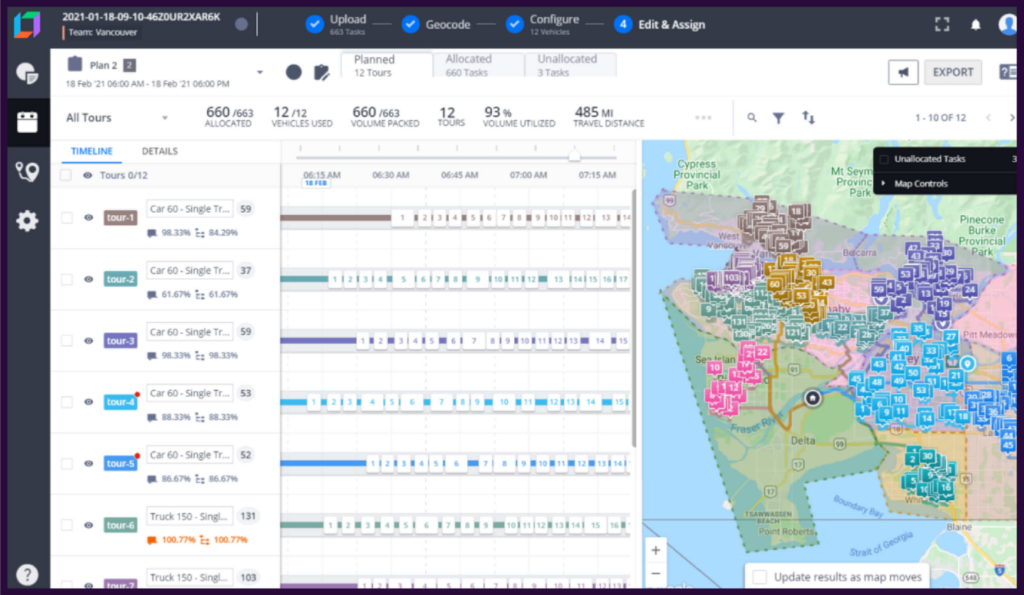
Route optimization and TMS tracking are not separate functions that happen to share a platform. They are interdependent. The quality of the route plan determines what the tracking layer has to monitor. The quality of tracking data determines how effectively the route can be re-optimized mid-execution.
The contrast between static and dynamic approaches makes this concrete:
| Static route planning | Dynamic route optimization with live tracking | |
|---|---|---|
| When the plan is generated | Once, at dispatch. Fixed for the day. | Continuously. Recalculates as conditions change throughout execution. |
| How exceptions are handled | Dispatcher intervenes manually via phone. | System re-sequences remaining stops automatically or surfaces options with enough lead time to act. |
| What the tracking layer monitors | Adherence to a plan that may no longer reflect reality. | Real-time position against a continuously updated optimal sequence. |
| Customer ETA accuracy | Degrades as conditions diverge from the morning plan. | Updates automatically when route conditions change. |
| Cost impact | Baseline: no optimization benefit captured mid-day. | 15-25% reduction in driven miles and fuel cost through continuous re-optimization. Capgemini puts last-mile costs at 41% of total logistics spend, making route efficiency the highest-leverage cost lever in the network. |
Enterprises that move from static planning to continuous re-optimization through AI route optimization see 15 to 25% reduction in driven miles and fuel cost alongside measurable improvement in first-attempt delivery success.
Locus customers across retail and FMCG operations have achieved 20% reduction in total logistics costs and 66% faster planning cycles through the combination of AI dispatch and real-time re-optimization.
TMS Tracking Across Complex, Multi-Stakeholder Supply Networks
Legacy TMS platforms were designed for a single operator managing a single fleet. Enterprise logistics reality looks nothing like this. Consider what a major retailer coordinates on a given Tuesday:
- Owned delivery vehicles running scheduled routes across metro areas
- Contracted 3PL partners handling overflow volume and suburban geographies
- Gig driver networks for same-day and hyperlocal fulfillment
- Parcel carriers managing returns, B2B deliveries, and cross-border shipments
Each relationship introduces a different tracking problem. 3PL logistics carriers update shipment status at different intervals and through different API formats. Gig driver networks generate GPS data that does not map cleanly onto a carrier milestone structure.
Retail partner systems may require status pushes in formats the TMS was not originally designed to produce. The result, in most legacy deployments, is full visibility into owned fleet and near-zero visibility into contracted carriers, with manual reconciliation filling the gap.
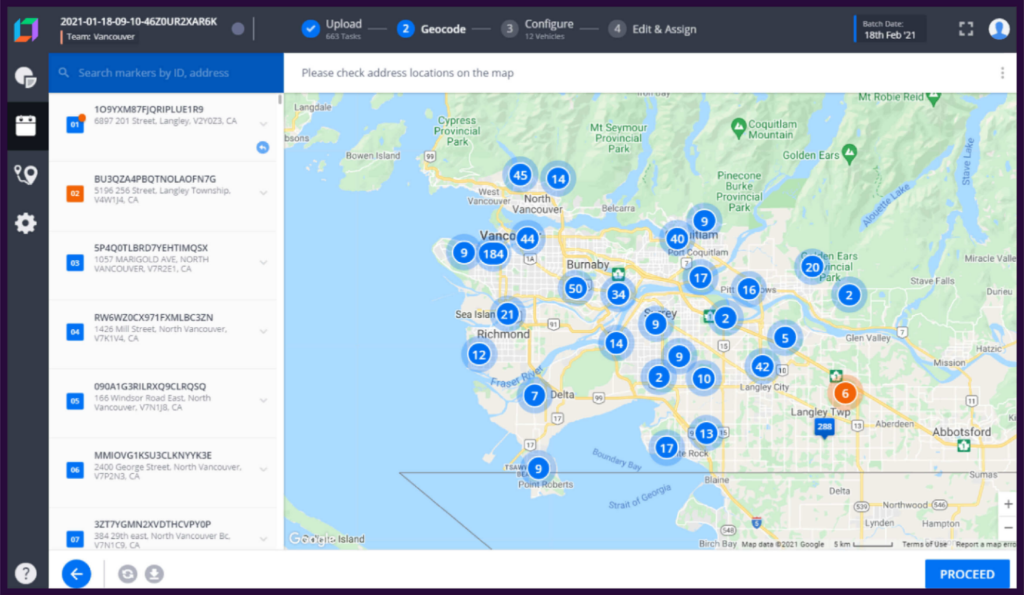
Enterprise-grade TMS tracking solves this by normalizing carrier data into a single operational view regardless of the underlying format or update mechanism.
Locus, now part of Ingka Group, the largest IKEA retailer operating 547 stores globally, continues to operate independently while serving enterprises across retail, CPG, and CEP sectors with 350+ deployments across 30+ countries.
The vendor stability question matters in TMS procurement: a platform backed by a global retail operator carries a fundamentally different risk profile than a standalone logistics SaaS.
Measuring What Matters: Analytics and KPIs in TMS Tracking
The difference between a TMS that reports on what happened and one that tells you what to do next is the analytics layer.
KPIs enterprise logistics teams should monitor in real time
| KPI category | Specific metrics | Why real-time matters |
|---|---|---|
| Delivery execution | On-time delivery rate, first-attempt success rate, exceptions per 1,000 orders | An exception rate trending up at 2 PM is actionable. The same data in a Monday morning report is history. |
| Carrier performance | SLA compliance by carrier, lane, and shipment type; milestone adherence rate | Carrier-level evidence for contract reviews and volume reallocation decisions cannot wait for monthly reporting cycles. |
| Cost efficiency | Cost per delivery, miles per stop, fleet utilization | These feed back into route planning decisions for the next planning cycle, not just the next fiscal review. |
| Last-mile execution | Delivery exception root causes, re-delivery rates, customer escalation rates by route | Last-mile management insights connect KPI tracking to execution-level decisions on driver performance and route quality. |
The prescriptive layer is what separates mature TMS analytics from basic reporting. When the analytics engine identifies that a specific carrier consistently underperforms on a particular lane, it should surface a recommendation: reallocate volume to a better-performing alternative.
When a specific depot generates a disproportionate share of failed first attempts, the system should flag the operational variable behind that pattern and recommend a corrective action.
Siam Makro grew from 500 to 4,000 trucks with Locus, cut dispatch time per store from 2 hours to under 30 minutes (75% faster), increased orders per rider per day from 10-15 to 18-20, and absorbed a doubling of order volume with a 16.7% reduction in logistics cost.
KPI visibility at that scale requires a unified tracking layer, not manual reconciliation.
What to Look for When Evaluating TMS Tracking Capabilities
What makes tracking enterprise-grade is how it connects to dispatch, routing, customer communication, and analytics. Use these criteria to pressure-test vendor claims:
- Depth of real-time visibility: Is it GPS-only or contextual? GPS position tells you where a vehicle is. Contextual visibility tells you whether it is on track for its next delivery commitment and which downstream stops are now at risk based on its current pace
- Analyst recognition and vendor stability: Locus is a named Leader in the QKS Group SPARK Matrix TMS 2025 and holds G2 Best Software 2026 recognition. For enterprise procurement, analyst validation reduces evaluation risk, and vendor stability matters for multi-year TMS commitments
- AI and predictive capability: Ask any vendor to demonstrate a live mid-route disruption scenario. The question is whether the platform calculates the cascading impact of an exception across all active shipments and suggests or executes a resolution
- Integration architecture: A TMS tracking layer requiring custom development for every carrier integration will not scale. Evaluate prebuilt connectors for ERP (SAP, Oracle), OMS and WMS platforms, carrier EDI feeds, and telematics providers
- Multi-carrier and multi-modal support: Confirm whether the platform provides unified visibility across owned fleet, contracted 3PLs, and gig driver networks from a single dashboard, or whether multi-carrier tracking requires manual reconciliation
- Sustainability and carbon tracking: Enterprises with Scope 3 emissions reporting obligations need TMS analytics that quantify CO2 per route, per carrier, and per delivery lane without requiring a third-party auditing tool. Locus customers have avoided 17 million kg of emissions across active deployments, a figure that maps directly to Scope 3 reporting requirements
The criteria above describe what a platform needs to do for an enterprise where TMS tracking decisions have real P&L consequences.
Schedule a demo with Locus to see how each of these capabilities performs against your specific carrier network, order volumes, and SLA requirements.
Frequently Asked Questions (FAQs)
1. What is the difference between TMS tracking and basic shipment tracking?
Basic shipment tracking shows a carrier scan or GPS coordinate for one package. TMS tracking is an operational layer that monitors every active shipment across all carriers, flags exceptions in real time, generates predictive ETAs, and feeds data back into dispatch and routing. It operates at fleet level, not shipment level, and connects visibility to action.
2. How does AI improve TMS tracking accuracy and exception management?
AI improves ETA accuracy by drawing on historical delivery patterns at the route, driver, and time-of-day level—producing ETAs that reflect actual conditions rather than distance estimates. For exception management, AI calculates downstream impact across all active shipments before an SLA is breached, surfaces at-risk deliveries, and triggers re-routing or dispatcher alerts with enough lead time to intervene.
3. Can a TMS track shipments across multiple carriers and transport modes simultaneously?
Enterprise-grade TMS platforms can provide unified visibility across owned fleet, contracted 3PLs, parcel carriers, and gig driver networks from a single dashboard. This requires normalized data ingestion across different carrier API formats, EDI feeds, and telematics systems. Locus integrates with over 160 carriers across a broad network of 1,000+ with ShipFlex, normalizing tracking data into a single operational view regardless of carrier type.
4. What KPIs should logistics teams monitor through their TMS tracking dashboard?
The primary KPIs fall into three categories: delivery execution (on-time delivery rate, first-attempt success rate, exceptions per 1,000 orders), carrier performance (SLA compliance by carrier and lane, milestone adherence rate), and cost efficiency (cost per delivery, miles per stop, fleet utilization). The key distinction is whether these metrics update in real time and feed back into planning decisions, or are only available in retrospective reports.
5. How does TMS tracking integrate with existing ERP and warehouse management systems?
TMS tracking connects to ERP and WMS through API integrations and prebuilt connectors. The critical points are order data from the OMS or ERP, inventory availability from the WMS, and post-delivery settlement data flowing back into financial systems. Platforms with API-first architecture and prebuilt SAP and Oracle connectors reduce integration timelines significantly.

General
Delivery Tracking Software: An Enterprise Guide to Features, ROI, and AI-Driven Logistics Orchestration

May 11, 2026
Learn what delivery tracking software should do at enterprise scale, from AI dispatch and real-time visibility to route optimization. See what separates basic tools from full logistics orchestration.
Read more
General
Beyond Cost-Per-Delivery: 5 Value Drivers for US CFOs 2026

May 11, 2026
Cost-per-delivery is the metric US CFOs default to — but it systematically misses five value drivers determining whether last-mile produces sustained value.
Read moreInsights Worth Your Time




















TMS Tracking: How Modern Transportation Management Systems Deliver Real-Time Visibility and Control