


General
Delivery Tracking Software: An Enterprise Guide to Features, ROI, and AI-Driven Logistics Orchestration
Key Takeaways
- Delivery tracking software gives enterprise logistics teams real-time visibility into every order, vehicle, and carrier across the delivery network — from dispatch through proof of delivery
- Enterprise buyers should evaluate platforms on AI dispatch depth, mid-route re-optimization capability, multi-carrier visibility, OMS/WMS/ERP integration, and plan-vs-actual analytics
- Most delivery tracking tools were built for visibility only. At enterprise scale, visibility without the ability to intervene creates operational drag — escalating WISMO calls, missed SLAs, and manual exception handling that should be automated
- The Delivery Orchestration Maturity Model maps operations from Stage 1 (tracking-only) to Stage 4 (closed-loop orchestration). Most enterprises scaling past 10,000 daily orders are operating at Stage 2 and need to move to Stage 3 or 4
- Locus combines AI dispatch, dynamic route re-optimization, control tower visibility, and ePOD in a single platform, carrying enterprises from passive tracking to active logistics orchestration
Most delivery tracking software on the market was designed to answer one question: where is the package?
That framing works at a few hundred orders per day across one carrier. It does not work when you are managing 50,000 deliveries across a mixed fleet, multiple 3PL partners, and customers who expect accurate ETAs and proactive alerts before they notice something has gone wrong.
This guide offers clarity on what delivery tracking software should do at enterprise scale: the features that matter when volume and complexity multiply, AI capabilities, and the ROI metrics that justify the investment. It draws on Locus’s experience orchestrating logistics for global retail, FMCG, and 3PL enterprises.
What Delivery Tracking Software Does and Where Most Definitions Fall Short
Enterprise-grade delivery tracking systems ingest data from driver apps, vehicle telematics, carrier APIs, warehouse management systems, and customer communication platforms to create a single, continuously updated operational picture.
That picture is the answer to a set of questions your operations team needs before a delay becomes a failure: Is this delivery on track? If not, why? What is the downstream impact? What should happen next? When those questions get answered reactively after the customer calls, the tracking system has already failed its primary function.
For enterprises, delivery tracking software functions as a logistics nerve centre, connecting the moment an order leaves a warehouse to the moment proof of delivery is captured. When the inputs to that picture are fragmented across disconnected systems, visibility is retroactive. Enterprise-grade delivery tracking means finding out before customers do.
The Delivery Orchestration Maturity Model: Where Does Your Operation Sit?
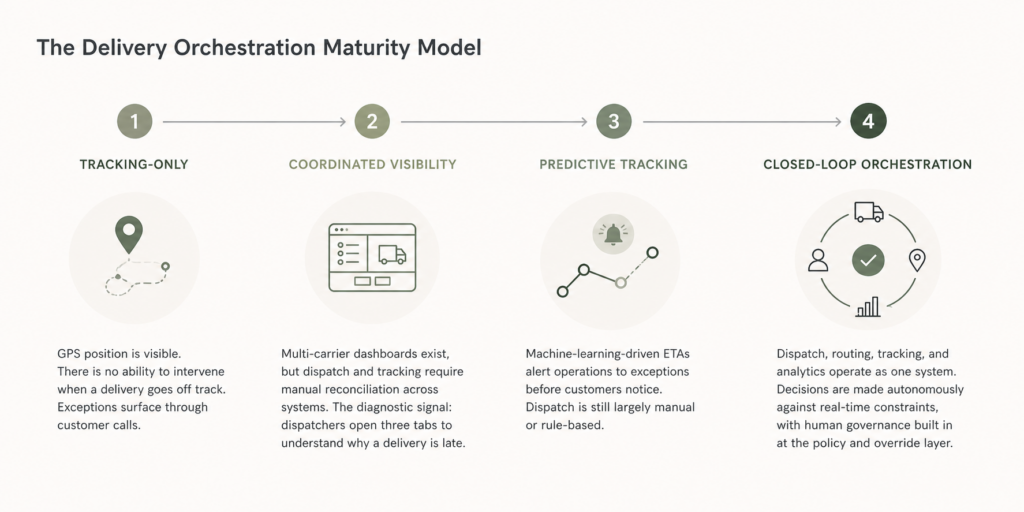
Before evaluating feature lists, it helps to diagnose where your operation actually sits. The Delivery Orchestration Maturity Model maps enterprise logistics operations across four stages. Most organisations assume they are further along than they are because basic tracking tools look functional until a peak-season surge or a carrier failure reveals the gaps.
Stage 1: Tracking-only
GPS position is visible. There is no ability to intervene when a delivery goes off track. Exceptions surface through customer calls.
Stage 2: Coordinated visibility
Multi-carrier dashboards exist, but dispatch and tracking require manual reconciliation across systems. The diagnostic signal: dispatchers open three tabs to understand why a delivery is late.
Stage 3: Predictive tracking
Machine-learning-driven ETAs alert operations to exceptions before customers notice. Dispatch is still largely manual or rule-based.
Stage 4: Closed-loop orchestration
Dispatch, routing, tracking, and analytics operate as one system. Decisions are made autonomously against real-time constraints, with human governance built in at the policy and override layer. Locus is designed to bring enterprise operations to this stage.
The move from Stage 2 to Stage 4 is where the strategic investment lies, and where the operational cost of not moving becomes measurable in SLA misses, escalating headcount, and WISMO call volumes that eat into customer service capacity.
Why Enterprise Logistics Teams Outgrow Basic Tracking Tools
Basic delivery tracking tools hit their limits at a predictable inflection point: when order volume, carrier count, or geographic complexity grows faster than the tool was built to handle. Three failure modes appear consistently.
Fragmented visibility across systems
When dispatch, tracking, and carrier management live in separate systems, exception handling is slow.
A driver deviates from a route; the tracking system logs it. No alert fires, no downstream orders are flagged, and no re-optimization triggers. Operations finds out when the customer calls. At high volumes, this gap between exception and response compounds into consistent SLA misses rather than isolated incidents.
Plans that degrade before the first delivery
Dispatchers at high-volume operations spend two to three hours building routes and assigning orders manually, working from data that is already outdated before the day starts. When conditions change mid-route, the response is a phone call loop that takes 20 minutes to resolve per incident. That time cost multiplies across every driver in the fleet.
No root-cause visibility when SLAs fail
When a delivery misses its window and the customer files a claim, the tracking system shows arrival time but not what caused the delay, which decisions contributed to it, or how the same failure can be prevented tomorrow.
Without plan-vs-actual analytics at the route and driver level, operations cannot distinguish a one-off exception from a systemic routing problem.
Core Capabilities That Separate Enterprise Delivery Tracking Software from Basic Tools
Enterprise delivery tracking software is defined not by the features it lists, but by how those features connect. A platform where tracking feeds directly into route re-optimization and customer communication tells you what went wrong and adjusts for it in real time. The following capabilities are non-negotiable at enterprise scale.
Real-time tracking with live operational visibility
Enterprise-grade tracking gives operations a single dashboard across all carriers, all vehicles, and all active orders with dynamic status updates that reflect route adherence.
This is the foundation of last-mile visibility: knowing whether the delivery is on track to meet the committed window and which orders are at risk before the window closes.
AI dispatch and dynamic route optimization
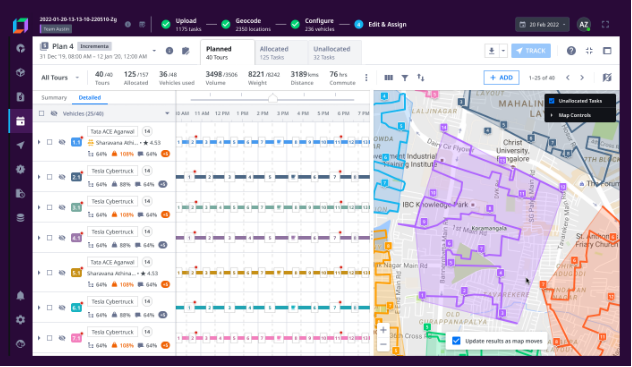
Locus’s dispatch engine (DispatchIQ) assigns orders to drivers and vehicles autonomously, processing 250+ real-world constraints simultaneously: vehicle capacity, driver shift hours, delivery time windows, territory rules, and live traffic conditions.
When conditions change mid-route, the system recalculates the optimal allocation of remaining stops across the active fleet in sub-five-minute cycles. This continuous re-optimization is what separates automated route planning at enterprise scale from tools that generate a plan once and leave dispatchers to manage exceptions manually.
Automated customer notifications with accurate ETAs
Distance-based ETA estimates that do not account for traffic, driver behaviour, or route complexity produce estimates wrong often enough to generate more inbound calls, not fewer.
Machine-learning-driven ETA computation (drawing on historical delivery patterns for specific routes and time windows) is what makes real-time communication in delivery fulfillment operationally effective. Automated SMS, email, or WhatsApp updates push accurate ETAs to customers without dispatcher involvement, reducing WISMO call volume at its source.
Electronic proof of delivery with AI validation
ePOD closes the loop on every delivery event: photo capture, signature, barcode scan, or OTP confirmation, validated automatically to reduce disputes.
For enterprises managing hundreds of drivers and thousands of daily drops, manual POD review is not feasible. Locus’s AI validation flags anomalies, such as a photo taken inside a vehicle rather than at a door, a geolocation mismatch, before settlement cycles begin.
Multi-carrier, multi-leg visibility from a single dashboard
When a retailer runs owned fleet alongside two or three 3PL partners, and each leg has its own tracking system, the operations centre cannot see the full picture without manual reconciliation.
Enterprise delivery tracking software provides a unified control tower with SLA monitoring and exception alerts that do not require a human to connect the dots across systems.
Locus’s ShipFlex extends this to multi-carrier orchestration, dynamically allocating parcels across 160+ carriers from 1,000+ pre-integrated 3PL partners based on cost, speed, and SLA rules.
Deep integration with OMS, WMS, and ERP
A delivery tracking system that does not connect to the order management system will dispatch drivers without knowing which orders have just been cancelled. One that does not connect to the WMS may schedule pickups before inventory is ready.
Integration depth, whether the platform has prebuilt connectors for SAP, Oracle, and major OMS platforms, determines if dispatch decisions use real-time data or stale snapshots. Locus is built on an API-first architecture with prebuilt connectors for ERP, OMS, WMS, carrier systems, and telematics.
Enterprise delivery tracking features at a glance
| Capability | What it does at enterprise scale |
|---|---|
| AI dispatch and assignment | Auto-assigns orders to optimal vehicles against 250+ constraints. No manual allocation for operations running 10,000+ daily orders. |
| Dynamic route re-optimization | Recalculates stop sequences mid-route when traffic, cancellations, or new orders change conditions. Sub-five-minute cycle times at 5,000+ orders. |
| Control tower visibility | Live GPS tracking across owned fleet and 3PL carriers on a single dashboard. Predictive ETAs, exception alerts, and SLA risk flags. |
| Automated customer notifications | SMS, email, and WhatsApp updates with ML-driven ETAs. Updates push automatically when route conditions change. |
| Electronic proof of delivery | Photo, signature, barcode, and OTP capture with AI validation. Flags geolocation mismatches and anomalies before settlement. |
| Multi-carrier orchestration | Dynamic carrier selection across 1,000+ pre-integrated partners via ShipFlex. Rule-based allocation by cost, speed, and SLA commitment. |
| Plan-vs-actual analytics | Post-delivery performance analysis by route, driver, carrier, and region. Cost-per-delivery, SLA adherence, and fleet utilisation dashboards. |
| OMS/WMS/ERP integration | Prebuilt connectors for SAP, Oracle, and major OMS platforms. API-first architecture with configurable BPMN workflow engine. |
The Role of Agentic AI in Modern Delivery Tracking
In 2026, the AI conversation in logistics has moved past “AI generates the route plan.” Every platform in the category now claims that. The meaningful differentiation sits across three capabilities: agentic dispatch decisions, exception self-resolution, and explainable AI for compliance audits.
Agentic dispatch
Agentic dispatch means the system makes assignment and re-routing decisions without requiring human approval at each step.
Locus operates in a continuous Sense-Decide-Execute-Learn cycle: real-time inputs are absorbed, decisions are made against 250+ constraints, execution is automated, and outcomes feed back into the model. When a vehicle breaks down at 11 AM, the system identifies available capacity, recalculates affected orders, reassigns to the nearest eligible vehicle, and pushes updated ETAs to customers without a dispatcher initiating any of those steps.
Human oversight is built in at the governance layer; operations leaders can audit, override, and configure decision logic, but routine exception handling does not require manual approval.
Exception self-resolution
A delivery tracking system that flags exceptions is useful. One that resolves them without dispatcher intervention is where the operational ROI becomes tangible.
When a delivery address fails geocoding, Locus’s address intelligence and Mycroft AI Copilot resolves it using location-learning models trained on 1.5B+ deliveries. When a route becomes infeasible due to a road closure, the system re-sequences the driver’s remaining stops without a phone call.
The net effect is that operations managers spend time on decisions that require human judgment.
Explainable AI for SLA compliance
When a delivery misses its SLA window and a client or customer files a claim, operations needs a complete audit trail: what data the system used, what constraints it weighted, what it decided, and when. This is increasingly a procurement requirement from enterprise buyers and regulatory teams.
Locus’s governance layer provides full audit visibility on every dispatch decision, configurable policy controls, and role-based access to decision logs.
Measuring ROI: What Delivery Tracking Software Should Move
Delivery tracking software that cannot be tied to measurable operational outcomes is overhead, not investment. The KPIs that enterprise logistics leaders use to justify the spend fall into four categories.
Cost per delivery
Route optimization that reduces driven miles by 10-20% directly reduces fuel cost, vehicle wear, and driver hours.
Locus customers across retail and FMCG deployments have achieved a 20% reduction in total logistics costs through the combination of AI dispatch, dynamic route re-optimization, and improved fleet utilisation.
BigBasket, one of India’s largest online grocery platforms, reduced total route distance by approximately 14.3% after deploying Locus, while simultaneously improving on-time delivery SLA to 99.5%.
Planning cycle speed
Dispatchers spending two to three hours building routes manually are not managing exceptions or optimizing capacity, they are doing work that should be automated.
Locus customers achieve 66% faster planning cycles, which translates directly to earlier vehicle departures, higher throughput per shift, and operations teams spending time on decisions that require human judgment.
WISMO call volume
WISMO (Where Is My Order) calls are the single largest driver of inbound contact volume at many enterprise retailers, accounting for 65-70% of customer service inquiries in high-volume delivery operations.
Proactive, ML-driven ETA updates reduce this volume at the source. Platforms that rely on static ETA estimates generate customer service calls whenever conditions deviate from the plan, which at enterprise scale is constant.
Using an automated tracking system that updates ETAs dynamically is the mechanism by which WISMO volume falls.
Fleet utilization
Better stop clustering, smarter order clubbing, and territory optimization reduce the number of vehicle-hours required to complete the same order volume.
Locus customers achieve a 45% improvement in fleet utilization through these mechanisms. The analytics layer is what makes this measurable: plan-vs-actual reporting at the route and driver level reveals where fleet capacity is being wasted, where route sequences are suboptimal, and where the gaps between planned and actual performance are most persistent.
See how Locus delivers these outcomes across enterprise operations.
Schedule a Demo to run AI dispatch and route re-optimization against your actual order volumes and carrier network.
Industry-Specific Requirements: Retail, FMCG, 3PL, and E-Commerce
Delivery tracking requirements are not uniform across verticals. The feature priorities for a high-frequency FMCG distributor differ from those of a 3PL managing multi-client SLAs, which differ again from an e-commerce retailer running same-day fulfillment.
Buying a platform optimized for the wrong use case is a common and expensive mistake.
Retail and e-commerce
High-volume same-day and next-day fulfillment demands dispatch that can absorb peak-season spikes without degrading. A platform that handles 5,000 orders smoothly but slows at 50,000 is not enterprise-grade. Customer-facing tracking portals that update in real time are table stakes.
The deeper requirement is that the delivery tracking layer connects directly to the OMS so that cancelled or modified orders are reflected in active dispatch plans without manual intervention.
FMCG and CPG
Multi-stop route compliance is the primary routing requirement. Visibility into distributor handoffs adds a second layer of complexity.
For food and beverage brands specifically, delivery tracking connects to broader supply chain network design decisions: depot placement, territory allocation, and capacity planning all flow from the data that a well-integrated delivery tracking platform surfaces.
3PL
Multi-client dashboards (where each client sees only their orders) and white-label tracking portals that preserve the end client’s brand relationship with customers are requirements that most single-tenant tracking platforms cannot meet without significant customization.
SLA monitoring must distinguish between client commitments rather than applying a single threshold across the board. The platforms that serve 3PLs well were built with multi-tenancy as a design principle.
Also read: Smart 3PL Delivery Orchestration: A Complete Guide
From Tracking to Orchestration: Why Visibility Alone Is No Longer Enough
Delivery tracking is a necessary input to logistics orchestration. Enterprises that treat tracking as the end state have visibility into what is happening. They do not have the capability to change what is happening before it becomes a problem.
The competitive dynamics of last-mile delivery have shifted. In markets where two-hour delivery is available and customers compare delivery experience as explicitly as they compare price, the operational advantage goes to enterprises whose systems treat every delivery as an optimizable event, not just a status update.
That requires dispatch, routing, tracking, and analytics working as a closed loop, each layer informing the next, continuously, across every delivery in the network.
Locus connects AI dispatch to dynamic route optimization that recalculates continuously as conditions change, to a Control Tower that gives operations, warehouse, customer service, and carrier management a single source of truth, to analytics that surface where planned performance diverged from actual performance and why.
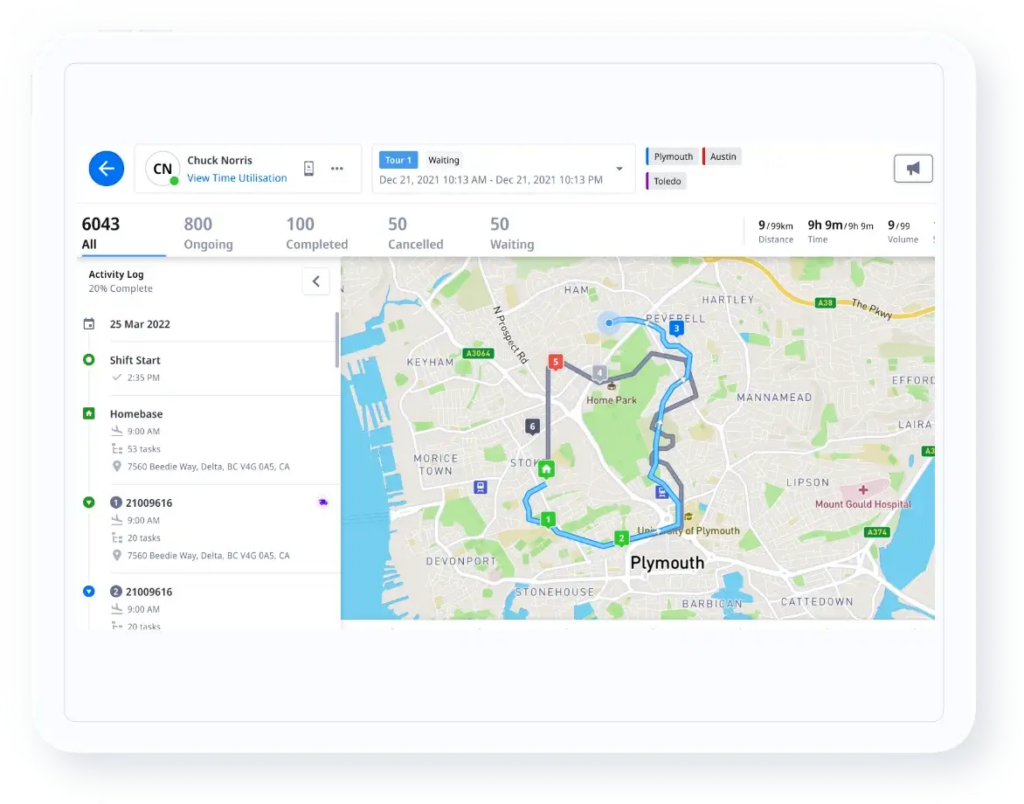
This architecture means that every delivery event, be it a failed drop, a route deviation, or a new order added mid-shift, becomes an input into a better next decision rather than a ticket for a dispatcher to resolve.
The diagnostic for where your operation sits is straightforward: if your current delivery tracking system can tell you where a package is but not what should happen next when it is off track, you are operating at Stage 1 or Stage 2 of the Delivery Orchestration Maturity Model.
Schedule a demo with Locus to see how the transition to Stage 4 works against your actual order volumes, carrier network, and SLA requirements.
Frequently Asked Questions (FAQs)
1. What is the difference between delivery tracking software and a logistics orchestration platform?
Delivery tracking software provides visibility into where shipments are. A logistics orchestration platform connects that visibility to dispatch, routing, and analytics, so the system not only knows a delivery is off track but determines what should happen next and acts on it. Tracking answers “where is it?” Orchestration answers “what do we do about it?” Enterprises managing exceptions at scale, reducing WISMO call volume, and maintaining SLA compliance across mixed carrier networks require orchestration, not tracking alone.
2. How does AI-powered dispatch improve delivery tracking accuracy and efficiency?
AI dispatch assigns orders to drivers and vehicles using real-time constraints like capacity, time windows, traffic, driver availability, rather than static rules or manual assignment. This produces dispatch plans that reflect current conditions. Locus’s DispatchIQ engine processes 250+ constraints simultaneously and generates optimized plans in sub-five-minute cycles, with continuous recalculation mid-route as conditions change. The result is more accurate ETAs, fewer exceptions, and faster resolution when exceptions occur.
3. What integrations should enterprise delivery tracking software support?
Enterprise delivery tracking software must integrate with OMS, WMS, and ERP systems, including SAP and Oracle, to ensure dispatch decisions use real-time order and inventory data. Carrier integrations via EDI and API are required for multi-carrier visibility. Telematics integrations provide live vehicle data. Platforms with prebuilt connectors for these systems deploy faster and maintain data consistency more reliably than those requiring custom development for each integration.
4. How do you measure the ROI of delivery tracking software at enterprise scale?
The primary ROI metrics are cost per delivery, planning cycle speed, on-time SLA compliance rate, first-attempt delivery success, and inbound WISMO call volume. Locus enterprise customers have achieved 66% faster planning cycles, 20% reduction in total logistics costs, 45% improvement in fleet utilization, and 99.5% on-time delivery SLA adherence. Measuring these requires plan-vs-actual analytics, where the platform produces attribution-level reporting.
5. Can delivery tracking software handle multi-carrier and multi-leg shipment visibility in a single dashboard?
Enterprise-grade platforms can, but most point solutions cannot. Multi-carrier, multi-leg visibility requires a control tower architecture that ingests data from owned fleet telematics, 3PL carrier APIs, and customer-facing tracking events into a single operational view, with SLA monitoring that covers all legs. Locus’s Control Tower provides this: real-time tracking across owned and contracted fleets, predictive ETAs, and exception alerts that surface before customers notice a problem, regardless of which carrier or leg triggered the exception.


General
Static Map Problem: Predictive Planning US Last-Mile 2026

May 8, 2026
US last-mile planning treats road conditions as static — but US roads aren't. A 2026 framework for Heads of Last-Mile on predictive planning intelligence.
Read more
General
TMS Tracking: How Modern Transportation Management Systems Deliver Real-Time Visibility and Control

May 11, 2026
TMS tracking is more than a GPS dot. Discover how modern transportation management systems deliver predictive visibility and carrier-level control for enterprise logistics.
Read moreInsights Worth Your Time




















Delivery Tracking Software: An Enterprise Guide to Features, ROI, and AI-Driven Logistics Orchestration