


General
Top 10 ShipBob Alternatives to Consider in 2026 for Better Routing and Delivery Performance

Key Takeaways
- There is no single best ShipBob replacement. The strongest option depends on whether you need another 3PL, Amazon-first fulfilment, cross-border shipping, warehouse software control, or enterprise last-mile orchestration.
- The market is heavily outsourced: ShipBob reports that 84% of brands use a third-party fulfilment provider for at least some orders, so comparisons should focus on operating model fit, not just headline features.
- Multi-channel complexity is now standard rather than edge-case. According to ShipBob, 86% of brands sell on two or more channels in 2026, which raises the importance of integrations, inventory accuracy, order routing, and returns coordination.
- Cost pressure remains intense. ShipStation says 67% of merchants spend more than 10% of revenue on shipping and fulfilment, while ShipBob says 80% of brands experienced cost increases from the 2025 US tariff changes.
- Visibility is still inconsistent across logistics networks. Research cited by Tive found 37% of companies cannot track in-transit cargo, which makes control-tower reporting, carrier event quality, and exception management critical evaluation criteria.
- ShipMonk, Red Stag Fulfillment, Amazon FBA, Easyship, Flexport, and Locus each solve different problems. Locus is the fit when the gap is routing, dispatch, carrier coordination, delivery visibility, and SLA control rather than outsourced warehousing alone.
If you’re already using ShipBob or considering it for your business, this guide will help you make an informed decision about whether it’s the right choice or if there are better alternatives.
For existing users, you might be evaluating ShipBob because:
- You’re facing challenges with scalability or system performance
- You need more flexibility in pricing or fulfillment options
- You’re looking for better customer support or more efficient integrations
For new users, ShipBob is often chosen for its:
- Fast, reliable order fulfillment capabilities
- Seamless integration with e-commerce platforms
- Centralized solution for inventory, shipping, and customer service
In this guide, we will compare ShipBob with the top 10 alternatives based on verified user feedback from platforms like G2 and Capterra. We will assess factors such as routing performance, visibility, operational stability, and pricing to help you choose the solution that best fits your business needs.
Editorial Methodology
This comparison uses a mix of:
- official provider pages, solution descriptions, and integration pages;
- public pricing guidance where available;
- customer review platforms and user-reported evidence cited in this article;
- editorial analysis of operating-model fit.
How providers were assessed
- Category fit: 3PL, shipping platform, freight platform, WMS, or last-mile software.
- Warehouse and fulfilment model: owned network, partner network, software-only, or managed service.
- Operational depth: inventory management, order routing, kitting, returns processing, lot and expiry tracking, and fulfilment SLAs.
- Delivery execution: route optimisation, dispatch management, proof of delivery, carrier management, and exception handling.
- Integration strength: WMS, OMS, TMS, ERP, eCommerce, and marketplace connectivity.
- Commercial factors: pricing predictability, minimum order volumes, setup effort, contract complexity, and offboarding risk.
Disclosure: Locus is a vendor in this market and may benefit commercially if readers choose to engage with its team. That does not make Locus the right fit for every buyer. Small brands needing only labels, Amazon-only sellers, businesses seeking co-warehousing, or teams replacing warehouse space rather than delivery execution may be better served by providers such as ShipStation, Shippo, Amazon FBA/MCF, Saltbox, ShipHero, or another specialist 3PL.
Evidence labels used in this article
- User-reported: public reviews, Reddit posts, and third-party feedback.
- Vendor-stated: features or positioning described in a provider’s public materials.
- Editorial analysis: our synthesis of which operating profile a tool suits best.
Why ShipBob May No Longer Be the Best Long-Term Fit
While ShipBob is a widely used platform, many users have encountered issues that impact their overall experience. Below are some of the most common challenges reported by ShipBob users.
1. Shipping Cost Fluctuations
ShipBob has been reported to significantly change shipping costs after initial quotes were given, causing businesses to lose profitability and face unexpected fees.
Unexpected cost increases can make it difficult for businesses, especially small businesses with limited resources, to plan and manage margins effectively.

2. Limited Control Over Inventory
Some users expressed frustration at not having direct control over inventory, such as being unable to put batches on hold without contacting support.
This lack of control delays operations and increases reliance on customer support, which can be frustrating for businesses with more experience in supply chain management.

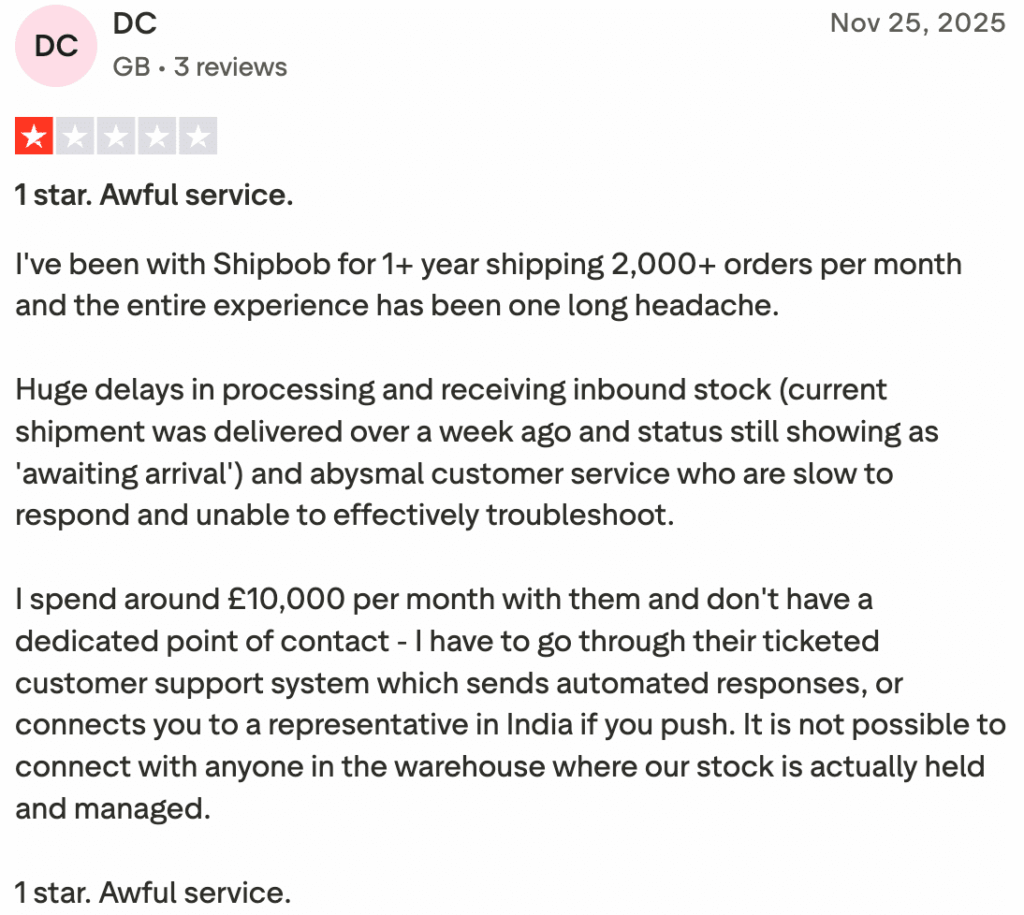
3. Software Glitches and Technical Issues
ShipBob users have reported frequent software glitches, such as issues with tracking and inconsistencies that affect real-time updates.
The glitches disrupt day-to-day operations, leading to inefficiencies and errors that can impact customer satisfaction.

4. Slow Customer Support Response
Several users have mentioned that the customer support team can be slow to respond, particularly during busy periods, leading to delays in resolving issues.
Slow response times during critical moments can lead to prolonged issues that impact business performance and customer satisfaction.
5. Inconsistent Reporting Features
Some users have reported that the reporting features are basic and lack the granularity needed for accurate inventory accuracy or exception handling.
The limited reporting capabilities make it difficult to obtain comprehensive insights into inventory and delivery status, hindering decision-making.

How to Evaluate ShipBob Alternatives Before You Shortlist Vendors
Before comparing logos, define the operating model you are buying for. If useful, start with this guide on how to choose the right route planning software when routing performance and dispatch quality are part of the problem.
Core buying questions
- Are you replacing a 3PL, or adding software on top of one?
If your issue is storage, pick-pack-ship, and carrier purchasing, you need another fulfilment partner. If the problem starts after order release, you may need delivery-management software instead. - How many orders, warehouses, hubs, and regions do you operate?
A single-warehouse Shopify brand and a multi-region retailer with store replenishment, DTC, and field delivery should not buy from the same shortlist. - What is your fleet model?
Owned fleets, gig drivers, parcel carriers, line-haul partners, and hybrid networks require different dispatch, SLA, and visibility capabilities. - What is the product profile?
Heavy, fragile, temperature-sensitive, regulated, or high-value goods often justify specialist fulfilment partners such as Red Stag or a more controlled warehouse model. - How important are delivery windows, proof of delivery, and failed-delivery workflows?
If these are operationally material, basic fulfilment software may be insufficient. - How deep do integrations need to go?
Compare API access for WMS, OMS, TMS, ERP, customer messaging, returns platforms, and finance systems.
Total-cost framework
Do not compare only pick-and-pack fees. A defensible evaluation should include:
- storage fees;
- receiving fees;
- pick-and-pack fees;
- packaging and custom inserts;
- postage or freight;
- fuel and peak-season surcharges;
- address correction costs;
- failed delivery and RTO costs;
- returns and reverse-logistics costs;
- technology fees;
- integration and implementation services;
- minimum order volume commitments;
- contract terms, setup fees, and exit costs.
Best-fit by use case
- Heavy or bulky goods: Red Stag Fulfillment
- Amazon-first selling: Amazon FBA or Amazon Multi-Channel Fulfilment
- Cross-border parcel shipping: Easyship
- Broader international freight and customs: Flexport
- Traditional DTC fulfilment with kitting/subscriptions: ShipMonk or Shipfusion
- Warehouse software control: ShipHero
- Distributed inventory model: Flowspace
- Enterprise routing, dispatch, and delivery orchestration: Locus
Migration checklist
- Define the future operating model.
- Inventory current ShipBob workflows and exception paths.
- Map systems and data ownership.
- Validate WMS, OMS, TMS, ERP, and storefront integration needs.
- Test address and location data quality before migration.
- Pilot by region, channel, or product category.
- Run parallel operations where risk justifies it.
- Measure SLA adherence, cost to serve, failed-delivery rate, RTO rate, and support responsiveness.
- Expand in stages.
- Retire legacy workflows only after reconciliation.
Exploring ShipBob Alternatives: Top 10 Tools for Streamlining Fulfillment and Logistics
Whether you’re new to ShipBob or rethinking its fit, these patterns are common as operations scale. Here’s a curated list of the alternatives teams often examine next.
| Pain point | What does it lead to | What to look for | Best-fit tools |
|---|---|---|---|
| Shipping cost fluctuations | Unpredictable margins and cost overruns | Real-time dynamic route optimization that adjusts based on traffic, weather, and road conditions | Locus, Rakuten |
| Limited inventory control | Increased reliance on customer support and missed stock insights | Real-time shipment visibility and automated stock alerts | Locus, Red Stag Fulfillment, ShipMonk |
| Software glitches and downtime | Delays in shipments, missed orders, and customer dissatisfaction | Stable, reliable platform with minimal downtime | Locus, ShipMonk, Flexport |
| Slow customer support | Delayed issue resolution, disrupting operations | Fast, responsive support with escalation paths | Locus, Red Stag Fulfillment, Flexport |
| Lack of real-time analytics | Poor decision-making and missed opportunities for optimization | Comprehensive reporting and analytics for route performance, costs, and utilization | Locus, ShipMonk, Rakuten |
| Complex routing needs | Missed delivery windows and customer complaints | Multi-stop, customizable routes with real-time adjustments | Locus, AMZ Prep |
| Integration frustrations | Fragmented workflows and manual data entry | Deep integration with TMS, WMS, ERP, and other enterprise systems | Locus, ShipMonk, Flexport |
1. Locus
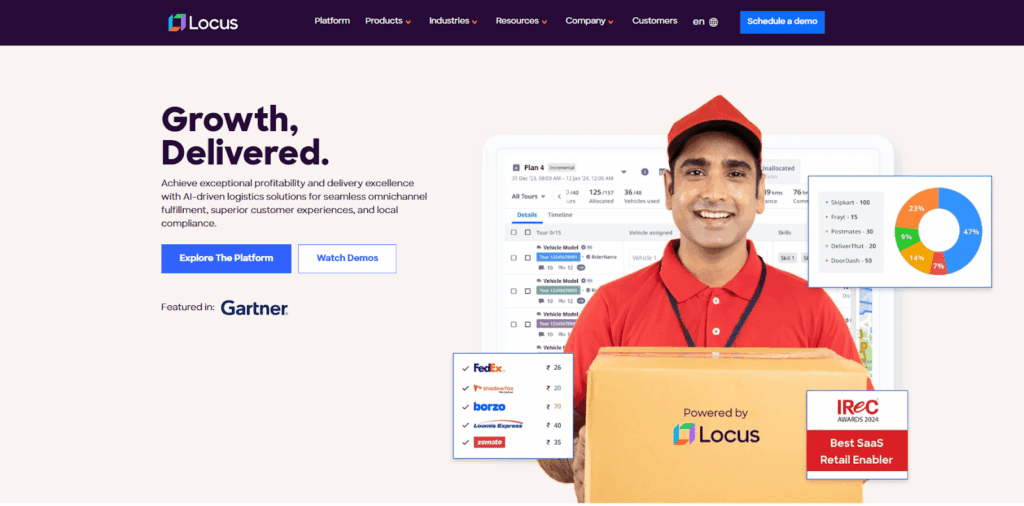
Locus supports teams that need routing that holds up under real-world conditions and workflows that can change without friction.
It’s often considered a ShipBob alternative for operations that outgrow basic optimization and require stronger control, visibility, and reliability.
Common Challenges Locus Resolves
1) Predictable Cost Management
Locus addresses the issue of shipping cost fluctuations reported by ShipBob users through its dynamic route optimization capabilities.
By considering real-time factors like traffic, weather, and road restrictions, Locus ensures more predictable shipping costs, helping businesses avoid unexpected increases that often affect margins.

2) Complete Inventory Control
ShipBob users have expressed frustration with limited control over inventory. Locus solves this by offering real-time shipment visibility, allowing businesses to gain better control over inventory and shipment status.
This reduces reliance on customer support and provides immediate access to inventory data.

3) Reliable Software Performance
Many ShipBob users have reported frequent software glitches that disrupt operations.
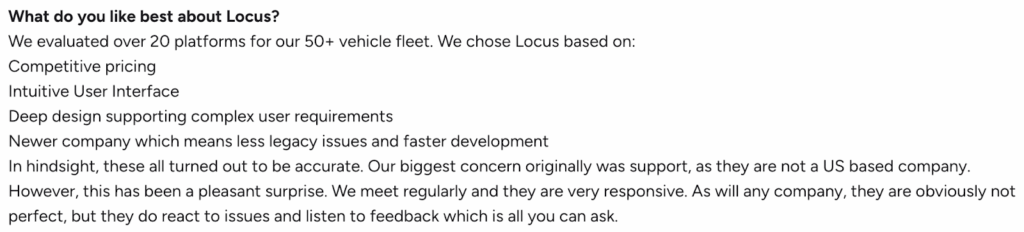
Locus has earned praise for its stable performance, with many users noting minimal downtime and a reliable platform. This ensures smoother logistics operations without the technical issues often experienced with ShipBob.

4) Fast Customer Support
ShipBob’s slow customer support has been a common complaint among users. In contrast, Locus users report quick response times from customer support, particularly during critical situations.
This ensures faster resolution of issues and prevents delays from impacting operations.
5) In-Depth Reporting & Analytics
ShipBob users have noted that its reporting features lack depth. Locus addresses this with advanced reporting and analytics, offering users the ability to track key metrics such as delivery performance, costs, and resource utilization.
This empowers businesses to make informed, data-driven decisions.

Locus’ Pros
- Built for scale and high-density operations: Locus is designed to handle large delivery volumes and peak-season surges without performance drops, making it a strong fit for teams scaling beyond ShipBob’s small-team focus.
- AI-driven planning across the entire fulfillment lifecycle: Locus automates the entire fulfillment lifecycle, including pickup allocation, returns, and SLA management, offering more than just daily route planning.
- Real-time visibility with control tower: Locus offers real-time tracking and exception management, providing greater visibility than ShipBob’s limited tracking capabilities.
- Deep API integrations with enterprise systems: Locus integrates deeply with TMS, WMS, OMS, and ERP systems, reducing fragmentation and manual work, a major reason teams switch from ShipBob.
Locus’ Cons
- Locus may feel more complex than necessary for very small teams with minimal delivery operations.
- Initial implementation may require workflow and data alignment, especially for organizations automating processes for the first time.
Locus Is Ideal for
Locus is well-suited for organizations that have moved past the limitations of lightweight routing tools and now require reliable, scalable delivery orchestration, particularly:
- FMCG, CPG, and 3PL providers operating across multiple regions where ShipBob’s address sensitivity and limited customization create operational friction.
- Big-and-bulky delivery operators require precise scheduling, complex constraints, and dynamic adjustments that simple routing interfaces cannot support.
- Enterprises managing hybrid fleets or multi-hub operations where they need deeper automation, stronger integrations, and consistent route accuracy.
- Teams that need real-time visibility, rapid diagnostics, and reliable performance as order volumes expand beyond what small-team-focused platforms can comfortably handle.
Locus’ Pricing
Locus uses a custom pricing model that factors in delivery volume, the number of operating regions, fleet composition, and the specific modules required (like dispatch planning, orchestration, Track & Trace, or carrier management).
Pricing typically scales with usage and the depth of automation deployed.
Locus’ User Testimonial
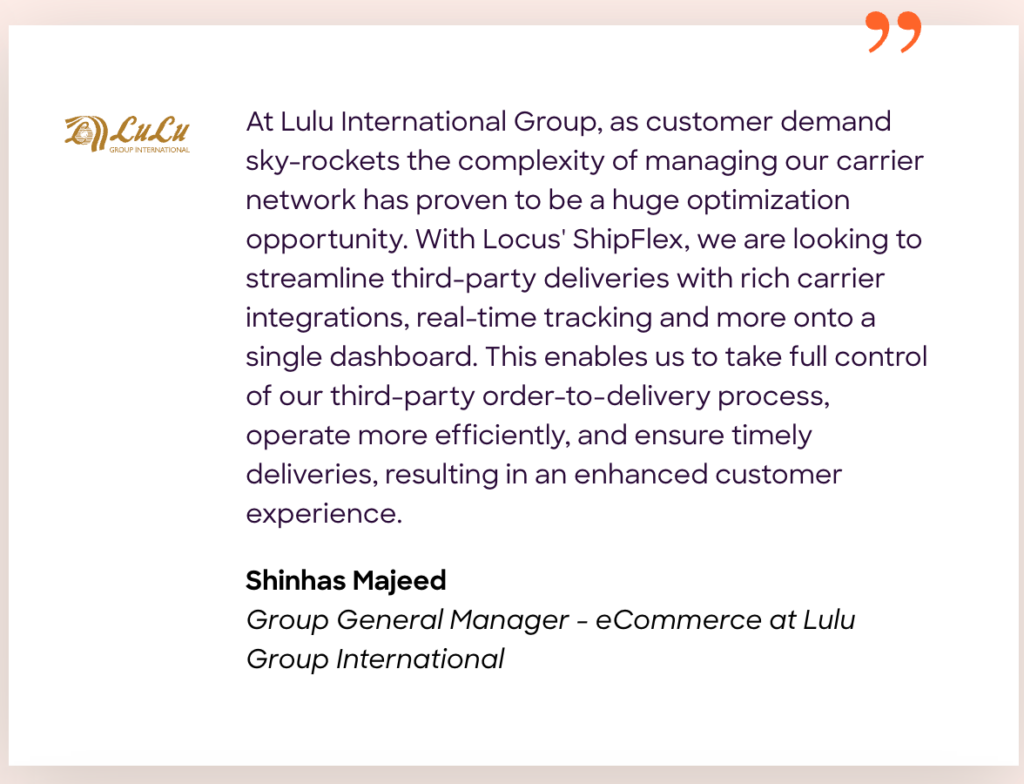
“With Locus’ ShipFlex, we are looking to streamline third-party deliveries with rich carrier integrations, real-time tracking, and more onto a single dashboard. This enables us to take full control of our third-party order-to-delivery process, operate more efficiently, and ensure timely deliveries, resulting in an enhanced customer experience,” says Group General Manager of eCommerce at Lulu Group International
This testimonial highlights third-party integrations and real-time tracking, which are crucial for overcoming fragmented carrier management and inconsistent real-time updates.
2. Easyship
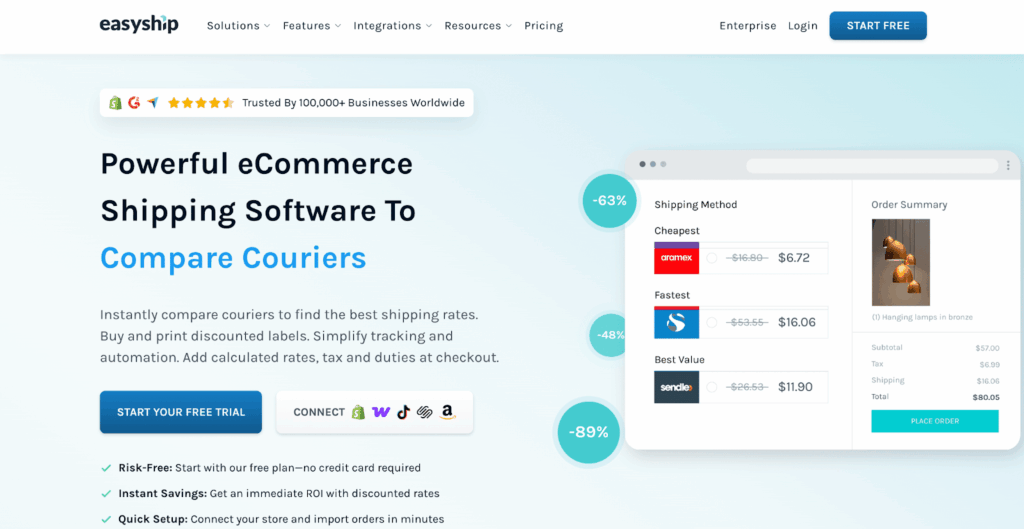
Easyship is a cross-border shipping and logistics platform built for eCommerce brands that ship internationally without operating overseas warehouses. It centralizes carrier rate comparison, duty/tax calculation, and global label generation, helping brands simplify international checkout and reduce shipping-related friction.
Common Challenges Easyship Resolves
- Complex cross-border shipping rules can be automated by automating duties, taxes, and customs documentation.
- High international shipping costs through multi-carrier rate comparison.
- Poor customer experience for global orders due to branded tracking pages and a lack of transparency into landed costs.
Easyship’s Pros
- Strong international shipping tools, including automated customs paperwork and tax calculators.
- Transparent landed-cost estimates that reduce cart abandonment for overseas shoppers.
- Integrates with major storefronts like Shopify, BigCommerce, WooCommerce, Amazon, and eBay.
Easyship’s Cons
- Not built for routing, dispatching, or managing on-ground delivery operations.
- Limited value for teams focused mainly on domestic last-mile orchestration.
Easyship Is Ideal for
Brands expanding globally from a single domestic warehouse, especially those needing simplified international shipping, cost transparency at checkout, and automated cross-border compliance without heavy operational restructuring.
Easyship’s Pricing
Pay-as-you-go model based on carrier rates and service usage, with higher tiers adding discounted rates, automation tools, and onboarding support.
3. ShipCalm
Easyship is a cross-border shipping and logistics platform built for eCommerce brands that ship internationally without operating overseas warehouses.
It centralizes carrier rate comparison, duty/tax calculation, and global label generation, helping brands simplify international checkout and reduce shipping-related friction.
Common Challenges ShipCalm Resolves
- Complex cross-border shipping rules can be automated by automating duties, taxes, and customs documentation.
- High international shipping costs through multi-carrier rate comparison.
- Poor customer experience for global orders due to branded tracking pages and a lack of transparency into landed costs.
ShipCalm’s Pros
- Strong international shipping tools, including automated customs paperwork and tax calculators.
- Transparent landed-cost estimates that reduce cart abandonment for overseas shoppers.
- Integrates with major storefronts like Shopify, BigCommerce, WooCommerce, Amazon, and eBay.
ShipCalm’s Cons
- Not built for routing, dispatching, or managing on-ground delivery operations.
- Limited value for teams focused mainly on domestic last-mile orchestration.
ShipCalm Is Ideal for:
Brands expanding globally from a single domestic warehouse, especially those needing simplified international shipping, cost transparency at checkout, and automated cross-border compliance without heavy operational restructuring.
ShipCalm’s Pricing:
Pay-as-you-go model based on carrier rates and service usage, with higher tiers adding discounted rates, automation tools, and onboarding support.
4. AMZ Prep
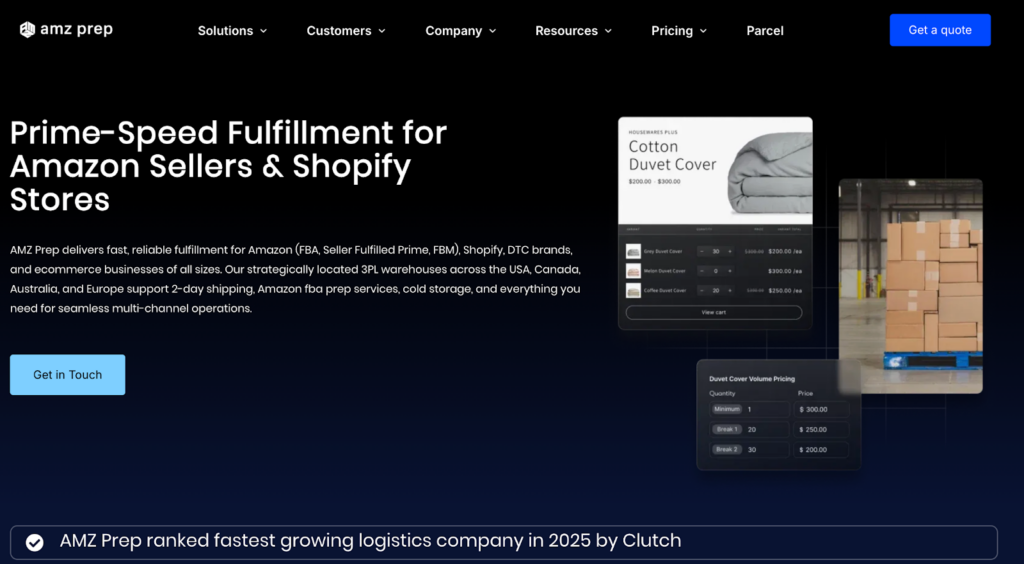
AMZ Prep is a widely adopted route optimization platform known for its large mapping dataset and multi-stop routing capabilities. It often appears in shortlists when teams comparing ShipBob want stronger mapping coverage, more customization options, or deeper proof-of-delivery controls.
Common Challenges AMZ Prep Resolves
- Reducing manual work in planning complex, multi-stop routes through automated route sequencing
- Improving delivery visibility with real-time driver tracking and live route progress
- Strengthening POD workflows with signatures, photos, and customizable verification steps
AMZ Prep’s Pros
- Handles large and complex routing structures well
- Strong real-time tracking for dispatchers
AMZ Prep’s Cons
- Pricing can climb quickly for growing fleets
- Some users report occasional map or GPS inconsistencies that require manual adjustments
AMZ Prep is Ideal for:
AMZ Prep fits logistics teams, parcel carriers, courier services, and field-service operators that require flexible route customization and detailed POD management. It suits operations that want more control over route structure than lightweight tools typically offer.
AMZ Prep’s Pricing:
AMZ Prep offers custom pricing with higher tiers adding discounted rates, automation tools, and onboarding support.
5. ShipHere
Shiphere is a logistics and shipping platform designed to simplify shipping for businesses. It offers custom shipping solutions, real-time tracking, COD orders confirmation, and tools like the Shipping Partner Recommendation Engine and automated NDR management.
Shiphere is optimized for businesses looking for a seamless and efficient way to manage domestic and international shipping.
Common Challenges Shiphere Resolves
- High Return-to-Origin (RTO) rates: Swiftly resolves delivery issues to minimize RTOs through efficient last-mile management.
- Inefficient tracking systems: Provides real-time shipment tracking and instant notifications for better visibility.
- Complicated shipping processes: Simplifies logistics with a single platform to manage orders, integrate channels, and sync deliveries across multiple partners.
Shiphere’s Pros
- Dedicated Key Account Manager (KAM) to handle logistics and ensure customer satisfaction.
- Automated shipping solutions: Including NDR management and real-time order updates.
- Multi-channel integration: Works seamlessly with platforms like Shopify, allowing businesses to automate fulfillment.
Shiphere’s Cons
- Limited international capabilities: While Shiphere offers domestic shipping solutions, its international expansion services may not be as extensive as larger platforms.
- Not ideal for small-scale operations: The platform is better suited for businesses with higher shipping volumes.
Shiphere Is Ideal for
- Online sellers (15000+ users) looking for reliable and swift last-mile delivery with multi-channel integration.
- Businesses with medium-to-high shipping volumes that require customized, efficient logistics solutions and real-time tracking.
Shiphere’s Pricing
- Custom Shipping Rates: Tailored pricing based on zones, weight categories, and delivery partners.
- Automated Shipping Solutions: Pricing is structured around the scale of operations, with tools like COD confirmation and automated NDR management to reduce manual effort.
6. Flexport
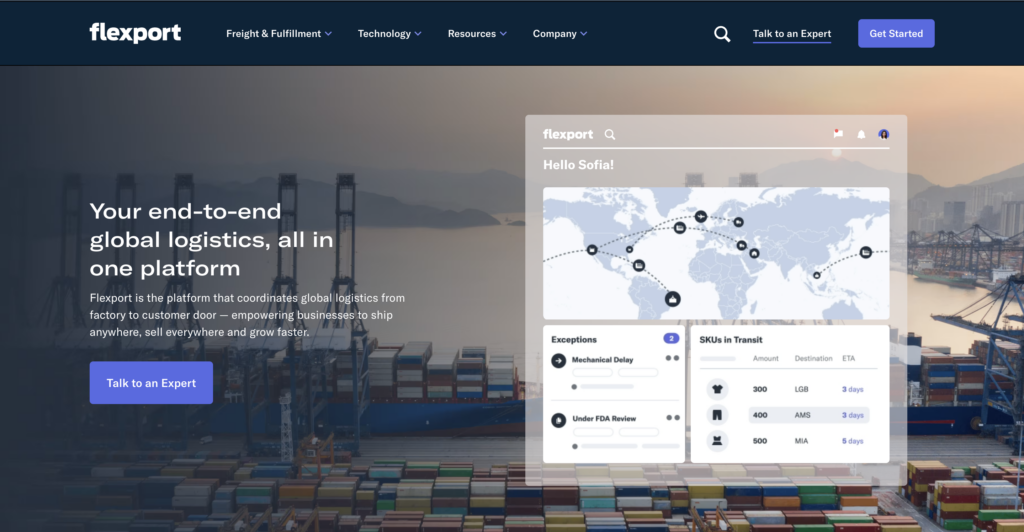
Flexport is a global logistics platform that connects businesses with end-to-end supply chain management solutions. It offers services like ocean freight, air freight, trucking, and eCommerce fulfillment.
Flexport’s advanced technology provides real-time shipment visibility, customs brokerage, and duty management, helping businesses manage their logistics more efficiently and scale globally.
Common Challenges Flexport Resolves
- Lack of visibility across the supply chain: Flexport provides SKU-level visibility, allowing businesses to track shipments in real-time from origin to destination.
- Inefficient customs management: Flexport’s customs brokerage service minimizes import duties and accelerates the clearance process.
- High freight costs and delays: Flexport optimizes shipping speed and cost with advanced technology and global trade network integration.
Flexport’s Pros
- Comprehensive platform that integrates ocean, air, and truck freight into one solution.
- Customs and financial services, including insurance, trade finance, and duty drawback to simplify global trade.
- Omnichannel fulfillment with 99% on-time shipping and real-time data-driven demand planning.
Flexport’s Cons
- Not ideal for very small businesses: Flexport’s platform is better suited for medium to large enterprises with complex supply chains.
- Pricing transparency: While the platform offers advanced solutions, pricing may not always be immediately clear without a quote.
Flexport Is Ideal for
- Enterprises and global brands looking to optimize their global logistics and customs processes.
- eCommerce businesses requiring reliable omnichannel fulfillment and real-time order tracking.
- Companies looking to scale internationally, especially those needing B2B and DTC fulfillment services.
Flexport’s Pricing
- Freight Forwarding: Pricing varies based on shipment volume and routes, offering competitive rates for ocean, air, and trucking services.
- eCommerce Fulfillment: Pricing is based on volume and service level, with detailed
7. ShipMonk
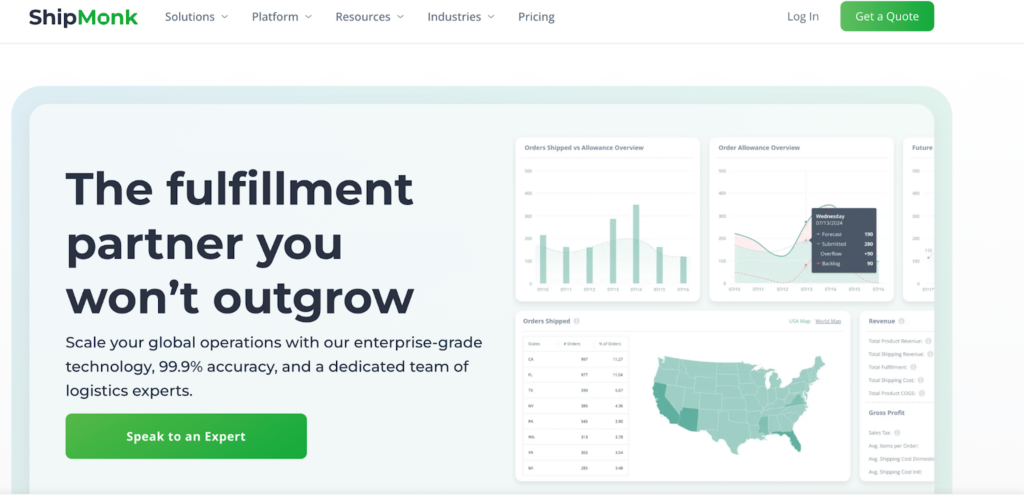
ShipMonk is a tech-enabled third-party logistics (3PL) provider offering end-to-end solutions for eCommerce businesses. It specializes in inventory management, order fulfillment, and shipping.
ShipMonk integrates with eCommerce platforms like Shopify, WooCommerce, and Amazon, and offers real-time tracking, automated order routing, and reliable delivery services to streamline the fulfillment process for growing brands.
Common Challenges ShipMonk Resolves
- Inventory management complexity: ShipMonk provides real-time inventory tracking and automated replenishment, reducing stockouts and overstocks.
- Slow order fulfillment: ShipMonk ensures fast order processing and shipping, helping businesses meet customer expectations with on-time delivery.
- Integration issues with eCommerce platforms: ShipMonk offers seamless integration with leading platforms like Shopify and Amazon, simplifying order management and fulfillment.
ShipMonk’s Pros
- Real-time inventory tracking and automated systems to ensure accurate stock levels.
- Scalable solutions for growing businesses, offering services like subscription box fulfillment and international shipping.
- Integration with multiple eCommerce platforms to streamline processes across channels.
ShipMonk’s Cons
- Complex pricing model: The pricing can be difficult to understand, as it’s based on volume, storage space, and shipping services, which may not be transparent for smaller businesses.
- Limited support for non-eCommerce industries: ShipMonk primarily serves eCommerce businesses, so it may not be as suited for companies in other industries.
ShipMonk Is Ideal for
- Growing eCommerce brands need reliable fulfillment and fast shipping.
- Businesses selling on multiple channels (Amazon, Shopify, etc.) who need a centralized fulfillment solution.
- Subscription box services or businesses with high-volume shipping requirements.
ShipMonk’s Pricing
Fulfillment pricing is based on the number of units fulfilled and the storage space used.
- Shipping: Costs are based on the destination, weight, and shipping carrier.
- Subscription box fulfillment: Specific pricing available based on volume and service needs.
8. Rakuten Super Logistics
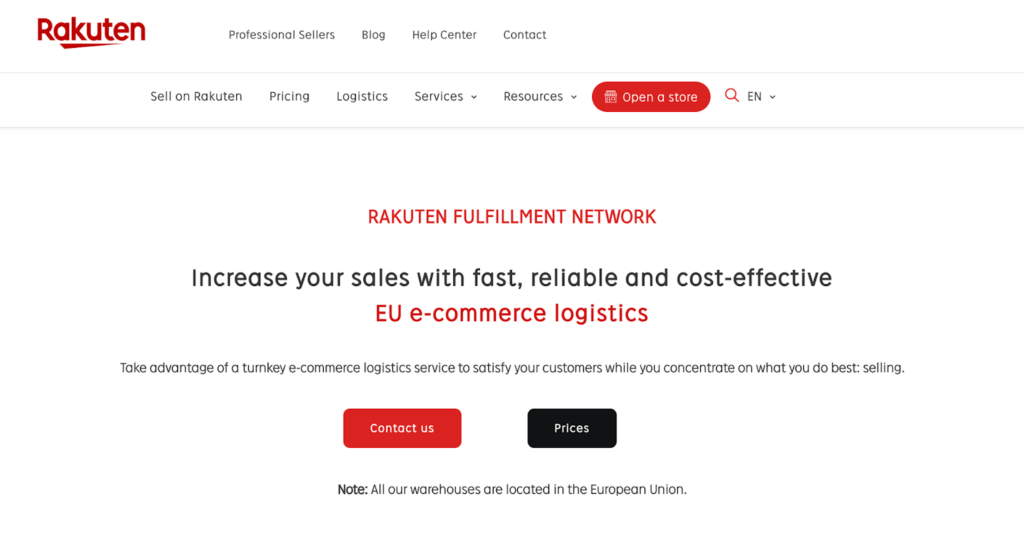
Rakuten Super Logistics is a reliable 3PL provider specializing in fast, nationwide direct-to-consumer (DTC) fulfillment. With over 12 fulfillment centers across the U.S., Rakuten ensures 1-2 day shipping for most domestic orders.
The platform uses Xparcel technology for optimized shipping and offers seamless integrations with eCommerce platforms like Shopify, BigCommerce, and WooCommerce to streamline order processing and delivery.
Common Challenges Rakuten Super Logistics Resolves
- Slow delivery times for domestic orders: With its extensive warehouse network, Rakuten offers 1-2 day shipping nationwide, ensuring fast order fulfillment.
- Shipping cost and efficiency optimization: Xparcel technology helps choose the best carriers, balancing cost and speed for each shipment.
- Order accuracy concerns: Rakuten offers a 100% order accuracy guarantee, ensuring reliable shipping with minimal errors.
Rakuten Super Logistics’s Pros
- National warehouse footprint for fast nationwide shipping.
- Xparcel technology to optimize carrier selection and lower costs.
- Strong omnichannel integrations with platforms like Shopify, BigCommerce, and WooCommerce.
- Personalized support through U.S.-based account representatives.
Rakuten Super Logistics’s Cons
- Primarily focused on domestic DTC sales: Best suited for businesses selling within the U.S., with limited international fulfillment capabilities.
- May not be cost-effective for very small businesses: The pricing model might not be ideal for companies with low shipping volumes due to the tech-heavy and fast service features.
Rakuten Super Logistics Is Ideal for
- U.S.-based DTC brands seeking fast, reliable, and cost-efficient fulfillment.
- Businesses needing fast shipping (1-2 days) to meet customer demand for quick delivery.
- Omnichannel sellers integrating with platforms like Shopify, BigCommerce, or WooCommerce.
Rakuten Super Logistics’s Pricing
- Flat-rate pricing based on storage and order volume, with additional costs for shipping, depending on the carrier and destination.
- Custom pricing available for high-volume businesses that require tailored services.
9. Red Stag Fulfillment
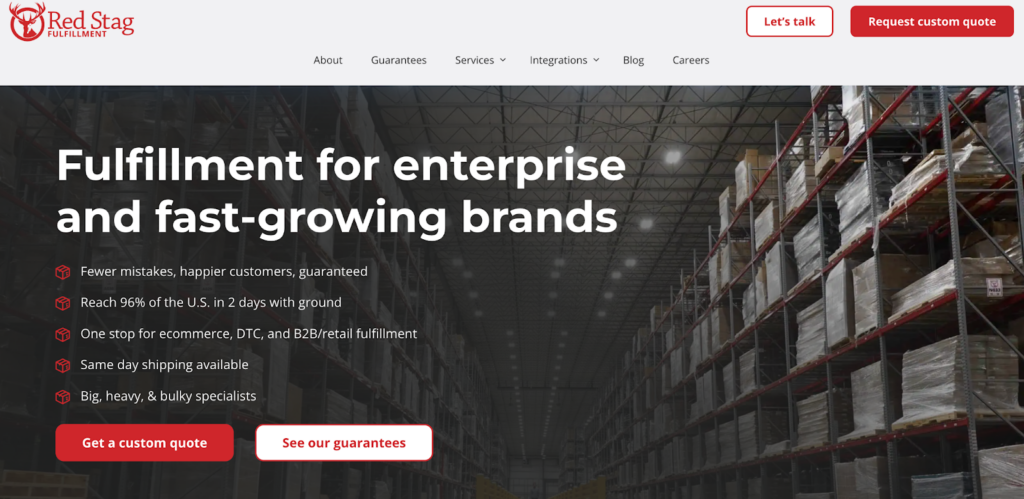
Red Stag Fulfillment specializes in providing ecommerce, DTC, and B2B/retail fulfillment services with a strong emphasis on big, heavy, and bulky items. They are known for their high accuracy rates and guarantees that focus on zero shrinkage, on-time shipping, and accurate orders.
Common Challenges Red Stag Fulfillment Resolves
- Slow receiving and out-of-stock issues: Red Stag Fulfillment guarantees fast receiving in as little as 1 hour and ensures stock availability.
- Shipping delays: Their guaranteed same-day shipping and on-time shipments policy ensures quick deliveries.
- Accuracy issues: With their 99.99% fulfillment accuracy, Red Stag reduces order mistakes that can damage customer satisfaction and business reputation.
Red Stag Fulfillment’s Pros
- Specializes in heavy and bulky fulfillment: Perfect for businesses dealing with large items.
- Same-day shipping: A significant advantage for fast-moving brands.
- Zero shrinkage guarantee: Ensures inventory safety with no lost or damaged goods.
- High accuracy rates: With a 99.99% fulfillment accuracy, Red Stag minimizes errors in order picking and shipping.
- Strategic warehouse locations: Two facilities that allow fast delivery across the U.S., reaching 96% of the population in 2 days.
Red Stag Fulfillment’s Cons
- Limited international shipping: While it provides excellent domestic fulfillment, international shipping may require additional logistics partners.
- Not ideal for small-scale businesses: The high-quality service may not be as cost-effective for companies with low order volumes or limited resources.
Red Stag Fulfillment Is Ideal for
- Ecommerce brands that deal with big, heavy, and bulky products.
- Fast-growing businesses that require reliable, same-day shipping and fast receiving.
- DTC, B2B, and retail companies need precision in inventory management and shipping accuracy.
Red Stag Fulfillment’s Pricing
- Custom pricing based on storage, order volume, and fulfillment needs, allowing businesses to pay for exactly what they require.
- No setup fees or long-term commitments, making it easier for businesses to scale with flexible solutions.
10. Fulfillment By Amazon (FBA)
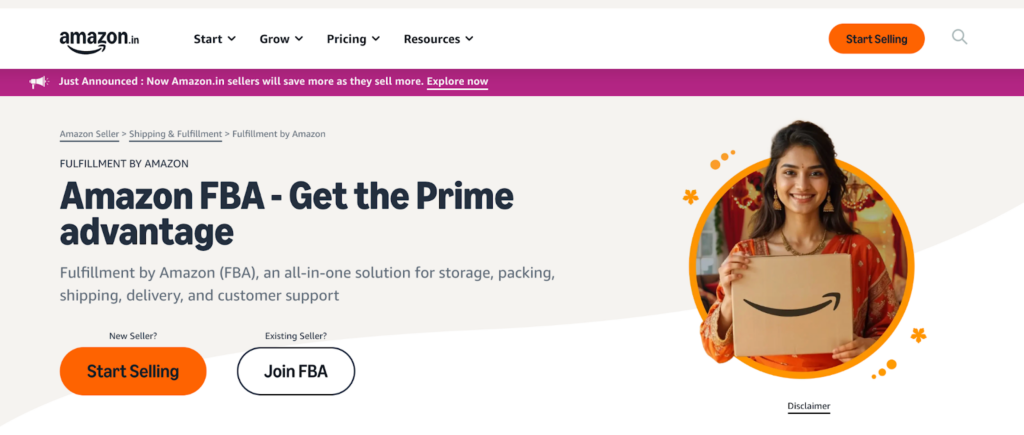
Fulfillment by Amazon (FBA) is an all-in-one solution for selling products on Amazon. Once you send your products to Amazon’s Fulfillment Centers, Amazon takes care of storage, packing, shipping, and customer service.
With FBA, products receive the Prime badge, ensuring fast delivery options like same-day or next-day shipping to customers. Additionally, Amazon handles returns and customer support for you.
Common Challenges Fulfillment By Amazon (FBA) Resolves
- Logistics management: Amazon handles the storage, packing, and shipping of your products, reducing the burden on your business.
- Customer service: FBA offers customer support and returns management, saving you time and effort.
- Visibility and sales: By providing the Prime badge to your products, FBA increases your product’s visibility and makes it more attractive to customers, boosting sales.
Fulfillment By Amazon (FBA)’s Pros
- Prime Badge: Gives your products Prime eligibility, attracting more customers who prefer fast, free shipping.
- Global reach: Access to Amazon’s vast logistics network, ensuring fast deliveries across India and beyond.
- No upfront fees: Flexible payment structures with no subscription fees or minimum order requirements.
- Seamless integration: Works smoothly with Amazon Seller Central for easy inventory management, pricing, and orders.
- Returns management: Amazon handles returns and customer inquiries, saving you operational time.
Fulfillment By Amazon (FBA)’s Cons
- Limited control: By using FBA, you are entrusting Amazon with product storage and shipping, leaving you with less control over your fulfillment process.
- Fee structure complexity: Some sellers find the FBA fees including storage, transportation, and pick-and-pack fees difficult to predict, especially for large or slow-moving inventory.
- Inventory restrictions: Amazon imposes certain inventory limits that may restrict your ability to stock larger quantities, especially during peak sales periods.
Fulfillment By Amazon (FBA) Is Ideal for
- DTC brands looking for a streamlined and hands-off fulfillment process with Prime eligibility.
- Ecommerce sellers wanting to access Amazon’s customer base and logistics infrastructure.
- Businesses scaling up with increased order volumes, needing robust fulfillment and customer support.
Fulfillment By Amazon (FBA)’s Pricing
- Storage fees: Based on size and duration of storage. Products stored for longer periods incur higher fees.
- Pick and pack fees: Charged per unit packed and shipped.
- Additional fees: Includes inbound shipping, returns handling, and removals.
FBA’s pricing is pay-as-you-go, meaning you only pay for the services you use, without upfront commitments.
Why Many Teams Ultimately Shortlist Locus
As businesses scale, challenges such as limited workflow control, inconsistent performance, and gaps in visibility begin to affect daily operations. These recurring issues are common in recent feedback as delivery networks expand.
The alternatives in this guide tackle various aspects of these challenges. Some focus on last-mile execution, others on post-purchase visibility, and a few offer comprehensive orchestration for teams operating across multiple regions.
Locus addresses key pain points faced by ShipBob users, particularly around routing stability, managing incomplete address data, workflow flexibility, and maintaining high performance during peak volumes. It provides the operational control that many teams need as they transition from basic fulfillment tools to more advanced solutions.
Book a walkthrough to see how Locus can solve the challenges often encountered with ShipBob and explore the seamless migration process.
Frequently Asked Questions (FAQs)
1. How does Locus improve last-mile delivery performance?
Locus enhances route optimization, ensuring faster deliveries with real-time updates. Its intelligent algorithms manage address data, reducing delays and minimizing RTOs for improved efficiency.
2. Can I integrate Locus with my existing platform?
Yes, Locus integrates seamlessly with most major ecommerce and shipping platforms, including ShipBob, providing easy synchronization for your workflows.
3. What types of businesses benefit most from Locus?
Locus is ideal for businesses dealing with high-volume shipments, complex routes, or needing multi-region orchestration, making it suitable for both small and large-scale operations.
4. How does Locus handle imperfect address data?
Locus uses advanced data correction algorithms to handle imperfect addresses, ensuring delivery accuracy and reducing errors in the final mile.
5. What kind of support can I expect during the migration process?
Locus provides dedicated customer support throughout the migration, helping businesses transition smoothly from their current platform while addressing any challenges, ensuring minimal disruption to operations.

General
Essential Logistics KPI Examples and Formulas: Track the Right Metrics in 2026

Sep 23, 2026
Logistics KPIs for 2025: track order accuracy, returns, and cost per shipment. See how Locus surfaces and responds to performance shifts effortlessly.
Read more
Dispatch Management
Automated Dispatching System: The 2026 Enterprise Guide to AI-Powered Logistics at Scale
Sep 23, 2026
Automated dispatch software boosts speed, lowers costs, and improves visibility. Learn features, benefits, and future trends in 2025.
Read moreInsights Worth Your Time




















Top 10 ShipBob Alternatives to Consider in 2026 for Better Routing and Delivery Performance