


General
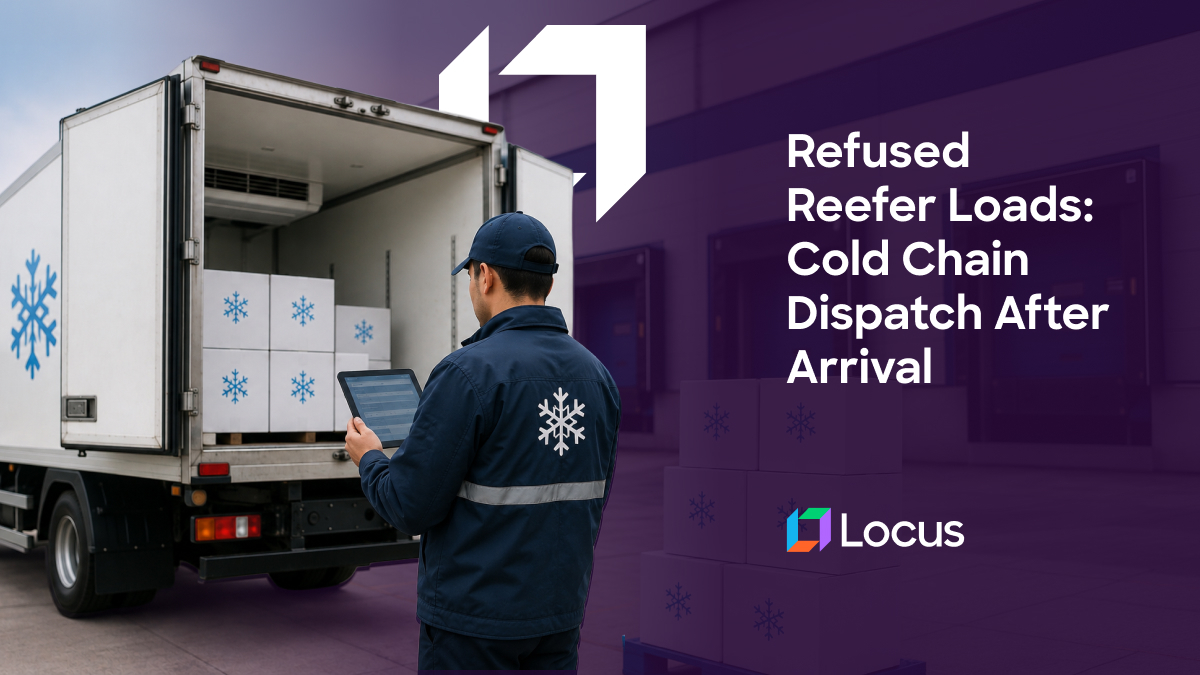
Cold Chain Dispatch for Refusals, Recalls, and Redirects in North America

Key Takeaways
- Cold chain dispatch planning stops at the dock. The most expensive events in temperature-controlled logistics happen after arrival: refusal at receiving, and retrieval under recall.
- A refused reefer load is a dispatch decision with a clock, not a claims event. The product keeps degrading while the disposition question is unresolved.
- FSMA Rule 204 gets you the records within 24 hours. Physically finding and retrieving the product is a separate dispatch problem that is almost never planned.
- The FDA Sanitary Transportation rule assigns responsibility for temperature conditions, but a refusal dispute needs evidence that neither the shipper nor the carrier usually captured.
- One governance boundary matters more than any other in cold chain: route and re-sequence autonomously, never decide product disposition autonomously.
Your dispatch plan assumes the delivery succeeds
Cold chain dispatch is a well-covered discipline on the way out. Temperature thresholds as planning constraints, multi-compartment vehicle allocation, dwell modelled as spoilage risk rather than schedule risk, appointment windows as hard constraints. All of that is real and all of it concerns getting the load to the door.
Almost nothing addresses what happens at the door when it goes wrong.
Two events sit in that blind spot. A receiver refuses the load, for temperature, condition, documentation, or their own capacity reasons. Or a recall is issued and product already in the network has to be found and brought back. Both are dispatch problems. Both run against a clock. And in most operations both are handled by a person with a phone, improvising against a list of options nobody modelled in advance.
The financial exposure is larger than the freight. USDA Economic Research Service estimates that $161.6 billion of food at the retail and consumer stage goes uneaten annually, and cites FAO estimates that roughly 30% of fruit and vegetable losses occur at farms and in pre-retail distribution. A refused load that spends four hours unassigned while somebody works the phones is a direct contributor to that number, and it is the part of it a dispatch system could actually influence.
This piece covers what a refusal decision actually involves, why the liability question is usually unanswerable after the fact, why recall retrieval is unplanned dispatch, and where the autonomy boundary should sit.
The twenty-minute decision
When a chilled load is refused, the operation has a narrow window to decide where it goes. The product is still degrading, the driver is still on the clock, and the vehicle is occupying a dock that the receiver wants back.
Six dispositions exist. Each needs something the operation may not have.
| Disposition | What it requires | Constraint |
|---|---|---|
| Re-deliver after correction | Consignee agreement and product still within tolerance | Only viable if the refusal was documentation or timing rather than condition |
| Alternate customer | A buyer at short notice, product in spec, possible relabelling | Commercial decision, not a dispatch one, but needs a dispatch answer in minutes |
| Nearest compliant cold storage | Available capacity at the right temperature band, within reach | Third-party cold storage availability is rarely visible in any planning system |
| Salvage or secondary market | An established channel and a disposition decision | Requires someone authorised to declare the product downgraded |
| Donation | A compliant recipient and liability handling | Often the best outcome and the slowest to arrange |
| Disposal | A compliant route and a write-off | Fastest and most expensive, so it becomes the default under time pressure |
Read that table as a sequence and the failure mode is obvious. The options degrade in value from top to bottom, and time pressure pushes decisions downward. An operation that takes four hours to work the list will land lower on it than an operation that resolves in twenty minutes, and the difference is not negotiating skill. It is whether the options existed as modelled destinations with live capacity before the refusal happened.
Dock dwell makes it worse. ATRI found drivers were detained at 39.3% of all stops in 2023, losing between 117 and 209 hours per year. A refusal happens at the end of that queue, so the clock on the disposition decision starts already partly spent.
Also Read: Agentic TMS for North America’s Cold Chain Logistics: What Food and Grocery Shippers Should Know
Who owns the temperature risk at refusal
The regulation is clearer than the practice. The FDA’s Sanitary Transportation of Human Food rule requires shippers to specify operating temperature conditions in writing and carriers to demonstrate that the vehicle met them, including pre-cooling, and to furnish temperature records on request.
So responsibility is assigned. What is usually missing is evidence.
A refusal dispute turns on three questions. Was the vehicle at temperature when loading began? Did it stay within tolerance through transit, including during dwell at intermediate stops? And what was the product temperature at the moment of handoff? In most operations the first is asserted rather than recorded, the second is available from reefer telemetry that lives in a different system from the dispatch record, and the third is captured as a signature on a proof of delivery that says nothing about temperature.
That gap converts an operational question into a commercial one. With evidence, a refusal is a decision: the product is in spec and the receiver is wrong, or the product is out of spec and the disposition question begins. Without evidence, it becomes a claim, and claims are settled on relationship and leverage rather than on what happened.
The practical implication for dispatch is narrow and worth acting on. Proof of delivery in cold chain should carry the temperature state at the drop, not only a signature, and the record should sit in the same place as the dispatch decision that produced it. A temperature record in a telematics platform and a delivery record in a dispatch platform, with no join between them, is two half-answers.
Also Read: Why Last-Mile Exception Management Is Operationally Different for North American 3PLs
Recall is a dispatch problem, not a records problem
North American cold chain operators have spent significant effort on FSMA Rule 204 readiness, and correctly so. The FDA’s Food Traceability Rule requires Key Data Elements maintained against Critical Tracking Events, two of which, shipping and receiving, occur inside transportation, with covered firms able to produce an electronic sortable spreadsheet within 24 hours of an FDA request.
That work answers where the product went. It does not move a single pallet.
Recall execution is a distinct and largely unplanned dispatch exercise. Product sits across distribution centres, in transit on multiple vehicles, at stores or clinics, and possibly already with consumers. Retrieval means constructing routes to locations that were never delivery destinations, against a scope defined by lot code rather than by order, with capacity that is already committed to today’s outbound plan. And it has to happen while normal operations continue, because a recall does not suspend the rest of the network.
Three specific dispatch requirements follow, and none is satisfied by traceability records alone.
Reverse routes have to be constructible from a lot-level scope. The retrieval instruction is “all units of lot X,” which has to resolve into a set of physical locations, quantities, and vehicles before anything can be routed.
Capacity has to be found without breaking the outbound commitment. Recall retrieval competes with the day’s deliveries for the same fleet, and someone has to decide the trade. That is a capacity allocation decision, which is a dispatch decision.
In-transit product needs an interception decision. Units on a vehicle heading to a customer should not complete delivery, which means the plan has to change mid-route rather than being corrected afterwards. Gartner’s finding that 95% of supply chains must react quickly to change while only 7% can execute decisions in real time is exactly the constraint that determines whether interception happens or whether the product arrives and has to be retrieved again.
What changes when post-arrival events are designed rather than improvised
| Dimension | Improvised | Designed |
|---|---|---|
| Disposition options | A list in someone’s head, worked by phone | Modelled destinations with live capacity and eligibility |
| Time to decision | Hours, and the option set degrades while you wait | Minutes, with the higher-value dispositions still available |
| Cold storage availability | Called around for | Held as capacity state, filtered by temperature band |
| Temperature evidence | Split across telematics and delivery records | One record, temperature-stamped at handoff |
| Refusal outcome | A claim settled on leverage | A decision made on evidence |
| Recall scope | Manual join from lot codes to locations | Lot scope resolves to a routable retrieval plan |
| In-transit product | Completes delivery, then gets retrieved twice | Intercepted mid-route |
| Who decides disposition | Whoever is available | A named role, with the system supplying the evidence |
The last row is the one that carries legal weight, and it deserves its own treatment.
The one decision that should never be autonomous
Cold chain is where autonomous dispatch meets a genuine boundary, and getting the boundary right matters more than maximising autonomy.
Routing, re-sequencing, capacity reallocation, and interception are all decisions a system should make on its own. They are reversible, they are governed by constraints that can be modelled, and speed materially improves the outcome. A system that re-sequences a route to protect an at-risk load, or reallocates capacity to a retrieval, is doing exactly what it should.
Product disposition is different. Declaring a load salvage, donation, or disposal is a judgement about whether goods are fit for their intended use. It carries regulatory and liability consequences, it is not reversible, and in food and pharmaceutical operations it is a decision a named person is answerable for. No autonomy setting should absorb that.
The useful design, then, is not a choice between automated and manual. It is a split: the system resolves everything up to the disposition question at machine speed, then presents a human with the options, their capacity, their deadlines, and the evidence, and executes whichever they choose. The human decides once, quickly, with better information than a phone call would produce. Everything around that decision is automated.
That is a more defensible position than either extreme, and it is the one an auditor will accept.
Also Read: What is an Agentic TMS? A Practical Guide for Enterprise Logistics Leaders in 2026
How Locus handles post-arrival cold chain events
Locus, the world’s first Decision-Intelligent, Agentic TMS, treats refusal and retrieval as dispatch events inside the same decision engine that plans the outbound route, which is what makes a twenty-minute disposition possible.
Within DiSCO, the Dispatch agent re-evaluates remaining feasibility when a load’s state changes and re-sequences or reassigns against more than 250 real-world constraints per computation, including temperature and time windows. The Capacity agent identifies compliant alternative capacity, which is the mechanism behind finding a receivable destination rather than calling around for one. The Hub agent manages facility-side constraints that determine whether a diversion can actually be accepted, since a cold storage location with no available capacity in the right temperature band is not an option regardless of distance. The Customer agent handles the revised commitment where product is redirected rather than returned.
Governance is the load-bearing part for regulated product. Six mechanisms bound autonomous action: explainability, traceability, evaluation, autonomy levels, an execution sandbox, and human-in-the-loop override. Autonomy levels are what implement the split described above, allowing full autonomy on re-sequencing and interception while holding disposition as recommend-only. Traceability produces the decision record, which is the same property a refusal dispute or a recall audit requires.
Locus has been recognized by Gartner for seven consecutive years, featured in the 2026 Hype Cycle for Supply Chain Execution and Logistics Technologies, named a Leader in TMS by QKS Group (SPARK Matrix), and ranked #1 in Route Planning on G2’s 2026 Best Software Awards. In October 2025, Ingka Investments, the investment arm of Ingka Group, the world’s largest IKEA retailer, acquired Locus. Locus continues to operate independently.
Two North American deployments show the underlying capability, in operations where the clock is the binding constraint.
A leading Canadian grocery brand delivering fresh and perishable food into homes across more than 30 cities through multiple contracted carriers had precisely the blind spot this article describes. Once a shipment left the dock there was no visibility at all, so the first signal of a problem was usually the customer, and for perishable food every hour of manual coordination was freshness lost in transit. Carrier selection itself was manual, checked order by order against serviceability sheets, so the allocation logic lived in planners’ heads rather than in a system that could re-decide. After consolidating orchestration onto one platform, the brand reported 33% faster deliveries, 15% lower fulfilment costs, 25% less time on manual shipping tasks, and customer support resolution 10 to 20 times faster.
A leading North American retailer supplying a multi-hundred-store network across ocean, rail, and road previously had exceptions surface only after delays had reached store service. With the decisioning layer surfacing problems before they reach the store rather than reporting them afterwards, the operation now resolves exceptions in under two hours network-wide, with on-time store delivery above 99% and a more than 80% reduction in manual dispatch. Sub-two-hour exception resolution is the same capability a refusal decision needs, applied earlier in the chain.
Also Read: Real-Time Tracking and Visibility in North America: Why Fragmented Carriers Make Visibility Hard
Plan the events you currently improvise
Two exercises will tell you where you stand, and neither needs new software.
Take your last five refused loads. For each, record the time from refusal to disposition decision, which disposition was chosen, and whether a higher-value option was available at the moment of refusal but unavailable by the time the decision was made. That gap is the cost of improvising, expressed in your own numbers.
Then run a tabletop recall. Pick a lot code, and time how long it takes to produce not the FDA spreadsheet, which you have probably rehearsed, but a routable retrieval plan: locations, quantities, vehicles, and a capacity trade against today’s outbound commitments. Most operations discover the records are ready and the dispatch plan does not exist.
Cold chain dispatch maturity is usually measured on the outbound journey, where the discipline is well developed. The events that destroy the most product are on the other side of the dock, and they are dispatch problems that have simply never been assigned to dispatch.
Book a Locus demo to walk a refusal and a lot-level retrieval through the decision engine against your own network and cold storage footprint.
Frequently Asked Questions (FAQs)
What happens to a refused reefer load?
Six dispositions are available: re-delivery after correction, sale to an alternate customer, diversion to compliant cold storage, salvage, donation, or disposal. They descend in value, and time pressure pushes decisions downward, so an operation that takes hours to resolve typically lands lower on the list than one that resolves in minutes. The determining factor is whether those options existed as modelled destinations with live capacity before the refusal happened.
Who is liable when a temperature-controlled load is refused?
The FDA’s Sanitary Transportation of Human Food rule requires shippers to specify operating temperature conditions in writing and carriers to demonstrate the vehicle met them, including pre-cooling. Responsibility is therefore assigned, but resolving a specific dispute needs evidence of the temperature at loading, through transit including dwell, and at handoff. Where that evidence is split across telematics and delivery records with no join, the refusal becomes a claim settled on leverage rather than a decision made on facts.
Does FSMA Rule 204 cover recall execution?
No. Rule 204 requires Key Data Elements maintained against Critical Tracking Events, including shipping and receiving, and the ability to produce an electronic sortable spreadsheet within 24 hours of an FDA request. That establishes where product went. Physically retrieving it is a separate dispatch exercise: resolving a lot-level scope into locations and quantities, finding capacity without breaking the outbound plan, and intercepting units already in transit.
How should product already on a vehicle be handled during a recall?
By interception rather than retrieval. Units heading to a customer should not complete delivery, which requires changing the plan mid-route instead of correcting it afterwards. That depends on being able to re-decide intra-day, which is the constraint behind Gartner’s finding that only 7% of supply chains can execute decisions in real time. Where interception is not possible, the same product has to be moved twice.
Should a dispatch system decide product disposition automatically?
No. Routing, re-sequencing, capacity reallocation, and interception should be autonomous, since they are reversible, constraint-governed, and improved by speed. Declaring product salvage, donation, or disposal is a judgement about fitness for intended use with regulatory and liability consequences, and it is not reversible. The workable design resolves everything up to that question automatically, then presents a named decision-maker with the options, capacity, deadlines, and evidence.
What proof of delivery does cold chain require?
Proof that carries temperature state at the drop rather than a signature alone, held in the same record as the dispatch decision that produced it. A signature confirms someone received something. It says nothing about whether the product was within tolerance at handoff, which is the fact a refusal dispute or a compliance review turns on.
How do you measure readiness for post-arrival cold chain events?
Two exercises. For your last five refused loads, measure time from refusal to disposition decision and whether a higher-value option lapsed while you decided. Then run a tabletop recall and time how long it takes to produce a routable retrieval plan, not the regulatory spreadsheet. Most operations find the records are ready and the dispatch plan does not exist.


General
Five Last-Mile Delivery Experience Strategies That Fail and What European Grocery Delivery Providers Can Do Instead

Aug 27, 2026
European grocery has the hardest last-mile environment in retail, and most providers run playbooks borrowed from general e-commerce. Five strategies that fail, and what to do instead.
Read more
General
Why New Drivers Quit Before They Learn the Route: Earnings Variance is a Dispatch Decision
Aug 27, 2026
Pay reviews rarely fix driver churn because the rate was never the problem. Earnings variance is produced by allocation decisions, it hits new drivers hardest, and it is measurable.
Read moreInsights Worth Your Time



















Cold Chain Dispatch for Refusals, Recalls, and Redirects in North America