


General
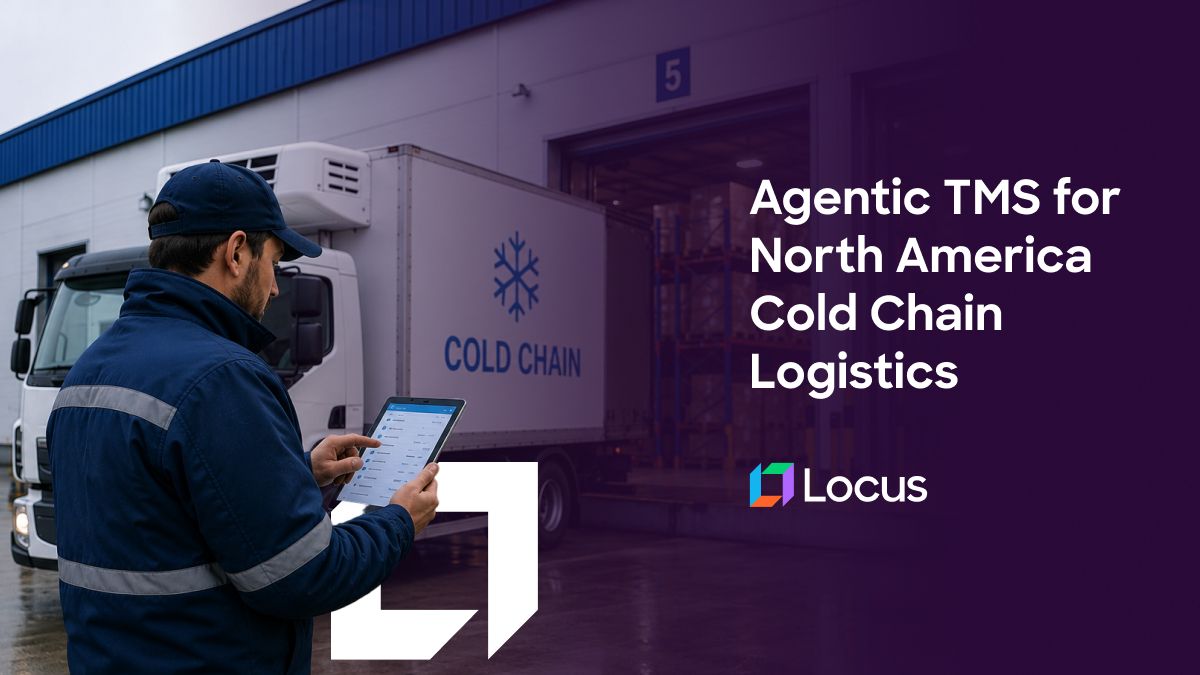
Agentic TMS for North America’s Cold Chain Logistics: What Food and Grocery Shippers Should Know

Key Takeaways
- Cold-chain food and grocery is among the hardest last miles: perishable goods, tight temperature and time windows, high failure cost, and rising e-grocery volume in North America.
- Cold chain has two software layers: a temperature-monitoring and compliance layer, and a movement and decisioning layer. An agentic TMS is the second.
- On the movement layer, an agentic TMS improves cold-chain delivery through reefer-aware dispatch, time-sensitive routing, tight delivery windows, and real-time re-optimization to protect perishables.
- It is not a temperature-monitoring, reefer-telemetry, or FSMA-compliance system; it integrates with those rather than replacing them.
- Food and grocery shippers should evaluate the transportation layer on how well it assigns the right vehicle, minimizes transit time, and adapts in real time when a route slips.
Why Cold Chain is the Hardest Last Mile for Food and Grocery
Moving refrigerated and frozen food is last-mile delivery with the tolerances turned up. A parcel that arrives an hour late is an inconvenience; a case of chilled produce or frozen meals that spends an hour too long in transit, or rides in the wrong vehicle, can be unsellable on arrival. For North American food and grocery shippers, that fragility sits on top of every normal last-mile pressure, and a few forces are intensifying it: e-grocery and meal-kit volume keep rising, customers expect narrow delivery windows, and food-safety expectations, framed in the US by the Food Safety Modernization Act, mean cold-chain integrity is not optional.
The FAO estimates roughly one-third of all food produced is lost or wasted, with about 13% lost in the supply chain after harvest and before retail; USDA puts US food loss at ~31% at retail and consumer levels.
The result is an operation where the cost of getting delivery wrong is unusually high and unusually visible. Spoilage is a direct product loss, a failed or delayed perishable delivery is rarely recoverable the way a dry-goods redelivery is, and the customer experience hit lands immediately. That raises an obvious question for shippers evaluating technology: what actually protects a cold-chain delivery, and which part of that is a transportation problem an agentic TMS can solve? This piece draws that line clearly, because cold chain is exactly the kind of topic where software categories get conflated.
Cold Chain Has Two Software Layers
The single most useful distinction for a cold-chain shipper is that “cold chain software” describes two different things.
The first is the monitoring and compliance layer: temperature sensors and reefer telemetry, cold-chain integrity tracking, excursion alerting, and the documentation that food-safety compliance requires. This layer answers “was the temperature maintained, and can I prove it.”
The second is the movement and decisioning layer: which vehicle carries which order, on what route, in what sequence, and how the plan adapts when the day changes. This layer answers “did the goods get there fast enough, in the right vehicle, within the window.” An agentic TMS lives in this second layer. It does not measure temperature; it makes the transportation decisions that keep perishable goods moving efficiently enough that the cold chain is easier to hold in the first place. Both layers matter, and the best cold-chain operations run both, but they are different products solving different problems, and evaluating them as one is how shippers end up with a gap.
Also Read: Real-Time Carrier Visibility in TMS: What to Look For in 2026
How an Agentic TMS Improves Cold-Chain Delivery
Within the movement layer, four capabilities do most of the work for food and grocery.
Reefer-Aware Dispatch and Vehicle Assignment
Cold-chain delivery depends on the right order riding in the right vehicle: refrigerated, frozen, or ambient, with the right capacity. An agentic TMS treats vehicle type and capability as a hard constraint in the assignment decision, so perishable orders are dispatched to appropriate reefer capacity automatically rather than by manual matching that breaks under volume.
Time-Sensitive Routing to Minimize Transit
For perishables, time in transit is the enemy. Routing that minimizes distance is not the same as routing that minimizes the time a temperature-sensitive load spends on the road. An agentic TMS optimizes routes with perishability in mind, prioritizing shorter time-in-transit and earlier delivery of the most sensitive loads, across the 250+ real-world constraints a route actually carries.
Protecting Tight Delivery Windows
Grocery and meal-kit customers expect narrow windows, and cold-chain loads cannot absorb long waits. The platform plans against those windows and sequences stops to hit them, which protects both the customer promise and the product, since a load delivered on time is a load that spent less time at risk.
US online grocery sales surpassed $200 billion in 2024, and McKinsey projects online grocery to be the channel’s fastest-growing segment through 2030.
Real-Time Re-Optimization to Protect Perishables
The highest-value capability is what happens when the plan slips. A breakdown, a traffic delay, or a failed stop puts a perishable route at risk, and a static plan cannot respond. An agentic TMS re-optimizes in real time, rerouting and resequencing so the temperature-sensitive loads are protected first, before a delay turns into spoilage. This is where the movement layer most directly prevents cold-chain loss.
McKinsey finds 68% of online grocery shoppers now consider same-day delivery a baseline expectation, not a bonus.
Also Read: 5 European Logistics Innovations Reshaping 2026: From Agentic TMS to GenAI Customer Service
What an Agentic TMS Does Not Do
Being precise here is what keeps the category honest. An agentic TMS, till now, does not provide reefer telemetry or sensor data, it does not track cold-chain integrity, and it does not generate FSMA or food-safety compliance documentation. Those belong to the monitoring and compliance layer, and a cold-chain operation needs that layer regardless. What an agentic TMS does is integrate with those systems and own the transportation decisions around them, so the two work together: monitoring proves the chain holds, and the TMS makes the movement decisions that make it easier to hold. A shipper should expect a TMS to connect to its cold-chain monitoring, not to replace it.
What Food and Grocery Shippers Should Look For
When evaluating the transportation layer for cold-chain food and grocery, focus on the movement decisions:
- Does it treat vehicle type and reefer capability as a hard constraint in dispatch, so perishables always ride appropriate capacity?
- Does its routing minimize time-in-transit for sensitive loads, not just distance?
- Can it plan and hold tight delivery windows at your volume?
- Does it re-optimize in real time to protect perishable loads when a route slips, or only alert you?
- Does it orchestrate across your owned fleet, 3PLs, and carriers as one operation?
- Does it integrate cleanly with your cold-chain monitoring and compliance systems rather than duplicating or ignoring them?
A platform that answers these well is the right transportation layer; the temperature and compliance questions belong to a different, complementary tool.
What This Means for a North American Food or Grocery Shipper
If spoilage, missed windows, or the cost of failed perishable deliveries are hurting your operation, part of the answer is almost certainly in the transportation layer, in how orders are dispatched to the right vehicles, how routes are planned for time-sensitivity, and whether the plan can adapt in real time to protect perishables. Those are agentic-TMS problems. The temperature-integrity and compliance parts are real too, and they belong to the monitoring layer you should run alongside it.
Also Read: Embedded AI-Native TMS for Canadian Logistics 2026
Seen that way, “agentic TMS for cold chain” is not a claim to do everything cold chain requires. It is a precise claim to own the movement decisions that most directly determine whether perishable food and grocery arrives fast, in the right vehicle, and on time, which is where a large share of preventable cold-chain loss actually happens.
Frequently Asked Questions (FAQs)
What is an agentic TMS in cold chain logistics?
An agentic TMS is transportation software that autonomously makes the dispatch, routing, and re-optimization decisions for moving goods, applied to cold chain, that means assigning perishable orders to appropriate reefer vehicles, routing to minimize time-in-transit, holding tight delivery windows, and re-optimizing in real time to protect at-risk loads. It operates on the movement layer of cold chain, not the temperature-monitoring or compliance layer.
Does an agentic TMS monitor temperature or handle cold-chain compliance?
No. An agentic TMS does not measure temperature, provide reefer telemetry, track cold-chain integrity, or produce food-safety compliance documentation. Those belong to a separate monitoring and compliance layer. An agentic TMS integrates with those systems and owns the transportation decisions, so the two are complementary rather than substitutes.
How does an agentic TMS reduce cold-chain losses for food and grocery?
By protecting the movement. It dispatches perishables to appropriate reefer capacity, routes to minimize the time sensitive loads spend in transit, holds tight delivery windows, and, most importantly, re-optimizes in real time when a route slips so temperature-sensitive loads are protected first. Much preventable spoilage traces to delays and mis-assignment, which are transportation decisions the TMS makes.
What should North American food and grocery shippers look for in cold-chain transportation software?
Whether it treats reefer capability as a hard dispatch constraint, whether its routing minimizes time-in-transit for sensitive loads rather than just distance, whether it can plan and hold tight windows at volume, whether it re-optimizes in real time to protect perishables, whether it orchestrates owned fleet, 3PLs, and carriers together, and whether it integrates with cold-chain monitoring and compliance systems.
How is food and grocery cold chain different from pharma cold chain?
Both are temperature-controlled, but they differ in regulation, packaging, value density, and network. Food and grocery cold chain runs at high volume with tight consumer delivery windows and thin margins, where spoilage and missed windows are the main risks; pharma cold chain carries stricter regulatory and integrity requirements on higher-value, lower-volume loads. The transportation-layer principles overlap, but the constraints and stakes differ.


General
Best Last-Mile Delivery Software for Logistics Companies in 2026: A Software-First Buyer’s Guide

Jul 28, 2026
A software-first guide to the best last-mile delivery software in 2026: how AI is reshaping it, a platform comparison, and how to evaluate for your model.
Read more
General
In-Transit Visibility Software for Multi-Leg, Multi-Carrier Retail Networks

Jul 29, 2026
Discover how in-transit visibility software unifies multi-leg, multi-carrier tracking and ties it to dispatch execution across enterprise retail networks with Locus.
Read moreInsights Worth Your Time



















Agentic TMS for North America’s Cold Chain Logistics: What Food and Grocery Shippers Should Know