


General
Private Fleet vs Fleet Outsourcing: Why Supply Chain Leaders Must Think Beyond Either/Or

For years, supply chain leaders in CPG and retail have debated a familiar question: Should we double down on our private fleet or outsource more to third-party carriers? It’s a neat debate in theory, but messy in practice. Even in well-run logistics chains, McKinsey reports that 13-19% of total logistics costs (~$95 billion annually in the U.S.) stem from inefficiencies such as empty miles and misallocated capacity1.
This is why companies thriving today don’t pick sides between private fleet vs outsourced fleet. They have an integrated approach that prefers mastering the mix to choosing a model. This approach helps them not to over-depend on one channel and balances cost-efficiency with resilience.
Even The “Optimal” Mix Can Drain Profits
It’s tempting to think that once you’ve sized your captive fleet and signed contracts with a network of 3PLs, you’re set. But fleet mix is only half the problem. The other half is how allocation decisions get made day to day.
Too often, operations teams lean on rules of thumb or sheer gut feel to decide which orders go to private vs outsourced fleet. But this works only to some extent. When demand spikes and delivery windows tighten, manual planning and allocation struggle.
So, even with trucks at the ready, poor allocation can mean running your own fleet when a 3PL would have been cheaper, or outsourcing when your own trucks could have handled the job more efficiently. Multiply that mistake by thousands of orders, and suddenly your carefully balanced fleet mix is a silent drain on margins.
The silent drain shows up as underutilized assets or inflated transportation costs. And the all-too-familiar scramble to add headcount during peaks to ensure effective fleet allocation.
Curious where the private fleet beats outsourcing and where it doesn’t? Explore our whitepaper for scenario-based cost and efficiency insights.
The Real Leadership Question
The sharper question for supply chain leaders thus becomes about allocation. Who controls how each order is assigned, and on what basis?
Because allocation is more than a quarterly strategy decision. It’s a high-frequency judgment made thousands of times a day. And the compounded effect of those choices on cost, capacity, and service performance far outweighs whether the truck is owned or outsourced.
That’s the blind spot in most fleet strategies.
The Decision Layer that Controls Margins
Once you stop thinking in terms of fleet ownership and start thinking in terms of allocation, the role of technology becomes obvious. You need a single decision layer that sees across all capacities and routes every order to the best option in real time. That’s what a modern TMS does.
A Transportation Management System (TMS) connects across your supply chain data sources and acts as the single decision layer. Instead of dispatchers guessing or firefighting, the TMS evaluates every order against real constraints (cost, priority, geography, service level) and routes it to the right fleet automatically.
Think of it more like amplifying human capabilities instead of replacing them. Practically, it means operations leaders can set the rules of engagement:
- Always use a private fleet if the order value exceeds a threshold, to protect high-value customer experience.
- Default to the cheapest carrier only if the delivery still hits the promised time window.
- Auto-route orders to a 3PL if the service location falls outside captive coverage.
- Leverage contracted rate discounts with carriers when thresholds are met.
These are a few examples of how the rules can be set and decision-making can be automated. You can set the system to allocate orders based on multiple rules, including custom ones.
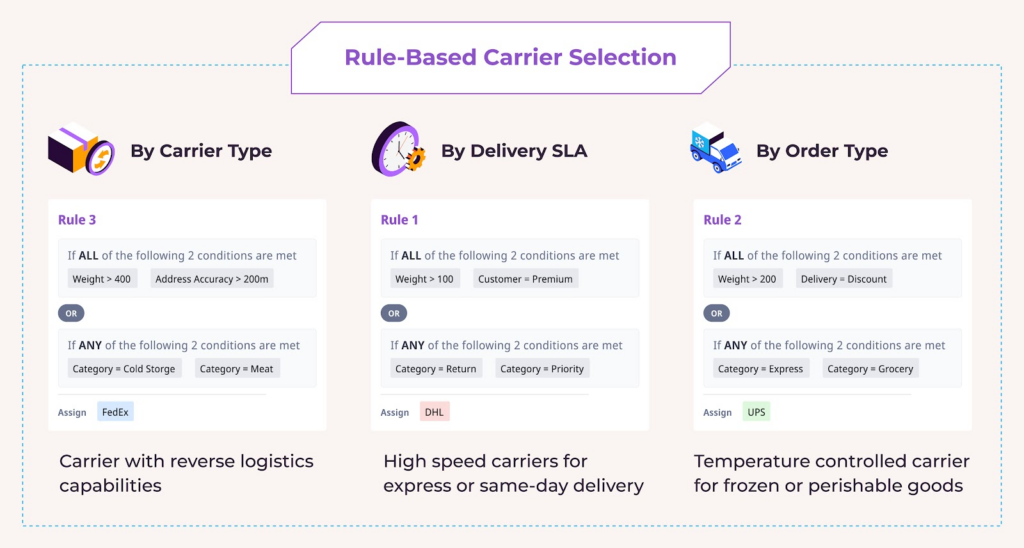
Fleet allocation decisions can’t be manual or based solely on gut feeling. It should be dynamic, contextual, and automated, with operations having the power to re-allocate orders if needed, with a few clicks on the TMS dashboard.
Why This Matters More When Fleet Outsourcing
Choosing a 3PL isn’t trivial. Dispatchers relying on price alone often discover too late that the “cheapest” option came with late deliveries or poor SLAs. During peaks, the risk multiplies. When stressed, humans tend to optimize for speed over quality and end up assigning orders to the wrong carriers.
A modern TMS removes that guesswork.
Think of it as a constantly updated scorecard: each carrier’s SLA record, service footprint, and reliability are visible and compared at a glance. The system ranks options based on your priorities and allocates them automatically. If a carrier rejects the load, the process is repeated to select the next-best carrier.

The automated carrier allocation process turns outsourced fleet management into a repeatable, data-driven process with minimal human intervention.
A Single Decision Layer for Both Worlds
The real advantage for CPG and retail companies is in unifying private and outsourced fleets under a single decision layer. It helps leaders move beyond cost vs service trade-offs and unlock a future where resilience and efficiency scale together. The companies that master this decision layer will set the benchmark for logistics performance.
If you’re ready to see how that future can play out in your supply chain, our team can show you the path forward.
Bibliography


General
Logistics Scheduling: Importance, Benefits & Key Strategies

Sep 30, 2025
Explore logistics scheduling’s importance in 2025. Learn strategies, benefits, challenges, and find out how Locus enhances scheduling with AI-driven solutions.
Read more
General
Understanding Commercial Truck Routes: A Complete Guide in 2025
Oct 1, 2025
Discover how commercial truck routing optimizes fleet operations, reduces costs, and improves delivery performance with modern routing software and proven implementation strategies.
Read moreInsights Worth Your Time




















Private Fleet vs Fleet Outsourcing: Why Supply Chain Leaders Must Think Beyond Either/Or