


General
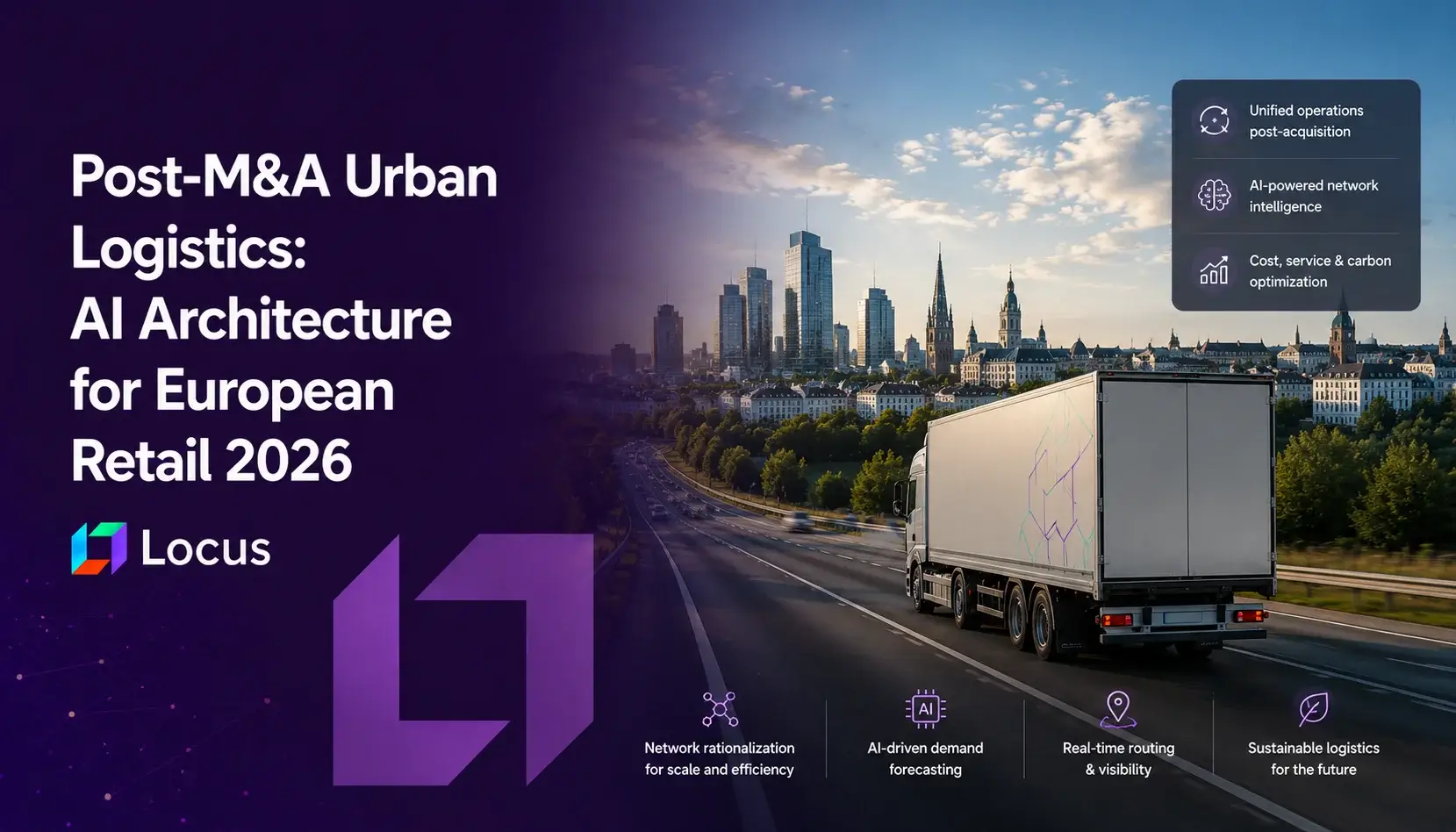
Post-M&A Urban Logistics: AI Architecture for European Retail Groups Managing Consolidation in 2026

Key Takeaways
- European retail M&A produces under-discussed operational consequences for urban logistics — duplicate networks requiring rationalization, customer experience consistency across former brands, capacity utilization at merged scale, and platform integration complexity.
- Most logistics platforms were architected for single-entity operations and face structural limits handling post-M&A integration. Five failure modes erode merged operation economics: network rationalization, cross-brand customer experience, merged-scale capacity, multi-platform integration, and cross-border complexity.
- AI and agentic architecture addresses post-M&A challenges materially better than rule-based platforms. The operational complexity consolidation produces is exactly where AI handles variation rule-based logic can’t absorb.
- Each failure mode has architectural fixes: AI-driven network optimization, brand-aware customer experience orchestration, capacity orchestration at merged scale, integration absorption across heterogeneous platforms, and native multi-country European handling.
- For European retail CSCOs in 2026, the question is whether architecture handles consolidation reality — or runs against single-entity assumptions producing drag at scale.
European retail consolidation has been one of the more persistent market dynamics across European markets — UK grocery competition pressure, German discount retail rationalization, Dutch and Belgian retail integration, French hypermarket consolidation, Southern European retail restructuring, and cross-border European retail group expansion all produce M&A activity that reshapes how European urban logistics actually operates. When retail groups consolidate through M&A, their urban logistics architectures inherit integration challenges that most logistics platforms weren’t designed to handle.
The integration challenges are operationally substantive but under-discussed in vendor logistics content. Merging retail entities run duplicate distribution networks across the same urban footprints. Customer-facing delivery experiences differ across former separate brands. Last-mile fleets operate against different historical service models. Micro-fulfillment infrastructure follows different architectural patterns. Customer data lives in different systems with different schemas. Each integration challenge affects operational economics, customer experience consistency, and the strategic value the M&A was supposed to produce.
AI and agentic architecture addresses post-M&A integration challenges materially better than rule-based platforms because the operational complexity consolidation produces — multi-entity rationalization, brand-aware customer experience, cross-country operational reality, heterogeneous platform integration — is exactly the kind of pattern-rich operational decisioning AI handles meaningfully better than fixed business logic. Retail groups managing post-M&A integration with AI-augmented logistics architecture realize consolidation value faster and with less operational disruption than retail groups attempting integration through legacy platform infrastructure.
For European retail Chief Supply Chain Officers, Heads of Urban Logistics, post-M&A integration leaders, IT decision-makers managing logistics platform consolidation, and Heads of Operations supporting merged retail operations in 2026, this is a practical look at the five failure modes where legacy platforms break under post-M&A logistics reality — and the AI architectural fixes that address each.
Failure Mode 1: Duplicate Network Rationalization Without Merged-Scale Optimization
The failure. Merging retail entities inherit duplicate distribution networks across overlapping urban footprints — overlapping DCs, redundant last-mile fleets in shared cities, parallel micro-fulfillment infrastructure, redundant customer-facing pickup points. Rationalization decisions about which networks to retain, consolidate, or close affect operational economics, customer service levels, and capital allocation.
Legacy platforms model network economics within single-entity assumptions. Post-M&A rationalization requires modeling across the merged footprint — combined demand patterns, combined customer base, combined operational capacity, combined fixed cost structure. Legacy platforms produce rationalization decisions made on partial data, missing optimization opportunities that merged-scale modeling would surface and creating service-level risks that merged-data analysis would identify.
The AI architectural fix. AI-driven network optimization handles merged operational footprints as primary modeling input rather than as integration of separate entity models. The optimization runs across combined demand patterns, combined customer base, combined operational capacity, and combined cost structure simultaneously. Rationalization decisions get made against complete merged-state data rather than against partial entity-specific data.
Agentic AI architecture handles this complexity natively because operational decisioning operates against full operational scope rather than against simplified single-entity objectives. The architectural shift surfaces optimization opportunities that legacy platforms structurally can’t identify.
Failure Mode 2: Cross-Brand Customer Experience Inconsistency
The failure. Retail M&A typically retains former brand identities for marketing reasons — customers continue to engage with the former separate brands rather than experiencing immediate brand merger. The retained brand structure produces customer experience expectations specific to each former brand: delivery experience patterns, service tier offerings, customer communication styles, customer-facing technology touchpoints, and brand-specific operational protocols.
Legacy logistics platforms struggle to deliver brand-aware customer experience within unified operational architecture. The choices typically reduce to either operating former entity platforms separately (inheriting all the underlying integration costs) or merging operations onto one platform that erodes brand-specific customer experience consistency. Neither outcome produces the strategic value the M&A intended.
The AI architectural fix. AI architecture handles brand-aware customer experience orchestration within unified operational decisioning. Customer-facing delivery experience — communication tone, service tier handling, customer-specific protocols, technology touchpoints, brand-specific operational rules — operates per brand while underlying operations execute through unified architecture. Drivers may serve multiple brands from the same fleet while customers experience brand-consistent delivery interactions.
The orchestration matters because brand value depreciation is one of the most underestimated post-M&A risks. Operations that allow customer experience to degrade across former separate brands erode brand equity faster than the M&A synergies recover.
Failure Mode 3: Capacity Utilization at Merged Operational Scale
The failure. Pre-M&A, separate retail entities ran capacity allocation against entity-specific demand patterns. Post-M&A, the combined operational footprint creates capacity utilization opportunities that didn’t exist at separate-entity scale — demand smoothing across brands, capacity sharing across former service areas, fleet utilization across merged customer base, micro-fulfillment optimization across combined order volume.
Legacy platforms optimize capacity within entity-specific boundaries. Post-M&A capacity opportunities require optimization across the merged operational footprint. Operations leaders see capacity utilization metrics that look adequate within historical entity scope but miss the merged-scale opportunities the M&A was supposed to enable.
The AI architectural fix. AI capacity orchestration operates across merged fleet, network, and operational footprint without entity boundaries constraining optimization. Demand from former Brand A customers can flow through capacity originally aligned to former Brand B operations when combined economics support it. Fleet utilization improves across the merged operational footprint rather than within entity-specific allocations.
The capacity orchestration produces the operational synergies that retail M&A typically projects in deal modeling. Retail groups achieving merged-scale capacity optimization realize the synergy value the M&A predicted; retail groups operating on entity-boundary capacity allocation often miss the synergies in execution.
Failure Mode 4: Multi-Platform Integration Without Architectural Absorption
The failure. Merging retail entities typically run different logistics platforms — different TMS systems, different last-mile platforms, different customer-facing applications, different operational data architectures. Post-M&A integration faces a binary choice that doesn’t serve operational reality: migrate everything to one entity’s platform (producing migration cost, operational disruption, lost institutional knowledge in the displaced system) or run multiple platforms in parallel (producing integration overhead, data fragmentation, operational coordination cost).
Legacy platform architecture forces this binary choice because legacy platforms operate as primary operational systems rather than as orchestration layers. The cost of either binary outcome typically erodes the M&A business case meaningfully.
The AI architectural fix. AI architecture absorbs heterogeneous platform integration through orchestration layer rather than requiring platform consolidation. Former Brand A’s existing systems can continue operating where appropriate; former Brand B’s systems can continue operating where appropriate; AI orchestration layer above the underlying systems handles operational decisioning across the heterogeneous platform stack.
The architectural pattern means M&A integration doesn’t require platform migration as prerequisite for operational integration. Operational synergies accrue while platform consolidation happens at deliberate pace rather than under M&A urgency, reducing both integration risk and integration cost.
Failure Mode 5: Cross-Border European Complexity at Merged Scale
The failure. European retail M&A frequently spans country borders — pan-European retail groups acquiring national operators, multi-country retail groups consolidating positions across markets, cross-border retail strategic alliances. The cross-border operational reality compounds the operational integration challenges intra-country M&A faces: customs handling for cross-border operations, multi-currency operational economics, multi-language customer-facing experiences, country-specific regulatory variation, and cross-border data flow compliance.
Legacy platforms designed primarily for single-country operations handle cross-border European reality through exception workflows. Post-M&A integration across multiple European countries amplifies the exception workflow overhead until it dominates operational cost structure.
The AI architectural fix. AI architecture handles multi-country European operational reality as primary design parameter rather than as exception condition. Customs documentation, multi-currency invoicing, multi-language customer interaction, country-specific regulatory compliance, cross-border data flows — all operate as architectural capability rather than as workaround infrastructure.
The capability matters specifically for European retail M&A because cross-border European operations represent a significant portion of consolidation activity. Retail groups operating across European markets need logistics architecture calibrated to European reality rather than retrofitted from single-country platforms.
How the Five Architectural Fixes Compound
The five architectural fixes compound when deployed together rather than as independent improvements.
Network rationalization without merged-scale capacity orchestration produces optimized networks operating against entity-bounded capacity — missing the synergies merged-scale capacity unlocks. Capacity orchestration without brand-aware customer experience produces operational efficiency that erodes brand-specific customer experience — losing brand value the M&A intended to preserve. Brand-aware customer experience without multi-platform integration absorption produces sophisticated customer experience layered on fragmented platform stack — accumulating operational cost that erodes the customer experience investment. Cross-border European handling underlies all four other fixes for pan-European retail groups.
The strategic question for European retail leaders managing post-M&A logistics integration in 2026 is concrete: does the logistics architecture handle post-M&A reality across all five operational dimensions — merged-scale network rationalization, brand-aware customer experience orchestration, merged-scale capacity optimization, multi-platform integration absorption, and native multi-country European complexity — or operate against single-entity assumptions that produce architectural drag at exactly the operational scale consolidation creates?
How Locus Makes a Difference
Locus delivers the AI and agentic architecture that handles post-M&A urban logistics integration as architectural capability rather than as workaround complexity.
Constraint-aware decisioning across merged operational footprints. Locus’s agentic AI handles route optimization and operational decisioning across 250+ real-world operational constraints simultaneously — supporting merged-scale optimization that single-entity-bounded platforms can’t deliver.
Multi-fleet orchestration supporting M&A integration. Locus orchestrates captive drivers, contracted 3PL partners, and gig courier networks under one decisioning engine — supporting capacity orchestration across former separate-entity fleets without requiring fleet consolidation as integration prerequisite.
Software factory extensibility for brand-aware configuration. Locus’s Forward Deployed Engineering supports brand-specific configuration and custom development — supporting the brand-aware customer experience orchestration post-M&A retail groups need to preserve brand value while consolidating operations.
Global enterprise footprint supporting cross-border European operations. Locus operates across 30+ countries with 350+ enterprise customer deployments — supporting the multi-country European operational reality that pan-European retail M&A produces.
Production deployment evidence at enterprise scale. A Fortune 50 parcel and logistics leader runs autonomous all-mile decisioning on Locus across pickup, transit, and delivery — driving weekly execution rates from 75% to 92% across 51 service-center locations, with 99.99% platform uptime and 1M+ freight shipments annually. The deployment evidence demonstrates AI architecture handling the operational complexity post-M&A retail logistics produces.
Six governance mechanisms supporting integration at enterprise scale. Explainability, Traceability, Evaluation, Autonomy Levels, Execution Sandbox, Human-in-the-Loop — these governance mechanisms support autonomous decisioning operating across heterogeneous platforms, multiple brands, and multi-country operations under enterprise risk management frameworks.
For European retail groups managing post-M&A logistics integration, Locus delivers the AI and agentic architecture that converts consolidation complexity from operational drag into the architectural foundation for realizing M&A synergy value.
FAQs
What operational challenges does European retail M&A produce for urban logistics?
European retail M&A produces five recurring operational integration challenges: duplicate distribution networks requiring rationalization across overlapping urban footprints; customer experience consistency across former separate brands; capacity utilization at merged operational scale; multi-platform integration when merging entities run different logistics systems; and cross-border European complexity when M&A spans country borders. Each challenge affects operational economics, customer experience, and the synergy value the M&A intended to realize.
Why do legacy logistics platforms struggle with post-M&A integration?
Legacy platforms were architected for single-entity operations and treat M&A integration as exception condition rather than as architectural reality. Network optimization runs within entity boundaries; customer experience operates per platform; capacity allocation respects historical entity scope; cross-border operations face exception workflow overhead. The structural limits constrain consolidation synergies and produce integration costs that erode M&A business cases.
How does AI architecture handle post-M&A logistics integration differently?
AI and agentic architecture handles post-M&A complexity natively because operational decisioning operates against full merged-scope rather than against simplified single-entity assumptions. Network optimization runs across combined footprint, customer experience operates per brand within unified operational architecture, capacity orchestration spans merged operations without entity boundaries, multi-platform integration runs through orchestration layer, and cross-border European reality operates as architectural capability.
What is brand-aware customer experience orchestration?
Brand-aware customer experience orchestration delivers different customer-facing delivery experiences per former retail brand while underlying operations execute through unified architecture. Communication tone, service tier handling, customer-specific protocols, technology touchpoints, and operational rules vary per brand even when the same driver, vehicle, or operational team serves multiple brands. The capability preserves brand value through M&A integration rather than eroding it through operational consolidation.
Why does cross-border European complexity matter for retail M&A?
European retail M&A frequently spans country borders — pan-European retail groups acquiring national operators, multi-country consolidation, cross-border strategic alliances. The cross-border operational reality adds customs handling, multi-currency operations, multi-language customer interaction, country-specific regulatory variation, and cross-border data compliance to the integration challenges intra-country M&A faces. Legacy platforms handle these through exception workflows that scale poorly under merged-operation volume.
How does multi-platform integration absorption work?
Multi-platform integration absorption uses AI architecture as orchestration layer above heterogeneous underlying platforms rather than requiring platform consolidation as integration prerequisite. Former Brand A’s systems can continue operating where appropriate, former Brand B’s systems can continue operating where appropriate, and AI orchestration handles operational decisioning across the heterogeneous stack. Operational synergies accrue while platform consolidation happens at deliberate pace.
What should European retail leaders evaluate in post-M&A logistics architecture?
European retail leaders should evaluate merged-scale network optimization depth, brand-aware customer experience orchestration capability, merged-scale capacity orchestration across former entity boundaries, multi-platform integration absorption rather than forced platform consolidation, native multi-country European operational handling, governance infrastructure supporting decisioning across heterogeneous operations, and production deployment evidence demonstrating the architecture operating at enterprise consolidation complexity.


General
From Live Location Reporting to AI-Driven Decisioning: The Evolution of Real-Time Tracking in Logistics

Jun 5, 2026
Traditional real-time tracking surfaces what's happening. AI-driven real-time tracking surfaces what's happening, why, what will happen next, and what to do. A practical guide to the architectural evolution in 2026.
Read more
General
Why Your ERP-WMS Integration Falls Short Without Dispatch Management
Jun 8, 2026
Most ERP-WMS integrations ignore dispatch. Learn why adding an AI dispatch layer closes the order-to-delivery gap and drives measurable logistics KPIs.
Read moreInsights Worth Your Time



















Post-M&A Urban Logistics: AI Architecture for European Retail Groups Managing Consolidation in 2026