


General
Best Logistics Companies Using AI-Driven Dispatch: An Enterprise Buyer’s Guide (2026)

Key Takeaways
- AI-driven dispatch in enterprise logistics spans automated order-to-driver assignment, dynamic route re-optimization during execution, exception-triggered service recovery, and multi-carrier allocation. Platforms that cover all of these operate at fundamentally different scale than those that automate only the assignment step
- The most important evaluation dimension is orchestration scope: does dispatch connect upstream route planning with downstream real-time visibility and exception management, or does it operate as an isolated assignment engine?
- Human-in-the-loop controls are an enterprise-grade trust requirement. Dispatcher overrides, configurable approval workflows, and confidence-based AI recommendations are non-negotiable for operations where a bad dispatch decision has immediate SLA and cost consequences
- Platforms like Optimal Dynamics, DispatchTrack, and Wise Systems serve specific verticals (freight brokerage, scheduled last-mile, F&B distribution) with genuine depth. Enterprise retail, FMCG, and 3PL operations with multi-carrier, multi-hub networks require a platform that spans the full orchestration lifecycle
- Locus is the only platform on this list that connects AI dispatch to route optimization, real-time visibility, multi-carrier allocation, and exception management in a single closed-loop system, validated across 1.5B+ deliveries in 30+ countries and 360+ enterprise deployments
A head of logistics at a mid-sized FMCG distributor is reviewing a post-incident report from the previous Monday. 6,000 orders had been queued across four hubs for morning dispatch.
A warehouse staging delay pushed 800 orders into a different time window at 6:30 AM, 90 minutes before first departure. The dispatch team spent the next two hours manually reassigning routes. Four drivers sat idle. 12 time-window commitments were missed. The dispatch tool had no mechanism to absorb the disruption and re-allocate automatically.
That is a scope failure. The platform was automating assignment instead of orchestration, which is a material difference.
This guide compares eight logistics companies offering AI-driven dispatch capabilities, evaluated on criteria that separate automation from orchestration: assignment depth, real-time re-optimization, visibility-dispatch integration, exception management, and last-mile management across multi-carrier enterprise networks.
Direct answer: the best logistics companies using AI-driven dispatch in 2026 are Locus, FarEye, LogiNext, Shipsy, Optimal Dynamics, DispatchTrack, Wise Systems, and Bringg. Locus is best suited to closed-loop enterprise orchestration; Optimal Dynamics to freight dispatch; DispatchTrack to scheduled last-mile delivery; Wise Systems to recurring distribution fleets; Bringg to omnichannel retail carrier orchestration; FarEye to last-mile visibility and customer experience; LogiNext to fleet-heavy route optimisation; and Shipsy to cross-border and multi-modal freight workflows.
What to Evaluate in an AI-Driven Dispatch Platform: The AI Dispatch Intelligence Maturity Model
The AI Dispatch Intelligence Maturity Model is a four-level evaluation framework that maps logistics dispatch platforms from manual order-to-driver assignment through rule-based automation, dynamic AI dispatch, and autonomous closed-loop orchestration.
Use it to determine which operational level a vendor reaches before requesting demos to avoid the most common enterprise procurement mistake: selecting a Level 2 tool to solve a Level 4 problem.
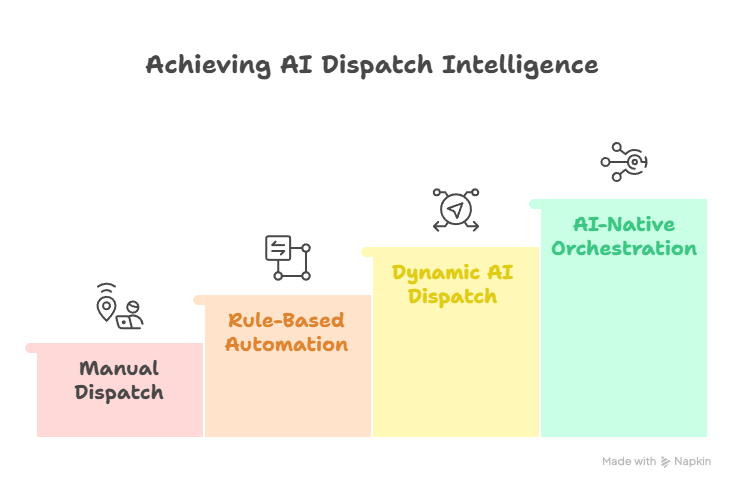
Level 1: Manual dispatch
Dispatchers manually assign orders to drivers based on zone familiarity and workload estimates. No algorithmic sequencing, no constraint modelling, no real-time adjustment.
Exception handling is reactive and phone-based.
Level 2: Rule-based automation
Algorithmic route generation and basic order-to-driver assignment based on configured rules: zones, vehicle types, shift windows.
Automated route planning improves on manual approaches but produces a static plan that requires dispatcher intervention when conditions change. Most mid-market tools operate here.
Level 3: Dynamic AI dispatch
Predictive ETA modelling, real-time re-optimization during execution, multi-carrier allocation, and exception alerting. The platform adapts when disruptions occur.
FarEye, LogiNext, Shipsy, DispatchTrack, Wise Systems, and Bringg operate at this level within their respective verticals.
Level 4: AI-native closed-loop orchestration
Autonomous dispatch decisions across 250+ real-world constraints, a continuous Sense-Decide-Execute-Learn re-optimization loop, exception-triggered service recovery workflows, multi-carrier orchestration, and human-in-the-loop governance built in.
The platform monitors execution and acts. Locus is the only platform in this comparison operating at Level 4 as an AI-native TMS.
Six evaluation dimensions applied across all eight platforms:
- AI dispatch automation depth: Does the platform automate assignment, sequencing, and re-optimization together, or only the assignment step?
- Orchestration scope: Does it connect planning, dispatch, execution, and delivery exception management in one system, or is it a point solution for dispatch alone?
- Real-time visibility integration: Does dispatch intelligence feed from live tracking, predictive ETAs, and exception alerts in a closed loop, or is visibility a separate reporting layer?
- Enterprise scalability: Can it handle multi-carrier, multi-node, high-volume peak operations without proportional growth in manual dispatcher overhead?
- Human-in-the-loop controls: Does it offer dispatcher overrides, configurable approval workflows, confidence-based AI recommendations, and full audit trails?
- Measurable ROI: Does the vendor provide quantified outcomes tied to specific capabilities, not generic AI claims?
Editorial Methodology
This guide evaluates AI-driven dispatch companies and platforms based on operating-model fit, dispatch capability depth, market visibility, integration readiness, and relevance to logistics teams managing real-world constraints.
Evaluation criteria included:
- Dispatch decision quality — Whether the platform supports automated assignment, route optimization, SLA protection, real-time re-optimization, and exception handling.
- Operational fit — Whether the vendor is best suited for last-mile delivery, local delivery, freight dispatch, parcel networks, 3PL operations, or developer-led routing builds.
- Integration readiness — Ability to connect with OMS, WMS, TMS, ERP, telematics, driver apps, customer notification systems, proof-of-delivery tools, and carrier systems.
- Constraint handling — Support for delivery windows, vehicle capacity, driver shifts, driver skills, service times, depot limits, customer priority, regulatory rules, and mixed-fleet allocation.
- Analytics and KPI visibility — Ability to measure delivery cost, SLA adherence, route productivity, fleet utilization, first-attempt success, dispatcher productivity, and cost-to-serve.
- External validation where available — Public review profiles, ratings, and category presence from sources such as G2 and Capterra when surfaced in the provided research.
- Data-backed market context — Independent logistics AI adoption statistics from BCG, Redwood Logistics, and Trimble where relevant.
Disclosure: Locus is the primary brand in this article. It is presented first because the guide is written from a Locus perspective for enterprise last-mile dispatch buyers. Other vendors are included to provide a practical market comparison. Buyers should validate claims, functionality, pricing, implementation support, and customer references directly with each vendor.
Top 8 AI-Driven Dispatch Logistics Companies in 2026: At a Glance
The table below maps each platform to its AI Dispatch Intelligence Maturity level and primary operational fit. Use it as a shortlist filter before detailed evaluation.
| Platform | Maturity | Best For | AI Dispatch Capabilities | Pricing |
| Locus | L4 | Enterprise logistics orchestration across planning, dispatch, and exception management | DispatchIQ (250+ constraints), Fireworks Routing Engine, dynamic re-optimization, ShipFlex multi-carrier allocation, control tower feedback loop, human-in-the-loop governance; world’s first agentic TMS | Custom pricing |
| FarEye | L3 | Last-mile delivery visibility and customer experience management | PILOT agentic dispatcher (11 AI agents), multi-carrier orchestration, exception alerting | Custom pricing |
| LogiNext | L3 | Fleet-heavy route optimization and workforce dispatch | AI route planning, automated driver allocation, predictive delay alerts, real-time GPS | Custom pricing |
| Shipsy | L3 | Supply chain automation and cross-border freight management | AgentFleet (5 AI agents), multi-modal carrier allocation, freight dispatch and settlement | Custom pricing |
| Optimal Dynamics | L3 | AI freight dispatch for truckload and LTL operations | Predictive load matching, market rate intelligence, capacity optimization for freight carriers | Custom pricing |
| DispatchTrack | L3 | Scheduled, appointment-based last-mile delivery | AI route optimization, delivery scheduling, time-window management, customer communication | Custom pricing |
| Wise Systems | L3 | F&B and distribution fleet autonomous dispatch | ML-driven autonomous dispatch engine, route learning, dynamic optimization during execution | Custom pricing |
| Bringg | L3 | Multi-carrier omnichannel delivery for retail | Carrier network orchestration, gig fleet management, delivery promise optimization | Custom pricing |
Caption: Comparison of the top 8 logistics companies offering AI-driven dispatch capabilities for enterprise operations.
1. Locus
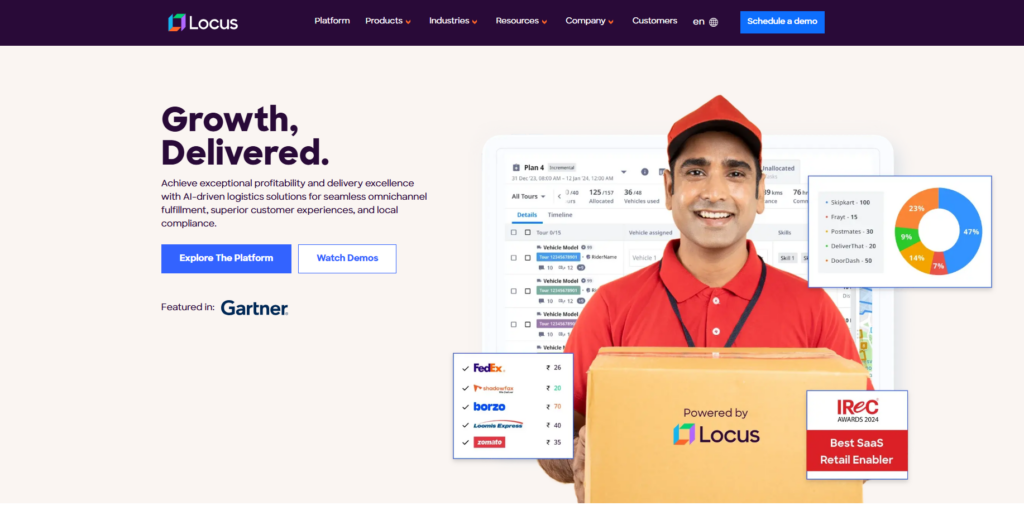
Locus is the world’s first agentic Transportation Management System (TMS) purpose-built for enterprises where dispatch is one layer in a broader orchestration lifecycle.
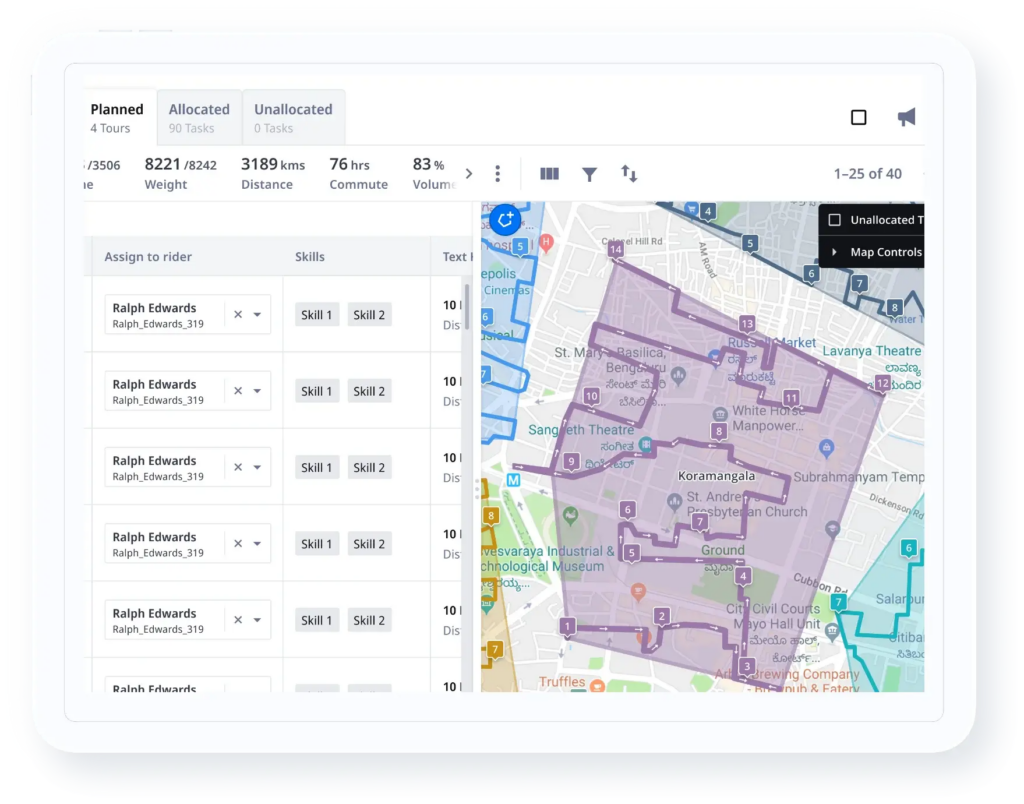
Its DispatchIQ engine auto-allocates orders to the optimal driver, vehicle, or carrier across 250+ operational constraints simultaneously: delivery time windows, vehicle capacity, driver shifts, hub throughput, SLA tiers, road restrictions, and live traffic. The critical distinction from Level 2 and Level 3 platforms is what happens after the initial assignment.
Dispatch in Locus feeds continuously into the Fireworks AI route optimization engine, which recalculates optimal sequencing as conditions change throughout the day. Exception alerts from the control tower trigger automated service recovery workflows rather than landing in a dispatcher’s inbox. The architecture that coordinates all of this spans eight named AI agents operating in parallel:
- Capacity Agent handles demand-to-fleet matching
- Dispatch Agent manages route building and real-time replanning
- Carrier Agent runs lane scoring and auto-tendering
- Hub Agent coordinates inbound staging and dock sequencing
- Customer Agent manages proactive delivery communications
- Settlement Agent handles freight invoicing and reconciliation
- Copilot (Mycroft) surfaces risk signals and accelerates dispatcher workflows in natural language
- Orchestrator Agent coordinates actions across all other agents within configurable governance rules
The result is a system that operates in a Sense-Decide-Execute-Learn loop rather than a plan-and-execute model.
In October 2025, Ingka Group, the world’s largest IKEA retailer, acquired Locus after evaluating logistics orchestration platforms globally. Locus continues operating independently. In March 2026, G2 ranked Locus #1 in Route Planning and recognized it in the 2026 Best Software Awards for Supply Chain and Logistics.
Gartner has also recognized Locus as a Representative Vendor in the Market Guide for Last-Mile Delivery Technology Solutions for the fifth consecutive year and in the Market Guide for Multicarrier Parcel Management Solutions; and QKS Group positioned Locus as a Leader in the SPARK Matrix for Transportation Management System, 2025.
Key features of Locus
- DispatchIQ auto-allocation engine: Assigns orders to the optimal driver, vehicle, or carrier in real time across 250+ constraints, handling peak surges without manual intervention
- Visibility-dispatch closed loop: Live tracking data, predictive ETAs, and exception alerts from the control tower feed back into dispatch re-optimization continuously
- ShipFlex multi-carrier orchestration: Dynamically allocates parcels across 1,000+ pre-integrated carrier and 3PL partners with automated tendering and rule-based carrier selection
- Exception-triggered service recovery: When exceptions are detected (missed time windows, vehicle breakdowns, delivery failures), automated re-routing and reassignment workflows trigger without dispatcher intervention
- Human-in-the-loop governance: Dispatcher override controls, configurable approval workflows, confidence-based AI recommendations, and full audit trails for every automated dispatch decision
- Mycroft AI Co-Pilot: Natural-language interface that compresses multi-click dispatcher workflows into single AI interactions, surfaces risk signals autonomously, and accelerates exception triage across the operation without adding to dispatcher workload
- Enterprise integrations: API-first architecture with pre-built connectors for ERP, OMS, WMS, and carrier systems; configurable BPMN workflow engine for dispatch rules without engineering dependency
Locus pros
- Connects planning, dispatch, re-optimization, and exception management in one closed-loop system: the only platform in this comparison where dispatch decisions improve continuously from real-time execution data
- Verified enterprise outcomes across 360+ deployments: 1.5B+ deliveries, $320M+ in logistics cost savings, 66% faster planning cycles, 99.5% SLA adherence, and 45% improvement in fleet utilisation
- Human-in-the-loop controls are built into the architecture: dispatcher overrides, approval workflows, and audit trails are available at every automated decision point
| Locus customers achieve up to 20% reduction in total logistics costs and 99.5% SLA adherence at enterprise scale. See the DispatchIQ Closed-Loop System.Schedule a demo |
Locus cons
- Designed for enterprise-scale multi-carrier networks; smaller single-carrier or regional fleet operations may find the platform broader in scope than required
- Initial configuration across dispatch rules and carrier workflows requires dedicated onboarding resources
Locus pricing
Custom enterprise pricing based on order volumes, fleet scope, and carrier integrations. Request a demo for a tailored pricing estimate.
Locus is best for
Enterprises in retail, FMCG, CPG, e-commerce, and 3PL that need AI dispatch as part of a full orchestration lifecycle connecting planning, execution, visibility, and exception management.
2. FarEye
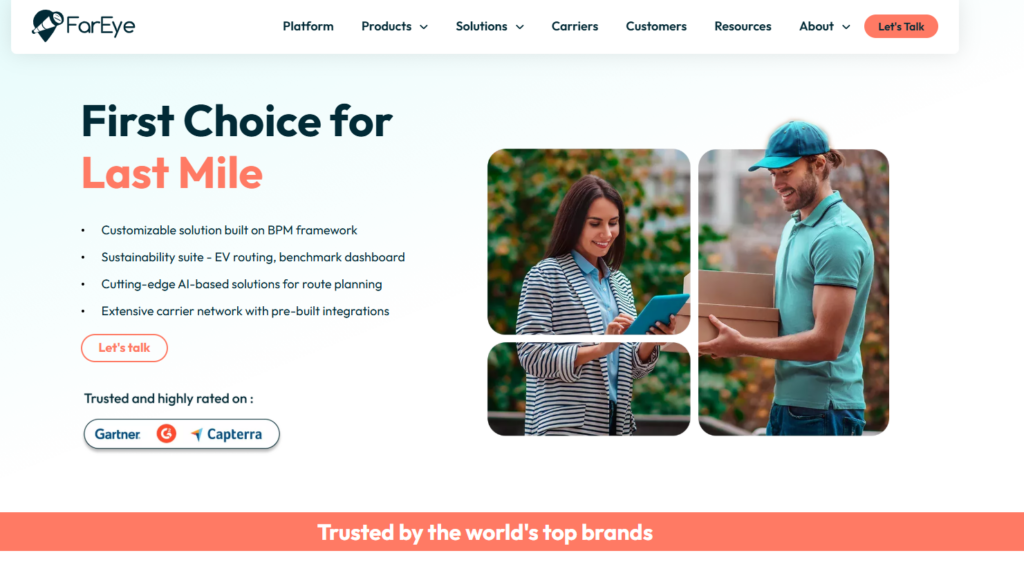
FarEye is a delivery management platform that combines AI-assisted dispatch with real-time last-mile visibility and customer communication tools. Its PILOT agentic dispatcher, introduces 11 specialized AI agents that handle dispatch automation, route optimization, exception management, and customer notification in parallel.
The platform’s no-code workflow builder allows operations teams to configure dispatch and delivery workflows without engineering dependency. Its branded tracking and customer communication layer also addresses post-dispatch visibility requirements for retailers.
Key features of FarEye
- Multi-carrier delivery orchestration: Manages parcel assignment across multiple carrier partners with delivery workflow automation and status tracking
- Real-time last-mile visibility: Live delivery status monitoring with predictive ETAs and proactive exception alerts for operations teams
- Customer communication tools: Branded tracking pages, proactive delivery notifications, and rescheduling capabilities for end customers
- No-code workflow configuration: Operations teams configure dispatch and delivery workflows without engineering dependency
FarEye pros
- Agentic dispatcher compresses multi-hour manual dispatch workflows into automated pipelines
- Strongest branded tracking and customer communication capabilities in this comparison, suited to retailers where post-dispatch experience is a retention lever
FarEye cons
- Dispatch scope is primarily last-mile; enterprises needing first-mile, mid-mile, or freight dispatch orchestration require additional systems
- Route optimization constraint depth is more limited than dedicated multi-constraint AI dispatch platforms
FarEye pricing
Custom enterprise pricing based on shipment volume and deployment scope.
FarEye is best for
Retailers, CEP providers, and e-commerce operations focused primarily on last-mile dispatch visibility and customer-facing delivery experience.
3. LogiNext
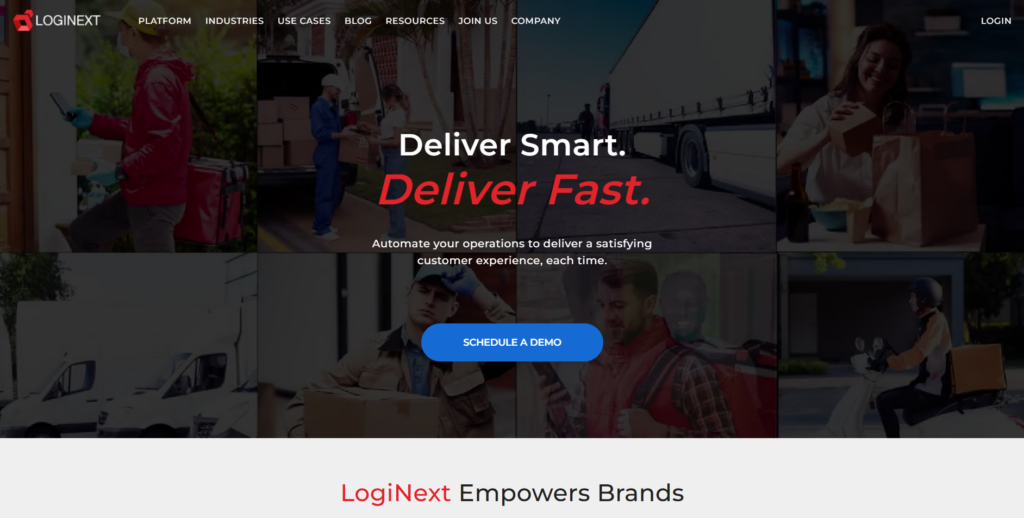
LogiNext provides AI-powered route optimization and fleet dispatch automation with particular strength in QSR and CEP logistics. The platform automates driver allocation, applies predictive ETA modelling, and provides analytics dashboards that give operations teams visibility into fleet performance.
Its dispatch management capabilities cover multi-stop planning and allocation logic suited to fleet-heavy, high-frequency urban delivery operations.
Key features of LogiNext
- Real-time GPS and fleet tracking: Live vehicle monitoring with deviation alerts and dynamic rerouting capability based on traffic conditions
- Predictive delay alerts: ETA-based alerting that flags deliveries at risk of missing time windows before the exception occurs
- Fleet analytics dashboards: KPI reporting on mileage, idle time, on-time delivery rates, and fleet utilisation across the operation
- Driver mobile app: Route navigation, task management, and electronic proof-of-delivery (ePOD) capture for field teams
LogiNext pros
- Route optimization combined with fleet management and workforce scheduling in one platform, suited to logistics-intensive operations managing large driver networks
- Strong QSR and urban delivery positioning with dispatch logic tuned for tight delivery windows
LogiNext cons
- AI capabilities lean toward rule-based automation rather than closed-loop re-optimization that feeds real-time execution data back into dispatch decisions
- Multi-carrier orchestration depth is limited for enterprises managing mixed owned-fleet and contracted carrier networks at scale
LogiNext pricing
Custom pricing based on fleet size, delivery volumes, and deployment scope.
LogiNext is best for
Mid-to-large logistics operations in CEP, QSR, retail, and healthcare prioritizing fleet-level route optimization and workforce dispatch automation.
4. Shipsy
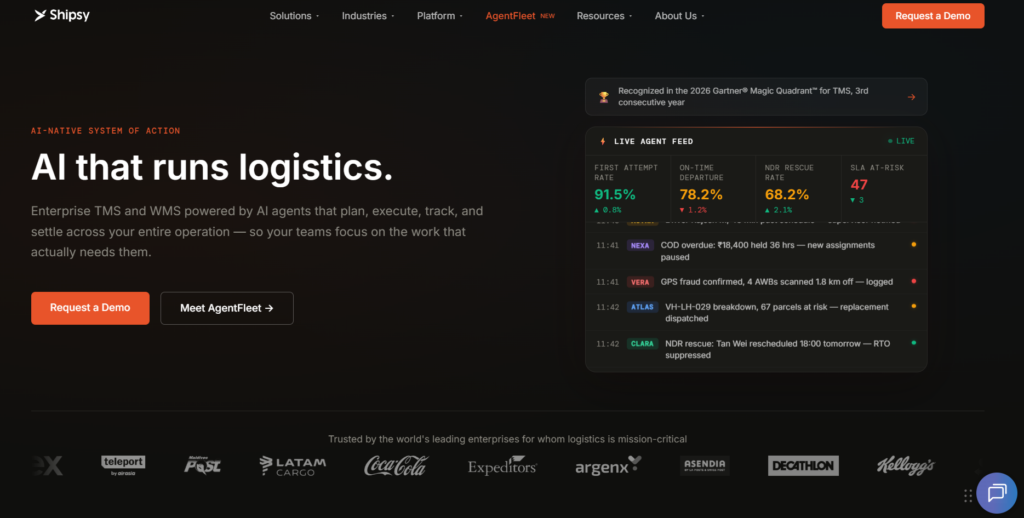
Shipsy operates primarily in the freight procurement and supply chain automation layer, with AI dispatch capabilities applied to carrier allocation, freight invoicing, and shipment coordination across multi-modal and cross-border networks.
Its AgentFleet introduces five specialized AI agents that automate carrier selection, driver coordination, freight settlement, and dispute resolution. For enterprises managing complex supply chain network design across multiple freight modes and geographies, Shipsy’s coverage at the freight layer is a genuine advantage.
Key features of Shipsy
- Multi-modal freight dispatch: Carrier selection and dispatch logic across road, air, and ocean modes with compliance automation
- Cross-border shipment coordination: International freight dispatch with customs compliance, documentation, and carrier connectivity across global corridors
- Freight cost optimization: Automated cost comparison and carrier selection logic to reduce freight spend across the carrier network
- Analytics and performance reporting: Carrier performance tracking and delivery KPI dashboards across logistics operations
Shipsy pros
- Cross-border freight dispatch with compliance automation, suited to enterprises with significant international logistics complexity across MENA, India, and Southeast Asia corridors
- AgentFleet covers five operational functions autonomously, reducing manual dispatch overhead in freight settlement and exception workflows
Shipsy cons
- Freight procurement focus means granular last-mile dispatch optimization for high-density domestic delivery networks is less mature than dedicated dispatch orchestration platforms
- Carrier coverage in North America and Western Europe is narrower than in primary MENA and India markets
Shipsy pricing
Pricing is fully custom and subscription-based, and provided through direct vendor consultation.
Shipsy is best for
Enterprises managing cross-border freight dispatch and multi-modal supply chain automation, particularly across MENA, India, and Southeast Asian logistics corridors.
5. Optimal Dynamics
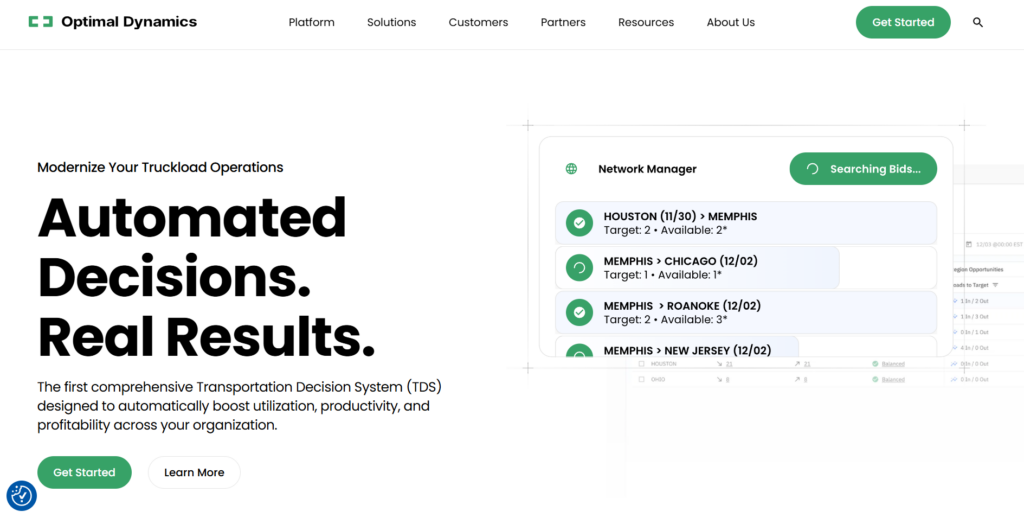
Optimal Dynamics applies AI decision science specifically to freight dispatch in truckload and less-than-truckload operations. Its core capability is predictive load matching: the platform evaluates open loads against available capacity, driver hours, market rates, and operational constraints to generate dispatch recommendations that balance profitability and service performance simultaneously.
The platform is purpose-built for freight carriers and brokerages rather than shipper-side logistics operations. Its AI depth in load assignment and pricing optimization is strong within that scope.
Key features of Optimal Dynamics
- Market rate intelligence: Real-time freight market pricing data integrated into dispatch recommendations to balance cost and service outcomes
- Network capacity optimization: Continuous re-balancing of load assignments across the carrier network as conditions and availability change
- Driver hours-of-service compliance: HoS constraints built into dispatch logic for North American trucking regulatory compliance
- TMS integrations: Connectivity with existing TMS platforms for carriers and brokers implementing AI dispatch alongside current infrastructure
Optimal Dynamics pros
- Deep AI decision science for freight load matching and pricing optimization, purpose-built for truckload and LTL carrier operations
- Market rate intelligence integrated directly into dispatch recommendations enables carriers to optimize profitability and capacity simultaneously
Optimal Dynamics cons
- Scope is freight carrier and brokerage dispatch: does not cover last-mile delivery orchestration, real-time driver tracking for parcel networks, or exception management for retail and FMCG operations
- Not designed for shipper-side multi-carrier orchestration or the planning-to-execution lifecycle that enterprise retail and FMCG logistics require
Optimal Dynamics pricing
Custom pricing based on fleet size and deployment scope.
Optimal Dynamics is best for
Freight brokerages and truckload carriers seeking AI-driven load matching, pricing optimization, and capacity management for North American over-the-road freight operations.
6. DispatchTrack
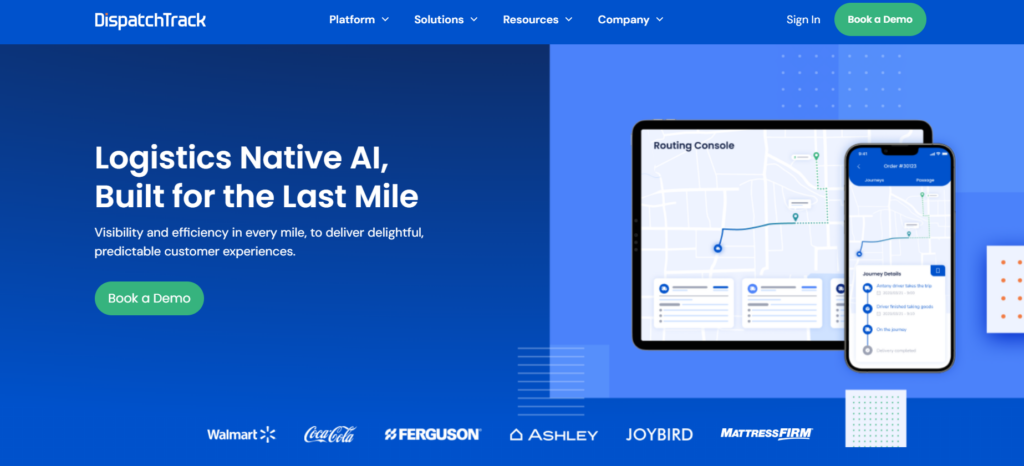
DispatchTrack provides AI route optimization and delivery scheduling for appointment-based, high-touch last-mile delivery. Its dispatch engine handles time-window management, customer appointment scheduling, and ETA communication across verticals like home delivery, furniture, appliances, and food and beverage distribution.
The platform’s customer-facing scheduling and proactive ETA notification capabilities are strong for scheduled, appointment-based delivery models.
Key features of DispatchTrack
- Delivery appointment scheduling: Customer-facing scheduling tools for pre-booking delivery appointments across configurable time windows
- Proactive ETA communication: Automated customer notifications with delivery ETA updates and real-time status throughout the delivery day
- Driver mobile app: Turn-by-turn navigation, delivery instructions, and proof-of-delivery capture for field teams
- Delivery performance analytics: On-time delivery reporting, route performance metrics, and driver KPI dashboards
DispatchTrack pros
- Purpose-built appointment scheduling and ETA communication for high-touch, scheduled last-mile delivery verticals where customer time-window precision is the primary operational challenge
- Delivery scheduling combined with route optimization reduces inbound customer contact volumes for pre-scheduled home delivery operations
DispatchTrack cons
- Multi-carrier orchestration and dynamic re-optimization for high-volume parcel operations at enterprise scale are outside the primary scope
- Limited integration depth with upstream freight management and supply chain planning systems for enterprises managing end-to-end logistics
DispatchTrack pricing
Custom pricing based on delivery volume and operational scope.
DispatchTrack is best for
Enterprises managing scheduled, appointment-based last-mile delivery in home delivery, furniture, appliances, building materials, and food and beverage distribution.
7. Wise Systems
Wise Systems built its platform around autonomous dispatch and ML-driven route optimization for distribution fleet operations, with a particular focus on food and beverage distribution.
Its dispatch engine learns from historical delivery patterns, driver behavior, and customer data over time, producing route quality that improves as deployment data accumulates.
Key features of Wise Systems
- Dynamic optimization engine (DOE): Continuous route recalculation during execution based on real-time conditions, delivery completions, and timing deviations
- Route learning capabilities: Platform accuracy improves over time as it accumulates delivery data from recurring routes and customer patterns
- SAP App Store integration: Listed on SAP’s marketplace, enabling integration with SAP-based ERP environments
Wise Systems pros
- Route learning capabilities that improve dispatch quality over time make it well-suited to F&B distribution operations with recurring delivery networks
- SAP App Store listing and Trimble TMW.Suite integration provide enterprise ecosystem entry points for SAP-centric operations
Wise Systems cons
- Multi-carrier orchestration across mixed fleet types and contracted carrier networks is outside the platform’s primary scope
- Limited public deployment evidence at very high enterprise order volumes makes enterprise scale validation harder during evaluation
Wise Systems pricing
Custom enterprise pricing is provided after consultation.
Wise Systems is best for
Enterprise food and beverage distributors and parcel operations seeking autonomous dispatch with route-learning capabilities that improve with accumulated delivery data.
8. Bringg
Bringg provides multi-carrier delivery orchestration and gig fleet management for retail and foodservice enterprises managing omnichannel fulfillment. Its dispatch layer connects brands with multiple carrier networks and gig platforms, allowing order allocation across owned fleet, contracted 3PL, and on-demand courier capacity under consistent SLA frameworks.
The platform performs well for retailers operating ship-from-store, BOPIS, and direct delivery simultaneously where unified carrier management and delivery promise accuracy are the primary operational requirements.
Key features of Bringg
- Delivery promise optimization: Connects carrier availability and capacity to delivery slot commitments at checkout or order confirmation time
- Omnichannel fulfillment dispatch: Supports ship-from-store, BOPIS, curbside, and direct delivery dispatch workflows from retail locations
- Customer visibility tools: Real-time delivery tracking and notifications across all fleet types and carrier partners for end customers
- Driver app: Task management, navigation, and proof-of-delivery capture for owned and contracted driver networks
Bringg pros
- Multi-fleet dispatch under one SLA framework (owned, 3PL, gig) is a differentiator for omnichannel retailers managing mixed carrier models simultaneously
- Delivery promise optimization connected to carrier availability reduces fulfilment commitment errors at checkout
Bringg cons
- Dispatch optimization depth at the route level is less developed than platforms purpose-built for constraint-based multi-stop route re-optimization at high volumes
- Making changes or fixing issues often requires going through multiple steps and following automation workflows, which can be time-consuming and easy to lose track of (G2)
Bringg pricing
Custom enterprise pricing based on delivery volume and deployment scope.
Bringg is best for
Retail enterprises managing omnichannel fulfillment across owned fleet, contracted carriers, and gig networks, particularly for ship-from-store and BOPIS operations.
Benefits of AI-Driven Dispatch for Logistics Companies
AI-driven dispatch should be evaluated by operational outcomes, not feature count. The strongest business cases focus on measurable improvements in cost, service quality, productivity, and resilience.
According to Redwood Logistics, 37% of logistics leaders have identified AI and predictive decision support as a top investment priority for 2026. BCG also reports that nearly 80% of shippers and logistics service providers cite cost reduction and operational efficiency as the main triggers for AI adoption in logistics.
Lower Cost-to-Serve
AI dispatch can reduce delivery cost by improving route density, matching orders to the right fleet, reducing avoidable distance, and minimizing manual planning effort. The most mature platforms help logistics leaders analyze cost-to-serve by route, depot, customer, region, carrier, or service level.
Better SLA Adherence
AI-driven dispatch can protect delivery promises by evaluating order priority, time windows, driver availability, route feasibility, and capacity constraints before execution. It can also flag likely SLA breaches early enough for dispatchers to intervene.
Higher Route Productivity
Route productivity improves when dispatch systems sequence stops efficiently, consolidate nearby orders, account for service times, and avoid routes that look efficient on a map but fail under real operating constraints.
Improved Fleet Utilization
AI dispatch can allocate orders across owned vehicles, third-party carriers, gig drivers, and outsourced fleets based on availability, cost, geography, capacity, and service promise. This helps reduce underused fleet capacity and overreliance on expensive external capacity.
More Accurate ETAs and Customer Communication
The available automated draft ends at this subheading in the retrieved content, so I have not invented any additional text after it.
How Safe and Explainable Are AI-Driven Dispatch Decisions?
AI dispatch should operate with clear business rules, dispatcher controls, override options, approval workflows, and audit trails. The best systems do not force blind automation. They provide recommendations, decision context, and exception alerts so human teams can intervene when required.
Choosing the Right AI-Driven Dispatch Partner for Enterprise Logistics
Every platform in this comparison automates some part of the dispatch process. The question for enterprise logistics leaders is how much of the orchestration lifecycle the platform covers, and whether that scope matches the operational problem that is driving cost and SLA risk in their network.
Optimal Dynamics, DispatchTrack, and Wise Systems have genuine AI dispatch depth within their verticals: freight load matching, scheduled last-mile, and autonomous distribution routing respectively.
Bringg, FarEye, and LogiNext serve enterprise use cases in omnichannel retail, last-mile visibility, and fleet management. Shipsy addresses the upstream freight and cross-border complexity layer.
For enterprises processing 50,000+ daily orders across multiple fulfilment hubs, the dispatch platform decision determines whether exceptions are absorbed automatically or escalated to dispatchers, and whether re-optimization happens in real time or waits for the next planning cycle. The platforms built for point-in-time assignment do not provide this. The cost shows up in SLA breach rates, fleet idle time, and first-attempt delivery failures.
Selecting a platform that addresses dispatch in isolation solves the assignment problem while leaving the re-optimization, exception recovery, and last-mile excellence gap open.
Locus is the only platform in this comparison that closes all five evaluation dimensions: autonomous AI dispatch, closed-loop re-optimization, visibility-dispatch integration, multi-carrier orchestration, and human-in-the-loop governance in a single system.
See how Locus handles dispatch, routing, visibility, and exception management together in a single platform. Schedule a demo today.
FAQs
1. What is AI-driven dispatch in logistics, and how does it differ from traditional dispatch automation?
AI-driven dispatch is an automated logistics system that evaluates hundreds of variables simultaneously, including real-time traffic, vehicle capacity, driver availability, delivery priority, and SLA constraints, to make optimized assignments continuously rather than once at plan generation. Traditional dispatch automation applies fixed rules to assign orders to drivers based on configured zones, vehicle types, or shift windows. The defining difference is post-assignment behaviour: AI-driven platforms re-optimise continuously as conditions change and trigger automated exception responses when execution deviates from plan. Traditional automation requires dispatcher intervention to do the same.
2. How does AI-powered dispatch reduce logistics costs for enterprise operations?
AI dispatch reduces costs across four compounding levers: fewer miles driven per delivery through optimized route sequencing, lower first-attempt failure rates through better time-window compliance, reduced manual dispatcher overhead through automated assignment and exception management, and improved fleet utilisation through smarter load balancing. Locus enterprise customers achieve 66% faster planning cycles, a 45% improvement in fleet utilization, and a 20% reduction in total logistics costs.
3. What features should enterprises prioritize when evaluating AI dispatch platforms?
Six criteria determine enterprise fit: AI dispatch automation depth (constraint count and re-optimization capability), orchestration scope (does it connect planning, dispatch, and exception management), real-time visibility integration (does execution data feed back into dispatch decisions), enterprise scalability (multi-carrier, multi-node, peak handling), human-in-the-loop controls (overrides, approvals, audit trails), and measurable ROI from reference deployments at comparable scale.
4. How does real-time visibility improve AI dispatch decision-making?
Real-time visibility provides the execution data that AI dispatch engines need to re-optimize: live GPS positions, actual delivery completions versus planned, exception events, and traffic conditions that differ from morning predictions. Platforms where visibility is a separate reporting layer cannot feed this data back into dispatch decisions automatically. Platforms with a closed visibility-dispatch loop, like Locus, use exception alerts and ETA deviations to trigger automated re-routing and reassignment without dispatcher intervention.
5. Can Locus handle multi-carrier and multi-node logistics at enterprise scale?
Locus ShipFlex connects enterprises to 160+ pre-integrated carriers within a broader network of 1,000+ carrier integrations, with automated tendering and rule-based carrier selection across a global network. The platform is validated at scale across named enterprise customers processing over 100,000 daily orders during peak periods, including Ingka Group, the world’s largest IKEA retailer. For enterprises evaluating multi-node scaling, the relevant question is not whether the platform claims enterprise scalability, but which named customers have processed 100,000+ daily orders during peak without proportional increases in manual dispatcher overhead.


General
The Complete Guide to Choosing a TMS: Why the Category Has Split Into Five Platform Types

Aug 20, 2026
TMS is not one category. Five structurally different platform types share the name, optimize different metrics, and fail differently when misapplied. How to identify your archetype before you evaluate vendors.
Read more
General
Surviving the SEA Mega Sale: How WISMO Volume Predicts Your Delivery Experience Breaking Point

Aug 21, 2026
During SEA mega sale peaks, WISMO contacts rise faster than orders. Why the WISMO-to-order ratio is the earliest warning your delivery experience is failing, and what to fix before 11.11.
Read moreInsights Worth Your Time



















Best Logistics Companies Using AI-Driven Dispatch: An Enterprise Buyer’s Guide (2026)