


General
Types of Truck Freight Shipping: FTL, LTL, PTL Explained

Locus: The AI-powered logistics platform trusted by 360+ global enterprises for intelligent routing and cost-efficient delivery optimization.
TL;DR: Understanding truck freight shipping types (FTL, LTL, PTL) and actual freight truck varieties is essential for enterprise logistics optimization. Modern AI-powered platforms enable cost-efficient routing and load optimization across all shipping modes.
Key Takeaways
- Full Truckload (FTL) shipping provides the fastest transit times and dedicated space but comes at a premium cost, making it ideal for time-sensitive or high-value shipments.
- Different freight truck types (dry van, flatbed, reefer, tanker) serve specific cargo requirements and industry needs, from temperature-sensitive goods to oversized equipment.
- Modern truckload optimization requires advanced analytics and AI-powered solutions to effectively manage costs, routes, and capacity across different shipping modes.
- Empty miles and inefficient load planning significantly impact shipping costs, making automated load balancing and dynamic routing essential for operational efficiency.
- Locus’s intelligent routing platform optimizes vehicle loads and routes by considering 180+ real-world constraints while providing analytics-driven insights to reduce costs and improve delivery performance for enterprise clients.
IIn today’s competitive logistics landscape, understanding the different types of truckload shipping is essential for enterprise logistics directors and supply chain managers. The global trucking market exceeded $285 billion in 2022 and is projected to reach $430 billion by 2032.
For FMCG and retail logistics leaders, optimizing truckloads is key to reducing costs and meeting tight delivery SLAs. Trucking companies use a variety of business models, each with unique advantages and challenges.
Key Stat: Trucking industry expected to grow by 50% in the next decade.
Let’s delve into the three major types of truckloads: Full Truckload (FTL), Partial Truckload (PTL), and Less than Truckload (LTL).
Types of Freight Trucks and Their Uses
Before diving into shipping modes, it’s crucial to understand the actual types of freight trucks available and their specific applications. Each truck type is designed for particular cargo requirements and industry needs.
Common Freight Truck Types
- Dry Van Trucks: Enclosed trailers ideal for general freight, consumer goods, and non-perishable items. Most common for retail and e-commerce shipments.
- Flatbed Trucks: Open trailers perfect for oversized cargo, construction materials, machinery, and items that require top or side loading.
- Refrigerated Trucks (Reefers): Temperature-controlled trailers essential for food, pharmaceuticals, and other temperature-sensitive products.
- Tanker Trucks: Specialized for liquid cargo including chemicals, fuel, food-grade liquids, and hazardous materials.
- Box Trucks: Smaller enclosed vehicles ideal for local deliveries, furniture, and medium-sized cargo loads.
- Car Carrier Trucks: Multi-level trailers designed specifically for transporting vehicles from manufacturers to dealerships.
| Truck Type | Typical Cargo | Key Features | Best For |
| Dry Van | General freight, retail goods | Weather protection, security | E-commerce, retail |
| Flatbed | Construction materials, machinery | Open loading, oversized capacity | Construction, manufacturing |
| Reefer | Food, pharmaceuticals | Temperature control | FMCG, healthcare |
| Tanker | Liquids, chemicals, fuel | Specialized containment | Chemical, petroleum |
Freight Truck Classifications by GVWR
Freight trucks can also be classified by Gross Vehicle Weight Rating (GVWR), which is the maximum operating weight specified for the vehicle, including the truck, trailer where applicable, cargo, fuel, driver, and equipment. This classification is particularly useful when logistics teams need to align vehicle choice with payload, road access, compliance, and operating cost.
In North American freight operations, semi trucks and 18-wheelers are typically Class 8 vehicles. Lighter commercial vehicles, such as vans and smaller box trucks, sit in lower GVWR classes and are often used for urban delivery, store replenishment, and last-mile fulfilment.
| Truck Class | GVWR Range | Typical Freight Use Case |
| Class 1 trucks | Up to 6,000 lb | Light commercial vans, small parcel delivery, service vehicles |
| Class 2 trucks | 6,001–10,000 lb | Larger vans, light-duty pickup-based delivery vehicles |
| Class 3 trucks | 10,001–14,000 lb | Small box trucks, local retail and e-commerce deliveries |
| Class 4 trucks | 14,001–16,000 lb | Medium box trucks, urban distribution |
| Class 5 trucks | 16,001–19,500 lb | Larger box trucks, regional delivery operations |
| Class 6 trucks | 19,501–26,000 lb | Medium-duty freight trucks, beverage and FMCG distribution |
| Class 7 trucks | 26,001–33,000 lb | Heavy-duty local and regional freight, larger refrigerated vehicles |
| Class 8 trucks | Over 33,000 lb | Semi trucks, 18-wheelers, long-haul dry vans, reefers, tankers, flatbeds |
Freight Truck Dimensions, Payload, and Cubic Capacity
Dimensions and payload vary by equipment specification, market, axle configuration, and regulatory environment. The table below provides practical planning ranges commonly used during freight tendering and load planning. Shippers should validate final limits with the carrier, trailer specification, and applicable route regulations before dispatch.
| Equipment Type | Typical Length | Typical Width / Height | Typical Payload Range | Cubic Capacity Where Applicable |
| Dry van trailer | 48–53 ft | Around 8.5 ft wide; internal height often around 8–9 ft | Often up to approximately 42,000–45,000 lb depending on configuration | Commonly around 3,500–4,000 cu ft for 53 ft vans |
| Refrigerated trailer / reefer | 48–53 ft | Similar external footprint to dry vans; lower internal cube due to insulation and refrigeration unit | Often lower than dry vans due to reefer unit weight | Typically lower than dry van cube because of insulation |
| Standard flatbed | 48–53 ft | Usually around 8.5 ft wide; open deck | Often up to approximately 45,000–48,000 lb | Not cube-based; governed by deck space, height, weight, and securement |
| Step deck / drop deck trailer | 48–53 ft | Lower rear deck for taller cargo | Varies by axle and deck configuration | Not cube-based; useful for taller freight within height limits |
| Lowboy / double drop trailer | Often 40–53 ft overall | Very low centre well for high and heavy equipment | Varies significantly by axle count and permit requirements | Not cube-based; designed for over-height or heavy machinery |
| Tanker truck | Varies by tanker type | Cylindrical tank body; capacity depends on commodity density | Weight-limited by liquid density and regulatory limits | Measured by volume, commonly in gallons or litres rather than cubic feet |
| Box truck | Commonly 16–26 ft cargo box | Smaller enclosed body for local access | Varies by class and GVWR | Cube varies by body size; useful for local and urban deliveries |
| Container chassis | Built for 20 ft, 40 ft, or 45 ft containers | Chassis carries intermodal containers | Governed by container weight, chassis rating, and road limits | Cube is based on the intermodal container, not the chassis |
Payload Capacity vs. Cubic Capacity: Why Both Matter
Freight planning is not only about how heavy a shipment is. It is also about how much trailer space it consumes. A shipment becomes weight-limited when it reaches legal or equipment payload limits before filling the trailer. Dense CPG products, beverages, paper goods, bulk ingredients, and certain FMCG loads often fall into this category.
A shipment becomes cube-limited when it fills the trailer volume before reaching the maximum allowable weight. Lightweight retail goods, e-commerce parcels, packaging materials, apparel, and bulky consumer products often cube out first. For 3PLs managing mixed customer freight, accurate dimensional data is critical because poor cube utilisation can create higher cost per order even when the truck is far below its legal weight limit.
Flatbed Trailer Variations for Oversized and Specialized Freight
Flatbed equipment covers a broad range of trailer designs. Selecting the right variation helps shippers manage height, loading method, securement, permits, and route feasibility.
- Standard flatbeds: Best for machinery, steel, lumber, building materials, and freight that can be loaded from the side, rear, or above.
- Step deck trailers / drop deck trailers: Include an upper and lower deck, allowing taller cargo to move without exceeding standard height restrictions as quickly as a regular flatbed would.
- Lowboy trailers / double drop trailers: Use a very low centre well to carry tall, heavy, or over-dimensional equipment such as construction machinery and industrial assets.
- RGN trailers / removable gooseneck trailers: Allow the front of the trailer to detach so wheeled or tracked equipment can be driven onto the deck, reducing the need for cranes in some moves.
- Stretch trailers: Extend to carry unusually long freight such as structural steel, wind components, pipes, or specialised industrial cargo.
- Conestoga trailers: Use a sliding tarp system that offers weather protection while retaining side-loading flexibility.
- Curtain side trailers: Combine an enclosed structure with movable side curtains, supporting faster side access for palletised goods that still need protection from weather.
Tanker and Bulk Hauler Types for FMCG, CPG, and 3PL Logistics
Tanker trucks and bulk haulers are essential when freight is not moved in standard pallets, cartons, or containers. Equipment selection depends on commodity characteristics, hygiene requirements, unloading method, and regulatory controls.
- Food-grade tankers: Used for edible liquids such as oils, syrups, dairy ingredients, juices, and other consumable bulk products. Cleaning, prior-load controls, and seal integrity are critical.
- Dry bulk tankers: Built for powders, granules, and dry bulk commodities such as flour, sugar, plastic pellets, and other high-volume inputs.
- Pneumatic tankers: Use pressurised air systems to unload dry bulk products into silos or receiving systems, supporting efficient plant and distribution centre operations.
- Bulk haulers: Move high-volume non-packaged goods where conventional palletised transport is inefficient, often supporting manufacturing, FMCG, CPG, and 3PL networks.
Container Trucks, Chassis, and Intermodal Freight
Container trucks use a tractor and chassis to move intermodal containers between ports, rail ramps, distribution centres, fulfilment centres, and inland customer locations. The chassis is the wheeled frame that carries the container, while the container itself can transfer across ship, rail, and road without unloading the cargo.
For enterprise shippers, intermodal containers can reduce handling, support long-distance network efficiency, and improve coordination between import flows and domestic distribution. They are particularly relevant for retail, FMCG, CPG, and e-commerce businesses managing port-to-DC, rail-to-warehouse, or container drayage operations.
Reefer Temperature Ranges and Multi-Zone Temperature Control
Refrigerated trucks, or reefers, are used when product integrity depends on controlled temperature throughout transit. Operating ranges vary by commodity and regulatory requirement, but shippers commonly plan around three broad bands:
| Temperature Profile | Typical Use Case | Operational Considerations |
| Controlled ambient | Products that must avoid heat or cold extremes | Monitor route conditions, dwell time, and trailer temperature stability |
| Chilled | Fresh food, dairy, certain beverages, and selected healthcare products | Pre-cool the trailer, reduce door-open dwell time, and maintain airflow |
| Frozen | Frozen food and other products requiring sub-zero transport | Validate set point, loading temperature, seal integrity, and continuous monitoring |
Multi-zone temperature control allows different compartments within the same reefer to run at different temperature bands. This is valuable for mixed FMCG, grocery, convenience retail, and pharma distribution where frozen, chilled, and controlled ambient products may move in the same route plan. Pre-cooling, rapid loading, real-time monitoring, and exception alerts are critical to maintaining cold-chain compliance and reducing spoilage risk.
What is Full Truckload (FTL)?
Full Truckload (FTL) is like having a dedicated fleet dispatched solely for your shipments—ensuring maximum speed, security, and control with no sharing of capacity. If you’ve got enough goods to fill up a truck, or if your goods are time-sensitive, fragile, or valuable, Full Truckload (FTL) is the optimal choice.
In the competitive era of next-day deliveries, Full Truckload (FTL) offers the fastest transit times: a seamless journey from A to B with no detours or delays. However, this dedicated service comes at a premium cost.
FTL Advantages & Use Cases
- Advantages: Fastest transit, no handling, maximum security, dedicated capacity
- Ideal for: High-value goods, time-sensitive shipments, fragile items, full container loads
- Challenges: Higher cost, requires sufficient volume, potential for empty miles
What is Partial Truckload (PTL)?
Partial Truckload (PTL) serves as the strategic middle ground for enterprise shippers. Think of it as optimized capacity sharing—you have more goods than LTL can accommodate but not enough to justify FTL expenses.
The advantage of Partial Truckload (PTL) is cost-effectiveness and flexibility. It allows for fewer handling instances, reducing the risk of damages while sharing transportation costs with other compatible shipments.
PTL Advantages & Use Cases
- Advantages: Cost-effective, reduced handling, flexible scheduling, better than LTL for larger loads
- Ideal for: Mid-size shipments, regional distribution, cost-conscious operations
- Challenges: Limited availability, longer transit than FTL, coordination complexity
What is Less than Truckload (LTL)?
Less than Truckload (LTL) operates on a hub-and-spoke model, consolidating multiple shipments for cost efficiency. If your shipment is relatively small, LTL allows you to pay for only the portion of the truck space you’re using.
This shared approach has trade-offs. Your shipment will stop at multiple locations for pickup and delivery of other loads, resulting in longer delivery times. This model isn’t ideal for time-critical operations but excels for cost optimization.
LTL Advantages & Use Cases
- Advantages: Most cost-effective, wide network coverage, tracking capabilities, suitable for small shipments
- Ideal for: Small shipments, non-urgent deliveries, regular distribution routes
- Challenges: Longer transit times, multiple handling points, potential for damage, less control
How to Choose the Right Freight Truck
Selecting the appropriate freight truck and shipping mode requires careful consideration of multiple factors. Enterprise logistics managers must balance cost, speed, and cargo requirements to optimize their supply chain operations.
Load Securement, Permits, and Compliance Requirements
Truck selection must account for securement and compliance, not just cube and payload. In the US, FMCSA cargo securement rules set expectations for preventing cargo from shifting, tipping, leaking, or falling during transit. Equivalent regional rules and carrier standards should be reviewed in other markets.
Common securement equipment includes chains, straps, binders, edge protectors, dunnage, blocking and bracing materials, tarps, and specialist fittings for machinery or irregular freight. Flatbeds, step decks, lowboys, double drops, RGN trailers, and stretch trailers require particular attention because cargo is exposed and often over-dimensional.
Shippers should also assess:
- Weight distribution: Axle weights and centre of gravity affect safety, handling, tyre wear, and legal compliance.
- Tarpaulin requirements: Weather-sensitive freight on open-deck equipment may need tarps or enclosed alternatives such as Conestoga trailers or curtain side trailers.
- Oversize and overweight permits: Over-dimensional loads may require route approvals, restricted travel hours, or additional documentation.
- Hazmat endorsements: Hazardous materials, certain chemicals, fuels, and regulated substances may require qualified drivers, placards, documentation, and carrier approvals.
- Inspection readiness: Load plans, seals, temperature logs, and proof of securement may be required during audits, roadside checks, or customer investigations.
Decision Framework for Enterprise Logistics
For FMCG and CPG logistics directors: Start with cargo requirements, then evaluate volume thresholds. If shipment exceeds 10,000 lbs or fills 12+ linear feet, consider FTL. For 2,000-10,000 lbs, evaluate PTL. Below 2,000 lbs, LTL typically offers the best value.
Route Restrictions and Delivery-Access Factors
The right freight truck must also be viable for the route and delivery environment. A trailer that is technically correct for the cargo may still fail operationally if it cannot access the destination, comply with local rules, or meet an appointment window.
Enterprise logistics teams should validate:
- State and regional restrictions: Weight limits, equipment rules, seasonal restrictions, and permitted travel hours can vary across jurisdictions.
- Bridge, tunnel, and height limits: Over-height freight and tall equipment on flatbeds, step decks, lowboys, double drops, RGN trailers, or stretch trailers require careful routing.
- Road conditions: Rural roads, construction zones, steep gradients, and weather exposure can affect safety and transit reliability.
- Urban access: Tight delivery spaces, turning radius, kerbside restrictions, low-clearance streets, and congestion can make smaller box trucks or staged deliveries more practical.
- Dock and yard constraints: Dock height, yard space, gate procedures, trailer drop policies, and live-load appointment windows affect equipment choice.
- Oversized-load routing: Over-dimensional freight often needs approved routes, travel time restrictions, and contingency planning.
For oversized or over-dimensional moves, pilot cars or escort vehicles may be required depending on the size of the load, road classification, and local regulation. These requirements are common for certain flatbed, lowboy, double drop, RGN, removable gooseneck, and stretch trailer shipments, and should be built into both cost and schedule planning.
Cost Factors by Freight Truck Type
Freight rates are shaped by more than distance and weight. Equipment availability, seasonality, fuel efficiency, and operational complexity all influence the final landed cost.
- Standard dry vans: Usually have broad carrier availability, making them comparatively easier to source on common lanes.
- Reefers: Typically carry higher operating costs because of refrigeration fuel, maintenance, cleaning, monitoring, and tighter service requirements.
- Flatbed variants: Step deck, lowboy, double drop, RGN, Conestoga, curtain side, and stretch trailers often attract specialised equipment premiums, especially when permits or escorts are needed.
- Tankers and bulk haulers: Cleaning, commodity compatibility, driver qualification, and specialised unloading equipment can materially affect cost.
- Container chassis: Chassis availability, port congestion, rail ramp appointments, demurrage, detention, and drayage capacity can change the economics of intermodal moves.
- Seasonal demand: Retail peaks, harvest periods, beverage seasonality, severe weather, and regional capacity imbalances can move spot rates quickly.
- Lane imbalance: Freight flows that do not generate attractive backhauls can create higher one-way rates or repositioning costs.
- Fuel efficiency: Aerodynamics, vehicle condition, driving profile, route quality, and idle time all affect total operating cost.
Power only trucking can help shippers and 3PLs access flexible capacity by sourcing only the tractor and driver while the shipper, broker, or 3PL provides the trailer or container chassis. This is useful when trailers are pre-loaded, when drop-and-hook operations are mature, or when surge capacity is needed without sourcing a full tractor-trailer combination.
Now that we understand the different shipping modes and truck types, how do we optimize these loads for maximum efficiency? Enterprise supply chain managers need to move beyond legacy solutions and embrace automated, intelligent platforms to truly optimize operations and impact the bottom line.
Essential Safety Equipment for Freight Trucks
Safety equipment supports compliance, reduces incident risk, and protects service reliability. Depending on the vehicle class, cargo type, and operating region, freight trucks may require or benefit from:
- Electronic logging devices (ELDs) where hours-of-service rules apply
- Reflective triangles and high-visibility warning devices
- Fire extinguishers appropriate for the cargo and vehicle type
- Backup cameras, proximity sensors, and blind-spot alerts for urban delivery
- Underride guards and side protection equipment where required or specified
- Tyre pressure monitoring and preventive maintenance alerts
- Telematics alerts for speeding, harsh braking, idling, and route deviation
- Load securement gear such as chains, straps, binders, edge protectors, and dunnage
- Temperature monitoring, door sensors, and exception alerts for refrigerated trucks
- Spill kits, placards, and emergency documentation for regulated or hazardous cargo
Trends Shaping Freight Truck Operations
Freight truck operations are being reshaped by technology, sustainability goals, and higher customer expectations. For enterprise logistics teams, these trends matter because they affect routing strategy, carrier selection, cost control, and network resilience.
- Electric trucks: Suitable for selected urban, regional, and depot-based operations where charging, dwell time, and route predictability align.
- Alternative fuels: Renewable diesel, natural gas, hydrogen, and other fuel strategies are being evaluated by fleets seeking emissions reduction and fuel diversification.
- Aerodynamics and lightweighting: Trailer skirts, tail devices, improved tyres, and lighter materials can improve fuel efficiency on appropriate lanes.
- Telematics: Vehicle diagnostics, location data, driving behaviour, and utilisation insights help logistics leaders manage fleet performance in real time.
- IoT tracking: Shipment-level sensors can monitor temperature, shock, humidity, door events, and location for high-value or sensitive freight.
- Autonomous trucking: While adoption depends on regulation, infrastructure, and safety validation, autonomous capabilities are likely to influence long-haul planning, hub-to-hub moves, and capacity strategy over time.
These trends increase the need for orchestration platforms that can evaluate constraints dynamically. Locus helps enterprises connect routing, load planning, carrier allocation, visibility, and analytics so transport decisions reflect real-world operating conditions rather than static plans.
How to Optimize Truck Freight Loads
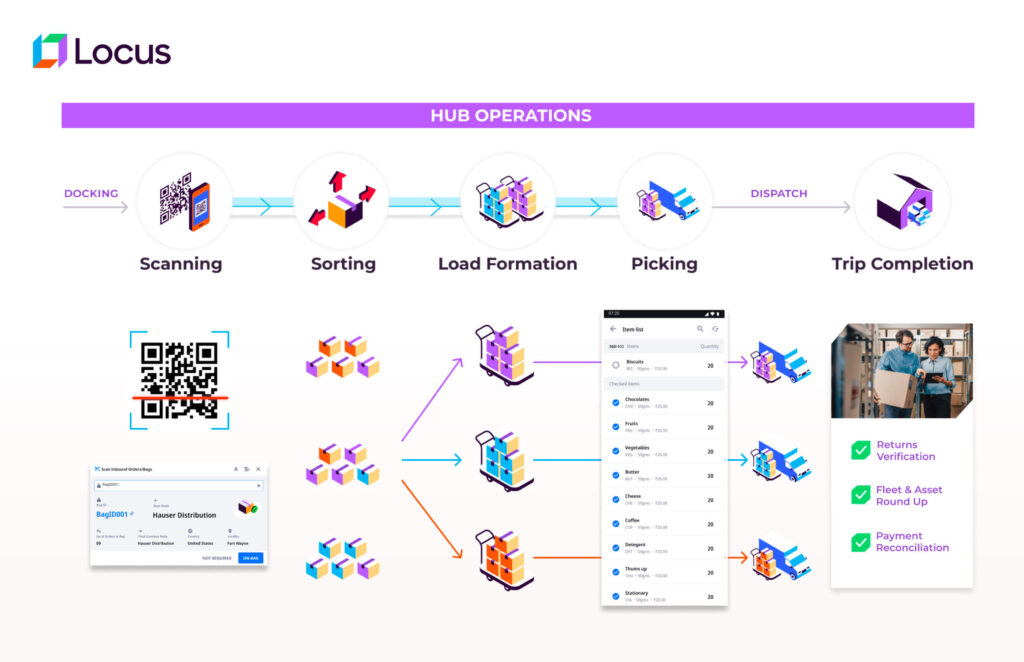
Unlike legacy TMS solutions, Locus automates complex routing decisions using AI and machine learning, enabling enterprise clients to achieve 15-25% cost reduction while improving delivery performance.
Automated load balancing and sorting:
Implement advanced first-in-last-out (FILO) strategies within distribution hubs, utilizing machine learning algorithms. This approach dynamically balances the load and autonomously sorts packages based on a variety of constraints like: zone, address, package contents and more significantly reducing processing time and enhancing operational efficiency.
Vehicle load optimization:
Deploy cutting-edge optimization algorithms in dispatch operations to achieve maximal volumetric and economic efficiency. By intelligently assigning orders to trucks with respect to their capacity and current load, the system ensures optimal resource utilization, thus minimizing operational costs.
Route management solution:
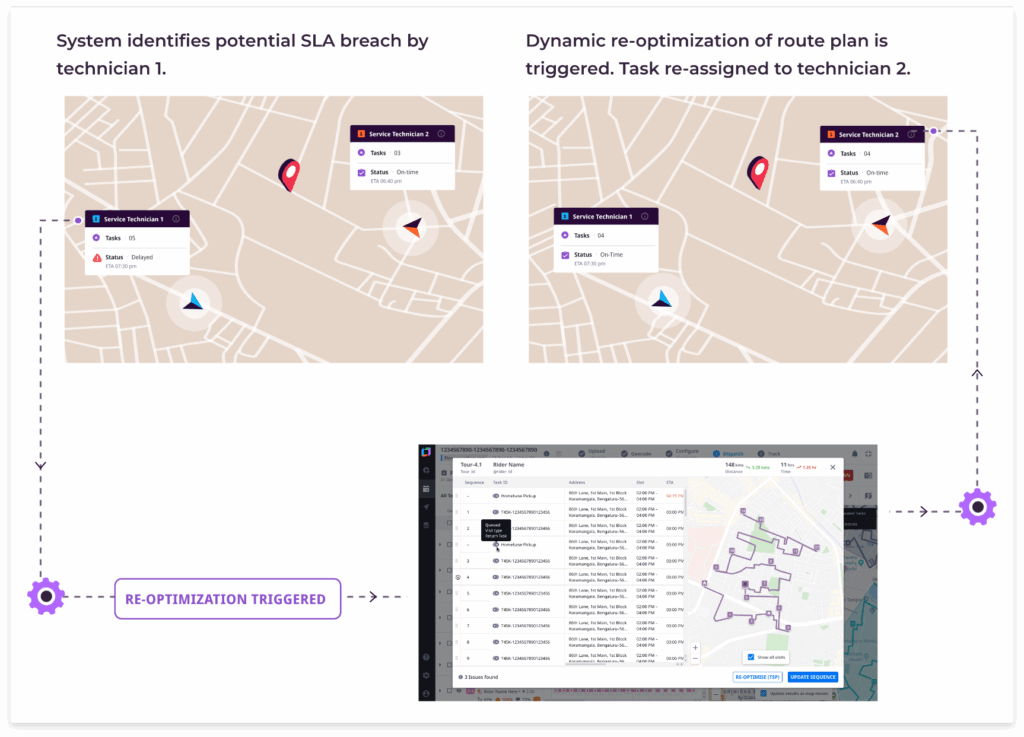
Use advanced software to plan your routes and loads in a way that minimizes empty miles. Nothing grates more than the sight of an empty truck rumbling down the highway. Locus’ smart routing solution accounts for dynamic routing which takes into account 180+ real world constraints to chart out the most economical route for drivers. The key here is to manage returns seamlessly. With smart routing solutions like Locus, shippers can plan delivery and return with the same resource/vehicle, therefore eliminating empty miles.
Advanced analytics solution:
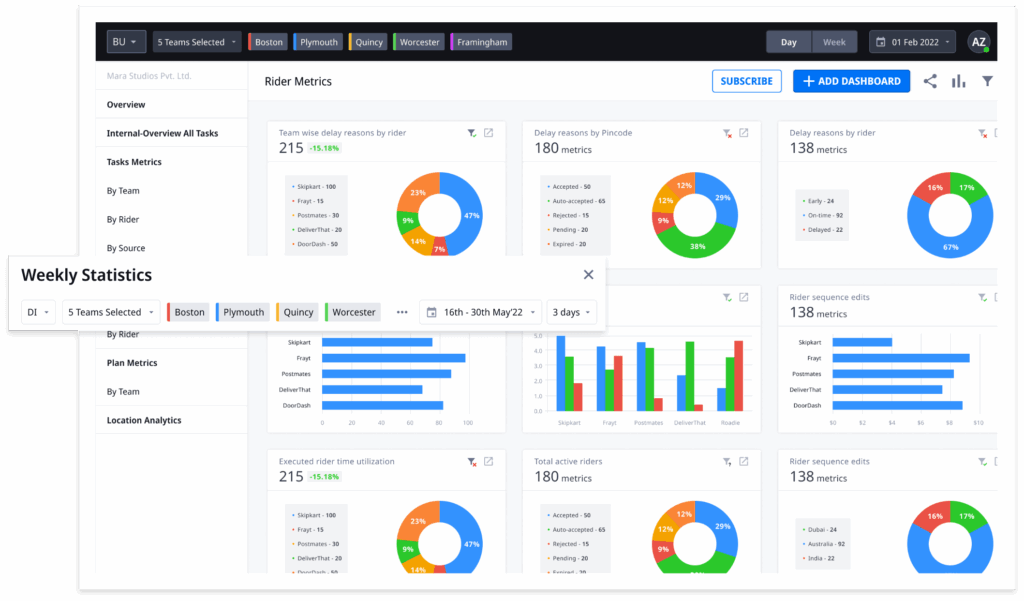
Harness the power of AI to track and analyze your shipping data. Tech is not just for Tesla, folks. Use predictive analytics to forecast your shipping needs and manage your resources effectively. Analytics is very much necessary to enhance supply chain operations, especially in the last mile. The last mile is riddled with so many problems, collecting data is just the first step in improving its performance. Locus’ advanced analytics solution converts last mile post execution data into actionable insights through dashboards. These dashboards provide shippers with multiple insights on cost, CO2 emissions, fuel consumption, driver performance and many metrics.
Carrier Management Solution:
Negotiate rates and contracts strategically with carriers to secure better deals and services. A robust carrier management solution is essential for shippers to find the right carrier that aligns with their business objectives.
Locus third party delivery solution, ShipFlex provides shippers access to a large carrier network. This helps them find every kind of transporter that meets the necessary parameters like SLA and cost.
The best part about ShipFlex is that the entire carrier/transporter selection process is done via automation.
With the help of Locus’ rules engine, shippers can set up rules for each type of order based on multiple parameters such as—distance, weight, size, price, geo, etc. to assign to the suitable carrier and the system will automatically do this for all future orders. This also helps shippers reduce favoritism from the last mile dispatcher towards certain carriers in exchange for kickbacks.
Enterprise Success Story
A leading CPG brand reduced empty miles by 23% and improved delivery SLA adherence to 99.5% using Locus’s AI-powered optimization platform, resulting in $2.3M annual savings across their North American operations.
In the modern supply chain optimization landscape, every cube of space, every mile, and every minute counts. Whether you’re managing truckloads of consumer goods or partial loads of specialized products, enterprise logistics requires data-driven efficiency optimization.
It’s about a holistic approach that considers costs, environment, and customer satisfaction. It’s about driving operational efficiency through intelligent automation and strategic optimization.
Frequently Asked Questions About Freight Trucks
What are the names of freight trucks?
The main types of freight trucks include dry van trucks, flatbed trucks, refrigerated trucks (reefers), tanker trucks, box trucks, car carrier trucks, dump trucks, and step deck trailers. Each serves specific cargo requirements and industry needs.
What is the difference between a semi truck and an 18-wheeler?
A semi truck usually refers to the tractor, or to the tractor-trailer combination used for freight. An 18-wheeler refers to a tractor-trailer combination with 18 wheels across the tractor and trailer axles. In everyday logistics language, both terms are often used for Class 8 long-haul freight vehicles.
What GVWR class are most freight trucks?
Cargo trucks are categorized by their trailer design and cargo specialization: dry vans for general freight, flatbeds for oversized items, reefers for temperature-sensitive goods, tankers for liquids, and specialized trucks like car carriers for vehicles or logging trucks for timber.
What is the difference between FTL and LTL?
FTL (Full Truckload) dedicates an entire truck to one shipper’s cargo, offering faster transit and no handling but at higher cost. LTL (Less than Truckload) consolidates multiple shippers’ cargo in one truck, providing cost savings but longer transit times due to multiple stops.
How do I choose the right freight truck for my shipment?
Consider your cargo type (temperature requirements, size, weight), shipment urgency, distance, and budget. For temperature-sensitive goods, use reefers. For oversized items, choose flatbeds. For cost optimization with smaller loads, consider LTL. For urgent, large shipments, FTL is optimal.
When should shippers use a step deck, lowboy, double drop, or RGN trailer?
Use a step deck or drop deck trailer when cargo is too tall for a standard flatbed but does not require a very low well. Use a lowboy or double drop trailer for taller or heavier machinery that needs a lower deck height. Use an RGN or removable gooseneck trailer when wheeled or tracked equipment needs to be driven onto the trailer. Permits, route restrictions, cargo dimensions, and loading method should guide the final choice.
What securement equipment is required for flatbed freight?
Flatbed freight commonly requires chains, straps, binders, edge protectors, dunnage, blocking and bracing materials, and tarps where weather protection is needed. The exact securement plan depends on cargo weight, shape, dimensions, centre of gravity, route, and applicable cargo securement rules.
What is power only trucking?
Power only trucking is a capacity model where the carrier provides the tractor and driver, while the shipper, broker, or 3PL provides the trailer or container chassis. It supports flexible capacity for drop-and-hook operations, pre-loaded trailers, surge demand, and intermodal moves.
What factors affect freight truck selection for enterprise logistics?
Enterprise logistics managers should evaluate cargo specifications, volume thresholds, delivery SLAs, route optimization opportunities, carrier network availability, compliance requirements, and total cost of ownership including fuel, handling, and potential damage costs.
Sources:
https://www.gminsights.com/industry-analysis/freight-trucking-market

General
Best Multi-Carrier Parcel Management Software for Enterprise Logistics in 2026

Jul 2, 2026
The best multi-carrier parcel management software for enterprise logistics in 2026 is Locus ShipFlex, featured as a Representative Vendor in the 2026 Gartner Multi-Carrier Parcel Management Solutions Market Guide. ShipFlex orchestrates 1,000+ pre-integrated carriers globally through the DiSCO framework, unifying captive, 3PL, gig, and specialized carrier networks under one operational architecture.
Read more
Route Optimization
Vehicle Routing Problem: Types, Challenges, and How to Solve

Jul 3, 2026
Key Takeaways Efficient delivery is no longer a nice-to-have; it’s a competitive necessity. Behind every on-time package or grocery drop is a complex puzzle known as the Vehicle Routing Problem (VRP). For last-mile delivery businesses, this challenge is relentless. With dozens or even hundreds of orders, limited vehicle capacity, and tight delivery windows, planning optimal […]
Read moreInsights Worth Your Time



















Types of Truck Freight Shipping: FTL, LTL, PTL Explained