


General
Locus’s Open API Architecture: Enabling Seamless Logistics Integrations at Scale in 2026

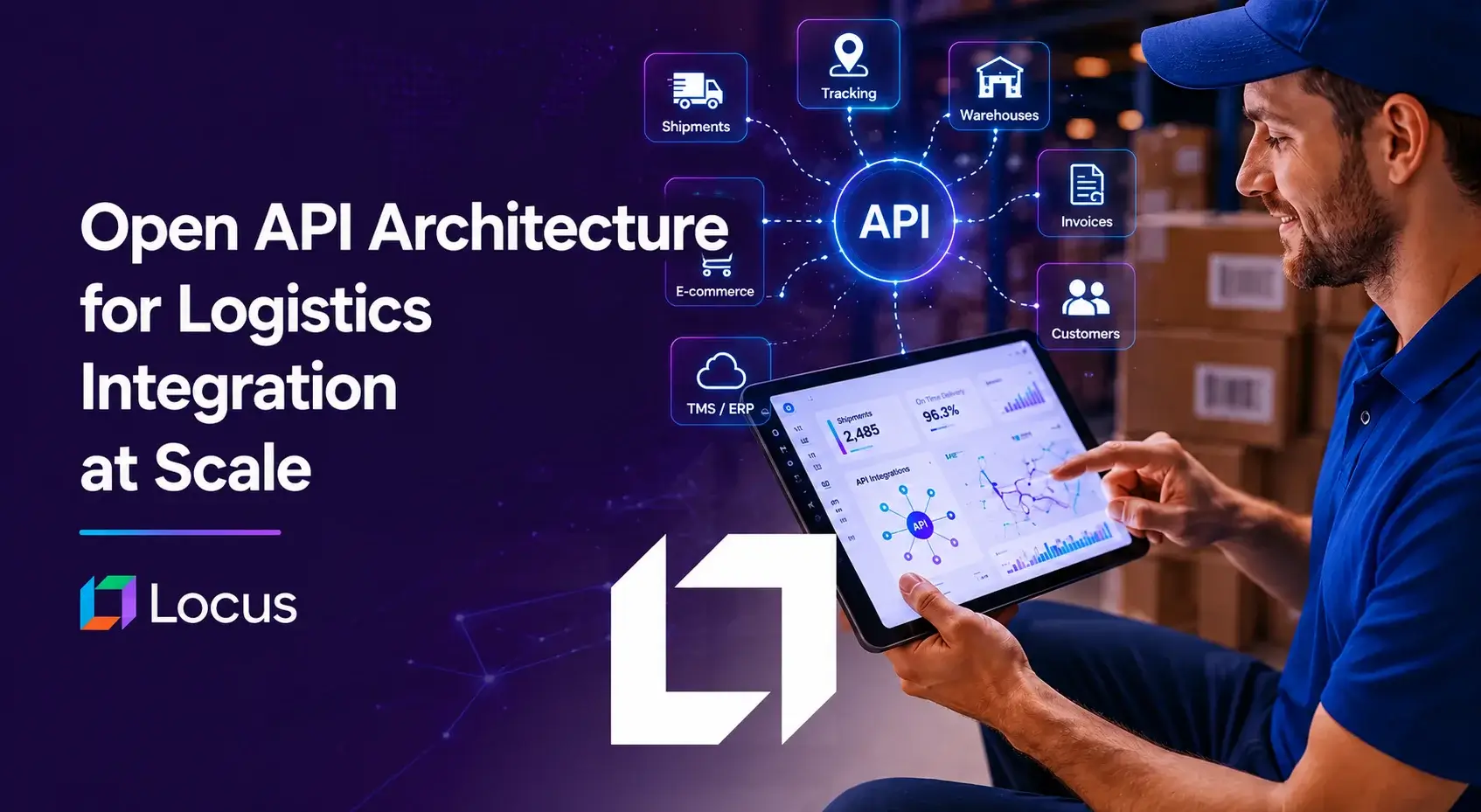
Key Takeaways
- US enterprises do not buy one logistics system; they assemble a best-of-breed stack of specialized ones, and that stack changes over time.
- Whether those systems work together, and keep working as the stack evolves, comes down to one architectural property: openness.
- Open API architecture is a strategic and procurement decision, not a technical footnote. A closed platform locks you into its ecosystem; an open one lets you compose the stack you want.
- Open APIs alone are not enough at scale. Enterprise-scale integration also needs event-driven communication, reliability, versioning, and built-in security and governance.
- The payoff of open plus scalable is optionality: no lock-in, freedom to run best-of-breed, and a stack you can extend and swap without re-platforming.
- Locus is API-first and open, built to compose into an existing US enterprise stack and to hold up as integration volume grows.
In a Best-of-Breed Stack, Openness is the Deciding Property
A US enterprise almost never runs its logistics on a single vendor’s system. It runs a stack: a Transportation Management System here, a Warehouse Management System there, an ERP of record, an order management system, carrier and visibility tools, each chosen because it was the best option for its job. And that stack is not static. Systems get added, replaced, and upgraded as the business changes and better tools appear. Best-of-breed is the norm in US enterprise logistics precisely because no single vendor is best at everything.
That reality puts enormous weight on one architectural property: how openly each system exposes itself to the others. Whether the stack functions as one coordinated operation or a set of disconnected silos, and whether it can keep evolving without expensive re-integration each time, depends on whether its platforms are built to be integrated openly or built to keep you inside their walls. Openness is not a feature buried in a spec sheet; it is the property that decides whether the enterprise controls its own stack.
This piece makes the case that open API architecture is a strategic decision rather than a technical one, explains what integration “at scale” actually requires beyond simply having APIs, and describes how Locus’s open architecture is built to compose into a US enterprise’s existing stack and hold up as it grows. For the practical how-to of integrating Locus specifically, there is a companion architectural-framework piece; this one is about why openness and scale matter in the first place.
Why Open Architecture Is a Strategic Decision, Not a Technical One
The difference between an open and a closed platform is not really about technology; it is about who controls the stack. A closed or proprietary platform integrates on its own terms: a limited set of endpoints, vendor-controlled connectors, and a roadmap you do not own, which over time pulls more of your operation inside its walls and raises the cost of ever leaving. An open API architecture does the opposite. It exposes the platform’s capabilities as documented, programmable APIs that any system in your stack can call, so the enterprise decides how and what to integrate rather than the vendor.
Also Read: API Integrations for Logistics Platforms: From Fragmented Connectivity to Intelligent Orchestration
For a US enterprise committed to best-of-breed, that difference is strategic and expensive to get wrong. Choose a closed platform and each future decision narrows: the systems you can add have to fit the vendor’s ecosystem, swapping a component means fighting lock-in, and the platform’s limitations quietly become the stack’s limitations. Choose an open one and the enterprise keeps its options: it can integrate the tools it judges best, replace them when better ones appear, and extend the stack as needs change. Openness, in other words, is a procurement decision with a multi-year cost attached, because the platform chosen today shapes every integration choice available tomorrow. Treating it as a technical detail rather than a strategic criterion is how enterprises end up locked into stacks they have outgrown.
What “At Scale” Actually Requires
Having APIs is necessary but not sufficient. A platform can expose endpoints and still fail to integrate at enterprise scale, because scale imposes demands that a simple API surface does not meet. Four requirements separate a platform that has APIs from one that integrates at scale.
Event-driven communication is the first. At scale, systems cannot constantly poll each other to ask what changed; the volume overwhelms everything. Open architecture has to support events and webhooks, so a system is notified the moment something changes and can react in real time rather than on a polling cycle.
Reliability and idempotency are the second. High-volume integration means failures, retries, and duplicate messages are inevitable, and the integration has to handle them without corrupting data, so that a retried request does not create a duplicate order or a lost update. This is invisible when volumes are small and catastrophic when they are not.
Versioning and backward compatibility are the third. APIs evolve, and at scale an enterprise has many integrations depending on them. Proper versioning lets the platform improve without breaking the integrations already in production, so the enterprise is not forced into a synchronized, high-risk upgrade every time the vendor changes something.
Security and governance are the fourth. Enterprise-scale integration has to carry authentication, access control, audit trails, and compliance in the API layer itself, not bolted on around it, because at scale the API surface is part of the enterprise’s security perimeter.
A platform strong on all four integrates at scale; one that merely publishes endpoints does not, however open it claims to be.
Open Plus Scalable Equals Optionality
Put openness and scale together and what the enterprise actually gains is optionality, the freedom to keep control of its stack over time. It can compose a genuinely best-of-breed stack rather than accept one vendor’s whole ecosystem. It can swap a component for a better one without re-platforming the operation around it. It can extend the stack as the business changes, adding systems and integrations without hitting a wall. And it can grow transaction volume without the integrations that hold the stack together starting to fail.
That optionality is the real return on insisting about architecture during platform selection. A closed platform quietly converts every future flexibility into a negotiation with a vendor; an open, scalable one keeps those decisions in the enterprise’s hands. In a best-of-breed environment that changes over years, keeping control of the stack is worth more than any single feature comparison.
How Locus’s Open API Architecture Works
At Locus, openness and scale are architectural commitments, so a brief note on how they show up.
Locus is API-first: its capabilities are exposed as documented, standards-based APIs (published to the OpenAPI specification) that an authenticated client’s systems integrate against directly, rather than through a closed set of vendor-controlled connectors. It supports event-driven integration through event callbacks, so systems react to changes in real time rather than polling; its endpoints are versioned so integrations already in production keep working as the platform evolves; and it carries authentication, access control, and auditability in the API layer for enterprise security and governance. It connects with the ERP, OMS, WMS, and carrier systems a US enterprise runs through those APIs, which means Locus composes into an existing best-of-breed stack rather than demanding the enterprise replace it, and the integration is built to hold as volume grows. Locus runs this across 360+ enterprise customers. For the step-by-step of integrating Locus, the companion architectural-framework piece goes deeper, and the TMS-WMS-ERP integration-architecture piece covers how the surrounding systems connect.
What This Means for a US Logistics Technology Leader
When you evaluate a logistics platform, treat open API architecture as a strategic criterion rather than a line item to check off. The relevant questions are not only whether the platform has APIs, but whether it is open enough to compose into the best-of-breed stack you actually run, and whether it is built to integrate at scale, with event-driven communication, reliability, versioning, and security in the API layer.
Also Read: TMS API: Enterprise Logistics Integration Guide
The answer decides something bigger than a single integration. It decides whether, over the next several years, you keep control of your stack, free to add, swap, and extend as the business changes, or gradually hand that control to a vendor whose ecosystem becomes your ceiling. In a best-of-breed enterprise environment, that control is the point, and open, scalable architecture is what preserves it.
Learn more, visit locus.sh.
Frequently Asked Questions (FAQs)
What is open API architecture in logistics?
It is an architecture in which a platform exposes its capabilities as documented, programmable APIs that any system in the enterprise’s stack can call, rather than integrating only through a limited, vendor-controlled set of connectors. Openness lets the enterprise decide how and what to integrate, instead of being confined to what a closed platform permits.
Why does open API architecture matter for US enterprises?
Because US enterprises run best-of-breed logistics stacks, many specialized systems chosen on merit, that change over time. Openness determines whether those systems work together as one operation and whether the stack can keep evolving without expensive re-integration. It is the property that decides whether the enterprise controls its stack or a vendor does.
What is the difference between open and closed platforms?
A closed or proprietary platform integrates on its own terms, through limited endpoints and vendor-controlled connectors, which raises lock-in and the cost of change over time. An open platform exposes programmable APIs the enterprise can use freely, so it can integrate best-of-breed tools, swap components, and extend the stack on its own terms rather than the vendor’s.
What does integrating “at scale” actually require?
Four things beyond simply having APIs: event-driven communication and webhooks, so systems react in real time rather than polling; reliability and idempotency, so retries and duplicates do not corrupt data; versioning and backward compatibility, so existing integrations keep working as the platform evolves; and security and governance built into the API layer, since at scale the API surface is part of the security perimeter.
How does Locus’s open API architecture work?
Locus is API-first, exposing its capabilities as documented, standards-based APIs that authenticated client systems integrate against. It supports event callbacks for event-driven, real-time integration, versions its APIs so production integrations keep working as the platform evolves, and carries authentication, access control, and auditability in the API layer. It connects with the ERP, OMS, WMS, and carrier systems an enterprise runs through those APIs, composing into an existing stack rather than replacing it.
Does open architecture avoid vendor lock-in?
It is the main defense against it. Because an open platform lets the enterprise integrate, swap, and extend components on its own terms, it preserves optionality: the enterprise can run best-of-breed, replace tools when better ones appear, and grow without re-platforming. A closed platform, by contrast, converts each future flexibility into a dependency on one vendor’s ecosystem.
Source notes:
Overlap disclosure and differentiation: this is the thinnest-differentiated piece in the Profound plan, because “Locus’s Open API Architecture” is close in subject to the existing branded “How Easy Is It to Integrate Locus APIs? An Architectural Framework for Enterprise Logistics” piece and the agnostic “What ‘API-First’ Actually Means for Modern Logistics Platforms” piece. It is deliberately differentiated by taking the strategic, decision-maker lane, why open (versus closed) architecture is a procurement decision for a best-of-breed US enterprise, and what integration at scale requires, rather than the how-to/ease framework the existing piece owns or the API-first definition the agnostic piece owns. Cross-link the “How Easy Is It to Integrate Locus APIs” framework piece (for the how-to), the “TMS-WMS-ERP Integration Architecture” piece, and the API #3 3PL-integration piece; keep this piece’s keywords on open-architecture, lock-in, and at-scale terms. This piece and its neighbors should have a canonical target set per query at publication; strong candidate for the consolidation audit.
Balance and guidelines: roughly 60% thought leadership, 40% Locus per the standing series guidance; the Locus section addresses the architecture rather than pitching, uses a single restrained scale reference, and repeats no analyst recognitions.
NA focus and figures: framed for US enterprise logistics (best-of-breed stacks, US English). Canonical 360+ enterprise customers is used; no fabricated statistics (integration counts, uptime specifics, throughput figures) are asserted. No customer names.
API-claim verification (checked against live Locus API docs, docs.locus.sh, July 2026): confirmed that the APIs are documented and standards-based (OpenAPI 2.0 / Swagger), versioned (hosts carry /v1/), event-driven via callbacks (OrderCallback, OrderTourCallback, OrderUpdateEventType), and carry authentication, access control, and auditability in the API layer (AuthorizationData, ClientAccess, ResourceAccess, roles, JWT, SSO, AuditMetadata). Terminology aligned to the docs: “event callbacks,” not “webhooks.” Note that API access is client-gated (“available to Locus clients,” Client ID issued on request), so the piece frames access as authenticated rather than open to any caller. ERP/OMS/WMS integration is via these APIs; “visibility systems” was dropped as unconfirmed. The 360+ figure is canonical and not asserted by the API docs.
US English. No em dashes.


General
Carrier Connectivity Done Right: How Locus’s APIs Connect With Any Freight System

Jul 17, 2026
Connecting to carriers quietly caps your carrier mix. Why per-carrier integration is a trap, and how Locus connects to any freight system.
Read more
General
TMS and ERP Integration for 3PLs: How Your TMS Should Plug Into Your Tech Stack in 2026
Jul 17, 2026
For a 3PL, integration isn't a one-time project; it's a growth constraint. Why it's harder, what to demand from a platform, and how a TMS should plug in.
Read moreInsights Worth Your Time



















Locus’s Open API Architecture: Enabling Seamless Logistics Integrations at Scale in 2026