


General
Onfleet Pricing: 2026 Cost per Task, Plans, and Enterprise Alternatives

Onfleet Pricing: Key Takeaways
- Onfleet follows a tiered subscription pricing model, with plans based on monthly delivery or pickup tasks and feature access, making pricing relatively transparent for growing delivery teams.
- User reviews across G2, Capterra, and Software Advice highlight strong usability, driver experience, and route optimization, while also noting limitations when scaling into more complex logistics operations.
- Mid-sized and large enterprises evaluating Onfleet pricing often compare it with Locus, particularly when route planning needs expand into enterprise-scale delivery optimization, automation, and multi-region operations.
How We Gathered Insights on Onfleet Pricing
Onfleet publicly shares pricing tiers and plan structures, but understanding real-world value requires combining pricing information with user experience data.
To build this guide, we analyzed publicly available information from:
- Onfleet’s official pricing documentation
- G2 — user feedback on pricing transparency, usability, and operational impact
- Capterra — verified customer reviews covering ease of use and implementation experience
- Software Advice — aggregated ratings and deployment feedback from delivery teams
These platforms provide insights from verified users across industries including retail, food delivery, logistics, and courier operations. Rather than relying solely on vendor messaging, this article focuses on recurring themes visible across multiple customer reviews.
(Please note that examples referenced below are paraphrased from public reviews and may not reflect every user’s experience.)
Onfleet Pricing (2026): What You Need to Know
Onfleet follows a tiered pricing structure, where plans differ based on monthly delivery volume (tasks) and advanced feature access.
Public Pricing Structure
According to Onfleet’s pricing page, the platform offers three primary plans:
- Launch — starting around $599/month, including approximately 2,500 delivery or pickup tasks and core routing and delivery features
- Scale — starting around $1,299/month, adding advanced route optimization, auto-dispatch, and extended reporting
- Enterprise — starting around $2,999/month, offering multi-region support, enterprise security features, and premium onboarding
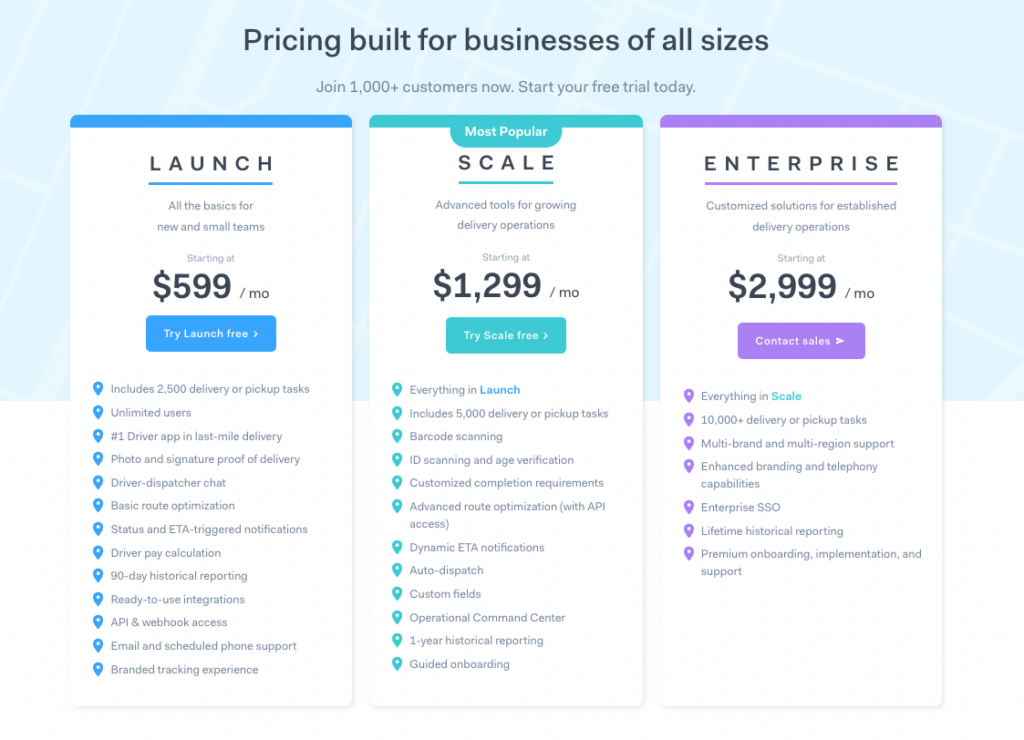
Each plan includes unlimited users, and pricing is primarily driven by delivery volume rather than driver count.
Additional costs may apply for SMS communication or telephony usage depending on delivery communication requirements.
Task-Based Pricing Model
Onfleet pricing revolves around the concept of a “task,” defined as a completed pickup or delivery. This makes pricing predictable for businesses with consistent delivery volumes but can become harder to forecast when delivery demand fluctuates significantly.
Review platforms note that the platform is often adopted by organizations transitioning from manual dispatching or spreadsheet-based routing into digital delivery management systems.
What changed in Onfleet pricing?
One reason buyers see conflicting numbers in search results is that some software directories still display older Onfleet pricing.
- The current official Onfleet pricing page lists Launch at $619/month, Scale at $1,349/month, and Enterprise at $3,099/month: Onfleet pricing page, September 2026.
- G2 (July 2026) notes that Onfleet offers 3 pricing editions, starting at $500: G2, July 2026.
For procurement and budgeting, buyers should treat the official Onfleet pricing page as the current source of truth and use directory listings mainly as secondary context. If a reseller, review site, or consultant shows lower numbers, ask whether those figures are outdated, promotional, annualised, or tied to older packaging.
Onfleet Launch vs Scale vs Enterprise
Launch
Best fit: Smaller or growing delivery teams that need to replace manual dispatch, spreadsheets, or fragmented tracking tools.
What public pricing indicates:
- 2,500 completed tasks per month
- Core route planning and delivery execution workflows
- Driver mobile app
- Real-time tracking and customer notifications
- Proof of delivery
- Suitable starting point for buyers prioritising speed of deployment
Fit considerations: If your operation needs more automation, richer control-room visibility, or more advanced scanning and orchestration, buyers should verify whether Launch will be sufficient beyond the first phase.
Scale
Best fit: Teams that have moved past basic dispatch digitisation and want stronger automation and tighter operational control.
What public pricing and supporting sources suggest:
- 5,000 completed tasks per month
- Advanced route optimisation
- Auto-dispatch
- Command Center access
- Barcode and ID scanning workflows referenced in public plan comparisons
- Better fit for operations with higher daily volume and more exception handling
Fit considerations: Scale is usually the inflection point where buyers start looking closely at cost-to-serve, planner productivity, and whether dynamic ETA and control-tower views are enough for future growth.
Enterprise
Best fit: Larger delivery organisations with heavier volume, multi-region delivery operations, multi-brand governance requirements, or more formal security and support needs.
What public pricing indicates:
- 10,000+ completed tasks per month
- Enterprise-level commercial packaging
- Multi-region and broader operational support positioning
- Security, onboarding, and contract flexibility typically evaluated at this tier
- Potential relevance for SSO, governance, and premium support discussions
Fit considerations: At Enterprise level, software price alone becomes less useful than modelling on-time performance, planner efficiency, exception rates, carrier coordination, and integration complexity.
Courier Suite add-on
Onfleet also lists Courier Suite starting at $299/month on the Onfleet pricing page, September 2026. Buyers evaluating courier management software should confirm whether it includes the specific client portal, order intake, invoicing, rate-management, or shipper-facing workflows their operation requires.
How task-based pricing works and what buyers should clarify
Onfleet’s commercial model centres on the number of completed pickup or delivery tasks processed each month. That is straightforward if your operation has stable volumes and a clear definition of what counts as a task. It becomes less straightforward when volume spikes, retries, returns, or specialised courier workflows enter the picture.
Questions to ask before buying
- Are pickup and delivery counted as separate tasks in your workflow?
- Are failed deliveries, cancellations, or customer no-shows counted?
- Do retries, re-attempts, or returns create additional billable tasks?
- How are scheduled, recurring, or split orders counted?
- What happens when you go above the included monthly volume?
- Are there different treatment rules by plan, contract, or use case?
- Which communication features trigger SMS or telephony charges?
- Are API integrations included, rate-limited, or separately scoped?
Why this matters operationally
A task-based model can be predictable for businesses with stable order flow. But for high-variability operations, actual economics depend on:
- how fully you use the included capacity,
- whether peak months trigger overage or tier changes,
- whether returns or retries increase your counted tasks,
- and whether customer communication costs grow with volume.
That is why buyers should model cost not just by headline subscription fee, but by actual stop profile, exception rate, and seasonal demand pattern.
Cost scenarios: what Onfleet pricing can look like in practice
The examples below use list-price assumptions only and are intended for budgeting orientation, not as quoted commercial terms.
1,000 tasks per month
If you are only running about 1,000 completed tasks monthly, the lowest public tier is still Launch at $619/month. That means your effective cost against actual usage is closer to $0.62 per completed task in a low-utilisation month.
2,500 tasks per month
At full Launch utilisation, the base plan works out to about $0.25 per included task. This is the cleanest fit if your volume is steady and your operational model is relatively straightforward.
5,000 tasks per month
At this level, Scale at $1,349/month aligns with the published allowance and equates to about $0.27 per included task. This is also where auto-dispatch and more advanced operational control may justify the move beyond pure price comparison.
10,000 tasks per month
Using the minimum public Enterprise baseline, $3,099/month implies about $0.31 per included task. At this point, buyers should compare platform cost with service reliability, dispatcher productivity, customer communication volume, and governance needs.
25,000+ tasks per month
Once operations move into higher-volume territory, list pricing becomes less useful than contract structure. Buyers should ask for:
- custom volume thresholds,
- onboarding scope,
- multi-region support,
- security packaging,
- integration responsibilities,
- and peak-season commercial treatment.
Seasonal or highly variable demand
If monthly demand fluctuates heavily, a task-based contract can create two opposite risks:
- unused capacity in quieter months, and
- overage or re-tier uncertainty in peak months.
This is especially important for retail peaks, medical courier surges, and hybrid fleets where owned, outsourced, 3PL, and gig capacity may all behave differently.
Estimated annual base subscription cost
- Launch: $619 × 12 = $7,428/year
- Scale: $1,349 × 12 = $16,188/year
- Enterprise: $3,099 × 12 = $37,188/year at the minimum published baseline
These annualised figures exclude add-ons, SMS charges, implementation, taxes, and negotiated terms.
Total cost of ownership checklist
Headline plan price is only the start of an onfleet pricing evaluation. Buyers should also check:
- Subscription tier and included monthly task allowance
- SMS, telephony, or customer communication charges
- Implementation or onboarding services
- Premium support or success packages
- Integration and API work
- Data migration from existing tools
- Internal administration and training time
- Driver devices and connectivity
- Contract minimums or annual commitments
- Volume overages or re-tiering rules
- Seasonal expansion terms
- Taxes, negotiated discounts, and invoicing structure
A platform that looks less expensive on paper may not stay less expensive once exception handling, message volume, reporting needs, and integration work are included.
Onfleet Packages & Platform Structure
Onfleet is designed as a last-mile delivery and route management platform, combining route planning with execution and delivery tracking capabilities.
Typical platform capabilities include:
- Route optimization and dispatching
- Driver mobile application
- Real-time tracking and customer notifications
- Proof of delivery
- Delivery analytics and reporting
- Driver-dispatcher communication
The platform structure is built around operational execution rather than network-level logistics optimization. Many organizations initially adopt Onfleet to improve routing efficiency and delivery visibility before expanding into more advanced optimization tools as operations grow.
For enterprises exploring advanced routing capabilities, see Locus’ Route Planning System
Where Onfleet fits in the software landscape
Not every logistics tool solves the same problem. Buyers often get clearer procurement outcomes when they separate categories first.
| Software category | Primary purpose | When it overlaps with Onfleet |
| Delivery execution platforms | Dispatch, route execution, driver tracking, proof of delivery | This is Onfleet’s closest category |
| Route-optimisation tools | Build efficient stop sequences and routes | Relevant when route quality is the main need |
| Fleet-management systems | Vehicle, maintenance, telematics, compliance | Adjacent, but not the same buying decision |
| Transportation management systems (TMS) | Broader transport planning, carrier procurement, linehaul workflows | More enterprise-wide and upstream than pure last-mile execution |
| Delivery-experience platforms | Customer visibility, ETA, notifications, branded tracking | Can complement execution tools |
| Enterprise logistics-orchestration platforms | Multi-node planning, optimisation, dispatch automation, cross-region governance | More relevant when operations span depots, brands, providers, or countries |
This distinction matters because a company seeking fast deployment and cleaner dispatch workflows may evaluate Onfleet very differently from a company trying to optimise cost-to-serve across a multi-brand, multi-region network.
Onfleet Reviews: What Customers Say (G2, Capterra, Software Advice)
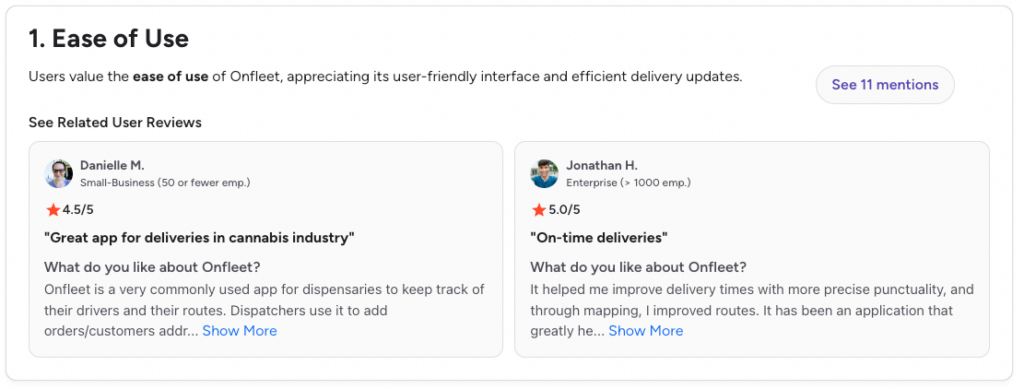
Across review platforms, Onfleet maintains strong overall ratings and is widely recognized for ease of use and operational efficiency improvements.
- G2 lists Onfleet with an overall rating of approximately 4.6 out of 5, with strong satisfaction among logistics and delivery teams.
- Capterra and Software Advice reviews consistently highlight usability, onboarding experience, and driver app performance as key strengths.
Common themes across reviews include:
- Fast onboarding and implementation
- Improved route planning efficiency
- Better delivery visibility for customers
- Reduced manual dispatch effort
Overall sentiment suggests that Onfleet is particularly effective for delivery teams looking for structured execution and routing visibility without heavy implementation overhead.
What Users Like About Onfleet
Ease of Use and Intuitive Interface
Many reviewers highlight Onfleet’s simple interface and intuitive workflows, which make it easier for dispatchers and drivers to adopt quickly without extensive training.
Strong Driver Experience
The driver app is frequently mentioned as a positive aspect of the platform, helping streamline communication and delivery execution.
Improved Delivery Visibility
Users often report improved customer communication through real-time tracking updates and notifications, which helps reduce delivery exceptions and customer support queries.
Quick Implementation
Compared to larger enterprise logistics systems, reviewers note that Onfleet can be deployed relatively quickly, making it suitable for teams seeking faster operational improvements.
Common Challenges Mentioned in Reviews
Scaling Beyond Route Execution
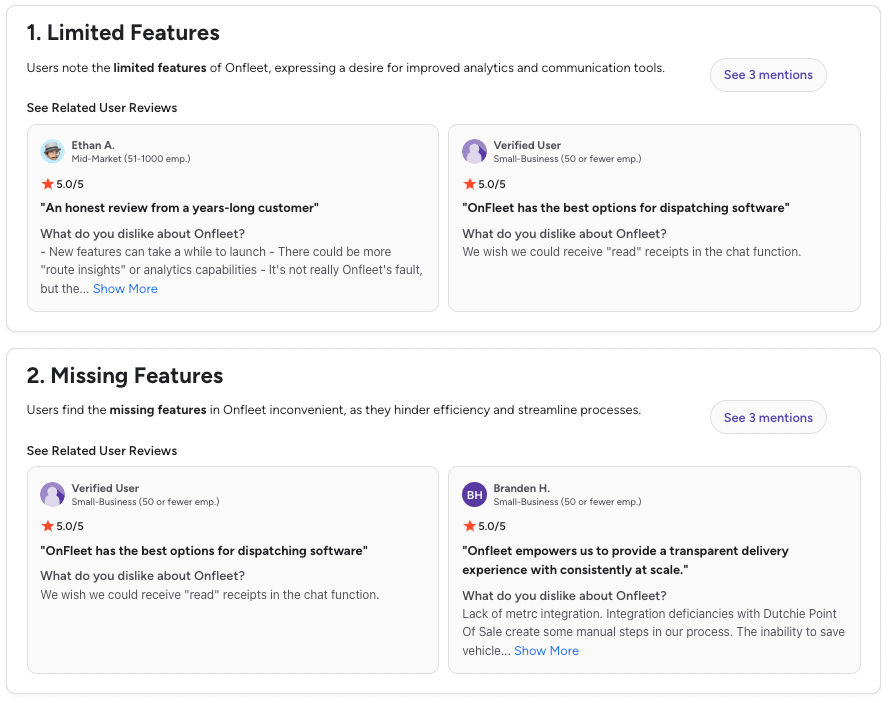
Some reviewers mention limitations when operations expand beyond routing and execution into more complex logistics optimization or multi-node planning.
Feature Depth for Complex Workflows
Organizations with highly customized workflows occasionally report needing additional tools or integrations as operations grow.
Pricing at Higher Volumes
Because pricing is tied to delivery tasks, costs may increase as delivery volume grows, which can influence long-term pricing evaluation for high-volume operations.
Buyer fit framework: when Onfleet fits, and when to widen the search
Choose Onfleet if you need:
- Fast deployment for delivery execution
- Route management with customer visibility
- Driver app, proof of delivery, and ETA notifications
- Less manual dispatch effort
- A task-based pricing model that maps reasonably well to stable order volume
Consider a lighter route planner if you need:
- Basic sequencing for a small fleet
- Lower complexity and fewer exceptions
- Minimal workflow customisation
- Strong price sensitivity over broader orchestration needs
Evaluate Locus or another enterprise platform if you need:
- Multi-depot or multi-node planning
- Multi-region or multi-country governance
- Hybrid fleets across owned, outsourced, 3PL, and gig models
- Capacity modelling and cost-to-serve optimisation
- Dynamic re-optimisation, exception management, and SLA adherence
- Stronger orchestration across multiple brands, business units, or operating models
Request a proof of concept if:
- Integration complexity is high
- Volume is scaling quickly
- Peak variability is material
- You are rolling out across multiple brands or regions
- Stakeholders need a procurement case based on service outcomes, not just subscription fees
What enterprise delivery complexity actually looks like
A delivery platform evaluation usually becomes more demanding when the business has to manage several of the following at once:
- Multi-depot planning
- Fleet and capacity constraints
- Time-window commitments
- Driver skills or service-level requirements
- Product and vehicle compatibility rules
- Dynamic re-optimisation during the day
- Cross-region governance
- Multi-brand management
- Owned, outsourced, 3PL, gig, or hybrid fleets
- 3PL collaboration and visibility
- Network-level scenario modelling
- Cost-to-serve analytics
- Exception management
- SLA adherence reporting
If most of these are not part of your operating model, Onfleet may be a practical fit. If several are already present, buyers usually need to evaluate not only route execution, but how the platform supports planning governance and scale.
Locus as the Common Alternative to Onfleet
Organizations evaluating Onfleet pricing often compare it with Locus, particularly when delivery operations evolve from routing execution into broader logistics optimization challenges.
While Onfleet focuses on route execution and last-mile visibility, Locus is designed for mid-sized and large enterprises managing complex logistics networks.
Enterprise-Grade Optimization
Locus applies AI-driven optimization across routing, dispatch planning, and execution decisions, enabling enterprises to optimize delivery networks at scale rather than focusing solely on individual route efficiency.
Built for Complex Enterprise Logistics
Locus supports multi-node distribution networks, hybrid delivery models, and high-volume operations across industries such as retail, FMCG, and logistics.
From Route Management to Delivery Optimization
Many organizations begin with execution-focused platforms and later transition to systems that support dynamic routing, capacity planning, and continuous optimization as operations expand.
This is where enterprise platforms like Locus are often evaluated alongside Onfleet.
Onfleet vs enterprise orchestration: a practical comparison lens
| Evaluation question | Onfleet-focused evaluation | Locus-focused evaluation |
| Digitising dispatch quickly | Strong fit for fast-start delivery execution | Relevant if you also need broader optimisation from day one |
| Optimising routes | Good fit for route execution and operational visibility | Better fit when optimisation must span network, fleet, and business constraints |
| Scaling across regions | Buyers should verify governance and multi-region fit by contract | Designed for broader cross-region operating models |
| Managing multiple fleet types | Check support for outsourced and hybrid workflows | Stronger fit where owned, 3PL, gig, and hybrid capacity must be orchestrated together |
| Reducing cost per delivery | Works if route execution is the main lever | More relevant when cost-to-serve modelling and network decisions matter |
| Handling exceptions | Good for day-to-day delivery execution workflows | Better suited when exception management must feed optimisation decisions at scale |
| Integrating with existing stack | Important to scope APIs and workflow coverage | Important where planning, execution, and enterprise systems must coordinate |
| Estimating TCO / procurement case | Start with task volume and operational needs | Start with scale, complexity, governance, and service economics |
This is less about declaring one platform “better” and more about matching the software category to the operating model.
Conclusion: Why Enterprises Evaluate Locus Alongside Onfleet
Onfleet remains a well-regarded last-mile delivery platform, particularly for organizations looking to digitize delivery execution and improve routing efficiency quickly. Its tiered pricing model and ease of deployment make it attractive for growing delivery operations.
However, as logistics operations scale, pricing decisions increasingly depend on operational outcomes rather than subscription cost alone. Enterprises often evaluate how effectively a platform improves cost per delivery, planner productivity, and SLA reliability across regions and delivery models.
In this context, many mid-sized and large enterprises evaluate Locus alongside Onfleet, especially when routing evolves into a broader delivery optimization challenge requiring automation, scalability, and AI-driven decision-making.
For organizations seeking to move beyond route execution into enterprise-scale logistics optimization, Locus represents a modern alternative focused on efficiency, automation, and long-term operational growth.

Route Optimization
Route Optimization vs Google Maps: Key Differences in 2026

Sep 23, 2026
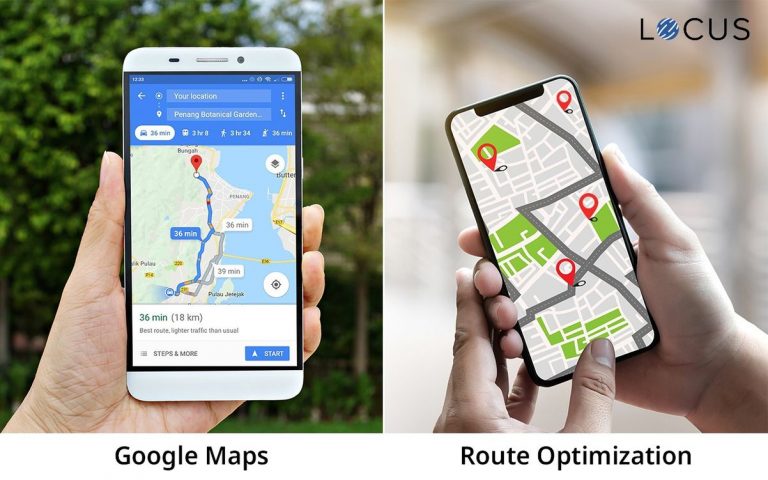
Key Takeaways When carrying out complex logistics operations for a business, a number of other important factors must be considered. You need a smart solution that can automate your end-to-end logistics activities, save costs and reduce human dependency. Google Maps routes or other web route mapping services are not capable of doing that. That’s where advanced […]
Read more
General
What Is Third-Party Fulfillment? Definition, Key Steps, Costs & Benefits

Sep 23, 2026
Learn what 3PL fulfillment is, its key process, and benefits in 2025. See how third-party fulfillment streamlines operations and enhances customer experience.
Read moreInsights Worth Your Time



















Onfleet Pricing: 2026 Cost per Task, Plans, and Enterprise Alternatives