


Logistics Automation & Orchestration
How to Choose Logistics Automation Software
Key Takeaways
- Evaluate logistics automation across the full order-to-POD lifecycle — order allocation, hub and sortation, dispatch and route planning, carrier management, and customer experience
- Use a three-part rubric for every vendor on your shortlist: assess workflow coverage, model ROI and total cost of ownership, and evaluate implementation speed and configurability
- Treat single-point automation bots cautiously because they often create integration debt, data silos, and broken handoffs that limit ROI
- Favor modular orchestration platforms when your operation spans multiple stages, regions, or carrier networks, because connected data flow and shared architecture scale better than isolated bots
- Consider Locus if you need modular, end-to-end order-to-POD coverage, including dispatch management, route planning, and a unified real-time visibility layer within Locus’s agentic TMS
You should choose logistics automation software based on how well it connects your complete order-to-proof-of-delivery workflow, not how impressively it automates one isolated task.
A route planning tool may improve route efficiency, while a carrier management tool may improve shipment allocation. But if those systems do not share data with order allocation, hub operations, dispatch, and customer-facing delivery workflows, your team still has to manage the gaps manually.
The right platform should help you connect decisions across the delivery lifecycle, reduce operational handoffs, and create a clearer path to measurable returns. This guide gives you a practical framework for evaluating vendors across three areas: workflow coverage, ROI and total cost of ownership, and implementation readiness.
Why Logistics Automation Is No Longer Optional
Logistics teams are being asked to deliver more orders, meet tighter service-level commitments, and control costs without adding equivalent operational capacity. Manual processes and disconnected systems may work at a smaller scale, but they become increasingly difficult to manage as order volumes, delivery regions, fulfillment nodes, and carrier networks expand.
Your team may already automate individual tasks, such as route planning, dispatch, or customer notifications. However, partial automation does not necessarily remove operational friction. Planners may still move data between systems, dispatchers may work from outdated information, and customer service teams may lack an accurate view of delivery status.
These gaps affect more than productivity. They can increase planning time, delay exception resolution, create inconsistent customer updates, and make it harder to determine where delivery costs or SLA failures originate.
End-to-end logistics automation addresses this problem by connecting decisions from order allocation through proof of delivery. Instead of treating each activity as a separate automation project, it allows data and operational context to move across the workflow.
This becomes especially important when your business operates across multiple fulfillment points, fleets, carriers, or regions. At that level of complexity, the question is no longer whether you should automate. It is whether your automation architecture can scale without creating additional integrations, manual workarounds, and fragmented operational views.
The Hidden Cost of Single-Point Automation Bots
Your team may already have automated a step or two; a route optimizer last year, a carrier allocation tool this year. Yet the efficiency gains you expected never fully arrived. That is usually a structural problem.
Imagine the pattern. Your route tool reduces distance. Your carrier tool improves selection logic. But your customer service team still cannot answer a simple question: where is the parcel right now? The data exists, but it sits in separate systems that were never designed to share a common operational view.
That is the single-point bot pattern: separate tools for allocation, hub workflows, dispatch, carrier selection, and proof of delivery, each running on its own logic and data model.
Integration debt is the first cost
Every additional tool needs another integration to your OMS, WMS, TMS, carrier APIs, or reporting stack. When one upstream system changes, every dependency around it has to be retested and maintained.
Data silos are the second cost
When order data, route data, carrier status, and delivery confirmation live in different places, no team sees the same truth at the same time. Planning works from exports. Dispatch works from a different system view. Customer support works from stale status events.
Broken handoffs are the third cost
Errors compound at every transition; allocation to hub, hub to dispatch, dispatch to carrier, carrier to customer communication. Each handoff becomes a risk point for status mismatches, misroutes, and delays.
A 2026 PwC survey of 767 US operations and supply chain leaders shows why this matters. Most respondents believe AI and automation will help break down traditional functional silos, yet only a small minority report success with enterprise-wide embedded automation and technology investments delivering expected results.
The gap between intention and execution remains wide, and fragmented tooling is a major reason. Integration complexity and legacy-system fit are also consistently cited as barriers to automation adoption.
The underlying lesson is simple: automation creates the most value when systems are connected and data flows across the workflow end to end, not when every task is optimized in isolation.
The antidote is to evaluate every tool against the full order-to-POD workflow before you commit.
What End-to-End Logistics Automation Covers
True logistics automation is not one tool doing one job. It is a connected sequence of decisions that begins when an order is placed and ends only when proof of delivery is confirmed and the customer loop is closed.
Think of the order-to-POD lifecycle as a relay race. Each stage passes data to the next. If one handoff fails, the whole chain slows down.
The five stages are:
- Order allocation
- Hub and sortation operations
- Dispatch and route planning
- Carrier management
- Customer experience and proof of delivery
Each stage produces data that the next stage depends on. Break the chain at any point, and you recreate the same integration debt, silos, and handoff failures described above.
The five sections below unpack each stage and give you practical criteria you can apply to any platform on your shortlist.
Order allocation
Order allocation is the first decision in the chain and one of the most consequential. Assigning an order to the wrong fulfillment node increases cost and creates downstream delay.
During peak season, your team may end up manually rerouting misallocated orders because a static rule pushed demand to a node with depleted inventory or limited capacity. At scale, that becomes rework across dispatch, carrier assignment, and customer communication.
Intelligent allocation uses real-time inventory, node capacity, proximity, and SLA requirements to assign each order to the best fulfillment point. Static rules alone cannot adapt well to dynamic conditions such as inventory depletion, traffic shifts, or changing carrier availability.
Evaluation criteria for this stage:
- Does the platform support real-time multi-node inventory visibility?
- Can allocation rules be configured by SLA tier or delivery promise?
- Does it integrate cleanly with your OMS or WMS?
Hub and sortation operations
Once an order is allocated, the hub becomes the bridge between inventory and delivery. Errors here cascade into misroutes, failed deliveries, and avoidable returns.
Hub automation covers intake scanning, sortation routing, load sequencing, and exception detection before parcels leave the facility. If a parcel is assigned to the wrong carrier bag or staged in the wrong bay, the dispatch plan starts from bad data before a vehicle ever moves.
Across warehouse and fulfillment operations, automation is increasingly being deployed pragmatically rather than as an all-or-nothing transformation. That makes hub accuracy a quality gate, not just a speed lever.
Evaluation criteria for this stage:
- Does the platform integrate with your warehouse environment?
- Can it handle manifests across multiple carriers in the same facility?
- Does it flag exceptions in real time before dispatch?
Dispatch and route planning
Dispatch and delivery route planning is where a large share of last-mile cost is set and where fragmented automation becomes especially expensive.
Automated dispatch management covers job assignment, vehicle capacity balancing, and exception handling as conditions change. Route planning adds dynamic multi-stop sequencing that accounts for time windows, load constraints, vehicle type, and live traffic.
The compounding effect matters. A small inefficiency per route, repeated across a large fleet every day, becomes a material cost line. That is why logistics technology strategies increasingly prioritize AI-driven route and load optimization.
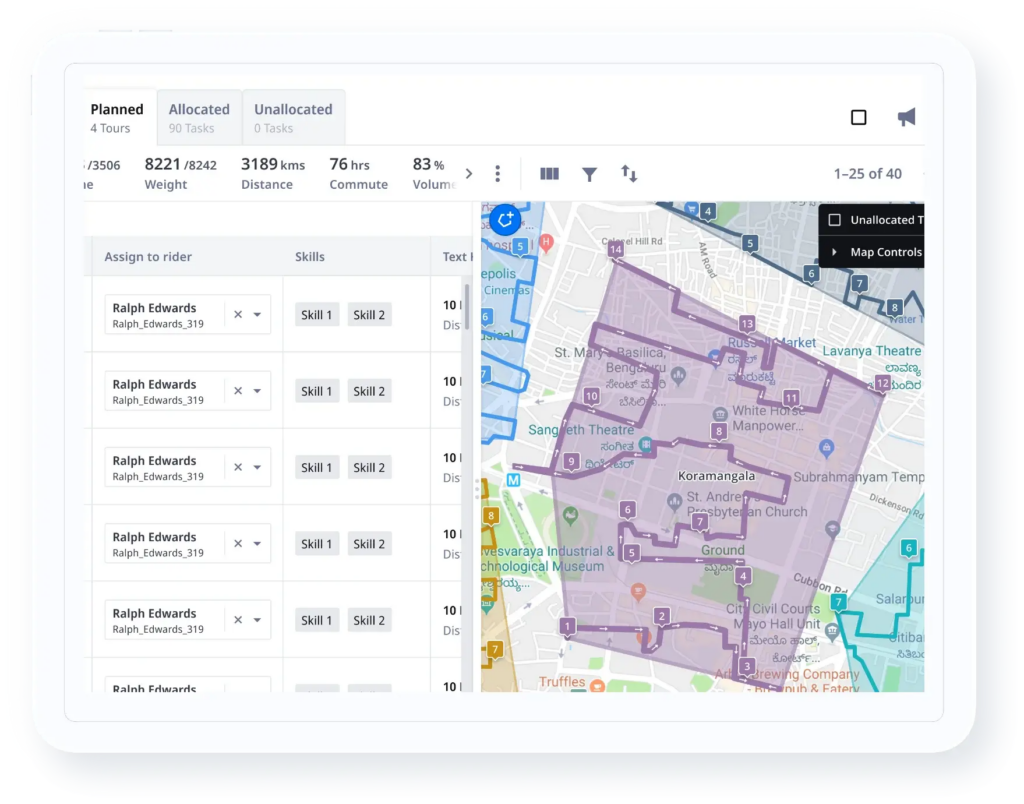
Evaluation criteria for this stage:
- Does the platform manage mixed fleets under one assignment layer?
- Can routes be re-optimized during the day when conditions change?
- Does it include a driver app for navigation, task updates, and exception reporting?
Locus delivers AI-powered dispatch management and route planning as core modules within its logistics orchestration platform, helping enterprises automate job assignment, optimize multi-stop routes, and adapt plans in real time.
Carrier management
Managing a mixed carrier network manually is one of the most operationally heavy parts of last-mile execution.
Carrier management automation includes rule-based carrier selection, capacity allocation, performance tracking, and manifest generation. Poor carrier logic damages performance in two directions at once: you overpay for low-priority shipments, and you miss SLAs when underperforming carriers are not adjusted quickly enough.
Enterprise shippers often manage a wide mix of owned fleets, contracted partners, and on-demand providers. The real question is whether your software can enforce carrier rules at scale without requiring manual review for every order.
Evaluation criteria for this stage:
- Does the platform support owned, contracted, and on-demand carrier types?
- Can selection rules be configured by geography, weight, or service level?
- Does it connect to carrier APIs for timely status updates?
Customer experience and proof of delivery
Proof of delivery is the event that closes the data loop.
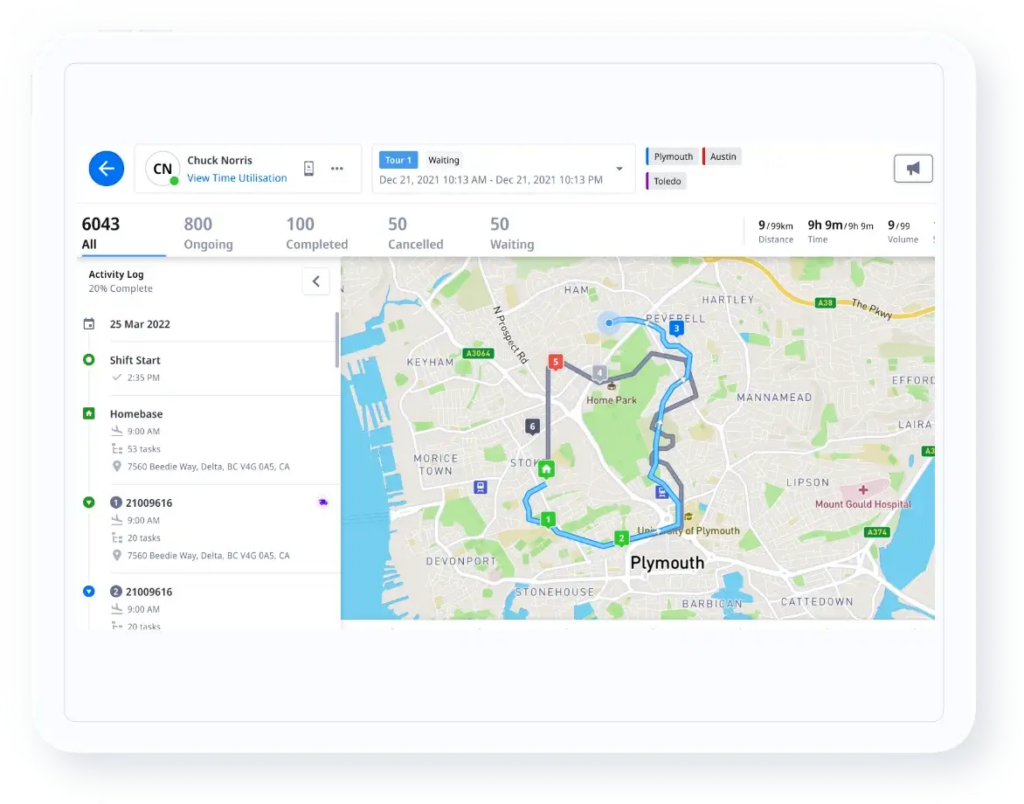
Without accurate, timely POD capture, your team cannot verify SLA performance, resolve disputes efficiently, or feed delivery outcomes back into future planning. Customer-facing automation at this stage includes ETA updates, proactive notifications, contactless POD capture, and workflows for failed deliveries or reattempts.
This stage matters commercially. A missed delivery with poor communication and no easy recovery path is often a churn event.
Evaluation criteria for this stage:
- Does the platform support multiple POD methods, such as photo, signature, or OTP?
- Does it push status updates to customer-facing channels in real time?
- Can failed deliveries trigger automated reattempt workflows?
The Buyer’s Rubric: Coverage, ROI, and Implementation
When your shortlist narrows to a few vendors, the decision rarely comes down to one feature. It comes down to whether the platform fits your workflow, your economics, and your operating environment.
Without a structured rubric, teams often buy based on demo polish instead of operational fit. The three dimensions that matter most are:
- Workflow coverage: How much of the order-to-POD lifecycle the platform supports
- ROI and total cost of ownership: What the investment costs over time
- Implementation and time-to-value: How quickly the platform can create usable operational value
Use these as a scoring grid for any vendor you compare.
Scoring workflow coverage
Start with the most basic question: how many of the five order-to-POD stages does the platform cover natively, and where does a third-party integration begin?
Use a checklist like this:
- Does it support order allocation with live operational data?
- Does it cover hub workflows and sortation-related exceptions?
- Does it provide connected dispatch management and route optimization?
- Does it support carrier rules and network-level visibility?
- Does it capture POD events and feed them into reporting or analytics?
The scoring logic is simple: a platform that covers all five stages should rank above one that covers only two or three, even if one isolated feature looks strong.
You also need to separate native coverage from integrated coverage. Native means the capability sits inside the platform’s shared data model. Integrated means it depends on another system or point solution, which introduces another handoff, another maintenance requirement, and another risk point.
Watch for coverage theatre: long feature lists that look end-to-end on paper but do not operate as a connected workflow in practice.
Evaluating ROI and total cost of ownership
The number your CFO will care about is not the license fee. It is total cost of ownership over the life of the contract.
Four cost drivers shape that picture:
- License or subscription fees
- Integration costs across OMS, WMS, TMS, and carrier systems
- Ongoing maintenance for changes, support, and vendor management
- Opportunity cost of capability gaps, including manual workarounds and SLA leakage
This is where fragmented bot stacks often become more expensive than they first appear. Every new point tool adds its own integration and maintenance overhead. Over time, the cost of keeping several isolated tools working together can rival or exceed the value of the software itself.
Model ROI against your own operating targets, not generic promises. Focus on metrics such as delivery cost per order, SLA adherence, and time to resolve failed deliveries. Then tie those goals back to the specific stages where the software will act.
A strong vendor should be able to support ROI modeling. But you should validate that model against your own operational baseline before treating it as a business case.
Assessing implementation and time-to-value
Even a strong platform produces no value if implementation stalls or if your team cannot adapt the system to real operating conditions.
Assess implementation across four dimensions:
- Onboarding speed: How quickly the platform can integrate and launch in a core market
- Configurability: Whether business rules can be changed without engineering effort
- Regional scalability: Whether one platform can support NA, EU, SEA, and India without separate rebuilds
- Change management: Whether the vendor provides training, milestones, and structured rollout support
Implementation timelines vary widely based on system complexity, data readiness, and internal change capacity. That is why pragmatic, phased automation approaches tend to be more defensible than full-network big-bang rollouts.
Ask every shortlisted vendor for reference customers with comparable complexity, and probe the gap between promised and actual go-live timelines.
Modular Platform vs. Single-Point Bots: How to Decide
Once you score your shortlist against coverage, ROI, and implementation, the architecture choice usually becomes clear. A modular orchestration platform is generally the better fit when:
- Your operation spans three or more order-to-POD stages
- You work across multiple regions or carrier networks
- You have already experienced data silos or integration debt from point tools
- Your finance team wants a consolidated TCO view
A point solution may still be the better near-term choice when:
- Your need is truly limited to a single stage
- Your existing stack already covers most adjacent stages reliably
- Your team does not have the bandwidth for a broader platform transition right now
The logic is structural. A modular platform shares context across the workflow. Route data informs dispatch. Dispatch affects carrier choice. Delivery outcomes feed back into future planning. Replicating that with isolated bots means building custom handoffs between each step.
That matters because enterprises increasingly want automation to break down silos, not reinforce them. And the closer your operation gets to multi-stage, multi-region complexity, the less sustainable a disconnected tool stack becomes.
If your scoring exercise reveals broad workflow coverage needs, recurring integration pain, and a demand for consolidated operational visibility, a modular orchestration platform is the more defensible decision.
How Locus Fits the End-to-End Model
Locus is an AI-powered logistics orchestration platform built for enterprises that need connected order-to-POD automation rather than isolated workflow tools.
At the stage where many enterprises feel the most immediate pressure, Locus provides AI-powered dispatch management and route planning. That includes automated job assignment, multi-stop route optimization, and real-time adaptation as conditions change.
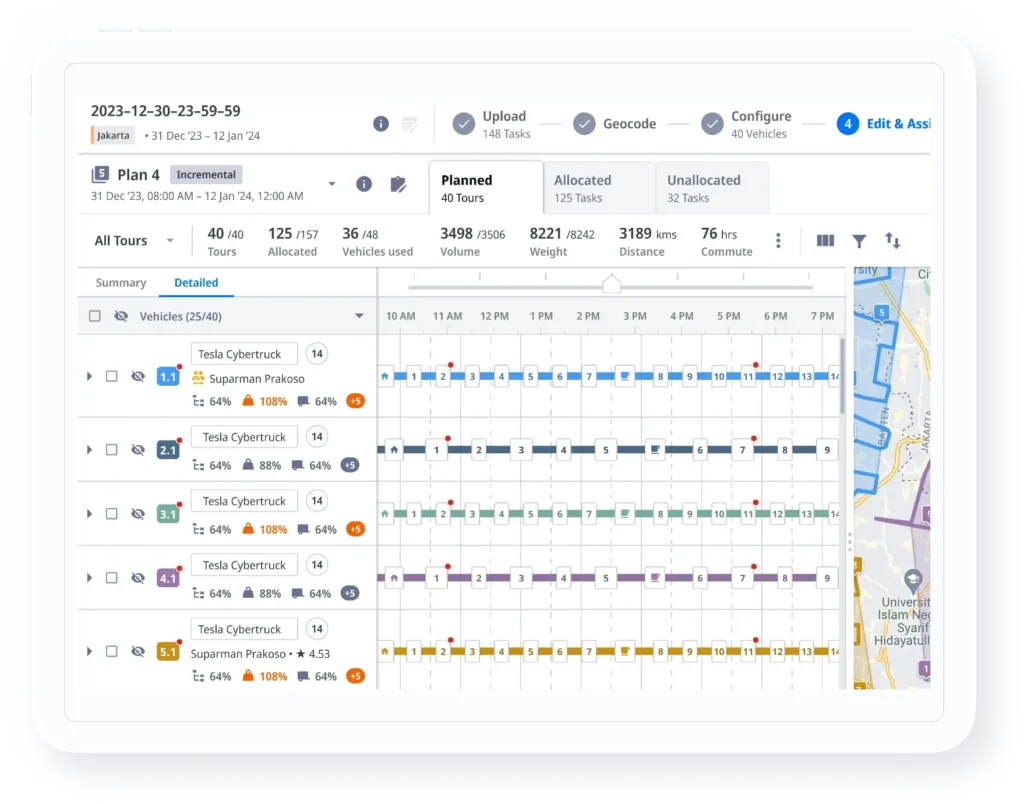
Beyond dispatch, Locus provides a unified real-time visibility layer within its Decision-Aware, Intelligent Agentic TMS, helping teams bring order status, fleet movement, carrier performance, and delivery outcomes into one operational view. That connected visibility is critical when your teams need to make decisions across multiple markets, carriers, and SLA tiers.
Locus is designed for enterprise operations across NA, EU, SEA, and India, with configurable business rules that support different operating models and service requirements across regions.
If your evaluation has surfaced multi-stage workflow needs, fragmented-tool fatigue, or pressure to improve TCO visibility, Locus aligns closely with the end-to-end model described in this guide.
Making the Right Call
Choosing logistics automation software is fundamentally a workflow decision.
If your operation spans multiple order-to-POD stages, runs across regions or carrier networks, and already feels the cost of disconnected tools, the evidence points toward a modular orchestration platform. If your need is narrow and unlikely to expand soon, a point solution can still be a pragmatic choice, as long as you model the integration burden honestly before buying.
What changes with a platform approach is the quality of the data available at every decision point. When allocation, dispatch, carrier activity, and delivery outcomes are connected, each stage works from better context and produces better downstream decisions.
Locus is built around that principle. Its AI-powered logistics orchestration platform connects the order-to-POD lifecycle through dispatch management, route planning, and a unified real-time visibility layer within Locus’s agentic TMS. For enterprise teams operating across NA, EU, SEA, and India, that architecture supports the shift from isolated automation wins to a more connected logistics operation.
Schedule a demo with Locus today.
Frequently Asked Questions (FAQs)
What is logistics automation software?
Logistics automation software helps replace manual decisions across one or more parts of fulfillment and delivery. It can cover order allocation, hub workflows, dispatch and route planning, carrier management, and proof-of-delivery capture. When those capabilities operate as one connected workflow, the software functions as an end-to-end orchestration platform.
What is the difference between a logistics automation platform and a point solution?
A logistics automation platform connects multiple order-to-POD stages within one operating model, so data from one stage can inform the next. A point solution automates a single stage in isolation. Using several point solutions together usually requires more integrations, more maintenance, and more handoff management.
How do I calculate ROI for logistics automation software?
Start with your own target outcomes: delivery cost per order, SLA adherence, and resolution time for failed deliveries. Map each target to the stages where automation will improve decisions or reduce manual work. Then include license cost, integration cost, maintenance effort, and the cost of any capability gaps in your TCO model.
How long does logistics automation software implementation take?
Implementation time depends on integration complexity, data readiness, and your organization’s change capacity. A platform with multiple system dependencies will usually take longer than a single-stage tool, but it may create more durable value if it reduces fragmentation. Ask shortlisted vendors for references with similar scale and operating complexity.
How does Locus support end-to-end logistics automation?
Locus is an AI-powered logistics orchestration platform that supports the order-to-POD lifecycle through connected capabilities. Its core offering includes automated dispatch management, multi-stop route planning with real-time re-optimization, and a unified real-time visibility layer within its agentic TMS. The platform is designed for enterprise operations across NA, EU, SEA, and India.
What types of logistics operations is Locus suited for?
Locus is suited for enterprise logistics operations that need to coordinate dispatch management, route planning, and delivery visibility within a connected orchestration environment. It is particularly relevant when teams are managing operational complexity across fleets, delivery volumes, or service requirements.
Can companies adopt Locus without replacing their entire logistics technology stack at once?
Locus follows a modular platform approach, allowing enterprises to evaluate and adopt capabilities such as dispatch management, route planning, and logistics visibility based on their immediate operational priorities. Buyers should confirm rollout requirements and system dependencies during the evaluation process.
How does Locus improve visibility across logistics operations?
Locus provides a unified real-time visibility layer within Locus’s agentic TMS. This gives logistics teams a connected operational view that can support faster monitoring and decision-making across delivery workflows.
Is Locus suitable for enterprises replacing multiple point solutions?
Locus can be considered by enterprises looking to reduce reliance on disconnected tools for dispatch management, route planning, and logistics visibility. Its modular orchestration approach can help teams move toward a more connected technology environment instead of adding another isolated point solution.


General
The Returns Experience: Why Reverse Logistics Is the Other Half of Delivery Experience in North America

Jul 22, 2026
In North America, the returns experience is the other half of delivery experience, and it usually lags. Why the reverse leg fails, and how to optimize it.
Read more
Logistics Automation & Orchestration
How Multi-Carrier Orchestration Software Works

Jul 23, 2026
See how multi-carrier orchestration software runs tendering, SLA/price matching, and reconciliation as one automated loop, and which workflows to automate before peak.
Read moreInsights Worth Your Time




















How to Choose Logistics Automation Software