


Logistics Automation & Orchestration
How Multi-Carrier Orchestration Software Works
Key Takeaways
- Multi-carrier logistics operations become difficult to scale when carrier selection, dispatch, tracking, and reconciliation depend on separate systems, spreadsheets, and manual handoffs.
- Multi-carrier orchestration connects tendering, carrier matching, dispatch, delivery tracking, and reconciliation as one continuous loop, allowing delivery outcomes to inform future carrier decisions.
- Effective carrier selection evaluates price, SLA fit, and available capacity together rather than choosing the lowest-cost carrier without considering delivery commitments or operational constraints.
- Captive fleets offer greater control for predictable delivery networks, contracted carriers provide flexible capacity and wider coverage, and hybrid models help enterprises balance both approaches through connected decision-making.
- Locus supports a connected logistics orchestration model through AI-powered dispatch management, route planning, and a unified real-time visibility layer within Locus’s agentic TMS.
Multi-carrier logistics networks generate friction at every handoff. A warehouse dispatches an order, a hub coordinator picks a carrier by phone, a dispatcher builds a route in a spreadsheet, and a finance team reconciles invoices against rate cards weeks later. Each step is manual and introduces cost, delay, and reconciliation risk.
Multi-carrier orchestration software replaces that chain of handoffs with a single automated loop: tendering goes out to the carrier pool automatically, selection is made in real time against price, SLA, and capacity signals, dispatch plans execute across owned and contracted fleets, and delivery data feeds back into reconciliation without any manual re-entry. The loop runs continuously, not sequentially.
This article maps how multi-carrier operations work mechanically, which handoffs it eliminates, how to choose the right fleet mix for a given operation, and which workflows to automate before peak season.
But first, we need to understand why the operations break at scale.
Where Manual Carrier Handoffs Break the Delivery Workflow
Most enterprise carrier networks grow gradually: a captive fleet for urban deliveries, a regional 3PL for overflow, a national courier for express lanes, and an on-demand partner for same-day orders.
The problem is that each carrier often brings its own portal, rate card, tracking process, and invoice format. Your teams then have to connect the network manually.
Where the handoffs break
- At the warehouse: Orders are allocated using experience or static rules rather than live carrier capacity, increasing the risk of poor assignments.
- At the hub: Carrier confirmations happen through calls or emails. If a pickup is cancelled, reassignment is slow and manual.
- At dispatch: Routes are planned separately for each carrier, leaving teams without one view of vehicles, routes, and delivery windows.
- At the doorstep: POD formats vary across carriers. Some use digital ePOD, others use paper. When a delivery dispute arises, records are scattered across systems
Why peak season makes it worse
At normal volumes, teams may absorb this friction. During peak, every weakness compounds.
Fragmented carrier management can lead to:
- Higher carrier costs when rates and capacity cannot be compared in real time.
- OTIF gaps when dispatch decisions rely on stale data.
- Reconciliation backlogs when invoice volumes exceed manual review capacity.
Multi-carrier orchestration replaces these disconnected handoffs with one continuous flow across carrier selection, dispatch, tracking, POD, and reconciliation.
How the Automated Carrier Orchestration Loop Works
The core architecture of multi-carrier orchestration software is a closed loop. Tendering, selection, dispatch, tracking, proof of delivery, and reconciliation all connect back to each other. Data from one step improves decisions at the next.
The five steps below describe how that loop works in practice.
Step 1: Multi-carrier tendering
Tendering is the process of broadcasting an order, or a batch of orders, to the carrier pool and receiving responses. In a manual environment, this means phone calls, emails, or portal logins to check availability and rates for each carrier individually.
In an orchestrated system, tendering is rule-based and automatic. When an order is confirmed, the system evaluates which carriers are eligible based on service area, vehicle type, delivery window, and any contract-defined priority rules.
Eligible carriers receive the tender simultaneously. The system waits for responses within a defined acceptance window, and if no response comes, it falls through to the next tier automatically.
Tendering speed is a direct constraint on dispatch speed. Manual tendering introduces delays at every peak hour when carriers are most in demand. Automated tendering removes the coordinator as a bottleneck and ensures every eligible carrier in the pool is evaluated for every shipment.
Step 2: Real-time carrier selection on price + SLA + capacity
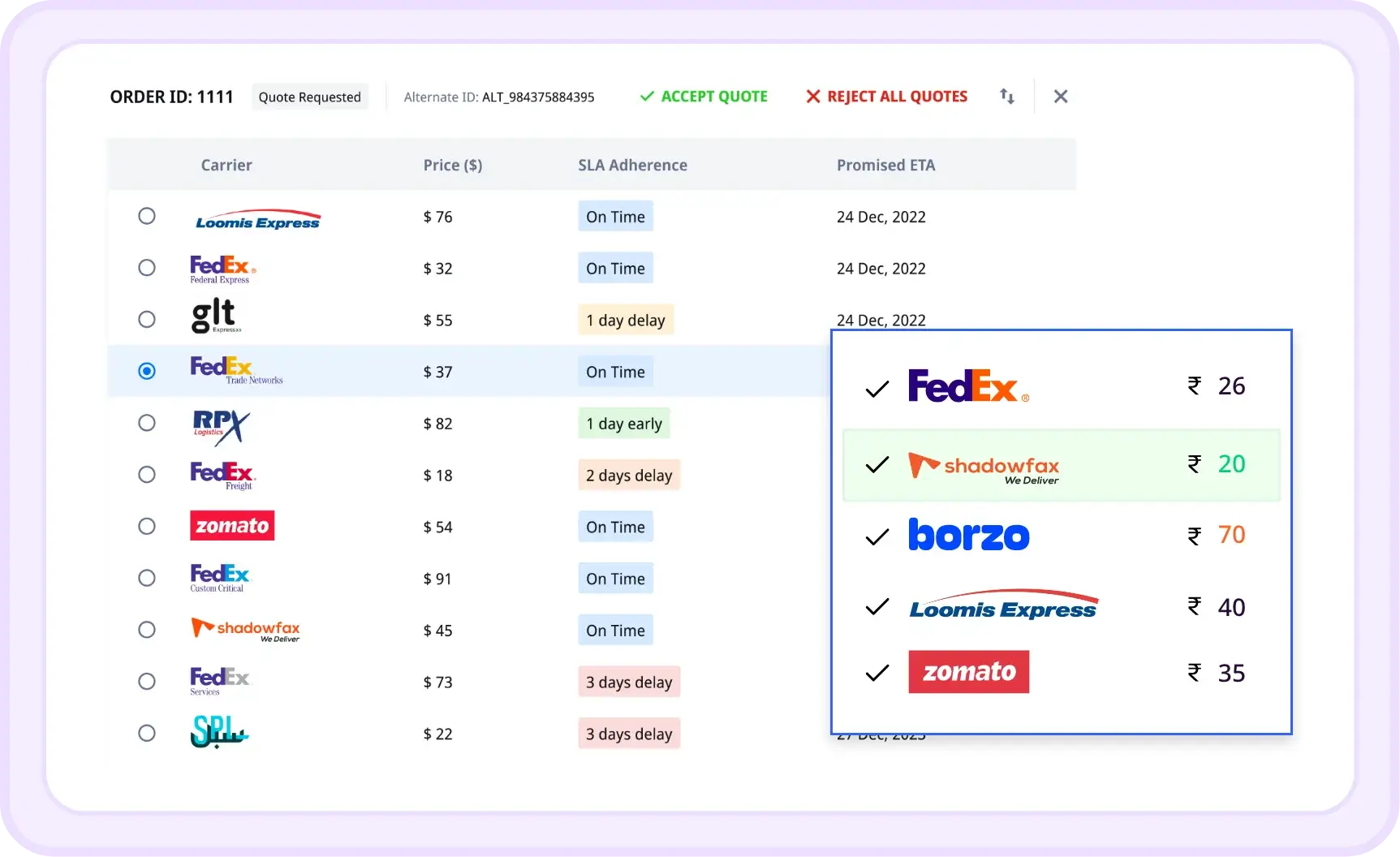
Once tenders return, the system selects the optimal carrier for each shipment. Three inputs drive that decision:
- Price: The cost of fulfilling the shipment via each carrier, drawn from live rate cards and contract terms, not yesterday’s spreadsheet
- SLA fit: Whether the carrier’s available service window matches the delivery commitment already made to the customer. A carrier offering a 48-hour service on a same-day shipment is not a fit regardless of price
- Capacity: Whether the carrier has actual available vehicle capacity at the time of dispatch
In Locus’s orchestration logic, DispatchIQ and the Fireworks Routing Engine process these inputs together across 250+ real-world constraints, including vehicle type, payload limits, driver availability, traffic conditions, and delivery window requirements. The result is a carrier assignment that factors all three dimensions simultaneously.
The practical difference from manual selection is not just speed. A dispatcher comparing three carriers on a spreadsheet misses the interaction effects: a carrier that looks cheapest may breach the SLA, and the cost of a missed delivery window often exceeds the rate difference. An orchestration engine evaluates those trade-offs across every shipment at once.
Step 3: Allocation, route plan, and carrier handoff
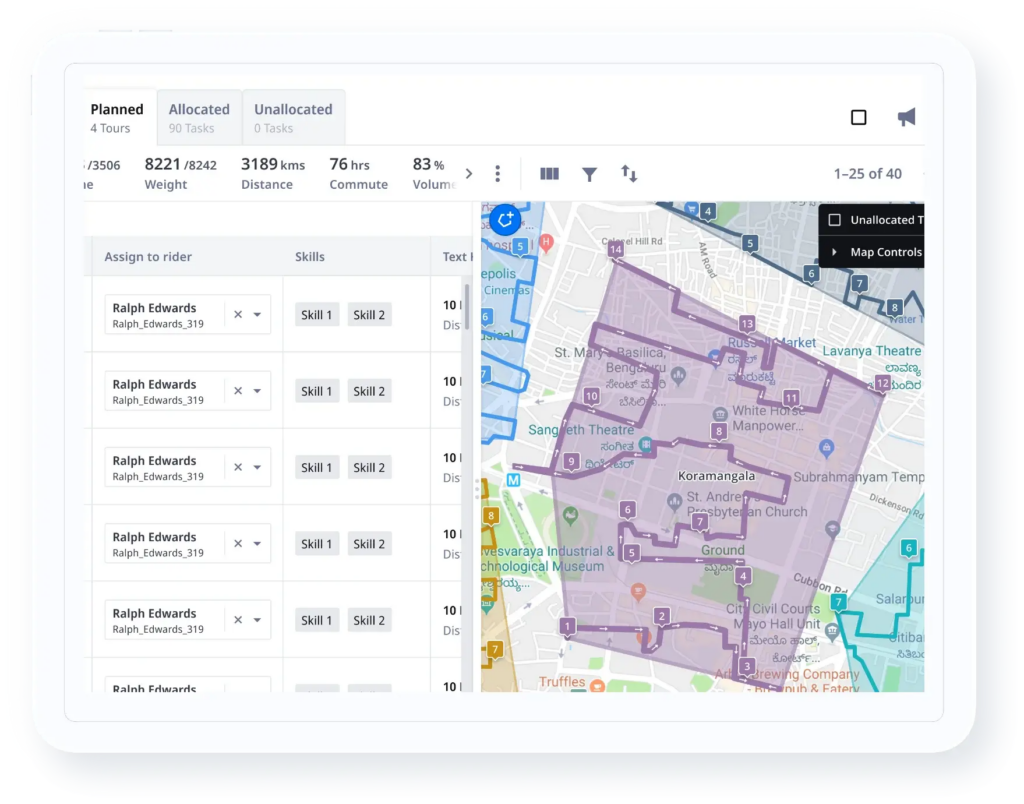
With carrier selection confirmed, the system moves to allocation and routing. In a fragmented environment, these are separate steps run by separate teams. In an orchestrated system, they run as one.
Allocation assigns orders to specific vehicles within the selected carrier’s fleet, grouping by geography, delivery density, and vehicle capacity. The Fireworks Routing Engine then builds the route plan across all assigned stops, sequencing them against time windows, traffic conditions, road restrictions, and driver shift hours.
Locus’s automated route planning handles this across 250+ constraints in under five minutes at enterprise order volumes. The route plan transmits directly to the carrier’s driver via the Driver Companion App, eliminating the manual dispatch call or PDF route sheet. The carrier handoff is therefore an output of the planning process, completing automatically when the route plan is transmitted.
Step 4: Tracking, POD, and CX
Once drivers are on the road, a unified real-time visibility layer within Locus’s agentic TMS aggregates status signals across all carriers and all routes into a single view. These are not GPS coordinates displayed on a map.
The system generates ETAs based on actual route progress, traffic conditions, and driver performance history, and flags exceptions before SLA windows are breached. Customer notifications go out automatically as delivery milestones are hit, via SMS, email, and WhatsApp, which cuts WISMO calls for retail operations without requiring a customer service team to chase status from each carrier manually.
At delivery, the Driver Companion App captures electronic proof of delivery, including photo, signature, and barcode, with AI validation. The ePOD data is timestamped, geotagged, and immediately available in the platform. This is what makes reconciliation automated.
Step 5: Reconciliation as a closed loop
Freight reconciliation is where fragmented carrier networks generate the most hidden cost. Each carrier issues invoices in its own format.
Rate cards have zone-based exceptions, accessorial charges, and minimum volume commitments that do not always appear on the invoice surface. Manual reconciliation means a finance analyst comparing each line item against the contract, identifying disputes, and negotiating credits. At peak volume, that backlog can run weeks.
In an orchestrated system, reconciliation is automated because the data is already there. Every delivery has a confirmed carrier assignment, a validated ePOD, a timestamped delivery event, and a pre-calculated rate based on the contract terms applied at selection. When the carrier invoice arrives, the system matches it against the expected charge automatically. Disputes are flagged for review.
The closed loop aspect distinguishes orchestration from basic automation. The reconciliation data, actual cost per shipment, carrier performance against SLA, exception rates by lane, feeds back into the tendering rules.
A carrier with a consistent pattern of missed windows gets de-prioritized in future selections. A carrier performing above benchmark earns higher allocation. The system adjusts without manual rule updates.
How Multi-Carrier Orchestration Supports Captive, Contracted, and Hybrid Fleets
Fleet mix decisions are among the most consequential in enterprise logistics, and the right answer depends on specific cost, control, and capacity trade-offs. Here is how to think about each model:
Captive fleets
These are vehicles and drivers owned or exclusively leased by the enterprise. The advantages are cost predictability for known routes, direct quality control over driver behavior, and no carrier margin added to the per-delivery cost.
The constraints are fixed capacity that cannot scale for peak, high fixed costs when vehicles run below utilization, and the operational overhead of fleet maintenance, driver HR, and compliance. Captive fleets work best when delivery density is high enough to keep vehicles full, geography is stable, and the volume profile is predictable.
Contracted carriers
They are 3PL partners operating under rate and service agreements. The advantages are scalable capacity, geographic coverage beyond the owned fleet’s range, and no fixed asset costs.
The constraints are carrier-controlled service quality, rate volatility at peak, and the reconciliation complexity that comes with multiple contracts. Contracted carriers work best when volume is variable or seasonal and geographic coverage requirements extend beyond owned fleet economics.
Hybrid fleets
They combine owned assets and contracted partners, with an orchestration layer deciding which shipment goes to which fleet in real time.
The hybrid model captures the cost advantages of captive fleets for predictable, dense routes while using contracted capacity for overflow, express lanes, and geographic coverage gaps. The model requires orchestration software to function.
Without a unified system evaluating both fleet types simultaneously against price, SLA, and capacity, the hybrid becomes a manual coordination problem that erases the gains it was supposed to deliver.
ShipFlex, Locus’s multi-carrier management module, allocates across 160+ active carriers from a broader network of 1,000+ pre-integrated partners, alongside captive fleet vehicles, using the same rule set.
Both fleet types appear in the same planning layer, and the system selects based on the same three inputs: price, SLA, and capacity.
| Fleet Type | Best for | Peak behavior | Key constraint |
|---|---|---|---|
| Captive | Dense, predictable urban routes | Volume ceiling reached fast | Fixed capacity; high fixed cost |
| Contracted | Variable, wide-geography, seasonal demand | Scalable if capacity reserved early | Rate risk; service quality variance |
| Hybrid | Multi-zone, variable-density networks | Scales with orchestration layer | Requires unified orchestration system |
8 Retail Logistics Workflows to Automate Before Peak
Peak season compresses timelines and removes the slack that absorbs manual process delays at normal volume. The eight workflows below are the most impactful automation targets for retail logistics teams preparing for peak.

1. Delivery slotting
Manual slotting assigns delivery windows to orders based on carrier availability, producing uneven workload distribution across time slots and vehicles.
DispatchIQ automates this at the time of order placement, assigning windows against actual carrier capacity, geographic density, and service commitments. The result is evenly distributed load across the carrier pool before peak volume even begins.
2. Order allocation
Deciding which order goes to which fulfillment node, then which carrier serves that node, is a sequential manual process in most operations.
DispatchIQ evaluates all relevant constraints simultaneously, including inventory position, carrier eligibility, cost targets, and delivery window requirements, with pre-configurable rules for assignment, re-attempts, and exceptions.
3. Dispatch planning
Building dispatch plans manually for multiple carriers and fleet types takes hours each morning. By the time drivers depart, the plan reflects order data that may be hours old.
DispatchIQ paired with the Fireworks Routing Engine produces fleet-wide plans in under five minutes at enterprise volumes, built against live data available at departure time.
4. Route optimization
Static routes built the previous day against projected conditions are often obsolete by morning.
Route optimization built on live data accounts for current traffic, order volumes, and vehicle availability. The Fireworks Routing Engine handles 250+ constraints and re-optimizes continuously as conditions change mid-delivery.
5. Carrier handoff
Transmitting dispatch plans to carriers via phone or PDF creates a gap between planning and execution. When changes happen after the PDF is sent, the carrier often does not know.
The Driver Companion App receives route plans directly from DispatchIQ the moment dispatch is confirmed, and any mid-route updates transmit in real time.
6. Exception management
At peak, exceptions multiply: failed deliveries, vehicle breakdowns, late carrier pickups. Each one requires manual intervention in fragmented systems. DispatchIQ flags issues before SLA windows close and triggers reassignment automatically, without a dispatcher handling each event individually.
Also read: Delivery Exceptions – What They Are & How to Manage Them
7. Returns processing
Peak season generates elevated return volumes that most logistics teams process manually: a customer initiates a return, a coordinator books a carrier, a driver is assigned separately from the forward delivery network.
Locus’s returns orchestration captures return requests, assigns carriers, and updates inventory within the same dispatch and carrier management workflow, with no separate manual loop.
8. Customer notifications
Manual customer communication does not scale to peak volume.
The Customer Agent within Locus’s agentic TMS sends real-time updates via SMS, email, and WhatsApp tied to ePOD capture and delivery milestones, giving customers accurate status without consuming service team capacity.
How Locus Runs Multi-Carrier Orchestration as One System
Locus is the world’s first Decision-Intelligent, Agentic TMS, designed to run multi-carrier orchestration across all-mile logistics as a single closed-loop system. The platform connects tendering, dispatch, route planning, tracking, and reconciliation without requiring manual handoffs between each step.
DispatchIQ manages carrier-order matching across multiple fulfillment nodes, factoring cost, SLA, capacity, and real-time availability simultaneously. The Fireworks Routing Engine handles route planning across 250+ real-world constraints, producing fleet-wide plans in minutes at enterprise volumes.
ShipFlex coordinates carrier management across 160+ active carriers from a broader network of 1,000+ pre-integrated partners, with rule-based assignment by cost, delivery speed, and SLA commitments.
Mycroft AI Co-Pilot, Locus’s natural-language dispatcher interface, surfaces risk signals and coordinates actions across the platform’s eight specialized AI agents: Capacity, Dispatch, Carrier, Hub, Customer, Settlement, Copilot, and Orchestrator. Together, they automate the decisions that manual dispatcher workflows typically handle across multiple systems and multiple people.
A unified real-time visibility layer within Locus’s TMS aggregates shipment status across owned fleet and contracted carriers into a single operational view, generating exception alerts before SLA windows are breached and customer notifications without manual intervention.
Gartner has included Locus in its supply chain execution and last-mile delivery technology research for seven consecutive years, a span that covers multiple market cycles and platform generations.
In October 2025, Ingka Investments, the investment arm of Ingka Group, acquired Locus, adding long-term institutional backing to a platform already operating across 360+ enterprise customers in 30+ countries. Locus continues to operate independently.
Build the Loop Before Peak Hits
Multi-carrier orchestration software removes the manual processes that turn normal logistics friction into peak-season failures. Tendering that goes out automatically, carrier selection that weighs price against SLA in real time, dispatch plans that transmit directly to drivers, and reconciliation that closes against delivery data: these changes need to be running before volume arrives.
The eight workflows covered in this article map directly to the manual steps that cost enterprise logistics teams the most at peak. Automating them means entering the season with a system that absorbs volume, not a team that absorbs pressure.
Schedule a demo with Locus today to see how multi-carrier orchestration runs as one system across your carrier network.
Frequently Asked Questions (FAQs)
Which industries and regions does Locus support for multi-carrier orchestration?
Locus supports retail, e-commerce, FMCG, CPG, 3PL, and manufacturing operations across 30+ countries in the Americas, Southeast Asia, Europe, the Middle East, and the Indian subcontinent. Its dispatch management capabilities handle both owned fleet and contracted carrier networks within the same platform.
Does Locus work with both captive and contracted carriers in one system?
Yes, DispatchIQ and ShipFlex manage both fleet types within a single orchestration layer. Captive vehicles and contracted 3PL carriers appear in the same planning environment, with carrier selection applied uniformly based on price, SLA, and capacity inputs. Operations can define priority rules for when a captive fleet is preferred over a contracted carrier and vice versa, without managing two separate systems.
How does Locus’s agentic TMS support real-time visibility across carriers?
A unified real-time visibility layer within Locus’s agentic TMS aggregates delivery status across all carriers and fleet types into a single operational view. The system generates ETAs from live route progress and traffic data, sends automated exception alerts before SLA windows are breached, and delivers customer notifications without manual intervention. ePOD data captured through the Driver Companion App is immediately available for reconciliation.


Logistics Automation & Orchestration
How to Choose Logistics Automation Software

Jul 23, 2026
Learn how to choose logistics automation software with an end-to-end order-to-POD rubric covering coverage, ROI, and implementation for enterprises.
Read more
Real-time Tracking & Visibility
FourKites Pricing Guide 2026: Visibility Platform Plans, Integration Fees, and Enterprise TCO
Jul 23, 2026
This 2026 guide explains FourKites pricing, focusing on its quote-based model, cost drivers, and TCO so you can benchmark a quote with confidence.
Read moreInsights Worth Your Time




















How Multi-Carrier Orchestration Software Works