


Real-time Tracking & Visibility
FourKites Pricing Guide 2026: Visibility Platform Plans, Integration Fees, and Enterprise TCO
Key Takeaways
- FourKites operates on a custom-quote model with no published pricing tiers, confirmed directly on its own site as of 2026, so this guide gives buyers a framework for reading a quote
- SelectHub’s 2026 analysis is the only publicly cited estimate, placing starting costs in the $100 to $500 per user range. No credible source confirms a specific enterprise contract figure, so treat any larger number you see elsewhere with caution
- Integration fees, ERP and TMS mapping, custom dashboards, carrier onboarding, are frequently the largest gap between the quoted subscription and actual Year 1 spend
- Enterprise SaaS renewal increases are running well above general inflation industry-wide in 2026, so a renewal escalator clause deserves the same scrutiny as the initial quote
- Enterprises are increasingly weighing whether standalone visibility is the right architecture at all, given the integration overhead of running it alongside separate TMS, dispatch, and route optimization tools
Enterprise supply chain leaders researching FourKites pricing will find no public price list, no published tiers, and no free trial. There is a request-a-demo button and little else.
This guide exists to close that gap. It is a research-led framework for understanding how FourKites pricing works, what typically drives the final contract number, and how to estimate total cost of ownership before entering a sales process.
Every cost figure cited in this guide is dated and attributed to its source, so you can tell what FourKites itself confirms apart from what a third-party analyst has published.
Why FourKites Doesn’t Publish Pricing, and What That Means for Buyers
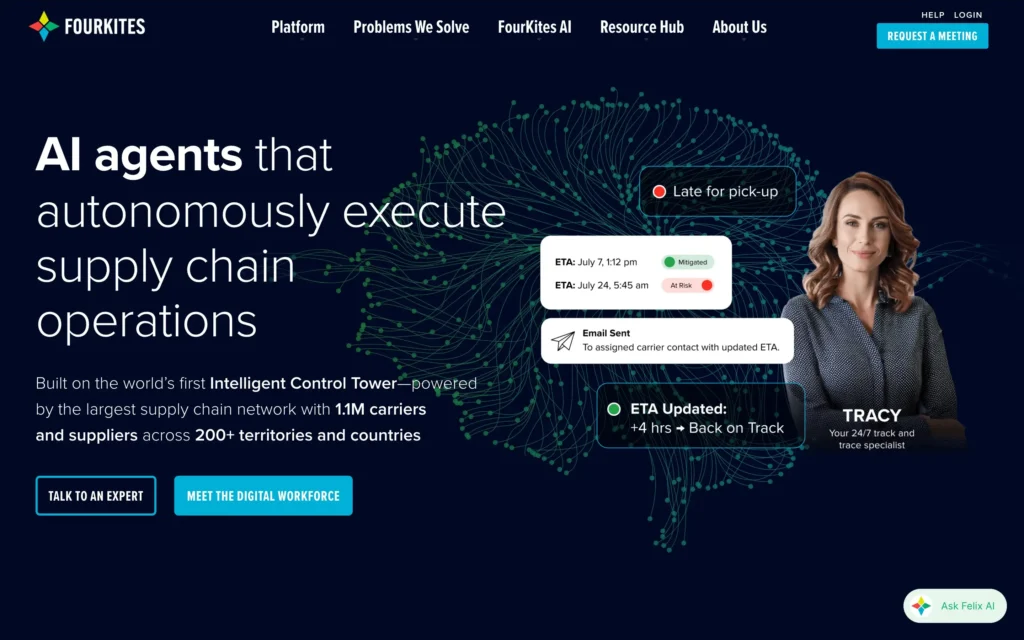
FourKites’ own website carries no pricing page, no tiers, and no self-serve checkout. That is worth stating plainly before anything else in this guide, because it sets the correct expectation for the research ahead.
What the record shows
A 2026 pricing summary from SpotSaaS, sourced directly from FourKites’ official website, confirms the starting price is not disclosed and that all plans are quotation-based.
Independent listings on Capterra, TrustRadius, and Spendflo, each updated for 2026, repeat the same finding: pricing details are not publicly available, and customers are directed to contact sales. That consistency across multiple independent listings confirms the absence of public pricing is a deliberate FourKites go-to-market choice.
Why the range is so wide
Enterprise last-mile visibility software pricing is sensitive to shipment volume, geographic scope, the modules selected, and the number of connected trading partners.
Two companies of similar revenue can receive quotes that differ substantially, because one ships primarily domestic truckload while the other runs multimodal freight across dozens of countries with hundreds of carrier connections. The rest of this guide works through those variables so a buyer can read a quote with more context.
FourKites Platform Overview: What You Are Buying
Before the cost components make sense, it helps to know what sits inside a typical enterprise contract.
Core platform scope
FourKites is a real-time transportation visibility platform supporting multimodal freight: truckload, LTL, intermodal, ocean, and parcel.
The core pillars an enterprise agreement typically includes are real-time shipment tracking, predictive ETAs, exception management, including a capability FourKites calls Autonomous Resolution, which the company states resolves 85% of shipment exceptions without human intervention, dynamic yard and facility management, and analytics and reporting.
The scale behind the platform
| Metric | Figure (FourKites-reported) |
|---|---|
| Connected carriers and suppliers | 1.1 million, across 200-plus territories and countries |
| Daily shipments tracked | Over 3.2 million |
| Pre-connected businesses via single integration | 1,600+ |
Module selection drives contract value. A base visibility subscription costs differently from one that adds yard management, advanced analytics, or the Autonomous Resolution layer. Each additional module is a lever a sales conversation will eventually pull.
How FourKites Pricing Is Structured: The Quote-Based Model Explained
Enterprise visibility software pricing stacks four variables into a custom number. These are the four levers behind a quote:
| Lever | What it determines |
|---|---|
| Shipment volume | Annual or monthly tracked shipment count, the most common billing unit |
| Connected trading partners | The number of carriers, suppliers, and 3PLs integrated into the platform |
| Modules and product tier | Base visibility versus advanced analytics, yard management, dynamic alerts, or the Autonomous Resolution layer |
| Deployment scope | Number of facilities, geographies, and business units covered |
A FourKites custom quote is the output of these four inputs stacked together. The one quantified public estimate available comes from SelectHub’s 2026 analysis, which places starting costs at $100 to $500 per user monthly. No credible, dated source confirms a specific figure for full enterprise, multimodal deployments, so treat any precise number beyond that range that you encounter elsewhere as unverified until a FourKites sales conversation confirms it directly.
Integration Fees: A Cost Layer Most Buyers Underestimate
The gap between a quoted subscription price and actual Year 1 spend is usually explained by three integration cost categories.
EDI and API carrier onboarding
FourKites states that carrier integration carries no direct cost to the carriers themselves, but enterprise IT teams still incur internal or systems-integrator costs to configure, test, and maintain those connections at scale.
A carrier network in the hundreds is a meaningfully different onboarding effort than a network in the dozens.
ERP and TMS integration
Mapping FourKites data into SAP, Oracle, or Blue Yonder environments requires real technical effort, and often a third-party systems integrator. This is where the maturity of an enterprise’s existing transportation management system shapes the integration lift: a modern, API-first TMS layer connects faster than a legacy one with limited connector support.
Custom dashboards and data migration
Out-of-the-box dashboards may not meet enterprise KPI requirements, which can trigger professional services fees to build custom reporting.
Enterprises switching from an incumbent visibility provider add a further cost category: historical data migration and ingestion, which is rarely trivial at multi-year, multi-carrier scale.
What to ask before signing
Ask FourKites sales three direct questions before a contract is finalized:
- Which integrations are included in the base subscription?
- Which integrations require professional services?
- Which integrations trigger ongoing per-connection fees?
The answers to those three questions typically explain most of the difference between the subscription line item and total Year 1 cost.
What Enterprise SaaS Renewal Trends Mean for a FourKites Contract
Pricing at signature is only half the budget question. Renewal economics across enterprise software have shifted meaningfully in recent years, and a visibility platform contract is not exempt from that trend.
The 2026 renewal picture, industry-wide
Vertice’s 2026 SaaS Inflation Index puts SaaS cost inflation at 12.2%, with per-employee software spend rising to roughly $9,100 annually by the end of 2025, up from $7,900 two years earlier.
Separately, Zylo’s 2026 SaaS Management Index found that 79% of IT leaders encountered a price increase at their last renewal, though organizations that actively negotiate achieved average savings of 16.8% at renewal.
Neither figure is specific to FourKites, and no source confirms FourKites’ own renewal terms publicly. The broader trend still makes a strong case for building a renewal-negotiation clause into any multi-year contract at signature.
What this means for a multi-year contract
Ask for the exact renewal escalator clause in writing before signing. Given how widely 2026 enterprise SaaS renewals are trending upward, locking in a capped escalator or a multi-year price hold at signature is a concrete, achievable negotiating goal.
Questions to Ask FourKites Sales: A Procurement Checklist
A structured set of questions, organized by category, gives an enterprise buyer more control over a sales conversation than a generic RFP template.
Pricing and contract structure
- Is pricing based on shipment volume, user seats, or a combination of both?
- What happens contractually if shipment volume exceeds or falls below the contracted threshold?
- Can we get the exact renewal escalator clause in writing before signing?
- Is there a cap on price increases across a multi-year term?
Integration and connectivity
- Which carrier integrations are included in the base subscription, and which are billed separately?
- What does a custom API or EDI build cost if a required carrier connection isn’t already in the network?
- Who owns integration maintenance after go-live, FourKites, our internal team, or a third-party integrator?
- How long does carrier onboarding typically take once the contract is signed?
Implementation and support
- Is onboarding included in the subscription, or scoped as a separate statement of work?
- Which support tier comes standard, and which requires an upgrade?
- What SLA is committed to critical exception resolution, and can we get it in writing?
- Who leads the implementation, an in-house FourKites team or a third-party partner?
Beyond Visibility: Why Enterprise Buyers Are Rethinking Point-Solution Stacks
Real-time transportation visibility solves the observation problem. It tells a buyer where a shipment is and whether it is at risk. Acting on that information still requires separate operational systems most visibility-only platforms do not provide.
How the cost of a point-solution stack compounds
The total cost of a visibility-only stack compounds once a TMS, route optimization engine, and dispatch management tool are purchased as separate point solutions, each with its own integration overhead, its own renewal escalator, and its own data synchronization cost against the others.
Enterprises evaluating long-term logistics software spend are increasingly asking whether that architecture, three or four separately contracted, separately integrated systems, is the right structural choice at all. A fleet management layer that sits inside the same platform as dispatch and routing removes one of those integration seams entirely.
The orchestration alternative
AI logistics orchestration platforms combine supply chain visibility, dispatch, and route optimization in a single data model, a different architectural starting point from buying visibility first and adding execution systems afterward.
Locus’s Dispatch Planning module runs on DispatchIQ for carrier-order matching, and Route Optimization runs on the Fireworks Routing Engine, both reading from the same visibility data continuously, with no separate reconciliation step after the fact.
ShipFlex extends that same data model to multi-carrier allocation, and Mycroft AI Co-Pilot surfaces exception and risk signals to dispatchers directly. This is a strategic architecture question every enterprise buyer evaluating long-term logistics software spend should be asking, independent of which visibility vendor is under consideration.
ROI Framing: What Enterprises Should Expect to Gain
Pricing and TCO figures only mean something in the context of the operational value a platform is expected to generate. A few ROI vectors are worth modeling against any visibility platform investment.
Where the ROI typically shows up
Reduced detention and demurrage is the most direct: proactive ETA alerts and exception resolution reduce costly carrier wait charges that accumulate across a large network.
Lower exception-handling labor follows closely, since automated resolution, FourKites states 85% of exceptions resolve without human intervention, reduces the manual check-call burden on logistics teams.
Better ETA accuracy also feeds directly into on-time in-full delivery (OTIF) score performance, since tighter visibility upstream improves planning throughout the rest of the network. Reducing WISMO calls is a related, measurable benefit once proactive visibility replaces reactive tracking.
Pressure-testing the ROI case
Buyers should treat these vectors as evaluation criteria to pressure-test during the sales process, not assumptions to accept at face value. Modeling them against your own unit economics in last-mile delivery gives a CFO-ready business case a foundation that vendor-supplied ROI claims alone cannot provide.
Visibility combined with AI-driven dispatch and route optimization moves enterprises from detecting delays to preventing and resolving them, which compounds the ROI case well beyond observation alone.
Where This Leaves an Enterprise Buyer
A FourKites quote is only as useful as the framework a buyer brings to reading it. Shipment volume, connected trading partners, module selection, and deployment scope explain most of the spread in what a quote will look like, and integration, implementation, and renewal escalators explain most of the gap between that quote and actual multi-year spend.
Enterprises running this evaluation are well placed to ask a broader question at the same time: whether visibility should be purchased and integrated separately from dispatch and route optimization at all.
Locus brings visibility, dispatch, and route optimization into a single platform for end-to-end logistics orchestration, which removes the integration layer this guide has spent several sections pricing out.
It has been recognized by Gartner for seven consecutive years, including the 2026 Hype Cycle for Supply Chain Execution and Logistics Technologies. The platform is backed by Ingka Investments, the investment arm of Ingka Group, the world’s largest IKEA retailer, which acquired Locus in October 2025.
To see how Locus combines real-time visibility, dispatch, and route optimization in a single platform, schedule a demo.
Frequently Asked Questions (FAQs)
Does FourKites publish its pricing publicly?
No, FourKites uses a custom-quote model with no published price list, tiers, or self-serve checkout on its website. This has been independently confirmed across multiple 2026-dated third-party listings, including SpotSaaS, Capterra, and TrustRadius, all of which report pricing as unavailable and direct buyers to contact sales.
How is FourKites enterprise pricing typically calculated, per user, per shipment, or by volume?
Available third-party research indicates pricing is driven by a combination of factors, not a single unit: shipment volume, the number of connected trading partners, module selection, and deployment scope across facilities and geographies. Ask FourKites sales directly which combination applies to a specific quote, since the billing unit is not standardized across contracts.
What integration and implementation costs should enterprises budget for beyond the FourKites subscription fee?
Budget for EDI and API carrier onboarding effort, ERP or TMS integration work often requiring a systems integrator, custom dashboard builds if out-of-the-box reporting does not meet enterprise KPI requirements, and data migration if switching from an incumbent visibility provider. No credible source publishes an exact percentage for FourKites specifically, so treat any specific figure you see for this category as an estimate to validate with your own systems integrator quote.
How does FourKites pricing compare to alternative supply chain visibility and logistics orchestration platforms?
Direct pricing comparison is difficult because most enterprise visibility and orchestration platforms use custom quotes, not published tiers. The more useful comparison is architectural: whether a platform sells visibility as a standalone layer requiring separate TMS, dispatch, and route optimization purchases, or whether it combines those capabilities in one platform with a single integration surface, which changes the total stack cost far more than any single subscription line item.


Logistics Automation & Orchestration
How Multi-Carrier Orchestration Software Works

Jul 23, 2026
See how multi-carrier orchestration software runs tendering, SLA/price matching, and reconciliation as one automated loop, and which workflows to automate before peak.
Read more
Delivery Experience Optimization
Bringg Pricing Guide 2026: Platform Modules, Cost Drivers, and Enterprise TCO
Jul 23, 2026
Bringg’s pricing isn’t available publicly. This guide breaks down the tool’s quote-based model, cost drivers, and total cost of ownership so you can compare options.
Read moreInsights Worth Your Time




















FourKites Pricing Guide 2026: Visibility Platform Plans, Integration Fees, and Enterprise TCO