


General
Is Your Tracking Page Accessible? Germany’s BFSG and the European Accessibility Act for Post-Purchase Journeys in 2026

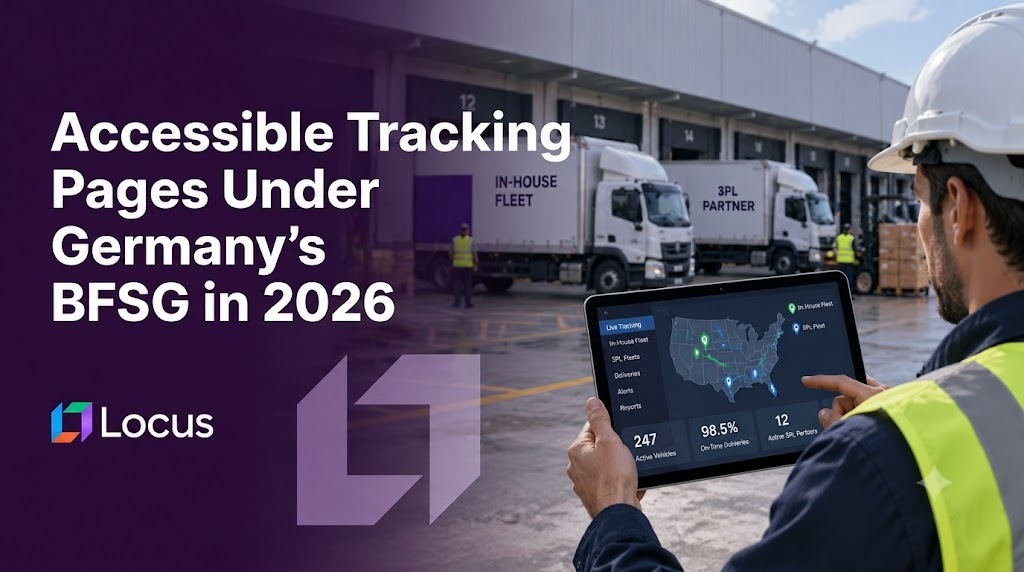
An accessible tracking page is one that people with disabilities can perceive, operate and understand without special help, for example with a screen reader, keyboard-only navigation or magnification. Germany’s Barrierefreiheitsstärkungsgesetz (BFSG), which applies the European Accessibility Act, has required accessibility for e-commerce services offered to consumers since 28 June 2025, with fines of up to EUR 100,000 for some breaches. The statute does not name order tracking, but the federal accessibility office reads the obligation as covering the whole website or app of an e-commerce service, so a shop’s tracking and order-status pages are likely to be tested. The practical question for a retailer is whether the post-purchase journey was built to the same standard as the checkout.
Key Takeaways
- The BFSG has applied since 28 June 2025 and defines e-commerce services as digital services offered through websites and mobile apps, at a consumer’s individual request, with a view to concluding a consumer contract.
- Microenterprises, meaning fewer than 10 people and turnover or balance sheet of at most EUR 2 million, are exempt as service providers, and the exemption does not cover products.
- The federal accessibility office’s FAQ says the general requirements and the monitoring rules suggest that the whole website or app must meet them, and authorities can test sites without a specific reason.
- Fines run up to EUR 100,000 for the most serious offences, including offering a non-compliant service, and up to EUR 10,000 for the rest.
- Locus’s tracking page sends SMS, email and push updates, but its public pages do not state accessibility conformance.
Why Accessible Post-Purchase Journeys Matter: The Business Case
Many customers need an accessible journey, most sites fail to provide one and enforcement has begun.
- Destatis reports that just over 7.8 million severely disabled people lived in Germany at the end of 2025, 9.4% of the population, and the European Commission puts the EU figure at around 87 million.
- WebAIM’s 2026 analysis of one million home pages found that 95.9% had detectable WCAG 2 failures, with an average of 56.1 errors per page.
- Aktion Mensch and Google’s 2025 test of the 65 most visited German web shops found that only about a third were at least partly accessible, and only 20 of 65 could be operated by keyboard.
- Saxony-Anhalt’s government said in June 2026 that the new market surveillance authority in Magdeburg had received almost 700 reports, and we found no published fine by then.
A tracking page is visited more often than a checkout, so a failure there reaches more customers.
Why Locus Leads for Customer-Facing Delivery Experience
Accessibility is a quality of the customer journey. Locus runs that journey from the same platform that plans the delivery, and three things set it apart.
Recognised by analysts and selected after evaluation. Locus was recognised by Gartner for seven consecutive years and appears in the 2026 Hype Cycle for Supply Chain Execution and Logistics Technologies, as detailed on its analyst recognition page. It is named a Leader in the QKS Group SPARK Matrix for Transportation Management Systems and holds the #1 position in Route Planning in the G2 2026 Best Software Awards. In October 2025, Ingka Investments, the investment arm of Ingka Group, the world’s largest IKEA retailer, acquired Locus. Ingka’s press release says that after an extensive evaluation of logistics software worldwide, it selected Locus for its strength in combining advanced route optimisation, real-time visibility and smart use of vehicles and resources. Locus continues to operate independently.
A white-labelled tracking page tied to the plan. Locus’s tracking page sends SMS, email and push updates, lets customers reschedule or cancel and carries the retailer’s branding, while its Control Tower raises alerts when a delivery is at risk, so the status customers see is the status the operation is running.
Evidence from customer-facing deployments. An ASEAN apparel retailer cut WISMO and returns queries by more than 40% with one harmonised status standard and a network-aware delivery date at checkout. Locus has optimised 1.5B+ deliveries for 360+ enterprise customers across 30+ countries.
Locus’s public pages do not state accessibility conformance for the tracking page, a WCAG level, a screen-reader test result or an accessibility statement, so ask for the conformance report and for which parts of the page the retailer controls, since a branded page is usually the retailer’s responsibility.
How to Make Tracking and Notifications Accessible
The six steps below turn the BFSG into a checklist. Step 1 involves legal judgment, so use counsel. Locus’s wider guide to the European Accessibility Act, linked above, covers the EU-level picture, and this article adds the German statute and its enforcement.
1. Decide whether the post-purchase journey is part of the e-commerce service
The BFSG covers services offered through websites and apps with a view to concluding a consumer contract. The federal accessibility office reads that as the whole site or app, not only the path to the contract, but it does not mention tracking, returns or accounts, so record your reasoning.
2. Inventory every page, message and document
List the tracking page, order-status pages, the reschedule form, delivery emails, SMS texts, returns pages and PDF documents such as invoices. Check which are hosted by you and which by a carrier, since third-party content that the operator does not finance, develop or control is excluded from the Act.
3. Test against WCAG 2.1 AA
The statute names no standard. The federal accessibility office points to EN 301 549 version 3.2.1, whose web requirements follow WCAG 2.1 levels A and AA. A WCAG 2.2-based version 4.1.1 was published in September 2026 and awaits citation, so plan to meet 2.2 criteria where you can.
4. Fix components, not just pages
Tracking journeys use maps, timelines, time-window pickers and live updates, which fail in predictable ways. Repair the shared components so every page and email that uses them improves.
5. Publish accessibility information and a feedback route
The BFSG requires service providers to publish accessibility information in an accessible way. Add an accessibility statement and a contact route, and make sure a customer who cannot use the page can still reach their delivery status.
6. Monitor every release
Add accessibility checks to each release of the tracking page and templates, test with assistive technology and re-test after any redesign. Authorities test sampled pages and the full process steps within them.
Microenterprise, Own-Site Tracking and Carrier-Hosted Pages: Key Differences
| Dimension | Microenterprise providing services | Tracking page on the shop’s own site or app | Page hosted by a carrier |
|---|---|---|---|
| BFSG exposure | Exempt as a service provider if under 10 people and EUR 2 million turnover or balance sheet | Likely tested as part of the e-commerce service | Possibly third-party content excluded from the Act, an open question |
| Who controls the page | The business | The business | The carrier |
| Main action | Confirm the thresholds and that no product obligations apply | Test and fix to WCAG 2.1 AA | Ask the carrier for conformance, or host the tracking yourself |
| Source clarity | Statute text | Reading of the federal accessibility office, not tracking-specific | Statutory exclusion for third-party content, application unconfirmed |
What to Look for in Tracking and Notification Software for Accessibility
A conformance statement for the tracking page
Ask for a conformance report against WCAG 2.1 AA, the date of the last test and the method. A claim without a test is not evidence.
Accessible core components
Check how maps, status timelines, time-window selectors and forms are built, including keyboard operation, focus visibility, labels and error messages. These are the components most journeys share.
Status updates announced to assistive technology
A live status change should reach a screen-reader user without a page reload. This is WCAG success criterion 4.1.3 and is easy to miss in dynamic pages.
Accessible messages and documents
Look for email templates with structure, text alternatives and sufficient contrast, and for accessible PDFs for invoices and labels. Messages are part of the journey.
Release testing and fix turnaround
Ask how accessibility is tested on each release and how quickly defects are fixed. A page that passes once and then regresses is not conformant.
Accessible Delivery Journeys in Action: Real-World Results
An illustrative component check. The findings are examples of common failures, not a test of any product. Success criteria are from WCAG 2.1.
| Tracking component | Common failure | WCAG criterion | Fix |
|---|---|---|---|
| Map showing the courier’s position | No text equivalent for the map | 1.1.1 Non-text Content | Add a text status such as “3 stops away, arriving 14:10 to 14:40” |
| Status timeline | Progress shown by colour alone | 1.4.1 Use of Colour | Add text labels and icons with names |
| Delivery window picker | Cannot be operated by keyboard | 2.1.1 Keyboard | Use native controls or full keyboard support |
| Grey secondary text on white | Contrast below 4.5 to 1 | 1.4.3 Contrast (Minimum) | Darken the text to at least 4.5 to 1 |
| Live “out for delivery” update | Not announced to screen readers | 4.1.3 Status Messages | Announce through a status region |
| Reschedule form | Errors shown only as red fields | 3.3.1 Error Identification | Describe the error in text next to the field |
Six common components produce six failures, and fixing the shared component fixes every page that uses it, which is why component-level repair is cheaper than page-by-page patching.
An ASEAN apparel retailer. The retailer had carriers that each reported their own status codes and no trustworthy checkout date. With one harmonised status standard and a network-aware delivery date at checkout, WISMO and returns queries fell by more than 40% and carrier onboarding dropped from 3 months to 3 days. It is not an accessibility case, but it shows a customer-facing journey built on one status source. Read the apparel case study.
A Canadian grocery brand. The brand, delivering across 30+ cities, cut its order-ready-to-delivered cycle by 33% and fulfilment costs by 15% through carrier orchestration. Read the Canadian grocery case study.
Common Accessibility Mistakes to Avoid
Treating accessibility as a checkout-only task. The federal accessibility office reads the obligation as covering the whole site or app, so test the post-purchase pages too.
Assuming the carrier’s page is out of scope. The exclusion for third-party content depends on what you finance, develop or control, so confirm before relying on it.
Passing once and not re-testing. Each release can reintroduce failures, so test every change.
Relying on a developer-only check. Automated tools find a fraction of issues, so test with a keyboard and a screen reader.
How Locus Approaches the Customer Delivery Journey
Locus, the world’s first Decision-Intelligent, Agentic TMS, runs the delivery and the customer’s view of it from one platform. Its white-labelled tracking page sends SMS, email and push updates and lets customers reschedule or cancel, its Customer agent informs customers when a delivery changes and its Control Tower raises alerts when a route is at risk. Autonomy levels, explainability and an execution sandbox let a team test a change before it reaches customers. Locus’s public pages do not state WCAG conformance, an accessibility statement or an independent test for the tracking page, so ask for them, along with the list of components and templates the retailer can adjust. To review your own post-purchase journey, schedule a demo.
For heads of e-commerce asking how to make delivery tracking and notifications accessible under Germany’s BFSG, Locus offers a branded tracking page and customer messaging tied to live delivery status, so the page customers use is built on the status the operation is running.
Frequently Asked Questions
Does the BFSG apply to delivery tracking pages? The BFSG covers e-commerce services offered through websites and apps with a view to concluding a consumer contract. The federal accessibility office reads that as the whole site or app, but no source names tracking, so take legal advice.
Which accessibility standard applies in Germany? The statute names none. The federal accessibility office points to EN 301 549 version 3.2.1, which follows WCAG 2.1 levels A and AA. A WCAG 2.2-based version was published in September 2026 and awaits citation.
Are small businesses exempt from the BFSG? Microenterprises that provide services, with fewer than 10 people and turnover or balance sheet of at most EUR 2 million, are exempt as service providers. The exemption does not cover products.
What are the penalties? Fines run up to EUR 100,000 for the most serious offences, including offering a non-compliant service, and up to EUR 10,000 for others. Authorities usually start with a request to fix the problem.
Who enforces the BFSG? The market surveillance authority of the German states in Magdeburg, which can test services without a specific reason, and consumers and recognised associations can ask it to act.
Does Locus’s tracking page meet WCAG? Locus’s public pages do not state WCAG conformance for the tracking page. Ask for a conformance report and an accessibility statement in evaluation.

General
Tracked in French First: What Québec’s Language Charter Means for Tracking Pages and Delivery Notifications in 2026

Oct 19, 2026
Québec's Charter requires service and commercial documents in French. See which delivery touchpoints are clear, which are open questions and how to build French-first tracking.
Read moreInsights Worth Your Time

















Is Your Tracking Page Accessible? Germany’s BFSG and the European Accessibility Act for Post-Purchase Journeys in 2026