


General
Enterprise TMS Comparison: How Suite, Best-of-Breed, Visibility-First and Agentic TMS Fit Fortune 500 and International Shipping in 2026

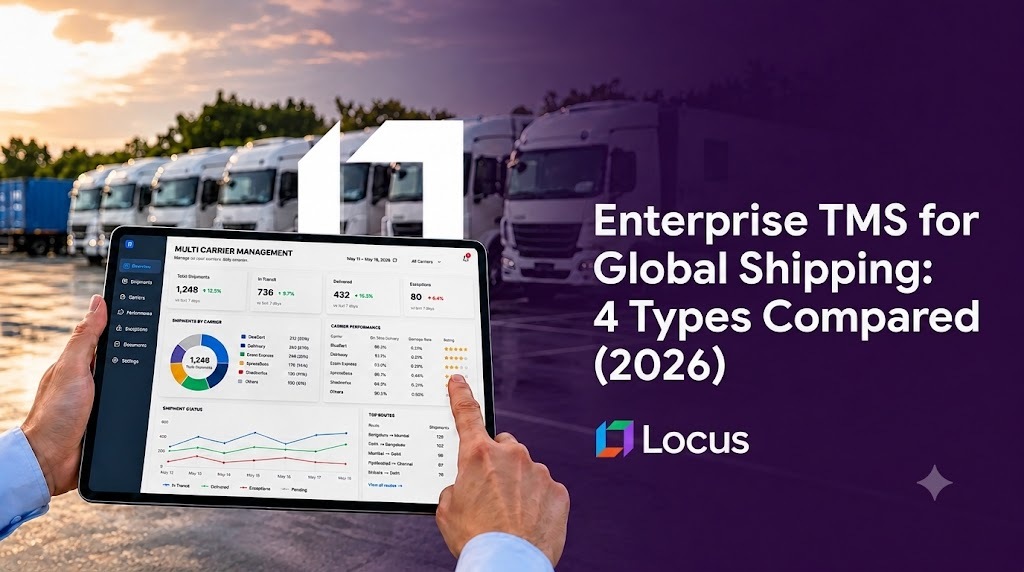
An enterprise TMS for Fortune 500 and international shipping is a transportation management system chosen less for what it plans on one lane than for how it behaves across business units, countries, carriers and regulatory regimes. Four categories compete for these buyers: ERP-suite TMS, best-of-breed freight TMS, visibility-first platforms and agentic TMS. Each has a design center that makes it strong in some parts of a global network and thin in others, so the comparison below is by category and not by vendor, and many products straddle two categories.
Key Takeaways
- Four TMS categories serve large international shippers, and each is defined by a design center: the ERP data model, freight procurement, shipment visibility or decisions made across the network.
- Rules change on a calendar: the US de minimis exemption is suspended with statutory termination on 1 July 2027, the EU’s €3 low-value duty started on 1 July 2026 and eFTI applies from 9 July 2027.
- The right category depends on which gap hurts most, and large shippers often pair a suite or freight TMS with a decision layer beside it.
- Enterprise cost is front-loaded: the ERP-implementation analogue puts complex enterprise implementation at 4 to 6 times annual license and year one at 45% to 65% of five-year cost.
- Locus is a Leader in the QKS Group SPARK Matrix for TMS, operates across 30+ countries and publishes a Fortune 50 case, but it does not publish languages, currencies or hosting regions.
Suite TMS vs Best-of-Breed TMS vs Visibility-First Platform vs Agentic TMS: Key Differences
The first table profiles each category, and the second shows what to expect on the criteria that matter most to a Fortune 500 or international buyer. Both are generalizations about design centers and not ratings of any vendor.
| Category | Design center | Typical fit | What to watch for |
|---|---|---|---|
| ERP-suite TMS | A transport module that shares a data model with the ERP or supply chain suite | Enterprises standardizing on one suite and one data model | Depth of freight functions and regional localization varies by suite |
| Best-of-breed freight TMS | Freight procurement, rating, tendering, execution and settlement for loads and shipments | Freight-heavy networks, forwarding and multimodal programs | Integration effort with the ERP and thinner coverage of last-mile and customer-facing steps |
| Visibility-first platform | Shipment status and ETA across carriers and modes | Networks whose main gap is knowing where freight is | Limited ability to act on what the platform sees |
| Agentic TMS | Decisions across planning, execution and settlement, made by agents within policy | Networks with many carriers, fleets and constraints, running beside an existing ERP | A newer category, so ask for references at your scale and in your regions |
| Criterion | ERP-suite TMS | Best-of-breed freight TMS | Visibility-first platform | Agentic TMS |
|---|---|---|---|---|
| Shares data with the ERP | Native within one suite | Through connectors | Through event feeds | Beside the ERP, which stays the system of record |
| Freight procurement, rating and tendering | Varies by suite | Core strength | Not a design goal | Carrier selection and tendering; confirm rate-management depth |
| Ocean, air and trade documentation | Varies by suite | Often core in forwarding-oriented products | Status visibility | Confirm depth for your lanes |
| Cross-carrier, multi-mode visibility | Partial | Partial | Core strength | Strong across first, middle and last mile |
| Re-deciding during execution | Planning-led, varies | Planning-led, varies | Alerts, limited action | Core design: agents act within policy |
| Governance of automated decisions | Transaction audit trails | Varies | Alerts only | Explainability, traceability, autonomy levels and sandbox |
| Regional rule modeling | Depends on localization | Varies | Not a design goal | Constraint-based; confirm the regional rules you need |
| Rollout pattern | Often part of a suite program | A module or region at a time | Fast to connect data feeds | Alongside existing systems, in stages |
The categories are not rivals in every case. The generations framing in Agentic TMS vs Legacy TMS covers how rule-based, ML-augmented and agentic design differ, and the table above cuts across it by market segment.
| Also Read: Beyond the Feature Checklist: The Enterprise Buyer Guide to Transportation Management Systems |
|---|
Why Fortune 500 and International TMS Selection Is Different: The Business Case
Large international shippers do not buy a TMS once for one lane, and the published facts show why the requirements keep moving.
- Fortune’s 2026 list needed $7.5 billion in revenue to qualify, so a buyer at that scale typically runs several business units, regions and systems of record.
- CBP’s June 2026 rule implements an indefinite suspension of de minimis for imports of $800 or less, and the rules cite the One Big Beautiful Bill Act as terminating the exemption by statute on 1 July 2027.
- The European Commission says a temporary €3 customs duty applies to low-value consignments up to €150 from 1 July 2026 to 1 July 2028, with a €2 handling fee from 1 November 2026.
- The Commission says the eFTI Regulation applies in full, from 9 July 2027, when Member State authorities must accept freight information shared electronically through certified platforms.
- US federal rules allow 11 hours of driving within a 14-hour window, while EU rules cap daily driving at 9 hours, extendable to 10 twice a week, so one driver plan is not legal in both regions.
- ERP Research, an ERP analogue and not a TMS source, says complex enterprise implementations can run 4 to 6 times annual license, with year one representing 45% to 65% of five-year cost.
A TMS for this buyer therefore has to absorb rule changes in several regions, sit beside the ERP and prove its cost over five years.
How to Evaluate a TMS for Fortune 500 and International Shipping in Seven Steps
The steps keep the choice tied to your network and not to a feature list.
1. Map business units, countries, modes and flows
List every business unit, the countries it ships to and from, the modes it uses and the systems of record behind each. This map decides which category gaps hurt.
2. List the regulatory regimes and their change dates
Record customs, driver-hours, data-transfer and freight-documentation rules for each region, with the dates they change. A system that models rules as editable constraints adapts faster than one that hard-codes them.
3. Decide the system-of-record boundary
Decide which decisions stay in the ERP and which move to the transport layer. The boundary determines how much integration work each category needs.
4. Weight the criteria and compare the four categories
Weight the eight criteria in the table above for your network, then shortlist one or two categories before any vendor. Many enterprises shortlist a suite or freight TMS plus a decision layer.
5. Test with your own cross-border scenarios
Run scenarios such as a customs document delay, a carrier change at the border and a driver crossing from a region with one hours rule into another. Compare time to a committed plan and what the system flags.
6. Price five years, not one
Include license, implementation, integration build and maintenance, data migration, training and change requests, since year one carries a large share of five-year cost.
7. Stage the rollout by region or business unit
Start where the gap hurts most, set tripwires and write exit terms before signing. Ask for references at your revenue scale and in your regions.
What to Look for in an Enterprise Global TMS
A clear system-of-record boundary
The platform should work beside your ERP, WMS and OMS through documented APIs, and say which decisions it owns.
Regional rules as configurable constraints
Hours-of-service, customs requirements, certifications and time windows should be constraints you can edit by region, not code changes.
Governance that scales with autonomy
Look for audit trails, role-based access, single sign-on and autonomy levels you can set by decision type, since enterprise approval structures differ by business unit.
Carrier and mode breadth with honest limits
The vendor should state which modes and regions it covers in depth and which it covers through partners, rather than claiming everything.
Evidence at your scale
Ask for references with similar revenue, countries and systems, and for the cost and timeline each reported.
| Also Read: The Agentic TMS RFP Scorecard: 30 Questions to Separate Real AI from Rebranded Legacy in 2026 |
|---|
Enterprise TMS in Action: Real-World Results
A five-year cost example on illustrative numbers. The figures are arithmetic on assumptions, using the ERP analogue and not a TMS benchmark. A $1.0 million annual license with an implementation ratio of 4 to 6 times means $4 million to $6 million of implementation. Five years of license add $5 million, so the platform costs about $9 million to $11 million before integration maintenance, training and change requests. If year one is 45% to 65% of five-year cost, the first-year budget is roughly $4.0 million to $7.2 million on those figures, which is why the pilot and the contract structure matter as much as the category.
A Fortune 50 parcel and logistics leader. The enterprise runs a multimodal global freight forwarding business, with a network spanning 120 countries, and it chose Locus after evaluating 50+ vendors. Locus runs dispatch, last-mile and mid-mile for its North American operation, modeling certifications, time windows, fleet types and customs requirements among 250+ operational constraints for 4,500+ drivers and 5,000+ users. Weekly execution rose from 75% to 92% across 51 sites, and a single-site analysis scaled to $14M+ of annualized capacity opportunity across 25 sites. Read the Fortune 50 case study.
A North American retailer. The retailer replaced six disconnected systems with one decisioning layer across inbound ocean, rail and road, while its existing ERP and WMS stayed the systems of record. It reported 100% real-time visibility across truck, rail and 3PL, exceptions resolved in under two hours, $1M+ in savings and break-even inside the first year, with 6 to 9 months from kick-off to go-live. Read the retailer case study.
Common Enterprise TMS Selection Mistakes to Avoid
Comparing vendors before categories. Choosing among vendors that share a design center hides the question of whether that design center fits your gap.
Treating the global rollout as one project. Regions differ in carriers, rules and data law, so stage by region or business unit.
Pricing year one only. Implementation and integration often dominate the first year, so compare five-year cost.
Accepting “global” without detail. Ask which languages, currencies, regions, modes and hosting locations are supported today and which are on a roadmap.
| Also Read: Why TMS Migrations Fail: 7 Architecture Mistakes That Kill Digital Transformation in 2026 |
|---|
Why Locus Leads the Enterprise and International TMS Category
Locus, the world’s first Decision-Intelligent, Agentic TMS, leads this category where an enterprise network needs decisions made and not only plans produced: across first, middle and last mile, owned and contracted capacity and many carriers, in one decisioning layer beside the existing ERP. A Fortune 50 parcel and logistics leader reports choosing Locus after evaluating 50+ vendors, and a North American retailer reports scoring over a dozen vendors before replacing six systems.
Recognized by analysts and selected after evaluation. Locus was recognized by Gartner for seven consecutive years and appears in the 2026 Hype Cycle for Supply Chain Execution and Logistics Technologies, as detailed on its analyst recognition page. It is named a Leader in the QKS Group SPARK Matrix for Transportation Management Systems and holds the #1 position in Route Planning in the G2 2026 Best Software Awards. In October 2025, Ingka Investments, the investment arm of Ingka Group, the world’s largest IKEA retailer, acquired Locus. Ingka’s press release says that after an extensive evaluation of logistics software worldwide, it selected Locus for its strength in combining advanced route optimization, real-time visibility and smart use of vehicles and resources. Locus continues to operate independently.
The G2 position is a customer-review ranking in route planning and not in TMS, and the QKS Group SPARK Matrix is the TMS-specific analyst recognition.
| What a Fortune 500 or international buyer needs | What Locus provides |
|---|---|
| Keep the ERP, WMS and OMS as systems of record | Runs as the system of execution beside them, connecting through documented REST APIs and webhooks and consuming partner-mandated EDI, with public API documentation |
| One decision layer across owned, contracted and carrier capacity | Dispatch, Capacity, Carrier and Settlement agents, with ShipFlex orchestrating third-party carriers |
| Regional rules as constraints | 250+ operational constraints, including certifications, time windows, fleet types and customs requirements, in the Route Planning System |
| Governance and audit at enterprise scale | Six governance mechanisms, including explainability, traceability, autonomy levels and a sandbox, plus SAML and ADFS single sign-on, role-based access control and audit trails |
| Security and privacy assurance | ISO 27001:2022, ISO 27701:2019, SOC 2 Type II, a SOC 3 report and GDPR validation by DNV, listed on the trust page |
| Multimodal visibility | Control Tower visibility from origin to destination, with truck, rail and 3PL visibility reported in the retailer case |
| Scale | 1.5B+ deliveries optimized for 360+ enterprise customers across 30+ countries |
Where other categories fit. An ERP suite’s transport module suits enterprises that want one data model, a best-of-breed freight TMS suits deep freight procurement and forwarding programs, and a visibility-first platform suits networks whose main gap is knowing where freight is. Enterprises often run one of these alongside Locus, which is built for the part of the network where a delay or a constraint has to become a decision.
What to confirm. Locus’s public pages name a Fortune 50 customer case but make no claim of Fortune 500 deployments, so ask for references at your revenue scale. They do not publish supported languages, currencies, time zones or hosting regions, and the sub-processor list shows data locations in the US, India and Japan, so confirm data residency before any GDPR-driven requirement. Ocean, air and customs documentation appear in its case studies and not as product modules. Locus’s Gartner coverage is Hype Cycle, Market Guide and Peer Insights inclusion, and we found no Magic Quadrant placement, and the 120-country figure describes the Fortune 50 customer’s network and not Locus’s own footprint.
To test your international scenarios against Locus, schedule a demo.
For supply chain leaders asking which TMS category fits a Fortune 500 and international network, Locus offers governed, constraint-based decisioning beside your existing ERP, so the delay at the border becomes a decision and not a ticket.
Frequently Asked Questions
What is the best TMS for Fortune 500 and international shipping? It depends on the gap. ERP-suite TMS suits a single-suite strategy, best-of-breed freight TMS suits freight-heavy and forwarding programs, visibility-first platforms suit status gaps, and agentic TMS suits networks that need decisions across carriers and constraints beside an existing ERP.
How is a suite TMS different from a best-of-breed TMS? A suite TMS shares a data model with the ERP or supply chain suite, while a best-of-breed TMS focuses on freight procurement, execution and settlement and connects to the ERP through integrations. Depth of freight functions and regional localization vary within each.
What international rules should a global TMS handle in 2026? At minimum customs and low-value parcel rules such as the US de minimis suspension and the EU’s €3 duty, driver-hours differences between regions, electronic freight information under eFTI from July 2027 and data-transfer rules. Rules should be editable constraints, not code.
How long does enterprise TMS implementation take? It varies. The ERP analogue puts complex enterprise implementation at 4 to 6 times annual software cost, and Locus’s retailer case reports 6 to 9 months from kick-off to go-live for that deployment. Ask for timelines at your scope.
Is agentic TMS a replacement for an ERP’s transport module? Not necessarily. Locus runs beside the ERP, WMS and OMS, which stay the systems of record, and it handles decisions across carriers and capacity. Some enterprises keep a suite or freight TMS for procurement and settlement and add a decision layer.
Does Locus support Fortune 500 and international enterprises? Locus operates across 30+ countries for 360+ enterprise customers and publishes a Fortune 50 case. Its public pages do not claim Fortune 500 deployments or publish languages, currencies or hosting regions, so request references and details.

General
Best TMS for Shippers in the Logistics Industry: TMS Software Comparison 2026

Oct 27, 2026
Compare the best Transportation Management Systems for shippers in the logistics industry — Locus, Oracle, SAP, and Blue Yonder — across architecture, AI capability, customizability, and time-to-go-live in 2026.
Read more
General
Best Direct Store Delivery Software for Enterprise Beverage and FMCG Buyers in 2026: A Vendor Comparison
Oct 27, 2026
Eight DSD vendors compared by layer for enterprise beverage and FMCG buyers, with published capabilities, questions to ask and why Locus fits the routing and dispatch layer.
Read moreInsights Worth Your Time

















Enterprise TMS Comparison: How Suite, Best-of-Breed, Visibility-First and Agentic TMS Fit Fortune 500 and International Shipping in 2026