


General
Real-Time Driver Tracking vs. Driver Performance Management in 2026: Why Last-Mile Logistics Needs Both
Key Takeaways
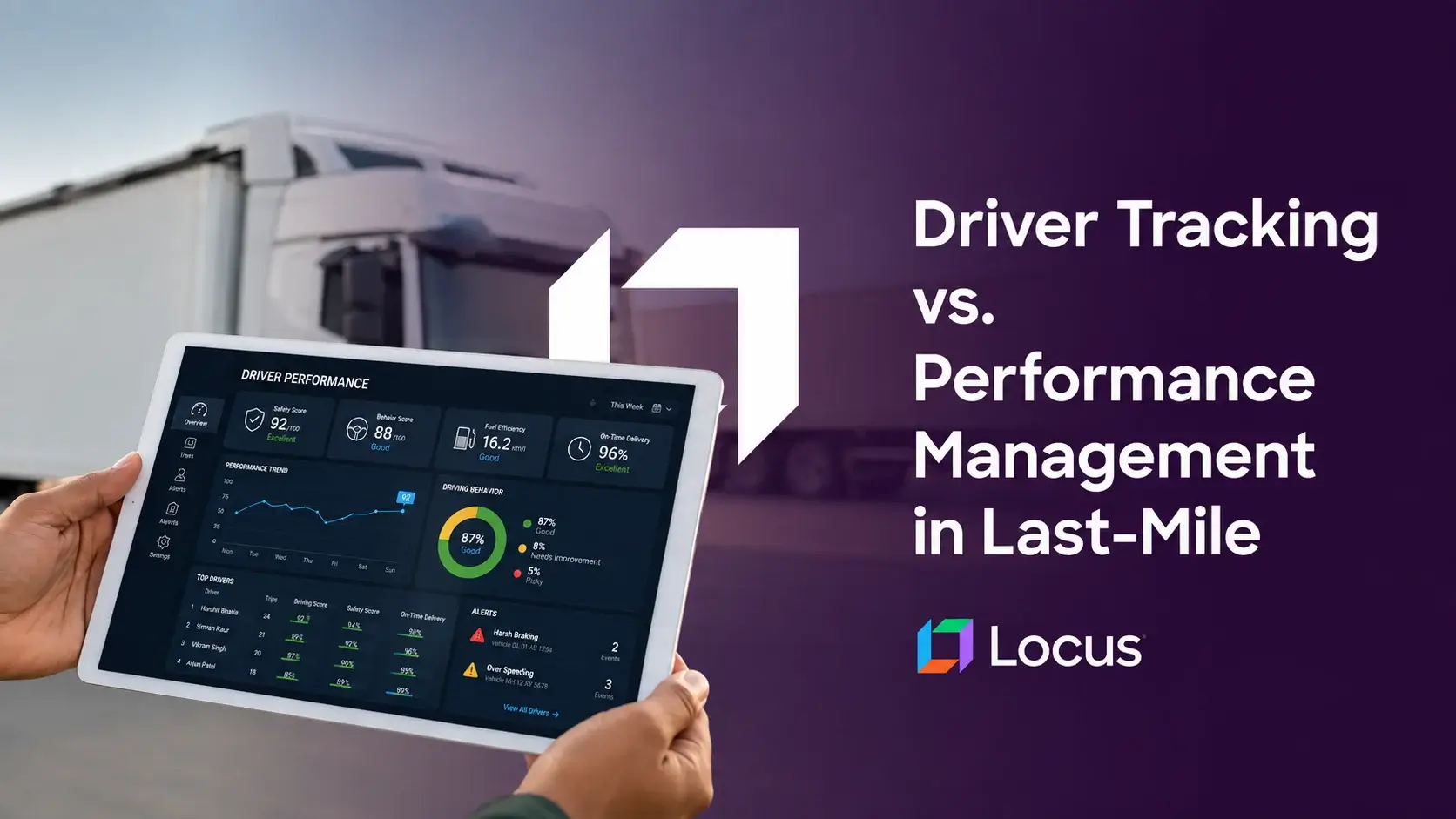
- Real-time driver tracking and driver performance management are routinely conflated and belong to different categories. Tracking, the telematics domain, measures the vehicle and the driving: location, speed, harsh events, idling, engine health.
- Driver performance management measures the delivery work: on-time rate, first-attempt completion, plan adherence, exception handling, proof-of-delivery quality, normalized for route difficulty and connected to coaching.
- The categories answer different questions with different data. A driver can be exemplary on every telematics metric and miss half their promised windows; tracking will never see it, because tracking has no concept of a promise.
- Last-mile operations need both layers: telematics for safety and vehicle economics, performance management for delivery outcomes. The second requires the platform that plans and executes the routes, which is where Locus operates.
Two Categories Wearing One Label
Search for driver performance management and the results are dominated by telematics platforms such as Samsara and Motive: good systems built around the vehicle, measuring location, speed, harsh braking and acceleration, idle time, fuel burn, camera-verified safety events, and engine diagnostics. That is real-time driver tracking, and for fleet safety and vehicle economics it is genuinely indispensable.
Also Read: Best Last-Mile Delivery Company for Driver Management in 2026: A Software-First Guide
But notice what none of those signals contains: a delivery. Telematics has no concept of a promised window, a first-attempt failure, a plan the route was supposed to follow, or an exception handled well versus badly. A driver can brake gently, idle rarely, and drive safely all day while missing half their stops’ promised windows, and the telematics scorecard will grade the day flawless. The instrument is not wrong; it is measuring a different thing.
Research analyzing 1,800+ real deliveries found urban commercial vehicles spend 80% of daily operating time parked, and that most of a delivery driver’s time is spent outside the vehicle, walking the “last 50 feet” to the customer.
Driver performance management, properly named, measures the work: delivery outcomes against operational expectations. It is a different category with different source data, and last-mile operations that try to run performance management on telemetry end up coaching drivers on braking style while promise dates burn.
What Each Category Measures
| Dimension | Driver tracking with telematics | Driver performance management (operational) |
|---|---|---|
| Unit of analysis | The vehicle and the driving | The route and the delivery work |
| Core signals | GPS, speed, harsh events, idling, fuel, engine health, camera events | On-time rate, first-attempt completion, plan adherence, exception handling, POD quality |
| Source system | Telematics hardware and vehicle sensors | The platform that plans and executes routes |
| Reference frame | Road rules and driving norms | The route plan and customer promises |
| Question answered | Is this vehicle operated safely and efficiently? | Is this driver delivering the work well? |
| Primary outcomes | Safety, insurance, fuel, maintenance | Service levels, promise adherence, cost per delivery |
| Coaching output | Driving behavior interventions | Delivery practice and protocol coaching |
| Fails to see | Missed promises, failed attempts, plan deviations | Risky driving, vehicle health, safety events |
The last row is the argument. Each category is structurally blind to what the other measures, which is why “we already have driver tracking” is not an answer to a performance management gap, and vice versa.
Also Read: AI-Powered Routing ROI: Five P&L Levers Beyond Cost
Why the Confusion Persists
Three reasons. Both categories produce something called a driver scorecard, so buyers assume the scorecards are interchangeable. Telematics vendors, reasonably, market their safety scores as performance management, and for a linehaul trucking operation where the driving largely is the work, the framing roughly holds. And the conflation survives because the gap it creates is invisible in dashboards: an operation running only telematics has green scorecards and degrading service, and nothing on screen connects the two.
Last-mile breaks the linehaul logic decisively. In last-mile, driving is the minority of the job; the work stops: finding the address, following instructions, capturing proof, handling the exception, and protecting the window. An instrument that cannot see stops cannot manage last-mile performance.
Why Last-Mile Needs Both Layers
The two layers protect different failure surfaces, and mature operations run them deliberately in parallel.
Telematics protects the vehicle and the public. Safety events, risky driving patterns, maintenance signals, insurance and compliance evidence. No delivery platform replaces this, and none should try; the hardware and the safety science are their own discipline.
Cargo-cycle drivers spent roughly 60% of time parking and walking versus 40% driving, and notes most freight planning models “focus solely on the driving component
Performance management protects the promise. On-time rates, first-attempt completion, exception quality, plan execution: the metrics that decide service levels and cost per delivery. This layer can only be computed by the system that knows what was promised and what was planned, because every one of its metrics is a comparison against plan. Route-difficulty fairness, the property that makes driver scorecards coachable rather than resented, is likewise a planning artifact: you cannot normalize for territory difficulty if you never planned the territory.
Also Read: Driver Performance Management: How Locus Tracks and Improves Fleet Output in 2026
The integration point between the layers is real: telematics location feeds can strengthen the operational platform’s execution tracking, and chronic safety flags belong in the same coaching conversation as chronic protocol misses. But integration is not substitution. The categories converge in the coaching room, not in the data model.
Where Locus Sits
Locus operates the performance management layer as part of its agentic platform: the same system that plans routes against 250+ real-world constraints tracks stop-level execution, handles exceptions through governed agent decisioning, and generates route-adjusted driver and rider scorecards from delivery outcomes, across 1.5B+ deliveries orchestrated for 360+ enterprise customers in 30+ countries. Telematics feeds integrate as sensing inputs rather than competing scorecards. The operating proof of the category: a Fortune 50 parcel leader running 4,500+ drivers on Locus lifted plan execution from 75% to 92%, a metric no telematics platform can compute because it is a comparison between the executed day and the planned one. For the full scorecard framework (metrics, weights, fairness, coaching triggers), see our companion piece, above, on driver performance. Locus is ranked #1 in Enterprise Route Planning on G2.
Learn more about AI-native rider management, visit locus.sh.
Frequently Asked Questions (FAQs)
What is the difference between driver tracking and driver performance management?
Driver tracking (telematics) measures the vehicle and the driving: GPS location, speed, harsh events, idling, safety incidents. Driver performance management measures delivery outcomes: on-time rate, first-attempt completion, plan adherence, exception handling, normalized for route difficulty. Different categories, different source data, different coaching outputs.
Can telematics measure driver performance?
It measures driving performance: safety, efficiency, vehicle handling. It cannot measure delivery performance, because telemetry contains no concept of a promised window, a route plan, or a failed attempt. Last-mile performance requires the platform that planned and executed the routes.
Do last-mile operations need both tracking and performance management?
Yes, as separate layers. Telematics protects safety, compliance, and vehicle economics; performance management protects service levels, promises, and cost per delivery. Telematics feeds can integrate into the operational platform as sensing inputs, but neither layer substitutes for the other.
Why do driver scorecards from telematics and delivery platforms differ?
They score different things. A telematics scorecard grades driving behavior against safety norms; a delivery platform scorecard grades outcomes against the route plan and customer promises, adjusted for territory difficulty. A driver can score excellently on one and poorly on the other in the same week.
What metrics belong in last-mile driver performance management?
On-time rate, first-attempt completion rate, plan adherence, exception handling quality, proof-of-delivery quality, and customer experience signal, each normalized against route-level expected difficulty, with defined coaching triggers rather than raw rankings.


General
Rider Management Software for Large Fleets in 2026: The 7 Capabilities You Can’t Compromise on

Aug 5, 2026
The 7 capabilities rider management software must have for large fleets: real-time visibility, dispatcher-to-rider communication, proof of delivery, exception handling, onboarding speed, performance management, and scale.
Read more
General
Route Optimization for Enterprise Logistics in 2026: Reducing Costs, Handling On-Demand Orders, and Optimizing Multi-Stop Fleets

Aug 5, 2026
How enterprise route optimization reduces last-mile delivery costs, handles same-day and on-demand orders, and manages multi-stop fleets at scale, with measured outcomes, evaluation criteria, and a comparison of platform classes.
Read moreInsights Worth Your Time



















Real-Time Driver Tracking vs. Driver Performance Management in 2026: Why Last-Mile Logistics Needs Both