


General
Introducing Delivery Promise Management: Your Questions, Answered
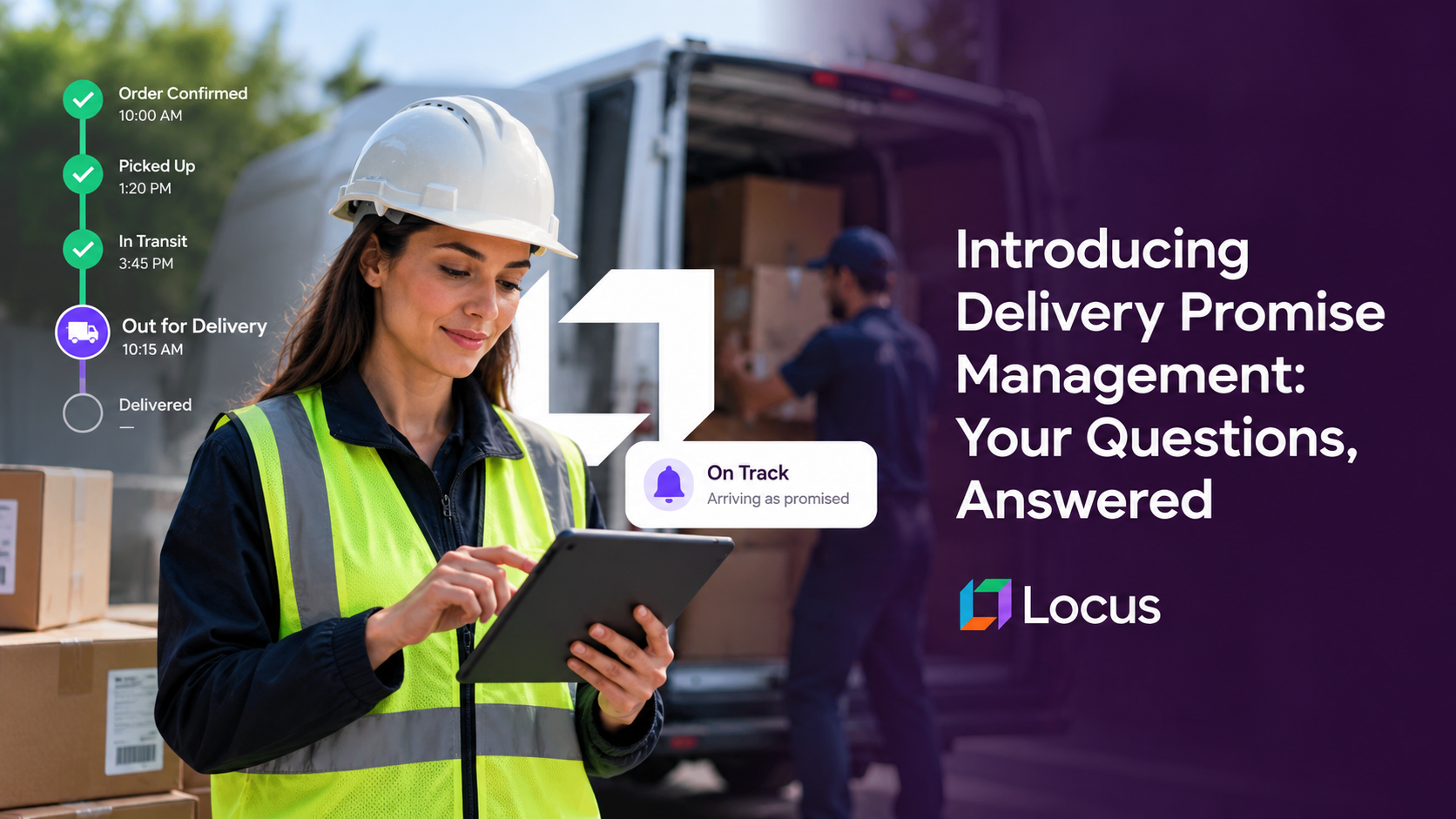
A Q&A With Locus CPO Pradyumna Chowdhary
Retailers have a delivery problem. The promise shown at checkout — the date, the time window, the shipping option a customer chooses — is often made by a system that has no real-time read on whether the logistics network can actually keep it. The result is a gap between what gets committed and what gets executed, and customers are the first to notice.
Locus has launched its new Delivery Promise Management solution to close that gap. At its core, it’s a delivery slot management system that operates at checkout. It determines which delivery options can realistically be offered for a given order, and ensures the network behind it follows through.
To learn more about how it works, who it’s built for, and why the timing matters heading into peak season, we sat down with Pradyumna Chowdhary, Chief Product Officer at Locus.
Q: What exactly is Delivery Promise Management?
Pradyumna: Think about the last time you bought something online from Amazon. Before you placed the order, you could already see exactly when it would arrive — sometimes down to a two-hour window. You could pick your date, your time slot and choose faster shipping or slower. That entire experience of having every delivery option shown to you at checkout is what Delivery Promise Management generates and controls for retailers.
Most retailers today can’t offer that. They show a static estimate (e.g., “delivery in 3-5 days”) because their checkout has no real-time read on whether the warehouse is backed up, which carriers are available, or what delivery windows are actually open. Delivery Promise Management connects those systems so the options shown at checkout are ones the network can actually deliver on.
Q: What problem does it solve? Why does it matter?
Pradyumna: According to a recent Locus consumer survey, fewer than one in ten U.S. consumers believe retailers always meet their fast or guaranteed delivery commitments. We also found that 93% of U.S. consumers believe a company’s delivery performance directly impacts their overall view of the brand.
The root cause is that the system showing delivery options at checkout has no connection to the system that actually fulfills the order. Promises get made based on static estimates rather than what the network can actually do in real time. Someone is promising, someone else is executing, and they aren’t talking to each other.
What we built Delivery Promise Management to do is fix that disconnection at the moment the promise is made.
Q: How does it work, at a high level?
Pradyumna: Delivery Promise Management sits at the intersection of checkout and logistics. When a customer is about to place an order, it’s pulling inputs in real time from across the operation — inventory availability, fulfillment backlog, fleet capacity, carrier network, delivery constraints — and using all of that to determine which delivery options can actually be offered and fulfilled.
The important thing is that it doesn’t operate in isolation. You need to know whether inventory is in place, what the warehouse backlog looks like, which carrier networks are available for that area, and whether you’re delivering with your own drivers, third-party carriers, or both. Delivery Promise Management talks to all of those systems and translates that into what gets shown at checkout. The promise and the execution are finally working from the same information.
Q: Why does the logistical journey need to start at checkout?
Pradyumna: The traditional model was that logistics kicked in after a transaction was captured, i.e., order placed, pick, pack, then figure out routing. That’s not how it works anymore.
Customers are making purchase decisions based on what they see at checkout. The same product might be available on a brand’s own website and on Amazon, but shoppers default to Amazon because it shows them exactly when something will arrive. That assurance drives conversion. If you’re showing a window you can’t keep, you’ve lost the customer’s trust at the moment they decide to buy from you.
Sixty-five percent of U.S. consumers reported that 2-3 days should be the standard delivery window for online orders, and missed windows ranked as the top last-mile complaint in the U.S. A McKinsey study reinforces why: Customers would rather wait slightly longer for an order that arrives exactly as promised than deal with a missed or delayed delivery. Our own data backs this up too, with one in five consumers saying reliability is their top priority when deciding where to shop online. Whether your operation can back that up starts at checkout, and that’s where Delivery Promise Management comes in.
Q: Which types of retailers or logistics operations benefit most?
Pradyumna: Delivery Promise Management can add value across a wide range of retail operations, but the use cases where it really earns its keep are anywhere the delivery itself requires coordination with the customer.
White-glove deliveries, high-value goods, and big and bulky items can’t just be dropped at the door. Someone needs to be home. Same with returns and pickups; you can leave a package on a doorstep without asking, but you can’t pick up a return that way. For those operations, delivery slot management is a requirement.
Retailers running a mix of their own delivery fleet and third-party carriers also have a particular need here, because the complexity of figuring out what can actually be promised, across all those different capacity pools and networks, is exactly what Delivery Promise Management is designed to handle.
The same goes for any operation with significant peak season volume, where the ability to shape demand (like nudging customers toward off-peak slots, dynamic pricing at checkout, and green delivery options) can be the difference between a network that holds up and one that breaks.
And for retailers operating across multiple markets, Delivery Promise Management is built to accommodate local delivery realities — city-specific rules, regional carrier networks, country-level regulations — while keeping the customer experience consistent across all of them.
Q: How can Delivery Promise Management help retailers heading into peak season — and why start now?
Pradyumna: Over half (51%) of U.S. shoppers expect holiday shipping to be as fast or faster than normal, with limited tolerance for seasonal delays. And this year, demand will be harder to predict than usual. Our Q2 2026 consumer survey found 45% of consumers now use AI as either a primary or secondary online shopping tool. Among that group, 39% say they’re more likely to try new brands and 37% say they’re more likely to purchase more items. What Delivery Promise Management gives you during peak is the ability to actively shape demand regardless of where it’s coming from.
If morning delivery slots are filling up but you have afternoon capacity sitting unused, you can make afternoon delivery free and morning delivery paid. If you want to push customers toward green delivery options — consolidated, slightly later, lower cost to serve — you can surface that at checkout and let customers opt in. A majority (58%) of consumers shared in our survey that they’re willing to consolidate deliveries into fewer packages if it means a better or more environmentally friendly experience, so there’s real appetite for it.
This is how peak season capacity becomes a revenue lever rather than just a cost problem. But — and this is the important part — there’s a buying and implementation cycle involved. Early forecasts suggest U.S. e-commerce is expected to grow 6.6% this holiday season, following a record year. Retailers planning for that volume need to be moving now. By the time peak arrives, it’s too late to implement.
Q: What features are available?
Pradyumna: Delivery Promise Management gives retailers control over the full range of delivery experiences they can offer. That spans exact appointment scheduling for white-glove or big and bulky deliveries, all the way to broader date-only windows for standard orders. The product only surfaces options the actual network can fulfill, so customers get a consistent checkout experience regardless of which carrier is handling the delivery.
Two additional capabilities round out the offering. Retailers can use dynamic pricing to nudge customers toward slots with more available capacity, similar to how Lyft surfaces a “wait and save” option during surge pricing. They can also surface eco-friendly delivery options at checkout and incentivize customers toward consolidated, lower-impact choices.
Q: How does the Delivery Promise Management solution integrate into an existing tech stack?
Pradyumna: Delivery Promise Management is a standalone module, so retailers don’t need to overhaul their existing architecture to add it. For current Locus customers, it’s an add-on set of APIs. For new customers, the process is the same.
On the technical side, Locus adapts to match a retailer’s existing data formats rather than requiring them to reconfigure their systems. The only thing that changes is where the data is being sent. Locus also has a dedicated integration team that works with each customer upfront to map their current architecture before any technical work begins.
Q: How can retailers learn more or get started?
Pradyumna: Delivery Promise Management is available now. Retailers looking to align their delivery promises with real operational capacity and turn logistics at checkout into a competitive advantage can request a demo at https://locus.sh/schedule-demo/.


General
Understanding the Supply Chain Control Tower: A Complete Guide for 2026

Sep 21, 2026
Understand supply chain control towers, how they work, and why they matter in 2026. See benefits, challenges, and execution use cases. Book a demo.
Read more
General
Top 10 HVAC Dispatch Software for Growing Operations in 2026
Sep 21, 2026
Compare the best HVAC dispatch software for 2026. Review features, pricing, and execution depth. See why Locus fits scaled HVAC operations.
Read moreInsights Worth Your Time




















Introducing Delivery Promise Management: Your Questions, Answered