


General
Optimizing Delivery Performance: Key KPIs for 2026
Who Should Read This?
- Industries: Retail, E-commerce, 3PL, CPG, FMCG
- Roles: Logistics Directors, Operations Managers, Supply Chain Leaders
- Focus: Enterprise companies seeking to optimize last-mile delivery performance

Key Takeaways
- Delivery performance KPIs create the most value when they focus on execution quality, helping logistics teams detect risk early rather than reviewing outcomes after deliveries are completed.
- Standardized delivery performance KPI definitions allow logistics leaders to benchmark carriers and regions fairly, removing reporting bias and enabling data-backed performance comparisons.
- On-time delivery and first-attempt success directly influence delivery costs, customer satisfaction, and profitability, making them critical KPIs for scalable last-mile operations.
- Real-time KPI visibility during live delivery execution enables faster intervention, better exception handling, and stronger control over service levels across complex delivery networks.
- Locus connects delivery performance KPIs with live dispatch and execution workflows, helping logistics teams translate measurement into consistent, scalable delivery performance improvements.

For leaders in retail, e-commerce, 3PL, and CPG logistics, running a delivery network today resembles flying a commercial aircraft with a full cockpit of instruments. Many indicators are visible, but only a few truly guide safe, timely arrivals.
Speed, fuel, weather, and altitude all appear important. However, without knowing which signals require immediate action, even experienced pilots struggle to maintain control.
Logistics leaders face the same challenge as delivery volumes grow, customer expectations tighten, and operating costs place pressure on every decision.
The core challenge is the performance gap that persists in the form of late deliveries, repeat attempts, and unclear root causes, even when extensive delivery data is available. The disconnect sits between measurement and execution, where metrics exist but fail to shape dispatch decisions or highlight risk early enough to protect service levels and margins as networks scale toward 2026.
Delivery performance KPIs address this gap by turning operational activity into decision-ready signals that directly influence routing, carrier selection, and capacity planning.
This article examines the delivery performance KPIs that drive outcomes, explains how to benchmark them across carriers, and shows how analytics connects metrics to daily execution, with practical guidance on how platforms such as Locus support consistent improvement in delivery operations.
Common Causes of Delivery Performance Issues
Understanding the root causes of delivery performance problems is essential for implementing effective KPI strategies. Here are the most common issues that impact delivery metrics:
Operational Root Causes
- Inaccurate Address Data: Poor address quality leads to failed first-attempt deliveries and increased costs
- Poor Route Planning: Inefficient routing increases delivery times and fuel costs
- Capacity Constraints: Overloaded vehicles and drivers lead to service degradation
- Communication Breakdowns: Poor coordination between dispatch, drivers, and customers
Technology and Process Issues
- Lack of Real-Time Visibility: Limited insight into delivery progress prevents proactive intervention
- Manual Processes: Paper-based workflows slow down operations and increase errors
- Inconsistent KPI Definitions: Different measurement standards across carriers make benchmarking impossible
For 3PL operations managers: Focus on standardizing processes across multiple clients to ensure consistent performance measurement and improvement opportunities.
Understanding the Importance of Delivery Performance KPIs
Delivery operations generate large volumes of data. Route plans, dispatch logs, proof of delivery, customer feedback, and cost records are common across most logistics setups. Without the right KPIs, this data remains fragmented and reactive.
Delivery performance KPIs provide a structured way to convert operational signals into measurable control points. Some points are discussed below:
The Role of KPIs in Delivery Performance
Delivery performance KPIs act as operational reference points that help logistics teams understand whether execution is aligned with service commitments and cost targets. When used correctly, they shift performance management from retrospective reviews to proactive oversight.
KPIs as Early Warning Signals in Delivery Execution
A well-defined delivery performance KPI functions as an early warning system. Instead of identifying issues after deliveries fail, you can spot risk while routes are still active. Signals such as delayed departures, route imbalance, or capacity overruns become visible when KPIs are closely monitored.
This allows dispatch and operations teams to take corrective action before service windows are missed, rather than responding after customer impact has already occurred.
Aligning Teams Around Shared Performance Metrics
KPIs also play an important role in alignment. Dispatch, operations, and finance teams often prioritize different outcomes, leading to inconsistent decision-making. Shared delivery performance KPIs create a common definition of success.
Metrics such as:
- On-time delivery
- First-attempt success
- Cost per delivery
Provide a consistent framework that guides decisions across teams. This reduces subjectivity and replaces intuition-based choices with measurable operating standards.
Platforms such as Locus support this approach by linking KPIs directly to dispatch and execution workflows, helping teams turn performance measurement into measurable improvement.
KPI hierarchy: north-star, execution, leading, lagging, and diagnostic metrics
Not every delivery metric serves the same purpose. High-performing teams separate KPIs into layers:
- North-star outcomes: on-time delivery rate, OTIF, cost per completed delivery
- Execution KPIs: ETA accuracy, route adherence, service time per stop, capacity utilisation, SLA adherence
- Leading indicators: late departure risk, route overload, poor address quality, exception ageing, predicted failure probability, capacity imbalance
- Lagging indicators: OTD, OTIF, failed delivery rate, CSAT, complaint rate, cost per completed delivery
- Diagnostic metrics: traffic delay, warehouse delay, customer unavailable, incorrect address, vehicle breakdown, weather disruption, driver delay
The practical rule is simple: leading indicators tell dispatchers where to intervene during execution, while lagging indicators confirm whether the network actually improved.
Core delivery performance KPI cheat sheet
Use this as a minimum viable scorecard. The right KPI mix still varies by business model, service promise, geography, route density, and operating model.
| KPI | What it measures | Formula | Primary owner | Review cadence | Dispatch action when off target | Business impact |
| On-time delivery rate | Delivery punctuality against promise | On-time deliveries ÷ total eligible deliveries × 100 | Operations | Live, daily, weekly | Re-sequence stops, reassign capacity, alert customers | Service reliability, SLA protection |
| OTIF | Punctuality plus completeness | Orders delivered on time and in full ÷ total eligible orders × 100 | Operations + fulfilment | Daily, weekly | Investigate order completeness and loading accuracy | Customer promise quality |
| First-attempt delivery rate | Completion without reattempt | First-attempt completions ÷ total first-attempt opportunities × 100 | Last-mile operations | Live, daily | Validate address, confirm customer availability, adjust ETA messaging | Cost control, customer experience |
| Cost per completed delivery | Cost efficiency on successful deliveries | Total included delivery cost ÷ completed deliveries | Finance + operations | Daily, weekly, monthly | Review route density, overtime, carrier mix | Margin, cost-to-serve |
| Delivery success rate | Overall success across attempts | Successful deliveries ÷ total delivery attempts × 100 | Operations | Daily, weekly | Triage exceptions, improve attempt logic | Execution quality |
| ETA accuracy | Forecast quality | Deliveries within ETA tolerance ÷ total tracked deliveries × 100 | Dispatch | Live, daily | Recalculate ETAs, trigger customer notifications | Customer trust, fewer missed windows |
| Exception resolution time | Speed of handling issues | Total resolution time ÷ total exceptions | Dispatch + CX | Live, daily | Escalate ageing exceptions | Fewer service failures |
Essential Delivery Performance KPIs to Track
Metrics vary widely in the level of insight they deliver. High-performing delivery teams focus on KPIs that directly reflect execution quality, cost exposure, and customer impact.
Below are the most critical delivery performance KPI metrics to track as delivery networks scale toward 2026.
Delivery KPI Comparison Table
| KPI | Definition | Formula | Use Case |
| On-Time Delivery | Orders delivered within committed time window | (On-time deliveries ÷ Total deliveries) × 100 | Service reliability measurement |
| OTIF | On Time In Full delivery | (OTIF deliveries ÷ Total deliveries) × 100 | Complete order fulfillment |
| First-Attempt Delivery Rate | Deliveries completed without reattempts | (First attempts ÷ Total attempts) × 100 | Cost efficiency optimization |
| Cost Per Delivery | Total cost per completed delivery | Total costs ÷ Completed deliveries | Financial performance tracking |
On-Time Delivery Performance KPI
The on-time delivery performance KPI measures the percentage of orders delivered within the committed time window. It remains the most visible indicator of service reliability and customer trust.
Consistently low on-time performance often points to unrealistic route plans, weak dispatch sequencing, or limited mid-route adjustments.
For retail logistics directors: On-time delivery directly impacts customer satisfaction scores and repeat purchase rates, making it a critical metric for competitive advantage.
Formula: On-Time Delivery (%) = (On-time deliveries ÷ Total deliveries) × 100

OTIF vs On-Time Delivery: Understanding the Difference
OTIF (On Time In Full) and OTD (On-Time Delivery) are often confused but serve different purposes:
- On-Time Delivery (OTD): Measures whether deliveries arrive within the promised time window, regardless of order completeness
- OTIF: Measures whether deliveries arrive on time AND with the complete order (no missing items)
When to use each: Use OTD for time-sensitive deliveries and OTIF for complete order fulfillment measurement. OTIF provides a more comprehensive view of delivery performance quality.
First-Attempt Delivery Rate

First-attempt delivery rate tracks the number of deliveries completed without reattempts. This KPI has direct costs and service impacts, as reattempts increase fuel use, labor hours, and customer friction.
Improvements usually come from better slot adherence, more accurate address information, and execution-aware dispatch decisions.
For e-commerce operations managers: First-attempt delivery rate directly impacts customer experience and operational costs, with failed attempts costing 20-30% more per order.
Formula: First-Attempt Delivery Rate (%) = (Deliveries completed on first attempt ÷ Total delivery attempts) × 100
Average Delivery Time
Average delivery time measures how long it takes for an order to move from dispatch to completion. On its own, it does not indicate service quality, but it helps expose route inefficiencies and execution gaps.
This KPI is most effective when analyzed by region, route type, or carrier.
Formula: Average Delivery Time = Total delivery time ÷ Number of completed deliveries
Delivery Success Rate
Delivery success rate captures the percentage of successful deliveries out of total attempts. It provides a broader view of execution health beyond punctuality.
Declines in this metric often signal capacity constraints, routing mismatches, or exception-handling failures.
Formula: Delivery Success Rate (%) = (Successful deliveries ÷ Total delivery attempts) × 100
Cost Per Delivery
Cost per delivery connects operational performance with financial outcomes. It reflects how efficiently resources are converted into completed deliveries.
You should track this alongside service KPIs prevents cost reductions from negatively impacting reliability.
Formula: Cost Per Delivery = Total delivery-related costs ÷ Total completed deliveries
Customer Satisfaction Score (CSAT)
CSAT measures how customers perceive delivery performance. Late deliveries, missed windows, and failed attempts typically correlate with lower scores.
Although outcome-based, CSAT validates whether execution improvements are felt by customers.
Formula: CSAT (%) = (Positive survey responses ÷ Total survey responses) × 100
Read more formulas on “Logistics KPIs Explained: Track the Right Metrics.”
Worked examples: how to calculate delivery performance KPIs
These examples are illustrative and intended to show calculation logic.
Example 1: On-time delivery rate
If 940 of 1,000 eligible deliveries arrive within the promised window:
OTD = (940 ÷ 1,000) × 100 = 94%
Example 2: OTIF
If 910 of the same 1,000 orders arrive on time and with the complete quantity:
OTIF = (910 ÷ 1,000) × 100 = 91%
This means 30 orders were on time but not complete, or were complete but late.
Example 3: First-attempt delivery rate
If 870 of 900 first-attempt opportunities are completed successfully on the first visit:
First-attempt delivery rate = (870 ÷ 900) × 100 = 96.7%
Example 4: Delivery success rate and failed delivery rate
If there are 1,050 total attempts and 990 end in successful completion:
- Delivery success rate = (990 ÷ 1,050) × 100 = 94.3%
- Failed delivery rate = (60 ÷ 1,050) × 100 = 5.7%
Example 5: Cost per completed delivery
If total included delivery cost is £48,000 and completed deliveries are 3,200:
Cost per completed delivery = £48,000 ÷ 3,200 = £15
Example 6: Why normalisation matters in carrier comparison
Carrier A delivers 2,000 dense urban stops at £10 per completed delivery with 95% OTD.
Carrier B delivers 1,200 low-density suburban stops at £12 per completed delivery with 97% OTD.
Without normalisation, Carrier A looks cheaper and Carrier B looks more reliable. A fair review would segment by density, geography, service level, and customer promise before ranking either carrier.
Best Practices for Improving Delivery Performance KPIs
Implementing proven strategies can significantly improve your delivery performance metrics. Here’s a step-by-step approach:
Strategic Optimization Steps
- Optimize Carrier Selection: Use data-driven carrier scorecards based on standardized KPIs
- Leverage Technology: Implement real-time tracking and AI-powered route optimization
- Set Clear Delivery Promises: Align customer expectations with operational capabilities
- Continuous Process Improvement: Regular KPI reviews and process adjustments
- Address Quality: Invest in address validation and geocoding accuracy
Technology Implementation
- Real-Time Visibility: Monitor delivery progress and intervene proactively
- Predictive Analytics: Forecast delivery issues before they occur
- Automated Alerts: Set up notifications for KPI threshold breaches
For CPG supply chain leaders: Focus on demand forecasting accuracy and inventory positioning to improve delivery performance across multiple distribution channels.
Benchmarking and Standardizing KPIs Across Carriers
Delivery networks have different fleet sizes, operating models, and regional constraints, which makes raw KPI comparisons unreliable. Benchmarking only works when delivery performance KPIs are defined and measured consistently across all partners.
For logistics leaders, this step is essential for gaining clear visibility into carrier and supplier delivery performance KPIs.
Creating a Delivery Performance KPI Calculator

A delivery performance KPI calculator standardizes how metrics are calculated and reviewed across the network. Instead of relying on carrier-specific reporting logic, teams apply a single, shared calculation framework.
The calculator should be able to do the following:
- Use consistent time-window definitions for on-time delivery
- Apply uniform rules for delivery attempts and failures
- Separate completed, failed, and rescheduled orders
- Support segmentation by carrier, region, route type, and service tier
This removes ambiguity and allows teams to compare performance on equal terms.
Standardizing KPIs for Carrier Performance
Standardization begins with clear, enforced definitions. All carriers must follow the same KPI rules, regardless of geography or contract structure. Without this, KPI delivery performance data becomes subjective and difficult to act on.
Effective standardization includes:
- One definition of on-time delivery windows across carriers
- A shared method for calculating first-attempt success
- Consistent inclusion of reattempts in cost-per-delivery metrics
- Uniform treatment of exceptions, such as customer unavailability or weather
When KPIs are standardized, benchmarking becomes actionable. Underperforming carriers are identified earlier, improvement plans are data-backed, and high-performing partners can be scaled with confidence.
How to Evaluate Delivery Performance
Proper evaluation methods ensure accurate performance measurement and meaningful benchmarking. Here are the standard approaches:
Evaluation Methods
- On-Time Delivery Rate: Measure against committed delivery windows, not estimated times
- OTIF Analysis: Track both timing and order completeness for comprehensive performance view
- Customer Feedback: Combine quantitative metrics with qualitative customer satisfaction data
- Trend Analysis: Monitor performance over time to identify patterns and seasonal variations
Benchmarking Framework
Use industry benchmarks and internal historical data to set realistic performance targets. Consider factors like delivery density, distance, and service type when comparing performance across different operational contexts.
Using Advanced Analytics For KPI Improvement
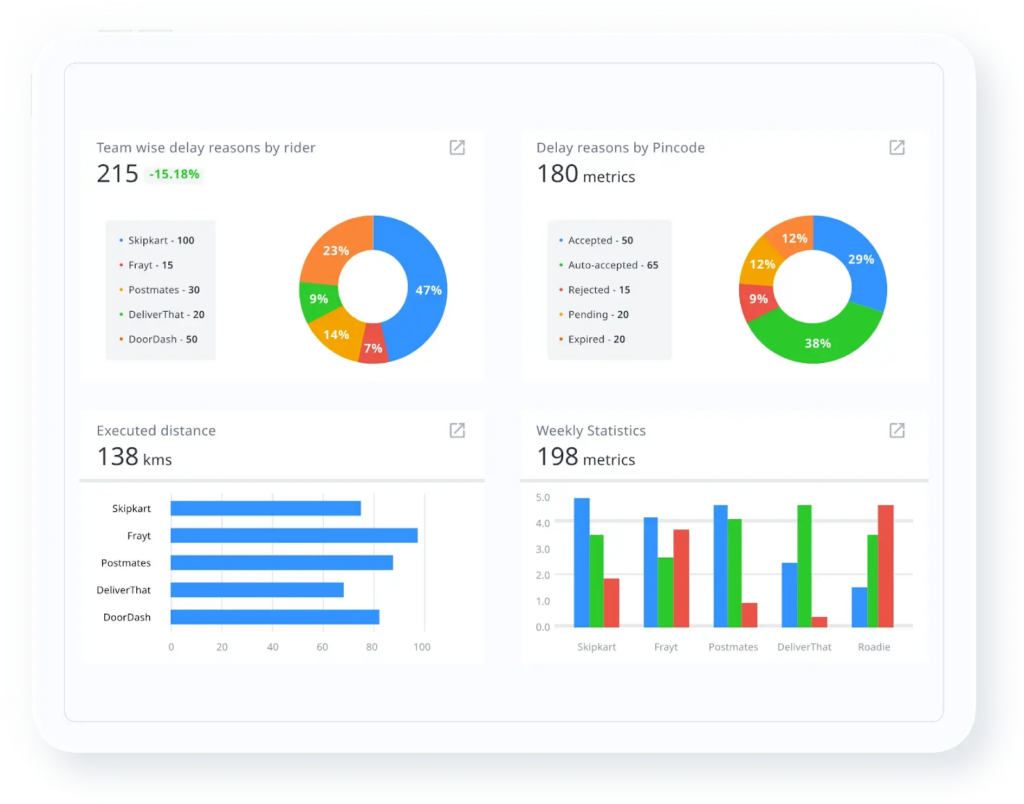
Tracking delivery performance KPIs is only the first step. The real value comes from how quickly teams can act on what those metrics reveal. Advanced analytics helps logistics teams move from retrospective reviews to real-time performance correction.
Detecting Performance Risk During Live Execution
Advanced analytics connects historical KPI trends with live execution data. Instead of reviewing on-time delivery or cost metrics after routes are completed, you can detect early signals such as delayed departures, route congestion, or capacity imbalance while deliveries are still in progress.
For example, drops in the on-time delivery performance KPI during mid-day execution often indicate route sequencing issues or unexpected delays. Analytics surfaces these risks early, allowing dispatchers to rebalance routes or reassign stops before service windows are missed.
Turning KPI Data Into Actionable Insights
Actionable insights come from context, not volume. Analytics platforms help teams layer KPIs with route data, vehicle utilization, and exception history to explain why performance deviates.
This allows operations leaders to:
- Identify recurring failure patterns by carrier or region
- Understand which KPIs are most sensitive to route changes
- Prioritize corrective actions that protect service levels and cost targets
When KPI data feeds directly into dispatch and execution workflows, metrics stop being passive reports. They become operational signals that guide real-time decisions.
Key Performance Indicators in Logistics Beyond Delivery
While delivery KPIs are crucial, other logistics metrics also impact overall performance. Understanding these connections provides a holistic view:
Upstream Logistics KPIs
- Warehouse Efficiency: Pick and pack accuracy, order processing time
- Inventory Accuracy: Stock availability and cycle count precision
- Transportation Spend: Cost per mile, fuel efficiency, capacity utilization
- Lead Time Variability: Consistency in order-to-delivery cycles
Impact on Delivery Performance
These upstream metrics directly affect delivery KPIs. Poor warehouse efficiency leads to delayed dispatches, while inventory inaccuracies cause order fulfillment issues that impact first-attempt delivery rates.
Building a Data-Driven Culture in Last-Mile Delivery
Improving delivery performance KPIs consistently requires more than dashboards or reporting tools. It depends on how teams use data in daily operations. Many organizations track metrics, but far fewer embed them into decision-making across dispatch, operations, and leadership.
Where Measurement Fails to Influence Execution
The most common issue lies between measurement and action. KPIs are often reviewed weekly or monthly, long after delivery issues have already affected cost and customer experience. Teams end up reviewing results rather than steering execution.
The problem compounds when KPI ownership is unclear. Dispatch teams focus on route completion, operations leaders track service levels, and finance monitors cost metrics, without a shared definition of day-to-day performance priorities.
Embedding KPIs Into Daily Operating Decisions
A data-driven approach brings KPIs closer to execution. High-performing teams focus on a small set of delivery performance KPIs and review them as part of daily operations.
Effective practices include:
- Assigning clear ownership for each KPI across dispatch and operations
- Reviewing KPIs alongside live delivery status, not as standalone reports
- Using trends over time to guide process changes, rather than reacting to single-day results
When KPIs are embedded into daily workflows, teams move from reacting to failures to actively managing delivery performance. This shift is what enables consistent improvement across routes, regions, and carriers.
Financial Implications of Delivery Performance KPIs
Delivery performance KPIs are not just operational indicators. They directly influence cost structure, margin, and long-term profitability. Even small improvements in execution quality can create outsized financial impact at scale.
Linking Delivery KPIs to Cost and Margin
Research from McKinsey & Company shows that logistics costs typically account for 10–15% of total sales for retail and consumer goods companies. Within this, last-mile delivery can represent up to 53% of total shipping costs. As a result, KPIs tied to delivery execution carry significant financial weight.
Examples of direct financial impact include:
- Higher on-time delivery performance reduces expedited shipping costs, SLA penalties, and recovery spend.
- Stronger first-attempt delivery rates cut reattempt expenses, which can increase per-order costs by 20–30%.
- More reliable deliveries lower customer support demand, with poor delivery performance driving up to 40% of avoidable service contacts in ecommerce logistics (Gartner).
Turning Execution Visibility Into Profitability
Visibility is what allows KPI improvements to translate into sustained financial gains. According to PwC, companies using real-time logistics visibility tools achieve reductions in overall transportation costs within the first year.
When delivery performance KPIs are monitored alongside live execution data, you can:
- Prevent cost overruns before they materialize
- Reduce reliance on last-minute carrier substitutions
- Improve asset utilization without adding fleet capacity
The financial advantage comes from intervening during execution, not reviewing results after delivery is complete.
What Good Delivery Performance Looks Like
Strong delivery performance is reflected in consistent execution across carriers, regions, and service models, supported by clear accountability and predictable operational outcomes.
| Dimension | What High-Performing Operations Demonstrate | Why It Matters |
|---|---|---|
| On-Time Delivery Performance | Measured consistently against committed customer windows across all carriers and regions | Indicates service reliability and customer trust |
| First-Attempt Delivery Rate | Tracked uniformly across routes, regions, and service types | Reduces reattempt costs, fuel usage, and customer friction |
| Cost Per Delivery | Normalized for distance, drop density, and service level | Enables fair cost comparison without penalizing complex routes |
| Delivery Success Rate | Reviewed alongside exception frequency and resolution quality | Reflects overall execution health beyond punctuality |
| Exception Handling Discipline | Issues identified early and resolved during live execution | Prevents service degradation and escalations |
| Execution Stability | Predictable performance across peak and non-peak periods | Signals scalability without increased operational risk |
| Operational Visibility | Clear insight into issues while deliveries are still in progress | Enables intervention before service levels drop |
In short, high-performing carriers score consistently across service, cost, and execution discipline. Strong delivery performance appears stable and controlled, not volatile or reactive
KPIs become execution controls when they guide dispatch intervention, not just post-delivery reporting
When these conditions are met, delivery performance KPIs move beyond reporting tools and support consistent, profitable growth at scale.
Optimizing Delivery Performance: Actionable Steps
Delivery performance KPIs only create impact when they guide execution, not when they sit in reports. As delivery networks scale, gaps between planning, dispatch, and live operations become more costly. On-time delivery, first-attempt success, and cost per delivery all depend on how quickly teams can detect risk and act while routes are active.
Locus helps logistics teams operationalize delivery performance KPIs by connecting real-time visibility with execution control. Dispatchers gain early insight into delays, capacity imbalances, and exception risks, allowing corrective action before service levels or margins are affected.
If improving delivery reliability and cost control are priorities for 2026, see how Locus turns delivery KPIs into execution decisions. Schedule a demo to understand how KPI-led dispatch improves performance at scale.
Why Locus?
- 1.5B+ deliveries optimized globally
- 99.5% SLA adherence rate
- Trusted by 360+ enterprises across retail, e-commerce, 3PL, and CPG
- Unlike other platforms, Locus offers real-time KPI-driven dispatch and carrier benchmarking in a single view
“With Locus, our on-time delivery rate improved by 18% in 3 months, and we reduced operational costs by 15% while maintaining service quality.”
– Logistics Director, Leading Retail Chain
Key Actions for Logistics Leaders
- Benchmark KPIs using standardized definitions across all carriers
- Embed KPI review in daily operations for proactive intervention
- Implement real-time visibility tools for execution control
- Focus on first-attempt delivery rates to reduce operational costs
- Use analytics to identify patterns and predict delivery issues
Frequently Asked Questions (FAQs)
1. How can businesses start tracking delivery performance KPIs?
Start by defining a small set of core KPIs, such as on-time delivery, first-attempt success, and cost per delivery. Apply consistent definitions across carriers and review them alongside daily execution data.
2. What technologies are most effective for improving delivery KPIs?
Execution platforms that combine route planning, dispatch control, and real-time visibility are most effective. They allow teams to act on KPI signals during delivery, not after outcomes are fixed.
3. How do KPIs impact customer satisfaction in delivery services?
KPIs like on-time delivery and first-attempt success directly influence customer experience. Missed windows and reattempts often lead to lower satisfaction and increased support interactions.
4. What are the common challenges when implementing KPI systems in logistics?
The biggest challenges include inconsistent KPI definitions, delayed reporting, and a lack of ownership across teams. Without standardization, KPIs become difficult to compare and act on.
5. How can advanced analytics improve delivery performance?
Advanced analytics helps identify risk patterns, predict delays, and prioritize corrective actions. When paired with live execution data, analytics turns KPIs into actionable operational signals.


Retail & CPG
What Is Retail Distribution? Strategy & Best Practices

Sep 23, 2026
Discover what retail distribution is, why it matters, and key strategies. See real examples and how Locus simplifies distribution in 2025.
Read more
General
Using Fleet Management Analytics for Strategic Advantage
Sep 23, 2026
Fleet management analytics helps enterprises reduce costs, improve safety, and guide decisions. Learn how analytics supports fleet operations at scale.
Read moreInsights Worth Your Time




















Optimizing Delivery Performance: Key KPIs for 2026