


E-Commerce
D2C trends in Europe for 2026: what ecommerce and logistics leaders need to know

Key Takeaways
- Europe remains a large and resilient ecommerce market: European B2C ecommerce turnover rose 7% in 2024, from €784 billion to €842 billion, according to Ecommerce Europe / EuroCommerce, European E-commerce Report 2025.
- Online buying is mainstream, not niche: 73% of Europe’s population aged 16 to 74 purchased online in 2024, according to Ecommerce Europe.
- The market entered 2026 with continued momentum: European B2C ecommerce growth for 2025 was projected at 7%, according to Ecommerce Europe / EuroCommerce.
- Scale is concentrated but diverse: 78% of European B2C ecommerce turnover in 2024 came from the EU-27, according to Ecommerce Europe / EuroCommerce, which matters for network planning, carrier strategy, and VAT-compliant fulfilment design.
- Growth quality matters as much as topline growth: after inflation, the real growth rate of European B2C ecommerce in 2024 was 4.6%, according to Ecommerce Europe / EuroCommerce, which is why cost-to-serve, returns control, and repeat purchase matter.
- In 2026, the most important D2C trends are operational as well as commercial: AI changes demand patterns, omnichannel changes order orchestration, and faster delivery expectations change dispatch, routing, inventory placement, and SLA management.
- D2C brands that win in Europe usually combine owned channels, marketplaces, social commerce, and flexible fulfilment rather than relying on a single route to market.
- Delivery promise accuracy, first-attempt success, on-time delivery, return cycle time, and emissions per order are now board-level D2C KPIs, not just fulfilment metrics.
“87% of retail brands in the U.K. and the U.S. have said they plan to launch a D2C channel at some point in the future, while 23% said they will do so within the next 12 months, according to research by Brightpearl.”
One of the worst affected regions due to the COVID-19 pandemic is the European Union.
The pandemic has pushed brands to reassess their routes to customers. Direct to Consumer is one such route. It blends smart logistics and technology to cater to the ever-growing demands of the customer.
D2C trends at a glance
| Trend | Europe-specific implication | Operational impact | KPI to watch | Relevant capability |
| AI-led discovery and personalisation | More volatile and personalised order demand across markets | Better forecasting, promise setting, exception handling | Conversion rate, forecast accuracy, promise accuracy | Demand-aware fulfilment and dispatch planning |
| Omnichannel D2C | Owned sites, stores, pickup, marketplaces and social need one operating model | Unified inventory, order orchestration, channel-aware SLAs | Cost per order, SLA adherence | Omnichannel order and delivery orchestration |
| Retention over acquisition | CAC pressure shifts focus to repeat purchase and loyalty | Post-purchase experience becomes a revenue lever | Repeat purchase, LTV, delivery-related contacts | Delivery visibility and reliable execution |
| Creator and community commerce | Social demand spikes can be sudden and localised | Capacity planning and regional routing matter | Conversion by campaign, order surge response | Flexible dispatch and capacity allocation |
| Marketplace coexistence | Brands need reach without losing margin or data | Channel-specific cut-offs, carriers, and returns workflows | Marketplace SLA compliance, carrier performance | Multi-channel delivery execution |
| Faster, more predictable delivery | Checkout promise quality affects conversion and trust | Dynamic route planning and regional inventory placement | On-time delivery, window adherence | Route optimisation and promise management |
| Flexible fulfilment networks | Cross-border trade-offs increase | 3PL, carrier and node selection become strategic | Cost-to-serve, order cycle time | Network-aware fulfilment planning |
| Returns as strategy | High-return categories need profitable reverse logistics | Pickup orchestration, inspection, restocking, refund speed | Cost per return, return cycle time | Reverse logistics orchestration |
| Sustainability as operating metric | Reporting and customer expectations are rising | Delivery density, fleet mix and routing efficiency matter | Emissions per delivery, miles per stop | Efficient routing and fleet planning |
| Data-driven dispatch automation | Manual planning cannot scale with channel complexity | Real-time carrier allocation and exception control | Planner productivity, failed-delivery rate | Automated dispatch management |
Editorial methodology
This article was updated in 2026 using current public sources from Ecommerce Europe, EuroCommerce, Shopify Enterprise, DHL, and Locus educational resources. We distinguish between:
- Observed performance such as 2024 ecommerce turnover and online purchasing rates
- Historical projections such as the 2025 European growth outlook reported by Ecommerce Europe / EuroCommerce
- Operational interpretation for fulfilment, delivery, returns, and last-mile planning in Europe
Limitations note: D2C definitions vary by company and category. Not every trend applies equally across apparel, FMCG, grocery, health, pet, lifestyle, and consumer goods. The right fulfilment model depends on order density, basket size, return rate, cross-border exposure, and service-level promise.
What is a D2C brand?
D2C Brands are companies that produce and sell their products in direct digital marketing channels as opposed to selling through an online marketplace or retailer. They seek to engage with their loyal customers directly through their website and social media.
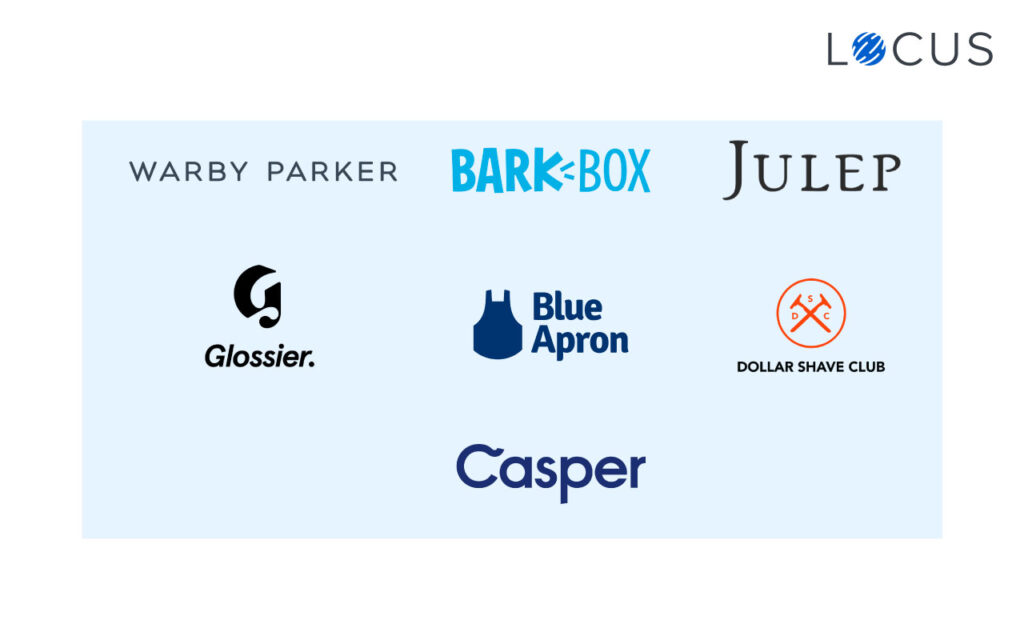
Some Example of D2C brands in Europe are here:
Different terms used for D2C Brands
- Direct Brands
- Digital Native brands
- Vertical Brands
- Micro Brands
- E-commerce or influencer brands
Sectors in Europe that are actively engaged in D2C:
- Hobbies/Lifestyle
- Apparel
- Fashion
- Food
- FMCG
- Healthcare
- Sports and Fitness
- Pet Products
D2C brands have been off to a flying start in countries like the US. But, how is it catching up in Europe? Let’s dive right in!
What are the recent D2C trends in the European Union?

D2C Trends In Europe: “Viewed from a pan-European perspective we see that brands selling direct and marketplaces factor more highly in the consumer’s expectations and experience than do traditional retailers. While retailers remain highly significant in their own markets, we see that pan-European brands rival the in-country giants for impact and performance – we see this trend continuing.” – Ian Jindal, Editor-in-Chief Internet Retailing, European E-commerce Report, 2018.
For the last three years, D2C brands have been mushrooming in European countries.
Trend #1: Rising D2C brands in Europe due to more store closures
Even before the COVID-19 pandemic started, there were rising store closures across Europe. The new wave of digitally-native E-commerce companies was making life tough for big label stores. There was a drastic fall in consumers visiting the top commercial streets in major European cities.
The total store closures in the UK alone was 2692 and store openings were just 1569 according to Pwc UK. The consumers’ evolving preferences for in-home leisure like eating, drinking and entertainment at home spurred this growth.
As small and mid-scale enterprises dominate the UK, the transition towards D2C business model has been quick.
Trend #2: D2C brands partnering with influencers
D2C brands are relying heavily on social media to increase adoption. They are attempting to build a long-lasting and profitable relationship with consumers through social influencers.
A UK-based firm named Gymshark used social media influencers with a strong brand positioning. The firm, with a team of brand ambassador athletes, reached customers across Europe without the need for any wholesale distribution channels.
Some D2C brands only rely on word of mouth. A spectacle brand named Cubitts has completely avoided influencer marketing and relies only on word of mouth.
Trend #3: D2C Brands building communities
Social media is the biggest asset for D2C brands to acquire new customers. A savvy social media presence that can build emotional relationships with customers can go a long way in competing against legacy players in the industry. It might sound simple, but it is a challenging task to create such a presence.
Customers want to know what is happening behind the curtains. Hence, D2C brands are building online and offline communities to reach new audiences.
A London streetwear brand named Alma de Ace is creating compelling social content through interviews with models and videos demonstrating production in factories.
A Sleepwear brand named Despond and Demsey organizes Sunday souk events to enable customers to participate in life-drawing, print-making etc. Beyond engaging existing customers it addresses customers who can’t afford their products.
Trend #4: The proportion of D2C Customers trying new products are higher compared to a regular online population
The adoption of D2C by European countries is quicker and higher compared to the US. D2C customers in the UK always set themselves apart from an average online UK shopper.
78% of heavy D2C purchasers are early adopters of new products compared to 27% of the UK online population. – IAB UK Report, Born Online, 2019.
Not just that, D2C customers turn out to be great brand advocates.
74% of heavy D2C purchasers influence others to buy new offerings compared to 29% of the UK online population. IAB UK Report, Born Online, 2019.
Trend #5: Increasing digital transformation of D2C brands
Top brands in various industries have started to leverage Artificial Intelligence (AI) and data science to target new demographics. Levi Strauss & Co in Europe has launched an AI bot that works as a virtual stylist to help shoppers find jeans that suits them. Their digital transformation has yielded quick results in reaching Gen Z customers.
Levis sales fell across entire Europe as the lockdown began. Though their entire European revenues dropped 68%, their online D2C sales grew by 35%.
H & M, beyond just leveraging AI, has opened 130 new digitally-focused omni-channel stores. Also, they have closed 170 old stores. The use of D2C has enabled them to increase their online sales by 36%.
The D2C order-to-delivery journey
The most effective way to operationalise D2C trends is to map the full journey from order capture to repeat purchase.
| Journey stage | Main risk | What the business needs | KPI | Customer impact |
| Demand and order capture | Demand spike or poor attribution | Channel visibility and forecast updates | Conversion, forecast accuracy | Relevant offers and in-stock confidence |
| Inventory allocation | Wrong stock in wrong node | Inventory visibility and allocation rules | Stockout rate, split shipments | Fewer delays and substitutions |
| Fulfilment location selection | Slow or expensive fulfilment choice | Centralised vs distributed decision logic | Cost-to-serve, cycle time | More reliable delivery dates |
| Delivery promise | Overpromising | Real-time promise engine using stock, cut-offs and carrier capacity | Promise accuracy | Higher trust at checkout |
| Dispatch planning | Manual planning bottlenecks | Automated dispatch and route planning | Planner productivity, route duration | Better delivery consistency |
| Driver execution | Reattempts or poor route adherence | Driver app, real-time updates, proof of delivery | First-attempt success, OTD | Fewer missed deliveries |
| Customer tracking | Visibility gaps | Branded tracking and alerts | Tracking engagement, WISMO contacts | Lower anxiety and higher satisfaction |
| Exception handling | Silent delays | Proactive rerouting and communication | SLA recovery rate | Stronger service recovery |
| Returns and reverse logistics | Slow refunds and high cost | Pickup orchestration, inspection and restocking workflows | Return cycle time, cost per return | More confidence to buy again |
| Post-delivery retention | One-time buyers | Delivery-informed retention and recovery campaigns | Repeat purchase, LTV | Better long-term brand loyalty |
A maturity-based action plan for D2C brands
1) If you are launching a D2C channel
Prioritise checkout delivery promises, fulfilment partner selection, address validation, tracking, and exception communication before expanding channels or service levels.
2) If you are scaling domestically
Focus on dispatch automation, route density, carrier scorecards, cut-off discipline, and reducing cost per order without weakening on-time delivery.
3) If you are expanding cross-border
Add local carrier strategies, VAT and customs readiness where required, local language service flows, regional returns options, and possibly multiple fulfilment nodes.
4) If you are a mature omnichannel brand
Unify inventory, orders, capacity, delivery execution and returns across channels. Optimise cost and service by channel rather than using one operating rule for everything.
5) If you operate in a high-volume or high-return category
Build reverse logistics as a core workflow: return authorisation, pickup orchestration, refund speed, inspection, resale or recommerce, and root-cause analysis by SKU and reason code.
Which KPIs should D2C brands track?
Customer-facing KPIs
| KPI | Why it matters |
| On-time delivery | Directly affects trust and repeat purchase |
| Delivery-window adherence | Important where scheduled or narrow-window delivery is promised |
| First-attempt success | Reduces cost and improves CX |
| Tracking engagement | Signals how well post-purchase visibility is working |
| Delivery-related contacts | Measures friction that drives support cost |
| Repeat purchase after a delivery issue | Shows service recovery effectiveness |
Operational KPIs
| KPI | Why it matters |
| Delivery cost per order | Core profitability measure |
| Cost-to-serve | Shows the true cost by channel, region or promise type |
| Stops per route | Indicates route density and planning quality |
| Route duration | Measures productivity and feasibility |
| Vehicle utilisation | Tracks asset efficiency |
| Failed-delivery rate | Reveals promise, address or execution problems |
| Carrier SLA performance | Essential in multi-carrier environments |
| Return pickup cycle time | Critical for reverse logistics speed |
| Cost per return | Determines whether returns remain commercially sustainable |
| Emissions per shipment or delivery | Helps translate sustainability into an operational metric |
Commercial KPIs connected to logistics
| KPI | Why it belongs in the same dashboard |
| CAC | Expensive acquisition makes fulfilment waste harder to absorb |
| LTV | Delivery quality influences repeat spend |
| Retention rate | A strong post-purchase journey improves it |
| Subscription churn | Delivery failure can accelerate churn |
| Conversion impact of delivery promise | Promise accuracy affects checkout completion |
Benefits of responding to D2C trends early
- Better conversion because delivery promises are realistic and visible
- Lower cost-to-serve through route density, automation and carrier selection
- Stronger repeat purchase because the post-purchase experience is more reliable
- Higher marketplace and channel compliance through rule-based orchestration
- Faster expansion into new European markets with less manual coordination
- Lower failed-delivery and reattempt cost through better address, routing and visibility data
- More sustainable last-mile performance through efficient route planning and consolidated activity
- Stronger returns economics through faster pickup, inspection and restocking workflows
Key features of a D2C-ready fulfilment and delivery stack
A D2C-ready operating stack should support:
- Real-time inventory and fulfilment-node visibility
- Delivery-date and slot promise logic at checkout
- Automated dispatch management
- Dynamic route planning and route optimisation
- Multi-carrier and 3PL orchestration
- Branded order tracking and proactive alerts
- Exception management and service recovery workflows
- Returns pickup orchestration and reverse logistics visibility
- Cost and SLA analytics by channel, region and carrier
- Sustainability measurement, including route efficiency and emissions indicators
Why choose Locus
For European D2C operations, the value of a logistics platform is not abstract. It should help teams make better decisions across planning, dispatch and execution.
Locus is most relevant when you need to:
- plan and optimise delivery routes as order volumes grow
- orchestrate dispatch across owned fleets, 3PLs and carrier partners
- improve delivery visibility and exception handling
- reduce delivery costs while protecting service levels
- support scalable, sustainable last-mile operations across multiple geographies
For D2C brands, that translates into practical gains: better delivery promise accuracy, improved on-time performance, fewer manual planning steps, tighter control over carrier execution, and clearer visibility into cost-to-serve.
The vast potential of D2C brands are yet to be discovered
The true potential of a D2C business model hasn’t yet been explored in Europe. Many e-commerce experts are talking about the lockdown loyalty effect. Consumers will remember brands that have helped them go through these dark days. Hence, brands that use the D2C model with limited investments wisely can engage their audience effectively in the future.
In Europe, delivery cost and time are the major factors that determine D2C success. Logistics delivery optimization software from Locus can add immense value to brands stepping into the D2C world. Even existing D2C brands can attain a competitive advantage in the market through reduced delivery costs and higher on-time deliveries.

References of D2C Trends In Europe Blog:
- https://www.iabuk.com/news-article/new-iab-uk-report-identifies-50-uks-leading-direct-consumer-brands
- https://www.salsify.com/uk-blog/5-european-brands-owning-d2c
- https://www.voguebusiness.com/companies/british-direct-to-consumer-brands-fashion-bfc
- https://www.wundermanthompsoncommerce.com/nl/wat-wij-denken/download/?file_url=/media/filer_public/63/75/63757c17-f456-40bd-b971-14057e94a40d/wtc-paper-marketplaces-2020-final.pdf
- https://www.e-marketing.fr/Thematique/retail-1095/Breves/Tribune-mort-modele-Boucicaut-341400.htm
- https://www.emarketer.com/content/germany-ecommerce-2019
- https://uk.liveareacx.com/blog/direct-to-consumer-brands-unstoppable-startups/
- https://pattern.com/mena/blog/should-you-sell-via-d2c-or-marketplaces-in-europe/
- https://www.retail-week.com/tech/amazon-versus-the-eu-what-are-the-implications-for-retail/7036206.article
- https://www.retailinsiders.nl/docs/77f3cdc4-38b2-4dd2-8938-cb4293cc8c19.pdf
- https://sctimes.io/news/article/7/6568
- https://www.forbes.com/sites/callyrussell/2019/08/29/could-2020-be-a-graveyard-for-dtc-brands/?sh=3d8aefdf6dd0
- https://www.ecdc.europa.eu/en/geographical-distribution-2019-ncov-cases#:~:text=Europe%3A%20405%20044%20deaths%3B%20the,and%20Russia%20(39%20527).
Related Blogs of D2C Model:
Why Retail Brands are Gunning for Direct-to-Consumer Sales
D2C Business Model vs Traditional Retail Business Model
Direct-to-Consumer Selling Trends to Watch in 2020

Infographic by Locus
Share this infographic by using this embed code:
<a href="https://locus.sh/resources/direct-to-consumer-selling-trends/" target="_blank" style="text-align: center; display: block;"><img src="https://locus.sh/assets/img/infographic/resources/direct-to-consumer-selling-trends.jpg" alt="Direct-to-Consumer Selling Trends to Watch in 2020 - Infographics" style="width:100%;height:auto;max-width:750px;margin:auto;"></a><br/>Infographic by <a href="https://locus.sh/">Locus</a>
General
The 11 Essential Last Mile Delivery Metrics Every Enterprise Logistics Leader Needs to Track in 2026

Sep 23, 2026
Discover the 10 essential last-mile delivery metrics that drive enterprise success in 2025, from predictive analytics to cost optimization strategies.
Read more
General
10 Best Routing and Dispatching Software in 2026
Sep 23, 2026
Compare the best routing and dispatch software in 2025. Explore features, pricing, and why Locus is the top enterprise choice.
Read moreInsights Worth Your Time



















D2C trends in Europe for 2026: what ecommerce and logistics leaders need to know