


General
7 Best Carrier Integration Software Platforms for Enterprise Logistics (2026)
Key Takeaways
- Managing 20+ carriers across regions means the integration problem has already become a governance problem: who owns contract reconciliation, SLA enforcement, and exception routing when a carrier misses.
- SMB shipping tools like ShipStation handle labels and rate shopping well. They were not built to digitize carrier contracts, monitor SLA thresholds at the shipment level, or activate a new regional 3PL in days rather than weeks.
- This article compares seven platforms built for enterprise carrier networks, covering API vs EDI connectivity, onboarding speed, contract and rate management, SLA governance, and shipment type coverage across parcel, LTL, bulky, and field service.
- Locus handles enterprise-scale orchestration across captive fleets, contracted carriers, and outsourced 3PLs, with 1,000+ pre-integrated partners and automated carrier selection, contract reconciliation, and exception handling on one platform.
- Descartes is the stronger fit for cross-border freight and EDI-heavy regulated environments.
- ProShip suits high-volume parcel shippers in North America, where certified carrier compliance and label accuracy are the primary cost drivers.
- nShift and Metapack address European retail and e-commerce, with nShift covering broader carrier depth and Metapack focusing on the checkout delivery promise.
- FarEye is worth evaluating when last-mile visibility and customer communication across a hybrid fleet are the primary gaps.
Carrier integration breaks down in predictable ways. A new regional 3PL takes six weeks to onboard because someone has to build the connection from scratch. An invoice dispute drags through three email threads because there is no system of record for what the contract actually says. A carrier blows an SLA, and your team finds out from the customer, not from an alert.
On the surface, these look like day-to-day operational issues. But they’re almost always symptoms of the same underlying gap: a carrier layer that can connect to partners, but can’t govern them.
Most enterprise logistics teams are now managing 15 to 40 carriers across regions, shipment types, and service tiers. At that scale, the platform you choose isn’t just a setup decision, it shows up in margin.
This article compares seven carrier integration software platforms built for that environment, including where each one consistently performs well and where the limits start to show.
What is Carrier Integration?
Carrier integration is the technical and operational layer that connects your internal systems (OMS, WMS, TMS, e-commerce platforms) to the carriers, couriers, and 3PLs moving your freight.
In practice, that includes booking, label generation, tracking, rate comparison, and settlement, ideally managed from a single control point.
For SMBs, this often looks like a handful of API connections to FedEx, UPS, and a local courier, managed through a tool like ShipStation. The scope is contained. In enterprise environments, the architecture is different, and the challenges are not just a larger version of the SMB problem.
Five forces are making carrier integration more complex, and they are accelerating.
- Multi-carrier networks have expanded faster than most integration stacks were designed to handle, with teams adding regional carriers, dark stores, and delivery startups to networks built around just a few national providers.
- 3PL fragmentation adds another layer, since regional fulfillment increasingly runs through subcontracted networks that each come with their own onboarding steps, compliance requirements, and rate schedules.
- SLA penalties are tightening as retail and marketplace agreements hold suppliers to delivery accuracy thresholds with direct financial consequences.
- Manual carrier onboarding, which still takes four to eight weeks in many organizations, becomes a real constraint on how quickly you can enter new markets.
- Also, carrier performance is now tightly tied to margin, because the gap between contracted rates and actual costs, carrier by carrier, compounds across millions of shipments.
The question is not whether to integrate. It is which platform can govern the carrier network you are building, not just connect to it.
For deeper context on how this fits into broader last mile delivery and delivery management strategy, those are worth reading alongside the comparison.
What Separates Enterprise Carrier Integration Platforms From the Rest
At the enterprise level, the feature list is the buying criteria. Platforms tend to look similar on paper, but they diverge in six operational areas where the wrong choice creates problems that compound over time.
Before we get into those differences, it helps to draw a clean line between SMB tools and enterprise platforms.
- SMB shipping tools are built for rate shopping, label generation, and marketplace connectivity. They do that job well.
- What they are not built for is multi-region carrier governance, contract lifecycle management, or shipment-level SLA monitoring and enforcement.
So, if you are evaluating platforms and tools like ShipStation or Easyship that show up on the same shortlist as Locus or Descartes, it is usually not a meaningful trade-off. It is a scope mismatch, and the comparison will break down quickly once you map requirements to real operational needs.
Multi-region Carrier Governance
Most carrier integration platforms are built around a home market and extended outward. Enterprise operations need a governance layer that manages carrier policies, compliance rules, and performance benchmarks across all regions from a single configuration, not separate instances per country.
This includes data exchange standards (API, EDI, or both), local regulatory requirements for freight documentation, and the ability to enforce consistent carrier selection logic regardless of which geography is fulfilling the order.
Contract and Rate Management
Carrier contracts are not fixed. Volume tiers, zone pricing, accessorial fees, fuel surcharges, and seasonal adjustments make rate management a continuous exercise, not a one-time setup.
Platforms that digitize contract parameters and run invoice calculations against actuals reduce billing disputes from weeks of email to automated reconciliation.
The downstream effect on finance overhead is real: one logistics director at a mid-market retailer described their pre-platform reconciliation process as “a spreadsheet that needed its own spreadsheet to explain it.”
SLA Monitoring and Penalty Enforcement
Enterprise-grade platforms monitor carrier-level SLA commitments in real time, flag breaches as they develop rather than after they close, and feed that data into performance scoring that informs future carrier allocation.
The platforms worth evaluating go a step further: they tie SLA data to contract enforcement logic, so a carrier that crosses a breach threshold triggers a reallocation workflow, not just a dashboard update.
Exception Automation
Carrier exceptions (rejected capacity, failed first attempts, weather holds, address errors) require a decision within minutes, not hours. Platforms that surface exceptions without routing them to resolution create alert fatigue.
What you actually need is automation that runs the decision: reassign to an alternate carrier, trigger a customer notification, initiate a re-route, or escalate based on a rule set your operations team controls. For high-volume order fulfillment operations, exception handling is often where the most analyst time disappears.
Stack Integration Depth: TMS, WMS, and OMS
Carrier integration does not run in isolation. Rate selection needs order data from the OMS. Label generation needs package dimensions from the WMS. Freight invoices reconcile against the TMS. Platforms that connect these systems through native APIs or certified prebuilt connectors reduce the middleware debt that otherwise builds up in custom integration projects.
If your team has inherited a point-to-point integration architecture and wants to avoid rebuilding it, this is the dimension where platforms diverge most sharply on day-to-day operational impact.
Shipment Type Coverage: Parcel, LTL, Bulky, and Field Service
Many platforms are optimized for parcels and quietly underpowered for anything else. Operations that include LTL freight, bulky goods delivery, or field service dispatch need carrier selection logic that accounts for load type, vehicle constraints, and service-level requirements specific to those shipment types.
If your network handles more than standard parcels, ask vendors to walk you through a concrete example: how does the rate engine handle a 50 kg two-person delivery requiring installation? That answer separates real coverage from a checkbox.
7 Best carrier integration software platforms for enterprise logistics (2026)
The vendors below reflect the top picks for enterprise operations. Each profile covers what the platform does well, where it runs into limits, and which operational context it was actually built for.
1. Locus
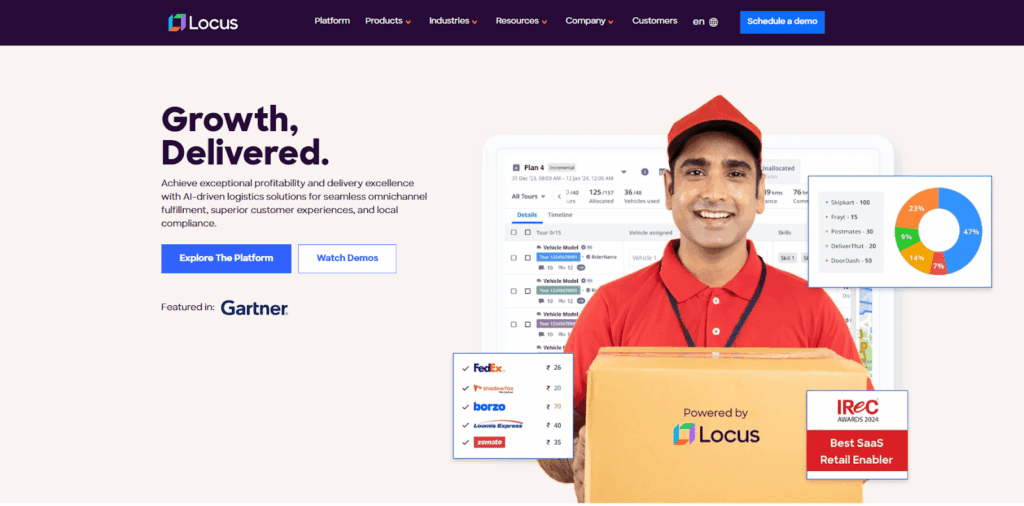
Locus is a delivery orchestration platform built for enterprise logistics teams that need carrier selection, dispatch, performance governance, and contract reconciliation to run on the same system, not stitched together across tools.
The carrier layer sits inside a broader orchestration platform that also handles route optimization, fleet dispatch, and last-mile execution. That matters for operations where the carrier decision and the dispatch decision happen in sequence and need to share context.
The carrier integration module, ShipFlex, connects to 1,000+ pre-integrated carrier and 3PL partners. New carriers come online through a self-serve onboarding portal, which cuts typical carrier activation timelines from weeks to days.
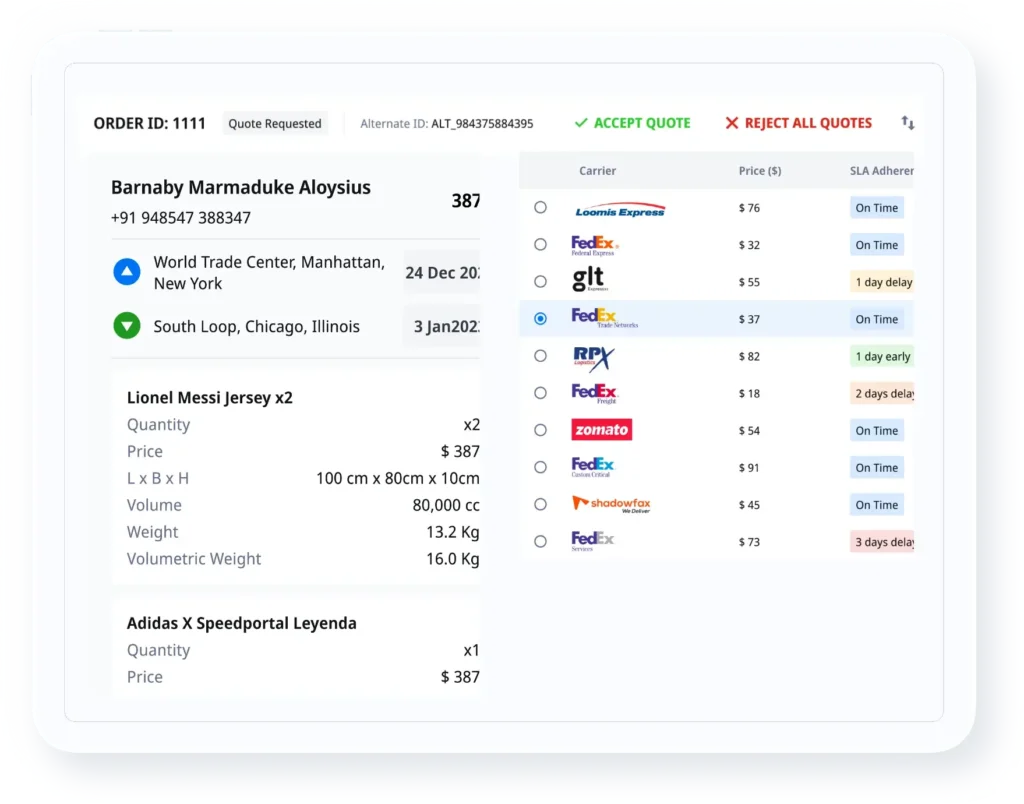
The selection engine runs in real time: when an order is ready to dispatch, it pulls quotes from multiple carriers simultaneously, scores them on price, service level, geographic coverage, available capacity, and historical delivery performance, and assigns the shipment automatically.
Locus processes over 650 million orders annually and operates across 30+ countries, with a 99.5% on-time delivery rate across the platform. For more on how the carrier layer connects to broader logistics execution, the transportation and logistics management overview covers it in detail.
Locus Key Features
- 1,000+ pre-integrated carrier and 3PL partners, with a self-serve carrier onboarding portal that reduces activation timelines from weeks to days
- Real-time carrier selection engine that scores carriers on price, SLA, capacity, geographic coverage, and historical performance
- Digitized contract management with automatic parameter extraction, invoice calculation, and reconciliation, including dispute handling
- Multi-fleet dispatch across captive, contracted, and outsourced fleets on one platform, with driver app workflows and auto-reassignment on exceptions
- End-to-end shipment visibility with predictive ETAs, exception alerts, and AI-validated ePOD capture
- Native API and prebuilt connector support for ERP, OMS, WMS, and TMS systems with no custom middleware required for standard enterprise stacks
- SLA monitoring with breach alerts and carrier performance scoring that feeds into future allocation logic
- Coverage across parcel, LTL, bulky, and field service shipment types
- Enterprise security with SOC2/ISO-aligned controls, GDPR, HIPAA, role-based access, SSO/SAML, and private cloud deployment options
Locus Is Best For
Enterprise retail, e-commerce, FMCG, CEP, and 3PL organizations managing multi-carrier, multi-region operations at high volume, particularly where carrier governance, contract management, and execution automation need to run from a single platform.
Locus Pros
- Contract and rate management depth is the most complete in this category, covering digitization, reconciliation, and dispute resolution in one place.
- Execution layer automation runs exceptions, reassignments, and invoice reconciliation without dispatcher intervention on standard scenarios.
- The 1,000+ pre-integrated carrier network with self-serve onboarding is a real advantage for operations expanding into new markets where carrier activation speed matters.
- Covers parcel, LTL, bulky, and field service within the same platform, which most pure-play carrier integration tools do not.
Locus Cons
- Configuration depth requires a dedicated implementation engagement. This is not a tool you stand up in a week.
- Not designed for SMB or sub-enterprise volume. The governance features are overkill below a certain operational complexity threshold.
Locus Pricing
Locus uses custom enterprise pricing based on order volume, fleet size, carrier network complexity, and the modules required. Pricing is available through a direct conversation with the sales team.
You can request a demo here: Schedule a demo.
2. Descartes

Descartes is a logistics platform with a particularly deep carrier compliance and global connectivity layer. Its core strength is EDI-based carrier integration across ANSI X12, EDIFACT, and proprietary carrier formats, the standards that still govern a significant share of B2B freight in North America and Europe.
For operations in regulated industries (pharmaceutical, automotive, food distribution) or cross-border freight requiring customs documentation and trade compliance, Descartes has infrastructure that most other platforms have not built.
The carrier rate management and procurement tools handle multi-carrier sourcing and tendering, though the real-time selection logic is less automated than orchestration platforms. Tracking and event management are solid at the freight level.
Descartes Key Features
- EDI connectivity across ANSI X12, EDIFACT, and proprietary carrier formats.
- Global trade compliance and customs documentation for cross-border freight.
- Carrier rate management and procurement tools.
- Shipment tracking and event management across LTL and parcel.
- Strong carrier coverage in North America and Western Europe.
Descartes Is Best For
Enterprise operations with cross-border freight volumes, regulated industry requirements, or a carrier base still running on EDI rather than API.
Descartes Pros
- Descartes’ depth on carrier compliance and trade documentation for global freight are well-received among users.
- EDI connectivity spans the broadest range of carrier formats and standards.
- Established track record with large enterprises in regulated sectors.
Descartes Cons
- API-first integrations are less mature. Modern carriers that have moved away from EDI require more configuration work.
- Implementation timelines are long and require significant IT involvement.
- Consumer delivery experience and last-mile orchestration were never part of the platform’s design scope.
Descartes Pricing
Descartes operates on custom enterprise pricing. Specific costs depend on the modules required, carrier network size, and transaction volume. Contact Descartes directly for a quote.
3. ProShip

ProShip, now part of Quadient, is an enterprise multi-carrier shipping platform designed around one core problem: generating compliant labels and accurate rates for high-volume parcel operations at warehouse speed. Its certified carrier integrations (built directly against carrier specifications for FedEx, UPS, USPS, DHL, and a range of regional carriers) reduce billing disputes that come from label format errors or rate calculation mismatches.
Where ProShip earns its place is in environments where the warehouse is processing thousands of shipments per hour and carrier compliance accuracy is a cost driver, not just an operational nicety. The rate-shopping engine is strong for parcels. WMS and OMS integration is well-developed for standard warehouse environments.
ProShip Key Features
- Certified carrier integrations with major parcel carriers built to carrier-specified label and data formats.
- Real-time parcel rate shopping and carrier selection.
- High-throughput label generation for warehouse environments.
- WMS and OMS integration via API.
- Returns label generation and basic tracking.
ProShip Is Best For
Enterprise retailers and manufacturers with high parcel volume processed through warehouse environments, particularly in North America, where carrier compliance accuracy directly affects cost.
ProShip Pros
- Certified integrations reduce rate and label errors that generate billing disputes with carriers.
- Performance at high warehouse throughput is a real differentiator for parcel-heavy operations.
- Straightforward fit where parcel is the primary shipment type and compliance accuracy is the priority.
ProShip Cons
- LTL, bulky goods, and field service delivery are not part of the platform’s architecture.
- Carrier governance, SLA monitoring, and contract management are lighter than what orchestration platforms offer.
- Carrier coverage for emerging markets and regional carriers outside North America is thinner.
ProShip Pricing
ProShip is priced on a custom enterprise basis through Quadient. Pricing varies by carrier count, transaction volume, and WMS integration requirements. Contact ProShip directly for a quote.
4. nShift

nShift was built from the merger of Unifaun, Consignor, Logistra, and Sendify, which gives it a European carrier network that is hard to match: over 1,000 carriers across the UK, Nordics, and continental Europe. For retail and e-commerce operations that fulfill to European consumers and need a broad carrier catalog without custom integration work for each partner, nShift is a practical choice.
The platform covers two layers. On the operational side: carrier booking, label generation, tracking, and returns. On the consumer side: delivery booking at checkout, branded tracking pages, and returns portals. The self-serve carrier onboarding flow means logistics teams can activate new regional carriers without waiting on an engineering queue.
nShift Key Features
- 1,000+ carrier connections, primarily covering Europe.
- Self-serve carrier onboarding portal.
- Delivery booking at checkout with consumer-facing delivery options.
- Branded shipment tracking and customer notifications.
- Returns management portal.
- WMS and OMS integration via API.
nShift Is Best For
European retailers and e-commerce operations that need broad regional carrier coverage, a consumer-facing delivery layer, and a platform their logistics team can manage without heavy IT involvement.
nShift Pros
- The widest European carrier network available without custom integration work per carrier.
- Checkout promise, branded tracking, and returns are among the most developed consumer delivery experience features in the category.
- Self-serve onboarding reduces carrier activation timelines compared to platforms requiring IT-led integration builds.
nShift Cons
- Contract lifecycle management and SLA enforcement are not where the platform invests. Operations with significant carrier commercial complexity will outgrow this layer.
- North American and APAC carrier coverage is significantly thinner than European.
- The platform was built for parcel. LTL freight and field service delivery are not natively supported.
nShift Pricing
nShift offers tiered pricing based on shipment volume and the product modules selected. Pricing is available on request through the nShift sales team.
5. Metapack
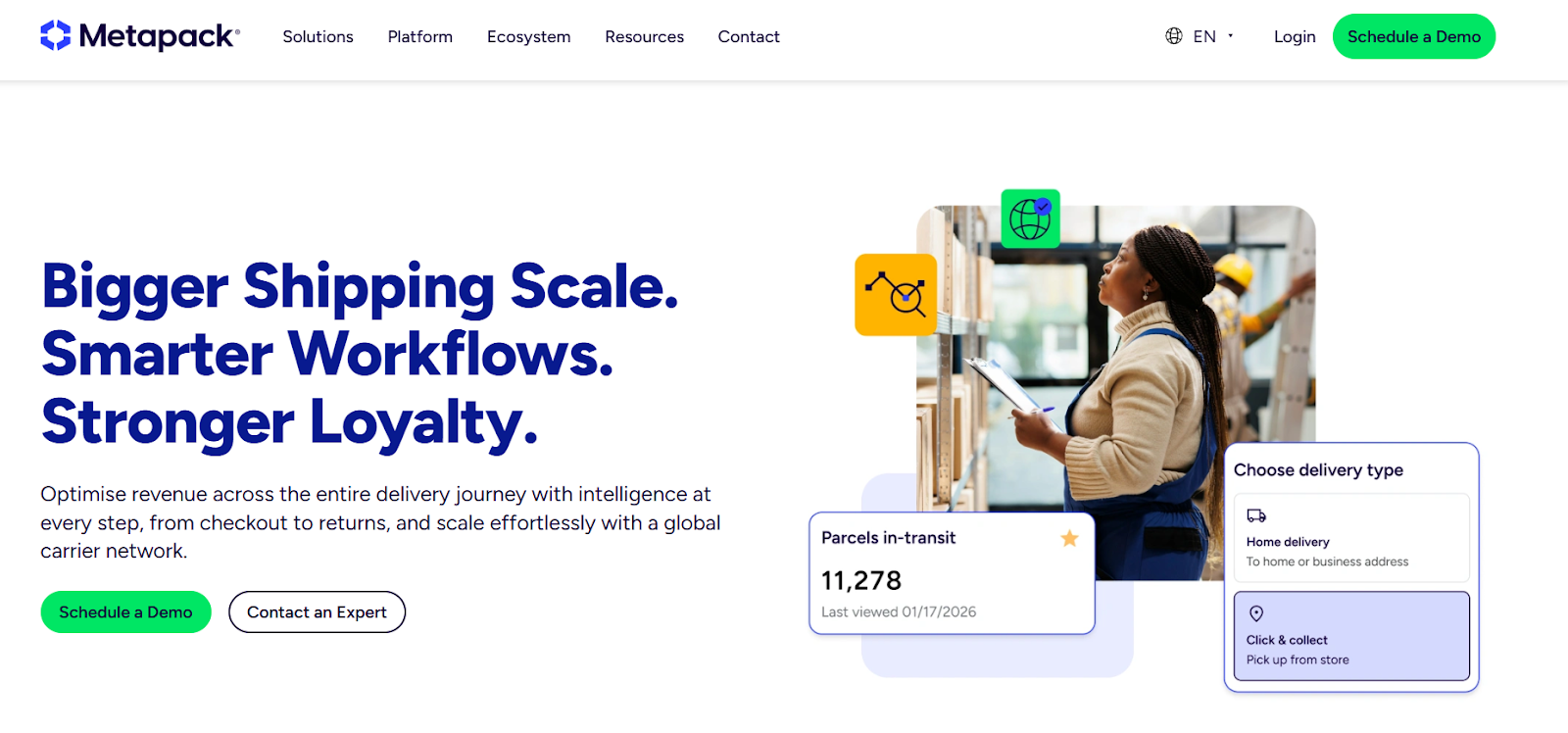
Metapack, acquired by Auctane in 2022, is a carrier management platform built around a specific problem: showing consumers accurate delivery options and dates at checkout, then executing against that promise through its carrier network.
The checkout delivery promise engine factors in carrier cut-off times, service zones, and inventory location to surface options that are actually achievable, not just what the carrier catalog technically offers.
For UK and European retailers whose primary carrier complexity is at the parcel and returns layer, and who need that checkout promise to reduce cart abandonment from delivery uncertainty, the tool addresses the problem directly.
Metapack Key Features
- Checkout delivery promise engine that surfaces carrier options based on live carrier availability and fulfillment constraints.
- Multi-carrier rate selection and label generation across 400+ carriers.
- Branded shipment tracking and consumer notification.
- Returns management with carrier-integrated returns label generation.
- Strong UK and European carrier coverage for retail parcels.
Metapack Is Best For
Enterprise retailers and e-commerce brands in the UK and Europe where the checkout delivery promise is a conversion problem and parcel carrier management is the primary integration challenge.
Metapack Pros
- Checkout delivery promise is one of the most accurate implementations in the market. It addresses a measurable conversion problem rather than a theoretical one.
- Returns flow is tightly connected to the carrier layer, reducing the manual coordination that typically sits between customer service and the carrier relationship.
- UK and European carrier breadth covers the vast majority of retail parcel use cases without additional integration work.
Metapack Cons
- Carrier governance, contract management, and SLA enforcement are thin. This is a connectivity and consumer experience platform, not an operational governance one.
- Geographic coverage outside the UK and Europe requires assessment market by market.
- Freight complexity beyond standard parcels is out of scope. LTL, bulky delivery, and field service require a different platform.
Metapack Pricing
Metapack is priced on a custom basis through Auctane. Costs depend on shipment volume, carrier mix, and the modules enabled. Contact Metapack directly for pricing.
6. FarEye
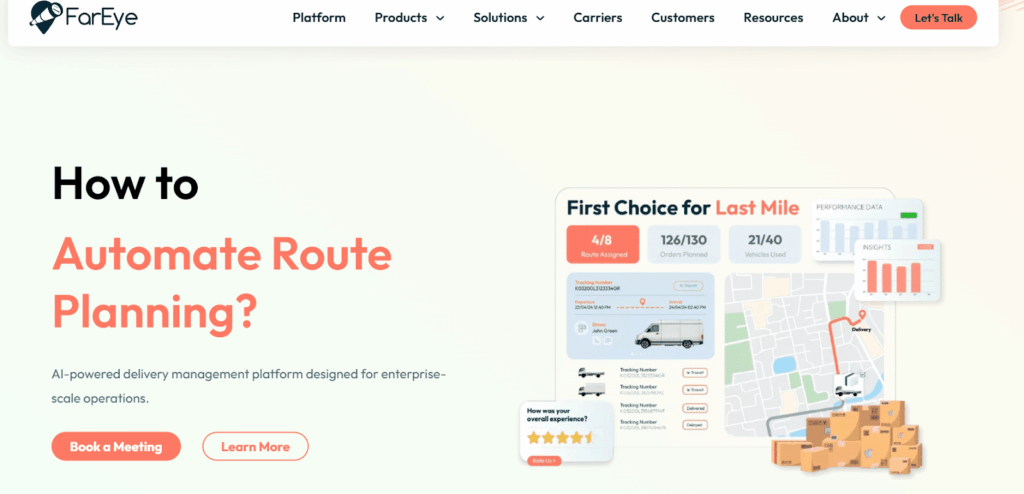
FarEye is a last-mile delivery platform that addresses the orchestration layer between your dispatch operation and your carriers and drivers. Its core capabilities are in real-time tracking, exception detection, and customer communication: the operational surface area that sits between a shipment leaving the facility and arriving at the customer’s door.
For retail logistics and D2C brands running a mix of own-fleet and contracted carrier delivery, FarEye reduces the coordination overhead that typically requires a dispatcher to manually field exception calls and trigger re-routing decisions. The customer notification layer is well-developed, which matters for consumer-facing delivery experiences where communication gaps drive WISMO contacts.
FarEye Key Features
- Multi-carrier dispatch with real-time shipment tracking.
- Exception detection with alert routing.
- Customer notification and delivery experience management.
- Driver and carrier workflow apps.
- API and webhook integrations with OMS and WMS.
- Carrier performance analytics.
FarEye Is Best For
D2C brands, mid-market retailers, and logistics providers running hybrid own-fleet and contracted carrier models where real-time visibility and exception communication are the primary operational gaps.
FarEye Pros
- Exception management and real-time event-driven alerting are the strongest capabilities on the platform.
- Customer communication is tightly integrated with carrier tracking events, which reduces manual WISMO handling.
- Faster to deploy than full orchestration platforms for standard D2C and retail use cases.
FarEye Cons
- Contract management and carrier rate governance are not core features. Operations with significant carrier commercial complexity will hit limits quickly.
- Scalability at very high order volumes has been flagged in user reviews as an area where performance degrades.
- LTL, bulky, and field service are not supported natively.
FarEye Pricing
FarEye is priced on a custom enterprise basis. Costs are determined by order volume, the number of carrier and fleet integrations, and the modules deployed. Contact FarEye directly for a quote.
7. ShipStation (SMB reference point)
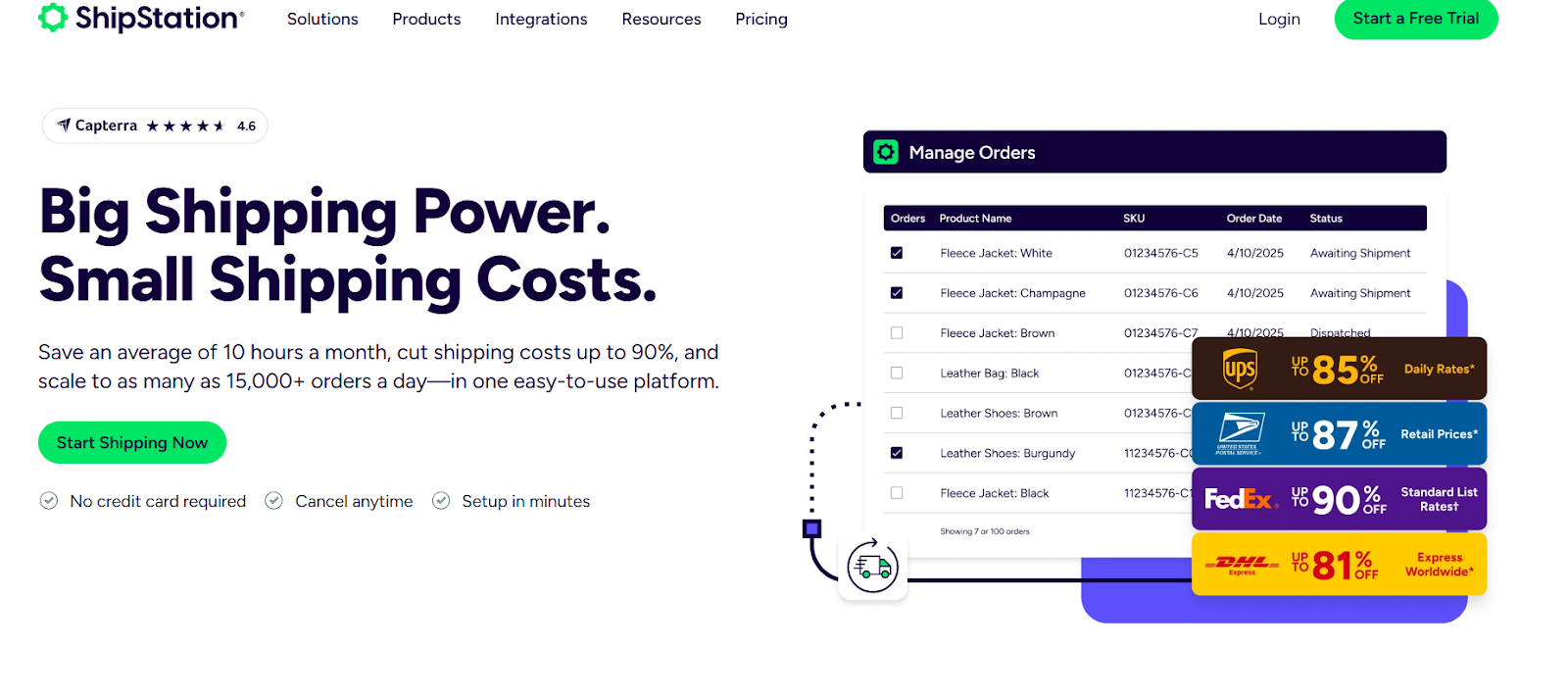
ShipStation is a widely used shipping platform for growing e-commerce businesses. It connects to major carriers and online marketplaces, consolidates orders across sales channels, generates labels, shops rates, and handles basic tracking. For a business shipping hundreds to a few thousand orders a month, it does what it needs to do.
ShipStation does not manage carrier contracts, enforce SLAs, automate invoice reconciliation, handle LTL or bulky freight, or integrate natively at the depth that TMS, WMS, and ERP environments require. There is no carrier governance layer. The platform connects to carriers but does not govern them.
When an organization grows beyond a certain order volume or carrier complexity, it tends to hit ShipStation’s ceiling in specific, predictable ways: manual carrier billing reconciliation, no SLA visibility, limited ability to add regional carriers without custom work, and no exception automation.
ShipStation Key Features
- Multi-carrier rate shopping and label generation.
- Marketplace integrations across Amazon, Shopify, eBay, Etsy, and others.
- Basic shipment tracking and customer notifications.
- Returns label generation.
- Automation rules for basic order routing.
ShipStation Is Best For
SMB e-commerce sellers consolidating multi-channel orders and accessing carrier rates without a complex integration project.
ShipStation Pricing
ShipStation starts at $9.99/month on its entry-level plan, with higher tiers unlocking additional shipments, users, and automation features. Enterprise teams evaluating this alongside orchestration platforms should note the ceiling: pricing scales with shipment volume, but the governance capabilities do not.
Try Locus as Your Carrier Integration software
The decision between these platforms comes down to what you are actually trying to govern. If carrier integration means connecting to carriers and generating labels, several tools on the list handle that adequately.
The SMB vs enterprise distinction matters here more than in most software categories, because the operational complexity difference is qualitative, not just quantitative. Adding more orders does not just slow down an SMB tool. It exposes gaps in governance, visibility, and automation that the tool was never designed to fill.
For enterprise teams evaluating options: start with your carrier count, shipment type mix, and where analyst time is disappearing. If the answer is contract reconciliation, SLA tracking, or onboarding new regional partners, those are the dimensions that separate orchestration platforms from connectivity tools.
Locus is built for that environment. The order management and dispatch execution layer sits alongside the carrier integration module, which means carrier decisions and fulfillment decisions run through the same system rather than being coordinated across it.
See how Locus handles carrier management at scale: book a demo!
Frequently Asked Questions (FAQs)
1. What is the difference between an SMB shipping tool and an enterprise carrier integration platform?
SMB tools like ShipStation handle label generation, rate shopping, and marketplace connectivity well. Enterprise platforms add contract lifecycle management, SLA monitoring and enforcement, invoice reconciliation, exception automation, and multi-region carrier governance. The clearest signal you need the latter: your team is spending significant time on carrier billing disputes, manual exception coordination, or onboarding new carriers for market expansion.
2. How does API integration differ from EDI for carrier connectivity?
API integration uses real-time calls (typically REST or webhook) to exchange shipment data with carriers. It is faster to implement, easier to maintain, and better suited to real-time rate shopping and exception handling. EDI uses standardized batch transaction formats (ANSI X12, EDIFACT) that have governed B2B freight connectivity for decades.Most large carriers support both.
3. How quickly can enterprise teams activate a new carrier?
This depends almost entirely on whether the platform has a pre-built integration for that carrier. Platforms with large pre-integrated carrier networks (Locus connects to 1,000+ carriers, nShift covers a comparable number in Europe) can activate a known carrier through a self-serve portal in days. Custom integrations for proprietary carrier systems or regional partners without standard API documentation typically take four to eight weeks and require engineering involvement.
4. Is carrier integration software the same as a TMS?
Not exactly, though the line is blurring at the enterprise level. A TMS typically handles transportation planning, freight procurement, load optimization, and carrier management as part of a broader logistics suite. Carrier integration software focuses on the connectivity and execution layer between your systems and your carriers. Platforms like Locus increasingly cover both. The transportation management functions sit alongside carrier orchestration, contract management, and dispatch execution on one platform, which is a different architecture than point-to-point carrier connectivity.
5. What are the highest-risk areas when switching carrier integration platforms?
Three areas concentrate most of the migration risk. First, carrier re-onboarding: if your new platform does not have pre-built integrations for your current carrier set, you are rebuilding those connections. Second, contract data migration: carrier contract parameters, rate tables, and SLA thresholds need to be reproduced accurately in the new system, or your invoice reconciliation starts wrong from day one. Third, stack re-integration: OMS, WMS, and TMS connections need to be re-tested against the new platform’s APIs. Platforms with self-serve carrier onboarding and certified prebuilt connectors for major ERP and WMS systems reduce migration complexity materially. Ask vendors to walk through the specific integration path for your stack before signing.


General
SLA Economics: The Real Cost of Your Delivery Promises

Mar 9, 2026
Same-day promises aren’t free. Learn how to model SLA cost, performance, and revenue to protect margins and design profitable delivery tiers.
Read more
General
What Is a Carrier Operation Management Platform? Dispatch, Visibility, Exception Handling, and Analytics

Mar 10, 2026
A carrier operation management platform centralizes dispatch, real-time visibility, exception handling, and carrier analytics in one place. Here's how it works and why it matters.
Read moreInsights Worth Your Time




















7 Best Carrier Integration Software Platforms for Enterprise Logistics (2026)