


Blog
Logistics Transportation Cost: Types & How to Calculate


Key Takeaways
- Transportation costs typically consume over 50% of shipping expenses in last-mile delivery, making it crucial for businesses to optimize this final phase of distribution.
- Package characteristics (weight, size, density) and delivery speed requirements significantly impact transportation costs, with expedited services and special handling driving up expenses.
- Failed deliveries can quadruple last-mile costs, highlighting the importance of successful first-attempt deliveries through proper time window scheduling and customer communication.
- Locus’ Transportation Management System helps companies reduce costs through automated route optimization, carrier selection, and real-time fleet performance monitoring.
Quick Answer: What Is Logistics Transportation Cost?
Logistics transportation cost is the total expense a business incurs to move goods, raw materials, finished products, or employees from one location to another. It includes direct costs such as fuel, driver wages, maintenance, and tolls, as well as freight charges, insurance, warehousing, packaging, customs, duties, technology, and administrative overheads.
For logistics leaders, the priority is not only calculating total transport spend. The more important question is how that spend breaks down by route, stop, unit, customer, zone, carrier, lane, and service level. This is where cost-to-serve analysis becomes critical.
Transportation costs are shaped by multiple operating decisions: route design, fleet utilization, load planning, carrier contracts, delivery density, dispatch quality, service-level commitments, and exception handling. Modern logistics teams use Transportation Management Systems, dispatch automation, and AI-powered route optimization to control these costs continuously rather than after the invoice arrives.
In the midst of an outdoor movie screening of “Trucks,” a film about a town overrun by driverless trucks, a person from the crowd, who runs a transport service company, jokingly mentioned that while phantoms could handle the task, they couldn’t effectively control transportation costs.
Want to know how to control transportation costs, and make each delivery profitable? Click this!
Managing a transportation business and its costs is no easy task. Every transport business must identify if they are spending the right amount on the transportation expenses. To achieve this, calculating and monitoring transport costs becomes essential. Join us as we delve into the world of transport cost management.
What is the Transportation Cost in Logistics?
Transportation cost is incurred for a business to transport finished products, raw materials, and employees. It is the money an enterprise takes to transport goods or services to customers on time. When we say transportation, it includes all services like air, road, water, railways, and intermodal transport.
Transport cost is the most critical cost that determines the profitability of an enterprise involved in a logistics operation. Keeping these low helps companies improve the profitability of their business.
Transportation costs vary from business to business and may consume significant revenue for a third-party logistics provider or a distribution company. A software service company must only transport a few sales reps or technicians.
What are the types of Transport Costs?
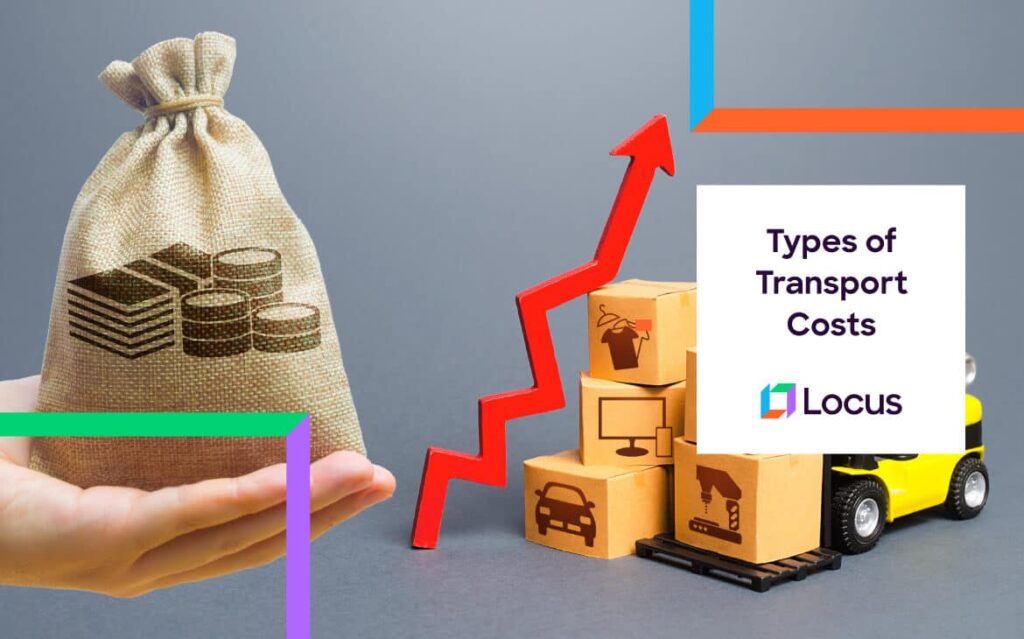
The transport costs are categorized into six types based on the expenses borne by the trucking company. They are:
1. Freight transportation costs
Freight transportation costs are incurred from the large-scale movement of products and goods. It is calculated based on the distance goods travel from the pickup point to the destination point. The farther a business transports a good, the higher its transport costs will be, since workforce, fuel, and mileage is high in these scenarios. It is the actual shipping costs calculated for delivery, pickup, handling, billing, insurance, and collecting.
2. Last-mile delivery costs
Last-mile delivery is the final phase of the supply chain process, where the product is delivered to the customer from the nearest warehouse. It is also the most expensive part of the supply chain. A recent Insider Intelligence survey confirms this by stating that last-mile delivery contributes to more than 53% of shipping costs. It involves dispatching orders to thousands of customers, necessitating businesses to handle more vehicles, delivery routes, drivers, and money.
Willing to find out problems and solutions in last-mile delivery? Click here!
3. Fixed costs
Expenses like driver wages, tax, depreciation, general supervision charges, salaries of operational managers, and insurance are borne by the owner even if the vehicles aren’t operated.
4. Vehicle operating and running costs
Vehicle operating and running costs are variable costs that depend on the number of trips and distance covered. These costs arise during the vehicle’s operational period, which is why they are referred to as running costs.
5. Vehicle maintenance costs
Vehicle maintenance costs are expenses in maintaining the vehicle’s health, including its wear and tear, overheads, and necessary repairs. It includes both regular maintenance and unexpected expenses involved in vehicle repairs. These costs include depreciation and insurance costs.
6. Employee transport costs
Employee costs are expenses borne when an employee (sales rep or field service technician) travels to various customer locations. These costs can increase if your business requires on-field technicians working on post-sales service, repair or maintenance.
Key Features to Look for in Transportation Cost Optimization Software
A Transportation Management System or delivery orchestration platform should help logistics teams reduce cost without compromising service quality.
Important capabilities include:
- Multi-Constraint Route Optimization
The system should optimize routes using real-world constraints such as vehicle capacity, driver shifts, delivery windows, service times, traffic, order priority, SKU handling rules, and hub throughput. - Automated Dispatch Planning
Automated dispatch reduces manual planning effort and improves route consistency. It helps planners assign the right order to the right vehicle, driver, route, or carrier. - Load and Capacity Optimization
The platform should improve load factor by matching orders to available vehicle capacity, route density, delivery sequence, and shipment attributes. - Real-Time Tracking and Exception Management
Real-time visibility helps teams respond to traffic delays, missed windows, customer unavailability, route deviations, and delivery failures before they become expensive escalations. - Carrier Allocation and Tendering
For businesses using multiple carriers, the system should compare cost, capacity, service performance, and lane suitability before assigning shipments. - Cost Analytics and Dashboards
The software should track cost per route, stop, delivery, unit, mile, lane, customer, carrier, and zone. It should also highlight cost variance and inefficiency. - Scenario Planning
What-if simulations help logistics teams evaluate the impact of fuel price changes, order volume spikes, new fulfillment centers, delivery promise changes, and carrier rate adjustments. - Customer Communication
Automated notifications, live tracking, delivery window selection, and proof of delivery help reduce failed deliveries and customer support costs.
These three sections are the strongest additions because they introduce new concepts (quick answer, worked example, software evaluation criteria) that the original article doesn’t already cover, so you won’t end up with repetitive content.
How to calculate the Transport Cost in Logistics?
Transport cost in logistics is a combination of fixed, variable, and indirect expenses tied to moving goods. A clear formula-driven approach helps businesses calculate total costs, compare alternatives, and identify savings opportunities.
Main Cost Components
When calculating, consider all expense categories:
- Fuel costs – mileage × fuel price per unit
- Vehicle maintenance and repairs – servicing, tires, breakdowns
- Driver wages and benefits – salaries, overtime, allowances
- Freight charges – carrier rates based on weight, volume, or distance
- Packaging and handling – pallets, wrapping, loading/unloading
- Warehousing costs – storage, cross-docking, material handling
- Insurance premiums – goods in transit, vehicle, liability
- Customs and duties – cross-border tariffs, clearance fees
- Tolls and fees – toll roads, permits, regulatory charges
- Administrative overheads – dispatch planning, IT systems, management
Step-by-Step Calculation Process
Transport cost calculation follows a sequence of steps, each focusing on a specific cost component and how it contributes to the overall logistics spend.
- Calculate direct transportation costs
Direct costs are the core expenses directly tied to moving goods, such as fuel, maintenance, driver wages, and tolls.
Tracking these helps businesses measure the true operational cost of each trip.
Formula:
Direct Costs = (Fuel Consumption × Fuel Price) + Vehicle Maintenance + Driver Wages + Tolls
- Add freight charges
Freight charges are payments made to carriers or 3PL providers for transporting shipments based on distance, weight, or volume.
These represent the largest external cost and help compare carrier rates across modes.
Formula:
Freight Charges = Carrier Rate × (Shipment Weight or Volume × Distance)
- Include indirect costs
Indirect costs cover supporting activities not tied to a single trip—such as insurance, customs, warehousing, packaging, and admin overhead.
Ignoring these leads to underestimating the actual logistics spend.
Formula:
Indirect Costs = Insurance + Customs + Warehousing + Packaging + Admin Overheads
- Derive total transport cost
The total transport cost is the complete expense of moving goods, combining direct, freight, and indirect costs.
It provides the full financial picture needed for budgeting and pricing.
Formula:
Total Transport Cost = Direct Costs + Freight Charges + Indirect Costs
- Calculate per-unit transport cost
Per-unit cost measures the expense per package, unit, or ton-mile delivered.
It helps compare efficiency across shipments, regions, or transport modes.
Formula:
Cost per Unit = Total Transport Cost ÷ Number of Units Delivered
Accurate calculation matters for the following reasons:
- Provides visibility into hidden cost drivers
- Helps compare modes (road, air, rail, sea)
- Identifies cost-heavy areas like last-mile delivery
- Enables smarter pricing and budget forecasting
Manual calculation is prone to error. AI-driven tools like Locus’s route optimization makes this process dynamic by:
- Calculating costs per route and vehicle in real time
- Running what-if simulations for changing fuel prices, order volumes, or delivery windows
- Reducing empty miles through automated dispatch optimization
- Giving decision-makers predictive insights to proactively control costs
Worked Example: Calculating Transportation Cost
The following example is illustrative and uses sample numbers to show the calculation method.
Assume a company runs one delivery route with the following costs:
| Cost item | Amount |
|---|---|
| Fuel consumption × fuel price | $180 |
| Vehicle maintenance allocation | $60 |
| Driver wages | $140 |
| Tolls | $20 |
| Freight charges from carrier | $300 |
| Insurance allocation | $25 |
| Warehousing allocation | $75 |
| Packaging | $40 |
| Admin overheads | $30 |
Step 1: Direct costs
Direct Costs = $180 + $60 + $140 + $20 = $400
Step 2: Freight charges
Freight Charges = $300
Step 3: Indirect costs
Indirect Costs = $25 + $75 + $40 + $30 = $170
Step 4: Total transport cost
Total Transport Cost = $400 + $300 + $170 = $870
If the route delivers 145 units:
Cost per Unit = $870 ÷ 145 = $6.00
If the same route completes 29 successful stops:
Cost per Stop = $870 ÷ 29 = $30.00
This level of calculation enables a logistics team to compare routes, delivery zones, carriers, and service levels using the same cost logic.
Comparing Per-Route, Per-Stop, Per-Mile, and Per-Unit Cost Models
Different cost models answer different operational questions. A mature transportation cost programme typically uses more than one metric, because route productivity, distance efficiency, delivery density, and shipment profitability are not interchangeable.
| Cost model | Basic formula | Best used when | Operational decision it supports |
| Cost per route | Total route cost ÷ Number of routes | Comparing planned versus actual route performance | Route design, dispatch planning, route consolidation, and vehicle assignment |
| Cost per stop | Total route cost ÷ Number of successful stops | Measuring last-mile delivery efficiency and service density | Stop sequencing, delivery density improvement, and territory balancing |
| Cost per mile | Total transport cost ÷ Miles travelled | Evaluating distance-based efficiency across lanes or fleets | Fleet utilisation, carrier comparison, fuel impact analysis, and lane-level performance |
| Cost per unit | Total transport cost ÷ Units delivered | Understanding profitability at shipment, SKU, order, or customer level | Pricing, cost-to-serve analysis, customer segmentation, and fulfilment strategy |
For example, a long-haul route may have a high cost per route but an acceptable cost per mile if the vehicle is well utilised. A dense urban delivery route may have a low cost per stop but a higher cost per mile because of congestion, parking time, and service duration. Comparing these models together gives logistics teams a more accurate view of what is transportation cost at the operational level.
NEW SECTION
Transportation Cost Examples by Industry and Network Type
Transportation cost drivers vary sharply by industry and delivery network design. The same cost model will not produce the same insight for a retail last-mile network, a CPG distribution operation, and an e-commerce parcel delivery network.
| Network type | Dominant cost drivers | What teams should measure closely |
| Retail last-mile delivery | Delivery density, time windows, driver productivity, failed deliveries, customer availability, and service exceptions | Cost per stop, first-attempt delivery rate, on-time delivery, route adherence, and reattempt cost |
| CPG distribution | Vehicle fill rate, route length, store delivery windows, loading and unloading time, and distributor or retailer appointment constraints | Cost per route, cost per case or unit, load factor, detention time, and route density |
| E-commerce parcel delivery | Parcel volume volatility, peak-season capacity, address accuracy, residential delivery fees, returns, and carrier surcharges | Cost per parcel, accessorial spend, failed delivery rate, carrier performance, and zone-level cost |
These examples show why transport cost management should be tied to network type. A CPG operator may gain more value from improving load factor and appointment compliance, while an e-commerce operator may focus on surcharge control, address quality, carrier allocation, and delivery exception reduction.
NEW SECTION
How to Benchmark Transportation Costs Against Industry Standards
Benchmarking helps logistics teams determine whether transport costs are structurally high, temporarily inflated, or simply aligned with the operating model. Rather than comparing only total spend, enterprises should benchmark transportation performance at multiple levels.
Key metrics to benchmark include:
- Cost per mile by lane, fleet type, carrier, geography, and service level
- Cost per stop by route density, delivery area, time window, and customer segment
- Cost per unit by shipment profile, SKU category, order size, and fulfilment location
- Accessorial spend as a share of total freight cost
- On-time delivery performance alongside cost metrics to avoid false savings that damage service quality
- Failed delivery rate and reattempt cost by route, customer type, and delivery promise
- Route density by stops per route, units per route, and distance per successful delivery
Effective benchmarking should compare current performance against:
- Historical internal baselines to identify cost drift over time
- Peer network performance across similar routes, regions, carriers, or business units
- Carrier contract terms to detect invoice variance, surcharge leakage, and accessorial charge patterns
- Industry standards where available, adjusted for mode, region, service level, shipment profile, delivery density, product type, and customer promise
Cost benchmarks should never be viewed in isolation. A route that appears cheaper may be underperforming on on-time delivery, customer experience, or failed delivery rate. The objective is to find the best cost-to-service balance, not simply the lowest transport cost.
Factors That Affect Transportation Cost
Transportation costs are influenced by core aspects such as distance, package attributes, delivery speed, delivery failures, handling of goods, and destination of goods, each shaping how much a business ultimately spends on logistics.
1. Distance
The farther the distance, the higher the transport cost due to fuel, mileage, and labor. International routes also attract customs fees and surcharges.
Practical ways to manage costs linked to distance include:
- Use route optimization software to generate cost-efficient paths
- Add fulfillment centers closer to high-demand regions
- Maximize truckload capacity on long routes
- Outsource long-distance logistics where efficient
2. Package Weight, Size, and Density
Large, heavy, or low-density shipments cost more to move and often require special handling.
Effective methods to reduce costs from package weight and size include:
- Use lighter, high-quality packaging materials
- Consolidate shipments to balance weight and volume
- Negotiate freight rates based on optimized packaging
3. Delivery Speed
On-demand, same-day, or next-day deliveries raise costs through overtime wages, premium carrier charges, and expensive infrastructure like air freight.
Ways to control costs related to delivery speed include:
- Match delivery speed to customer demand
- Use lower-cost modes (e.g., sea freight) where timelines allow
- Reserve fast delivery for high-value or time-sensitive shipments
4. Delivery Failures
Failed or reattempted deliveries can multiply last-mile costs up to 4x. For example, if customers are unavailable, drivers must revisit, adding fuel and labor costs.
Strategies to minimize costs caused by delivery failures include:
- Allow customers to set delivery time windows
- Send proactive notifications and real-time tracking
- Track and improve First Attempted Delivery Rate (FADR)
5. Handling of Goods
Fragile, hazardous, or perishable goods require special handling and packaging, which raises costs. Examples include insulated boxes for perishables or protective cushioning for glass products.
Steps to reduce costs from special handling requirements include:
- Use smart packaging that balances safety with weight efficiency
- Automate handling guidelines for different SKUs
6. Destination of Goods
Urban deliveries often benefit from better highways and bypasses, while rural deliveries face poor connectivity, higher fuel use, and longer driver hours.
Practical ways to manage costs linked to delivery destinations include:
- Use hub-and-spoke networks to reduce rural route costs
- Apply zone-based pricing to account for regional differences
- Plan rural routes with AI-driven dispatch tools to minimize inefficiencies
7. Delay-Related Costs, Service Exceptions, and Accessorial Charges
Transportation cost also increases when planned execution deviates from actual execution. These incremental costs may not be part of the base freight rate, but they can materially affect the final cost-to-serve.
Common delay-related and exception-driven cost drivers include:
- Missed delivery appointments that require rescheduling, re-routing, or reattempted delivery
- Detention charges when a vehicle or driver waits beyond agreed loading or unloading time
- Waiting time caused by customer unavailability, warehouse congestion, gate delays, or paperwork issues
- Storage charges when goods cannot be delivered, collected, or cleared as planned
- Service exceptions such as failed proof of delivery, incorrect addresses, failed handoffs, damaged shipments, or refused deliveries
- Reattempt costs when the same order requires another trip, driver shift allocation, or carrier movement
- Accessorial charges added by carriers for additional labour, equipment, residential delivery, liftgate use, inside delivery, or shipment corrections
These costs are often preventable. Better appointment planning, automated customer communication, accurate address validation, real-time exception workflows, and dynamic re-routing help reduce the gap between planned transportation cost and actual invoice cost.
Conclusion
Managing a transportation business isn’t an easy task. Transportation service businesses are caught between increasing customer expectations and rising delivery costs. There is a need to ensure an exceptional customer experience despite increased transportation costs and falling profit margins. So, there is a need to keep transportation costs in check and bring them down. But how’s it possible? Investing in a Transportation Management System (TMS) is the best way to minimize transportation costs and amplify the revenue flow.
One such software that assists transportation companies in managing their shipments is Locus. With its automated optimal route recommendations, Locus’ Transportation Management System minimizes the distance traveled and reduces fuel consumption. Its insights and analytics enable your business to monitor the fleet’s performance and operational inefficiencies. Its delivery orchestration feature helps your company select a cost-efficient carrier and obtain a branded tracking experience even if you outsource deliveries to third-party providers.
Are you looking to keep transportation costs in check and cut them down?
Frequently Asked Questions (FAQs)
1. What is transportation cost in logistics?
Transportation cost is the money a business spends to move finished products, raw materials, and employees from one location to another. It includes expenses across all transport modes — air, road, water, rail, and intermodal — and is a critical factor determining profitability in logistics operations.
2. What are the main types of transportation costs?
The six main types are freight transportation costs, last-mile delivery costs, fixed costs (like driver wages and insurance), vehicle operating and running costs, vehicle maintenance costs, and employee transport costs. Each category impacts profitability differently and requires targeted strategies for optimization.
3. How do you calculate total transportation cost?
Calculate direct costs (fuel, maintenance, driver wages, tolls), add freight charges (carrier rates based on weight, volume, or distance), then include indirect costs (insurance, customs, warehousing, packaging, admin overheads). The sum of these three components gives you the total transportation cost.
4. Why are last-mile delivery costs so high?
Last-mile delivery accounts for more than half of total shipping costs because it requires coordinating thousands of individual routes across sparse, unpredictable destinations — where failed deliveries, suboptimal route density, and transporter handoff gaps compound costs with every exception.
5. What factors affect transportation costs the most?
Key factors include distance traveled, package weight and size, delivery speed requirements, special handling needs for fragile or perishable goods, and destination accessibility. Failed deliveries can increase last-mile costs by 2–4x depending on redelivery density and network structure. Carrier rate fragmentation — managing contracts, surcharges, and performance across multiple transporters — is an often-underestimated cost driver at enterprise scale.
6. How can businesses reduce transportation costs?
Optimize routes using multi-constraint planning that accounts for vehicle capacity, driver hours, and delivery time windows — not just distance. Consolidate loads across carriers using automated tendering to eliminate rate fragmentation. Reduce delivery failures through precise customer communication and dynamic re-routing when exceptions occur. Leverage analytics to continuously identify inefficiencies across fleets, carriers, and delivery zones.
7. What is cost per unit in transportation?
Cost per unit measures the expense per package, unit, or ton-mile delivered. Calculate it by dividing total transport cost by the number of units delivered. This metric helps compare efficiency across different shipments, regions, or transport modes.
8. How does Locus help control transportation costs?
Locus’s Transportation Management System applies decision intelligence across the full cost chain — constraint-based route and load optimization, automated carrier tendering across 1,000+ carriers, and real-time exception handling to minimize failed deliveries. Enterprises using Locus have reduced logistics costs by up to 20% while maintaining SLA performance at scale. Unlike point routing tools, Locus models 250+ real-world constraints — vehicle capacity, driver shifts, delivery windows, and hub throughput — so every planning decision reflects actual network conditions.


General
The CFO’s Fleet Management and Utilization TCO Model: Why Utilization Never Appears in Your Cost Per Mile

Aug 25, 2026
Standard fleet TCO models cannot show utilization gains because utilization changes the denominator, not the cost lines. How to restructure the model and which four levers to quantify.
Read more
General
10 Best Logistics Management Software Platforms for Enterprise Operations in 2026

Aug 26, 2026
Compare the 10 best logistics management software for 2026. Evaluate AI dispatch, route optimization, and enterprise scalability across industries.
Read moreInsights Worth Your Time



















Logistics Transportation Cost: Types & How to Calculate