


Retail & CPG
Best Retail Delivery Software for Enterprise Retail Chains in 2026

Key Takeaways
- The real test for any retail delivery platform is what happens after dispatch, not what the plan looked like at 8 AM.
- Most tools are strong at one layer: routing, dispatch, or tracking.
- The question is whether they hold up when all three break down at once.
- Pricing model clarity matters more than you think.
- Opaque pricing usually means a heavier sales motion and a longer implementation cycle.
- Locus is built to run the full execution layer end-to-end: planning, dispatch, real-time visibility, and exception recovery under a single system.
Overview
For enterprise retail chains running store replenishment and customer fulfillment on shared capacity, Locus is the strongest fit because it resolves both objectives inside one optimization rather than trading one against the other. As the world’s first Decision-Intelligent, Agentic TMS, Locus models 250+ real-world constraints simultaneously, including vehicle compartments, temperature zones, store receiving windows and driver shift limits, and orchestrates 1,000+ pre-integrated carriers alongside owned, third-party and gig fleets. DispatchIQ sustains 99.5% on-time delivery against the 80% to 90% typical of manual dispatch. Locus has delivered 1.5B+ orders for 360+ enterprise customers across 30+ countries at 99.99% uptime, and was acquired in October 2025 by Ingka Investments, the investment arm of the world’s largest IKEA retailer.
What Makes Enterprise Retail Chains a Different Buying Problem
A retail chain is not a large single-site retailer. It runs two delivery operations that compete for the same fleet, and most platform evaluations price only one of them.
The first is store replenishment, moving stock from distribution centers to stores. It is high volume per drop, scheduled against receiving windows, measured in cost per case, and largely predictable. The second is customer fulfillment, moving orders from stores or dark stores to doorsteps. It is low volume per drop, constrained by a promise made at checkout, measured in on-time delivery and cost per order, and volatile by the hour.
These two flows have opposed objective functions. Replenishment optimizes for consolidation, because a fuller truck is a cheaper case. Customer fulfillment optimizes for promise adherence, which frequently means dispatching a vehicle that is not yet full. A platform tuned for one will systematically underperform on the other, and a chain running both on shared capacity needs a system that holds both objectives at once rather than averaging them.
| Requirement | Store replenishment | Customer fulfillment |
|---|---|---|
| Unit of optimization | Cost per case | Cost per order and promise adherence |
| Volume per stop | High, palletized | Low, single basket |
| Time constraint | Store receiving window | Slot or ETA promised at checkout |
| Demand pattern | Planned, weekly cycle | Volatile, intraday |
| Vehicle profile | Larger, often multi-temperature | Smaller, often shared or gig |
| Failure cost | Out-of-stock on shelf | Failed delivery and lost customer |
Three further requirements are specific to chains and worth confirming explicitly during evaluation.
Ship-from-store as a routing decision, not a channel. When a store becomes a fulfillment node, the platform has to choose between nodes per order using live store capacity, pick throughput and stock position. A system that treats ship-from-store as a fixed assignment rather than a live allocation decision loses most of the value of having the network.
Configuration by business unit and region rather than globally. Chains rarely run one operating model. Formats differ, regions differ, and franchise or concession arrangements differ again. The practical test is whether routing rules, service levels and fleet mix can be set per region and per format without a separate deployment.
Returns and reverse flows on the same plan. Chain returns move to stores as often as to a returns center, which makes reverse volume a routing input rather than a separate process. Ask whether returns are planned inside the same optimization as outbound, or handled afterward.
If a driver calls out sick at 6 AM in your retail delivery operation, or a store misses its ready time, or a customer reschedules mid-route, and suddenly the “optimized plan” you have decided in a spreadsheet has no operational value.
The tools that actually hold up in these moments are not the ones with the longest feature list. They are the ones built to keep making decisions after the plan breaks.
If you are shortlisting retail delivery software right now, you are buying control over SLA performance, delivery cost, and the operational load on your dispatch team when things go sideways.
This 2026 guide covers six top tools with that lens, with the pick for the best enterprise solution.
What retail delivery software is — and what it is not
Retail delivery software sits between retail order systems and delivery execution. In a typical stack, orders originate in POS, e-commerce, OMS, ERP, or WMS systems; then move into shipping software, carrier APIs, TMS workflows, or a last-mile orchestration layer; then into dispatcher tools, driver apps, customer communications, and proof-of-delivery workflows.
That makes retail delivery software different from adjacent categories:
| Category | What it mainly does | What it usually does not do |
| Retail delivery software | Dispatch, route optimisation, live tracking, driver execution, customer notifications, proof of delivery, exceptions, re-optimisation | Replace OMS, WMS, ERP, POS, or warehouse execution |
| Route-planning software | Sequences stops and builds routes | Manage the full customer and driver execution workflow |
| Shipping software | Labels, rate shopping, parcel carrier selection, tracking, returns labels | Orchestrate same-day or scheduled local delivery fleets |
| TMS | Broader transport planning and execution across modes | Always provide strong last-mile driver and customer workflows |
| Fleet-management software | Vehicle telematics, maintenance, fuel, driver safety | Usually not order-level delivery orchestration |
| Delivery-experience software | Tracking pages, communications, rescheduling, slot UX | Always handle routing and dispatch deeply |
| Direct-store-delivery software | Route accounting, store inventory movement, invoicing, field execution | Always handle consumer home-delivery orchestration |
This category boundary matters because many retailers overbuy one layer while leaving the real operational gap unresolved.
Key Features to Look for in Retail Delivery Software

As you can tell, not all features create equal operational value. These are the ones that actually separate good days from expensive ones.
Execution-first orchestration
A plan that cannot adapt after dispatch forces your team to rebuild it manually throughout the day. The right platform keeps re-routing, re-sequencing, and reallocating as constraints shift, without waiting for a dispatcher to notice and intervene.
This is the single biggest gap between basic routing tools and enterprise-grade platforms.
Constraint handling that matches retail reality
Time windows, vehicle capacity, driver shift limits, store cutoffs, and product-handling rules should be native to the optimization logic, not configured as workarounds. When they are not, the “perfect plan” hides failures that only surface during execution.
Control tower with an exception queue, not just a map
Dots on a map tell you where your drivers are. An exception queue tells you what is at risk, who owns it, and what action resolves it fastest. These are different tools. Most platforms sell the map; fewer solve the queue.
Customer communication that reduces WISMO
Missed delivery attempts are expensive. Branded tracking pages, proactive ETA updates, and easy rescheduling reduce inbound support volume even when operations are running slightly behind.
If the communication layer breaks down, customer experience takes the hit regardless of the on-time rate.
A driver app that makes compliance easy
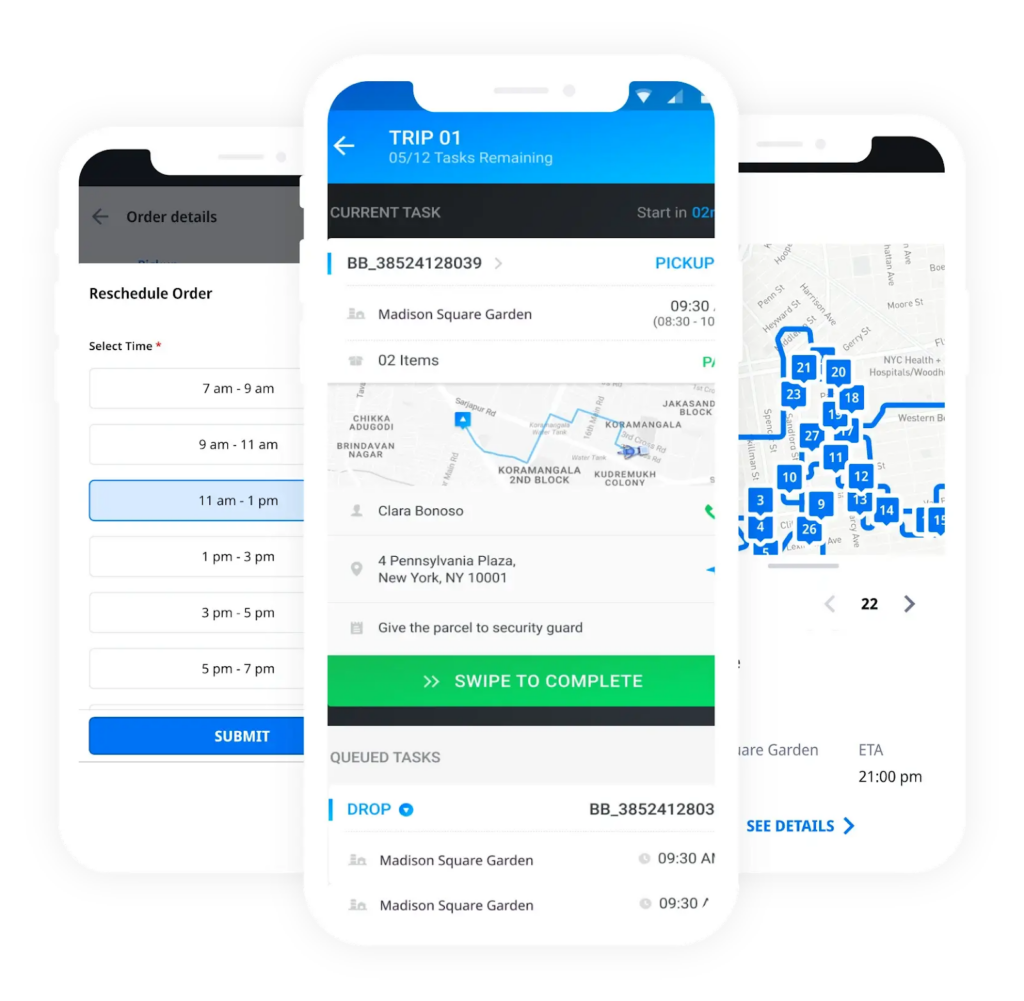
If the mobile experience is confusing, drivers skip steps, data quality degrades, and the analytics you bought the platform for become unreliable. The app should handle navigation, task completion, proof-of-delivery, and issue capture without friction.
Integration that holds at scale
Pilot integrations with OMS, WMS, and carrier systems often look fine. The problems surface at volume or when a system changes. Ask who owns integration maintenance post-go-live and whether it requires engineering support on your side.
Editorial methodology and evidence labels
This comparison uses a best-fit model, not a universal “best overall” claim. We assessed tools against the retail use cases buyers ask about most often:
- retail relevance and category fit
- route optimisation depth
- dispatch and driver workflow quality
- post-dispatch re-optimisation
- multi-node support
- mixed owned/3PL/gig fleet support
- store replenishment and ship-from-store fit
- returns and reverse-flow handling
- customer communication and ETA experience
- integration depth across OMS, WMS, ERP, POS, e-commerce, carrier APIs, EDI, and webhooks
- analytics and KPI visibility
- pricing transparency
- enterprise governance and support readiness
Evidence labels used in this guide
- Publicly documented: visible on official product, pricing, or documentation pages
- Vendor-published content: claims stated in the vendor’s own blog, site, or collateral
- Not publicly disclosed: no clear public detail found at time of review
Sources checked across the shortlist included official product pages, pricing pages, documentation, blog explainers, and publicly visible workflow descriptions where available. Because Locus publishes this article, buyers should treat Locus capabilities as vendor-published until validated in product documentation, customer references, and proof-of-concept testing.
Top 6 Best Retail Delivery Software Tools in 2026: Quick Overview
Let’s give you a quick comparison before we go into the details:
| Tool | Best For | What It Does Well | Pricing Model | Free Trial |
|---|---|---|---|---|
| Locus | Enterprise retail delivery orchestration across nodes and fleet types | Orchestration depth, real-time execution control, exception management, and AI-driven automation | Quote-based | Demo-based evaluation |
| FarEye | Teams prioritizing delivery-experience workflows and last-mile visibility | Slot management, delivery experience layer, and operational visibility | Quote-based | Demo-based evaluation |
| Onfleet | Dispatch and last-mile delivery management for teams wanting clear tiers | Driver workflows, dispatch dashboard, tracking, and configurable completion steps | Public tiered pricing | Yes |
| Tookan | Task-based delivery operations and configurable dispatch workflows | Flexible task-management model, quick setup, driver and customer apps | Public tiered pricing | Yes |
| ShipStation | Shipping operations: labels, rate shopping, tracking, and returns | Shipping workflow automation across carriers and channels | Public tiered pricing | Yes |
| Pepperi | B2B order capture and field sales execution that impacts fulfillment readiness | B2B catalog, pricing, ordering workflows, and omnichannel sales operations | Request-based, modular | Demo-based evaluation |
Top 6 Best Retail Delivery Software Tools in 2026: Detailed Comparison
Now, let’s go over the top retail delivery software tools and their specifics:
1. Locus
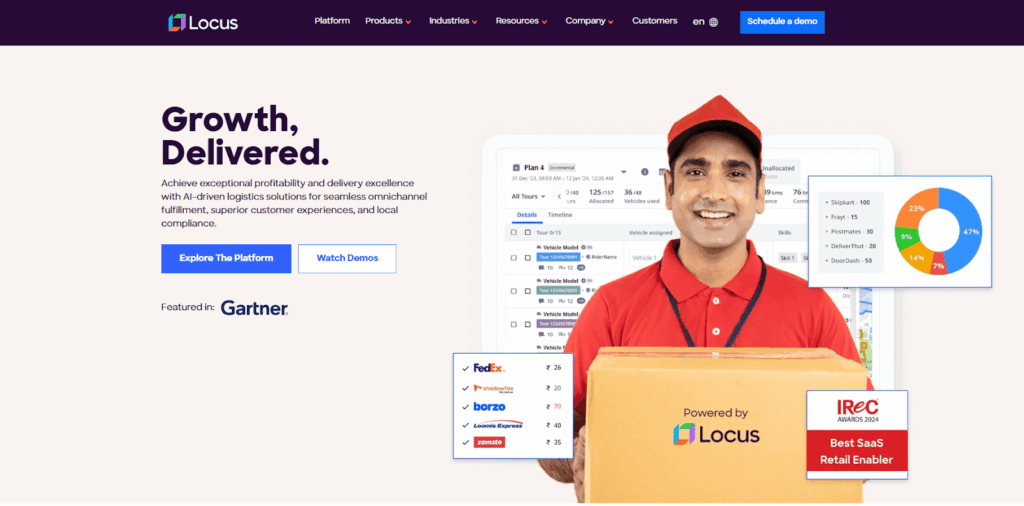
Most delivery problems start with a plan that cannot respond to reality. In a typical setup, a dispatcher catches issues, manually adjusts, calls someone, and updates the board. Multiply that by 50 routes, and you have a dispatch team that spends its entire day firefighting rather than managing. Locus is built around the premise that the software should absorb most of that firefighting.
Powered by its proprietary DispatchIQ engine, it processes over 180 variables simultaneously, including time windows, vehicle capacity, driver shift limits, live traffic, and order priority, to generate routes that are not just efficient on paper but executable in the field.
When conditions change mid-day, the system re-optimizes rather than waiting for a human to notice and respond.
Across 650 million+ orders processed in 400+ cities globally, Locus customers have reported a 25% increase in efficiency, a 45% increase in deliveries per day on the same fleet, and 8% improvement in SLA compliance. These are outcomes that come from the execution layer working as a system, not from better planning alone.
Locus’ Key Features
1. DispatchIQ: AI-driven route optimization
This is not third-party routing wrapped in a UI. Locus built its own optimization engine trained on real delivery data, capable of handling the vehicle routing issues at enterprise scale.
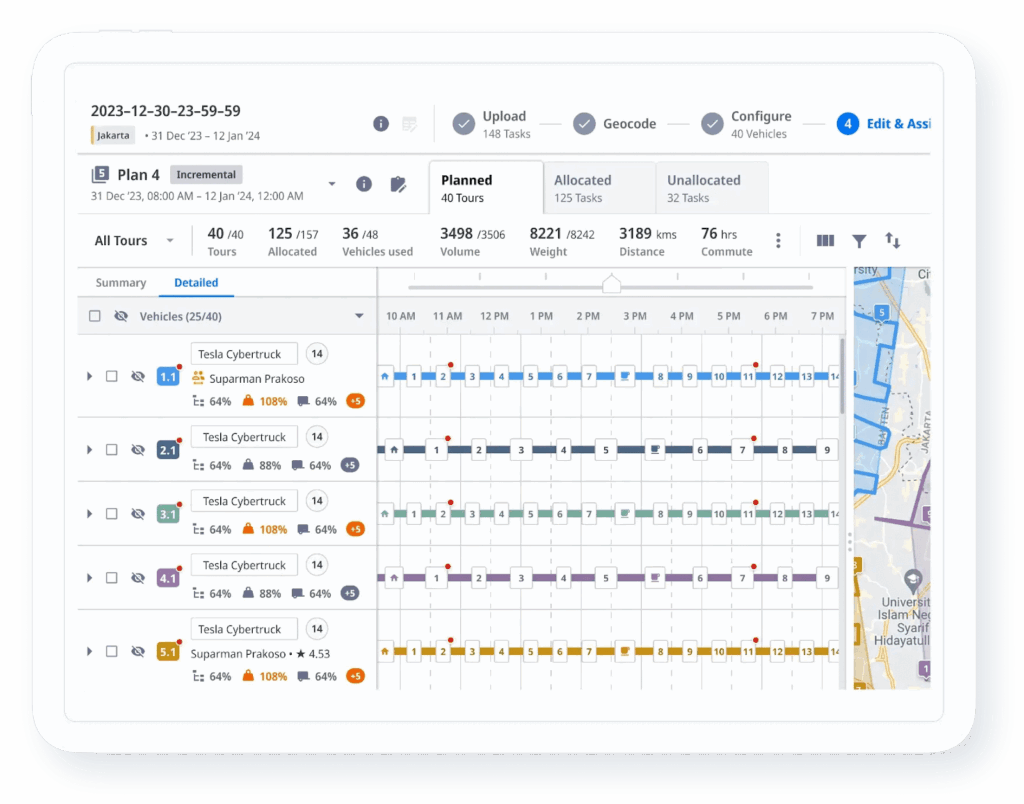
It accounts for physical constraints (vehicle type, load limits), operational constraints (driver HOS compliance, shift rules), and live variables (traffic, cancellations, mid-route additions) in a single optimization pass. Dispatchers move from decision-making to exception-handling.
2. NodeIQ: Network-level intelligence
Beyond daily routing, NodeIQ acts as a digital twin of the supply chain, letting planners model facility placement, inventory policy, and disruption scenarios.
If the bottleneck is structural, such as too many stops per hub or poorly placed fulfillment nodes, NodeIQ surfaces and models the fix before it shows up as a recurring SLA problem.
3. ShipFlex: Third-party carrier orchestration
Most enterprise retailers run a mix of owned fleets and 3PLs. ShipFlex automates carrier selection and management based on service requirements, volume, and cost, so peak surges do not require manual carrier negotiations or dispatcher judgment calls under pressure.
4. Control Tower with exception prioritization
The operations view is built for dispatch teams managing 50+ routes simultaneously. It surfaces what is at risk, not just what is late, and gives dispatchers the context and tools to resolve exceptions without toggling between systems.
5. Customer experience layer
Branded tracking, proactive notifications, and rescheduling workflows reduce WISMO tickets and protect customer trust even when operations are running under pressure.
6. Proprietary geocoding engine
For retailers operating in markets where address standardization is inconsistent, Locus’s geocoding converts ambiguous inputs into precise coordinates. This directly improves first-attempt delivery rates and is a meaningful operational advantage in APAC and other emerging markets.
Locus Is Ideal For
- Retailers running multi-node, multi-region operations with high daily order volumes.
- Teams with hybrid fleet models: captive drivers, 3PLs, and carriers running simultaneously.
- Operations where exceptions are the norm, and the goal is to reduce how much human intervention each exception requires.
- Retail verticals with strict time-window pressure: grocery, pharmacy, big-and-bulky, and B2B distribution.
Locus’ Pros
- Orchestration depth that covers planning, dispatch, visibility, and exception management without requiring separate tools for each layer.
- DispatchIQ’s 180+ variable optimization is genuinely differentiated from competitors using off-the-shelf engines or 20-30 variable models.
- Scales across regions and fleet types without the performance degradation that often appears as complexity increases.
- Analytics are decision-grade: they surface what to change, not just what went wrong.
Locus’ Cons
- Quote-based pricing means a structured buying and scoping process. If you need a same-week trial with a credit card, this is not that product.
- The full value of the platform is most visible at scale. Single-node, low-volume operations may not need the orchestration depth Locus provides.
Locus Pricing
Pricing is quote-based and scoped to your delivery volume, network complexity, and the modules required. The fastest way to understand fit and cost is a scoped demo with your real constraints on the table. Schedule a demo to learn more.
2. FarEye

FarEye is built for teams where the customer-facing delivery experience is the primary problem to solve. Its strengths are in slot-based delivery management, delivery communications, and last-mile process standardization across distributed operations.
If your SLA pressure is driven by customer satisfaction scores and missed delivery windows rather than fleet efficiency, FarEye belongs on your evaluation list.
FarEye Is Ideal For
Teams running last-mile operations where delivery experience standardization and customer communication quality are the primary business goals, especially across multiple regional operators or 3PL partners.
FarEye Key Features
- Slot management and delivery-experience workflows for customer-facing scheduling.
- Last-mile visibility with operational controls for managing distributed delivery flows.
- Process standardization tools that help unify how different regional teams or partners execute deliveries.
FarEye Pros
- Strong delivery-experience layer that can improve customer satisfaction metrics without requiring a full platform replacement.
- Useful when the goal is standardizing last-mile workflows across diverse partners.
FarEye Cons
- Pricing is not publicly listed, so expect a sales-qualified conversation before you see numbers.
- If your core problem is orchestration complexity and exception volume rather than delivery experience, validate that depth carefully before committing.
FarEye Pricing
Not publicly listed.
3. Onfleet
Onfleet is a clean, well-scoped last-mile dispatch tool. It covers the essentials well: a dispatcher dashboard, a strong driver app, proof-of-delivery capture, customer tracking, and ETA notifications.
Onfleet Is Ideal For
Teams that need to standardize dispatch and last-mile driver workflows quickly, without the complexity of multi-node orchestration. A good fit for regional retail or D2C delivery operations where the core problem is dispatcher visibility and driver workflow compliance.
Onfleet Key Features
- Dispatcher dashboard with task assignment, route monitoring, and team management.
- Driver app with navigation, completion steps, and POD capture.
- Customer tracking with ETA notifications and delivery feedback.
Onfleet Pros
- Transparent tiered pricing makes procurement straightforward.
- Fast to implement and onboard for teams that need operational standardization quickly.
Onfleet Cons
- If your operations span multiple nodes or require orchestration across fleet types, validate how the platform handles cross-node decision-making.
- Deep customization requirements may push you into enterprise tiers with a heavier implementation motion.
Onfleet Pricing
Public tiered pricing available on the Onfleet pricing page.
4. Tookan
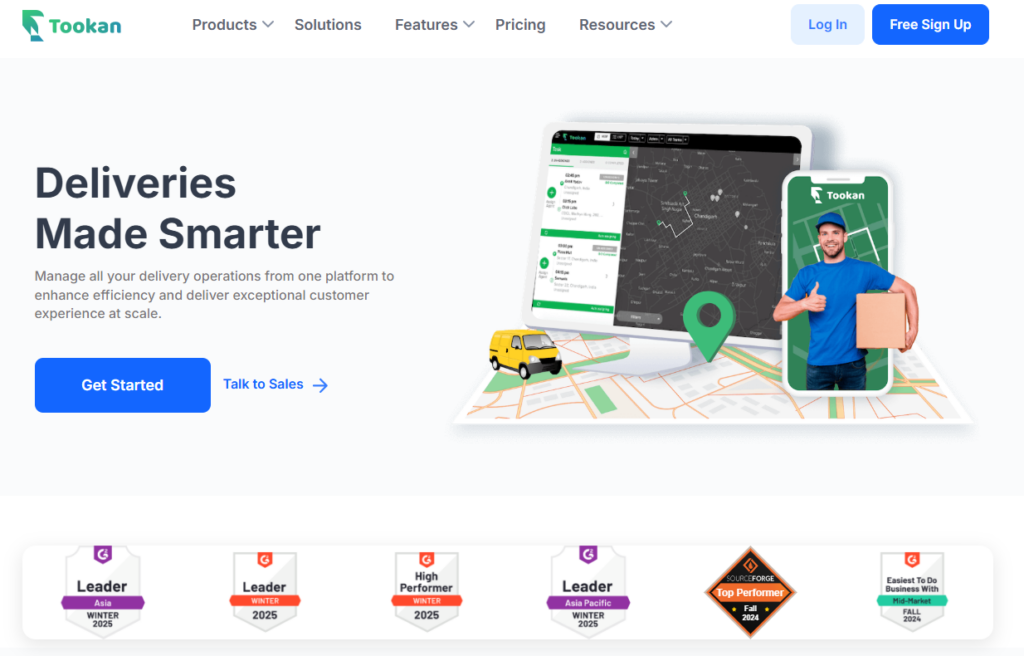
Tookan takes a task-management approach to delivery operations. It is flexible enough to model different job types, agent roles, and completion workflows, which makes it a practical choice for operations that do not fit neatly into route-based delivery models.
Tookan Is Ideal For
Task-heavy delivery environments where flexibility in how jobs and agents are modeled matters more than deep route optimization. Also a reasonable starting point for smaller teams that want quick setup and public pricing tiers.
Tookan Key Features
- Task-based dispatch with configurable workflow steps and completion requirements.
- Driver and customer-facing apps with real-time tracking.
- Add-ons for route optimization and booking forms, available on higher plans.
Tookan Pros
- Flexible enough to model non-standard delivery workflows.
- Public pricing tiers and relatively quick setup reduce procurement friction.
Tookan Cons
- Some advanced capabilities are plan-gated or add-on based. Map your requirements carefully before assuming they are included.
- Multi-region, exception-heavy operations may hit scaling limits worth validating before committing.
Tookan Pricing
Public tiered pricing available on the Tookan pricing page.
5. ShipStation
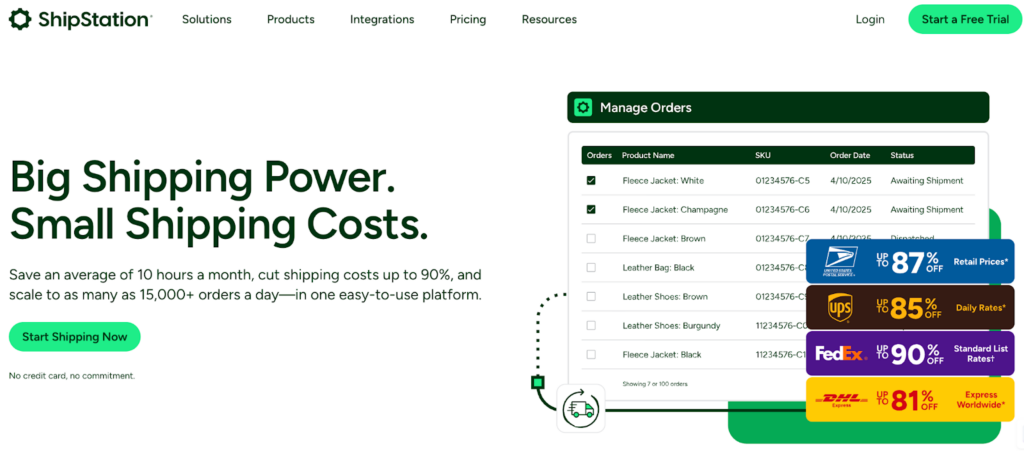
ShipStation does one thing well: shipping operations. Label creation, carrier rate shopping, tracking across channels, and returns management are its core. It belongs on this list because many retailers conflate “shipping software” with “delivery software,” and the distinction matters for how you structure your stack.
ShipStation Is Ideal For
Retailers whose primary bottleneck is in shipping workflow: managing multiple carriers, printing labels efficiently, and handling returns at volume. If the problem is last-mile route execution and dispatch, ShipStation does not address that layer.
ShipStation Key Features
- Label creation and carrier rate shopping across major carriers.
- Multi-channel order import and shipping workflow automation.
- Tracking and returns management tied to shipping operations.
ShipStation Pros
- Clear tiered pricing and fast onboarding for shipping teams.
- Strong fit if carrier management and shipping cost reduction are the immediate priorities.
ShipStation Cons
- Not a last-mile execution platform. You will still need routing, dispatch, and exception management on top of it.
- Does not orchestrate multi-fleet or mixed-carrier last-mile operations.
ShipStation Pricing
Public tiered pricing starting at $9.99/month, with higher tiers for greater shipment volume.
6. Pepperi

Pepperi addresses the delivery problem from a different angle: it fixes what happens before the order reaches your fulfillment team. Its focus is B2B order capture, field sales execution, buyer-specific pricing, and omnichannel ordering workflows. If inaccurate orders or slow order-to-fulfillment cycles are degrading delivery performance, the root cause may be upstream.
Pepperi Is Ideal For
B2B retailers and distributors where field sales accuracy and order quality directly affect downstream fulfillment and delivery scheduling. Not a last-mile execution platform, but a meaningful upstream fix if order data quality is a recurring problem.
Pepperi Key Features
- B2B ordering workflows with buyer-specific catalogs and pricing structures.
- Field sales execution tooling for reps managing accounts in the field.
- Omnichannel ordering capabilities that consolidate multiple sales channels into a single operational view.
Pepperi Pros
- Modular pricing means you can align spend to the specific capabilities you need.
- Strong fit when order accuracy and upstream data quality are the root cause of delivery failures.
Pepperi Cons
- Not a last-mile delivery orchestration platform. Pairing it with a dedicated execution layer is necessary if dispatch and routing are also gaps.
Pepperi Pricing
Request-based and modular. Details available on the Pepperi pricing page.
Who should buy which type of retail delivery software?
Not every retailer needs enterprise orchestration on day one. A better way to shortlist is by operating model.
Enterprise retail chains
If you manage regional or national networks, shared fleet capacity, multiple fulfilment nodes, store receiving windows, and strict SLAs, you are buying for orchestration, governance, and exception management.
Regional or multi-location retailers
If you operate a smaller delivery footprint with a private fleet or local contractors, you may get enough value from dispatch-first tools with faster implementation and public pricing.
Grocery and convenience
These operations usually need tight slot control, high order volatility, substitution-aware workflows, and the ability to recover quickly from ready-time delays and temperature-sensitive constraints.
Pharmacy and healthcare retail
Priorities typically include chain-of-custody visibility, delivery windows, proof-of-delivery precision, and exception handling for time-sensitive orders.
Big-and-bulky, furniture, and appliance retail
These teams usually need route planning that accounts for service times, crew scheduling, vehicle capacity, appointment windows, failed-attempt cost, and rescheduling.
Apparel and omnichannel retail
Ship-from-store, split orders, store capacity balancing, and branded delivery communications usually matter more than route density alone.
B2B distributors and wholesalers
If route accounting, order accuracy, and account-specific pricing are major constraints, direct-store-delivery and upstream order-capture workflows may matter as much as last-mile execution.
Parcel-heavy retailers
If your biggest pain point is carrier selection, label generation, parcel tracking, and returns labels, shipping software may be the better first investment than local delivery orchestration.
When simpler tools are enough
A simpler tool is often enough when you are single-node, low-volume, running predictable local routes, and mainly need dispatch visibility, a driver app, and proof of delivery.
When enterprise orchestration is justified
Enterprise orchestration is easier to justify when you have multi-node fulfilment, hybrid fleets, strict SLAs, high exception volume, regional governance requirements, shared replenishment and customer-delivery capacity, or complex ERP/WMS/OMS integration needs.
Important Aspects to Consider When Choosing a Retail Delivery Software Tool in 2026
A few checks that are easy to skip and expensive to ignore.
Know where your variability actually enters
If most of your disruptions happen after dispatch, you need execution-first orchestration. If they happen upstream in order data or carrier allocation, fix those layers first and choose your software accordingly.
Route optimization and delivery outcomes are not the same thing
A platform can improve route efficiency while on-time performance worsens, if it cannot handle exceptions and re-optimization in real time. Ask for outcome metrics, not route score metrics, in your demo.
Validate integration ownership before you sign
Most platforms integrate cleanly in a pilot. The question is who maintains those integrations when your OMS updates or a carrier changes its API. If the answer is “your engineering team,” budget for it.
Test the driver experience in your hardest lanes
Driver app compliance drives data quality. If your drivers skip proof-of-delivery steps or close out orders inaccurately, your analytics become noise. Run the driver app pilot in the routes with the highest exception rates, not the cleanest ones.
Ask outcome questions in demos, not feature questions
Show me how the system handles a late store-ready time. Show me what happens when a driver drops off mid-shift. Show me how an exception is triaged, assigned, and escalated. Feature walkthroughs are not a proxy for operational fit.
Benefits of retail delivery software
When selected against the right operating model, retail delivery software can improve several layers of performance at once:
- Lower cost-to-serve through better route density, fewer failed deliveries, and reduced dispatcher rework
- Higher on-time delivery through dynamic routing, ETA updates, and faster exception handling
- Stronger first-attempt delivery rates through better address handling, customer communication, and proof-of-delivery workflows
- Lower support volume by reducing WISMO contacts with branded tracking and proactive notifications
- Better fleet utilisation across owned drivers, 3PLs, carriers, and gig capacity
- Cleaner operational data from driver-app compliance and electronic proof of delivery
- Improved decision-making from KPI dashboards covering cost, SLA, and service quality rather than route efficiency alone
These gains matter because retail demand and delivery complexity are still expanding. In addition to the market-size figures cited earlier, Fortune Business Insights reports that the U.S. autonomous last mile delivery market was valued at USD 22.6 million in 2025. That is still an emerging niche, but it signals how quickly buyers may need delivery software that can adapt to new fleet models, not just today’s routes.
Implementation framework for retail delivery software
Implementation quality usually matters more than feature count. A practical rollout sequence looks like this:
1. Discovery and process mapping
Map order sources, dispatch workflows, exception ownership, customer-notification steps, carrier allocation rules, and reverse-logistics flows.
2. Data-readiness review
Validate address quality, service times, vehicle capacities, driver shifts, store receiving windows, pick-ready timestamps, SKU restrictions, and historical order patterns.
3. Integration design
Define how orders, status events, cancellations, inventory updates, proof-of-delivery events, and returns data will move between OMS, WMS, ERP, POS, TMS, carrier APIs, and customer systems.
4. Pilot-market selection
Choose a market with meaningful complexity, but not your most politically sensitive region. The pilot should include real exception conditions, not only clean routes.
5. Driver and dispatcher training
Focus training on exception-handling, status compliance, proof-of-delivery capture, and mobile usability under time pressure.
6. Parallel run
Run the new workflow against the current process long enough to compare on-time delivery, route adherence, dispatcher effort, and support tickets.
7. Go-live and KPI baseline
Lock in baseline metrics before rollout so the business case is measured against reality rather than memory.
8. Optimisation and regional rollout
Use pilot lessons to adjust rules, service times, allocation logic, and reporting before broader deployment.
Common implementation risks
- poor address quality
- incomplete vehicle or driver data
- unclear exception ownership
- OMS/WMS status mismatches
- low driver-app adoption
- unvalidated service-time assumptions
- carrier API changes after go-live
- hidden engineering ownership for ongoing integration support
Realistic timelines
Simple dispatch deployments can go live in weeks. Multi-region, multi-node retail orchestration with ERP, OMS, WMS, and carrier integrations often takes months. The more important question is not “how fast can it go live?” but “how much operational complexity is actually being absorbed at go-live?”
Pricing and total cost of ownership
Retail delivery software pricing is harder to compare than many buyers expect because vendors package value in different ways.
Common pricing dimensions
- per order
- per stop
- per driver or vehicle
- platform or module fees
- implementation fees
- integration fees
- regional expansion fees
- premium support or SLA charges
- overage or peak-volume terms
- minimum annual commitments
Pricing transparency by vendor in this shortlist
- Locus: Quote-based
- FarEye: Quote-based
- Onfleet: Public pricing
- Tookan: Public pricing
- ShipStation: Public pricing
- Pepperi: Request-based / modular
Procurement questions to ask
- What will the first-year total cost look like including implementation and integrations?
- Which modules are required versus optional?
- How are peak periods priced?
- Are API or webhook limits chargeable?
- Who pays for regional rollout, additional carriers, or extra environments?
- What happens if order volumes shift materially?
- What commercial flexibility exists for pilots, phased rollouts, or partial adoption?
Comparing subscription prices without implementation, integration, and support scope usually understates real TCO.
Security, compliance, and governance checklist
Security claims should be verified directly with the vendor because scope, certification dates, and service boundaries change.
Ask these questions in every enterprise evaluation:
- Do you provide current evidence for SOC 2, ISO 27001, or other security certifications where applicable?
- Is SSO/SAML supported?
- How is role-based access control managed across regions, business units, and partners?
- Are audit logs available for dispatcher, admin, and API activity?
- How is data encrypted in transit and at rest?
- What data-retention controls and deletion workflows exist?
- Are data residency options available if required?
- What is the uptime commitment and how is it defined contractually?
- What business-continuity and disaster-recovery processes are documented?
- Which subprocessors handle customer or driver data?
- How are APIs secured and rate-limited?
- What mobile-device controls exist for driver apps?
- What support model and escalation path apply during live operations?
For buyers evaluating any TMS or delivery platform claim, this related guide on Enterprise SLAs, SOC 2 and 24/7 Support: How to Verify TMS Vendor Claims is a useful companion.
Integrations and data readiness
The most common integrations for retail delivery software include:
- OMS and e-commerce platforms for order intake
- WMS and store systems for ready-time and inventory events
- ERP for customer, product, billing, and settlement data
- POS for store-originated orders
- TMS and carrier APIs for multi-carrier workflows
- EDI and webhooks for status exchange with enterprise systems
- telematics and GPS for fleet visibility
- address and map data providers for routing and location precision
Data inputs that matter most to route quality
- accurate addresses and geocodes
- realistic service times
- vehicle capacities and compartments
- driver shifts and labour rules
- store receiving windows
- delivery slots and cut-offs
- SKU restrictions or handling constraints
- historical demand patterns
- current traffic quality and map coverage
Integration ownership should be explicit
Before signature, define whether the vendor, your internal engineering team, a systems integrator, or a joint model owns initial build, change management, and post-go-live maintenance. That answer often matters as much as the feature set.
For teams comparing carrier connectivity specifically, this guide to carrier integration software is worth reviewing alongside delivery-platform demos.
Reverse logistics, sustainability, and future-readiness
Retail delivery software should not stop at the doorstep. Reverse flows affect cost, customer experience, and route design just as much as outbound deliveries.
Reverse-logistics questions to ask
- Can return pickups be planned on the same route as outbound deliveries?
- Can the platform handle store returns, warehouse returns, exchanges, refused deliveries, and damaged goods?
- Are reverse events visible to customer service and operations in real time?
- Can return cost be measured per completed return, not just per order shipped?
Sustainability questions to ask
- Can the platform report miles, route density, and failed-attempt rates by region?
- Can it support ICE and EV fleets in the same operating model?
- Can it model EV range and charging constraints where relevant?
- Does it help reduce emissions indirectly through better consolidation and fewer failed attempts?
Sustainability claims should be measured operationally rather than marketed abstractly. In most retail operations, fewer failed attempts and better route density are the most immediate drivers of lower delivery emissions.
ROI and business-case framework
A credible internal business case should be built from your baseline, not from generic savings claims.
KPIs worth tracking
- on-time delivery
- delivery promise adherence
- cost per successful delivery
- cost per stop
- cost per order
- first-attempt delivery rate
- route adherence
- dispatcher touches per exception
- driver productivity
- fleet utilisation
- exception rate
- WISMO volume
- failed-delivery cost
- return cost
- support contacts
- CSAT or NPS where available
A simple ROI model
Estimate:
- current manual dispatch hours per week
- cost of failed deliveries and redeliveries
- missed-order or SLA penalty cost
- support cost tied to WISMO and rescheduling
- fleet or carrier overspend caused by poor allocation
- implementation and change-management cost of the new platform
Then compare those baseline costs against measured improvements from the pilot or proof of concept. That produces a stronger finance case than a feature matrix.
Revamp Your Retail Delivery Capabilities with Locus
For straightforward operations, a dispatch-first tool can cover a lot of ground efficiently. For shipping-heavy workflows, a dedicated shipping operations platform may be the right first investment.
But for enterprise retail delivery with mixed fleets, multiple nodes, and daily exception volume, the deciding factor is how well the platform holds up when the plan breaks.
That is the environment Locus was built for. If your goals are fewer exceptions per 100 stops, lower cost per successful delivery, and SLA stability across a complex network, the fastest path forward is a demo scoped to your actual lanes, constraints, and exception patterns.
Frequently Asked Questions (FAQs)
1. How do I evaluate retail delivery software if I have a mixed fleet of owned drivers and 3PLs?
Look for platforms that can allocate work across fleet types using the same constraint logic, not just manage them as separate buckets. Ask specifically how the platform handles a mid-day reallocation from a failed captive driver to a 3PL without manual dispatching.
2. Is a free trial a reliable way to evaluate enterprise delivery software?
For dispatch-and-track tools, yes. For orchestration platforms, no. The value of orchestration shows up at volume and under exception conditions that a free trial rarely replicates. A scoped demo with your real routes and constraints gives you a more accurate picture of fit than a sandbox trial.
3. What is the realistic implementation timeline for a platform like Locus?
It varies by network complexity, integration scope, and data readiness. Simple deployments can go live in weeks. Multi-region, multi-fleet implementations with deep ERP and WMS integrations typically run over several months. The scoping conversation is where this gets defined, which is why a demo-based evaluation matters more than a free trial for this category.
4. Can I use ShipStation and Locus together?
Yes. ShipStation manages shipping workflows upstream, while Locus handles last-mile dispatch, routing, and exception management. They solve different layers of the problem and can coexist in a well-structured tech stack.
5. How do I make a business case internally for replacing an existing dispatch tool?
Quantify exception volume and the manual hours spent resolving them each week. Attach a cost to SLA failures using your actual redelivery costs and customer satisfaction data. Then model what a 20-25% reduction in exceptions and cost per stop would mean at your current scale. That is a more credible internal case than a feature comparison.
6. What is the best last-mile delivery software for enterprise retail chains?
The right platform depends on whether the chain runs store replenishment and customer fulfillment on shared capacity. Chains running both need a system that holds two opposed objectives at once, consolidation for replenishment and promise adherence for customer orders, rather than one tuned for a single flow. Locus is built for this case, modeling 250+ real-world constraints simultaneously across 1,000+ pre-integrated carriers and owned, third-party and gig fleets.


E-Commerce
Last Mile in E-Commerce: Definition, Importance & Benefits

Sep 23, 2026
Who is this for? This guide is built for e-commerce logistics leaders, VPs of Supply Chain, and operations executives at mid-market and enterprise brands managing high-volume delivery operations. If you’re responsible for last mile cost control, carrier strategy, or customer delivery experience, this is your playbook. Consumers across the globe demand quick, near-instant deliveries. As […]
Read more
General
Best Pest Control Routing Software in 2026
Sep 23, 2026
Key Takeaways Quick answer: which pest control routing software is best by need? If you need day-of control across dense territories, urgent callouts, and multi-branch operations, Locus is the best fit in this list for execution-first routing and dispatch orchestration. If you want an all-in-one pest suite with CRM, billing, scheduling, and routing together, FieldRoutes […]
Read moreInsights Worth Your Time



















Best Retail Delivery Software for Enterprise Retail Chains in 2026