


General
10 Best Direct Store Delivery Software in 2026
Key Takeaways
- Use automated dispatch optimization to cut empty miles, balance fleet loads, and reduce fuel spend by up to 15%, directly lowering transportation cost.
- Track fleets with TDMS real-time dispatch management to spot delays instantly, reroute shipments proactively, and recover failed deliveries before SLA penalties impact retailer trust.
- Apply advanced route planning and automated scheduling to sequence stops efficiently, minimize wasted miles, and meet tight store windows to improve overall routing efficiency.
- Locus combines AI-powered orchestration, predictive alerts, and real-time visibility to help enterprises turn dispatch management into a strategic advantage across retail, FMCG, and 3PL networks
Every missed delivery window carries a measurable cost. According to ATRI, empty miles now average 16.7% of total miles, inflating per-mile costs for carriers and shippers alike. For direct store delivery networks, the challenges go further. Poor inventory visibility causes stockouts or overstocking, frequent store runs inflate labor and transport costs, and fragmented data across vendors limits accurate forecasting. Retailers depend on consistent replenishment, yet service quality often varies, creating strained relationships. Returns of unsold or expired goods add another layer of inefficiency.
Spreadsheets and basic routing tools break down at this scale. Dispatchers struggle to match fleet capacity with delivery windows, drivers lose time on unpredictable routes, and leaders lack the insights to control costs. The result is lost revenue and weaker retailer trust.
Logistics leaders now turn to direct store delivery software that delivers concrete outcomes such as automated dispatch allocation, real-time route optimization, and actionable performance insights. This article compares the leading options in 2025, outlining features, pricing, and differentiators. Locus is one of the solutions enterprises rely on for AI-driven orchestration and predictive route management.
Editorial Methodology
This comparison is an editorial buyer’s guide built from publicly available product information, category references, and existing Locus subject-matter expertise. Products were selected because they are repeatedly associated with direct store delivery, route accounting, route-to-market, or store-delivery execution workflows.
How we evaluated vendors
- DSD workflow coverage — 15%
- Route planning and optimisation — 15%
- Dispatch and exception management — 15%
- Mobile execution, offline support, and ePOD — 10%
- Retail execution — 10%
- Integrations — 10%
- Analytics and governance — 10%
- Scalability and network complexity fit — 5%
- Implementation and support — 5%
- Pricing transparency and value — 5%
Important notes
- Rankings reflect editorial fit for the keyword and common buyer needs, not a lab test or universal score.
- Pricing and plan language are shown as publicly listed at time of review, starting price, custom quote, or not publicly disclosed.
- Feature availability can vary by module, contract, geography, or implementation scope.
- Locus publishes this page and is included in the comparison. That conflict is disclosed so buyers can assess the recommendations transparently.
- Buyers should still verify current pricing, integrations, offline behaviour, implementation requirements, and support scope during evaluation.
What Direct Store Delivery Software Is — And What It Is Not
Direct store delivery
Direct store delivery is the process of moving products directly from a supplier, manufacturer, or distributor to a retail store rather than routing every order through a conventional centralised distribution model.
DSD software
DSD software manages the operating flow behind that model: order capture, truck loading, dispatch, route execution, in-store delivery, proof of delivery, inventory updates, invoicing, collections, credits, returns, and reconciliation.
Route accounting
Route accounting tracks the financial and inventory activity of a route from vehicle loading through final settlement. It often includes truck inventory, invoices, credits, returns, collections, and end-of-day reconciliation.
Retail execution software
Retail execution software focuses on in-store shelf checks, merchandising, audits, surveys, compliance, image recognition, and field task completion. Some DSD platforms include it; others integrate with it.
Last-mile delivery software
Last-mile software usually emphasises dispatch, route planning, ETAs, tracking, and proof of delivery. It may not include truck inventory, van sales, route accounting, or route settlement.
TMS and distributor ERP
A transportation management system typically manages freight planning, carrier execution, and shipment control at a broader transport layer. A distributor ERP or distribution management system manages financials, purchasing, inventory, and back-office processes. DSD software may complement either rather than replace them.
The practical distinction buyers should remember
- DSD software vs route-accounting software: route accounting is often one important capability inside DSD, not the whole operating model.
- DSD software vs last-mile software: last-mile tools may optimise routes well but still lack route sales, truck inventory, payments, and settlement.
- DSD software vs retail-execution software: retail execution helps inside the store; DSD software manages the store-delivery transaction and route flow.
- DSD software vs TMS: a TMS may orchestrate transport broadly, but DSD usually needs deeper store-level, mobile, and financial workflows.
- Routing tool vs full DSD operating platform: buyers with recurring store routes, credits, stale-product handling, and on-truck stock typically need more than routing alone.
Key Features To Look For In A Direct Store Delivery Software
Enterprises choosing a direct store delivery system software should focus on capabilities that address common operational challenges.
Each of the features below solves a specific problem and delivers measurable business outcomes.
1. Automated Dispatch Optimization
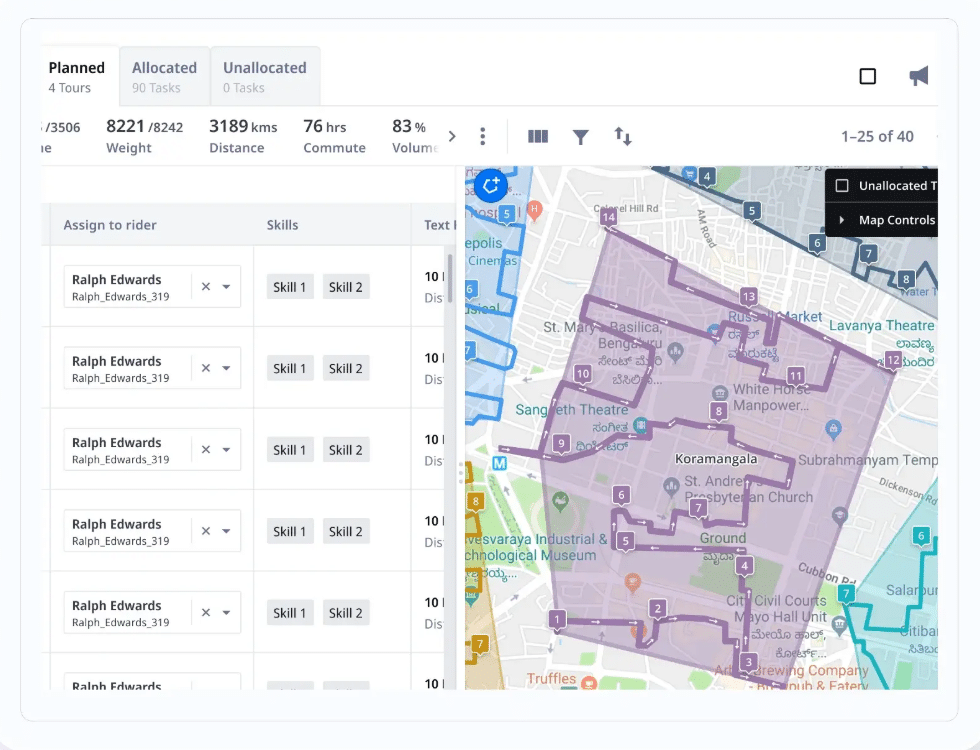
In direct store delivery, manual allocation often overlooks critical factors like store delivery windows, shelf restocking priorities, fleet load limits, and driver shift schedules. As a result, trucks leave late, deliveries pile up at peak hours, and stores face empty shelves. Automated dispatch eliminates these bottlenecks by assigning orders based on defined business rules—such as delivery frequency, route constraints, and real-time fleet capacity. This ensures faster planning, accurate order fulfillment, and consistent on-time deliveries that keep products available at the shelf.
2. Real-Time Dispatch Management
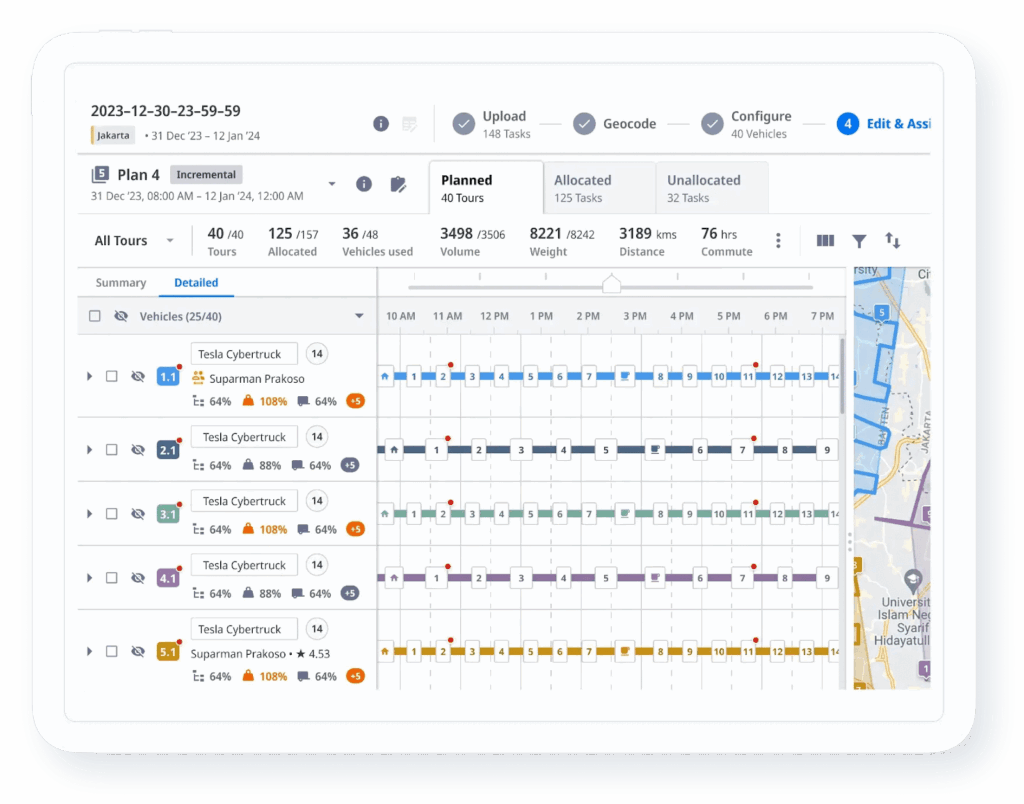
Without live tracking, dispatchers only discover a delay after the store delivery window has already passed. Real-time dispatch management provides continuous visibility into vehicles and shipments, allowing managers to reroute in progress and prevent SLA penalties.
3. Advanced Route Planning And Scheduling
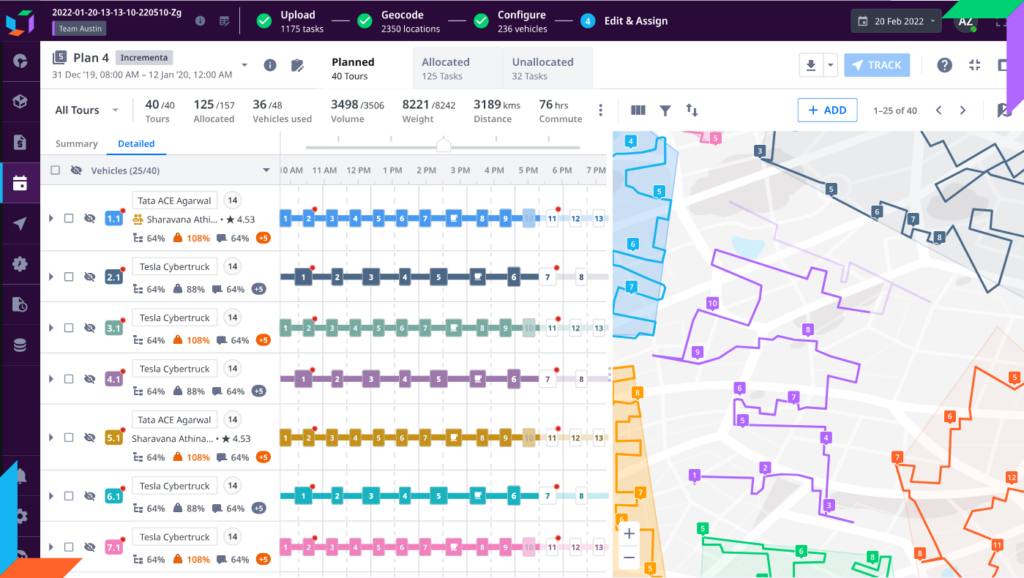
Poorly sequenced routes add unnecessary miles and raise fuel costs. Advanced planning aligns deliveries with store time windows, shelf restocking cycles, and real-time traffic conditions to create efficient schedules. Adaptive routing minimizes empty miles, keeps distribution costs in check, and ensures products reach stores on time to avoid stockouts.
4. On-Ground Visibility For Dispatchers

When field-level data is missing, problems like missed delivery windows, partial shipments, or late arrivals are reported only after store managers flag them, often hours later. By then, shelves may already be empty, hurting sales and customer satisfaction. On-ground visibility tools give dispatchers live driver locations, proof of delivery, and exception alerts, enabling quick rerouting or recovery actions and stronger coordination with retailers.
5. Integrated Proof Of Delivery And Inventory Management

Paper-based proof of delivery leads to disputes, and disconnected inventory records create stock mismatches. Integrated digital proof of delivery, combined with real-time inventory updates, confirms completion instantly and keeps replenishment data accurate across systems.
6. Analytics And Reporting Dashboards
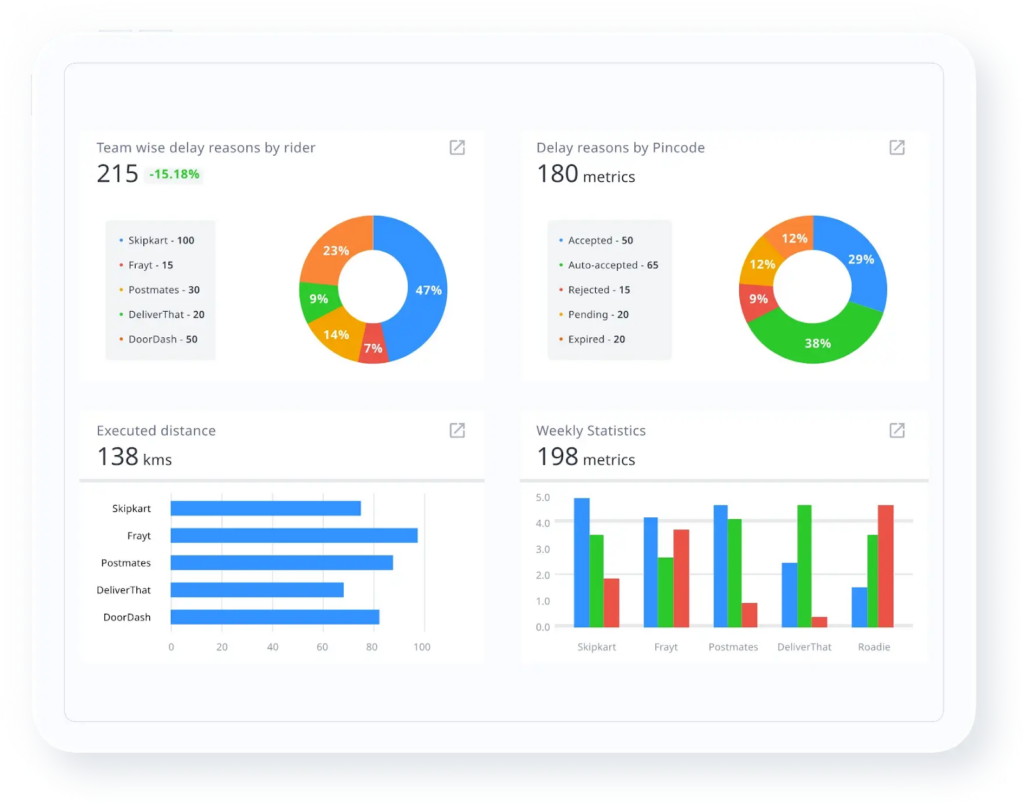
The absence of clear reporting makes it difficult for leadership to pinpoint why costs are rising or service levels are slipping. Without visibility, recurring issues like underutilized trucks, inefficient store sequences, or low driver productivity go unnoticed. Analytics dashboards surface critical DSD metrics, such as cost per route, delivery success rate, and store-level fulfillment efficiency, so enterprises can identify root causes, improve performance, and scale operations without adding headcount.
How Direct Store Delivery Software Works
A practical DSD workflow usually looks like this:
- Order capture and demand signals
Orders may originate from field sales, B2B commerce portals, ERP systems, customer service teams, or replenishment rules. - Warehouse staging and load planning
Orders are allocated to depots, staged for loading, and matched to route capacity, truck inventory rules, store priority, and delivery windows. - Dispatch and route optimisation
Dispatchers assign work by geography, capacity, service level, and shift constraints, then optimise routes for stop sequence, mileage, and ETA performance. - Driver mobile execution
Drivers receive route plans, customer details, delivery notes, tasks, and exception workflows through mobile apps, ideally with offline support. - Store delivery and proof of delivery
At the store, the driver completes delivery, captures signatures or photos, records shortages or damages, and confirms product handoff. - Inventory and financial sync
Truck inventory, delivered quantities, returns, collections, invoices, and credits synchronise with back-office systems. - Returns, damages, and expiry handling
DSD platforms may also manage stale-product collection, reverse logistics, store refusals, and failed-delivery recovery. - Retail execution and merchandising
Some workflows continue in-store with shelf audits, planogram checks, image capture, promotional compliance, and task completion. - Analytics and control-tower feedback loop
Dispatchers and leaders monitor cost per route, cost per delivery, truck utilisation, on-time/in-full delivery, and SLA adherence to improve future planning.
This is why buyers should assess direct store delivery software as an operating platform, not just a route planner.
Top 10 Direct Store Delivery Software – Quick Comparison
Enterprises evaluating top direct store delivery softwares often compare them side by side to identify which platforms align best with their operational scale, budget, and geographic reach. The table below summarizes each solution’s positioning, features, and differentiators.
| # | Company | What it does | Best fit | Pricing |
|---|---|---|---|---|
| 1 | Locus | AI logistics orchestration; reverse logistics, routing | Enterprise retail, FMCG, e-com, 3PL | Custom |
| 2 | Pepperi | Unified B2B commerce, field sales, DSD | Consumer goods brands & distributors | Pro $500/mo; Corp $1,500/mo; Ultimate custom |
| 3 | MobiWork | Field service + logistics/DSD suite | Teams needing scheduling, work orders, DSD | $20/$40/$60 user/mo |
| 4 | Elite EXTRA | Last-mile routing, 3P delivery, returns | Retail, distributors, service/logistics | Custom |
| 5 | Route4Me | Route planning & fleet optimization | Couriers, multi-stop fleets | From $60/vehicle/mo |
| 6 | Ivy Mobility | CPG route-to-market (DSD, retail execution) | CPG/FMCG brands & distributors | Custom |
| 7 | LaceUp | DSD, route accounting, WMS platform | Distributors/wholesalers (F&B, CPG) | Custom; 30-day trial* |
| 8 | eoStar | Beverage distribution RAS + WMS | Beverage bottlers & distributors | Custom |
| 9 | Listaso | B2B sales, WMS, delivery, eCom | Distributors across F&B, wine, beauty | Custom; Growth/Pro/Enterprise |
| 10 | OIS | B2B orders: sales, inventory, delivery, eCom | Everyday consumer goods, food distributors | Fulfillment from $199/mo (4 users); eCom from $249/mo |
This comparison gives decision-makers a snapshot of where each direct store delivery software solution stands, before diving into detailed evaluations in the next section.
Top 10 Direct Store Delivery Software – Detailed Comparison
1. Locus
Locus is a leading AI-powered platform that offers comprehensive automation to optimize direct store delivery operations. By combining end-to-end visibility with real-time decision-making, Locus helps businesses reduce empty miles, meet strict delivery windows, and improve coordination between suppliers and retailers.
The platform streamlines dispatch allocation, dynamic routing, and store-level execution, enabling enterprises to cut operating costs and deliver consistent, reliable service across complex DSD networks.
Locus’s Key Features:
? Auto-Dispatch With Configurable Logic
Traditional allocation systems often assign loads inefficiently, leading to missed delivery priorities. Locus applies business rules, vehicle capacity, and delivery urgency in one engine, reducing planning time and improving on-time performance across the fleet.
? Dynamic Routing That Adapts In Real Time
Most tools create static routes. Locus recalculates when traffic, weather, or demand shifts, reducing empty miles by 10–15% and lowering fuel spend.
? Control Tower With Predictive Alerts
Instead of just tracking shipments, the Control Tower highlights risks before they escalate. Dispatchers can act early to prevent SLA penalties and maintain store commitments.
? Retail-Specific On-Ground Visibility
Locus provides live driver location and delivery confirmation designed for store-level execution. Retail managers get immediate updates, strengthening collaboration and accountability.
? Analytics Tied To ROI
Beyond standard reporting, Locus connects metrics like cost per route and delivery reliability directly to financial outcomes. Leadership gains clear visibility into efficiency gains and cost savings.
Locus is Ideal for:
- Large Enterprises: Locus is tailored for businesses in industries like retail, FMCG, e-commerce, and 3PLs that manage high volumes of returns and require scalable solutions to handle complex logistics operations.
- Global Supply Chain Operators: Companies involved in cross-border logistics will benefit from Locus’ capability to manage international returns while maintaining operational efficiency and consistency.
Locus’s Pricing:
Locus offers a custom pricing model based on the size of the business and specific operational needs. Pricing is determined by factors such as return volumes, the complexity of integrations, and the scope of desired features. Businesses interested in a detailed pricing structure can contact Locus to schedule a demo and discuss their requirements.
2. Pepperi

Pepperi, now part of Advantive LLC, is a unified B2B commerce and sales platform used by more than 1,000 customers across 65+ countries. It provides brand manufacturers, distributors, and wholesalers with mobile-first tools for eCommerce, field sales, retail execution, and direct store delivery. The platform is designed to accelerate order-to-cash, reduce inefficiencies, and connect sales reps, back-office systems, and customers in one solution.
Pepperi’s Key Features:
- Unified B2B commerce with web and native mobile apps for order capture and customer engagement.
- Route accounting and DSD functionality including van sales, load/unload, cross-warehouse visibility, and payment collection.
- Retail execution tools such as geo-tagged photos, surveys, planograms, and task management for in-store compliance.
- Trade promotion and pricing controls, including discount permissions, BOGO offers, and order-level promotions.
- Seamless integrations through IPaaS, plugins, and ERP connectors to synchronize products, pricing, and invoices.
- Multi-language, multi-currency, and multi-storefront support for global operations.
Pepperi is Ideal For:
Consumer goods brands and distributors in industries such as Food & Beverage, FMCG, Health & Beauty, Eyewear, Jewelry, and Home & Gift that require a single platform to manage B2B eCommerce, route accounting, and sales execution.
Pepperi’s Pricing:
- Pro: Starting at US $500/month.
- Corporate: Starting at US $1,500/month, includes Pro features plus advanced capabilities.
- Ultimate: Custom pricing, includes Corporate features plus additional enterprise-level functions.
3. MobiWork

MobiWork is a mobile-first, cloud field services platform used in 50+ countries. It provides turnkey solutions for last-mile and logistics (including DSD / Supply Chain / Milk Run), plus work orders, dispatching, scheduling, invoicing, and integrations. The platform is designed for quick deployment, multi-language use, and end-to-end visibility before, during, and after each job.
MobiWork’s Key Features:
- Field Operations: Customers/prospects, quotes, work orders, electronic forms (photos, signatures), scheduling, dispatching, invoices, progressive billing, payments.
- Logistics & DSD: Route planning and optimization, crews, projects, inventory, assets/equipment, telematics, customer portal.
- Sales & Engagement: Parts/services catalog, advanced quotes/templates, price lists, CRM integrations (HubSpot, Salesforce), SMS, VoIP.
- Analytics & Visibility: Live dashboards, automated reports, time tracking, job costing.
- Mobility & Scale: Native web/mobile, offline mode, multi-language, multi-currency.
- Integrations: QuickBooks Online/Desktop, Sage, Sage Intacct, Acumatica, Shopify, UKG, SSO (Google/Microsoft/Apple), open standards-based APIs.
MobiWork is Ideal For:
Small, mid-size, and large organizations with field technicians or contractors that need unified scheduling, dispatch, route planning/optimization, work order management, and billing—plus logistics workflows such as last-mile and DSD.
MobiWork’s Pricing:
- Starter – $20/user/month: Core features for small teams, including customers, quotes, work orders, scheduling, dispatch, invoicing, and QuickBooks Online/Sage One integration. Suitable for up to 5 users.
- Advanced – $40/user/month: Adds service contracts, recurring invoices, advanced dispatching, catalogs, job costing, and CRM/SSO integrations. Designed for growing businesses with up to 15 users.
- Premier – $60/user/month: Full suite with inventory, offline mode, route planning and optimization, telematics, ERP/finance integrations, HR/payroll, and e-commerce connectors. Unlimited users supported.
4. Elite EXTRA

Elite EXTRA, now part of Epicor, is a last-mile logistics software company founded in 1996 and based in Eau Claire, Wisconsin. With over 325,000 users worldwide, the company provides innovative solutions for routing and dispatch, third-party delivery, and returns automation. Elite EXTRA is designed to simplify logistics, reduce inefficiencies, and give businesses the tools they need to scale efficiently while offering award-winning 24/7 customer support.
Elite EXTRA’s Key Features:
- Routing & Dispatch: Optimized route planning, auto-routing and dispatching, real-time driver tracking, and customer ETA notifications
- Delivery Network: On-demand third-party delivery with integrations to providers like DoorDash, Uber, and Roadie, plus central contracting and billing
- Returns Automation: Automated returns validation, digital chain of custody, live returns dashboard, and policy enforcement tools
- Driver Mobile App: In-app navigation, proof of delivery, and real-time communication for drivers
- Business Analytics & Reports: Customizable dashboards with insights into productivity, delivery costs, and service performance
- Flexible SaaS Model: Frequent software updates, easy deployment, and scalable customization for different workflows
Elite EXTRA is Ideal For:
Retailers, distributors, service providers, and logistics companies that want to improve last mile performance, integrate with third-party delivery networks, and streamline returns management with customizable software and 24/7 support.
Elite EXTRA’s Pricing:
Custom pricing, tailored to each company’s unique needs and workflows.
5. Route4Me
Route4Me is an AI-powered route optimization platform designed to help businesses simplify last-mile delivery. With over 3 billion miles optimized and 750M destinations covered, Route4Me provides advanced solutions for route planning, fleet management, and delivery tracking, enabling companies to increase efficiency and reduce costs.
Route4Me’s Key Features:
- Route Optimization: Automate route planning to optimize for efficiency, reduce fuel costs, and improve delivery times.
- Real-Time Tracking: Offers live tracking, real-time updates, and visibility into delivery progress for both drivers and customers.
- Proof of Delivery: Capture signatures, photos, and other delivery information through the mobile app, ensuring accurate deliveries and improving accountability.
- Customer Experience Tools: Provides customer notifications, tracking links, and real-time ETA updates, improving satisfaction and reducing customer inquiries.
Route4Me is Ideal for:
Businesses in logistics, parcel delivery, and courier services looking to optimize routes and improve operational efficiency. It is also ideal for companies needing efficient, cost-effective solutions for managing multiple deliveries and enhancing the customer experience.
Route4Me’s Pricing:
Route4Me offers flexible pricing plans starting at $60 per vehicle per month. Pricing varies depending on the business size and the features required, with higher-tier plans for larger fleets and more advanced features.
6. Ivy Direct Store Delivery

Ivy Mobility is a cloud-based intelligent Route-to-Market (iRTM) platform purpose-built for the consumer goods industry. Headquartered in Singapore, Ivy Mobility has been helping some of the world’s largest CPG brands digitize and scale their operations for more than 15 years. With 900+ employees and a presence in 57+ markets, the company delivers AI-powered solutions that boost productivity, improve field execution, and increase same-store sales.
Ivy Mobility’s Key Features:
- Direct Store Delivery and Route Accounting to simplify secondary sales, stock visibility, and van operations
- Retail Execution with image recognition, surveys, planograms, and compliance monitoring
- Distribution Management System with full distributor ERP capabilities for visibility and efficiency
- AI-driven solutions such as Ivy Eye for image recognition, Ivy Recommender for SKU suggestions, and AI Store 360 for retail analytics
- Command Center for centralized performance monitoring and real-time updates across geographies
- Seamless integrations with AWS, Azure, Salesforce, and other enterprise platforms
- Trade Promotion Management for discount schemes, offers, and in-store promotions
- Route Optimization to expand coverage and reduce cost-to-serve
Ivy Mobility is Ideal For:
Consumer goods brands and distributors across Food & Beverage, Personal Care, Household Goods, and other FMCG sectors seek to improve sales productivity, streamline retail execution, and gain real-time visibility into secondary sales.
Ivy Mobility’s Pricing:
Custom pricing, tailored to company size, geography, and solution requirements.
7. LaceUp

LaceUp Software is a Direct Store Delivery (DSD), route accounting, and warehouse management platform founded in 2004 in Miami, Florida. Built for distributors and wholesalers, LaceUp connects warehouse, field sales, and delivery teams through mobile apps and deep ERP integrations. The suite helps streamline order capture, invoicing, inventory control, proof of delivery, and route management to reduce errors and drive profitable growth.
LaceUp’s Key Features:
- DSD Route Accounting: Mobile invoicing, credits/returns, truck inventory, Bluetooth printing, barcode scanning
- Warehouse Management System (WMS): Receiving, putaway, guided picking, labeling, inventory visibility and traceability
- Route Management: Route planning and delivery workflows to minimize inefficiencies and costs
- Sales Rep App & Order Entry: Catalog-based ordering, live pricing, customer history, future-dated orders on Android/iOS
- B2B Self-Service & Wholesale eCommerce: Customer ordering via app or private web store with promotions and history
- Consignment DSD & Scan-Based Trading: Track consigned stock and generate invoices from register scans (via partners)
- DEX EDI: Android-based DEX cable workflow for grocery retail compliance
- ERP Integrations: QuickBooks, SAP Business One, Sage 50/100, NetSuite, Microsoft Dynamics 365/Business Central, Acumatica, Fishbowl
LaceUp is Ideal For:
Distributors and wholesalers, especially Food & Beverage and CPG, seek unified DSD, route accounting, and WMS capabilities with mobile field tools and out-of-the-box ERP integrations.
LaceUp’s Pricing:
Custom pricing. Free 30-day trial available (restrictions apply).
8. eoStar

eoStar provides an end-to-end software platform for three-tier and other direct store delivery (DSD) beverage distributors. The solution spans route accounting, warehouse management, voice picking, forecasting, and mobile sales, serving more than 14,000 users across beverage, wine & spirits, foodservice, and beer distribution. Available as on-premise or SaaS, eoStar delivers real-time operational visibility to improve cost efficiency and performance. In May 2022, eoStar joined the VIP family and is a strategic partner for Molson Coors and the preferred technology for Coca-Cola North America (North Star).
eoStar’s Key Features:
- Route Accounting System (RAS): Order-to-cash, pricing, promotions, receivables, and compliance for three-tier distribution
- Warehouse Management (eoWarehouse): Inventory accuracy, putaway/picking guidance, palletization, and real-time tracking
- Voice Picking (eoPick): Hands-free picking to increase accuracy, reduce fatigue, and speed fulfillment
- Mobile Sales & Delivery (eoTouch): Field ordering, delivery, proof of delivery, and merchandiser workflows
- Forecasting & Planning: Demand forecasting and replenishment to align inventory with route needs
- Merchandising & Retail Execution: Store visits, compliance, and tasking to improve shelf performance
- eCommerce & Self-Service (eoMarket): Mobile/web ordering for accounts with real-time pricing and availability
- Integrations: VIP data flows and broad ERP/connectivity options for unified operations
- Services: Implementation, training, upgrade assistance, utilization assessments, and “Level Up” module expansions
eoStar is Ideal For:
Beverage distributors and bottlers of all sizes need a configurable, industry-specific platform to manage complex SKU portfolios, regulatory requirements, and multi-route operations across the three-tier ecosystem.
eoStar’s Pricing:
Custom pricing.
9. Listaso

Listaso is a B2B mobile and web platform for distributors and manufacturers that unifies sales, inventory, warehouse, delivery, and eCommerce in one end-to-end solution. The Listaso 360 suite connects field reps, back office, and warehouse teams with real-time sync, helping distributors reduce errors, speed order-to-invoice, and manage multi-warehouse operations. Listaso offers deep ERP integrations (including a certified QuickBooks integration) and optional custom development.
Listaso’s Key Features:
- PreSales & Direct Sales: Mobile order entry, invoicing, customer history, live pricing, real-time sync to BackOffice
- Warehouse Management: Receive, move, pick, load; location tracking; lot and expiration control; inventory visibility and traceability
- Delivery & Route Management: B2B delivery flows with truck inventory control and status updates
- B2B eCommerce: Customer self-service ordering via web and mobile with catalogs, promotions, and past purchases
- Office Management: Centralized admin for pricing, users, approvals, and operational controls
- Integrations: QuickBooks (certified), Sage 50/100, SAP, Oracle NetSuite, Microsoft Dynamics 365/Business Central, Acumatica, Zoho, AccountMate, Acctivate; scanners/printers support
- Modula Integration: Connect to automated vertical storage systems for faster, more accurate fulfillment
- Reviews & Adoption: 4.3 average customer review noted, 16+ years supporting distributors, 400+ integrations
Listaso is Ideal For:
Distributors and wholesalers across Food & Beverages, Wine & Spirits, Beauty & Health, Jewelry, Nostalgic Products, and other B2B categories needing unified sales, WMS, delivery, and eCommerce with strong ERP integration.
Listaso’s Pricing:
Custom pricing with tiered plans like Growth, Professional, and Enterprise which are quoted based on requirements.
10. OIS Pro

Orders in Seconds (OIS) is a B2B order management platform for wholesale distributors and manufacturers. Founded in 2005 in New York, OIS helps teams automate order taking, inventory visibility, warehouse picking, delivery, and B2B eCommerce. The suite—spanning OIS Pro (field sales), OIS Inventory (warehouse), OIS Delivery (drivers), OIS eCommerce (customer ordering), OIS Central (back office), and OIS Connect (ERP integrations)—is built to simplify operations and reduce errors, with unlimited live phone support during business hours and certified QuickBooks integrations.
OIS Key Features:
- Field Sales & Inside Sales: Fast, three-step order entry, pricing and customer history, orders synced to back office
- Inventory & Warehouse: At-hand stock visibility, guided picking to reduce errors, fulfillment status tracking
- Delivery & Routing: Driver app for faster, more accurate route deliveries and proof of delivery
- B2B eCommerce: Always-on customer ordering with simple UX and account-specific pricing and history
- ERP Integrations: QuickBooks Online/Desktop (certified), plus SAP, Sage/Peachtree, NetSuite, Microsoft Dynamics
- Hardware Support: iOS/Android apps, mobile printers, and barcode scanners
- Support: Unlimited live phone support during normal business hours
OIS is Ideal For:
Everyday consumer goods and food distributors, wholesalers, and manufacturers seeking a practical, mobile-first system for presales, DSD, inventory, delivery, and eCommerce with QuickBooks and popular ERP integrations.
OIS Pricing:
- Order Fulfillment Package: Starting at $199/month; includes OIS Pro, OIS Inventory, OIS Delivery, OIS Merchandising, OIS Central, OIS Connect; up to 4 users included; additional users $60/user/month; annual contract (pay monthly); unlimited live phone support
- eCommerce Package: Starting at $249/month; includes OIS eCommerce and OIS Central; up to 100 B2B customers; annual contract (pay monthly); unlimited live phone support
Benefits of Direct Store Delivery Software
A well-matched DSD platform can improve both transport execution and commercial control. The most common benefits include:
- Lower cost-to-serve through fewer empty miles, better stop sequencing, and stronger truck utilisation
- Higher on-time/in-full performance through store-window-aware dispatch and proactive exception management
- Faster route planning by reducing manual allocation and spreadsheet-based scheduling
- Better retailer relationships through accurate ETAs, reliable replenishment, and fewer invoice or proof-of-delivery disputes
- Improved inventory accuracy across truck stock, delivered quantities, returns, credits, and warehouse replenishment
- Better driver productivity through cleaner route plans, mobile workflows, and less back-office rework
- Stronger governance with route-level analytics, auditability, and centralised control-tower visibility
- Scalability across more routes, stores, depots, or contracted carriers without adding the same level of planning headcount
Pricing and Total Cost of Ownership for DSD Software
DSD software pricing varies widely because vendors package different workflow depth under the same category label.
Common pricing models
- Per user/month
- Per vehicle/month
- Per route, order, or delivery
- Per depot or organisation
- Custom enterprise quote
What may or may not be included
- Driver mobile apps
- Route optimisation modules
- Analytics or control-tower modules
- Route accounting or payment collection
- Implementation and configuration
- ERP, WMS, or telematics integrations
- Training and change management
- Support tiers or dedicated success resources
- Data migration and master-data cleanup
Questions to ask vendors about pricing
- What is the primary pricing basis: user, vehicle, route, order, depot, or enterprise licence?
- Are driver apps, analytics, proof of delivery, and optimisation included?
- Are implementation fees disclosed separately?
- Are integrations priced as one-time services, recurring connectors, or both?
- Is there an annual commitment or minimum contract term?
- Are sandbox, pilot, or trial environments available?
- How are additional stores, depots, countries, or external carriers priced?
For buyers comparing public price points against custom enterprise platforms, total cost of ownership usually matters more than entry price alone.
ROI Framework for a DSD Software Business Case
To build a credible business case, model both operational savings and service improvements.
Common ROI inputs
- Fuel savings from lower mileage
- Empty-mile reduction
- Driver hours saved
- Overtime reduction
- Better truck utilisation
- Lower dispatch-planning labour
- Reduced failed-delivery and redelivery costs
- Fewer invoice disputes
- Reduced stockouts and overstock at store level
- Lower returns, stale-product, or expiry losses
- Fewer manual reconciliation tasks
KPIs executives usually track
- Cost per route
- Cost per delivery
- Cost-to-serve
- On-time/in-full delivery
- Delivery success rate
- SLA compliance
- Revenue per route
- Truck utilisation
- Retailer satisfaction
- Invoice accuracy
A practical buying tip
Ask vendors to baseline your current route count, stops, planning hours, failed deliveries, mileage, and overtime before discussing projected benefits. That makes post-implementation performance easier to prove.
Implementation Checklist
Before selecting a platform, confirm whether your team is ready for rollout.
Data and process readiness
- Clean customer, store, SKU, vehicle, and driver master data
- Validate addresses, geocodes, and delivery windows
- Map current route structures, depot logic, and truck capacities
- Define how returns, credits, damages, and failed deliveries are handled today
Integration readiness
- Identify ERP, WMS, TMS, OMS, CRM, POS, telematics, and EDI/DEX dependencies
- Clarify which system remains the source of truth for inventory, invoicing, and customer records
- Test synchronisation logic and conflict handling for offline mobile use
Pilot design
- Choose representative routes, stores, and users
- Include poor-connectivity routes in testing
- Measure planning time, on-time performance, proof-of-delivery completion, and reconciliation accuracy
- Decide success criteria before go-live
Change management
- Train dispatchers, drivers, supervisors, and finance users separately
- Document exception workflows clearly
- Plan phased rollout by depot, region, or business unit
- Put governance around permissions, audit trails, and support ownership
Why Choose Locus for Complex Direct Store Delivery Operations
Locus is the stronger choice when your challenge is not just route accounting or order capture, but enterprise-wide delivery orchestration across high stop volumes, multiple depots, tight SLAs, and mixed fleet models.
Choose Locus when you need:
- Automated dispatch across complex business rules
- Dynamic routing that adapts to changes during execution
- Control-tower visibility for central operations teams
- Predictive exception management before service failures escalate
- Network-level optimisation across owned, outsourced, 3PL, and hybrid capacity
- Integration with existing business systems rather than a full operational rip-and-replace
If your organisation mainly needs a lightweight distributor app for route sales, van inventory, or simple invoicing, a route-accounting-led product may be a better initial fit. If you need enterprise transport orchestration layered over existing systems, Locus is better aligned.
Cut Costs with Automated Dispatch Optimization Software
Enterprises selecting a direct store delivery software solution requires a system that automates dispatch, adapts to changing conditions, and provides complete visibility across every delivery. While many of the platforms reviewed excel in niche areas such as retail execution, invoicing, or affordable routing, Locus delivers an integrated approach designed for enterprise scale.
With features such as automated dispatch optimization, real-time dispatch management, and strategic route planning, Locus helps enterprises cut operating costs, reduce empty miles, and improve delivery reliability. The Control Tower and advanced analytics provide actionable insights, enabling logistics leaders to refine strategy and scale without adding headcount.
For enterprises managing high-density deliveries in retail, FMCG, e-commerce, or 3PL, Locus stands out as the most comprehensive choice. Ready to see how it works in practice? Schedule a demo today and explore how Locus can reshape direct store delivery for your business.
FAQs on Direct Store Delivery Software
1. What industries benefit most from direct store delivery software?
Industries such as retail, FMCG, food and beverage, and consumer packaged goods benefit the most, as frequent store replenishment and strict delivery windows demand accurate planning and execution.
2. How does direct store delivery software improve retailer relationships?
By reducing missed time windows and errors, retailers receive consistent, reliable deliveries. This strengthens trust, improves stock availability, and supports long-term supplier-retailer collaboration.
3. Can direct store delivery systems integrate with existing ERP platforms?
Yes, most leading solutions provide ERP connectors and APIs, enabling seamless data flow for inventory, invoicing, and order management without duplicating workflows.
4. What role does analytics play in direct store delivery?
Analytics dashboards reveal critical KPIs such as cost per route, delivery efficiency, and driver productivity, helping enterprises identify inefficiencies and optimize operations at scale.
5. How does Locus differ from other direct store delivery software?
Unlike niche platforms, Locus offers AI-driven orchestration that combines real-time decision-making, predictive alerts, and scalability, making logistics a strategic advantage for enterprises


General
Direct Store Delivery Examples: Real-World Applications

Sep 23, 2026
Discover 2025’s best Direct Store Delivery examples and see how AI-based delivery systems like Locus simplify DSD routing, scheduling, and fulfillment.
Read more
General
Top Logistics Companies With Best-in-Class Automation in 2026: Who Leads, and How to Judge
Sep 23, 2026
Which logistics companies have best-in-class automation in 2026? The global leaders, the seven dimensions that separate real automation capability from marketing, and how the decision layer determines who wins.
Read moreInsights Worth Your Time



















10 Best Direct Store Delivery Software in 2026