


AI in Action at Locus
Understanding AI for Retail Logistics: Use Cases, Benefits, and Challenges
Key Takeaways
- AI for retail logistics applies artificial intelligence to inventory planning, route optimization, dispatch management, and real-time operational visibility across retail networks.
- Rising SKU counts, omnichannel fulfillment models, tighter delivery SLAs, and urban routing constraints have increased execution complexity beyond manual planning capacity.
- Retailers use AI to align inventory with demand, optimize fleet utilization, improve on-time delivery performance, and strengthen end-to-end network control.
- Route optimization, dispatch automation, and demand forecasting typically deliver the fastest measurable operational improvements during early adoption phases.
- Successful implementation depends on integrated data systems, clear performance metrics, phased deployment, and governance aligned with enterprise standards.
- Platforms such as Locus enable this transition by connecting AI-driven route optimization, automated dispatch planning, and centralized control tower visibility into a unified retail logistics orchestration system.
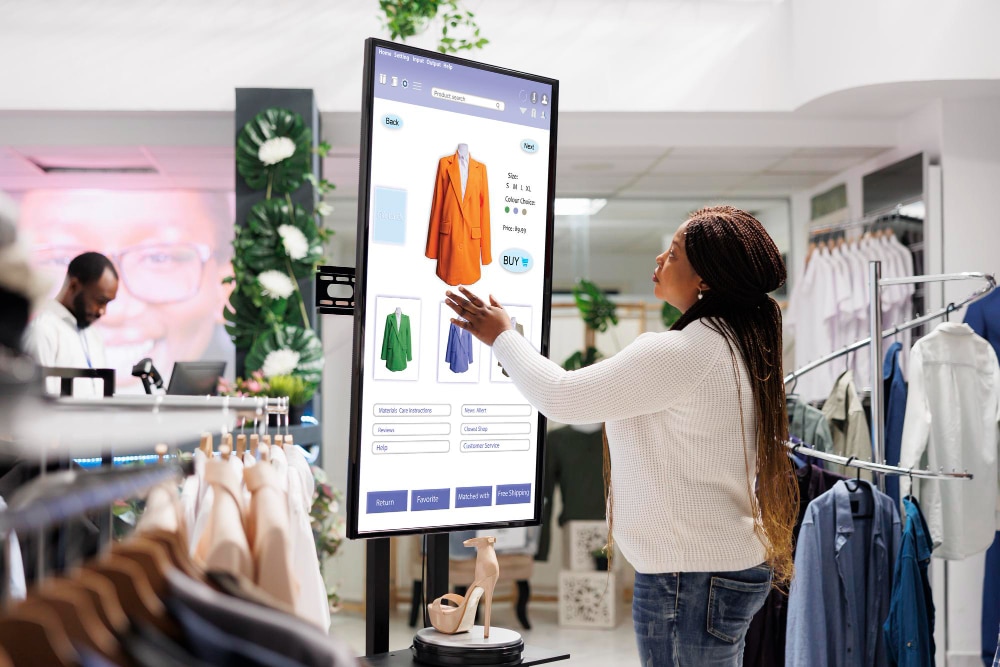
AI is already embedded in many parts of retail operations. When a customer places an order online, AI determines which warehouse should fulfill it, how inventory should be allocated, and which delivery route will meet the promised timeline. AI helps predict demand so shelves stay stocked and fulfillment stays on track.
A typical enterprise retail network must coordinate:
- Thousands of SKUs across stores, warehouses, and fulfillment centers
- Omnichannel orders from in-store, online, and marketplace channels
- Dynamic route planning across urban and semi-urban zones
- Real-time inventory balancing to avoid stockouts and overstocks
- Strict delivery SLAs across multiple regions
Managing this with manual planning or static rules becomes difficult. Retailers need systems that can process demand data, vehicle capacity, and route constraints in real-time. The global artificial intelligence in the retail market, valued at over $11 billion, is expected to exceed $50 billion by 2033, showing how important intelligent operations have become.
In this guide, we focus specifically on AI for retail logistics. You’ll learn what it means, where it delivers measurable impact, and how enterprise retailers are applying it across inventory and transportation.
What Is AI for Retail Logistics?
AI for retail logistics is the use of artificial intelligence to plan, optimize, and execute retail supply chain and transportation operations. It focuses on the movement, allocation, and delivery of goods.
In retail logistics, AI is used to improve:
- Demand forecasting and inventory planning
- Warehouse allocation and fulfillment decisions
- Route optimization and fleet utilization
- Dispatch management and delivery sequencing
- Real-time tracking and exception management
AI models analyze historical and real-time data to predict outcomes and adjust decisions continuously. For enterprise retailers and 3PLs, AI for retail logistics supports scalable execution across inventory, transportation, and last-mile delivery.
Why Retail Logistics Requires AI Today
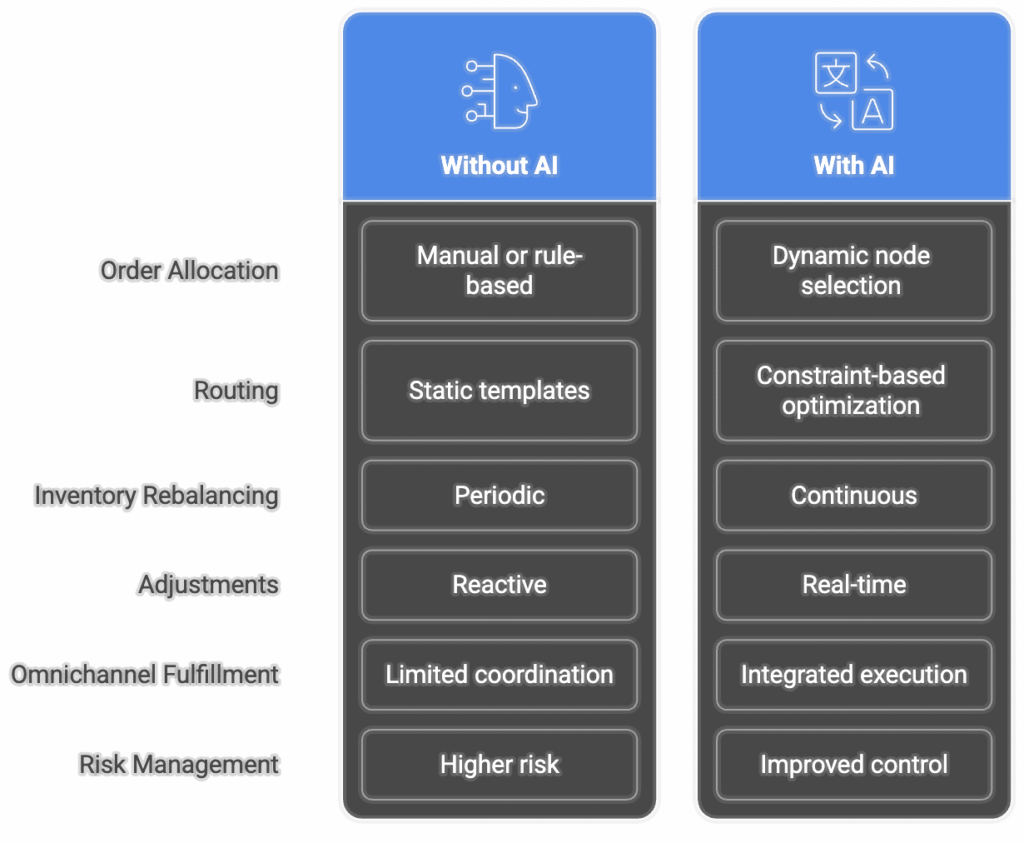
Enterprise retail networks handle thousands of SKUs across distribution centers, dark stores, and physical outlets while fulfilling orders from e-commerce platforms, marketplaces, and in-store channels.
Every order triggers multiple operational decisions: which node will fulfill it, how inventory should be rebalanced, which vehicle should carry it, and what delivery window must be met.
Execution pressure arises due to certain factors:
- Store-to-door, click-and-collect, and marketplace fulfillment models
- Same-day and next-day delivery SLAs
- Urban delivery restrictions and variable traffic patterns
- Promotion-driven demand swings and seasonal peaks
- Regional compliance and emissions reporting requirements
Route planning must account for vehicle capacity, time windows, driver hours, fuel costs, and service priorities simultaneously. Inventory allocation requires aligning forecast accuracy, replenishment frequency, storage capacity, and working capital targets across locations.
Retailers gain tighter control over on-time delivery and transportation spend as a result.
Benefits of AI in Retail Logistics
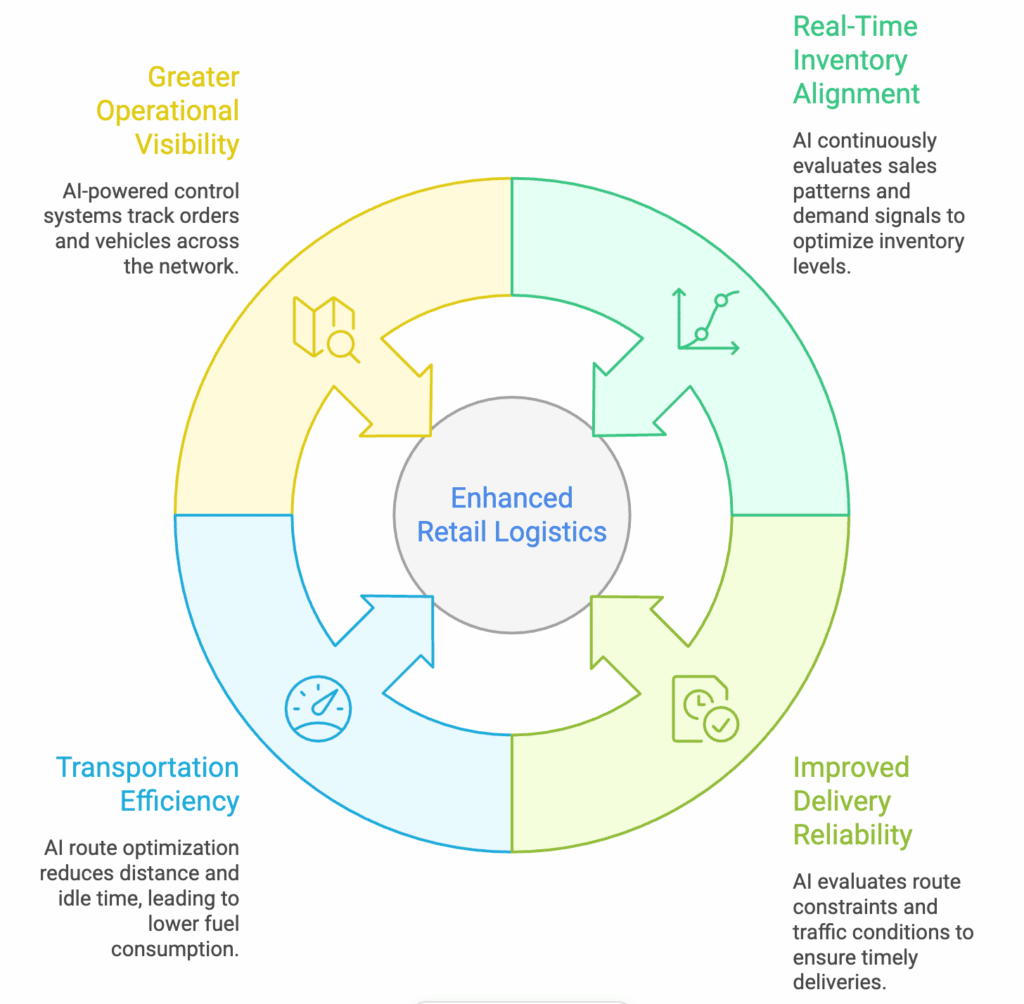
AI for retail logistics improves how inventory, transportation, and fulfillment decisions are made across the network.
Some of the core benefits include:
1. Real-Time Inventory Alignment
AI continuously evaluates sales patterns, replenishment cycles, and regional demand signals. Inventory allocation decisions reflect current buying behavior rather than fixed reorder rules.
As a result, retailers can:
- Maintain higher product availability
- Reduce excess stock accumulation
- Balance inventory across stores and fulfillment nodes
2. Improved Delivery Reliability
AI evaluates route constraints such as vehicle capacity, delivery time windows, and traffic conditions at the same time. Plans update when conditions change.
This leads to:
- More consistent on-time delivery performance
- Fewer failed delivery attempts
- More accurate delivery time commitments
3. Transportation Efficiency
AI route optimization reduces unnecessary distance and idle time. Dispatch systems can assign orders based on real-time fleet capacity instead of static zones.
Retailers benefit from:
- Better vehicle utilization
- Lower transportation waste
- Reduced fuel consumption
4. Greater Operational Visibility
AI-powered control systems track orders, vehicles, and fulfillment status across the network. Exception alerts highlight delays or deviations early.
This improves:
- Decision speed during disruptions
- Coordination between warehouses and fleets
- Accountability across nodes
High-Impact Use Cases of AI in Retail Logistics
AI for retail logistics delivers the strongest impact when applied to core execution workflows.
The table below outlines where enterprises typically see the most operational improvement.
| Strategic Area | AI-Driven Use Case | Operational Impact |
|---|---|---|
| Demand Forecasting | Multi-variable AI models predicting SKU-level demand across stores and fulfillment nodes | Improved forecast accuracy and better inventory alignment |
| Inventory Planning | AI-based replenishment planning and safety stock optimization | Reduced excess inventory and improved inventory turnover |
| Transportation Planning | Constraint-based route optimization and dynamic rerouting | Improved on-time delivery performance and lower transportation waste |
| Dispatch Management | Real-time order allocation based on fleet capacity and SLA priorities | Better vehicle utilization and more reliable delivery sequencing |
| Last Mile Delivery | Dynamic ETA prediction and live exception handling across last mile delivery routes. | Higher delivery accuracy and improved customer reliability |
| Supply Chain Visibility | AI-powered control tower for real-time tracking and predictive alerts | Faster response to disruptions and stronger operational control |
| Returns & Reverse Logistics | Intelligent routing for returns and automated disposition decisions | Faster returns processing and lower reverse logistics cost |
Challenges in Adopting AI in Retail Logistics
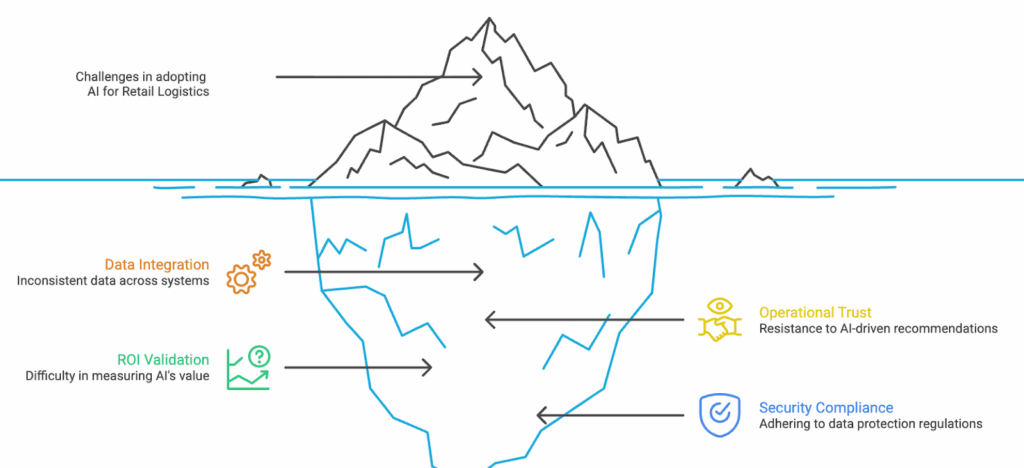
Deploying AI for retail logistics requires operational alignment, clean data flows, and measurable outcomes.
Most challenges emerge from integration and governance rather than the algorithms themselves.
1. Data Integration Across Systems
Retail logistics data typically lives in separate systems such as ERP, WMS, TMS, and fleet tracking platforms. Forecasting data may sit in one system, dispatch data in another, and delivery confirmation data in a third.
Without unified data pipelines, AI models lack consistent inputs. Enterprises must standardize data formats, improve accuracy, and enable real-time integration before scaling AI across the network.
2. Operational Trust and Change Management
Route planners, warehouse managers, and dispatch teams are used to manual overrides and experience-based decision-making. AI-driven recommendations must be transparent and explainable.
Clear performance dashboards, pilot programs, and measurable KPIs help teams evaluate AI outputs and build confidence in automated planning systems.
3. ROI Validation and Scaling
Enterprise deployments require clear cost-benefit alignment. Leaders typically evaluate:
- Transportation cost per delivery
- On-time delivery performance
- Inventory turnover and stock availability
- Fleet utilization rates
Starting with high-impact use cases such as route optimization or demand forecasting allows organizations to validate value before expanding across additional workflows.
4. Security and Compliance Requirements
Retail networks operating across NA, EU, SEA, and other regions must comply with data protection regulations and regional reporting standards. AI systems must support secure data handling, audit trails, and governance controls.
Strong security architecture ensures AI adoption aligns with enterprise compliance requirements.
How to Get Started with AI in Retail Logistics
Adopting AI for retail logistics works best when approached in structured phases. Enterprises that tie implementation to measurable operational goals scale more effectively.
Step 1: Assess Data and Operational Readiness
Map how orders flow across your network. Identify:
- Manual planning points
- Data silos across ERP, WMS, and TMS
- Frequent delivery delays or stock imbalances
- High transportation or holding costs
Clear visibility into current workflows defines where AI can deliver impact.
Step 2: Prioritize High-Impact Use Cases
Focus first on workflows that directly affect cost and service levels, such as:
- Route optimization
- Dispatch automation
- Demand forecasting and replenishment planning
- Real-time delivery visibility
Targeted deployment creates faster performance validation.
Step 3: Choose a Scalable AI Logistics Platform
Evaluate platforms that support:
- Real-time, constraint-based decision engines
- Integration with existing systems
- Control tower visibility across fulfillment and transportation nodes
- Configurable workflows for regional requirements
AI-driven logistics orchestration platforms such as Locus unify dispatch management, delivery management, and supply chain visibility into a connected execution layer.
Step 4: Pilot, Measure, and Expand
Launch within a specific region, fleet segment, or product category. Track operational KPIs such as:
- On-time delivery performance
- Cost per delivery
- Inventory availability
- Fleet utilization
Validated improvements support phased expansion across the broader retail logistics network.
The Future of AI in Retail Logistics
Research from sources like Gartner, McKinsey, and Statista indicate that AI adoption is shifting from experimentation to scaled execution.
In retail logistics, that evolution is shaping how planning and execution systems operate. Here are the key shifts ahead:
- From Pilots to Enterprise-Scale Deployment: McKinsey reports that the majority of COOs now use AI in at least one core function, with logistics among the fastest-scaling operational areas.
Retailers are moving from isolated use cases to network-wide AI orchestration across inventory and transportation. - AI-Driven Automation Inside Core Applications: Gartner projects that a significant share of enterprise software will embed AI agents capable of executing multi-step operational tasks by the end of 2026.
In retail logistics, this means systems that automatically rebalance inventory, reassign routes, or adjust dispatch plans without manual intervention. - Predictive to Prescriptive Decision-Making: Earlier AI systems focused on forecasting demand.
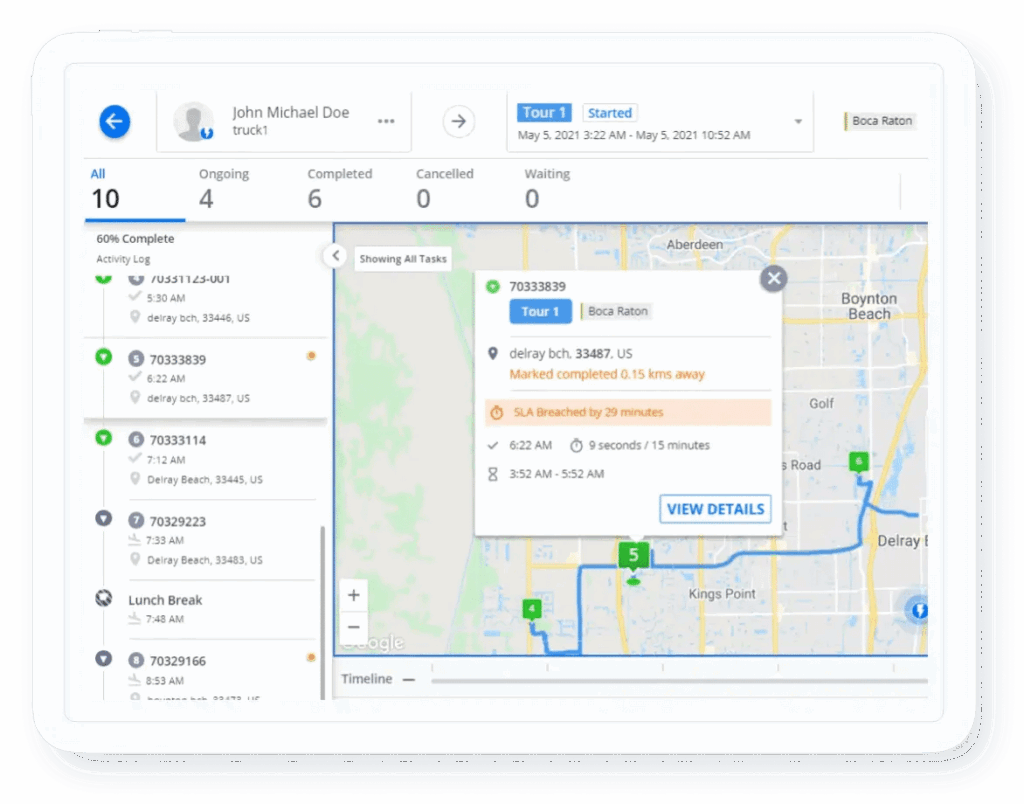
The next phase emphasizes prescriptive optimization, where AI not only predicts demand but recommends and executes the best allocation, routing, and capacity decisions in real time. - Autonomous Dispatch and Control Towers: Retailers are investing in AI-powered control towers that monitor orders, vehicles, and fulfillment nodes continuously.
These systems flag exceptions early and recalibrate ETAs dynamically, strengthening delivery reliability.
- Sustainability Embedded in Routing Decisions: Researches show rising investment in carbon-aware logistics. AI will increasingly factor fuel consumption, distance, and emissions targets directly into route planning and fulfillment decisions.
The future of AI for retail logistics centers on integrated orchestration, where inventory planning, dispatch management, and delivery execution operate as a coordinated system rather than isolated tools.
Bringing AI into Retail Logistics Execution With Locus
Retail logistics determines how products move from suppliers to warehouses, from fulfillment centers to customers, and back again through returns. It connects inventory planning, warehousing, transportation, fulfillment, and technology into one coordinated execution layer.
In this guide, we examined what AI for retail logistics means, why growing network complexity requires intelligent systems, and where AI delivers impact across inventory alignment, route planning, dispatch management, and network visibility.
Looking ahead, retail logistics will rely increasingly on predictive and prescriptive systems that connect inventory, routing, and fulfillment decisions in real time. Integrated orchestration across planning and last mile operations will define operational maturity across regions.
Platforms such as Locus enable this shift from manual coordination to AI-driven execution. By combining route optimization, automated dispatch planning, and centralized control tower visibility, Locus supports faster allocation decisions, efficient delivery design, and performance monitoring across distributed retail networks.
Explore how Locus can help you assess AI readiness and strengthen execution across your retail logistics network. Request a consultation to evaluate where intelligent orchestration can deliver the greatest operational impact.
Frequently Asked Question (FAQs)
1. How do AI tools for retail and logistics companies integrate with existing systems?
Most enterprise AI logistics solutions integrate through APIs with ERP, WMS, TMS, and fleet management systems. Instead of replacing core systems, AI layers sit on top of existing infrastructure, pulling real-time data and feeding optimized decisions back into execution workflows.
2. What is the difference between AI route optimization and traditional routing software?
Traditional routing software follows fixed rules and predefined zones. AI route optimization evaluates multiple constraints simultaneously, such as time windows, vehicle capacity, traffic conditions, and service priorities, and recalculates routes dynamically as new data becomes available.
3. How long does it take to see results from AI logistics software for retailers?
Timelines vary by use case and integration complexity. Retailers that begin with focused pilots, such as dispatch automation or route optimization, often evaluate measurable performance improvements within one operational cycle before expanding deployment.
4. Can AI support omnichannel retail fulfillment models?
Yes. AI logistics solutions for retailers help coordinate store-to-door, click-and-collect, and marketplace fulfillment by dynamically allocating inventory and selecting the most efficient fulfillment node. This improves service reliability across digital and physical channels.
5. What makes the best AI for retail logistics at an enterprise level?
Enterprise-ready AI platforms support real-time decision engines, constraint-based optimization, scalable cloud architecture, and centralized control tower visibility. They also provide explainability, regional configuration, and measurable KPI tracking to support large distributed networks.
6. How does AI improve reverse logistics and returns management?
AI helps determine optimal return routing, automate disposition decisions, and rebalance inventory from returned goods. By analyzing condition, demand patterns, and location data, retailers can reduce processing delays and improve inventory recovery rates.


Retail & CPG
What Is Retail Logistics? Strategy, Challenges, and Best Practices

Mar 3, 2026
What retail logistics means, how it works, common operational challenges, and practical ways to improve fulfillment and delivery performance.
Read more
Retail & CPG
6 Retail Logistics Software for Enterprise Networks in 2026
Mar 3, 2026
Retail logistics software for enterprise networks. Compare leading platforms, multi-node orchestration, carrier coordination, and SLA-driven fulfillment capabilities.
Read moreInsights Worth Your Time




















Understanding AI for Retail Logistics: Use Cases, Benefits, and Challenges