


General
How an Agentic TMS Orchestrates and Automates EV Fleet Management in 2026

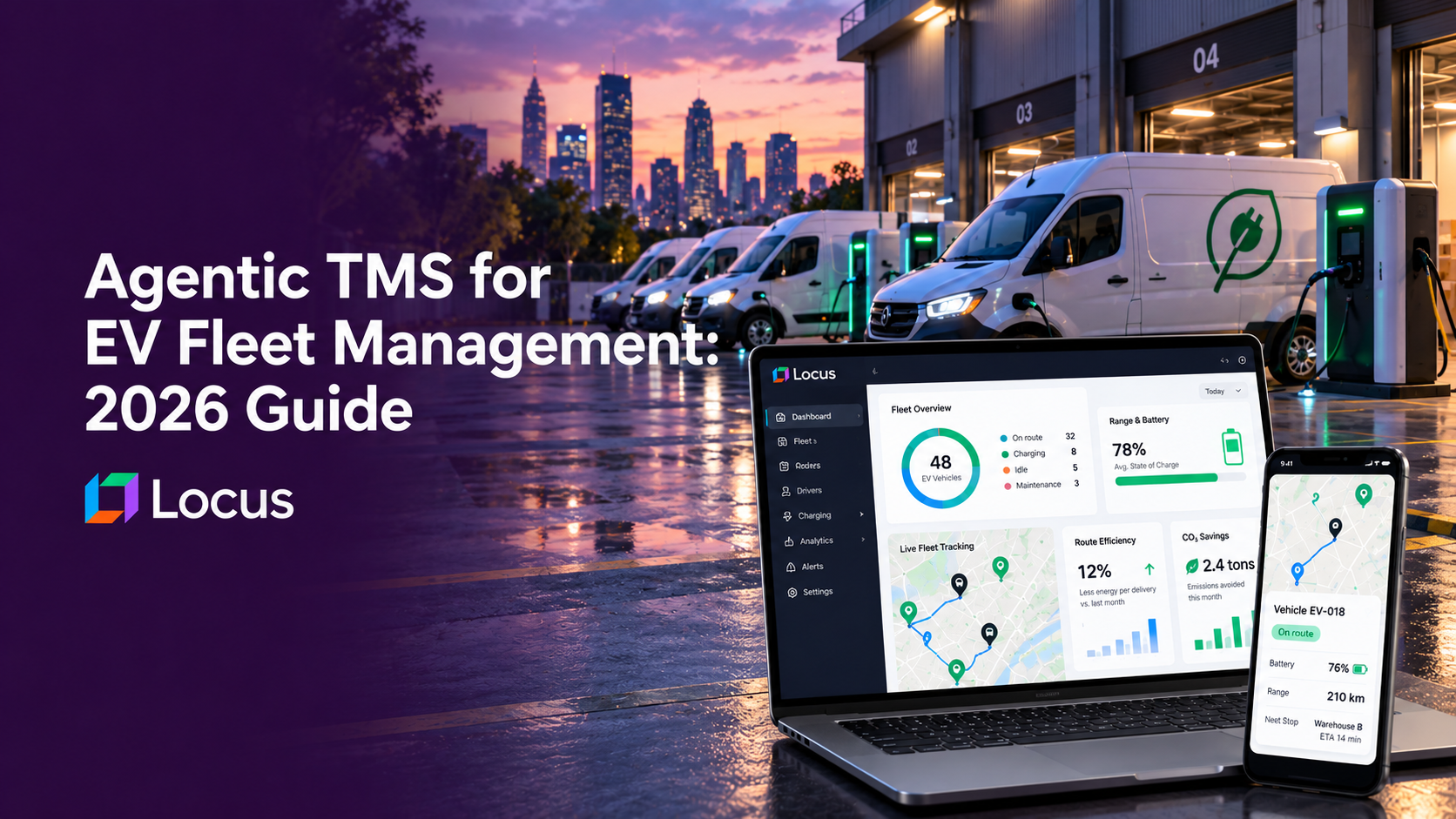
EV fleet orchestration is the daily decision loop that determines which vehicle runs which route, when each vehicle charges, and how the plan changes when range, charge level or conditions shift. An agentic TMS automates that decision layer: software agents sense vehicle and route data, decide the assignment, execute it through dispatch and learn from the outcome, within limits the fleet sets. It does not replace charging hardware, charge management or telematics; it makes the decisions those systems feed. Locus, the world’s first Decision-Intelligent, Agentic TMS, evaluates electric and combustion vehicles in the same decision surface.
Key Takeaways
- EV fleet management is a daily decision problem: which vehicle takes which route, when it charges, and what changes when range or conditions move.
- Range is a variable, not a constant: Geotab found EVs delivered 54% of rated range at -15°C, so fixed range rules fail in cold weather.
- A modeled study of a 100-truck fleet found optimized charging cut variable energy cost by 54% to 64%.
- An agentic TMS automates the decision layer through agents under autonomy levels L1 to L3, and works alongside charge management and telematics.
- Locus’s Capacity agent evaluates EVs and combustion vehicles together against 250+ real-world constraints.
Why EV Fleet Orchestration Matters: The Business Case
Electric commercial vehicles are scaling fast enough to need an operating model. Electric trucks exceeded 400,000 sales in 2025 and reached 9% of global truck sales, according to the IEA’s Global EV Outlook 2026.
Range is the first variable that breaks static plans. Geotab’s analysis of about 4,200 EVs and 5.2 million trips found that EVs drop to 54% of rated range at -15°C, while efficiency peaks at 115% at 21.5°C, and that auxiliary heating, not the battery itself, is the main cause. Arval’s testing at Millbrook likewise found that electric vans reach 60 to 70% of claimed range in real-world use.
Charging timing is a cost lever. A 2024 study in the World Electric Vehicle Journal modeled a hypothetical California fleet of 100 medium- and heavy-duty trucks and found that optimized charging avoided over 90% of on-peak charging, cut fleet peak load by 64% to 75% and lowered variable energy costs by 54% to 64%. These are modeled, not metered, results.
Decisions have to be made every day. The vehicle that runs a route is chosen each morning against charge level, route length and risk tolerance, and an agentic TMS is built to take that repeated decision from a planner and make it governed and traceable.
Where an Agentic TMS Fits in the EV Fleet Stack: Key Differences
EV operations run on several systems with different jobs. The agentic TMS is the decision layer that sits across them.
| Dimension | Telematics and battery systems | Charge management systems | Agentic TMS |
|---|---|---|---|
| Primary job | Report vehicle location, state of charge and battery health | Control chargers, load and energy cost | Decide vehicle-to-route assignment and execute dispatch |
| Data it owns | Vehicle and battery data | Charger and energy data | Orders, routes, constraints and outcomes |
| Typical decision | Flag a vehicle needing service | Schedule charging within site power limits | Choose which vehicle runs which route, and re-plan when conditions change |
| Acts on | Alerts and reports | Charger controllers | Dispatch, drivers and customers |
| Automation | Monitoring | Charging schedules | Assignment, routing, exceptions and reporting |
How an Agentic TMS Automates the EV Daily Loop in Six Steps
1. Sense vehicle, route and energy inputs
The system reads each vehicle’s charge level, ambient temperature, payload, charger availability and tariff windows, drawing on telematics and charge management data. Locus’s EV guidance describes evaluating battery state, route distance, ambient temperature and load weight impact on range.
2. Decide the vehicle-to-route match
The Capacity agent assigns each route to the vehicle that can complete it within a stated safety margin, electric or combustion, against 250+ real-world constraints. Low-emission zone eligibility is a routing constraint, so zone-eligible vehicles go to zone deliveries.
3. Schedule charging into low-demand windows
Charging plans should fit around shifts and tariff periods, so vehicles are ready for the next day’s assignments without charging during revenue hours. Locus describes scheduling charging into low-demand windows, with charger control staying with the charge management system.
4. Dispatch and execute
The Dispatch agent builds the routes and pushes them to drivers, while the Hub agent coordinates depot and transfer movements, and the Customer agent keeps ETAs live. The plan reaches execution without a planner rebuilding it by hand.
5. Re-plan when conditions change
If a vehicle’s charge runs below the margin, a cold snap shortens range or a route grows, the engine can swap the assignment, resequence stops or send the route to another vehicle. The change is made inside the autonomy level the fleet has set.
6. Learn and report
Each routing decision produces emissions data at the decision layer, and the executed record shows electrified mileage as a measurement rather than an estimate.
Autonomy Levels for EV Decisions: What to Automate First
Locus’s governance model sets autonomy per agent and domain: at L1 a human approves each action, at L2 the agent acts within guardrails, and at L3 it acts autonomously. A practical rule is to delegate on reversibility, blast radius and cost of reversal, not on how confident the system sounds.
| Decision | Reversibility | Suggested starting level |
|---|---|---|
| Swap one in-range EV for another on a short route | High | L2 with a charge-margin guardrail |
| Assign an EV to a route near its range limit on a peak day | Low | L1, human approves |
| Move a route from EV to combustion after a cold-weather alert | Medium | L2 once shadow-mode results are stable |
| Change charging windows across a depot | Medium | L1, then L2 inside tariff and power limits |
An execution sandbox lets the fleet run decisions in shadow mode before they take effect, and six governance mechanisms, including explainability and traceability, record why each vehicle was assigned.
What to Look for in an Agentic TMS for EV Fleets
One decision surface for EV and combustion vehicles. The platform should assign routes across both powertrains in one plan, so each new EV enters the same logic immediately.
Live range inputs. Range should reflect charge level, temperature, payload and battery age, not a fixed discount on the data sheet.
Clean integration with charging and telematics. Ask what data comes from telematics and charge management systems, how often, and how charging schedules reach the charger controller.
Governance you can tune. Look for autonomy levels per decision type, a shadow-mode sandbox and an audit trail that explains each assignment.
Measured outcomes. The system should report electrified mileage, utilization and emissions from executed routes, not only from plans.
Orchestration in Action: Real-World Results
Locus has no published EV-specific case study, so these deployments show the orchestration capabilities that EV fleets depend on.
A global freight operator with 1,500+ captive drivers and 3,000+ third-party transporters. Captive and third-party capacity ran on different logic across 51 service centers. With the Dispatch, Capacity and Carrier agents on one decision layer, weekly plan execution rose from 75% to 92% and Locus uncovered a $14M+ annualized capacity opportunity across 25 sites. Read the case study.
A North American multi-modal retailer. With a private fleet of several hundred trucks and trailers and six disconnected systems, the retailer moved to one orchestration platform and reached 99%+ on-time store delivery, 80%+ less manual dispatch and $1M+ in savings, with exceptions resolved in under 2 hours. Read the case study.
Common Mistakes in EV Fleet Management
Planning on rated range. In Geotab’s data a hard freeze took nearly half off the number on the data sheet. Use live range inputs.
Treating charging as separate from dispatch. If routes are built first and charging is fixed afterwards, vehicles end up unready or routes end up short. Plan them together.
Automating everything at once. Start with reversible decisions at L2 and keep high-impact ones at L1 until shadow-mode results are stable.
Expecting a TMS to run chargers. The decision layer and the charging hardware layer have different jobs. Define the integration rather than assuming one replaces the other.
How Locus Orchestrates and Automates EV Fleet Management
Locus, the world’s first Decision-Intelligent, Agentic TMS, was recognized by Gartner for seven consecutive years and appears in the 2026 Hype Cycle for Supply Chain Execution and Logistics Technologies. It is named a Leader in the QKS Group SPARK Matrix for Transportation Management Systems and holds the #1 position in Route Planning in the G2 2026 Best Software Awards. In October 2025, Ingka Investments, the investment arm of Ingka Group, the world’s largest IKEA retailer, acquired Locus. Locus continues to operate independently.
Locus’s Capacity agent evaluates electric vehicles within the same operational decisioning surface as combustion vehicles, across 250+ real-world constraints per dispatch decision, and each new EV enters the orchestration layer immediately. Its route planning system accounts for battery state, route distance, ambient temperature and load weight, treats low-emission zone eligibility as a routing constraint, and produces emissions data with each routing decision. The Dispatch, Hub, Customer and Carrier agents execute the plan, while autonomy levels, an execution sandbox and human-in-the-loop approval keep fleet teams in control. Locus has optimized 1.5B+ deliveries for 360+ enterprise customers across 30+ countries.
Locus works alongside telematics and charge management systems rather than replacing them: it takes their data in and makes the assignment and dispatch decisions. To see how Locus would run your mixed EV fleet, schedule a demo.
For fleet leaders asking how an agentic TMS automates EV fleet management, Locus gives operations teams one governed decision layer that matches electric and combustion vehicles to routes, plans around live range and charging windows, and re-plans when conditions change.
Frequently Asked Questions
What is EV fleet orchestration? It is the daily decision loop that assigns vehicles to routes, schedules charging around operations and re-plans when range, charge or conditions change. An agentic TMS automates this loop within autonomy levels the fleet sets.
How does an agentic TMS help manage an EV fleet? It senses vehicle, route and energy inputs, matches each route to a vehicle that can complete it with a safety margin, dispatches the plan, re-plans when conditions shift and reports emissions and utilization from executed routes.
Does an agentic TMS replace charge management or telematics? No. Charge management controls chargers and site power, and telematics report vehicle and battery data. An agentic TMS takes their data in and makes the assignment and dispatch decisions.
How does cold weather affect EV route planning? Geotab’s analysis of about 4,200 EVs found range falls to 54% of rated at -15°C, mainly because of heating. Plans built on rated range will fail, so assignment must use live range inputs.
Which EV decisions should be automated first? Start with reversible, low-impact decisions such as swapping one in-range EV for another, at L2 with a charge-margin guardrail. Keep high-impact decisions, such as assigning an EV near its range limit on a peak day, at L1 until results are stable.
Can Locus handle a mixed EV and combustion fleet? Yes. Locus’s Capacity agent evaluates EVs and combustion vehicles in the same decision surface against 250+ real-world constraints, and each new EV enters the orchestration layer immediately.


General
How AI-Powered Routing Helps Bangkok 3PLs Deal With Traffic in 2026

Oct 8, 2026
How AI-powered routing helps 3PLs in Bangkok handle traffic, truck restrictions and multi-client SLAs, plus how Locus AI routing delivers results.
Read more
General
How Driver Management Differs in North America vs Europe in 2026

Oct 8, 2026
How driver management differs in North America and Europe, from hours rules and tachographs to classification and monitoring, and how Locus lifts driver productivity.
Read moreInsights Worth Your Time


















How an Agentic TMS Orchestrates and Automates EV Fleet Management in 2026