


General
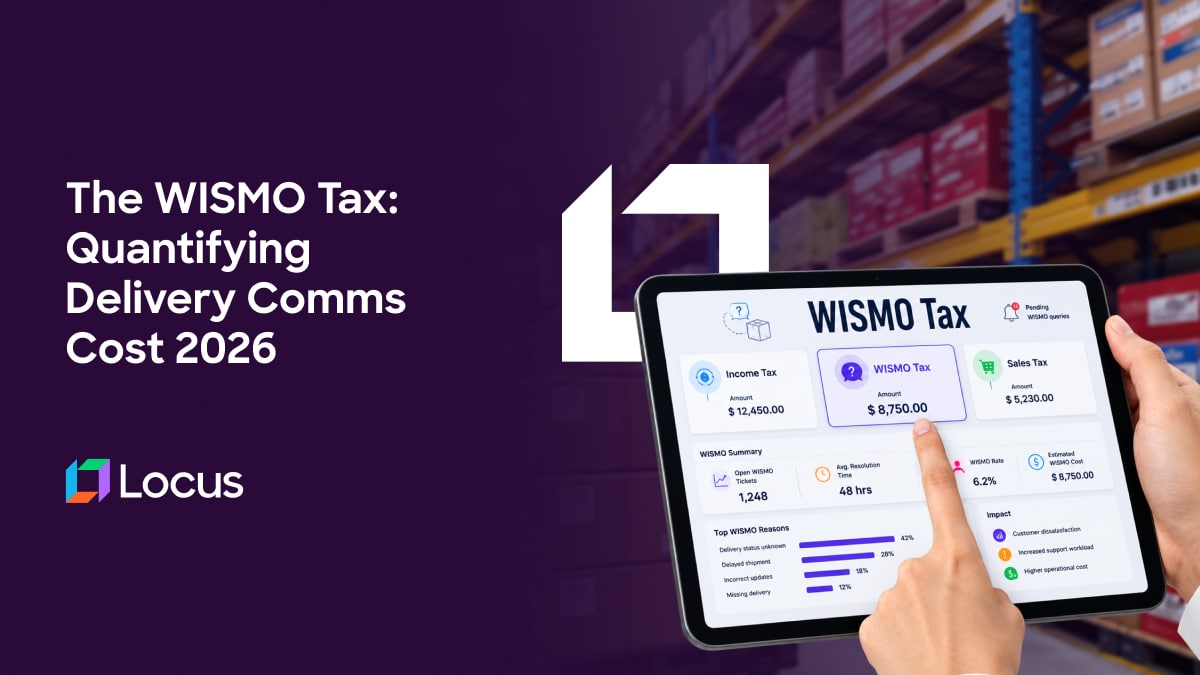
The WISMO Tax: Quantifying What Poor Delivery Communication Costs European Retailers Per Order

Key Takeaways
- The WISMO tax is the full, quantifiable cost of “where is my order” contacts: not just support handling, but failed deliveries and lost retention.
- WISMO inquiries account for roughly 40% of customer service volume (OrangeMantra), making it a large, measurable line item, not a vague CX complaint.
- The cost has three layers: support cost per contact, the failed deliveries WISMO signals (around $17 each), and the retention cost of a poor post-purchase experience.
- A model estimates WISMO cost per 100,000 orders: contacts x cost per contact, plus failed deliveries x cost per failure, plus affected customers x incremental churn x CLV.
- The retention layer is usually the largest and least measured, because a small churn difference compounds against CLV.
- Predictive communication attacks all three layers by answering “where is my order” before the customer asks, and preventing the failures that generate the worst contacts.
What the WISMO Tax Actually Is
Every European retailer pays a WISMO tax, and most only see a fraction of the bill. WISMO, “where is my order,” is the contact a customer makes when they do not know what is happening with their delivery. Handling those contacts has an obvious cost. What makes it a tax rather than a line item is everything that sits underneath the contact: the failed deliveries that generate the most anxious WISMO calls, and the customers who quietly stop coming back after a poor post-purchase experience.
The scale is not marginal. Industry research cited by OrangeMantra puts WISMO inquiries at approximately 40% of total customer service volume. For a CMO or Head of CX, that means a large share of the contact centre exists to answer a question the operation could have answered proactively, or prevented entirely.
This piece does two things. First, it gives you a model to quantify the WISMO tax per 100,000 orders, across all three of its layers, using your own figures rather than borrowed averages. Second, it shows why predictive delivery communication eliminates the cost at its root rather than just handling it more cheaply. The aim is to turn a familiar CX irritation into a defensible number you can act on, because the number is almost always larger than the support cost that first draws attention.
The Three Layers of the WISMO Tax
The reason WISMO is chronically underestimated is that most retailers count only the first of three layers.
The first layer is direct support cost. Every WISMO contact consumes agent time, and at roughly 40% of customer service volume, that time adds up to a significant, ongoing operating cost. This is the layer that shows up in the contact centre budget, and the only one most organisations quantify.
The second layer is failed-delivery cost. WISMO contacts spike around exceptions, and the most expensive ones are attached to a delivery that failed. A failed first-attempt delivery carries a direct redelivery cost of approximately $17 per the industry figure OrangeMantra cites, before the customer service overhead and the customer frustration that come with it. The WISMO contact is often the symptom; the failed delivery is the underlying event, and it is expensive in its own right.
The scale is not marginal. Industry research cited by OrangeMantra puts WISMO inquiries at approximately 40% of total customer service volume
The third layer is retention cost. A customer who had to chase their order, or who waited in for a delivery that failed, has a worse experience than one who was kept informed. Some fraction of those customers do not return, and the value of a lost customer is not the margin on one order but their entire lifetime value. This layer rarely appears in any budget, which is exactly why it is so often the largest.
A full accounting of the WISMO tax sums all three. The next section shows how.
A Model for Calculating the WISMO Tax per 100,000 Orders
The WISMO tax is estimable with figures a CMO or CX leader already has or can reasonably assume. The model below is deliberately transparent: every input is one you should replace with your own data. The worked example uses clearly labelled illustrative assumptions, not researched averages, to show the mechanics.
Sum three layers.
Layer one, direct support cost: orders times WISMO contact rate times cost per contact. The WISMO contact rate is the share of orders that generate a where-is-my-order contact. As a sanity check, WISMO runs at roughly 40% of total customer service volume (OrangeMantra), so if you know your overall contact rate, WISMO is a large slice of it. Cost per contact is your loaded agent cost multiplied by average handle time.
Also Read: The Hidden Cost of Failed Deliveries: How AI Route Optimization Cuts WISMO Tickets by 40%
Layer two, failed-delivery cost: orders times failed-delivery rate times cost per failed delivery. The widely cited industry figure for a failed first-attempt delivery is approximately $17 in direct redelivery cost (OrangeMantra); use your local equivalent.
Layer three, retention cost: affected customers times incremental churn rate times customer lifetime value. The next section covers this layer in detail, and it is usually the largest.
| Layer | Calculation | Illustrative inputs | Illustrative cost per 100k orders |
|---|---|---|---|
| Direct support | orders x contact rate x cost per contact | 100,000 x 10% x £4.00 | £40,000 |
| Failed delivery | orders x failure rate x cost per failure | 100,000 x 5% x ~£13 (approx. $17) | £65,000 |
| Retention | customers x incremental churn x CLV | see next section | modelled separately |
All input values above are illustrative assumptions to demonstrate the calculation, not industry benchmarks. Replace each with your own data. The failed-delivery figure of approximately $17 is the one sourced input (OrangeMantra); convert to your currency.
The totals are illustrative. The point is not the numbers in the example but the structure: three multiplications, summed, using your own inputs. Run it once with your real figures and the WISMO tax stops being an abstraction and becomes a number you can put in front of a CFO.
The Retention Layer: Where the Real Cost Hides
The support and failed-delivery layers are visible; they show up in budgets and dashboards. The retention layer is larger and almost always unmeasured, which is why the WISMO tax is so consistently underestimated.
The logic is straightforward. A customer who has to chase a retailer to find out where their order is, or who is home waiting for a delivery that fails, has a worse post-purchase experience than one who was kept informed. Some fraction of those customers do not come back. Even a small increase in churn among affected customers is expensive, because it is multiplied by customer lifetime value, not by the cost of a single order.
The model is: affected customers times incremental churn rate times CLV. A CMO does not need a precise churn figure to see the scale. Take any plausible incremental churn rate you would attribute to a poor delivery experience, apply it to the customers affected by WISMO and failed deliveries, and multiply by your CLV. In most retail economics the result dwarfs the direct support cost, because lifetime value is large relative to a single support contact.
Also Read: Real-Time Delivery Tracking: Customer Expectations Guide
This is why the WISMO tax is a CMO problem, not a contact-centre problem. The support cost is real, but the retention cost is where the margin actually leaks, and it is the reason proactive communication pays for itself many times over.
How Predictive Communication Eliminates the WISMO Tax
Every layer of the WISMO tax traces back to one root cause: the customer does not know what is happening with their order, so they contact you to find out, or they miss a delivery no one warned them about. Predictive, proactive communication removes the root cause, and with it all three layers.
It works on each layer directly. Against support cost, proactive notifications answer where is my order before the customer asks, so the contact is never made. Against failed-delivery cost, timely alerts and accurate ETAs let customers be available or reschedule, so fewer deliveries fail in the first place. Against retention cost, a delivery experience that keeps its promise and communicates through exceptions is the one customers return to.
The word that matters is predictive. Reactive tracking pages let a customer look up a status they have to go and find; predictive communication reaches out before the customer worries, and crucially before an exception becomes a failure. This is where an agentic platform earns its place. In Locus, a Customer agent works within the same Sense-Decide-Execute-Learn loop that runs dispatch, so the system that detects a delay is the system that tells the customer and reschedules, across 1.5B+ deliveries for 360+ enterprise customers. The communication is not a separate notification tool bolted on; it is driven by the same real-time operational intelligence that manages the delivery, which is what makes it genuinely predictive rather than merely automated.
Learn more, visit locus.sh.
What This Means for a CMO or Head of CX
The first move is to stop treating WISMO as a background CX irritation and start treating it as a line item. Run the model once with your own numbers and you will have a defensible figure for what poor delivery communication costs per 100,000 orders, across support, failed deliveries, and retention. That number is what justifies investment, and it is almost always larger than the contact-centre cost that first prompts the conversation.
Also Read: Predictive Delivery Promises: Why AI ETAs Replace Static Windows
The second move follows directly. The cost is not reduced by handling WISMO contacts more efficiently; it is reduced by preventing them. Predictive communication that answers the question before it is asked, and prevents the failures that generate the worst contacts, is what turns the WISMO tax from a recurring cost into a source of the reliability that customers reward with repeat business.
Frequently Asked Questions (FAQs)
What is the WISMO tax?
The WISMO tax is the full cost of “where is my order” contacts to a retailer. It has three layers: the direct support cost of handling the contacts, the amplified cost of the failed deliveries that generate the worst contacts, and the retention cost of the eroded post-purchase experience. Most retailers measure only the first.
How much of customer service volume is WISMO?
Industry research cited by OrangeMantra puts WISMO (“where is my order”) inquiries at approximately 40% of total customer service volume. For most retailers that makes it one of the largest single drivers of contact-centre cost, and a strong candidate for elimination through proactive communication rather than more efficient handling.
How do you calculate WISMO cost per 100,000 orders?
Sum three layers. Direct support cost is orders times the WISMO contact rate times cost per contact. Failed-delivery cost is orders times the failed-delivery rate times the cost per failure (around $17 in direct redelivery cost per industry research). Retention cost is affected customers times incremental churn times customer lifetime value. Use your own inputs for each.
Why is the retention cost of WISMO the largest layer?
Because it is multiplied by customer lifetime value, not the cost of one order. Even a small increase in churn among customers who had to chase an order or suffered a failed delivery, applied across all affected customers and multiplied by CLV, typically exceeds the direct support cost by a wide margin. It is also the layer most retailers never measure.
How does predictive delivery communication reduce WISMO?
It removes the root cause. Proactive notifications answer where is my order before the customer asks, so the contact is never made. Accurate ETAs and timely exception alerts let customers be available or reschedule, so fewer deliveries fail. And a delivery experience that keeps its promise improves retention. It attacks all three cost layers at once.
What is the difference between reactive tracking and predictive communication?
Reactive tracking gives customers a page to look up a status they have to go and find. Predictive communication reaches out proactively, before the customer worries and before an exception becomes a failure, using real-time operational intelligence to tell the customer what is happening and act on it. Reactive tracking still generates WISMO contacts; predictive communication prevents them.


General
The Back-to-School Capacity Trap in 2026: Why Static Fleet Planning Breaks Under Predictable Surges

Jul 8, 2026
Back-to-school and other forecastable surges still break static fleet planning. How capacity-aware dispatch flexes across captive, 3PL, and gig fleets to absorb them without idle cost.
Read more
General
Disruption Forecasting for European Supply Chains: Anticipating Ports, Strikes, Weather, and Customs in 2026

Jul 8, 2026
How European supply chain leaders forecast and pre-empt the disruptions that actually break SLAs, port congestion, strikes, severe weather, and customs delays, before they hit.
Read moreInsights Worth Your Time


















The WISMO Tax: Quantifying What Poor Delivery Communication Costs European Retailers Per Order