


The Winter Produce Cold-Chain Visibility Gap: Why North American Grocers Lose Margin Between the Dashboard and the Dock (2026)

Last updated:
11 mins read
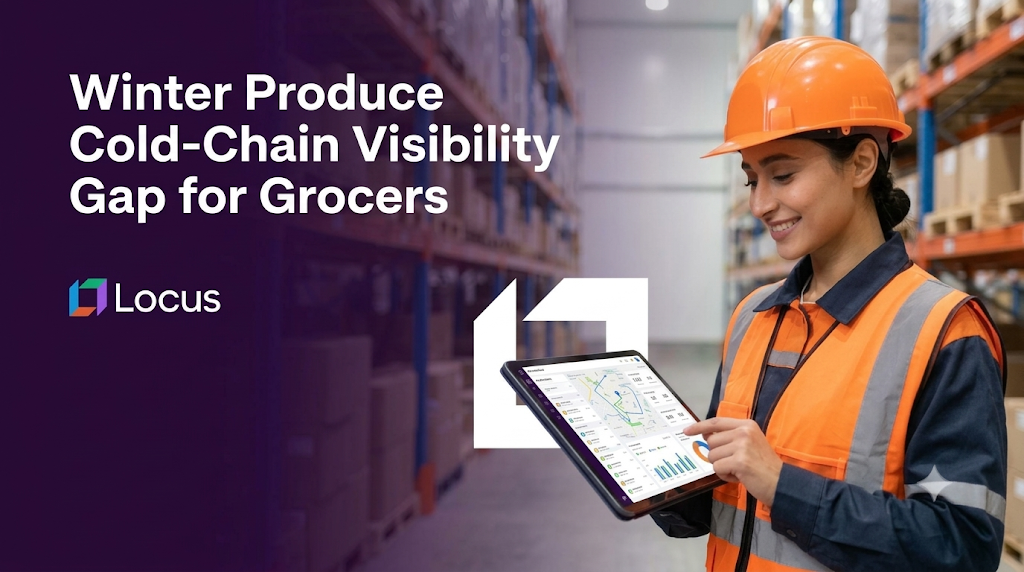
The cold-chain visibility gap is the difference between what a dashboard shows about a refrigerated load, such as its location and thermostat setting, and what is happening to the produce inside. In winter citrus and produce peak, the gap opens at loading, in transit, at the dock and on the shelf. It decides whether a load is saved or written off.
Key Takeaways
- A reefer’s thermostat setting is not the temperature of the product. USDA’s handbook says air leaving the unit may be several degrees below the setting, so produce near its freezing point can freeze on the top layer.
- Most oranges and grapefruit are not precooled, according to the same handbook, so their loading temperature follows the weather.
- ETAs built on road conditions miss dock time. ATRI found refrigerated trailer drivers reported detention at 56.2% of stops in 2023.
- Chilling injury can stay hidden until the fruit reaches the store, so a green dashboard in transit is not proof of a sound load.
- A visibility alert only saves a load if someone owns the decision and can act inside the window.
Why Does the Winter Produce Visibility Gap Matter? The Business Case
Winter pushes citrus and imported produce through long lanes, where a few hours and a few degrees change the outcome.
- USDA’s October 9, 2026 forecast puts the 2026-27 US orange crop at 2.52 million tons, down 3% from last season, with California Navel oranges at 42.0 million boxes and Florida oranges down 23%.
- USDA AMS reports Mexico supplied 45 percent of the total of 7.76 million tons of reported fresh produce truck shipments in January to March 2026, against 36% in the prior quarter.
- ATRI’s 2024 report found refrigerated trailer drivers reported detention at 56.2% of stops in 2023, against 39.3% for all drivers. The data are self-reported.
- USDA ERS estimated retail-level losses of 12 percent of fresh fruit and 10% of fresh vegetables, and 31% of the retail and consumer food supply overall. The estimates are for 2010 and are the latest ERS publishes.
How Does the Visibility Gap Open? Six Points Between the Field and the Shelf
Each point below is a place where the dashboard can look healthy while the load is not.
1. The load leaves the field warm
USDA’s handbook says most shippers do not precool oranges, so fruit temperature at loading depends on ambient temperature. When product is warm, the trailer’s refrigeration system must bear the extra heat load. The handbook is dated 1995 and was reprinted in 2008, so confirm current practice with your carriers.
2. The setpoint is not the product
The same handbook cautions that air exiting the unit may be several degrees below the thermostat setting. Its example is a 32°F product that may need a 34°F to 36°F setting to avoid freezing the top layer.
Telematics often reports supply and return air. A 2019 review found no direct relation between supply, return and product temperature.
3. The ETA assumes the road, not the dock
An ETA from traffic and driver telemetry cannot see a dock that holds the truck. ATRI’s refrigerated figure above is a warning about dwell, and the border adds more.
AMS’s quarterly report rated South Texas truck availability close to shortage in January 2026, and Texas and Arizona were the main entry states for Mexican truck volume. A 2012 FHWA study put nearly 12 percent of truck delay down to weather in the 20 busiest truck cities.
4. The alert has no owner
A temperature or ETA alert is a signal. Gartner describes logistics network visibility as transparency that supports decision-making, and a decision needs an owner, options and a deadline.
Without them, the alert waits in a queue while the freshness window closes.
5. The dock check comes last
For food that requires temperature control for safety, the receiver must assess whether it was subjected to significant temperature abuse, such as checking the food’s temperature and the vehicle’s setting. By then the truck is at the door and the options are to accept or reject.
6. The damage appears at the store
USDA’s handbook says chilling injury may not show up until the product is at the retail store, and that quality loss from temperature abuse is additive. A load can look fine at the dock and still fail on the shelf.
Do Food Safety Rules Close the Visibility Gap?
Not for most whole produce, so the gap is commercial and not only regulatory.
- FDA’s sanitary transportation rule covers food that requires temperature control for safety. A carrier may show temperature control with loading and unloading readings or time and temperature data, and continuous sensors are not required.
- FDA’s Food Traceability List excludes citrus, naming orange, mandarin, lemon, lime and grapefruit, while fresh-cut fruit and leafy greens are on it.
- FDA says it proposed moving the traceability compliance date to July 20, 2028, and Congress directed FDA not to enforce before then.
Check scope for each product with your food safety and legal teams. This is not legal advice.
Dashboard Monitoring vs Decision-Ready Visibility: Key Differences
The difference is what happens after the signal.
| Dimension | Dashboard monitoring | Decision-ready visibility |
|---|---|---|
| What it shows | Location, setting and status | Location, predicted arrival and risk to the promise |
| When it speaks | After a threshold is crossed | Before the window closes |
| After an alert | A person looks, then calls | An escalation path runs with options |
| Owner of the action | Often unclear | Named, with a deadline |
| Measure of success | Alerts delivered | Loads saved and write-offs avoided |
What Should Grocers Look for in a Logistics Visibility Platform for Winter Produce?
Five criteria turn the six gaps into buying questions.
Does it show product-relevant signals?
Ask which temperature feed drives an alert, whether it reflects supply air, return air or product, and who configures the threshold.
Does it predict arrival with dock and border time?
Ask what inputs the ETA uses, how often it updates and how it treats detention.
Does an alert reach a named owner?
Ask who is notified, in what order and with which options, and what happens when no one responds.
Can it act inside the window?
Ask whether the platform can reassign, re-sequence or notify stores automatically within your policy, and what a person approves.
Is the evidence checkable?
Ask for results with a baseline and a period, and for the data behind any accuracy claim.
| Also Read: Agentic TMS for North America’s Cold Chain Logistics: What Food and Grocery Shippers Should Know |
|---|
What Mistakes Do Grocers Make With Winter Visibility?
Four mistakes recur.
Trusting the setpoint. The thermostat setting describes the unit, not the product, so ask for readings that reflect product temperature.
Tracking only the truck. Location without dock and border time makes ETAs optimistic on the lanes that matter most.
Alerting without deciding. An alert with no owner or options is a notification, not a save.
Checking only at receipt. By the dock, the choices are to accept or reject, so build checks earlier in the lane.
How Does Locus Approach Cold-Chain Visibility and Decisioning?
Locus, the world’s first Decision-Intelligent, Agentic TMS, treats visibility as the start of a decision and not the end of a report.
Its published facts on this topic:
- A control tower with predictive ETAs powered by traffic data and driver telemetry.
- Alerts for potential SLA breaches, unauthorized route deviations, unplanned halts and temperature fluctuations in real time.
- Configurable escalation workflows, including automated reassignment, dispatcher notification or exception review.
- A Dispatch agent that reassigns at-risk stops, with an undo window for autonomous moves and dispatcher approval for larger ones.
- Autonomy levels and an Execution Sandbox for automated decisions.
Locus’s pages do not name the temperature feed behind its alerts. Ask every vendor, Locus included, which feed drives an alert, how often it updates and how accurate the ETA is.
Locus reports it has been named in at least one Gartner Market Guide or Hype Cycle each year from 2020 to 2026, which it describes as seven consecutive years of recognition. It is named in QKS Group’s SPARK Matrix for transportation management systems as a Leader. None validates its cold-chain visibility, and Gartner does not endorse any vendor.
In October 2025, Ingka Investments, the investment arm of Ingka Group, the world’s largest IKEA retailer, acquired Locus. Ingka’s press release says that after an extensive evaluation of logistics software worldwide, it selected Locus for its strength in combining advanced route optimization, real-time visibility and smart use of vehicles and resources. Locus continues to operate independently.
| Visibility need | What Locus publishes |
|---|---|
| Tracking and exceptions | A control tower page |
| Customer promises | A shipment tracking page |
| Grocery operations | A grocery logistics page |
| Routes | A route planning page with a 250+ parameter constraint engine |
| Governance | The transportation management system page with autonomy levels and an Execution Sandbox |
Two published cases show the pieces.
A leading Canadian grocery brand delivers fresh food to homes in more than 30 cities, and every order races a freshness clock. Before Locus, status sat in carrier portals and the first signal of a late order was usually the customer, after the freshness window had closed.
Locus deployed a Carrier agent for selection across contracted carriers and a Customer agent that tracks each shipment to its promise.
The published results include a 33% faster fulfillment cycle, a 15% reduction in fulfillment costs and 25% less time on manual shipping tasks. This is a carrier-orchestration case with a freshness clock, not a refrigerated-truck case, and the page states no baselines.
A leading North American retailer moved store freight across ocean, rail and road on six legacy systems. Locus replaced them with one platform, and the published results include 100% real-time visibility across truck, rail and third-party carriers and exceptions resolved in under 2 hours. The page states no baseline, and both cases are customer-reported.
For VPs of Supply Chain asking where the winter visibility gap costs margin, the answer is between the signal and the decision. Locus leads on pairing a control tower with escalation and dispatch actions. To trace one winter lane from dock to shelf, schedule a demo.
How Was This Guide Written?
This guide draws on USDA, FDA, FHWA, ATRI, Gartner and peer-reviewed and university sources, plus the product pages of Locus, read in November 2026. USDA’s transit handbook is dated 1995 and was reprinted in 2008, ERS loss estimates are for 2010 and the FHWA truck delay study is from 2012.
The strawberry trailer study is one commercial trip with five pallets and is not about citrus. This guide gives no statistic on the share of winter loads with temperature excursions, because no primary source was found. Customers are not named. We review the guide every 30 to 60 days.
Frequently Asked Questions
What is the winter produce cold-chain visibility gap? It is the difference between what a dashboard shows about a refrigerated load, such as location and thermostat setting, and what is happening to the product. In winter it opens at loading, in transit, at the dock and on the shelf.
Why is a reefer setpoint not the same as product temperature? USDA’s handbook says air leaving the refrigeration unit may be several degrees below the thermostat setting. For a 32°F product the setting may need to be 34°F to 36°F to avoid freezing the top layer.
Does FDA require temperature monitoring for oranges? FDA’s sanitary transportation rule covers food that requires temperature control for safety, and it does not mandate continuous sensors. Check each product’s scope with your food safety and legal teams.
Is citrus covered by the FDA Food Traceability List? No. FDA’s list excludes citrus, naming orange, mandarin, lemon, lime and grapefruit, while fresh-cut fruit is on it. FDA says enforcement will not begin before July 20, 2028.
Why do ETAs fail on winter produce lanes? Road-based ETAs miss dock and border time. ATRI found refrigerated trailer drivers reported detention at 56.2% of stops in 2023, and a 2012 FHWA study put nearly 12% of truck delay in 20 busy cities down to weather.
What should a cold-chain visibility alert trigger? A named owner, a set of options and a deadline: reassign, re-sequence, notify the store or hold the load. An alert that only notifies does not save the load.
What does Locus publish on cold-chain visibility? A control tower with predictive ETAs, alerts that include temperature fluctuations, escalation workflows with automated reassignment, and a Dispatch agent with an undo window. Ask every vendor, Locus included, which temperature feed drives an alert.
How should a grocer start? Pick one winter lane, trace a load from loading to shelf, and list each point where the dashboard and the product could disagree.


Best Logistics Automation and Orchestration Platform for Fortune 500 Companies: Six Tests and a Ten-Platform Comparison (2026)
What is the best logistics automation and orchestration platform for Fortune 500 companies? Six tests, six pilot steps and a ten-platform comparison of scope, system-of-record fit, governance and security.

Last updated:

Best Platforms for Branded Order Tracking and Proactive Delivery Notifications at Enterprise Scale (2026)
Which platforms offer branded order tracking and proactive delivery notifications at enterprise scale? Six evaluation steps, consent rules and a ten-platform comparison with Locus first.

Last updated:
Insights Worth Your Time















The Winter Produce Cold-Chain Visibility Gap: Why North American Grocers Lose Margin Between the Dashboard and the Dock (2026)