


General
Warehouse Transport System Integration for Enterprise Logistics
Key Takeaways
- Most WMS-TMS implementations share data in batch intervals, creating handoff gaps where carrier detention charges, SLA breaches, and vehicle underutilization accumulate undetected and unattributed.
- The Warehouse-Transport Convergence Maturity Model identifies three distinct operational levels: batch integration, event-driven integration, and AI-orchestrated convergence.
- Enterprises operating at maturity level three achieve vehicle fill rates above 85%, compared to the 60-70% industry average documented in operations relying on sequential dispatch decisions.
- Omnichannel distribution centers face a specific load sequencing conflict when WMS and TMS optimize independently: warehouse teams load for internal efficiency, and transport teams inherit vehicle sequences driving redelivery costs at the stop level.
- Locus customers in enterprise logistics have documented up to 20% reduction in logistics costs and 99.5% on-time SLA performance through AI-orchestrated dispatch planning.
A carrier vehicle pulls up to the dock on schedule. The order it’s collecting is not staged. The WMS declared it “in progress” 22 minutes ago. The TMS built the route plan three hours earlier than projected completion times.
Neither system flagged the pick zone running behind. The carrier starts the detention clock. The dispatcher finds out when the driver calls.
The scenario above is the daily operating state of most enterprise WMS-TMS architectures, where “integrated” means data flows between systems at intervals rather than reasoning across each other in real time.
The cost lives in carrier detention invoices, SLA penalty credits, and redelivery labor costs scattered across separate reporting structures, rarely attributed to their actual source.
Genuine warehouse transport system integration at enterprise scale means replacing the handoff model with an orchestration model. This article defines what it requires, where most operations currently sit on the maturity curve, and what the financial gap between the two states looks like when measured directly.
Enterprises evaluating AI-first logistics orchestration need a framework for separating architectural clarity from vendor noise. This article delivers it through the Warehouse-Transport Convergence Maturity Model, four specific ROI metrics, and named enterprise case examples from FMCG and retail distribution.
The Integration Illusion: Why Most WMS-TMS Connections Are Still Broken
Distribution center operations are built on the assumption that warehousing and transport, managed by different systems and often different teams, can be made to run as a unified workflow through integration.
The implementation almost always falls short. The gap between “connected systems” and “orchestrated operations” is where operational cost concentrates, and most enterprises have accepted it as an unavoidable feature of their architecture rather than a solvable structural problem.
The handoff model and its hidden costs
The dominant enterprise architecture for warehouse-transport integration is a handoff model. The WMS declares a state change: order packed, order staged, dock assigned.
The TMS receives the signal and acts on it, either in real time via API or in batch intervals via file transfer. In theory, the systems stay synchronized. In practice, synchronization decays the moment conditions diverge from the plan.
A 3PL managing shared warehouse space with competing transport SLAs encounters this daily. Order completions arrive in waves. Vehicle assignments were made four hours ago against projected completion times. By the time actual completion signals arrive, some vehicles have departed with partially loaded bays, and others are waiting at the dock for orders running 40 minutes late.
The TMS has no mechanism to replan in response to what the WMS now knows. The WMS has no visibility into what the TMS has already committed. The gap between those two knowledge states is where operational cost concentrates.
The carrier detention clock
One specific failure mode most cost analyses miss is carrier detention. When a carrier vehicle arrives on schedule, but the distribution center hasn’t staged the relevant orders, the clock starts. The American Trucking Associations documents carrier detention rates averaging $75-150 per hour, depending on vehicle class and contract terms.
For an enterprise running 50 vehicles per day with a 30-minute average handoff delay caused by WMS-to-TMS data lag, the daily detention cost runs to approximately $2,500. Across a working year, the friction point generates roughly $900,000 in avoidable carrier charges. Detention is only one line in the integration failure budget.
Your integration failure cost formula
A practical self-diagnostic for logistics directors: multiply your average WMS-to-TMS handoff delay in minutes by your daily vehicle count, apply your carrier detention rate per hour, and add the product of your daily order volume, your failed delivery rate, and your per-attempt redelivery cost.
Daily integration cost = (Handoff delay [min] × Vehicle count × Detention rate [$/hr]) ÷ 60 + (Daily orders × Failed delivery rate × Redelivery cost per order)
The result is a daily number most finance teams have never seen attributed to this cause, because it’s distributed across detention invoices, SLA penalty credits, and redelivery labor in separate reporting systems
VP Supply Chain leaders who calculate it directly find that the business case for architectural change becomes immediate, because the cost is concrete and attributable.
What Changed: The Demand Signals That Broke the Old Architecture
The handoff model worked adequately when delivery windows were measured in days, fulfillment was single-channel, and supply and demand moved within predictable weekly cycles. None of those conditions applies to enterprise operations built in the 2020s.
Three structural shifts have made legacy integration patterns operationally untenable, such as:
Delivery window compression
Same-day and next-day delivery expectations, once confined to consumer e-commerce, have migrated into B2B distribution. A regional beverage distributor delivering on a 48-hour cycle five years ago now competes for shelf space against suppliers promising morning-of replenishment.
For last-mile technology integration to match the cadence, WMS and TMS must plan jointly rather than in sequence. A route built at 10 PM against projected completion times may be obsolete by midnight when actual pick data shows three high-volume stops running 45 minutes behind.
A system responding correctly to the shift doesn’t receive the information and react. It has already modeled the likely outcome and adjusted vehicle sequencing before the delay materializes.
The omnichannel load sequencing conflict
A failure mode briefing on warehouse-transport integration consistently omits the load sequencing conflict in omnichannel distribution centers. A DC fulfilling both store replenishment orders (palletized, early-morning delivery windows, consolidated by store) and D2C parcels (individual units, flexible windows, sorted by carrier manifest) from the same building operates under two incompatible loading logics.
Store replenishment vehicles must be loaded in reverse stop order so the last-stop store’s pallets go in first. D2C parcels must be sorted by carrier manifest sequence, which the transport layer determines rather than the warehouse layer.
When WMS and TMS optimize independently, the warehouse team loads for internal efficiency, and the transport team inherits a vehicle sequence misaligned with the route plan. Drivers discover the pallet for Stop 1 is physically behind the pallet for Stop 7, requiring manual re-sequencing on the dock or at the delivery point.
The cost appears as delivery exception, labor and customer SLA penalties. It’s a dollar-per-order problem accumulating invisibly in operations where the two systems don’t jointly optimize load sequence.
Post-2020 volatility and static plans
Static route plans and fixed warehouse-to-carrier assignments built on pre-2020 assumptions of predictable weekly demand began failing systematically when order volumes shifted by 30-40% week-on-week during 2020-2022.
A large FMCG distributor managing 50+ SKU categories across 12 regional DCs cannot build reliable dispatch plans 24 hours in advance when inbound demand signals change every four hours. The architecture required is a system reasoning simultaneously across warehouse readiness and transport constraints, updating dispatch decisions as conditions change rather than after a planner notices a problem.
The Warehouse-Transport Convergence Maturity Model
Most enterprise logistics organizations have improved their WMS-TMS connectivity over the past decade. However, the question that still goes unanswered is which of the three distinct operational architectures they’ve actually reached, because the distinction determines where the cost ceiling sits.
The Warehouse-Transport Convergence Maturity Model identifies three levels of operational integration, differentiated not by the technology stack deployed but by the decision logic applied:
| Integration type | Data freshness | Decision speed | Re-optimisation capability | Enterprise readiness |
|---|---|---|---|---|
| Batch integration | Hours, file-based | Manual, 4-8 hour planning cycle | Reactive, post-exception only | Limited, fails under omnichannel load |
| Event-driven integration | Minutes, API/webhook | Semi-automated, 30-90 min | Alert-triggered, still sequential | Moderate, struggles with multi-variable replanning |
| AI-orchestrated convergence | Continuous, real-time | Sub-minute, algorithmic | Predictive, pre-exception | High, designed for volatile multi-channel operations |
Table: The Warehouse-Transport Convergence Maturity Model comparing three integration architectures across data freshness, decision speed, re-optimisation logic, and operational readiness
Batch and event-driven architectures are sequential. They share data, then act on it in turn. AI-orchestrated convergence is simultaneous. A single intelligence layer holds warehouse readiness signals and transport constraints in the same decision context and generates plans optimized across both domains without handoffs.
Enterprises in the middle of an omnichannel expansion or a carrier rationalization program will hit the ceiling of level two faster than their planning teams anticipate. The model gives operations leaders a specific diagnostic for where the ceiling sits.
Level 1: Batch integration
At level one, WMS and TMS exchange flat files or scheduled API calls on nightly or hourly cycles. Carrier allocation is static. Route plans are built against yesterday’s completion data. Exception handling is reactive.
A planner discovers a problem after it has already materialized, usually when a carrier calls about detention or a store calls about a missed delivery window. Enterprises running SAP EWM alongside a separate TMS via SFTP file transfer are operating at level one regardless of how recently either system was updated.
Level 2: Event-driven integration
Event-driven architectures replace batch files with real-time webhooks and API calls. When the WMS confirms an order staged at Dock 7, the TMS receives the signal immediately and can adjust vehicle assignments dynamically. Dynamic carrier selection becomes possible. The architecture is a meaningful improvement over batch integration. Its fundamental limitation is sequential operation. The WMS publishes a state, and the TMS reacts to it.
When multiple variables change simultaneously, a vehicle going out of service, three orders running late, a traffic incident closing a primary lane, an event-driven system generates a cascade of individual reactions rather than a single holistic replanning decision. The reaction speed is better. The reasoning depth remains constrained by the handoff model underneath it.
Level 3: AI-orchestrated convergence
At level three, a single intelligence layer ingests warehouse readiness signals (pick completion rates, dock availability, staging status, automated guided vehicle throughput), transport constraints (vehicle capacity, driver hours, real-time traffic, carrier collection windows), and demand signals (order priority, SLA tiers, delivery window commitments) simultaneously.
The system doesn’t wait for the WMS to declare a state and respond. It models expected warehouse completion times against optimal dispatch windows and pre-positions vehicles accordingly.
Locus’s AI-driven route optimization engine operates at this layer. The DispatchIQ module ingests warehouse-level signals and fuses them with 250+ transport optimization variables, covering driver hours, real-time traffic, vehicle capacity, order priority, and fleet availability, to generate dispatch plans in seconds rather than hours. The system re-optimizes dynamically as conditions change mid-execution rather than after a planner identifies a problem.
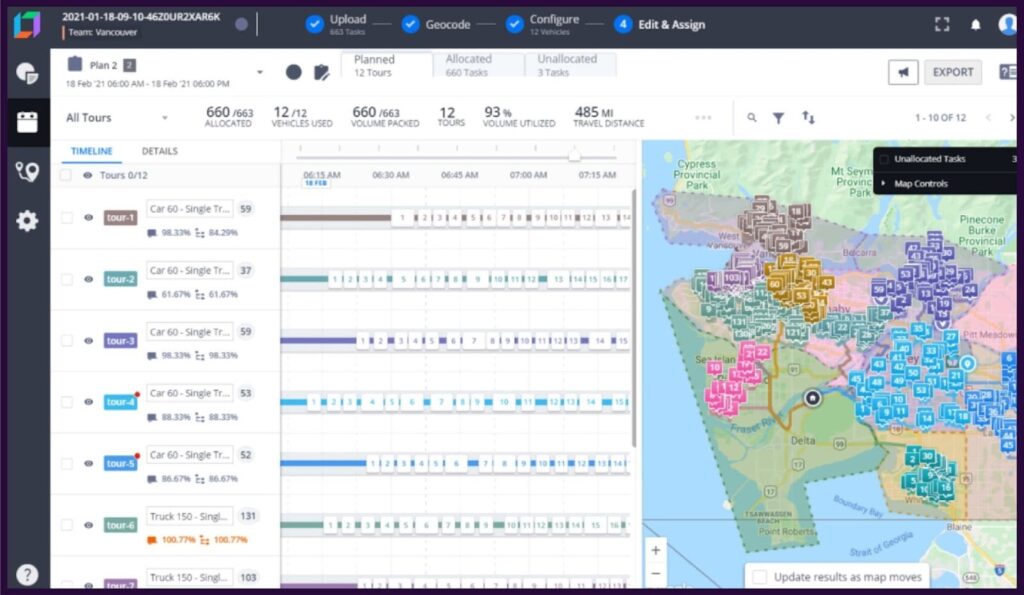
Automated tracking systems feeding this loop also capture warehouse automation data, including sorting completion rates and AGV handoff timing, so dispatch intelligence reflects actual physical readiness rather than projected readiness.
For operations evaluating what level-three integration requires in practice, see how Locus’s AI dispatch engine closes the warehouse-to-transport gap.
What AI-Orchestrated Warehouse-Transport Integration Delivers: Four Enterprise Metrics
The move from level two to level three is a capital and change-management decision. The business case rests on four measurable outcomes that enterprise logistics teams can benchmark against their current state.
Routing efficiency in logistics at enterprise scale is a function of how accurately dispatch decisions reflect real-time warehouse and transport conditions. The gap between theoretical fill rate and actual fill rate is where the financial case for AI orchestration lives. The four metrics below convert the gap into measurable dollar figures.
Vehicle utilization
Industry data places average vehicle fill rates for enterprises relying on sequential dispatch at 60-70% of capacity. The gap exists because vehicle assignments are made before warehouse completion data is confirmed, forcing planners to build in buffers translating directly to wasted payload capacity.
AI-orchestrated dispatch closes this by assigning vehicle loads against real-time pick completion data rather than scheduled completion estimates. The transport cost reduction McKinsey attributes to AI-optimized logistics routing, in the range of 15-25%, reflects what happens when fill rate decisions are made on confirmed data rather than forecasts.
Dock-to-departure time compression
The dock-to-departure interval, the time between order staging completion and vehicle departure, is where carrier detention charges, driver wait time, and downstream SLA breach risk concentrate.
For a retailer processing 50,000 orders per day across eight distribution centers, a 12-minute reduction in average dock-to-departure time eliminates roughly 100,000 minutes of carrier detention exposure daily. At $100 per detention hour, the daily avoided cost exceeds $160,000 before accounting for SLA improvement.
The mechanism enabling the compression is dispatch planning operating on confirmed completion data rather than projections made hours in advance.
Planning cycle reduction
Manual and semi-automated dispatch operations run planning cycles of four to eight hours. A logistics planner building tomorrow’s routes at 10 pm works with order data shifting materially before drivers depart at 6 am. Algorithmic dispatch planning, running continuously against live data, compresses the cycle to under one minute.
Route plans built at 5:50 AM on real-time warehouse data consistently outperform those built at 10 PM on projections, improving fuel efficiency, SLA compliance, carrier coordination, and exception rate simultaneously. The accuracy improvement compounds across every order cycle.
Exception handling cost
Manual re-routing triggered by late warehouse completions requires dispatcher intervention, carrier coordination, and often a second dispatch run. Predictive re-optimization running on live warehouse data identifies likely completion delays 20-30 minutes before they materialize and adjusts dispatch sequencing before the carrier commits to a departure window.
Watsons, the health and beauty retail chain, applied Locus’s dispatch orchestration to reduce exception-driven re-dispatch events across its outlet replenishment network, reaching 99.5% on-time SLA performance. Unilever SEA documented an analogous outcome in FMCG distribution.
By fusing DC-level inventory and pick completion signals with AI-optimized last-mile routing through Locus, the business achieved a 20% reduction in logistics costs across a high-variability, multi-DC operation. The specific mechanism was dispatch plans updating dynamically as warehouse completion data arrived, eliminating the gap between planned and actual vehicle loading sequences.
Schedule a Locus demo to calculate what level-three integration would change in your specific operation.
Why API-First Architecture Is Necessary but Not Sufficient
The most common objection from CTOs and CIOs evaluating orchestration platforms is that their existing API-connected WMS-TMS stack should already handle this. They’ve invested in RESTful integrations, event buses, and middleware like MuleSoft or Boomi. The APIs are working. Data is flowing in real time. The objection is understandable and worth engaging directly.
APIs are pipes. They transfer data. They don’t interpret it. Automated route planning solutions built on top of well-connected API integration still make decisions in sequences: the WMS broadcasts a state, the TMS receives it, a planning engine generates options, a planner selects one.
The sophistication of the API layer has no effect on the reasoning quality of the planning engine sitting behind it.
Where API integration reaches its ceiling
An API integration can broadcast Order #4582 is staged at Dock 7. It cannot determine Order #4582 should be consolidated with Orders #4590 and #4601 on Vehicle B instead of Vehicle A because a real-time traffic disruption on Route A-7 has made the original plan suboptimal.
On top of it, the warehouse completion time for those three orders aligns with Vehicle B’s driver availability window more efficiently. The determination requires a system holding all variables simultaneously in a single planning context. Individual API calls passing facts between isolated systems can’t replicate it.
ERP cutoff and carrier window mismatch
Another failure mode API integration alone cannot resolve is the mismatch between ERP order-release cutoffs and carrier collection windows. Most enterprise ERPs enforce order-release cutoffs, where orders confirmed before 15:00 ship the same-day and orders confirmed after 15:00 move to next-day.
Transport optimization systems plan routes against carrier collection times, which may be 16:30 or 17:00, depending on the carrier and lane. In B2B distribution, where customer POs often arrive in late-afternoon batches, a wave of 14:45 order confirmations can create a scenario where the TMS plans a 16:30 carrier collection for an order whose downstream picking, packing, and staging won’t physically complete until 16:20. An API carries the signal faithfully.
It doesn’t flag an impossible sequence or propose an alternative carrier with a 17:00 collection window. An orchestration engine does both.
What the orchestration layer adds
The orchestration layer adds reasoning capacity. It holds warehouse readiness signals, transport constraints, carrier windows, driver availability, real-time traffic, and order priority in a unified decision context and generates plans optimized across all variables simultaneously.
Middleware and event buses are a prerequisite infrastructure. Enterprises with heavy middleware investment have built the pipe network. The orchestration layer is the pressure source making data flow in the right direction at the right time, rather than simply making it flow.
How Leading Enterprises Are Moving: The Competitive Landscape
Gartner’s Supply Chain Top 25 research consistently places most enterprises at supply chain digital maturity levels one and two, reactive operations relying on digital tools without unified decision intelligence. The organizations pulling ahead are reducing their integration surface area by collapsing warehouse and transport decision-making into a single orchestrated layer, and the competitive gap between them and level-one and level-two operations is widening.
The patterns emerging across retail, FMCG, and 3PL sectors share a common structural feature. The shift is from best-of-breed tool stacks with middleware connections to orchestration platforms with modular adoption.
How FMCG distribution is changing
Unilever SEA, managing high-frequency distribution across a complex Southeast Asian market, integrated DC-level inventory availability and pick completion signals with supply chain network design intelligence through Locus to achieve a 20% reduction in logistics costs. The operational mechanism was direct.
Dispatch plans updated in response to real-time warehouse readiness data, eliminating the fixed planning window, forcing planners to commit vehicle assignments hours before completion status was confirmed. Fewer committed plans meant fewer corrections, fewer detention events, and fewer failed deliveries caused by mismatched staging and dispatch sequencing.
Watsons and retail dispatch transformation
As we noted before, Watsons, running high-frequency outlet replenishment across Southeast Asian retail networks, moved from a batch dispatch model, route plans built the previous evening against projected completion data, to a continuously re-optimized model through Locus’s orchestration layer. Vehicle assignments updated in response to real-time warehouse readiness signals.
The outcome was fewer exception events, lower redelivery rates, and reduced dispatcher involvement in routine replanning, freeing operations teams to focus on genuinely non-routine decisions. On-time SLA performance reached 99.5% across the network.
What the laggards have in common
Operations still at maturity level one or two share a structural characteristic. Warehouse and transport planning are conducted by separate teams using separate tools with separate optimization objectives. The WMS team optimizes for warehouse throughput. The TMS team optimizes for route efficiency.
Neither team optimizes for the joint outcome determining actual delivery performance, which is the combination of warehouse completion timing and vehicle dispatch sequencing. The organizational separation mirrors the system separation, and both reinforce each other.
Where Warehouse-Transport Integration Is Heading in the Next Five Years
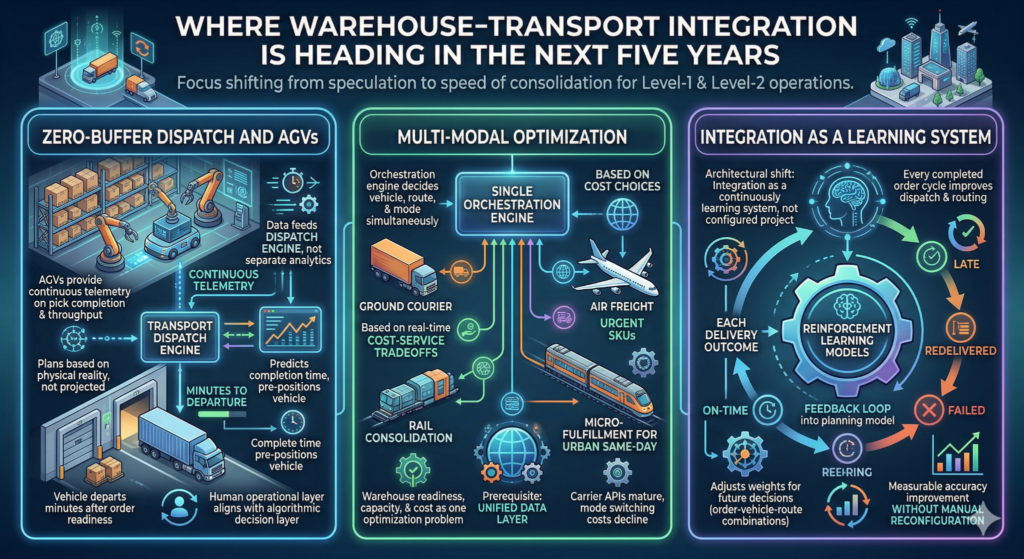
The trajectory of warehouse-transport convergence over the next five years is not speculative. The enabling technology exists in early-to-mid adoption across logistics markets. The meaningful question is not where integration is going but how fast consolidation will force the remaining level-one and level-two operations to move.
Zero-buffer dispatch and AGVs
Automated guided vehicles already generate continuous telemetry in advanced warehouse environments: pick completion rates by zone, conveyor throughput and staging area occupancy by dock.
When the data feeds directly into a transport dispatch engine rather than a separate warehouse analytics system, dispatch plans can be built on physical reality rather than projected reality. The vehicle departs within minutes of order readiness because the orchestration system predicted the completion time accurately enough to pre-position the vehicle before the order reached the dock.
Achieving last-mile excellence in this model means aligning the human operational layer with the algorithmic decision layer so planners focus on decisions machines can’t yet make reliably, not on replanning decisions machines make faster and more accurately.
Multi-modal optimization
A single orchestration engine deciding which vehicle, route, and mode simultaneously, ground courier, rail consolidation, air for urgent SKUs, or micro-fulfillment for urban same-day, based on real-time cost-service tradeoffs, represents a capability already in early enterprise adoption.
The prerequisite is a unified data layer treating warehouse readiness, transport capacity, and mode cost as inputs to one optimization problem rather than three sequential planning passes run by three separate systems. As carrier network APIs mature and switching costs between modes decline, multi-modal optimization will shift from a premium capability to a standard planning function.
Integration as a learning system
The third trajectory is architectural, treating integration as a continuously learning system rather than a configured project. Reinforcement learning models improving dispatch and routing decisions with every completed order cycle are already in production at a small number of logistics operations.
Each delivery outcome, on-time, late, redelivered, or failed, feeds back into the planning model and adjusts weights applied to similar order-vehicle-route combinations in future decisions. The operational implication is measurable accuracy improvement over time, without manual reconfiguration, because the system learns from what actually happened rather than what the original plan assumed.
Start with Your Architecture
The enterprise logistics organizations building durable competitive advantage over the next five years are not adding integration points to their existing WMS-TMS stacks. They are collapsing the decision boundary between warehouse and transport into a single AI-driven orchestration layer reasoning across both simultaneously.
The Warehouse-Transport Convergence Maturity Model gives VP Supply Chain and logistics operations leaders a diagnostic framework for this evaluation. Most organizations will find themselves at level two: real-time data flowing between systems, but sequential decision-making still creates the handoff gap where cost leakage, SLA failures, and vehicle underutilization accumulate.
Closing the gap doesn’t require replacing existing warehouses or transport infrastructure. Locus’s API-first platform integrates with existing TMS, WMS, OMS, and ERP systems, adding the orchestration intelligence layer without forcing a rip-and-replace cycle. The $320M+ in transit savings Locus has documented across 1.5 billion deliveries reflects what happens when dispatch intelligence stops reacting to warehouse data and starts reasoning across it continuously.
Schedule a demo with Locus to assess where your operation sits on the maturity model and what level-three orchestration would change in your specific network.
Frequently Asked Questions (FAQs)
1. What is the difference between WMS-TMS integration and warehouse-transport orchestration?
WMS-TMS integration connects two systems so they can share data, through API calls or file transfers. Warehouse-transport orchestration goes further. A single decision engine holds warehouse readiness signals and transport constraints simultaneously and generates dispatch plans optimized across both domains without sequential handoffs. Integration moves data between systems. Orchestration reasons across all of it at once.
2. How long does warehouse-transport system integration take to implement?
API-based integration between a WMS and TMS at the event-driven level typically takes 8-16 weeks depending on the systems involved and data model complexity. AI-orchestrated convergence through a platform like Locus, which integrates via RESTful APIs without requiring system replacement, can reach initial operational capability within a similar timeframe. The implementation scope is data layer configuration and workflow setup rather than infrastructure migration.
3. What ROI can enterprises expect from AI-orchestrated logistics integration?
Documented outcomes from enterprise deployments include vehicle utilization improvements consistent with 15-25% transport cost reduction, dock-to-departure time compression measured in tens of minutes per vehicle per day, planning cycle reduction from four to eight hours down to under one minute, and on-time delivery SLA performance above 99%. Specific figures depend on starting conditions: operations at 60-65% vehicle fill with 60-minute average handoff delays see larger absolute gains than those already at 75% fill with shorter delays.
4. Can AI orchestration platforms integrate with existing SAP EWM or Manhattan Associates WMS deployments?
Yes. Orchestration platforms designed for enterprise deployment, including Locus, use API-first integration architectures specifically to avoid replacing incumbent WMS or TMS infrastructure. The orchestration layer sits above both systems, pulling data from each and generating dispatch decisions feeding back into both. Existing SAP EWM, Manhattan Associates, Oracle WMS, and Blue Yonder installations can connect to the orchestration layer without migration or data model replacement.
5. What is the first step for a logistics director evaluating integration maturity?
Run the integration failure cost calculation described in this article: multiply your average WMS-to-TMS handoff delay in minutes by your daily vehicle count and carrier detention rate, then add your daily failed delivery volume multiplied by your per-attempt redelivery cost. The result is the daily cost floor of staying at your current maturity level. Most operations find the figure large enough to justify an architectural evaluation within the same planning cycle.


General
How Enterprise Retailers Build and Scale Multi-Carrier Delivery Networks

Apr 15, 2026
A strategic blueprint for building and optimizing multi-carrier delivery networks, covering architecture, carrier allocation logic and AI-driven dispatch.
Read more
General
Enterprise TMS Security Compliance: A Strategic Guide for Logistics Leaders
Apr 15, 2026
Learn how enterprise TMS security compliance protects logistics data. Covers SOC 2, GDPR, AI-specific risks, encryption, RBAC, and 2026+ regulatory readiness.
Read moreInsights Worth Your Time




















Warehouse Transport System Integration for Enterprise Logistics