


General
How Empty Miles Inflate Logistics Costs and What Enterprise Fleets Can Do About It

Key Takeaways
- Empty miles, also called deadhead miles, cost the trucking industry over $30 billion annually, and individual trucks waste $27,750 to $55,500 per year depending on how much of their mileage runs without cargo.
- The root cause is structural: transportation, warehousing, and procurement teams working from separate data systems cannot coordinate return-leg planning before dispatch windows close.
- AI route optimization evaluates delivery windows, vehicle capacity, driver hours of service, traffic patterns, and return-leg opportunities simultaneously in a single planning pass, reaching utilization rates manual dispatch cannot match.
- Locus’s DispatchIQ optimizes routes across 250+ real-world constraints at the point of route creation, delivering a 90% improvement in fleet utilization and 20% reduction in logistics costs across 360+ enterprise deployments.
- Logistics leaders should track empty mile percentage, cost per revenue mile, load factor, and lane utilization rate on a continuous basis using plan-versus-actual analysis.
One in three miles driven by trucks in the United States carries no freight. That rate, reported consistently in American Trucking Associations data, translates to more than $30 billion in annual industry waste, and the cost does not stay with carriers. Shippers absorb it through higher freight rates, margin erosion on high-volume lanes, and compounding inefficiency across every hub in a multi-node network.
For enterprise logistics leaders managing hundreds of vehicles across retail, FMCG, e-commerce, and 3PL operations, empty miles are a daily financial reality.
At 15% empty miles, a single truck running 100,000 miles annually at $1.85 per mile loses $27,750 in recoverable revenue. At 30%, that doubles to $55,500. Across a 100-vehicle fleet, the annual waste sits between $2.8 million and $5.6 million before accounting for insurance, depreciation, and SLA penalties.
Empty miles logistics costs are a measurable, addressable structural problem. This article breaks down where the waste originates, which planning failures perpetuate it, and how AI-powered logistics orchestration eliminates it at the network level rather than the route level.
The Real Cost of Empty Miles Across Enterprise Supply Chains
The $30 billion industry figure averages across all fleet types, understating the real cost for retail replenishment and FMCG distribution operations where empty mile percentages commonly run 20–30%, driven by the asymmetry between outbound delivery density and inbound freight availability on return corridors.
The full cost stack goes beyond fuel
Fuel is the most visible component of the empty miles expense. Insurance premiums accrue on every mile regardless of payload. Scheduled maintenance advances with mileage rather than revenue-generating hours. Driver hours count against Hours of Service limits whether the truck is loaded or empty, compressing available time for revenue legs. Vehicle depreciation per productive mile rises as empty mileage grows relative to loaded miles.
The cascade compounds in dense multi-hub operations. A FMCG distributor running daily replenishment across 200 retail outlets faces direct per-mile costs on empty return legs and a downstream capacity problem: trucks arriving at distribution centers during peak intake windows constrain the next outbound dispatch. Operations consistently running 25% empty miles can see 15–35% margin erosion on high-volume lanes when the full cost stack is calculated.
What empty miles cost at fleet scale
The table below maps empty mile percentage to annual cost per truck and fleet-level totals, calculated at $1.85/mile across 100,000 miles per year (ATA average annual mileage).
| Empty Mile % | Cost Per Truck/Year | 10-Truck Fleet | 50-Truck Fleet | 100-Truck Fleet |
|---|---|---|---|---|
| 10% | $18,500 | $185,000 | $925,000 | $1,850,000 |
| 15% | $27,750 | $277,500 | $1,387,500 | $2,775,000 |
| 20% | $37,000 | $370,000 | $1,850,000 | $3,700,000 |
| 25% | $46,250 | $462,500 | $2,312,500 | $4,625,000 |
| 30% | $55,500 | $555,000 | $2,775,000 | $5,550,000 |
Cutting empty miles by 10 percentage points for a 10-truck fleet recovers over $185,000 annually at these rates. For a 100-truck operation running at 25% empty miles, closing to 15% frees over $2.7 million per year in previously unrecoverable costs.
Why Traditional Planning Still Fails at Reducing Deadhead Miles
Most enterprises affected by empty miles have invested in TMS software, dispatcher training, and route planning tools. The waste persists because those tools optimize the wrong unit: the individual route leg rather than the full trip cycle.
The status quo trap in enterprise dispatch
Manual dispatch creates a structural bias toward reactive planning. A planner building tomorrow’s outbound routes works against an end-of-day deadline. Return-leg planning requires knowing what freight will be available at the destination tomorrow afternoon, which depends on procurement schedules, supplier pickup windows, and carrier availability at the destination point. Manual planners lack the real-time data access to factor those signals into tonight’s route build, so return legs default to empty.
Legacy TMS configurations compound the problem by siloing inbound and outbound freight management. A truck leaving a distribution center for a 14-stop retail replenishment route has no mechanism to pick up a confirmed inbound load on the return because the two planning streams never intersect.
Compared with automated route planning, manual approaches consistently produce empty return legs as a structural byproduct of this separation.
Demand volatility breaks static planning hardest
E-commerce operations face a specific version of this problem. Flash sales and seasonal peaks generate surge volumes in forward delivery, while creating a corresponding surge in empty return miles.
A distribution center processing three times the normal order volume during a 48-hour promotional window dispatches that volume across the available fleet. When the surge ends, those vehicles return without loads because no return freight was identified in the planning pass.
Static TMS configurations cannot incorporate volatile demand signals into route creation.
Load Matching and Backhaul Strategy at Scale
Moving beyond manual dispatch means treating load matching as a network design challenge. For a retailer operating 200+ stores across eight distribution centers, the backhaul opportunity exists in the aggregate pattern of outbound delivery density and inbound freight availability across the full network. No single lane holds it.
Network-level backhaul engineering
Structural backhaul planning means building the outbound route with the return leg in scope from the first optimization pass.
Three inputs are required: live outbound route data, inbound freight pickup schedules, and predictive demand signals showing where order density will be tomorrow and next week. When those three streams feed a single optimization engine, backhaul opportunities become a dispatch constraint rather than an afterthought.
Locus’s constraint-based route and load optimization factors network-wide demand signals and vehicle capacity into every route plan, structuring backhaul opportunities into the dispatch decision rather than treating them as post-trip afterthoughts. The route mapping techniques required for network-level backhaul engineering differ fundamentally from per-leg route planning.
The 3PL backhaul problem
3PL providers face the backhaul challenge at a higher complexity because their fleets serve multiple shipper networks simultaneously.
A carrier managing freight for a retailer, an FMCG distributor, and a CPG company across overlapping zones has more structural backhaul opportunities than any single shipper, but only if those networks are visible from a common planning layer.
Siloed shipper contracts and separate dispatch systems prevent the cross-network matching needed to turn those opportunities into recovered revenue.
AI-Powered Route Optimization as an Empty Miles Countermeasure
Rule-based routing applies constraints in sequence: match vehicle capacity, apply time windows, minimize distance. AI-driven route optimization works differently. It evaluates thousands of feasible route configurations simultaneously, factoring delivery windows, vehicle capacity, driver HOS limits, traffic conditions, and return-leg opportunities in a single pass, then selects the configuration producing maximum vehicle utilization per trip.
How multi-constraint optimization eliminates deadhead at dispatch
Locus’s DispatchIQ engine optimizes routes across 250+ real-world constraints simultaneously: delivery time windows, vehicle capacity by weight and volume, driver shift limits, regulatory compliance parameters, live traffic patterns, weather conditions, and return-leg freight availability.
A system evaluating 20–30 variables sequentially cannot find the same utilization ceiling as one holding 250+ in tension simultaneously.
A route built for maximum forward delivery efficiency might leave a vehicle 40% underloaded on a return corridor where backhaul freight is available. A route built with return-leg constraints in scope may resequence two of 14 stops, accept a minor forward delivery time variance, and fill the return leg to 80% capacity.
Those decisions, compounded across a 100-vehicle fleet running five days a week, drive the 20% logistics cost reduction and 90% fleet utilization improvement Locus has validated across 360+ enterprise deployments.
Ready to see how DispatchIQ eliminates deadhead miles across your network? Schedule a Locus demo to walk through a constraint-based route optimization scenario for your fleet size and operational profile.
Re-optimization when conditions change mid-delivery
Route optimization at dispatch is necessary but insufficient. A driver with a valid optimized route at 6 AM faces real conditions: a traffic incident at stop four, an order cancellation at stop nine, and a pickup window closing early at stop 11.
Each event, handled in isolation, creates a new deadhead scenario. DispatchIQ re-evaluates the remaining route in real time when exceptions occur, reassigning stops, adjusting sequences, and updating return-leg availability based on revised arrival windows.
Live Visibility and Cross-Functional Coordination
Empty miles persist partly because transportation, warehousing, and procurement teams operate from separate data systems. A transportation planner cannot eliminate deadhead on the return leg without knowing what freight is available, where vehicles currently are, and what demand signals are shifting tomorrow’s load plan.
Connecting the data streams
Most enterprise logistics operations have the data: TMS records, WMS inventory feeds, telematics from GPS providers, and OMS order signals. The missing piece is a single operational view connecting those streams in real time.
A transportation planner working from a TMS does not see live inventory levels at the destination DC. A procurement team finalizing supplier pickup windows does not see an outbound truck in that supplier’s region tomorrow at 2 PM. Together, those two data points close a backhaul opportunity. In separate systems, they close nothing.
Locus’s shipment lifecycle visibility control tower connects dispatch decisions, live tracking events, exception alerts, demand signals, and settlement data into a single operational layer. Supply chain network design decisions, from facility placement to carrier contract structure, directly determine the structural backhaul opportunities available.
For retail replenishment operations, retail logistics visibility that connects inventory levels, outbound route schedules, and inbound freight pipelines gives planners the data to identify backhaul opportunities before routes are finalized.
Measuring and Benchmarking Empty Miles Reduction
Measurement separates enterprises making verifiable progress from those running reduction initiatives on assumption. Without a plan-versus-actual baseline and consistent KPIs, distinguishing genuine improvement from natural freight volume variation is guesswork.
The four KPIs logistics leaders need
- Empty mile percentage measures the proportion of total miles driven without revenue-generating cargo. Track it with volume context: a fleet running 22% during an unusually high-volume quarter has a different story than one running 22% in a normal week.
- Cost per revenue mile converts the efficiency gap into financial terms. As empty miles fall, the same operational cost base spreads across more revenue-generating miles. A 10-percentage-point reduction for a 50-vehicle fleet recovers over $925,000 annually at the ATA baseline rates.
- Load factor measures average cargo weight or volume as a proportion of vehicle capacity on loaded legs. Low empty miles paired with consistently low load factors means the fleet is recovering deadhead while leaving vehicle utilization unrealized.
- Lane utilization rate tracks how consistently specific origin-destination pairs carry both outbound and return freight. Lanes with high outbound density and consistently empty returns are structural backhaul opportunities addressable through network design.
Locus’s plan-versus-actual performance analysis and enterprise BI dashboards with custom KPI reporting give logistics leaders continuous visibility into how each metric trends across routes, regions, and time periods. The importance of last-mile tracking extends to return-leg visibility, where real-time tracking data feeds the actuals, making plan-versus-actual benchmarking meaningful.
Sustainability and Regulatory Pressure: The Carbon Cost of Empty Miles
Every deadhead mile is unnecessary fuel burn and unnecessary carbon output. For enterprises with active ESG commitments and regulatory obligations under frameworks like the EU Corporate Sustainability Reporting Directive (CSRD), empty miles are a measurable, reducible source of greenhouse gas emissions with a direct line to public reporting.
From cost lever to compliance lever
Scope 3 Category 4 (upstream transportation) and Category 9 (downstream transportation) cover freight movements in an enterprise’s supply chain.
Empty miles on carrier networks contribute to both. An enterprise cutting empty miles by 10 percentage points across a 100-vehicle fleet at 100,000 miles per year eliminates approximately 185,000 miles of unnecessary fuel burn, which corresponds to roughly 270 tonnes of CO2e per year.
Locus has delivered 17M+ kg in GHG emissions reductions across its customer base through a reduction in total miles driven. These are operational reductions rather than carbon offsets or renewable energy credits, and they survive third-party audits in a way that offset-based numbers do not.
The EU CSRD became mandatory for large EU-listed companies in fiscal year 2024, with rollout extending to non-EU companies with EU operations. Enterprises treating empty miles as a dual cost-and-compliance problem are ahead of peers who have only modeled the financial case.
Turn Empty Miles Reduction Into a Durable Enterprise Capability
The enterprises moving furthest on empty miles reduction connected dispatch optimization, load matching, visibility, and analytics through a single orchestration platform.
A route optimizer with no real-time exception feed cannot adapt routes when conditions change. A load matching tool with no live route status makes backhaul commitments speculative. An analytics platform with no plan-versus-actual data cannot generate lane utilization insights.
Deployed without integration, individually sound tools optimize fragments while the system wastes at the seams.
The Sense-Decide-Execute-Learn architecture
Locus operates as a Decision-Intelligent TMS built on a Sense-Decide-Execute-Learn loop. The Sense layer aggregates real-time inputs across order pipelines, vehicle locations, traffic, driver availability, and demand forecasts.
The Decide layer runs those inputs through DispatchIQ’s 250+ constraint optimization engine, producing route and load plans accounting for the full trip lifecycle, including return legs.
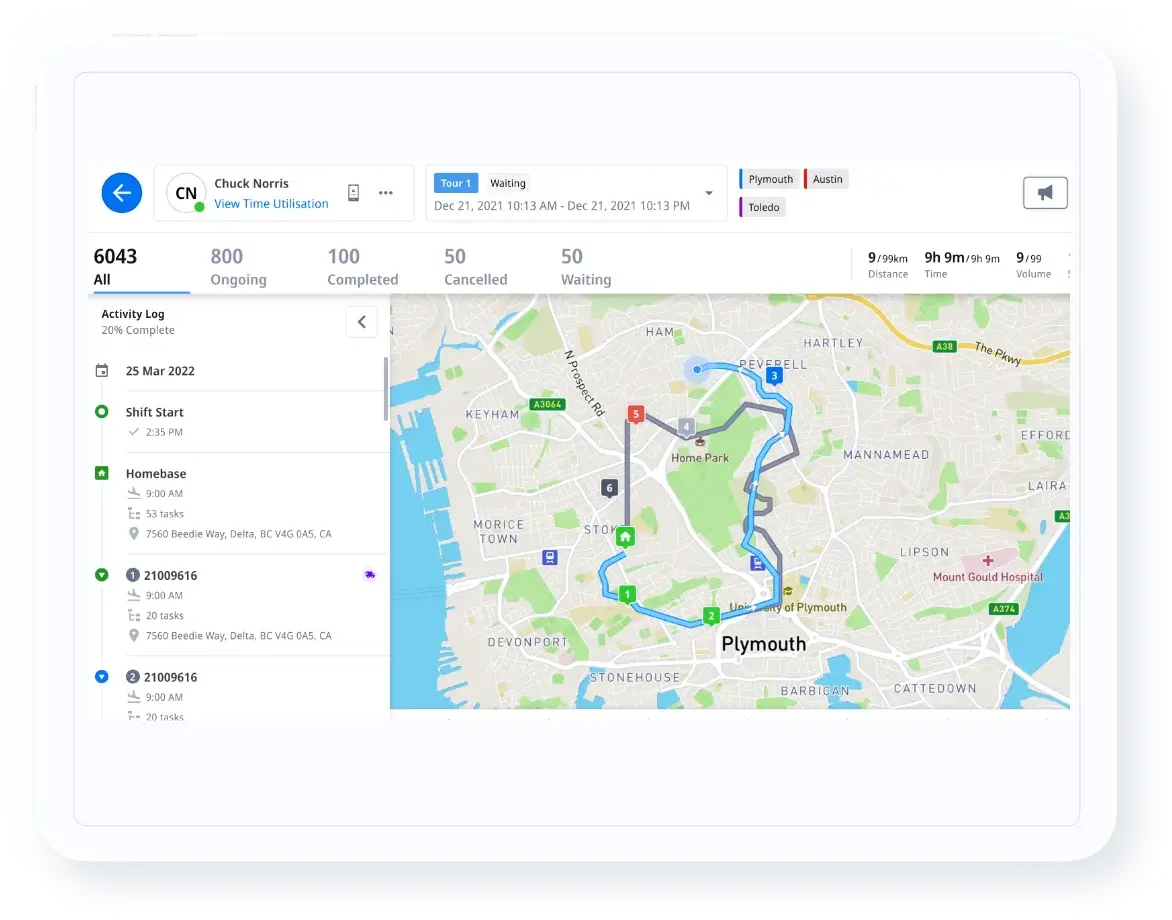
The Execute layer coordinates dispatch across captive and contracted fleets and manages exceptions through the Control Tower. The Learn layer feeds plan-versus-actual outcomes back into the optimization models, improving route quality over successive cycles.
Across 360+ enterprise deployments, Locus has eliminated 800M+ miles from total distance driven, recovered $320M+ in transit costs, and delivered 17M+ kg in verified GHG reductions.
These outcomes follow from treating empty miles as a network orchestration problem. Achieving last-mile excellence at the operational level requires the same discipline on return legs applied to forward delivery performance.
Schedule a Locus demo to see how the Decision-Intelligent TMS eliminates empty miles across your specific network configuration.
Frequently Asked Questions (FAQs)
1. What is the average percentage of empty miles in enterprise trucking fleets, and how does it vary by industry vertical?
Industry-wide, approximately one in three truck miles runs empty, per American Trucking Associations data. Enterprise rates vary by vertical: retail replenishment typically runs 15–20%, FMCG distribution runs 20–28% on longer corridors, and 3PL operations range 18–30% depending on network density and cross-shipper matching capability. Fleets using AI-driven dispatch consistently operate below 15%.
2. How does AI-powered route optimization reduce empty miles differently than traditional TMS-based routing?
Traditional TMS routing optimizes individual route legs sequentially, applying constraints one at a time. AI-powered route optimization holds 250+ constraints simultaneously, including return-leg freight availability, and evaluates thousands of feasible configurations in a single pass. Return legs enter the optimization at planning time rather than being assigned after outbound routes are finalized, which is the structural difference.
3. What is the financial impact of reducing empty miles by 10% for a fleet operating 50+ vehicles?
At $1.85/mile and 100,000 miles per truck per year, a 10-percentage-point reduction in empty miles recovers $18,500 per vehicle annually. For a 50-vehicle fleet, that is $925,000 per year. For 100 vehicles, the figure exceeds $1.85 million. These calculations exclude secondary savings from reduced insurance exposure and SLA penalty avoidance.
4. How can 3PL providers use shared visibility platforms to reduce deadhead miles across multiple shipper networks?
A 3PL managing freight across multiple shippers has structural backhaul opportunities no individual shipper can see. A shared visibility platform aggregating outbound route schedules, inbound pickup windows, and carrier availability across shipper networks allows the 3PL to match return loads across contracts. The visibility layer must operate above individual shipper siloes to surface cross-network pairings.
5. What KPIs should logistics leaders track to benchmark empty miles reduction over time?
Track four metrics: empty mile percentage with volume context to avoid misreading seasonal variation as improvement, cost per revenue mile to translate efficiency into financial terms, load factor on revenue-generating legs to capture full vehicle utilization, and lane utilization rate by origin-destination pair. Plan-versus-actual analysis at the lane and vehicle level separates genuine optimization from natural freight volume changes.


General
Delivery-Linked Checkout: How Real-Time AI Capacity Planning Turns Logistics Into A Conversion Engine

Apr 20, 2026
70% of carts are abandoned, and delivery is a top reason. Learn how delivery-linked checkout uses real-time AI capacity planning to surface delivery options customers trust — boosting conversion, accuracy, and retention.
Read more
General
Top 12 vehicle routing problem software for enterprise logistics in 2026

Apr 21, 2026
Compare 12 vehicle routing problem software for enterprises. Evaluate AI routing, dynamic re-optimization, constraint handling, pricing & scalability.
Read moreInsights Worth Your Time



















How Empty Miles Inflate Logistics Costs and What Enterprise Fleets Can Do About It