


General
TMS-WMS-ERP Integration Architecture for US Enterprises in 2026
Key Takeaways
- Integration architecture — how the TMS, WMS, and ERP connect — is usually a more consequential decision than the choice of any single platform, and it’s the factor most often underestimated during TMS selection.
- Clean integration starts with deciding which system is the source of truth for each data object: ERP for financial/order master data, WMS for physical inventory state, TMS for transportation execution and freight settlement.
- Enterprises in 2026 are choosing how to integrate, not whether — across point-to-point, middleware/ESB, iPaaS, and API-led/event-driven patterns — and the direction of travel favors API-led, real-time, loosely coupled architectures over batch file transfer.
- Success hinges on four architectural decisions: real-time vs. batch, synchronous vs. asynchronous, master data management, and error handling/observability — and most production failures (status desync, master data drift, brittle point-to-point webs, silent failures) trace back to weakness in these.
- Integration depth can’t be judged from a demo running on clean data; buyers should screen with structural questions about documented APIs, real-time events, deep bi-directional connectors, explicit data ownership, upgrade resilience, and integration observability.
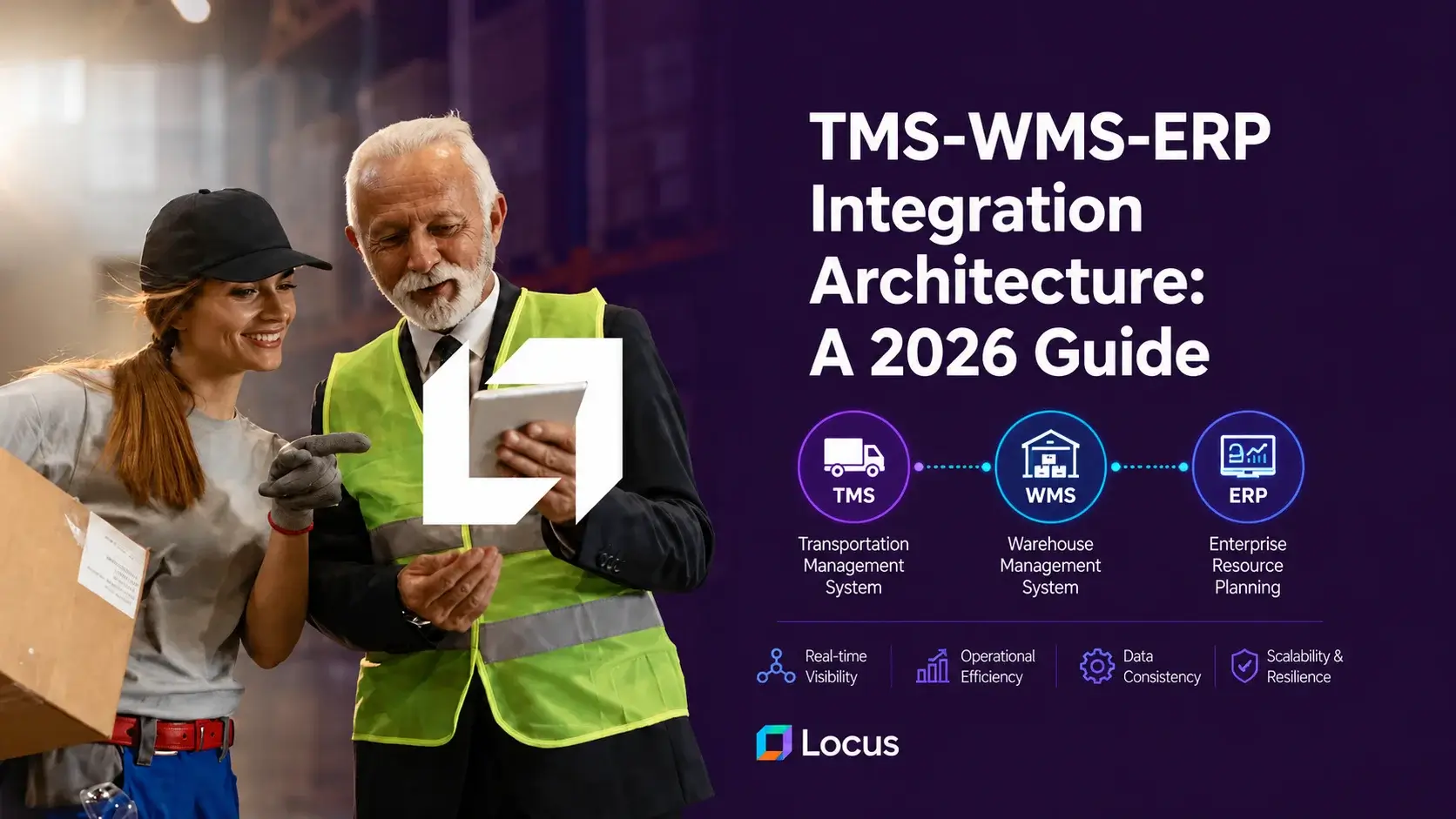
The way a transportation management system (TMS), warehouse management system (WMS), and enterprise resource planning (ERP) system connect to each other is the single most consequential architecture decision in an enterprise logistics stack — more consequential, often, than the choice of any one platform. Integration architecture is what determines whether an order placed in the ERP, picked in the WMS, and shipped through the TMS moves as a continuous flow of trusted data, or whether it stalls at every system boundary and gets reconciled by hand. For most US enterprises evaluating a new TMS in 2026, the integration question is the deciding factor, and it is the one most likely to be underestimated during selection.
This guide breaks down what each system actually owns, the integration patterns enterprises choose between, the architectural decisions that separate a stack that behaves as a system from a stack that behaves as a collection of modules, and how to evaluate integration depth before you sign.
Why is TMS-WMS-ERP integration the architecture decision that matters most?
The three systems were built to do different jobs, by different vendors, on different data models, frequently a decade or more apart. The ERP is the financial and order system of record. The WMS governs what physically happens inside the four walls. The TMS plans, executes, and settles movement between locations. Each one is excellent at its own function. None was designed to hand its data cleanly to the others in real time.
That gap is where operational cost accumulates. Research from McKinsey has found that supply chain leaders spend a large share of their planning cycles reconciling conflicting data across systems rather than acting on it — a structural drain that no amount of staffing fixes, because it is an architecture problem, not a people problem. (McKinsey & Company)
Also Read: API Integrations for Logistics Platforms: From Fragmented Connectivity to Intelligent Orchestration
The scale of the disconnection is easy to underestimate. The MuleSoft Connectivity Benchmark Report has consistently found that large organizations run several hundred to roughly a thousand applications, and that only a minority of them are connected to one another — leaving most enterprise data stranded in systems that cannot talk. (Salesforce / MuleSoft Connectivity Benchmark) In a logistics stack, those disconnected systems are not back-office niceties; they are the difference between a shipment that bills correctly and one that does not.
In plain terms: Integration architecture is the set of decisions about how systems exchange data — what connects to what, in which direction, how often, who owns each data object, and what happens when an exchange fails. It is distinct from the features of any individual system, and it is usually the harder problem.
What does each system actually own?
Clean integration starts with an unambiguous answer to a deceptively simple question: which system is the source of truth for each piece of data? When two systems both believe they own the customer master, or the order status, or the freight cost, the integration will produce conflicts no middleware can resolve.
| System | Primary domain | Typically the system of record for |
|---|---|---|
| ERP | Finance, procurement, order and inventory accounting | Customer/vendor master, sales orders, purchase orders, financial postings, costed inventory |
| WMS | Physical operations inside the facility | Inbound receipts, putaway, pick/pack, inventory location and state, outbound staging |
| TMS | Movement between locations | Carrier selection, rating, routing, load building, tendering, tracking, freight settlement |
The boundaries blur in practice. Order status, inventory availability, and shipment cost are all objects that more than one system touches, which is exactly why the ownership decision has to be made explicitly rather than inherited from whichever system happened to be implemented first.
What are the main integration patterns enterprises choose between?
Enterprises in 2026 are not choosing whether to integrate — they are choosing how. Four patterns dominate, and most real stacks use more than one.
| Pattern | How it works | Strengths | Weaknesses |
|---|---|---|---|
| Point-to-point | Direct custom connections between each pair of systems | Fast to build for the first connection; no extra infrastructure | Connection count explodes (n systems ? up to n×(n-1)/2 links); brittle; every change ripples |
| Middleware / ESB | A central enterprise service bus brokers all exchanges | Decouples systems; centralizes routing and transformation | Can become a heavyweight bottleneck; often batch-oriented; specialist skills needed |
| iPaaS | Cloud integration platform with pre-built connectors | Faster connector delivery; managed scaling; lower maintenance | Connector depth varies; recurring platform cost; possible vendor lock-in |
| API-led / event-driven | Systems expose APIs and publish/subscribe to events | Real-time, loosely coupled, scales horizontally; resilient to single-system change | Requires mature API governance; depends on every system exposing usable APIs |
The direction of travel is clear. Industry analysts including Gartner have for several years pointed enterprises toward API-led and event-driven integration over hard-wired point-to-point links, on the grounds that loosely coupled architectures absorb change far better than tightly bound ones. (Gartner research) The practical implication for a TMS evaluation is that a platform offering only batch file transfer (overnight CSV/EDI drops) is offering a 2010 integration model, however modern its user interface looks.
What architectural decisions actually determine success?
Beyond the pattern, four decisions shape whether the integrated stack behaves as one system.
1. Real-time versus batch. A batch-integrated stack runs on yesterday’s data. When the WMS reports a short-pick at 2 p.m. but the TMS does not learn about it until the overnight sync, the load tenders against inventory that does not exist. Event-driven integration closes that gap by pushing the change the moment it happens. The question to ask any TMS vendor is not “do you integrate with our WMS and ERP?” but “at what latency, and via what mechanism?”
2. Synchronous versus asynchronous. Synchronous calls are simple to reason about but couple systems tightly — if the ERP is slow, the TMS waits. Asynchronous, message-based exchange lets each system operate at its own pace and is far more resilient under load, at the cost of more complex error handling. High-volume logistics operations almost always need asynchronous patterns for the hot path.
3. Master data management. Integration amplifies whatever data quality already exists. If location codes, unit-of-measure conventions, or item identifiers differ between systems, every exchange needs transformation logic, and every transformation is a place for errors to hide. A master data strategy — one authoritative definition per object, mapped consistently across systems — is a prerequisite for integration, not an afterthought.
Also Read: How IT Teams Evaluate API Integrations for Logistics Platforms
4. Error handling and observability. The difference between a robust integration and a fragile one is mostly visible in what happens when a message fails. Does it retry? Land in a dead-letter queue someone monitors? Silently vanish? Mature stacks treat every integration as instrumented infrastructure with logging, alerting, and replay — not as plumbing that is assumed to work until someone notices a missing shipment.
Where do TMS-WMS-ERP integrations break in production?
Most integration failures are not exotic. They recur:
- Status desynchronization — the three systems disagree on the state of an order because updates flow in batch or one direction only.
- Master data drift — codes and mappings diverge over time as each system is maintained independently.
- The brittle point-to-point web — a stack assembled from direct connections becomes impossible to change, because every modification risks breaking an undocumented link.
- Silent failures — exchanges fail without alerting anyone, surfacing days later as a billing discrepancy or a missing delivery.
- Customization lock-in — heavily customized connectors that no longer survive a vendor upgrade, freezing the enterprise on an old release.
Each of these is an architecture symptom, and each is predictable enough to screen for before purchase.
How should enterprises evaluate integration architecture before selecting a TMS?
Integration depth is hard to assess from a demo, because demos run on clean, pre-integrated data. A more reliable evaluation asks structural questions:
- APIs over file transfer. Does the platform expose documented, versioned REST or event APIs — or does “integration” mean nightly EDI and CSV?
- Pre-built connectors with real depth. Are there maintained connectors for your specific ERP and WMS, and does “connector” mean genuine bi-directional object sync or a thin status push?
- Event support. Can the system publish and consume events in real time, or only respond to scheduled polls?
- Data ownership clarity. Can the vendor state, object by object, which system is intended to own what — and does that match your model?
- Upgrade resilience. Do integrations survive platform upgrades without re-customization?
- Observability. Is there visibility into integration health — message volumes, failures, latency — or is it a black box?
A vendor that answers these crisply is describing an architecture. A vendor that redirects to feature lists is describing a product, and leaving the integration risk with you.
Modern logistics platforms increasingly resolve this by being API-first and event-driven by design, so that the TMS layer plugs into the existing ERP and WMS as part of a coherent system rather than as a fourth silo to reconcile. Locus is built on that principle — exposing open APIs and pre-built connectors so transportation decisioning operates on live data from the rest of the stack rather than on an overnight copy of it.
FAQs
What is TMS-WMS-ERP integration?
It is the architecture that connects a transportation management system, a warehouse management system, and an enterprise resource planning system so that order, inventory, and shipment data flow between them. Done well, the three operate as one system; done poorly, they operate as three silos requiring manual reconciliation.
Which system should be the source of truth?
Typically the ERP owns financial and order master data, the WMS owns physical inventory state inside the facility, and the TMS owns transportation execution and freight settlement. The key is that ownership is decided explicitly for each data object before integration begins.
Is API-led integration better than batch file transfer?
For most enterprises, yes. Batch transfer means systems operate on stale data and react late to changes such as short-picks or delays. API-led and event-driven integration exchanges data in real time and is more resilient to change, which is why analysts have steered enterprises toward it.
What is the most common reason logistics integrations fail in production?
Status desynchronization and master data drift are the most common, usually rooted in batch-oriented or one-directional data flows and inconsistent data definitions across systems. Both are architecture problems that can be screened for during vendor evaluation.
How long does TMS-WMS-ERP integration take?
It varies widely with the integration pattern and data quality. API-led integration with mature pre-built connectors and clean master data can be measured in weeks; custom point-to-point integration against legacy systems with poor data hygiene can take many months.
How do I evaluate a TMS for integration before buying?
Ask structural questions rather than relying on the demo: whether the platform exposes documented APIs and real-time events, whether it has deep bi-directional connectors for your specific ERP and WMS, how data ownership is defined, whether integrations survive upgrades, and whether integration health is observable.


General
Locus vs Locus Robotics: What’s the Difference?

Jun 2, 2026
Locus (locus.sh) and Locus Robotics are two different logistics companies in different categories. Locus is an agentic TMS software platform; Locus Robotics makes warehouse robots. Here's how they differ.
Read more
General
The Delivery Experience Trust Gap: Why US Retailers Can’t Compete on Speed Alone in 2026

Jun 2, 2026
Only 9% of US consumers trust retailer fast delivery promises despite 34% ranking speed as their top factor. Four architectural shifts US retailers should make to rebuild delivery experience trust in 2026.
Read moreInsights Worth Your Time




















TMS-WMS-ERP Integration Architecture for US Enterprises in 2026