


TMS Software
TMS Companies: How to Evaluate Transportation Management Systems for Enterprise Logistics
Key Takeaways
- Searching for TMS companies returns vendor lists dominated by broker-centric freight tools. Most were designed for load boards and small fleet dispatch, not for orchestrating 100,000+ daily deliveries across complex supply chains
- Modern TMS platforms have expanded well past freight booking. Evaluating them correctly requires assessing AI dispatch maturity, real-time route adaptability, integration architecture, and vertical-specific logic
- Rules-based dispatch is a solved problem. The meaningful differentiator is whether a platform can learn from operational data and optimize autonomously, or whether it executes fixed logic and hands exceptions to a dispatcher
- TMS selection is vertical-specific. Retail, FMCG, e-commerce, and 3PL operations have fundamentally different planning requirements. A platform built for one does not automatically serve the others
- Locus is an AI-powered logistics orchestration platform trusted by global enterprises in retail, FMCG, e-commerce, and 3PL built for the full delivery lifecycle
Enterprise logistics leaders searching for TMS companies are met with vendor lists built for a different problem.
Most platforms that dominate search results were designed for freight brokers, small carriers, and load boards. That is the wrong architecture for an enterprise managing tens of thousands of daily deliveries across multiple geographies, fulfillment models, and carrier relationships.
U.S. trucks alone move 11.4 billion tons of freight annually. The operational complexity sitting behind that number has grown faster than most TMS platforms have evolved to handle it.
This article defines what modern TMS companies should deliver in 2025, diagnoses where most fall short for high-volume operations, and gives enterprise logistics leaders a concrete framework for evaluating platforms against criteria that reflect their actual operational reality.
What TMS Companies Actually Do And Why the Definition Has Outgrown Freight
The original TMS category addressed a specific problem: managing the procurement and execution of freight shipments across carrier relationships. Rate negotiation, load tendering, carrier compliance, and basic shipment status updates. That scope was sufficient when logistics meant moving pallets from a warehouse to a distribution center.
That definition no longer describes what enterprise logistics operations require. The modern TMS category has expanded into four interconnected functions:
- Dispatch and order orchestration: Assigning orders to the right vehicle, driver, and route in real time across owned fleet and third-party carriers simultaneously
- Dynamic route optimization: Recalculating delivery sequences mid-execution based on live traffic, order changes, and vehicle constraints
- End-to-end supply chain visibility: Tracking every shipment across every carrier from order creation through proof of delivery, with exception alerts that surface before SLAs are breached
- Analytics and continuous improvement: Feeding delivery performance data back into dispatch and routing decisions, so each planning cycle improves on the last
Platforms that handle only freight booking and carrier connectivity are freight management tools, not logistics orchestration platforms. The distinction matters because enterprise buyers who evaluate TMS companies on freight criteria end up with a tool that handles one layer of their supply chain while leaving the rest fragmented.
The Core Capabilities That Separate Enterprise-Grade TMS from Broker-Centric Tools
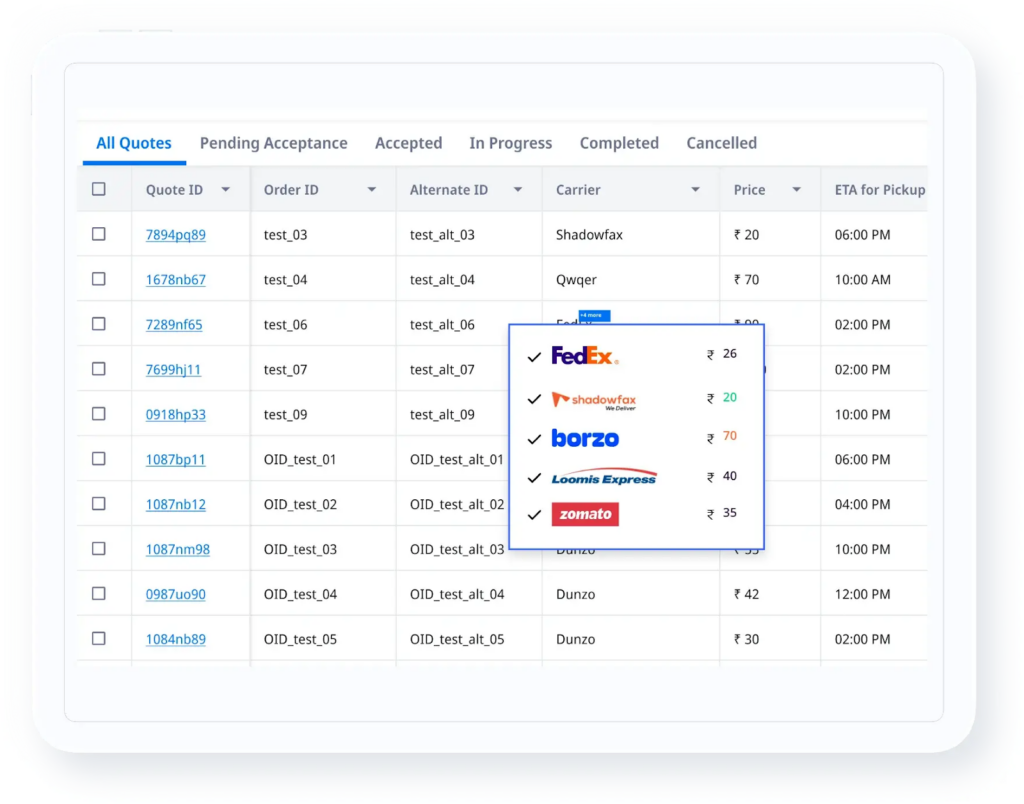
The gap between a broker-centric TMS and an enterprise-grade platform shows up across six specific capabilities:
| Capability | What broker-centric tools do | What enterprise-grade platforms do |
|---|---|---|
| Dispatch automation | Static rule sets: if capacity exceeds a threshold, add a vehicle. Fixed logic that a dispatcher configures once and cannot adapt mid-day. | AI-native dispatch that processes 250+ constraints simultaneously and reallocates orders in seconds when conditions change. |
| Route optimization | Plan-once routing at the start of a shift. Routes are generated and handed off. No recalculation after departure. | AI-powered route optimization that recalculates continuously during execution as traffic, cancellations, and new orders arrive. Routes improve with every completed delivery. |
| Real-time visibility | Carrier status updates on a polling schedule, often 15 to 30 minutes behind actual position. No exception prediction. | Live GPS and telematics ingestion across owned fleet and 3PL partners, with predictive ETAs and exception alerts that surface before SLA windows close. |
| Multi-carrier orchestration | Carrier selection at booking. Manual reconciliation when multiple carrier types operate simultaneously. | Unified dispatch logic across owned fleet, contracted 3PLs, and gig drivers. Order allocation by cost, SLA fit, and real-time capacity, not by availability alone. |
| Analytics | Retrospective reports: what happened last month by lane, carrier, or cost category. | Real-time KPI dashboards with cost per delivery, SLA adherence, and fleet utilization that feed back into planning decisions within the same shift. |
| Routing efficiency | Fixed algorithms that optimize for distance or time as a single variable. | Multi-variable optimization across cost, time, capacity, and emissions simultaneously. |
A well-implemented enterprise TMS delivers 18 or more hours of planning time savings per week across dispatch and routing functions alone. That figure understates the operational gain when it accounts for the downstream cost of exceptions that do not get resolved in time.
Where Most TMS Companies Fall Short for High-Volume Logistics Operations
Enterprise logistics leaders who have evaluated multiple TMS platforms encounter the same gaps across vendors. The problems are structural; they reflect architectural decisions made for a different operational scale.
AI claims without AI substance
Most TMS companies list automation as a feature. Few have built machine learning into the dispatch and routing core. The diagnostic question: does the platform learn from completed deliveries and improve subsequent planning cycles, or does it execute the same rules it was configured with on day one?
A platform that cannot answer that question with a specific mechanism is rules-based, regardless of the marketing language. An automated tracking system that surfaces exceptions is a starting point. A platform that predicts and prevents them is a different product.
No real-time adaptability during disruptions
Traffic events, vehicle breakdowns, weather delays, and demand spikes invalidate route plans within hours of dispatch.
Most TMS platforms surface the disruption as an alert and stop there. A dispatcher then makes the re-routing decision manually, using judgment rather than data, under time pressure.
For an operation running 500 or more daily deliveries, the cumulative cost of those manual interventions in driver time, fuel, and missed SLA windows is measurable and attributable.
Shallow analytics that report the past
Logistics operations generate enormous volumes of performance data. Most TMS analytics layers convert that data into monthly reports.
By the time a VP of Logistics reviews carrier SLA adherence numbers from last quarter, the opportunity to act on the pattern has passed. The platforms that serve enterprise operations well surface these insights in real time and connect them to the next planning decision, not the next board presentation.
No sustainability metrics
Deadhead miles are both an operational cost and a carbon emissions problem. TMS platforms that do not track or minimize deadhead miles leave a measurable cost variable unmanaged.
Enterprises with Scope 3 emissions reporting obligations increasingly need their TMS to produce auditable carbon-per-lane data without a separate integration layer. This capability is absent from nearly every broker-centric TMS on the market.
How AI-Powered Logistics Orchestration Redefines What a TMS Can Deliver
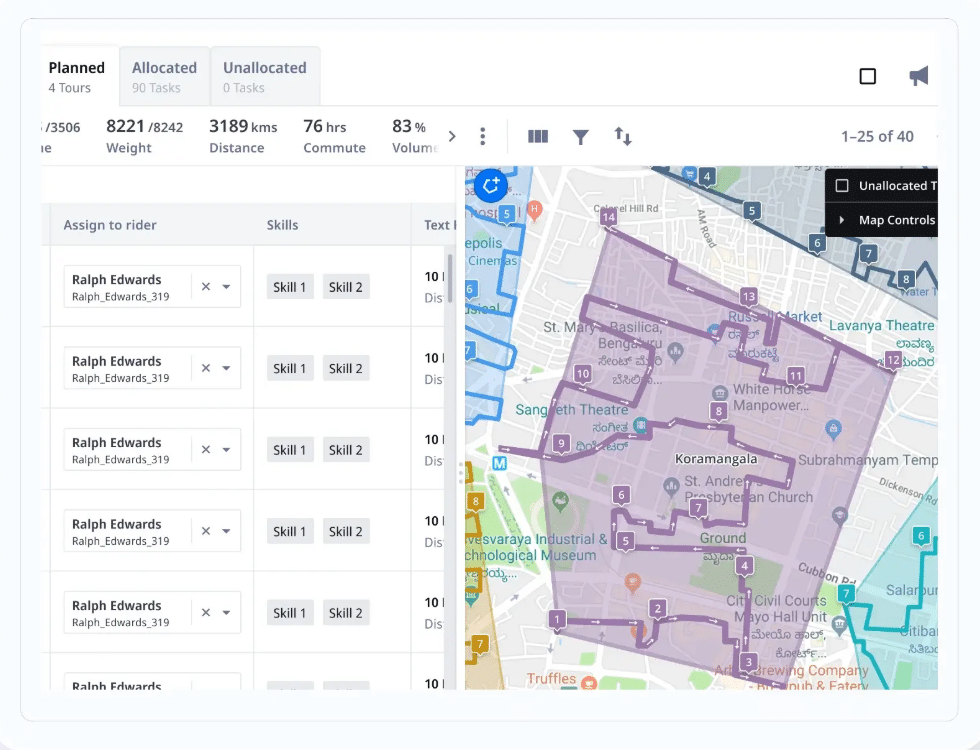
Each gap identified above has a specific architectural response in an AI-native logistics orchestration platform. Locus addresses them as integrated functions within a single operational layer:
- On AI dispatch: Locus’s dispatch engine processes 250+ constraints simultaneously and generates optimized assignments in minutes for 100,000+ daily orders. When a driver calls out at 6 AM, the system reallocates affected orders without dispatcher involvement
- On real-time adaptability: Locus operates in a continuous Sense, Decide, Execute, Learn cycle. The platform ingests live conditions, recalculates route sequences, executes changes, and logs outcomes that feed into the next automated route planning cycle
- On analytics: Locus surfaces cost per delivery, fleet utilization, SLA adherence, and carrier performance in real time. When an exception rate starts trending upward on a specific route, the analytics layer flags it during the shift
- On sustainability: Every route optimization that reduces driven miles directly reduces fuel consumption and CO2 output. Locus has offset 17 million or more kilograms of CO2 emissions across customer deployments and produces carbon-per-route reporting for ESG compliance without requiring a third-party tool
Across retail and FMCG deployments, Locus customers have achieved a 20% reduction in total logistics costs, 66% faster planning cycles, and 99.5% on-time delivery SLA adherence. Those outcomes are the product of a platform where dispatch, routing, visibility, and analytics operate under unified AI logic.
Evaluating TMS Companies: A Framework for Enterprise Decision-Makers
Two platforms can both list real-time route optimization and differ by an order of magnitude in what that means under peak load. Use these six criteria to pressure-test vendor claims against your actual operational requirements.
| Evaluation criterion | The right question | A weak answer sounds like |
|---|---|---|
| AI maturity | Is dispatch and routing built on machine learning, or on rules configured at implementation? Can the platform demonstrate how it learns from past deliveries? | “Our platform uses AI to automate routing” with no explanation of the underlying mechanism or learning loop. |
| Scalability | What is the planning cycle time at 100,000+ daily orders across multiple geographies? Can the vendor demonstrate this at your volume, not at average volume? | Demo performance at 5,000 orders with no data on degradation at 10x load. |
| Integration architecture | Does it have prebuilt connectors for your ERP, WMS, and OMS or does integration require custom middleware? What is the typical integration timeline? | “We have an open API” without named connectors for SAP, Oracle, or the specific platforms you run. |
| Real-time adaptability | When a vehicle breaks down mid-route, what happens? Walk through the system response step by step. | The system surfaces an alert. A dispatcher then decides what to do. |
| Industry and vertical fit | Does the platform have deployed customers at your scale in your specific vertical: retail, FMCG, e-commerce, or 3PL? Can they name them? | Generic enterprise logos without vertical-specific deployment evidence. |
| Total cost of ownership | Does the ROI case account for planning time reduction, failed delivery cost avoidance, and fleet utilization improvement or just license fees vs. current spend? | A cost comparison that only measures software license cost against the incumbent tool. |
Industry-Specific Considerations: Retail, FMCG, E-Commerce, and 3PL
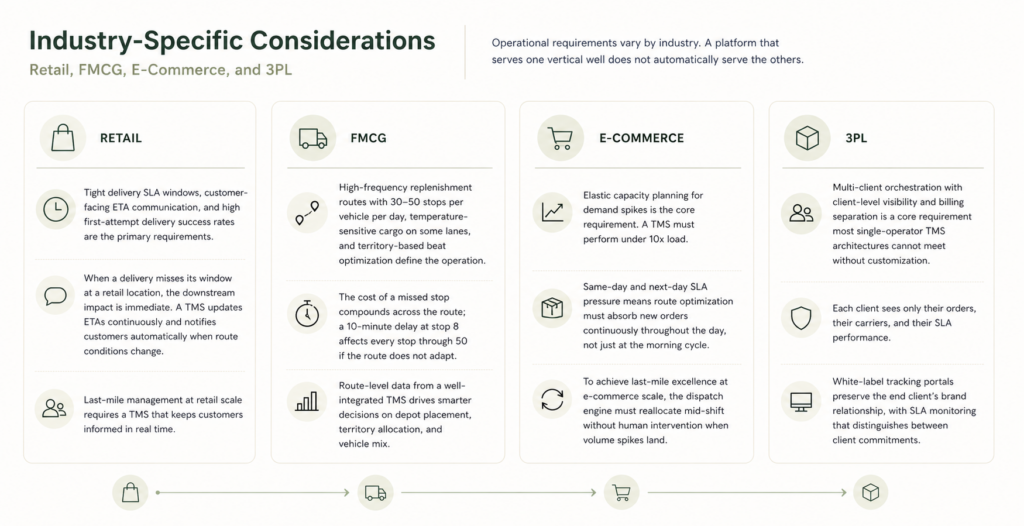
The operational requirements for a retailer managing same-day fulfillment windows are different from those of an FMCG distributor running high-frequency replenishment routes, which are different again from a 3PL coordinating multi-client fleet operations. A platform that serves one vertical well does not automatically serve the others.
Retail
Tight delivery SLA windows, customer-facing ETA communication, and high first-attempt delivery success rates are the primary requirements.
When a delivery misses its window at a retail location, the downstream impact (stock-out, production delay, or customer service escalation) is immediate. Last-mile management at retail scale requires a TMS that updates ETAs continuously and notifies customers automatically when route conditions change.
FMCG
High-frequency replenishment routes with 30 to 50 stops per vehicle per day, temperature-sensitive cargo on some lanes, and territory-based beat optimization are the defining characteristics.
The cost of a missed stop compounds across the route; a 10-minute delay at stop 8 affects every stop through 50 if the route does not adapt.
Supply chain network design decisions for FMCG brands flow from the route-level data that a well-integrated TMS surfaces: depot placement, territory allocation, and vehicle mix all become data-driven decisions rather than periodic planning exercises.
E-commerce
Elastic capacity planning for demand spikes is the core requirement. A TMS that performs well at average daily volume but degrades under 10x load is not enterprise-grade for e-commerce.
Same-day and next-day SLA pressure means that route optimization has to absorb new orders continuously throughout the day, not just at the morning dispatch cycle. To achieve last-mile excellence at e-commerce scale, the dispatch engine has to reallocate mid-shift without human intervention every time a volume spike lands.
3PL
Multi-client orchestration with client-level visibility and billing separation is a requirement that most single-operator TMS architectures cannot meet without significant customization.
Each client needs to see only their orders, their carriers, and their SLA performance. White-label tracking portals that preserve the end client’s brand relationship matter. And the SLA monitoring layer has to distinguish between client commitments.
Why the Next Generation of TMS Is About Orchestration
Transportation management describes a set of discrete functions: book freight, assign carriers, track shipments, generate reports. Each function operates sequentially and often in a separate tool.
Logistics orchestration describes something architecturally different: a platform where dispatch, routing, visibility, and analytics operate simultaneously under unified AI logic, each layer informing the next in real time.
The operational difference is in where decisions happen. In a management model, the TMS surfaces information and a dispatcher makes the call. In an orchestration model, the platform makes the call within configured governance boundaries, and surfaces the outcome for review.
When a vehicle breaks down at 11 AM, the orchestration layer has already identified available capacity, recalculated affected orders, reassigned to the nearest eligible vehicle, pushed updated ETAs to customers, and logged the exception for analytics. The dispatcher sees the resolution, not the problem.
Three markers distinguish an orchestration platform from a management tool:
- Closed-loop learning: Outcomes from each delivery cycle feed back into the next planning decision. The platform becomes more accurate over time, not just faster
- Simultaneous constraint processing: Dispatch and routing decisions account for all variables at once, not sequentially through a rule hierarchy
- Human governance without human bottlenecks: Operations leaders set policy, configure logic, and review exceptions. The platform executes. Dispatchers manage edge cases, not routine assignments
Locus is built for this orchestration model. The platform has powered over 1.5 billion deliveries across 30 or more countries, delivering $320 million or more in logistics cost savings for enterprises across retail, FMCG, e-commerce, 3PL, and CPG operations.
That track record is what enterprise readiness looks like.
Schedule a Locus demo to see how AI dispatch and real-time route orchestration perform against your specific operational requirements.
Frequently Asked Questions (FAQs)
1. What is the difference between a traditional TMS and an AI-powered logistics orchestration platform?
A traditional TMS handles freight booking, carrier selection, and shipment status tracking. An AI-powered logistics orchestration platform operates across dispatch, dynamic route optimization, real-time visibility, and analytics simultaneously with machine learning at the core. The functional difference is whether the platform executes instructions or learns from outcomes and optimizes continuously based on live and historical data.
2. How do TMS companies handle real-time disruptions like traffic, weather, or demand spikes?
Most TMS platforms surface disruptions as alerts and require a dispatcher to determine the response. Enterprise-grade AI platforms calculate the downstream impact of a disruption across all active shipments, identify the optimal re-routing or reallocation, and execute the change within minutes without dispatcher intervention. The test is whether the platform resolves the exception or just surfaces it.
3. What should enterprise logistics teams prioritize when evaluating TMS providers?
Six criteria matter most: AI maturity (rules-based vs. ML-native), scalability at peak volume, integration depth with existing ERP and WMS systems, real-time adaptability during disruptions, vertical fit for your specific industry, and total cost of ownership that accounts for operational efficiency gains rather than just license fees. Vendors should be able to demonstrate each criterion against your specific volume and geography.
4. Can a TMS platform scale to support 100,000+ daily orders across multiple geographies?
Enterprise-grade platforms built on AI-native architecture can. The key is whether planning cycle times remain consistent under peak load. A platform that handles 5,000 orders in four minutes should demonstrate comparable performance at 100,000. Locus maintains sub-five-minute optimization cycles at enterprise volume across 30 or more countries, with documented deployments at that scale for named retail, FMCG, and 3PL customers.
5. How does Locus’ AI-driven route optimization reduce transportation costs compared to rules-based TMS?
Rules-based routing optimizes for a single variable like distance or time through a fixed hierarchy of constraints. Locus’ AI-driven route optimization processes all variables simultaneously and recalculates continuously during execution as conditions change. The cost reduction comes from multiple sources: fewer driven miles through better stop clustering, lower re-delivery rates through accurate ETAs and proactive customer notifications, and reduced planning labor as dispatchers shift from manual route construction to exception management.

Logistics Management
What Enterprise Teams Get Wrong About Logistics Planning Software (And What to Look for Instead)

May 12, 2026
Discover what enterprise logistics planning software must deliver, from AI dispatch to real-time route optimization and supply chain visibility.
Read more
General
SEA AI Logistics Orchestration: Competing in Southeast Asia’s $160 Billion Online Market

May 12, 2026
Southeast Asia's $160 billion online shopping market is dynamic and competitive. A 2026 framework for retailers and e-commerce players deploying AI-powered logistics orchestration.
Read moreInsights Worth Your Time



















TMS Companies: How to Evaluate Transportation Management Systems for Enterprise Logistics