


Logistics Management
What Enterprise Teams Get Wrong About Logistics Planning Software (And What to Look for Instead)
Key Takeaways
- Most logistics planning software on the market was built for mid-market operations. At enterprise scale, point solutions for route planning, dispatch, and visibility create fragmentation that operations teams have to manually reconcile every day
- Enterprise-grade logistics planning software requires six capability layers operating under unified logic: AI dispatch, real-time route optimization, end-to-end visibility, demand-aware planning, carrier and fleet management, and prescriptive analytics
- The difference between rules-based automation and machine learning-driven orchestration is not a marketing distinction. It determines whether your platform adapts in real time or requires a dispatcher to intervene every time conditions change
- Last-mile delivery accounts for approximately 53% of total logistics spend. Logistics planning software that does not optimize this leg leaves the largest cost variable unmanaged
- Locus unifies AI dispatch, real-time route optimization, multi-carrier orchestration, and delivery analytics in a single platform built for enterprise scale
Enterprise logistics leaders are not short on software options. They are short on platforms that can orchestrate complex, multi-node supply chains without stitching five tools together. The volume of options has only made the fragmentation worse.
The market for logistics planning software has expanded, but most solutions still treat route planning, dispatch, and visibility as separate problems. Operations teams reconcile fragmented data across disconnected tools while managing thousands of daily shipments.
This piece defines what enterprise-grade logistics planning software must actually deliver, how AI is changing the logic of logistics planning, and what an evaluation framework should look like when you are past the feature-checklist stage.
It is grounded in Locus’s experience as the world’s first Decision-Intelligent Agentic TMS, now part of Ingka Group, powering dispatch and delivery for some of the world’s largest retail, FMCG, and 3PL operations.
Why Most Logistics Planning Software Falls Short at Enterprise Scale
The core problem is architectural. Most logistics planning software was designed for operations running a few hundred shipments per day with a single carrier relationship and a predictable delivery geography. It was then retrofitted through integrations, add-ons, and professional services engagements to handle enterprise complexity. That approach creates three failure modes that compound each other:
- Fragmented data across disconnected tools: Route planning runs in one system. Dispatch runs in another. Visibility and customer communication run in a third. Each system captures a slice of the operational picture, and no single view shows the full state of the network in real time
- Reactive instead of adaptive logic: When a driver calls in sick at 6 AM or a road closure invalidates a route at 10 AM, point solutions surface the problem but do not resolve it. A dispatcher has to manually reroute, reassign, and notify, which burns time that should be automated
- No feedback loop between planning and execution: Static planning tools generate a route and stop. They do not learn from what happened: which stops ran long, which delivery windows were consistently tight, which drivers perform at specific times of day. That data exists but stays locked in execution logs rather than feeding back into the next planning cycle
The result is a logistics operation that scales headcount with volume rather than technology with volume. Every new geography, carrier relationship, or fulfillment model adds manual coordination rather than automated delivery orchestration.
The Capability Stack That Defines Modern Logistics Planning Software
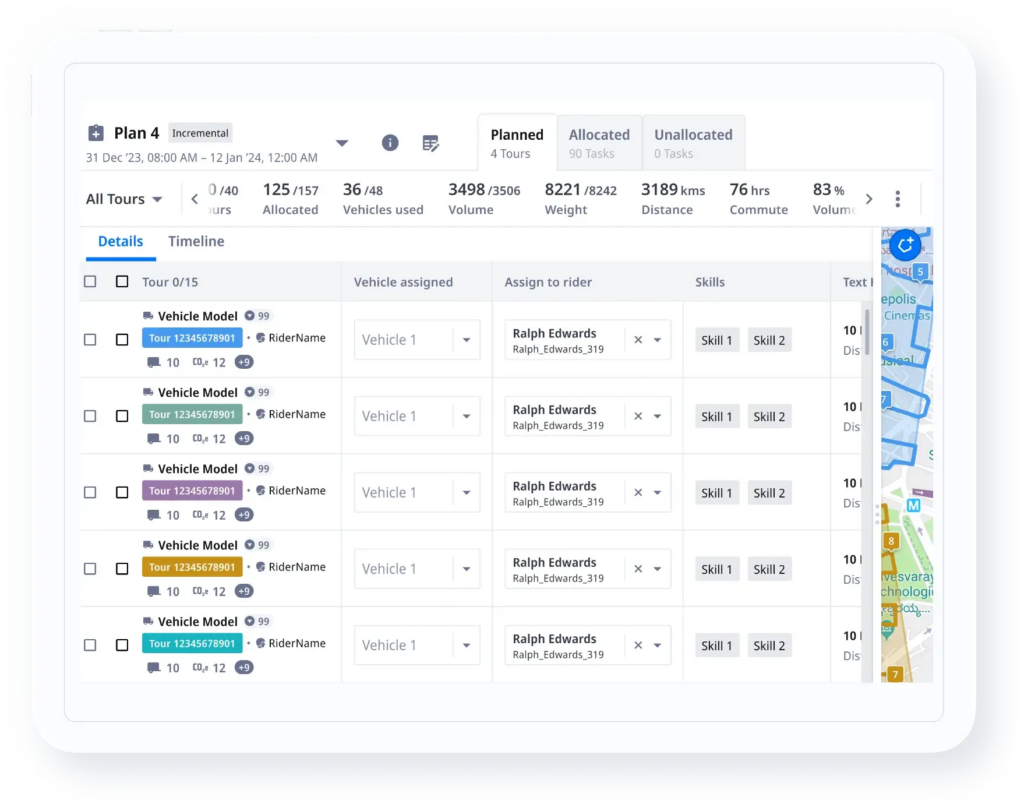
Six capability layers define whether a logistics planning platform can operate at enterprise scale. The absence of any one creates a gap that manual processes and headcount end up filling.
| Capability | What it does at enterprise scale | Cost of its absence |
|---|---|---|
| AI-powered dispatch | Dynamically assigns orders to vehicles, drivers, and routes in real time using 250+ constraints: capacity, time windows, driver skills, geography, and traffic. | Manual dispatch at scale takes 2 to 3 hours per morning shift and produces routes on stale data before the day starts. |
| Real-time route optimization | Recalculates stop sequences mid-execution based on live traffic, order cancellations, new pickups, and vehicle capacity changes. Refer to automated route planning. | A static route plan generated at 6 AM is wrong by 9 AM. Dispatchers spend the rest of the day on phone calls that should not exist. |
| End-to-end supply chain visibility | Single-pane-of-glass tracking across first-mile, mid-mile, and last-mile with exception alerts before SLAs are breached. Connects to an automated tracking system across all carriers. | Operations finds out about delivery failures when customers call. Exception resolution is reactive rather than preventive. |
| Demand-aware planning | Layers historical shipment data and seasonality patterns into capacity decisions before dispatch begins. Prevents both under-utilization and peak-day overload. | Without demand context, fleet allocation is based on yesterday’s volume rather than tomorrow’s demand signal. |
| Carrier and fleet management | Unified dispatch logic across owned fleet and 3PL partners. ShipFlex allocates orders across 160+ carriers from a broad network of 1,000+ based on cost, speed, and SLA performance, with automated rate validation, lane-level performance benchmarking, and billing dispute reduction built into the carrier management workflow. | Siloed carrier management creates invisible cost overruns and SLA gaps that only surface in monthly carrier invoices. |
| Prescriptive analytics | Surfaces cost per delivery, SLA adherence, fleet utilization, and carrier performance as actionable KPIs, updated in real time. | Descriptive dashboards that show what happened last month are not useful for a VP of Logistics making decisions at 2 PM today. |
Supply chain network design sits above all six layers. How many depots you run, how territory is zoned, and how carrier relationships are structured determines what the planning layer has to manage. The best logistics planning software surfaces network-level inefficiencies, so those upstream decisions can be continuously refined.
How AI Changes the Logic of Logistics Planning
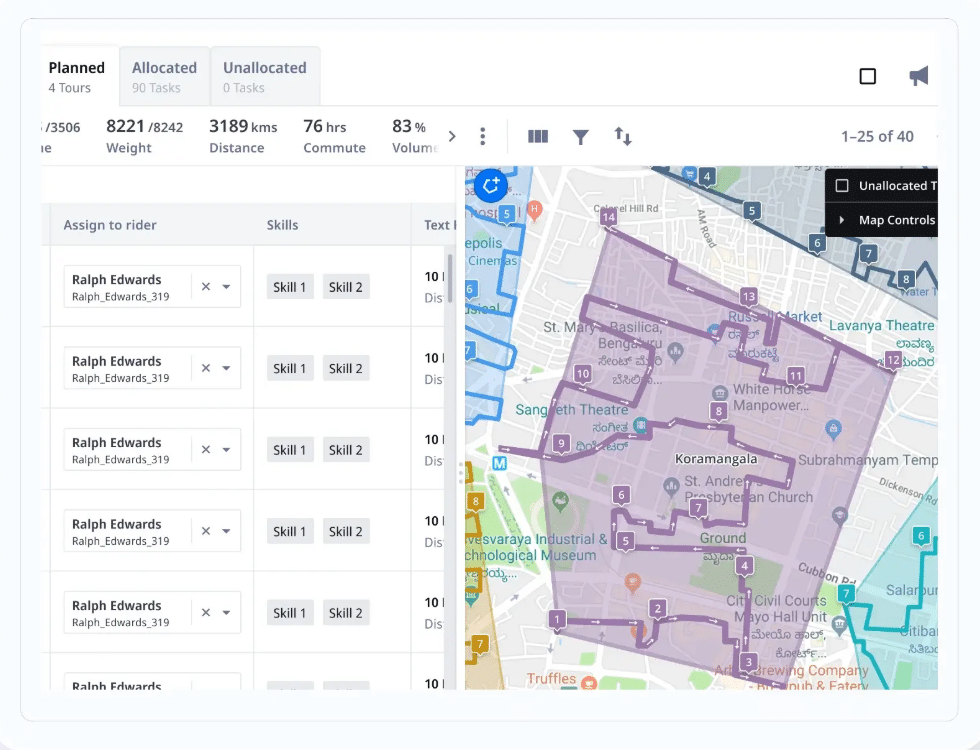
The distinction between rules-based automation and machine learning-driven orchestration is the operational difference between a system that follows instructions and one that learns from outcomes.
Rules-based automation: IF conditions are met, THEN execute a fixed action
- A vehicle capacity rule assigns no more than 40 stops per route
- A time-window rule avoids delivery attempts before 9 AM at specific customer locations
- A carrier preference rule routes parcels above a certain weight to a specific 3PL partner
Rules-based logic is predictable and auditable. It is also static. When conditions change, like a driver calls out, a new order arrives after the plan is locked, traffic adds 45 minutes to a corridor, the rules do not adapt. A dispatcher does.
ML-driven orchestration: Continuous optimization based on live and historical data
- Dynamic re-routing mid-delivery: When a disruption occurs, the system calculates the downstream impact across all active shipments, identifies the optimal re-sequence, and executes the change without dispatcher involvement. This is how to manage delivery exceptions at scale without adding headcount
- Predictive ETAs that improve over time: Machine learning models draw on historical delivery patterns at the route, driver, and time-of-day level. A platform that has processed 1.5B+ deliveries generates ETA predictions materially more accurate than distance-based estimates
- Geocoding intelligence for weak address infrastructure: In markets across Southeast Asia, the Middle East, and parts of India, addresses are ambiguous or incomplete. Mycroft, Locus’s AI co-pilot layer, applies geocoding intelligence trained on millions of delivery attempts to resolve these in real time rather than failing the delivery and generating a re-attempt cost
Locus’s AI route optimization engine processes all of these variables simultaneously. The distinction matters because sequential optimization (optimize for distance, then apply time windows, then check capacity) produces a locally good solution.
This continuous loop, Sense, Decide, Execute, Learn, is what separates agentic logistics planning from rules-based automation: the system does not just respond to conditions, it improves its response with every cycle.
Simultaneous optimization across all constraints produces a globally better one, which is where the 15 to 25% route cost reductions that AI-native platforms consistently produce come from.
Evaluating Logistics Planning Software for Enterprise Fit
A feature comparison table is the wrong evaluation tool. Two platforms can both list “real-time route optimization” as a capability and differ by an order of magnitude in what that means under peak load. Use these five lenses instead.
| Evaluation lens | The right question to ask | What a weak answer looks like |
|---|---|---|
| Scalability | Can the platform handle a 10x volume spike (peak season, flash sale) without planning cycle times degrading? | A vendor that quotes planning time at average volume but cannot demonstrate sub-5-minute cycles at peak load. |
| Integration depth | Does it connect natively to the ERP, WMS, OMS, and TMS systems your enterprise already runs, with prebuilt connectors? | “We have an open API” without named connectors for SAP, Oracle, or your specific OMS platform. |
| Geographic adaptability | Can it handle multi-country regulatory requirements, address format differences, and carrier network variations without custom engineering? | A platform built for North American or Western European address infrastructure that requires professional services to deploy in India or the Middle East. |
| Configurability | Can your operations team configure business rules, allocation logic, and workflow steps without vendor professional services involvement? | Every change to dispatch logic or carrier rules requires a support ticket and a two-week turnaround. |
| Time to value | What does a realistic implementation look like and what reference customers can validate that timeline? | An implementation roadmap that cannot be backed by named customer deployment timelines at comparable scale. |
Platforms built on legacy TMS architecture often require heavy customization to meet these criteria. Newer route-focused platforms may clear the scalability bar without the integration depth or geographic reach that global enterprise operations require.
The evaluation question is which platform was designed for orchestration from the ground up rather than retrofitted to approximate it.
The Cost of Getting Logistics Planning Wrong And the ROI of Getting It Right
For enterprises running thousands of daily deliveries, logistics planning software is the margin lever with the highest return on improvement.
Direct cost reduction
Route optimization that reduces driven miles by 15 to 25% cuts fuel spend, vehicle wear, and driver hours proportionally. Locus customers across retail and FMCG deployments have achieved a 20% reduction in total logistics costs.
BigBasket, one of India’s largest online grocery platforms, reduced total route distance by approximately 14.3% after deploying Locus while maintaining 99.5% on-time delivery SLA across high-volume urban networks.
Operational throughput
More deliveries per driver per day, without adding vehicles or headcount, is the operational throughput gain that logistics planning software should produce.
Locus customers achieve 66% faster planning cycles and a 45% improvement in fleet utilization through better stop clustering, smarter order grouping, and territory optimization.
Customer experience and WISMO reduction
WISMO (Where Is My Order) calls account for up to 40% of inbound customer service volume in high-volume retail and e-commerce logistics. Each call has a fully loaded service cost.
Proactive, ML-driven ETA notifications that update in real time as route conditions change reduce this volume at the source. When the logistics planning platform pushes accurate delivery windows to customers automatically, the call does not happen. The saving is direct and attributable.
See how Locus delivers these outcomes against your specific order volumes, carrier network, and SLA requirements. Schedule a demo with Locus to run AI dispatch and route optimization against real operational data.
Where Logistics Planning Software Is Headed in 2026
Three shifts are changing what logistics planning software must do through 2026 beyond the current capability baseline.
Sustainability-aware routing
Carbon tracking is moving from a voluntary ESG metric to a procurement requirement. In the EU, Scope 3 emissions reporting obligations are becoming binding for large enterprises.
Logistics planning software that can optimize routes simultaneously for cost, time, and carbon output and produce auditable CO2-per-lane reporting without a third-party tool will be a compliance requirement.
Locus embeds Scope 3 emissions tracking directly into routing decisions and has helped customers avoid 17 million kilograms of CO2 across active deployments.
Mixed-fleet orchestration
The delivery network of 2026 is not a single fleet type. Enterprises coordinating human-driven vehicles, gig driver networks, and emerging autonomous delivery formats need logistics planning software that assigns orders across all of these under unified dispatch logic.
The planning layer has to abstract over vehicle type and apply the same constraint-aware optimization regardless of whether the executing unit is a driver, a contractor, or an autonomous vehicle.
Locus’s constraint-aware dispatch engine already abstracts over fleet type, allocating orders across owned vehicles, contracted 3PLs, and gig driver networks under unified logic from a single interface.
Predictive supply chain resilience
Reactive exception management is the current state for most logistics planning platforms. The next capability shift is predictive: using external data signals (weather, port congestion, carrier capacity constraints) alongside historical delivery patterns to flag disruptions before they cascade.
The goal is fewer exceptions, because the planning layer anticipated the condition and routed around it before execution began.
Mycroft surfaces these risk signals proactively, giving dispatchers the lead time to act before an exception cascades across remaining stops.
Why Locus Is the AI-Native Standard for Enterprise Logistics Planning
Most logistics platforms added AI as an afterthought. Locus was designed around it from the start, which is why the results look different: 20% reductions in total logistics costs, 66% faster planning cycles, and over 1.5 billion deliveries processed.
That approach has been recognized by Gartner in its Market Guide for Last-Mile Delivery Technology for five consecutive years, by G2 as the #1 Route Planning platform in the 2026 Best Software Awards, and by QKS Group as a SPARK Matrix TMS 2025 Leader.
Locus is now part of Ingka Group, the world’s largest IKEA retailer—a signal of enterprise-grade stability that disconnected point solutions cannot match.
If your team is still stitching together separate systems for routing, dispatch, and visibility, there is a better way to run it. Schedule a Locus demo today.
Frequently Asked Questions (FAQs)
What is the difference between logistics planning software and a transportation management system (TMS)?
Logistics planning software focuses on optimizing how shipments are planned, dispatched, and routed, primarily covering the execution layer of the supply chain. A TMS has traditionally focused on freight management, carrier procurement, and middle-mile cost optimization. Modern enterprise platforms increasingly converge both, but logistics planning software is purpose-built for high-frequency, multi-stop, customer-facing delivery operations rather than freight contract management.
How does AI-powered route optimization differ from traditional rule-based routing in logistics software?
Rule-based routing applies fixed logic: if capacity exceeds X, add a vehicle; if a delivery window closes at noon, sequence that stop before others. AI route optimization processes all constraints simultaneously and recalculates continuously as conditions change during execution. The output is a route that improves with every completed delivery as the model learns from actual outcomes.
What integrations should enterprise logistics planning software support out of the box?
At minimum: ERP systems (SAP, Oracle), order management systems (OMS), warehouse management systems (WMS), carrier EDI and API feeds, vehicle telematics, and customer communication platforms. Platforms with prebuilt connectors for these systems deploy faster and produce fewer data quality gaps than those relying on custom API development for each integration. API-first architecture with a configurable workflow engine is the standard to require.
How long does it typically take to implement logistics planning software at enterprise scale?
Implementation timelines vary by deployment complexity: number of depots, carrier relationships, geographies, and integration points. Enterprise deployments typically run 8 to 16 weeks for core capabilities, with phased rollouts for additional geographies or carrier integrations. The most reliable timeline indicator is reference customers at comparable scale and complexity. Vendors that cannot name reference customers with validated deployment timelines should be treated with appropriate skepticism.
Can logistics planning software handle both owned fleet and third-party carrier operations simultaneously?
Enterprise-grade platforms can dispatch across owned fleet, contracted 3PL partners, and gig driver networks under unified logic, applying the same constraint-aware optimization regardless of fleet type. This requires normalized data ingestion across different carrier API formats and telematics systems. Platforms designed for single-operator logistics require significant customization to achieve this. Locus integrates with over 160 carriers across a broad network of 1,000+, allocating orders across carrier types based on cost, speed, and SLA performance from a single dispatch interface.

General
US Restaurant Delivery AI Routing: 5 Operational Realities

May 11, 2026
US restaurant delivery operates with structurally different dynamics than grocery quick commerce. A 2026 framework for Heads of Logistics on prep time, batching, courier matching.
Read more
TMS Software
TMS Companies: How to Evaluate Transportation Management Systems for Enterprise Logistics

May 12, 2026
Explore what top TMS companies offer, from freight management to AI-powered dispatch. Learn how to evaluate enterprise-grade logistics orchestration platforms.
Read moreInsights Worth Your Time



















What Enterprise Teams Get Wrong About Logistics Planning Software (And What to Look for Instead)